REVIEW 3 major objections 5 minor 15 references
Non-Local to Local Eigenbasis Permutations of Pauli Product Diagonal Operators
T0 review · 3 major / 5 minor · reviewed 2026-08-11 · deepseek-v4-flash
Pith's one-line read The paper proves that some sparse non-local diagonal Hamiltonians cannot be mapped to local diagonal form by any eigenbasis permutation.
desk verdict Interesting question and a clever group-ring setup, but Lemma A.12 is plainly false, so the central no-go theorem is unsupported. read the letter →
The pith
A machine-rendered reading of the paper's core claim, the machinery that carries it, and where it could break.
The reading
What carries the argument
The central object is an injective group-ring homomorphism $\Psi: \mathbb{Z}_2^n \to (\mathbb{C}\mathbb{Z}_2^n)^*$, defined for a permutation $\pi$ by sending each bit-vector $J$ to the full Fourier-transform element $F_J = \sum_g a^J_g g$, with $a^J_g = (1/2^n)\sum_x (-1)^{x\cdot g + \pi(x)\cdot J}$. This map converts the question of whether a set of bit-vectors can be localized into a counting question: each localized image has at most $A_m$ terms, at most $B_m$ nodes, and at most $D_m$ nodes collectively, and the number of distinct locality-$m$ group-ring elements is bounded by $E_m$, leading to the bound $G_m$. Because $\Psi$ is injective, any subgroup of $\mathbb{Z}_2^n$ larger than $G_m$ cannot be represented; choosing such a subgroup produces the counterexample.
What would settle it
A concrete calculation of the group-ring product $(a+b g)c$ for explicit images of $\Psi$ on a small bit-vector space would settle it: if the coefficient of $g$ includes a contribution from the $a$-term, then the node bound $D_m$ is unsupported and the contradiction in Theorem A.15 collapses.
Extended reading notes
Core claim
The central claim is a proof by contradiction: for any fixed locality $m$, there exists an $n$-qubit diagonal operator whose Pauli-string representation is sparse (a constant number of non-zero terms, independent of $n$) that cannot be written as an $m$-local diagonal operator after any eigenbasis permutation. The proof bounds the number of possible locality-$m$ group-ring elements by $G_m = (2m+1)^{m(3m)}64^{m^2-m}$. It then chooses a subgroup $S$ of the bit-vector space $\mathbb{Z}_2^n$ whose size exceeds that bound; if every element of $S$ could be localized, the injective map $\Psi$ would have to send more than $G_m$ distinct inputs into a set of at most $G_m$ outputs, which is impossible. The contradiction shows the set $R \setminus R''$ is non-empty, where $R$ is the set of diagonal forms with at least $2^{\lceil \log_2 G_m \rceil}$ non-zero terms and $R''$ is the set of forms that are eigenspectrum-equivalent to an $m$-local form. The proof is purely combinatorial and does not depend on the physical dynamics of the Hamiltonian.
Load-bearing premise
The proof assumes that in the group-ring product $(a+b g)c$, the coefficient of the single-node term $g$ is exactly the product $b c$, with no contribution from the product of the $a$ term with $c$.
Editorial extensions
If this is right
- For fixed locality $m$, the set of sparse non-local diagonal forms that can be mapped to $m$-local form is strictly smaller than the set of all sparse diagonal forms; the paper constructs a non-empty difference set $R \setminus R''$.
- Any quantum simulation approach that restricts the diagonal ansatz to a fixed locality cannot be universal for sparse diagonal Hamiltonians, even with unlimited classical freedom to permute eigenvalues.
- The obstruction is spectral in nature: it survives any permutation of the eigenvalue list and therefore any relabeling of the computational basis.
- Because the required system size $n$ is astronomically large for small $m$, the practical impact on near-term quantum devices is indirect; the theorem is a statement about the scaling limit.
Reading between the lines
- If the theorem is right, then the notion of "local form" is not a harmless gauge choice for sparse diagonal operators: there are genuinely non-localizable spectra, so algorithms must either increase locality with $n$ or restrict to a subclass of sparse forms.
- The probabilistic threshold hypothesis could be tested on small systems: sample random sparse diagonal forms with $k$ terms and measure the fraction that can be localized to $m$-local form; a sharp drop in that fraction at some $k$ would support the transition, though the astrophysical scale attached to $w$ is not derivable from the present proof.
- The paper's black-hole entropy comparison is speculative and should not be read as a physical derivation; the coincidence that $G_m$ becomes comparable to stellar black-hole entropies between $m=7$ and $m=8$ follows from exponential growth and does not by itself implicate quantum gravity.
- The injective-map counting strategy may generalize to other basis-change questions, such as whether a sparse operator can be made local by a Clifford conjugation, by replacing the group ring with a different algebraic model of the symmetry group.
Signed reviews
Editorial analysis
A structured set of objections, weighed in public.
Referee Report
Summary. The paper claims to refute a 'Quasiparticle Locality Conjecture' (Conjecture A.1) by showing that for each constant locality m there exist n-qubit diagonal forms with a constant number of Pauli terms that cannot be mapped to an m-local diagonal form by any eigenbasis permutation. The proof introduces an injective homomorphism Ψ from Z_2^n into a group ring, bounds the number of localized images of subgroups via a sequence of constants A_m, B_m, D_m, E_m, G_m, and derives a contradiction with injectivity. The paper also discusses a speculative probabilistic transition for random sparse diagonal forms and connects the bound G_m to black-hole entropies.
Significance. If correct, the refutation of Conjecture A.1 would be a noteworthy negative result for the program of variational Hamiltonian diagonalization, and the group-ring counting approach is a reasonable strategy. The paper is explicit about the structure of the attempted proof and makes a concrete falsifiable claim (R \ R'' non-empty). However, the significance is undercut by the fact that the proof as written contains a false claim in a central lemma and a key lemma is only sketched informally.
major comments (3)
- [Appendix B.4, Lemma A.12] The proof of Lemma A.12 is incorrect. Expanding (a+bg)c gives ac + (bc)g, since g commutes with the group-ring elements; the coefficient of the group element g in (a+bg)c is the coefficient of the identity in bc, not 'bc' as claimed. Nonzeroness of bc does not imply that this coefficient is nonzero; for example, with n=2, g=x, a=0, b=y, c=1, the product is xy, whose coefficient of x is 0 even though b, c, and a+bg satisfy the stated hypotheses. The lemma's conclusion (g is a node) happens to hold in that example because xy uses node x, but the proof's inference is invalid. The argument can be repaired by observing that bc ≠ 0 implies (bc)g has nonzero support on elements with the g-bit set, while ac has support on elements with the g-bit clear, so g is a node. As written, however, the proof of this load-bearing lemma is not valid, and Lemma A.13 relies on it repeatedly.
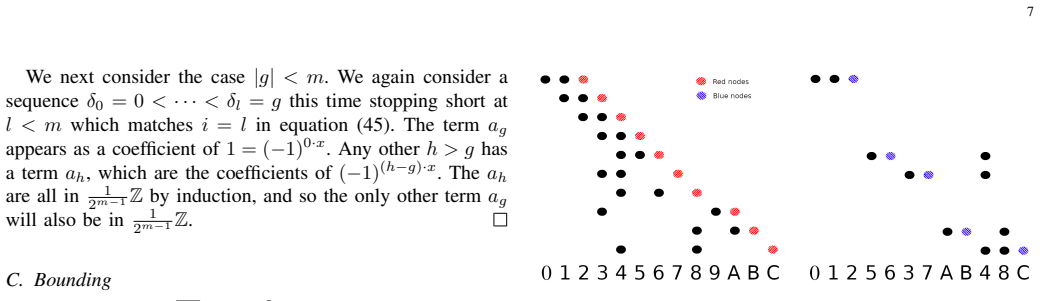
- [Appendix B.4, Lemma A.13] The proof of Lemma A.13 is a sketch rather than a rigorous proof. It depends on an informal red/blue node construction and an accompanying figure, with undefined operations such as 'permute columns', 'copied in', and 'we lose some potential red nodes'. There is no formal definition of the construction and no detailed proof that the product Ψ(J_{i1})···Ψ(J_{il}) contains all blue nodes. Since Lemma A.13 supplies the bound D_m used in Lemma A.14 and in the final contradiction, the main theorem requires a complete and rigorous proof of this statement.
- [Lemma A.14 and Eq. (22)] The formula for G_m stated in Eq. (22) (and repeated in Appendix E) does not follow from the preceding bounds. Using A_m = 2^{2m-2}, B_m = m A_m, D_m = B_m^3, and E_m = D_m^m, together with |A_{1/2^{m-1}}| = 2^m+1, one obtains G_m = (2^m+1)^{E_m} = (2^m+1)^{m^{3m} 64^{m^2-m}}. The printed expression (2m+1)^{m(3m)^{64(m^2-m)}} has a different base and a different exponent. This discrepancy must be resolved, because the stated size of G_m is used in the definition of the set R and in the quantitative claims of the paper.
minor comments (5)
- [Abstract] The sentence 'Our hypothesize suggests a sharp transition' is ungrammatical and should read 'Our hypothesis suggests a sharp transition'.
- [Section III, Eq. (24)] Equation (24) is introduced as a hypothesis with no derivation or numerical evidence; the text should explicitly state that this is speculative and separate from the mathematical proof, rather than treating the transition as an established finding.
- [Appendix B.4, Lemma A.12 proof] The final line of the proof contains a typo: 'Thus bc ̸= 0n a g is a node' should read 'Thus bc ≠ 0 and g is a node.'
- [Section II, definition of R] The condition NNZPSW(D) ≥ 2^{ceil(log2(Gm))} is not motivated; if the intent is to consider forms with at least G_m terms, this should be written directly as NNZPSW(D) ≥ G_m.
- [Throughout] The notation 2m+1 appears where 2^m+1 is evidently intended (e.g., Lemma A.14 and Eq. (22)); all superscripts and bases should be checked carefully in a revision.
Circularity Check
No significant circularity: the proof is a self-contained counting argument, and the astrophysical discussion is explicitly speculative rather than derived from the theorem.
full rationale
The paper's central claim, that R \ R'' is non-empty, rests on a combinatorial contradiction argument (Lemmas A.10 through A.15) involving the injective homomorphism Ψ, support and node bounds, and the final constant Gm. These bounds are derived from definitions within the paper and from the external entropic uncertainty relation [4]; they are not fitted to the conclusion, and the proof does not assume the conjecture it aims to refute. The conjecture itself is authored in the paper, but disproving a self-formulated statement is not circular: the statement has independent mathematical content, and the refutation proceeds by a countable contradiction rather than by presupposing its falsity. The only self-citation is Ref. [2] (Commeau et al., Variational Hamiltonian Diagonalization), which is used to motivate the problem and is not load-bearing in the proof. The probabilistic and astrophysical discussion, including Eq. (24) and the neutron-star-to-black-hole transition, is explicitly introduced as 'we suggest the hypothesis' and is not claimed to be a consequence of the theorem; therefore it is not a fitted prediction masquerading as a derived result. A possible error in Lemma A.12's coefficient computation would be a correctness defect, not a circularity, and is outside the scope of this circularity pass.
Assumptions & free parameters
free parameters (1)
- w
assumptions (5)
- standard math Maassen-Uffink entropic uncertainty inequality: h(pi lambda) + h(gamma(pi)) >= n
- standard math Fourier transform and group ring facts on Z_2^n, including injectivity of the character transform
- ad hoc to paper The Quasiparticle Locality Conjecture A.1 is the correct formalization of an independently known conjecture
- ad hoc to paper Lemma A.12: the coefficient of g in (a + bg)c is 'just bc'
- ad hoc to paper The probabilistic transition hypothesis in Eq. 24
Cite this review
Pith. "Pith review of Non-Local to Local Eigenbasis Permutations of Pauli Product Diagonal Operators." pith.science (2026). https://pith.science/paper/XHV7JSUD
@misc{pith2026241210223,
  author       = {Pith},
  title        = {Pith review of: Non-Local to Local Eigenbasis Permutations of Pauli Product Diagonal Operators},
  year         = {2026},
  howpublished = {\url{https://pith.science/paper/XHV7JSUD}},
  note         = {Machine review of arXiv:2412.10223}
}
abstract
This paper investigates the feasibility of mapping non-local, sparse, diagonal forms of quantum Hamiltonians to local forms via eigenbasis permutations. We prove that such a mapping is not always possible, definitively refuting the "Quasiparticle Locality Conjecture." This refutation is achieved by establishing a lower bound, denoted $G_m$, on the number of non-zero terms in a localized diagonal form. Remarkably, $G_m$ reaches cosmologically large values, comparable to the entropy of the observable universe for certain localities $m$. While this theoretically guarantees the conjecture's falsity, the immense scale of $G_m$ motivates us to explore the implications for practically sized systems through a probabilistic approach. We construct a set of random, non-local, sparse, diagonal forms and hypothesize their probability of finding a local representation. Our hypothesize suggests a sharp transition in this probability, linked to the Hamiltonian's sparsity relative to the Bekenstein-Hawking entropy of neutron stars to black holes transition. This observation hints at a potential connection between Hamiltonian sparsity, localizability, critical phenomena warranting further investigation into their interplay in both theoretical and astrophysical contexts.
Figures

Reference graph
Works this paper leans on
-
[1]
Tapia, O. (2010). Beyond standard quantum chemical semi-classic approaches: Towards a quantum theory of enzyme catalysis. Kinetics and Dynamics: From Nano-to Bio-Scale , 267-298
work page 2010
-
[2]
Commeau, B., Cerezo, M., Holmes, Z., Cincio, L., Coles, P. J., & Sorn- borger, A. (2020). Variational hamiltonian diagonalization for dynamical quantum simulation. arXiv preprint arXiv:2009.02559. 5
arXiv 2020
-
[3]
Peruzzo, A., McClean, J., Shadbolt, P., Yung, M. H., Zhou, X. Q., Love, P. J., ... & O’brien, J. L. (2014). A variational eigenvalue solver on a photonic quantum processor. Nature communications, 5 (1), 4213
work page 2014
-
[4]
Maassen, H., & Uffink, J. B. (1988). Generalized entropic uncertainty relations. Physical review letters, 60 (12), 1103
work page 1988
-
[5]
Balasubramanian, V ., Lawrence, A., Mag´an, J. M., & Sasieta, M. (2024). Microscopic origin of the entropy of astrophysical black holes. Physical Review Letters, 132 (14), 141501
work page 2024
-
[6]
Sachdev, S. (2024). Quantum statistical mechanics of the Sachdev-Ye- Kitaev model and charged black holes. International Journal of Modern Physics B, 2430003. APPENDIX A. Conjecture Let n be a positive integer with elementary abelian two group Zn 2 corresponding to the group of n-bit vectors under XOR. For v = ( v1, · · ·, vn) ∈ Zn 2 let |v| = Pn i=1 vi d...
work page 2024
-
[7]
1Alternatively, we could use a set of vectors that are approximately linearly independent
Thus Conjecture A.2 is true. 1Alternatively, we could use a set of vectors that are approximately linearly independent. Second we assume that Conjecture A.2 is true, and we let x = P J∈S cJ eJ. So I ∈ Zn 2 with |I| > m. Then we know that (HπHx )I = X J∈S cJ (HπH )I,J = 0 (27) and we have that Conjecture A.1 is true. B. Tools
-
[8]
Group Ring and Characters: Let R be a ring and G be an group. Then the group ring RG is defined using set of formal linear combinations of the form P g rgg with coefficients rg in R and group elements g in G. Addition in RG is coefficient-wise P g rgg + P g sgg = P g(rg + sg)g. Multiplication of elements in RG is given by multiplying the G elements and co...
Show all 15 references
-
[9]
full” transform and FJ a “partial
Fourier Transform: This maps to a Fourier transform of functions ˆf (x) = P g(−1)x·gf (g). Define a ring isomorphism ι : F unc(Zn 2 , C) → M atricesn,1(C) (30) that takes a function f (x) to a column vector of values (f (x))x∈Zn 2 . Then we see how H computes a Fourier trans- ...
-
[10]
For a π the map Ψ : Zn 2 → (CZn 2 )∗ that sends J 7→ FJ is an injective homomorphism
Defining Ψ Injection: Lemma A.7. For a π the map Ψ : Zn 2 → (CZn 2 )∗ that sends J 7→ FJ is an injective homomorphism. Also (χxΨ)(J) = FJ (x) and Ψπ(0) = 1. Proof. Using Lemma A.5 and Definition A.2 we have for each x χx(Ψ(J1 + J2)) = χx(FJ1+J2 ) = FJ1+J2 (x) = (−1)π(x)·(J1+J2...
-
[11]
Let δ ∈ Zn 2 be weight one ( |δ| = 1)
Partial Sums Over Weight Classes: Lemma A.8. Let δ ∈ Zn 2 be weight one ( |δ| = 1). Let & be the bitwise AND on Zn 2 . Define for suitable d Ad := {−1, (−1 + d), · · ·, (1 − d), 1}. (39) Then for a given d and l and values bg the set inclusion C(x) := X |α|≤l bα(−1)α·x ∈ Ad (4...
-
[12]
| supp(FJ )| is bounded by a function, which we call Am, of m
Bound Am: Lemma A.10. | supp(FJ )| is bounded by a function, which we call Am, of m. Proof. From Definition A.3 we defined that aJ g = 1 2n cFJ (g), so that Parsevals’s theorem tells us that X g aJ g 2 = FJ 2 = 1. (48) Lemma A.9 bounds nonzero |aJ g | below by 1 2m−1 or aJ g 2...
-
[13]
Recall that aJ g is zero for all g with |g| > m
Bound Bm: Lemma A.11. Recall that aJ g is zero for all g with |g| > m. Then | nodes(FJ )| is bounded by a function, which we call Bm, of m. Proof. This is a direct consequence of Lemma A.10. The maximum number of nodes that we can have is given by choosing m different nodes fo...
-
[14]
C” and the two black nodes to the left on the same row are “8
Bound Dm: Lemma A.12. Let g ∈ Zn 2 be density one ( |g| = 1 ) a.k.a. a node. Let a, b, cbe in CZn 2 each with no terms that use g. Suppose b is nonzero and suppose a + bg and c are both images of Ψ. Then g ∈ nodes((a + bg)c). Proof. The coefficient of g in (a + bg)c is just bc...
-
[15]
There is a bound on the number of group ring elements with locality m
Bounds Em and Gm: Lemma A.14. There is a bound on the number of group ring elements with locality m. Proof. Let Dm be the bound on the collective number of nodes from Lemma A.13. The number of group ring elements y with locality m on Dm nodes can be counted. There are 1 +· · ·...
Reviewed August 11, 2026 · model on record in the stance chip above.
Discussion (0). Continue with ORCID to comment.