REVIEW 2 major objections 5 minor 75 references
Exchange-Symmetrized Qudit Bell Bases and Bell-State Distinguishability
T0 review · 2 major / 5 minor · reviewed 2026-08-11 · deepseek-v4-flash
Pith's one-line read This paper constructs a complete exchange-symmetrized qudit Bell basis for every even dimension d and proves an LELM device can distinguish 2d−1 of its states, matching the upper bound.
desk verdict A genuinely new exchange-symmetrized qudit Bell basis for even d, with a correct odd-d no-go proof; the LELM optimality claim, however, rests on an unproven extension of a prior bound. read the letter →
The pith
A machine-rendered reading of the paper's core claim, the machinery that carries it, and where it could break.
The reading
What carries the argument
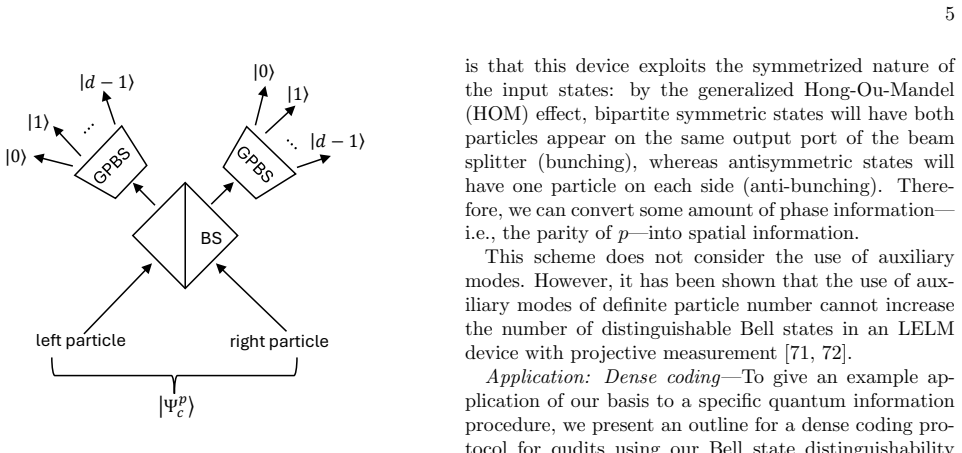
The central object is an exchange-symmetrized qudit Bell basis built from two ingredients: correlation classes supplied by a round-robin tournament pairing of the d single-particle basis states, and phase classes supplied by a discrete Fourier transform of size d/2 that makes states within a class mutually orthogonal while preserving definite swap symmetry. The generalized Hong-Ou-Mandel effect at a 50/50 beam splitter is what carries the distinguishability argument, separating symmetric (bunching) from antisymmetric (antibunching) states and reducing the LELM discrimination task to counting distinct two-particle detection signatures.
What would settle it
A concrete disproof would be an explicit LELM circuit for some even d that unambiguously distinguishes 2d Bell states, which would violate the claimed ceiling; alternatively, a direct calculation for d = 4 showing that the generalized Hong-Ou-Mandel bunching/antibunching signatures of two distinct symmetric states overlap, so that one of the purported 2d−1 distinguishable classes is not actually resolved, would collapse the saturation claim.
Extended reading notes
Core claim
For any even single-particle dimension d, the authors build d² fully entangled, mutually orthogonal qudit Bell states that are simultaneous eigenstates of the swap operator, with (d+1)d/2 symmetric and (d−1)d/2 antisymmetric states. The construction separates each state into a correlation class, given by a pairing of the d basis states according to a round-robin tournament schedule, and a phase class, given by a discrete Fourier transform over the d/2 pairs. No complete exchange-symmetrized Bell basis exists for odd d, because antisymmetric states require skew-symmetric coefficient matrices, and every odd-dimensional skew-symmetric matrix has zero determinant. Using the symmetrized basis, the paper shows that a device built from a 50/50 beam splitter and generalized polarizing beam splitters distinguishes 2d−1 Bell states under LELM, saturating the general upper bound. The key mechanism is the generalized Hong-Ou-Mandel effect: symmetric input states bunch on one side of the beam splitter while antisymmetric input states antibunch, converting the phase-class parity into a spatial signature.
Load-bearing premise
The load-bearing premise is that the 2d−1 upper bound on LELM-distinguishable Bell states, argued in Ref. [32] for hyperentangled qubit states with d = 2^n, holds unchanged for arbitrary even d and for the new exchange-symmetrized basis.
Editorial extensions
If this is right
- An LELM device can unambiguously distinguish 2d−1 Bell states for every even d, extending the known limits beyond d = 2, 3, and powers of two.
- This gives a qudit dense-coding protocol with 2d−1 codewords: Alice encodes her message by locally transforming the shared state into one of the distinguishable Bell states, and Bob decodes with the passive LELM apparatus.
- For odd d, no complete exchange-symmetrized Bell basis exists, so reaching the same distinguishability ceiling for odd d would require a different, unsymmetrized construction.
- The basis provides a family of fully entangled states with definite swap symmetry, which can serve as resources for quantum communication and algorithmic protocols whose qubit versions rely on exchange symmetry of the Bell states.
- Because the phase factors can be chosen from Walsh matrices instead of a DFT when d is a power of two, the construction reproduces the earlier hyperentangled symmetrized bases as a special case.
Reading between the lines
- Editorial inference: the same round-robin construction may extend to other exchange-invariant tasks, such as symmetric or antisymmetric subspace projections, where the tournament pairing gives a natural orthogonal decomposition of the two-qudit Hilbert space.
- Editorial inference: the paper's distinguishability result relies on the upper bound of Ref. [32] transferring unchanged to these new bases; a direct check of whether the 2d−1 bound can be beaten by an unsymmetrized basis for some even d would delimit how much the symmetry assumption actually costs.
- Editorial inference: a concrete experimental prediction is that, in a photonic realization with path-encoded qudits, the 2d−1 distinguishable states should appear as exactly 2d−1 distinct two-photon detection signatures, with the antisymmetric states always antibunching and the symmetric states always bunching.
- Editorial inference: the dense-coding sketch uses only 2d−1 of the d² basis states; whether adaptively choosing different subsets of the basis can boost the rate beyond one bit per transmitted qudit in a noisy setting is a natural next question.
Signed reviews
Editorial analysis
A structured set of objections, weighed in public.
Referee Report
Summary. The paper constructs a complete exchange-symmetrized generalized Bell basis for pairs of qudits of even dimension d, using a round-robin pairing of single-particle basis states into correlation classes and d/2-point DFT phase factors to generate phase classes. It proves that no such complete basis can exist for odd d via a unitary coefficient-matrix argument. The authors further claim that a linear-optical LELM device (a 50/50 beam splitter followed by generalized polarizing beam splitters) can unambiguously distinguish 2d−1 states from this basis for any even d, and that this saturates the upper bound for LELM-based Bell-state discrimination. A dense-coding protocol with 2d−1 codewords is sketched.
Significance. The exchange-symmetrized basis construction is a clean and correct generalization of the hyperentangled qubit bases to arbitrary even dimensions, and the odd-d impossibility proof is elegant and sound. The proposed distinguishability scheme, if fully substantiated, would be practically relevant for high-dimensional quantum communication with linear optics, and the dense-coding application is a natural use case. However, the optimality claim is currently supported only by a heuristic extension of a result proved for d=2^n, which is a load-bearing gap given the paper's title and abstract emphasis on Bell-state distinguishability.
major comments (2)
- [Maximal distinguishability of bell states for even d] The paper asserts in the section 'Maximal distinguishability of bell states for even d' that the upper bound k = 2d−1, previously established for d=2^n in Ref. [32], applies 'equally for any d provided the Bell basis is symmetrized under particle exchange.' This extension is not proved. The accompanying counting argument—that a detection signature consists of a pair of detections across 2d channels and that exchange symmetry reduces the count by one—does not suffice: the total number of two-photon detection patterns in 2d modes is d(2d+1), which is much larger than 2d−1, so the bound cannot follow from this counting alone. Since the abstract's claim 'achieves the upper bound in general' depends on this gap, the authors should either supply a rigorous derivation for arbitrary even d or explicitly present the upper bound as a conjecture or as an inherited result rather than as a theorem proven here.
- [Maximal distinguishability of bell states for even d and Figure 1] The positive statement that the device in Figure 1 can unambiguously distinguish 2d−1 Bell states is not demonstrated in the text. The paper does not define the set of states being distinguished (the dense-coding section later suggests the set {c=0,p=0} ∪ {c≠0,p=0,1}), nor does it show that the post-beam-splitter detection supports of these states are pairwise disjoint. The generalized HOM effect gives only the bunching/antibunching bit; one still needs to show that the round-robin pairing prevents any overlap of detection patterns between different correlation classes and that the chosen phase classes are resolved. An explicit mapping from states to detection signatures (e.g., a table for a small example) would make the claim verifiable.
minor comments (5)
- [Symmetric Basis for Even Dimension, Eqs. (8) and (11)] Equations (8) and (11) are garbled in the typeset text, with the fragment 'j p 2 k' appearing where a mathematical expression is intended. The intended phase appears to be φ_{j,p} = (4πj/d)⌊p/2⌋, using the d/2-point DFT; please correct the typesetting and define the floor notation.
- [Abstract] The phrase 'This achieves the upper bound in general' is ambiguous because the paper treats only even d, and the d=3 case has a different upper limit; please specify 'for even d' and clarify the relationship to the d=3 result.
- [Connection to hyperentangled basis] In the discussion of the Walsh-matrix construction, the statement that phase classes can be built from [H(2^{n−1})]_{j,p} should specify that the column index is ⌊p/2⌋, since H(2^{n−1}) has only d/2 columns while p ranges over d values.
- [Symmetric Basis for Even Dimension, Eq. (9)] The c=0 correlation class contains only symmetric states, despite the (−1)^p factor in Eq. (9), because each term |2j⟩|2j⟩ and |2j+1⟩|2j+1⟩ is individually symmetric under the exchange of internal states; a clarifying sentence would prevent readers from misinterpreting the odd-p states as antisymmetric.
- [Conclusion] The conclusion states that 'we have shown that an LELM device can unambiguously distinguish 2d−1 of these exchange-symmetrized qudit Bell states', but the body does not contain an explicit proof of this statement; either add the proof (as suggested in the major comments) or soften the conclusion to match the present level of detail.
Circularity Check
No circular reduction found: the exchange-symmetrized basis construction and its 2d-1 LELM protocol are self-contained, while the optimality clause's upper bound is inherited from a same-author prior theorem rather than being defined by the present inputs.
full rationale
The central construction is self-contained and not circular: the exchange-symmetrized qudit Bell basis is defined explicitly through round-robin correlation classes and DFT phase choices in Eqs. (7)-(9), with orthogonality established by disjoint pair supports and phase orthogonality; no free parameters are fitted, and the odd-d impossibility proof follows from counting symmetric and skew-symmetric coefficient matrices. The LELM lower-bound result is also an explicit protocol: the device in Fig. 1 distinguishes the 2d-1 selected states, so the lower bound is demonstrated directly on the constructed basis rather than imported. The only author-overlapping citation is Ref. [32], coauthored by T. W. Lynn, which supplies the 2d-1 upper bound used for the abstract's 'achieves the upper bound' claim. That citation is an external published theorem with its own proof for d=2^n, and the present paper extends the reasoning heuristically to arbitrary even d. This step is load-bearing for the optimality statement, but it is not circular: the upper bound is not defined in terms of the new basis, no fitted parameter is renamed as a prediction, and the cited result does not depend on the present paper. The generalization of the upper bound to all even d is asserted rather than fully proved, which is a rigor or correctness concern, not a circularity concern. On this basis, the paper exhibits no significant circularity; the score reflects the presence of author-overlapping load-bearing citation, not a reduction of the derivation to its inputs.
Assumptions & free parameters
assumptions (4)
- standard math A round-robin tournament schedule exists for any even number of players, yielding d-1 correlation classes of d/2 disjoint unordered pairs.
- standard math Every fully entangled bipartite pure state can be written, after Schmidt decomposition, with a unitary d x d coefficient matrix in the computational basis.
- domain assumption The 2d-1 upper bound for LELM distinguishability of exchange-symmetrized Bell states, proved in Ref [32] for d=2^n, applies to every dimension d and every exchange-symmetrized basis.
- domain assumption Auxiliary modes of definite particle number cannot increase the number of LELM-distinguishable Bell states under projective measurement.
Cite this review
Pith. "Pith review of Exchange-Symmetrized Qudit Bell Bases and Bell-State Distinguishability." pith.science (2026). https://pith.science/paper/AMDSGOSG
@misc{pith2026241210297,
  author       = {Pith},
  title        = {Pith review of: Exchange-Symmetrized Qudit Bell Bases and Bell-State Distinguishability},
  year         = {2026},
  howpublished = {\url{https://pith.science/paper/AMDSGOSG}},
  note         = {Machine review of arXiv:2412.10297}
}
abstract
Entanglement of qudit pairs, with single particle Hilbert space dimension $d$, has important potential for quantum information processing, with applications in cryptography, algorithms, and error correction. For a pair of qudits of arbitrary even dimension $d$, we introduce a generalized Bell basis with definite symmetry under exchange of internal states between the two particles. We show that no complete exchange-symmetrized basis can exist for odd $d$. This framework extends prior work on exchange-symmetrized hyperentangled qubit bases, where $d$ is a power of two. For our exchange-symmetrized basis we show that measurement devices restricted to linear evolution and local measurement (LELM) can unambiguously distinguish $2d-1$ qudit Bell states for any even $d$. This achieves the upper bound in general for reliable Bell-state distinguishability via LELM and augments previously known limits for $d = 2^n$ and $d=3$. This result is relevant to near-term realizations of quantum communication protocols.
Figures
Reference graph
Works this paper leans on
-
[32]
presented this reasoning in detail for hyperentangled qubit Bell states with d = 2n, it applies equally for any d provided the Bell basis is symmetrized under particle exchange. For qudit Bell states in our symmetrized basis, the op- timal device can be realized experimentally with a 50-50 BS (beam-splitter) and then two pairs of GPBS (gener- alized polar...
-
[1]
If |sjc⟩L|tjc⟩R is included in a set, so is |tjc⟩L|sjc⟩R, to allow for symmetry with respect to particle ex- change
-
[2]
first” particle detection there are only 2d available “second
No |sjc⟩L|tjc⟩R may appear in multiple sets, so the Bell states in different correlation classes contain non-overlapping two-particle basis states and are thus orthogonal to each other. The correlation class arising from the trivial permu- tation, π0(k) = k, certainly satisfies the first condi- tion since it involves the set of two-particle basis states {...
-
[3]
A. W. Harrow, A. Hassidim, and S. Lloyd, Quantum Al- gorithm for Linear Systems of Equations, Physical Re- view Letters 103, 150502 (2009)
2009
-
[4]
P. W. Shor, Polynomial-Time Algorithms for Prime Fac- torization and Discrete Logarithms on a Quantum Com- puter, SIAM Review 41, 303 (1999)
work page 1999
-
[5]
P. G. Kwiat, J. R. Mitchell, P. D. D. Schwindt, and A. G. White, Grover’s search algorithm: An optical approach, Journal of Modern Optics 47, 257 (2000)
work page 2000
-
[6]
V. Scarani, H. Bechmann-Pasquinucci, N. J. Cerf, M. Dusek, N. Lutkenhaus, and M. Peev, The security of practical quantum key distribution, Reviews of Modern Physics 81, 1301 (2009)
work page 2009
-
[7]
Lloyd, Universal Quantum Simulators, Science 273, 1073 (1996)
S. Lloyd, Universal Quantum Simulators, Science 273, 1073 (1996)
1996
Show all 75 references
-
[8]
X.-D. Cai, D. Wu, Z.-E. Su, M.-C. Chen, X.-L. Wang, L. Li, N.-L. Liu, C.-Y. Lu, and J.-W. Pan, Entanglement- Based Machine Learning on a Quantum Computer, Phys- ical Review Letters 114, 110504 (2015)
2015
-
[9]
Luo and X
M. Luo and X. Wang, Universal quantum computation with qudits, Science China Physics, Mechanics & Astron- omy 57, 1712 (2014)
2014
-
[10]
Senthoor and P
K. Senthoor and P. K. Sarvepalli, Communication effi- cient quantum secret sharing, Physical Review A 100, 052313 (2019)
2019
-
[11]
Kogias, Y
I. Kogias, Y. Xiang, Q. He, and G. Adesso, Unconditional security of entanglement-based continuous-variable quan- tum secret sharing, Physical Review A95, 012315 (2017)
2017
-
[12]
Jankovic, J.-G
D. Jankovic, J.-G. Hartmann, M. Ruben, and P.-A. Hervieux, Noisy qudit vs multiple qubits: conditions on gate efficiency for enhancing fidelity, npj Quantum Infor- mation 10, 1 (2024)
2024
-
[13]
K. S. Ranade, Symmetric extendibility for qudits and tolerable error rates in quantum cryptography, Physical Review A 80, 022301 (2009)
2009
-
[14]
Otten, K
M. Otten, K. Kapoor, A. B. Ozguler, E. T. Holland, J. B. Kowalkowski, Y. Alexeev, and A. L. Lyon, Impacts of noise and structure on quantum information encoded in a quantum memory, Physical Review A 104, 012605 (2021)
2021
-
[15]
Petiziol, A
F. Petiziol, A. Chiesa, S. Wimberger, P. Santini, and S. Carretta, Counteracting dephasing in Molecular Nano- magnets by optimized qudit encodings, npj Quantum In- formation 7, 1 (2021)
2021
-
[16]
Y. Wang, Z. Hu, B. C. Sanders, and S. Kais, Qudits and High-Dimensional Quantum Computing, Frontiers in Physics 8, 589504 (2020)
2020
-
[17]
Chiesa, F
A. Chiesa, F. Petiziol, E. Macaluso, S. Wimberger, P. Santini, and S. Carretta, Embedded quantum-error correction and controlled-phase gate for molecular spin qubits, AIP Advances 11, 025134 (2021)
2021
-
[18]
Y. Liu, L. Ju, X.-L. Liang, S.-B. Tang, G.-L. S. Tu, L. Zhou, C.-Z. Peng, K. Chen, T.-Y. Chen, Z.-B. Chen, and J.-W. Pan, Experimental Demonstration of Counter- factual Quantum Communication, Physical Review Let- ters 109, 030501 (2012)
2012
-
[19]
Wang, Z.-Q
S. Wang, Z.-Q. Yin, H. F. Chau, W. Chen, C. Wang, G.- C. Guo, and Z.-F. Han, Proof-of-principle experimental realization of a qubit-like qudit-based quantum key dis- tribution scheme, Quantum Science and Technology 3, 025006 (2018)
2018
-
[20]
S. Han, Y. Huang, S. Mi, X. Qin, J. Wang, Y. Yu, Z. Wei, and Z. Zhang, Proof-of-principle demonstration of semi- quantum key distribution based on the Mirror protocol, EPJ Quantum Technology 8, 1 (2021)
2021
-
[21]
Raissi, E
Z. Raissi, E. Barnes, and S. E. Economou, Deterministic Generation of Qudit Photonic Graph States from Quan- tum Emitters, PRX Quantum 5, 020346 (2024)
2024
-
[22]
Gaertner, C
S. Gaertner, C. Kurtsiefer, M. Bourennane, and H. Wein- furter, Experimental demonstration of four-party quan- tum secret sharing, Physical Review Letters 98, 020503 (2007)
2007
-
[23]
S. Lim, M. Vaganov, J. Liu, and A. Ardavan, Experimen- tal demonstration of a fault-tolerant qubit encoded on a hyperfine-coupled qudit (2024), arXiv:2405.20827
2024 arXiv
-
[24]
Lutkenhaus, J
N. Lutkenhaus, J. Calsamiglia, and K.-A. Suominen, Bell measurements for teleportation, Physical Review A 59, 3295 (1999)
1999
-
[25]
Meng, W.-Q
Z. Meng, W.-Q. Liu, B.-W. Song, X.-Y. Wang, A.-N. Zhang, and Z.-Q. Yin, Experimental realization of high- dimensional quantum gates with ultrahigh fidelity and efficiency, Physical Review A 109, 022612 (2024)
2024
-
[26]
P. Liu, R. Wang, J.-N. Zhang, Y. Zhang, X. Cai, H. Xu, Z. Li, J. Han, X. Li, G. Xue, W. Liu, L. You, Y. Jin, and H. Yu, Performing SU(d) Operations and Rudimentary Algorithms in a Superconducting Transmon Qudit for d=3 and d=4, Physical Review X 13, 021028 (2023)
2023
-
[27]
Mattle, H
K. Mattle, H. Weinfurter, P. G. Kwiat, and A. Zeilinger, Dense Coding in Experimental Quantum Communica- tion, Physical Review Letters 76, 4656 (1996)
1996
-
[28]
Vaidman and N
L. Vaidman and N. Yoran, Methods for reliable telepor- tation, Physical Review A 59, 116 (1999)
1999
-
[29]
J.-W. Pan, D. Bouwmeester, H. Weinfurter, and A. Zeilinger, Experimental Entanglement Swapping: En- tangling Photons That Never Interacted, Physical Re- view Letters 80, 3891 (1998)
1998
-
[30]
Y. Jo, K. Bae, and W. Son, Enhanced Bell state mea- surement for efficient measurement-device-independent quantum key distribution using 3-dimensional quantum states, Scientific Reports 9, 687 (2019)
2019
-
[31]
J. T. Barreiro, T.-C. Wei, and P. G. Kwiat, Beating the channel capacity limit for linear photonic superdense cod- ing, Nature Physics 4, 282 (2008)
2008
-
[33]
Bouwmeester, J.-W
D. Bouwmeester, J.-W. Pan, K. Mattle, M. Eibl, H. We- infurter, and A. Zeilinger, Experimental quantum tele- portation, Nature 390, 575 (1997). 7
1997
-
[34]
X.-M. Hu, Y. Guo, B.-H. Liu, Y.-F. Huang, C.-F. Li, and G.-C. Guo, Beating the channel capacity limit for super- dense coding with entangled ququarts, Science Advances 4, eaat9304 (2018)
2018
-
[35]
Pisenti, C
N. Pisenti, C. P. E. Gaebler, and T. W. Lynn, Distin- guishability of hyperentangled Bell states by linear evolu- tion and local projective measurement, Physical Review A 84, 022340 (2011)
2011
-
[36]
Sych and G
D. Sych and G. Leuchs, A complete basis of generalized Bell states, New Journal of Physics 11, 013006 (2009)
2009
-
[37]
Leslie, J
N. Leslie, J. Devin, and T. W. Lynn, Maximal LELM Distinguishability of Qubit and Qutrit Bell States Us- ing Projective and Non-Projective Measurements (2019), arXiv:1903.02655
2019 arXiv
-
[38]
Eifler, Non-local games and quantum symmetries of quantum metric spaces (2020), arXiv:2011.03867
K. Eifler, Non-local games and quantum symmetries of quantum metric spaces (2020), arXiv:2011.03867
2020 arXiv
-
[39]
Rodrigues and B
N. Rodrigues and B. Lackey, Nonlocal games, syn- chronous correlations, and Bell inequalities (2020), arXiv:1707.06200
2020 arXiv
-
[40]
Grosshans, M
F. Grosshans, M. Horodecki, M. Murao, T. Mlynik, M. T. Quintino, M. Studzinski, and S. Yoshida, Mul- ticopy quantum state teleportation with application to storage and retrieval of quantum programs (2024), arXiv:2409.10393
2024 arXiv
-
[41]
Jordan, Permutational quantum computing, Quantum Information and Computation 10, 470 (2010)
S. Jordan, Permutational quantum computing, Quantum Information and Computation 10, 470 (2010)
2010
-
[42]
Havlicek and S
V. Havlicek and S. Strelchuk, Quantum Schur Sampling Circuits can be Strongly Simulated, Physical Review Let- ters 121, 060505 (2018)
2018
-
[43]
Zheng, Z
H. Zheng, Z. Li, J. Liu, S. Strelchuk, and R. Kon- dor, Speeding Up Learning Quantum States Through Group Equivariant Convolutional Quantum Ans¨ atze, PRX Quantum 4, 020327 (2023)
2023
-
[44]
Zheng, Z
H. Zheng, Z. Li, J. Liu, S. Strelchuk, and R. Kondor, On the Super-exponential Quantum Speedup of Equivari- ant Quantum Machine Learning Algorithms with SU(d) Symmetry (2022), arXiv.2207.07250
2022
-
[45]
Anderson and A
M. Anderson and A. Dawar, On Symmetric Circuits and Fixed-Point Logics, Theory of Computing Systems 60, 521 (2017)
2017
-
[46]
Jacobs and S
D. Jacobs and S. Mehraban, The Space Just Above One Clean Qubit (2024), arXiv.2410.08051
2024 arXiv
-
[47]
D. P. DiVincenzo, D. Bacon, J. Kempe, G. Burkard, and K. B. Whaley, Universal quantum computation with the exchange interaction, Nature 408, 339 (2000)
2000
-
[48]
M. H. Freedman, M. B. Hastings, and M. S. Zini, Symme- try Protected Quantum Computation, Quantum 5, 554 (2021)
2021
-
[49]
Rudolph and S
T. Rudolph and S. S. Virmani, The two-qubit sin- glet/triplet measurement is universal for quantum com- puting given only maximally-mixed initial states, Nature Communications 14, 7800 (2023)
2023
-
[50]
M. A. Nielsen and I. L. Chuang, Quantum computation and quantum information (Cam- bridge University Press, Cambridge, 2000)
2000
-
[51]
C. H. Bennett, G. Brassard, C. Crepeau, R. Jozsa, A. Peres, and W. K. Wootters, Teleporting an unknown quantum state via dual classical and Einstein-Podolsky- Rosen channels, Physical Review Letters70, 1895 (1993)
1993
-
[52]
Wang, H.-Y
T.-J. Wang, H.-Y. Zhou, and F.-G. Deng, Quantum state sharing of an arbitrary m-qudit state with two-qudit entanglements and generalized Bell-state measurements, Physica A: Statistical Mechanics and its Applications 387, 4716 (2008)
2008
-
[53]
A. B. Klimov, D. Sych, L. L. Sanchez-Soto, and G. Leuchs, Mutually unbiased bases and generalized Bell states, Physical Review A 79, 052101 (2009)
2009
-
[54]
Hashimoto, M
T. Hashimoto, M. Horibe, and A. Hayashi, Simple crite- rion for local distinguishability of generalized Bell states in prime dimension, Physical Review A 103, 052429 (2021)
2021
-
[55]
Yang, C.-H
Y.-H. Yang, C.-H. Wang, J.-T. Yuan, X. Wu, and H.-J. Zuo, Local distinguishability of generalized Bell states, Quantum Information Processing 17, 29 (2017)
2017
-
[56]
B. Wu, J. Jiang, J. Zhang, G. Tian, and X. Sun, Local unitary classification for sets of generalized Bell states, Physical Review A 98, 022304 (2018)
2018
-
[57]
Wang, M.-S
Y.-L. Wang, M.-S. Li, and Z.-X. Xiong, One-way local distinguishability of generalized Bell states in arbitrary dimension, Physical Review A 99, 022307 (2019)
2019
-
[58]
M.-S. Li, F. Shi, and Y.-L. Wang, Local discrimination of generalized Bell states via commutativity, Physical Re- view A 105, 032455 (2022)
2022
-
[59]
Karimipour, A
V. Karimipour, A. Bahraminasab, and S. Bagherinezhad, Quantum key distribution for d -level systems with gener- alized Bell states, Physical Review A 65, 052331 (2002)
2002
-
[60]
G. Tian, S. Yu, F. Gao, and Q. Wen, Classification of locally distinguishable and indistinguishable sets of max- imally entangled states, Physical Review A 94, 052315 (2016)
2016
-
[61]
D. B. Horoshko, G. Patera, and M. I. Kolobov, Quantum teleportation of qudits by means of generalized quasi-Bell states of light, Optics Communications 447, 67 (2019)
2019
-
[62]
Lucas, H
E. Lucas, H. A. Delannoy, C. A. Laisant, and E. M. H. Lemoine, Recreations mathematiques (Paris Gauthier- Villars, 1883)
-
[63]
J. J. Sylvester, LX. Thoughts on inverse orthogonal matrices, simultaneous signsuccessions, and tessellated pavements in two or more colours, with applications to Newton’s rule, ornamental tile-work, and the theory of numbers, The London, Edinburgh, and Dublin Philo- sophical ...
-
[64]
Sun, Y.-L
Q.-C. Sun, Y.-L. Mao, S.-J. Chen, W. Zhang, Y.-F. Jiang, Y.-B. Zhang, W.-J. Zhang, S. Miki, T. Yamashita, H. Terai, X. Jiang, T.-Y. Chen, L.-X. You, X.-F. Chen, Z. Wang, J.-Y. Fan, Q. Zhang, and J.-W. Pan, Quantum teleportation with independent sources and prior entan- glement...
2016
-
[65]
Briegel, W
H.-J. Briegel, W. Dur, J. I. Cirac, and P. Zoller, Quantum Repeaters: The Role of Imperfect Local Operations in Quantum Communication, Physical Review Letters 81, 5932 (1998)
1998
-
[66]
Uphoff, M
M. Uphoff, M. Brekenfeld, G. Rempe, and S. Ritter, An integrated quantum repeater at telecom wavelength with single atoms in optical fiber cavities, Applied Physics B 122, 46 (2016)
2016
-
[67]
C. H. Bennett and S. J. Wiesner, Communication via one- and two-particle operators on Einstein-Podolsky- Rosen states, Physical Review Letters 69, 2881 (1992)
1992
-
[68]
J. A. W. van Houwelingen, N. Brunner, A. Beveratos, H. Zbinden, and N. Gisin, Quantum Teleportation with a Three-Bell-State Analyzer, Physical Review Letters96, 130502 (2006). 8
2006
-
[69]
Mirhosseini, O
M. Mirhosseini, O. S. Magana-Loaiza, M. N. O’Sullivan, B. Rodenburg, M. Malik, M. P. Lavery, M. J. Padgett, D. J. Gauthier, and R. W. Boyd, High-dimensional quan- tum cryptography with twisted light, New Journal of Physics 17, 033033 (2015)
2015
-
[70]
T.-C. Wei, J. T. Barreiro, and P. G. Kwiat, Hyperentan- gled Bell-state analysis, Physical Review A 75, 060305 (2007)
2007
-
[71]
Weinfurter, Experimental Bell-State Analysis, Euro- physics Letters 25, 559 (1994)
H. Weinfurter, Experimental Bell-State Analysis, Euro- physics Letters 25, 559 (1994)
1994
-
[72]
S. L. Braunstein and A. Mann, Measurement of the Bell operator and quantum teleportation, Physical Review A 51, R1727 (1995)
1995
-
[73]
Michler, K
M. Michler, K. Mattle, H. Weinfurter, and A. Zeilinger, Interferometric Bell-state analysis, Physical Review A 53, R1209 (1996)
1996
-
[74]
van Loock and N
P. van Loock and N. Lutkenhaus, Simple criteria for the implementation of projective measurements with linear optics, Physical Review A 69, 012302 (2004)
2004
-
[75]
Carollo and G
A. Carollo and G. M. Palma, The role of auxiliary pho- tons in state discrimination with linear optical devices, Journal of Modern Optics 49, 1147 (2002)
2002
Reviewed August 11, 2026 · model on record in the stance chip above.
Discussion (0). Continue with ORCID to comment.