REVIEW 5 major objections 5 minor 2 cited by
Undecidability of Translational Tiling with Three Tiles
T0 review · 5 major / 5 minor · reviewed 2026-08-11 · deepseek-v4-flash
Pith's one-line read Translational tiling of 4-dimensional space with three connected tiles is undecidable.
desk verdict Genuinely new frontier result (three connected tiles in Z^4), with a sound reduction strategy; the main weakness is that the load-bearing rigidity lemmas are asserted rather than fully derived, so the paper deserves peer review with a request for complete proofs. read the letter →
The pith
A machine-rendered reading of the paper's core claim, the machinery that carries it, and where it could break.
The reading
What carries the argument
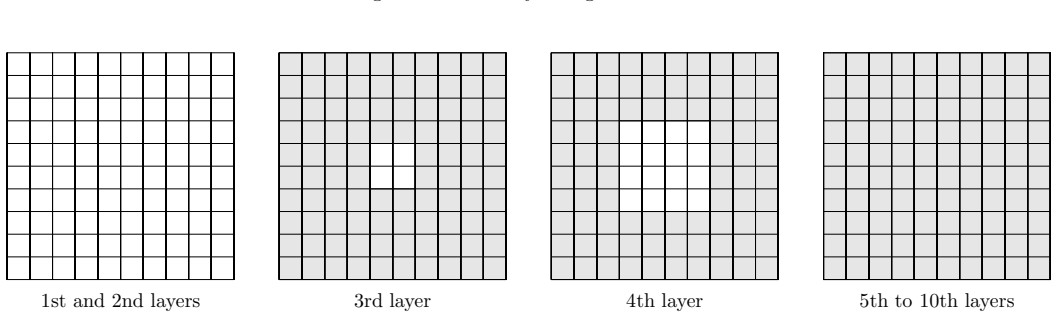
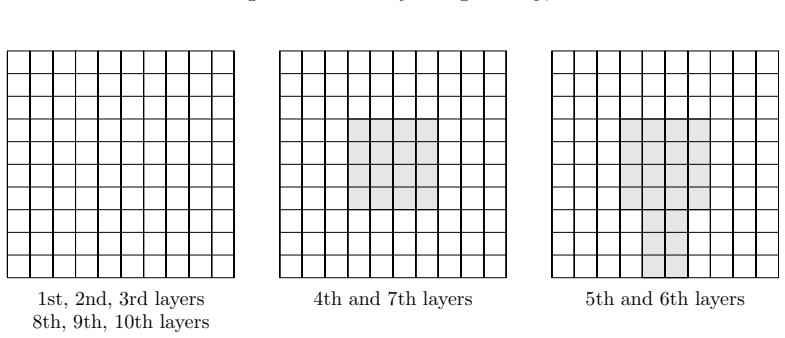
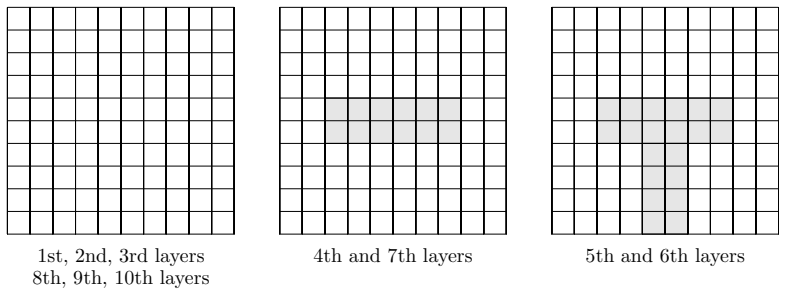
The carrying mechanism is a translation of Wang tilings into tiling constraints on three families of 4D tiles. The encoder is a thick 3D encoder whose color bits are stored by two spacetime building blocks, $C^{(4)}$ and $D^{(4)}$; the linker is a rigid frame that can only occupy positions on a lattice in space while remaining free to slide in the time direction; the filler is the single building block $c^{(4)}$. The load-bearing identity is Fact 2 from the 3D proof: in every tiling, the representative points of the linkers lie exactly on the lattice $\{(10x,60y,20pz) \mid x,y,z\in\mathbb{Z}\}$. In the 4D proof, the analogous rigidity requires each time slice to contain the same rigid lattice and the same encoder distribution, enforced by the building block $E^{(4)}$. The time-slicing lift is what replaces the two 3D linker types—$U$-linker and $D$-linker—by a single linker that shifts along the fourth dimension, reducing the tile count from four to three.
What would settle it
Look for a valid tiling of $\mathbb{Z}^4$ by the three constructed tiles whose linker representative points are not all on the lattice $\{(10x,60y,20pz)\}$, or in which two time slices have different encoder arrangements. A targeted way to search is to tile a finite torus whose side lengths are multiples of the construction's periods; any solution that does not descend to a Wang tiling of the matching layer would falsify the rigidity step on which the reduction rests.
Extended reading notes
Core claim
The paper's central claim, on its own terms, is that translational tiling with three connected polyhypercubes in $\mathbb{Z}^4$ is undecidable. The proof gives an explicit reduction: from any finite set of Wang tiles it builds a set of three tiles—an encoder, a linker, and a filler—such that the three-tile set tiles $\mathbb{Z}^4$ exactly when the Wang set tiles the plane. Encoding layers of the encoders reproduce the color-matching constraints of Wang tiles, while the linker tiles are forced into a rigid lattice whose gaps determine which encoding layer acts as the matching layer. The 3D version of the construction uses four tiles, comprising two linker types instead of one, establishing Theorem 2. Consequently, any algorithm that decided the three-tile problem in dimension 4 would also decide Wang's domino problem, which is known to be undecidable.
Load-bearing premise
The load-bearing premise is the asserted rigidity of the linker packing: every valid tiling must put linker representative points exactly on the lattice $\{(10x,60y,20pz)\}$ in 3D, and in 4D must keep the same rigid lattice and encoder distribution in every time slice. If any alternative packing of linkers exists, the reduction's equivalence with Wang tilings breaks.
Editorial extensions
If this is right
- No algorithm can decide whether an arbitrary set of three connected polyhypercubes tiles $\mathbb{Z}^4$; the existence of such an algorithm would decide Wang's domino problem.
- The known undecidable boundary for translational tilings drops to three tiles in dimension 4 and to four tiles in dimension 3.
- The two theorems sharpen the evidence for the conjecture that a fixed dimension may already admit an undecidable monotile translational tiling problem, because the construction trades one dimension for one tile: dimension 4 with three tiles lifts dimension 3 with four tiles.
- Every tiling produced by the reduction is forced, in matching layers, to simulate a tiling by the original Wang tile set, so any concrete Wang tile set that tiles the plane yields a concrete three-tile 4D tiling, and vice versa.
Reading between the lines
- The rigidity assertions (Fact 2 and its 4D analogue) are stated without a full derivation; a reader who wants to verify the proof should focus there. If a computer search on finite tori could produce a linker configuration not on the stated lattice with all encoders still matched, the reduction's equivalence would fail as written, though it might be repairable by altering block shapes.
- The single-linker time-sliding idea suggests a route toward two-tile undecidability in dimension 5 or higher: lift the encoder's alignment constraints to yet another dimension so one tile plays both the encoder and linker roles, matching the authors' closing remark that they are two steps from a monotile.
- Because Wang tile sets can have arbitrarily many tiles, the construction implies that three-tile 4D tilings can encode computations of arbitrary finite size; consequently no local, finite-window criterion can characterize whether such a tile set tiles the space.
- The same dimension-for-tiles tradeoff might be pushed further: the paper's 3D construction uses two linker types, and any 3D mechanism that merged them into one would establish 3D undecidability with three tiles as well.
Editorial analysis
A structured set of objections, weighed in public.
Referee Report
Summary. The manuscript claims two undecidability results: (Theorem 2) translational tiling of Z^3 with four connected polycubes is undecidable, and (Theorem 1) translational tiling of Z^4 with three connected polyhypercubes is undecidable. The proof reduces from Wang's domino problem: colors of Wang tiles are encoded by arrangements of building blocks, and an encoder tile, linker tile(s), and a filler tile are constructed so that tilings of the polycube set correspond exactly to valid Wang tilings. The 4D result lifts the 3D construction by interpreting the fourth dimension as time and replacing the two 3D linker types with one linker that can be shifted in time.
Significance. If the proofs are completed, Theorem 1 is a genuine advance in the fixed-parameter undecidability frontier: it improves the number of tiles from four to three in dimension four and provides further evidence for the conjecture that translational tiling by a monotile is undecidable in some fixed dimension. The reduction strategy is coherent and builds on the external undecidability of Wang's domino problem, so there is no circularity. The main caveat is that the manuscript's central claim rests on several rigidity assertions (Facts 1 and 2 and their 4D analogues) that are not proved in the text, and the algebraic claims about the time-shift matching need a precise derivation. At present the result is plausible but not established.
major comments (5)
- [Section 2.2, Fact 2] The claim that in any tiling the linker representative points form exactly the lattice {(10x,60y,20pz)} is load-bearing, because the encoders are placed only in the gaps left by this lattice. No proof of this rigidity statement is supplied; the preceding paragraph says the north-south linker main body is 'exactly 3 building blocks away', which would suggest 30y rather than 60y, and the discrepancy is not explained. Without a complete rigidity proof, the 'if and only if' with Wang tilings is not established.
- [Section 2.3, first bullet] The claim that every tiling of the four-tile set must use the encoder (and hence the linker) is not proved. The text argues that if the encoder is used then the linker must be used, and if the filler is used then the encoder must be used, but it does not rule out tilings consisting only of linkers, or of linkers plus fillers, in which no color information is encoded. Such tilings would break the 'only if' direction of the reduction, since a non-tiling Wang instance could still produce a tilable polycube set.
- [Section 3.3, matching D(4) by a 5-frame shift] The statement that linkers can match D(4) blocks by being translated 5 frames is not derived from the frame sequences in Section 3.1. With c(4) = (∅, T1∪T2∪T3∪T5, T1∪T3∪T5, T1∪T5, K, K, K, K, K, K) and D(4) = (∅,∅,∅,∅,∅, K, T4, T2∪T4, T2∪T3∪T4, ∅), a single c(4) shifted by 5 frames fills exactly frames 6–10 of the D(4) hypercube but leaves frames 1–5 empty, since D(4) is empty there and the shifted c(4) has no frame in range at those times. The paper does not explain how these empty frames are filled, for example by another copy of the linker in an adjacent time slice, nor how such copies avoid overlap. This 5-frame shift is the key mechanism that reduces the tile count from four to three, so it must be proved explicitly.
- [Section 3.3, time alignment and slice periodicity] The proofs that encoders are aligned in time and that every 10-frame slice is identical are presented in prose. The contradiction argument against a C(4)/D(4) mismatch relies on Figure 24 without a formal case analysis, and the claims that V(4)/v(4), W(4)/w(4), and E(4) force global time alignment and slice-periodicity are asserted rather than proved. These properties are essential: the equivalence with Wang tilings requires that every valid tiling decomposes into identical slices with the same simulated Wang tile, and any alternative time-shift configuration would break that correspondence.
- [Sections 3.2 and 3.3, reliance on prior work] The 4D construction is presented as an application of the lifting technique from [23,24], both of which are listed as 'to appear', and the rigidity statement in 4D is described as a 'slightly more involved argument' than Fact 2 without being given. Since the central theorem depends on these unpublished methods, the paper is not self-contained. Please state and prove the required lifting lemma, or give a complete proof of the 4D rigidity and time-alignment claims directly.
minor comments (5)
- [Abstract and affiliations] There are typographical errors such as 'Ch ina' in the author affiliation; the manuscript should be carefully proofread.
- [Section 2.2, Fact 2] The vertical spacing is written '20pz' without a separating space, and the y-spacing of 60 in Fact 2 appears inconsistent with the description of linkers being '3 building blocks away' in the north-south direction; please clarify the intended spacing.
- [Section 3.1, definition of T_i] The sets T_i are defined informally as successive outer-surface layers of a 10×10×10 cube. Please provide explicit coordinate definitions so that the frame sequences of c(4), C(4), and D(4) are unambiguous and machine-checkable.
- [General use of 'easy to check'] The phrases 'easy to check' and 'for a similar reason' are used for connectedness, complementarity, and rigidity properties that feed directly into the main argument. These should be replaced by short lemmas with proofs or explicit references.
- [Figures] Many figures are grayscale or low-contrast and label building blocks only by letters without coordinates. Adding coordinate axes and explicit layer indices would make the construction much easier to verify.
Circularity Check
No significant circularity: the reduction is grounded in Berger's external Wang undecidability; self-citations to prior lifting work are methodological and not load-bearing.
full rationale
The paper's derivation chain is a many-one reduction from Berger's undecidable Wang domino problem to the constructed three-tile translational tiling problem. The target claim is not assumed: tilability of the Wang tile set is shown to be equivalent, by explicit layer and matching arguments, to tilability of the constructed 4-dimensional tile set. The self-citations to [23,24] concern the lifting technique and earlier tile-count bounds, not the theorem being proved; the specific three-tile construction and its matching mechanism are described in the paper itself. Statements such as Fact 2 (linkers form a lattice) and the slice-rigidity role of E(4) are asserted without complete proof, but an omitted or hand-waved proof is a correctness/completeness issue, not circularity: no equation or object is defined in terms of the target result, and no fitted parameter is relabeled as a prediction. Since the conclusion is benchmarked against an external undecidability result rather than against the paper's own output, the circularity burden is low; the only mild concern is the repeated reliance on the authors' own prior technique, which is not load-bearing in a definitional sense. Therefore no specific circular step is identified, and the score reflects only that minor methodological self-citation.
Assumptions & free parameters
assumptions (4)
- standard math Wang's domino problem is undecidable for arbitrary finite tile sets (Berger 1966).
- standard math Translational tiling of Z^n by finite subsets of unit cubes is equivalent to tiling R^n by unions of the corresponding unit cubes.
- standard math Wang's domino problem remains undecidable when restricted to instances with at least two Wang tiles.
- ad hoc to paper The described building-block complement relations force exactly the claimed matching and rigidity behavior in any tiling.
Cite this review
Pith. "Pith review of Undecidability of Translational Tiling with Three Tiles." pith.science (2026). https://pith.science/paper/ZTLRWIOU
@misc{pith2026241210646,
  author       = {Pith},
  title        = {Pith review of: Undecidability of Translational Tiling with Three Tiles},
  year         = {2026},
  howpublished = {\url{https://pith.science/paper/ZTLRWIOU}},
  note         = {Machine review of arXiv:2412.10646}
}
abstract
Is there a fixed dimension $n$ such that translational tiling of $\mathbb{Z}^n$ with a monotile is undecidable? Several recent results support a positive answer to this question. Greenfeld and Tao disprove the periodic tiling conjecture by showing that an aperiodic monotile exists in sufficiently high dimension $n$ [Ann. Math. 200(2024), 301-363]. In another paper [to appear in J. Eur. Math. Soc.], they also show that if the dimension $n$ is part of the input, then the translational tiling for subsets of $\mathbb{Z}^n$ with one tile is undecidable. These two results are very strong pieces of evidence for the conjecture that translational tiling of $\mathbb{Z}^n$ with a monotile is undecidable, for some fixed $n$. This paper gives another supportive result for this conjecture by showing that translational tiling of the $4$-dimensional space with a set of three connected tiles is undecidable.
Figures


Figures from the paper (22 more)






Forward citations
Cited by 2 Pith papers
-
Undecidability of Translational Tiling with 2 Polycubes
The translational tiling problem for Z^3 is undecidable even for a set of two connected polycubes.
-
Undecidability of Translational Tiling of the Plane with Orthogonally Convex Polyominoes
Translational tiling of the plane with a set of seven orthogonally convex polyominoes is undecidable.
Reference graph
Works this paper leans on
-
[1]
D. Beauquier, M. Nivat, On translating one polyomino to tile the plan e, Discrete & Computational Geometry , 6(1991), 575-592
work page 1991
-
[2]
R. Berger, The undecidability of the domino problem, Memoirs of the American Mathematical Society , 66(1966), 1-72
work page 1966
-
[3]
Bhattacharya, Periodicity and decidability of tilings of Z2
B. Bhattacharya, Periodicity and decidability of tilings of Z2. American Journal of Mathematics , 142(2020), 255-266
work page 2020
-
[4]
E. D. Demaine, S. Langerman, Tiling with three polygons is undecida ble, arXiv:2409.11582 [cs.CG]
-
[5]
Greenfeld, T
R. Greenfeld, T. Tao. The structure of translational tilings in Zd. Discrete Analysis. (2021:16). 1-28
2021
-
[6]
R. Greenfeld, T. Tao, Undecidable translational tilings with only tw o tiles, or one nonabelian tile. Discrete & Computational Geometry , 70(2023), 1652–1706
work page 2023
-
[7]
R. Greenfeld, T. Tao, A counterexample to the periodic tiling conj ecture. Annals of Mathematics , 200(1)(2024), 301-363
work page 2024
-
[8]
R. Greenfeld, T. Tao, Undecidability of translational monotilings. to appear in Journal of the European Mathe- matical Society, arXiv:2309.09504 [math.CO]
Show all 25 references
-
[9]
Gr¨ unbaum, G
B. Gr¨ unbaum, G. C. Shephard, Tilings and Patterns, 2nd Edition , Dover Publications, 2016
2016
-
[10]
Jeandel, N
E. Jeandel, N. Rolin, Fixed parameter undecidability for Wang tiles ets, In: E. Formenti (eds), AUTOMATA and JAC 2012 conferences, EPTCS 90, (2012), 69–85
2012
-
[11]
J. C. Lagarias, Y. Wang, Tiling the line with translates of one tile, Inventiones mathematicae, 124 (1996), 341-365
1996
-
[12]
Ollinger, Tiling the plane with a fixed number of polyominoes, In: A .H
N. Ollinger, Tiling the plane with a fixed number of polyominoes, In: A .H. Dediu, A.M. Ionescu, C. Mart ´ ın-Vide (eds), Language and Automata Theory and Applications (LATA 200 9). Lecture Notes in Computer Science, vol
-
[13]
Sidorenko, Periodicity of one-dimensional tilings
V. Sidorenko, Periodicity of one-dimensional tilings. In: A. Chmo ra, S.B. Wicker (eds), Error Control, Cryptology, and Speech Compression (ECCSP 1993). Lecture Notes in Compute r Science, vol 829. Springer, Berlin, Heidelberg. 103-108
1993
-
[14]
Smith, J
D. Smith, J. S. Myers, C. S. Kaplan, C. Goodman-Strauss, An a periodic monotile. Combinatorial Theory . 4(1)(2024), #6. arXiv:2303.10798 [math.CO] 20
2024 arXiv
-
[15]
Smith, J
D. Smith, J. S. Myers, C. S. Kaplan, C. Goodman-Strauss, A ch iral aperiodic monotile, arXiv:2305.17743 [math.CO]
-
[16]
S. K. Stein, Algebraic tiling, The American Mathematical Monthly , 81 (1974), 445-462
1974
-
[17]
Wang, Proving theorems by pattern recognition-II, Bell System Technical Journal , 40(1961) 1-41
H. Wang, Proving theorems by pattern recognition-II, Bell System Technical Journal , 40(1961) 1-41
1961
-
[18]
Winslow, An optimal algorithm for tiling the plane with a translate d polyomino, In: K
A. Winslow, An optimal algorithm for tiling the plane with a translate d polyomino, In: K. Elbassioni, K. Makino (eds), Algorithms and Computation (2015), Springer, Berlin, Heide lberg, 3-13
2015
-
[19]
Yang, Tiling the plane with a set of ten polyominoes, International Journal of Computational Geometry & Applications, 33(03n04)(2023), 55-64
C. Yang, Tiling the plane with a set of ten polyominoes, International Journal of Computational Geometry & Applications, 33(03n04)(2023), 55-64
2023
-
[20]
Yang, On the undecidability of tiling the plane with a set of 9 polyo minoes (in Chinese), (2024), to appear in SCIENTIA SINICA Mathematica
C. Yang, On the undecidability of tiling the plane with a set of 9 polyo minoes (in Chinese), (2024), to appear in SCIENTIA SINICA Mathematica . https://doi.org/10.1360/SSM-2024-0035
2024 doi
-
[21]
C. Yang, Z. Zhang, Translational tiling with 8 polyominoes is undec idable., (2024), to appear in Discrete & Computational Geometry , https://doi.org/10.1007/s00454-024-00706-1
2024 doi
-
[22]
C. Yang, Z. Zhang, Undecidability of tiling the plane with a fixed num ber of Wang bars, arXiv:2404.04504 [math.CO]
-
[23]
C. Yang, Z. Zhang, Undecidability of translational tiling of the 3- dimensional space with a set of 6 polycubes, arXiv:2408.02196 [math.CO], to appear in Proceedings of the AMS
-
[24]
C. Yang, Z. Zhang, Undecidability of translational tiling of the 4- dimensional space with a set of 4 polyhypercubes, arXiv:2409.00846 [math.CO], to appear in SCIENCE CHINA Mathematics . 21
-
[5457]
Springer, Berlin, Heidelberg, 638-649
Reviewed August 11, 2026 · model on record in the stance chip above.
Discussion (0). Continue with ORCID to comment.