REVIEW 2 major objections 5 minor 85 references
Testing the Fifth Force on Lepton Spins through Neutrino Oscillations
T0 review · 2 major / 5 minor · reviewed 2026-08-11 · deepseek-v4-flash
Pith's one-line read A light vector boson coupling to lepton spins would also couple to neutrinos, and existing neutrino oscillation data exclude the vector-mediator explanation of the muon g-2 anomaly.
desk verdict Useful multi-experiment constraints on a spin-dependent fifth force, but the headline muon g-2 exclusion only applies to the pure-axial U(1)' model, not to a generic vector mediator. read the letter →
The pith
A machine-rendered reading of the paper's core claim, the machinery that carries it, and where it could break.
The reading
What carries the argument
The central object is a light vector boson $A'$ whose interaction Lagrangian is $L_{\rm int} = g_A A'_\mu(-\bar{\nu}_L \gamma^\mu \nu_L + \bar{e}\gamma^\mu\gamma^5 e) + g_V^N A'_\mu(\bar{p}\gamma^\mu p + \bar{n}\gamma^\mu n)$, with $g_A = -g_L = g_R$ ensuring a purely axial lepton coupling. The static potential $A'_0$ from an extended spherical source follows from the Yukawa integral in Eq. (4), and for a heavy mediator it reduces to the local-density form $A'_0 \simeq -g_V^N n(r)/m_{A'}^2$. This $A'_0$ enters neutrino evolution through the Hamiltonian $H = U M^2/(2E) U^\dagger + V_{\rm MSW} + g_A A'_0$, which is what converts a laboratory spin force into an oscillation effect. The numerical machinery then fits the resulting survival probabilities to IceCube DeepCore, T2K, BOREXINO+SNO+SK, KamLAND, and Daya Bay data to bound $g_A g_V^N$ for electron, muon, and tau couplings.
What would settle it
A global refit of the same public datasets with the sign of the coupling left free, using the full solar density profile, would falsify the central exclusion if any allowed region at $m_{A'}\sim 10^{-14}$ eV still overlaps the muon $g-2$ band; conversely, a reactor long-baseline search for the predicted dips at $\Delta m^2_{21}L/(4E)=(2N-1)\pi/2$ that finds nothing would support the null result, while observing them would confirm the fifth-force mechanism.
Extended reading notes
Core claim
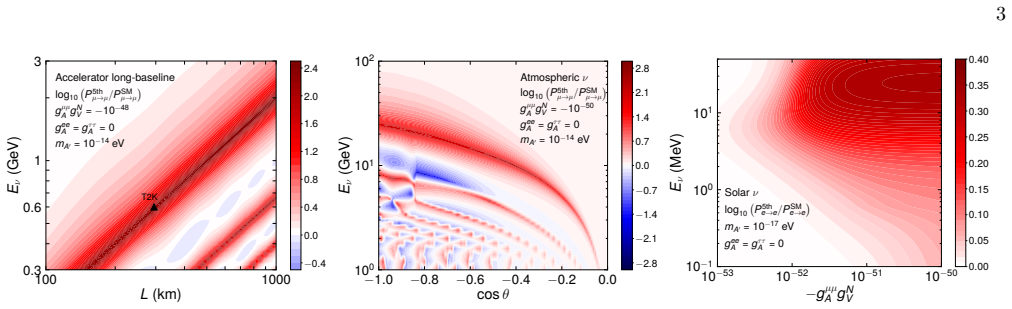
The paper's central claim is that a $U(1)'$ gauge boson with purely axial-vector lepton couplings and vector nucleon couplings produces a spin-velocity potential at low energies and, through the weak-doublet relation $g_A = -g_L = g_R$, an effective neutrino potential $g_A A'_0$ that adds to the MSW term in the oscillation Hamiltonian. With this potential, the fifth force shifts $P_{e\to e}$ in solar and reactor neutrinos and $P_{\mu\to\mu}$ in atmospheric and accelerator neutrinos. The authors compute these probabilities numerically with the Earth's and Sun's density profiles and fit them to published event rates. The stated result is that the combined solar, atmospheric, and accelerator data exclude the coupling range $|g_{\mu\mu}^A g_V^N| \in [7.2\times 10^{-50}, 1.4\times 10^{-49}]$ that would explain the muon $g-2$ anomaly for a $10^{-14}$ eV mediator, and that solar neutrinos bound electron couplings at a level competitive with precision spin sensors, surpassing them for short force ranges.
Load-bearing premise
The load-bearing premise is that a force coupling to charged leptons also couples to the left-handed neutrino with the same strength, because they share a weak doublet; if the force instead couples only to right-handed charged leptons, the neutrino-oscillation constraints in this paper disappear.
Editorial extensions
If this is right
- Solar, atmospheric, and accelerator neutrino experiments exclude the vector-mediator parameter window $|g_{\mu\mu}^A g_V^N| \in [7.2\times10^{-50}, 1.4\times10^{-49}]$ at $m_{A'}=10^{-14}$ eV that would explain the muon $g-2$ anomaly.
- Neutrino oscillations become a probe of spin-dependent fifth forces for all three lepton generations, not just electrons as in most spin-sensor searches.
- For electron couplings, the neutrino bounds scale as $m_{A'}^{-2}$ for heavy mediators while spin-sensor bounds scale as $m_{A'}^{-3}$, so neutrino experiments surpass the sensors for force ranges below roughly $10^5$ m.
- Tau-lepton couplings are constrained at a level similar to muon couplings by the same datasets.
- Because the fifth-force effect grows with neutrino energy, future high-energy solar and atmospheric data will sharpen these bounds.
Reading between the lines
- Beyond the paper's diagonal-coupling assumption, allowing off-diagonal axial couplings $g_A^{ij}$ would introduce new phases into the neutrino Hamiltonian and could be constrained even more sharply by long-baseline experiments.
- The exclusion is specific to a spin-dependent vector mediator; scalar or pseudoscalar explanations of the muon $g-2$ anomaly are not addressed by these data, so the anomaly could still live in that sector.
- A reactor experiment with a slightly longer baseline than Daya Bay, or JUNO in the long-baseline regime where the paper predicts resonance-like dips at $\Delta m^2_{21}L/(4E)=(2N-1)\pi/2$, would turn the current constraints into a direct search channel for the fifth force.
- The paper's conclusion that negative electron couplings fit solar data better than the Standard Model suggests that precision solar measurements could eventually discriminate the sign of the coupling, something spin sensors cannot do.
Editorial analysis
A structured set of objections, weighed in public.
Referee Report
Summary. The paper studies a light U(1)' vector boson (``fifth force'') that has axial-vector couplings to charged leptons and vector couplings to nucleons, so that it generates a spin-velocity potential for spin sensors. By imposing a weak-symmetry-motivated relation g_A = -g_L = g_R, the authors extend the coupling to left-handed neutrinos, which produces a matter-like potential in the neutrino Hamiltonian. Using public data from solar (Borexino, SNO+SK), reactor (KamLAND, Daya Bay), atmospheric (IceCube DeepCore), and accelerator (T2K) experiments, they compute 95% CL constraints on the products g_A^e g_V^N, g_A^mu g_V^N, and g_A^tau g_V^N as functions of the mediator mass. They find that neutrino oscillations give constraints comparable to or stronger than spin-sensor experiments, and they claim that solar, atmospheric, and accelerator neutrino data exclude the parameter region that could explain the muon g-2 anomaly via this vector mediator.
Significance. If the model assumption underlying the neutrino coupling is accepted, this paper demonstrates a genuinely new probe of spin-dependent fifth forces: neutrino oscillations are shown to be competitive with, and in some mass ranges superior to, precision spin sensors for electron and muon axial couplings. The claimed exclusion of the vector-mediator explanation of the muon g-2 anomaly is a strong, falsifiable result, and the paper assembles a broad set of public experimental data with a transparent chi-square framework. The significance is, however, conditional on the left-handed doublet coupling assumption; the general statement that the results constrain arbitrary lepton-spin fifth forces is not supported by the analysis.
major comments (2)
- [Section II, Eq. (2); Section VIII] The identification g_A = -g_L = g_R is a model choice, not a generic consequence of weak symmetry. This choice forces a coupling of strength -g_A between A' and the left-handed neutrino, and all neutrino oscillation constraints derived in this paper, including the exclusion of the muon g-2 parameter region, rely on this vertex. A U(1)' with q_L = 0 and q_R nonzero (for instance, a right-handed muon-only current) gives the same axial-vector coupling to the muon spin but has no active-neutrino coupling; in that case the solar, T2K, and IceCube limits in the central panel of Fig. 2 disappear. The paper should explicitly state in the abstract and in Section VIII that the constraints apply to vector mediators that couple to the SU(2)_L lepton doublet (or equivalently require q_R = -q_L), and the headline wording ``exclude the fifth force as a viable explanation'' should be qualified accordingly.
- [Section II, anomaly-cancellation paragraph; Section IX] The constraints are computed one generation at a time without imposing the stated anomaly-cancellation conditions sum_i a_i = 0 and sum_i a_i^3 = 0. For example, a model with only a_mu nonzero, which is exactly the case that would explain the muon g-2 anomaly in the central panel of Fig. 2, is anomalous unless additional spectator or generation-dependent fermions are introduced. The paper acknowledges this in a sentence, but the abstract and conclusions claim that neutrino oscillations probe a fifth force acting on ``all three generations of lepton spins'' without caveating that the reported single-generation limits are not simultaneously valid in a single anomaly-free U(1)' model. Please add an explicit statement that the bounds are effective limits on one coupling at a time, valid in a complete model with additional states that cancel the anomalies.
minor comments (5)
- [Throughout] The notation for the nucleon coupling is inconsistent: g_N^V is used in equations, while g_V or gV appears in figure labels and in some text passages (e.g., Fig. 3 and the right panel of Fig. 1 use gV). Please unify the notation.
- [Section V, IceCube analysis] The IceCube and T2K analyses use a simplified chi-square with events rescaled by the probability ratio and fixed systematic uncertainties. It would be helpful to state explicitly that no nuisance-parameter marginalization was performed and to comment on the robustness of the reported limits against the main systematic uncertainties (flux normalization, energy calibration, and detector response).
- [Section IV and Fig. 2 caption] The text says ``the radii of Sun'' in the right panel description and ``the Icecube DeepCore'' in the analysis section; these should be corrected to ``the radius of the Sun'' and ``IceCube DeepCore'' for accuracy.
- [Section V, Eq. (8)] The explanation below Eq. (8) reads ``a sums over e, µneutrinos and anti-neutrinos''; the missing comma and spacing make this hard to parse. It should be ``a runs over muon neutrinos and antineutrinos of electron and muon flavor'' or similar.
- [Appendix B and Section V] For the reactor analyses, the paper uses Eq. (10) with observed survival probabilities and uncertainties from the literature but does not discuss the energy-bin correlations in the published data. A brief statement on how these correlations are (or are not) handled would help the reader judge the confidence levels shown in Fig. 2.
Circularity Check
No significant circularity: neutrino constraints come from an independently constructed Hamiltonian and external data, with the g-2 band used only as a target region; self-citations are not load-bearing.
full rationale
The paper's central derivation is not circular. The fifth-force Hamiltonian in Eq. (6) follows from the explicitly stated Lagrangian in Eq. (2), and the oscillation probabilities are computed numerically against published solar (BOREXINO, SNO/SK), atmospheric (IceCube DeepCore), accelerator (T2K), and reactor (KamLAND, Daya Bay) data. The muon g-2 band in Section VI is introduced only after the oscillation analysis as a target region; it is not used as an input in deriving the neutrino constraints. The self-citations to [37] are limited to numerical-method details, the momentum-shift identity, and spin-evolution relations, and the same relations are supported by external references [44,45,72]; no uniqueness claim or central premise rests solely on the authors' prior work. The relation g_A = -g_L = g_R in Eq. (2) is an explicitly imposed model-building condition rather than a fitted or predicted quantity, so the conditional nature of the g-2 exclusion is transparent and not a circular reduction. The 'weak symmetry' language in the abstract overstates what is a deliberately chosen charge assignment, and a right-handed-only U(1)' could evade the neutrino bounds, but this is a model-dependence caveat, not circularity.
Assumptions & free parameters
free parameters (4)
- g_A^e g_V^N (electron-nucleon coupling product) =
No central fit is made. The 95% C.L. bound is [-16.5, 1.3] x 10^-53 in the massless limit and [-41.6, 3.0] x 10^-50 x…
- g_A^mu g_V^N (muon-nucleon coupling product) =
The g-2 preferred band is [7.2 x 10^-50, 1.4 x 10^-49] at mA'=10^-14 eV.
- g_A^tau g_V^N (tau-nucleon coupling product) =
No central fit is made. The constraints are reported as similar to the muon case, set by IceCube, T2K, and solar data.
- mA' (A' mediator mass) =
Scanned over the range 10^-18 eV to 10^-8 eV.
assumptions (4)
- ad hoc to paper SU(2)_L doublet inheritance: the U(1)' gauge boson couples to the left-handed lepton doublet, so the axial-vector coupling to charged leptons implies the same coupling to left-handed neutrinos with opposite sign.
- domain assumption Semi-classical background field: the A' field generated by the Sun and Earth is treated as a static Yukawa potential (Eqs. 3-5) and added linearly to the neutrino Hamiltonian (Eq. 6).
- ad hoc to paper Anomaly cancellation condition (sum_i a_i = 0, sum_i a_i^3 = 0) is quoted but not imposed in the constraints; bounds are derived for one generation at a time.
- domain assumption Flavor-diagonal couplings a_i delta_ij and equal proton and neutron couplings g_V^N.
invented entities (1)
-
A' light vector boson (fifth force mediator)
independent evidence
Cite this review
Pith. "Pith review of Testing the Fifth Force on Lepton Spins through Neutrino Oscillations." pith.science (2026). https://pith.science/paper/JJT3CE54
@misc{pith2026241210724,
  author       = {Pith},
  title        = {Pith review of: Testing the Fifth Force on Lepton Spins through Neutrino Oscillations},
  year         = {2026},
  howpublished = {\url{https://pith.science/paper/JJT3CE54}},
  note         = {Machine review of arXiv:2412.10724}
}
abstract
We investigate a fifth force mediated by a light vector boson that couples to lepton spins, characterized by axial-vector couplings to leptons and vector couplings to nucleons. This interaction generates a potential proportional to the inner product of the lepton spin vector and the nucleon-lepton relative velocity vector, a feature extensively explored with precision spin sensors. Employing weak symmetry, we show that left-handed charged lepton couplings naturally extend to left-handed neutrinos, enabling this fifth force to influence neutrino oscillations. For electron-nucleon couplings, we find that solar and reactor neutrino experiments provide comparable constraints to those from spin sensors and surpass them in the short-range fifth force region. For muon-nucleon couplings, neutrino oscillation experiments exclude the fifth force as a viable explanation for the muon $ g-2 $ anomaly in the context of a vector mediator, tightening the bounds by two orders of magnitude in coupling strength by solar and atmospheric neutrino data. Our results highlight the critical role of neutrino oscillations in probing fifth forces acting across all three generations of lepton spins.
Figures


Reference graph
Works this paper leans on
-
[37]
A plethora of long-range neutrino interactions probed by DUNE and T2HK,
S. K. Agarwalla, M. Bustamante, M. Singh, and P. Swain, “A plethora of long-range neutrino interactions probed by DUNE and T2HK,” JHEP 09 (2024) 055 [arXiv:2404.02775]
arXiv 2024
-
[1]
Using the spin evolution relations [37, 72], d⃗S dt = ⃗ ω× ⃗S , d ˆSi dt = i h H, ˆSi i , (12) where ˆSi = ˆσi/2 is the muon spin operator
is the A′ field in RMRF, γ ≈ 29.3 and ⃗β are the boost factor and velocity of the muon respectively. Using the spin evolution relations [37, 72], d⃗S dt = ⃗ ω× ⃗S , d ˆSi dt = i h H, ˆSi i , (12) where ˆSi = ˆσi/2 is the muon spin operator. We have the the precession frequency from the fifth force contribution: δ⃗ ω= −2gµµ A ⃗ p mµ A′
-
[2]
(14) Notably, ∆ ω is independent of the sign of the cou- pling constant gµµ A gN V
(13) Since ⃗ p⊥ ⃗ ω, the precession frequency shift is [70, 71] ∆ω = p (δ⃗ ω+ ⃗ ω)2 − |⃗ ω| ≈ |δ⃗ ω|2/ (2|⃗ ω|) . (14) Notably, ∆ ω is independent of the sign of the cou- pling constant gµµ A gN V . In RMRF, we have |⃗ ω| = γωa ≡ γ(ωc−ωs) where ωc (ωs) is the cyclotron (spin precession) frequency in the lab frame. In RMRF, using Eq. (13) and (14), we have...
2023
-
[3]
Search for exotic short-range interactions using paramagnetic insulators
P. H. Chu, E. Weisman, C. Y. Liu, and J. C. Long, “Search for exotic short-range interactions using paramagnetic insulators,” Phys. Rev. D 91 (2015) 102006 [arXiv:1504.00552]
work page Pith review arXiv 2015
-
[4]
Search of spin-dependent fifth forces with precision magnetometry,
N. Crescini, et al., “Search of spin-dependent fifth forces with precision magnetometry,” Phys. Rev. D 105 (2022) 022007 [arXiv:2011.07100]
arXiv 2022
-
[5]
Spin-dependent exotic interactions
L. Cong et al., “Spin-dependent exotic interactions.” arXiv:2408.15691
-
[6]
Search for an axionlike spin coupling using a paramagnetic salt with a dc SQUID,
W.-T. Ni, S.-S. Pan, H.-C. Yeh, L.-S. Hou, and J.-L. Wan, “Search for an axionlike spin coupling using a paramagnetic salt with a dc SQUID,” Phys. Rev. Lett. 82 (1999) 2439–2442
1999
-
[7]
Search for a coupling of the Earth’s gravitational field to nuclear spins in atomic mercury,
B. J. Venema, P. K. Majumder, S. K. Lamoreaux, B. R. Heckel, and E. N. Fortson, “Search for a coupling of the Earth’s gravitational field to nuclear spins in atomic mercury,” Phys. Rev. Lett. 68 (1992) 135–138
work page 1992
Show all 85 references
-
[8]
Limits on Anomalous Spin-Spin Couplings between Neutrons,
A. G. Glenday, C. E. Cramer, D. F. Phillips, and R. L. Walsworth, “Limits on Anomalous Spin-Spin Couplings between Neutrons,” Phys. Rev. Lett. 101 (2008) 261801. 8
2008
-
[9]
A New Limit on the Arion Interaction Constant,
P. V. Vorobev and Y. I. Gitarts, “A New Limit on the Arion Interaction Constant,” Phys. Lett. B 208 (1988) 146–148
1988
-
[10]
New Constraints on Exotic Spin-Spin-Velocity-Dependent Interactions with Solid-State Quantum Sensors,
Y. Huang et al., “New Constraints on Exotic Spin-Spin-Velocity-Dependent Interactions with Solid-State Quantum Sensors,” Phys. Rev. Lett. 132 (2024) 180801 [arXiv:2403.18263]
2024 arXiv
-
[11]
Constraints on Spin-Dependent Short-Range Interaction between Nucleons,
K. Tullney et al., “Constraints on Spin-Dependent Short-Range Interaction between Nucleons,” Phys. Rev. Lett. 111 (2013) 100801 [arXiv:1303.6612]
2013 arXiv
-
[12]
As the energy decreases, the effective mixing angle and mass- squared difference in the fifth force model initially ap- proach the corresponding values in the SM
= 1, rep- resented by the horizontal black dot-dashed line. As the energy decreases, the effective mixing angle and mass- squared difference in the fifth force model initially ap- proach the corresponding values in the SM. Specifically, when [63] Eν = ∆m2 12 cos 2θ12 V eem cos...
-
[13]
Limits on new long range nuclear spin-dependent forces set with a K - He-3 co-magnetometer,
G. Vasilakis, J. M. Brown, T. W. Kornack, and M. V. Romalis, “Limits on new long range nuclear spin-dependent forces set with a K - He-3 co-magnetometer,” Phys. Rev. Lett. 103 (2009) 261801 [arXiv:0809.4700]
2009 arXiv
-
[14]
Search for exotic spin-dependent interactions with a spin-based amplifier,
H. Su, et al., “Search for exotic spin-dependent interactions with a spin-based amplifier,” Sci. Adv. 7 (2021) abi9535 [arXiv:2103.15282]
2021 arXiv
-
[15]
Revisiting spin-dependent forces mediated by new bosons: Potentials in the coordinate-space representation for macroscopic- and atomic-scale experiments,
P. Fadeev, et al., “Revisiting spin-dependent forces mediated by new bosons: Potentials in the coordinate-space representation for macroscopic- and atomic-scale experiments,” Phys. Rev. A 99 (2019) 022113 [arXiv:1810.10364]
2019 arXiv
-
[16]
Constraints on exotic spin-velocity-dependent interactions,
K. Wei, et al., “Constraints on exotic spin-velocity-dependent interactions,” Nature Commun. 13 (2022) 7387 [arXiv:2203.07050]
2022 arXiv
-
[17]
Search for Spin-Dependent Gravitational Interactions at Earth Range,
S. Zhang, et al., “Search for Spin-Dependent Gravitational Interactions at Earth Range,” Phys. Rev. Lett. 130 (2023) 201401 [arXiv:2303.10352]
2023 arXiv
-
[18]
Spin-dependent macroscopic forces from new particle exchange,
B. A. Dobrescu and I. Mocioiu, “Spin-dependent macroscopic forces from new particle exchange,” JHEP 11 (2006) 005 [hep-ph/0605342]
2006 arXiv
-
[19]
Using Earth to search for long-range spin-velocity interactions,
N. B. Clayburn and L. R. Hunter, “Using Earth to search for long-range spin-velocity interactions,” Phys. Rev. D 108 (2023) L051701 [arXiv:2306.05327]
2023 arXiv
-
[20]
Preferred-Frame and CP-Violation Tests with Polarized Electrons,
B. R. Heckel, et al., “Preferred-Frame and CP-Violation Tests with Polarized Electrons,” Phys. Rev. D 78 (2008) 092006 [arXiv:0808.2673]
2008 arXiv
-
[21]
Probe Spin-Velocity Dependent New Interactions by Spin Relaxation Times of Polarized 3He Gas,
H. Yan, et al., “Probe Spin-Velocity Dependent New Interactions by Spin Relaxation Times of Polarized 3He Gas,” Phys. Rev. Lett. 115 (2015) 182001 [arXiv:1412.8155]
2015 arXiv
-
[22]
New Limits on Exotic Spin-Dependent Interactions at Astronomical Distances,
L. Y. Wu, K. Y. Zhang, M. Peng, J. Gong, and H. Yan, “New Limits on Exotic Spin-Dependent Interactions at Astronomical Distances,” Phys. Rev. Lett. 131 (2023) 091002 [arXiv:2302.09096]
2023 arXiv
-
[23]
Probing long-range leptonic forces with solar and reactor neutrinos,
M. C. Gonzalez-Garcia, P. C. de Holanda, E. Masso, and R. Zukanovich Funchal, “Probing long-range leptonic forces with solar and reactor neutrinos,” JCAP 01 (2007) 005 [hep-ph/0609094]
2007 arXiv
-
[24]
Neutrino Oscillations in Matter,
L. Wolfenstein, “Neutrino Oscillations in Matter,” Phys. Rev. D 17 (1978) 2369–2374
1978
-
[25]
Neutrino oscillations and Non-Standard Interactions,
Y. Farzan and M. Tortola, “Neutrino oscillations and Non-Standard Interactions,” Front. in Phys. 6 (2018) 10 [arXiv:1710.09360]
2018 arXiv
-
[26]
Neutrino non-standard interactions: A status report,
P. S. B. Dev, et al., “Neutrino non-standard interactions: A status report,” SciPost Phys. Proc. (2019) 001
2019
-
[27]
Lepton Flavorful Fifth Force and Depth-dependent Neutrino Matter Interactions,
M. B. Wise and Y. Zhang, “Lepton Flavorful Fifth Force and Depth-dependent Neutrino Matter Interactions,” JHEP 06 (2018) 053 [arXiv:1803.00591]
2018 arXiv
-
[28]
Constraints on flavor-dependent long range forces from solar neutrinos and KamLAND,
A. Bandyopadhyay, A. Dighe, and A. S. Joshipura, “Constraints on flavor-dependent long range forces from solar neutrinos and KamLAND,” Phys. Rev. D 75 (2007) 093005 [hep-ph/0610263]
2007 arXiv
-
[29]
Constraints from Solar and Reactor Neutrinos on Unparticle Long-Range Forces,
M. C. Gonzalez-Garcia, P. C. de Holanda, and R. Zukanovich Funchal, “Constraints from Solar and Reactor Neutrinos on Unparticle Long-Range Forces,” JCAP 06 (2008) 019 [arXiv:0803.1180]
2008 arXiv
-
[30]
Long-range Forces : Atmospheric Neutrino Oscillation at a magnetized Detector,
A. Samanta, “Long-range Forces : Atmospheric Neutrino Oscillation at a magnetized Detector,” JCAP 09 (2011) 010 [arXiv:1001.5344]
2011 arXiv
-
[31]
Future experiments, such as JUNO, could potentially detect these effects in this energy and baseline range. In Fig. 4, for the case where only gee A ̸= 0, the ra- tio depends on both the vacuum oscillations in the SM and the oscillations induced by the fifth force model. Conse...
2002
-
[32]
Neutrino nonstandard interactions via light scalars in the Earth, Sun, supernovae, and the early Universe,
K. S. Babu, G. Chauhan, and P. S. Bhupal Dev, “Neutrino nonstandard interactions via light scalars in the Earth, Sun, supernovae, and the early Universe,” Phys. Rev. D 101 (2020) 095029 [arXiv:1912.13488]
2020 arXiv
-
[33]
Wolfenstein potentials for neutrinos induced by ultra-light mediators,
A. Y. Smirnov and X.-J. Xu, “Wolfenstein potentials for neutrinos induced by ultra-light mediators,” JHEP 12 (2019) 046 [arXiv:1909.07505]
2019 arXiv
-
[34]
Impact of the cosmic neutrino background on long-range force searches
G. Chauhan and X.-J. Xu, “Impact of the cosmic neutrino background on long-range force searches.” arXiv:2403.09783
-
[35]
Solar neutrinos and leptonic spin forces,
S. Ansarifard, M. C. Gonzalez-Garcia, M. Maltoni, and J. P. Pinheiro, “Solar neutrinos and leptonic spin forces,” JHEP 07 (2024) 172 [arXiv:2405.05340]
2024 arXiv
-
[36]
Neutrino oscillation constraints on U(1)’ models: from non-standard interactions to long-range forces,
P. Coloma, M. C. Gonzalez-Garcia, and M. Maltoni, “Neutrino oscillation constraints on U(1)’ models: from non-standard interactions to long-range forces,” JHEP 01 (2021) 114 [arXiv:2009.14220]. [Erratum: JHEP 11, 115 (2022)]
2021 arXiv
-
[38]
Study of long range force in P2SO and T2HKK,
P. Mishra, R. Majhi, S. K. Pusty, M. Ghosh, and R. Mohanta, “Study of long range force in P2SO and T2HKK,” JHEP 09 (2024) 100 [arXiv:2402.19178]
2024 arXiv
-
[39]
CP -Violating Neutrino Nonstandard Interactions in Long-Baseline-Accelerator Data,
P. B. Denton, J. Gehrlein, and R. Pestes, “ CP -Violating Neutrino Nonstandard Interactions in Long-Baseline-Accelerator Data,” Phys. Rev. Lett. 126 (2021) 051801 [arXiv:2008.01110]
2021 arXiv
-
[40]
Long Range Interactions in Cosmology: Implications for Neutrinos,
I. Esteban and J. Salvado, “Long Range Interactions in Cosmology: Implications for Neutrinos,” JCAP 05 (2021) 036 [arXiv:2101.05804]
2021 arXiv
-
[41]
Muon g-2, long-range muon spin force, and neutrino oscillations,
R. Fang, J.-H. Guo, J. Liu, and X.-P. Wang, “Muon g-2, long-range muon spin force, and neutrino oscillations,” Phys. Rev. D 110 (2024) 035037 [arXiv:2405.02084]
2024 arXiv
-
[42]
Searching for axion forces with precision precession in storage rings,
P. Agrawal, D. E. Kaplan, O. Kim, S. Rajendran, and M. Reig, “Searching for axion forces with precision precession in storage rings,” Phys. Rev. D 108 (2023) 015017 [arXiv:2210.17547]
2023 arXiv
-
[43]
Muon g-2 and a Geocentric New Field,
H. Davoudiasl and R. Szafron, “Muon g-2 and a Geocentric New Field,” Phys. Rev. Lett. 130 (2023) 181802 [arXiv:2210.14959]
2023 arXiv
-
[44]
Axial vector Z ′ and anomaly cancellation,
A. Ismail, W.-Y. Keung, K.-H. Tsao, and J. Unwin, “Axial vector Z ′ and anomaly cancellation,” Nucl. Phys. B 918 (2017) 220–244 [arXiv:1609.02188]
2017 arXiv
-
[45]
Resonance Amplification of Oscillations in Matter and Spectroscopy of Solar Neutrinos,
S. P. Mikheyev and A. Y. Smirnov, “Resonance Amplification of Oscillations in Matter and Spectroscopy of Solar Neutrinos,” Sov. J. Nucl. Phys. 42 (1985) 913–917
1985
-
[46]
Inverse beta processes and nonconservation of lepton charge,
B. Pontecorvo, “Inverse beta processes and nonconservation of lepton charge,” Zh. Eksp. Teor. Fiz. 34 (1957) 247
1957
-
[47]
Remarks on the unified model of elementary particles,
Z. Maki, M. Nakagawa, and S. Sakata, “Remarks on the unified model of elementary particles,” Prog. Theor. Phys. 28 (1962) 870–880
1962
-
[48]
Fuzzy dark matter and nonstandard neutrino interactions,
V. Brdar, J. Kopp, J. Liu, P. Prass, and X.-P. Wang, “Fuzzy dark matter and nonstandard neutrino interactions,” Phys. Rev. D 97 (2018) 043001 [arXiv:1705.09455]
2018 arXiv
-
[49]
Neutrinophilic Axion-Like Dark Matter,
G.-Y. Huang and N. Nath, “Neutrinophilic Axion-Like Dark Matter,” Eur. Phys. J. C 78 (2018) 922 [arXiv:1809.01111]. 9
2018 arXiv
-
[50]
Preliminary reference earth model,
A. M. Dziewonski and D. L. Anderson, “Preliminary reference earth model,” Phys. Earth Planet. Interiors 25 (1981) 297–356
1981
-
[51]
Solar neutrinos and neutrino physics,
M. Maltoni and A. Y. Smirnov, “Solar neutrinos and neutrino physics,” Eur. Phys. J. A 52 (2016) 87 [arXiv:1507.05287]
2016 arXiv
-
[52]
Solar neutrino physics,
X.-J. Xu, Z. Wang, and S. Chen, “Solar neutrino physics,” Progress in Particle and Nuclear Physics 131 (2023) 104043
2023
-
[53]
Standard Solar Composition,
N. Grevesse and A. J. Sauval, “Standard Solar Composition,” Space Sci. Rev. 85 (1998) 161–174
1998
-
[54]
The Design and Performance of IceCube DeepCore,
IceCube Collaboration, “The Design and Performance of IceCube DeepCore,” Astropart. Phys. 35 (2012) 615–624 [arXiv:1109.6096]
2012 arXiv
-
[55]
Letter of Intent: The Precision IceCube Next Generation Upgrade (PINGU)
IceCube-PINGU Collaboration, “Letter of Intent: The Precision IceCube Next Generation Upgrade (PINGU).” arXiv:1401.2046
-
[56]
The IceCube Upgrade - Design and Science Goals,
IceCube Collaboration, “The IceCube Upgrade - Design and Science Goals,” PoS ICRC2019 (2021) 1031 [arXiv:1908.09441]
2021 arXiv
-
[57]
Measurement of atmospheric neutrino mixing with improved IceCube DeepCore calibration and data processing,
(IceCube Collaboration)*, IceCubeCollaboration, “Measurement of atmospheric neutrino mixing with improved IceCube DeepCore calibration and data processing,” Phys. Rev. D 108 (2023) 012014 [arXiv:2304.12236]
2023
-
[58]
Getting the most from the statistical analysis of solar neutrino oscillations,
G. L. Fogli, E. Lisi, A. Marrone, D. Montanino, and A. Palazzo, “Getting the most from the statistical analysis of solar neutrino oscillations,” Phys. Rev. D 66 (2002) 053010 [hep-ph/0206162]
2002 arXiv
-
[59]
Constraining Vector Dark Matter with neutrino experiments,
D. Brzeminski, S. Das, A. Hook, and C. Ristow, “Constraining Vector Dark Matter with neutrino experiments,” JHEP 08 (2023) 181 [arXiv:2212.05073]
2023 arXiv
-
[60]
Atmospheric neutrino flux calculation using the NRLMSISE-00 atmospheric model,
M. Honda, M. Sajjad Athar, T. Kajita, K. Kasahara, and S. Midorikawa, “Atmospheric neutrino flux calculation using the NRLMSISE-00 atmospheric model,” Phys. Rev. D 92 (2015) 023004 [arXiv:1502.03916]
2015 arXiv
-
[61]
The T2K Experiment,
T2K Collaboration, “The T2K Experiment,” Nucl. Instrum. Meth. A 659 (2011) 106–135 [arXiv:1106.1238]
2011
-
[62]
Updated T2K measurements of muon neutrino and antineutrino disappearance using 3.6×10²¹ protons on target,
T2K Collaboration, “Updated T2K measurements of muon neutrino and antineutrino disappearance using 3.6×10²¹ protons on target,” Phys. Rev. D 108 (2023) 072011 [arXiv:2305.09916]
2023
-
[63]
The Super-Kamiokande detector,
V. A. Ilyin, V. V. Korenkov, and D. Perret-Gallix, eds., “The Super-Kamiokande detector,” Nucl. Instrum. Meth. A 501 (2003) 418–462
2003
-
[64]
Comprehensive measurement of pp-chain solar neutrinos,
BOREXINO Collaboration, “Comprehensive measurement of pp-chain solar neutrinos,” Nature 562 (2018) 505–510
2018
-
[65]
Solar neutrino measurements using the full data period of Super-Kamiokande-IV,
Super-Kamiokande Collaboration, “Solar neutrino measurements using the full data period of Super-Kamiokande-IV,” Phys. Rev. D 109 (2024) 092001 [arXiv:2312.12907]
2024
-
[66]
Constraints on θ13 from A Three-Flavor Oscillation Analysis of Reactor Antineutrinos at KamLAND,
KamLAND Collaboration, “Constraints on θ13 from A Three-Flavor Oscillation Analysis of Reactor Antineutrinos at KamLAND,” Phys. Rev. D 83 (2011) 052002 [arXiv:1009.4771]
2011 arXiv
-
[67]
Reactor On-Off Antineutrino Measurement with KamLAND,
KamLAND Collaboration, “Reactor On-Off Antineutrino Measurement with KamLAND,” Phys. Rev. D 88 (2013) 033001 [arXiv:1303.4667]
2013 arXiv
-
[68]
Antineutrino Model
“Antineutrino Model.” https://reactors.geoneutrinos.org
-
[69]
Improved Predictions of Reactor Antineutrino Spectra,
T. A. Mueller et al., “Improved Predictions of Reactor Antineutrino Spectra,” Phys. Rev. C 83 (2011) 054615 [arXiv:1101.2663]
2011 arXiv
-
[70]
New Measurement of Antineutrino Oscillation with the Full Detector Configuration at Daya Bay,
Daya BayCollaboration, “New Measurement of Antineutrino Oscillation with the Full Detector Configuration at Daya Bay,” Phys. Rev. Lett. 115 (2015) 111802 [arXiv:1505.03456]
2015 arXiv
-
[71]
Measurement of electron antineutrino oscillation based on 1230 days of operation of the Daya Bay experiment,
Daya BayCollaboration, “Measurement of electron antineutrino oscillation based on 1230 days of operation of the Daya Bay experiment,” Phys. Rev. D 95 (2017) 072006 [arXiv:1610.04802]
2017 arXiv
-
[72]
Measurement of the Electron Antineutrino Oscillation with 1958 Days of Operation at Daya Bay,
Daya BayCollaboration, “Measurement of the Electron Antineutrino Oscillation with 1958 Days of Operation at Daya Bay,” Phys. Rev. Lett. 121 (2018) 241805 [arXiv:1809.02261]
2018 arXiv
-
[73]
Precision Measurement of Reactor Antineutrino Oscillation at Kilometer-Scale Baselines by Daya Bay,
Daya BayCollaboration, “Precision Measurement of Reactor Antineutrino Oscillation at Kilometer-Scale Baselines by Daya Bay,” Phys. Rev. Lett. 130 (2023) 161802 [arXiv:2211.14988]
2023
-
[74]
Storage ring probes of dark matter and dark energy,
P. W. Graham, et al., “Storage ring probes of dark matter and dark energy,” Phys. Rev. D 103 (2021) 055010 [arXiv:2005.11867]
2021 arXiv
-
[75]
Muon g-2 and EDM experiments as muonic dark matter detectors,
R. Janish and H. Ramani, “Muon g-2 and EDM experiments as muonic dark matter detectors,” Phys. Rev. D 102 (2020) 115018 [arXiv:2006.10069]
2020 arXiv
-
[76]
Muon spin force,
Y. Ema, T. Gao, and M. Pospelov, “Muon spin force,” Phys. Rev. D 110 (2024) 075024 [arXiv:2308.01356]
2024 arXiv
-
[77]
Combined Analysis of all Three Phases of Solar Neutrino Data from the Sudbury Neutrino Observatory,
SNO Collaboration, “Combined Analysis of all Three Phases of Solar Neutrino Data from the Sudbury Neutrino Observatory,” Phys. Rev. C 88 (2013) 025501 [arXiv:1109.0763]
2013 arXiv
-
[78]
Atmospheric neutrino oscillation analysis with external constraints in Super-Kamiokande I-IV,
Super-Kamiokande Collaboration, “Atmospheric neutrino oscillation analysis with external constraints in Super-Kamiokande I-IV,” Phys. Rev. D 97 (2018) 072001 [arXiv:1710.09126]
2018 arXiv
-
[79]
Atmospheric neutrino oscillation analysis with neutron tagging and an expanded fiducial volume in Super-Kamiokande I-V
Super-Kamiokande Collaboration, “Atmospheric neutrino oscillation analysis with neutron tagging and an expanded fiducial volume in Super-Kamiokande I-V.” arXiv:2311.05105
-
[80]
Measurement of the Positive Muon Anomalous Magnetic Moment to 0.46 ppm,
Muon g-2Collaboration, “Measurement of the Positive Muon Anomalous Magnetic Moment to 0.46 ppm,” Phys. Rev. Lett. 126 (2021) 141801 [arXiv:2104.03281]
2021
-
[81]
Measurement of the Positive Muon Anomalous Magnetic Moment to 0.20 ppm,
Muon g-2Collaboration, “Measurement of the Positive Muon Anomalous Magnetic Moment to 0.20 ppm,” Phys. Rev. Lett. 131 (2023) 161802 [arXiv:2308.06230]
2023
-
[82]
Detailed Report on the Measurement of the Positive Muon Anomalous Magnetic Moment to 0.20 ppm
Muon g-2Collaboration, “Detailed Report on the Measurement of the Positive Muon Anomalous Magnetic Moment to 0.20 ppm.” arXiv:2402.15410
-
[83]
Review of Particle Physics,
Particle Data GroupCollaboration, “Review of Particle Physics,” PTEP 2022 (2022) 083C01. and 2023 update
2022
-
[84]
Measurement of the anomalous precession frequency of the muon in the Fermilab Muon g − 2 Experiment,
Muon g-2Collaboration, “Measurement of the anomalous precession frequency of the muon in the Fermilab Muon g − 2 Experiment,” Phys. Rev. D 103 (2021) 072002 [arXiv:2104.03247]
2021
-
[85]
Testing Non-Standard Interactions Between Solar Neutrinos and Quarks with Super-Kamiokande
Super-Kamiokande Collaboration, “Testing Non-Standard Interactions Between Solar Neutrinos and Quarks with Super-Kamiokande.” arXiv:2203.11772
Reviewed August 11, 2026 · model on record in the stance chip above.
Discussion (0). Continue with ORCID to comment.