REVIEW 3 major objections 3 minor 40 references
Irradiation-driven Evaporation of Micro Droplets in an Optical Trap
T0 review · 3 major / 3 minor · reviewed 2026-08-11 · deepseek-v4-flash
Pith's one-line read Under strong infrared irradiation, evaporating water droplets first shrink at a rate proportional to their radius, then return to classical diffusion-limited evaporation once they fall below about 3 µm.
desk verdict The R-law regime under strong IR is real and new, but the claimed turnover to diffusion-driven evaporation does not survive contact with their own t^{-2/3} no-IR baseline. read the letter →
The pith
A machine-rendered reading of the paper's core claim, the machinery that carries it, and where it could break.
The reading
What carries the argument
The central measurement tool is the Fano comb of Mie resonances: as a droplet evaporates, it twinkles each time its circumference matches an integer number of wavelengths, and the authors use the average radius change between dominant resonances, $\Delta R = 68.5 \pm 0.6$ nm, as a fixed ruler to convert resonance periods into evaporation rates. The central theoretical object is the heat-balance equation combining absorption of the trapping and IR lasers with evaporative cooling; with the absorption efficiency $q_{abs} \approx \gamma R$ it yields $dR/dt \propto R$, the irradiation-driven law. The turnover model is a linear combination of the diffusion term and the irradiation term, with the diffusion coefficient adjusted upward under irradiation to account for laser heating of the droplet.
What would settle it
Record the Fano-comb twinkling times while simultaneously measuring droplet radius by an independent method, such as far-field interferometry or imaging, for the same evaporating droplet; if the radius steps between successive resonances deviate from 68.5 nm as the droplet passes through 2–3 µm, the claimed crossover from $\dot{R} \sim R$ to $\dot{R} \sim R^{-1}$ would need revision.
Extended reading notes
Core claim
The authors report that under IR irradiation up to $10^8$ W/m², an optically levitated water droplet evaporates in two distinct regimes as it shrinks from 10 µm to nothing. At radii above roughly 2.5–3 µm the evaporation rate follows $\dot{R} \sim R$, which is derived from a heat balance in which absorbed laser power, proportional to $R^3$ in the geometric-optics limit, is balanced by evaporative cooling, proportional to $R^2 \dot{R}$. At smaller radii the rate crosses over to $\dot{R} \sim R^{-1}$, the classical diffusion-limited behaviour. Without IR heating the trap alone produces a $\dot{R} \sim t^{-2/3}$ law, which the authors attribute to heating by the 532 nm trapping laser. The turnover is fitted with a linear combination of the two rate expressions, with the diffusion coefficient increasing under stronger irradiation because the laser raises the droplet's asymptotic temperature above ambient.
Load-bearing premise
All evaporation rates are computed from the fixed resonance spacing $\Delta R = 68.5$ nm; if the true spacing between successive Fano-comb resonances changes with droplet radius or temperature, every reported slope and the turnover position would be systematically shifted.
Editorial extensions
If this is right
- Under strong irradiation, evaporation rates of droplets larger than about 3 µm scale linearly with radius, so doubling the radius doubles the evaporation speed rather than halving it.
- The crossover radius moves slightly lower, from about 3 µm to about 2.5 µm, as irradiation increases, widening the irradiation-dominated window at higher laser power.
- The evaporation constant in the diffusion regime increases with irradiation, so a radiatively heated droplet evaporates faster than a D²-Law prediction even after the turnover.
- The Fano-comb technique resolves rapid evaporation-rate oscillations of 10–15% with a 14–16 ms delay after Mie resonances, providing a high-bandwidth probe of droplet heating.
- Even without IR irradiation, the optical trap itself heats the droplet enough to produce a $\dot{R} \sim t^{-2/3}$ law, so trap heating must be accounted for in levitation-based evaporation studies.
Reading between the lines
- If the geometric-optics approximation $q_{abs} \propto R$ fails for droplets comparable in size to the IR wavelength, the linear scaling could break down before diffusion takes over; the reported data do not resolve this because the turnover occurs at 2–3 µm.
- The two-regime law could be tested under blackbody radiation instead of a single IR laser; the same heat-balance argument predicts a similar turnover whenever absorption remains volumetric.
- The observed $t^{-2/3}$ law without IR heating suggests that even weakly absorbing trapping wavelengths can perturb evaporation kinetics, so earlier optical-tweezer studies assuming pure diffusion might warrant re-examination.
- For spray and combustion modeling, the implication is that radiative heating dominates for droplets above a few microns, so D²-Law-only corrections may misestimate droplet lifetimes in the hot near-injector region.
Signed reviews
Editorial analysis
A structured set of objections, weighed in public.
Referee Report
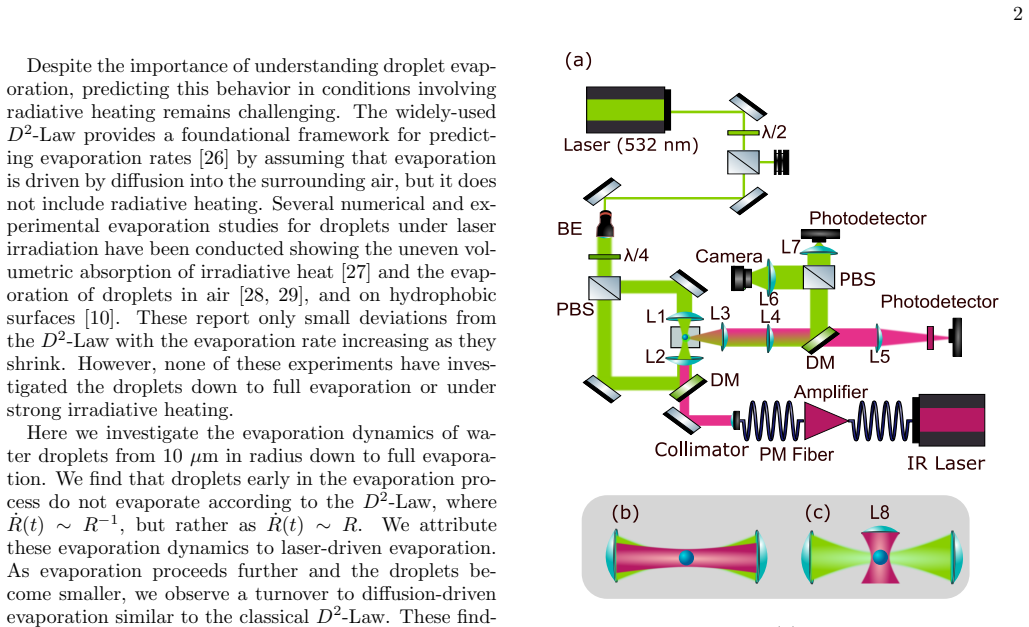
Summary. The paper reports experiments on water droplets of roughly 1–10 µm radius, optically trapped in a counter-propagating 532 nm trap and evaporating into a humid chamber, with optional additional heating by a 1550 nm IR laser. Evaporation rates are measured from the timing of Fano-comb resonances in the 90° scattering, using a fixed radius change between resonances of ΔR = 68.5 nm. A first-principles heat-balance model in Sec. III.B predicts that strong IR irradiation makes the evaporation rate scale as dR/dt ~ R, i.e., opposite to the classical D2-law's R^{-1}. The data show such an R-scaling for the early, larger-droplet stage, followed by a bend at radii of 2–3 µm, which the authors interpret as a turnover back to diffusion-driven, D2-law evaporation. The paper also reports a t^{-2/3} evaporation law in the absence of IR heating, which it attributes to heating by the 532 nm trapping beam.
Significance. The central observation — that strong radiative heating can produce an evaporation regime with dR/dt ~ R rather than the D2-law's R^{-1} — is physically interesting and relevant to combustion and aerosol applications. The experimental setup is a genuine advance: it traps pure water droplets down to full evaporation, without added solutes, and the Fano-comb method gives high sampling rates. A particular strength is that the irradiation-driven term in Sec. III.B is derived analytically and does not depend on the experimental fits, so the early-stage R-scaling is a concrete falsifiable prediction. The time-resolved correlation between Mie resonances and evaporation-rate spikes in Sec. IV.D is also a nice direct observation. However, the claim that the post-turnover branch is 'diffusion-driven' in the classical D2-law sense is undermined by the paper's own no-IR baseline, which follows t^{-2/3} (i.e., dR/dt ~ R^{-2}) rather than the D2-law's R^{-1}. This inconsistency, together with the unquantified assumption of a constant ΔR, means the two-regime interpretation needs substantial revision before the conclusions can be accepted.
major comments (3)
- [Sec. IV.A, Eq. (13); Sec. IV.C, Fig. 4] The post-turnover branch is identified as diffusion-driven D2-law evaporation, but the paper's own baseline contradicts this. In Sec. IV.A the no-IR evaporation rate is fitted as dR/dt = B(t')^{-2/3} (Eq. 13), which integrates to R ∝ (t')^{1/3} and is equivalent to dR/dt ∝ R^{-2}, not the D2-law's R^{-1}. The authors explicitly attribute this t^{-2/3} law to trapping-laser heating. In Sec. IV.B and Fig. 3(d–g), the late-stage rates of the IR-irradiated droplets are stated to 'tend toward' exactly this same t^{-2/3} baseline. Therefore the bend shown in Fig. 4 is more naturally a return to the trap-heating-dominated branch, not to classical diffusion. The linear-combination fit in Fig. 4 uses a D2-law term βK/(8R) from Eq. 3; a 1/R term cannot reproduce a 1/R^2 tail, so either the fit residuals must be large at small R or the displayed data do not actually follow the D2 law. Since the abstract's central claim depends on the second regime being 'diffusion-driven', this is a load-bearing inconsistency. I request a quantitative re-analysis: fit the late-stage data to dR/dt = C R^{-2} + D R (or an equivalent trap-heating + IR-heating model), compare residuals with the current βK/(8R) + linear-in-R model, and revise the interpretation accordingly. Note also that β is a fitted multiplier that increases with IR intensity (Sec. IV.C), so the 'diffusion' branch amplitude is not predicted from first principles.
- [Sec. II.B, Eq. (1)] All measured evaporation rates are computed as dR/dt = ΔR/Δt with a fixed ΔR = 68.5 nm, but Fig. 2(b) shows that the exact radius change between dominant resonances varies with droplet size, particularly across different combs and at small radii. If ΔR(R) is not actually constant, the conversion from resonance period to evaporation rate introduces a systematic distortion of the dR/dt versus R curve. This could shift the apparent turnover radius or modify the measured exponents. The paper reports only the mean and standard deviation of ΔR. Please provide a sensitivity analysis using the exact Mie-scattering ΔR(R) relation for the relevant size range, or at least quantify how much ΔR deviates from 68.5 nm between R = 2 µm and R = 10 µm, and show that the extracted power-law slopes and turnover position are robust to this variation.
- [Sec. III.B, Eqs. (10)–(12)] There is a text/equation inconsistency in the definition of Adroplet. The text introducing Eq. (10) says Adroplet is the droplet cross-sectional area, but one line later states 'Adroplet = 4πR^2' (a surface area), and Eq. (11) then uses πR^2. If the surface area were used, Eq. (12) would acquire an extra factor of 4. The final expression in Eq. (12) is consistent with using the cross-sectional area πR^2, so this appears to be a typo, but it must be corrected so the derivation is unambiguous and reproducible.
minor comments (3)
- [Sec. IV.A, text vs. Fig. 3 caption] The text says the best-fit curve in Fig. 3(b) is for 'all 9 droplets together', while the caption says 'ten separate droplets'. Please correct this numerical mismatch.
- [Sec. II.A] The chamber relative humidity is reported as 98 ± 3%, which is very close to saturation. The paper would benefit from a brief statement of how rapid complete evaporation is nevertheless achieved under these conditions (e.g., droplet heating by the trap raising the surface temperature).
- [Fig. 4] The figure legend uses dashed lines for both the irradiation-driven (magenta) and diffusion-driven (blue) references, and the black fit line is described in the text. Please make the line styles and labels more distinct, and state in the caption how β and the irradiation coefficient are obtained from the fits.
Circularity Check
Turnover to diffusion-driven evaporation is a fitted input: the D2 term is added by hand and β adjusted, while the paper's own no-IR baseline contradicts D2.
-
fitted input called prediction
[Sec. IV.B and IV.C, Figs. 3(d-g) and 4; Eq. (13) vs. Eq. (3)]
"Fig. 4 shows our model of this turnover where we use a linear combination of the terms in Eq. 3 and Eq. 12. We observe that the coefficient for the D2-Law term, β, in this combination must increase with higher IR irradiation to match the experimental data. [...] The constants related to each power law are βK and −(Ptrapγtrap + PIRγIR)/4AbeamρlL, where β is a fitting constant that accounts for droplet heating in the diffusion-driven regime."
The post-turnover branch is not an independently measured power law but the D2 term inserted by hand into the fitting function. Since Eq. 3 is dR/dt = −K/(8R), the linear combination in Fig. 4 forces the small-R tail to scale as R^{-1}; the claimed 'diffusion-driven' regime is therefore an input to the fit, not a prediction from the data. The fitted β is adjusted to match the curves, so the turnover radius and the apparent return to D2 are products of the chosen fitting form. Independently, the paper's own no-IR baseline (Eq. 13: dR/dt = B t'^{-2/3}) with R ∼ t'^{1/3} (Fig. 3c) gives dR/dt ∝ R^{-2}, not the D2 R^{-1}; thus the late-stage data are not classical diffusion even by the authors' own measurement.
full rationale
The irradiation-driven branch is derived from a heat-balance model (Eqs. 6-12) with the absorption efficiency qabs = γR taken from Bohren and Huffman; this part does not depend on the experimental fit and is not circular. The measured dR/dt ∼ R at early times is an independent empirical observation compared against that theory. The circularity burden arises only in the claimed turnover to diffusion-driven evaporation: the fitting model in Fig. 4 explicitly includes Eq. 3 (D2-law, dR/dt ∝ R^{-1}) as one of two terms, and the coefficient β is a fitting constant. Consequently, the conclusion that small droplets return to D2 scaling is built into the fitting function rather than extracted from the data. This is aggravated by the paper's own no-IR baseline, which follows dR/dt = B t'^{-2/3} (Eq. 13), equivalent to dR/dt ∝ R^{-2}—not the D2-law R^{-1} that the fit assumes. The self-citation to Fano combs [32] is not load-bearing here because the method is also supported by the paper's own Mie simulations and standard scattering theory. No other circular steps were found. Overall score 5: the central irradiation scaling has independent content, but the post-turnover 'diffusion-driven' conclusion is substantially a fitted input.
Assumptions & free parameters
free parameters (2)
- β (diffusion-term multiplier) =
not stated; increases with IR level
- B (baseline t^{-2/3} amplitude) =
not stated
assumptions (4)
- domain assumption Steady-state heat balance: all absorbed laser power is lost via evaporation; convective and radiative losses negligible.
- standard math Mie absorption efficiency in the geometric-optics limit is qabs = γR.
- domain assumption The radius change between successive Mie resonances is constant at 68.5 nm over the whole evaporation.
- ad hoc to paper The diffusion-limited branch follows the classical D2-law with a constant multiplier β, despite the no-IR baseline following t^{-2/3}.
Cite this review
Pith. "Pith review of Irradiation-driven Evaporation of Micro Droplets in an Optical Trap." pith.science (2026). https://pith.science/paper/NGWVNHHR
@misc{pith2026241210784,
  author       = {Pith},
  title        = {Pith review of: Irradiation-driven Evaporation of Micro Droplets in an Optical Trap},
  year         = {2026},
  howpublished = {\url{https://pith.science/paper/NGWVNHHR}},
  note         = {Machine review of arXiv:2412.10784}
}
abstract
Small droplets are irradiated with visible and infrared light in many natural and industrial environments. One of the simplest ways to describe their evaporation is the D$^2$-Law. It states that the evaporation rate is proportional to $t^{-1/2}$, and $R^{-1}$. However, models like the D$^2$-Law do not account for the volumetric heating of light and the effect of strong irradiation on individual droplets is not fully understood. Here we show the effects of IR irradiation on optically levitated water droplets. We find that, under strong irradiation of up to $10^8 W/m^2$, the droplet evaporation is initially driven by the heat from the laser following the power law $dR / dt \sim R$, i.e. the inverse of the D$^2$-Law. Then, when the droplets shrink to 2 - 3 $\mu$m in radius a turnover occurs from irradiation-driven back to diffusion-driven evaporation. Our findings support the understanding of droplet evaporation in cases such as rocket engines or internal combustion, where the radiation from the flame will heat water and fuel droplets.
Figures


Figures from the paper (2 more)


Reference graph
Works this paper leans on
-
[1]
Pharmaceutical particle engineering via spray drying
Reinhard Vehring. Pharmaceutical particle engineering via spray drying. Pharmaceutical Research, 25(5):999– 1022, 2008
work page 2008
-
[2]
Droplet evaporation study applied to dna chip manufac- turing
Vincent Dugas, J´ erˆ ome Broutin, and Eliane Souteyrand. Droplet evaporation study applied to dna chip manufac- turing. Langmuir, 21(20):9130–9136, 2005
work page 2005
-
[3]
Irradiation-driven Evaporation of Micro Droplets in an Optical Trap
in combustion, where atomized fuel droplets are stud- ied using optical diagnostics like LIF (Laser-Induced Flu- orescence). To study the evaporation of individual droplets, many studies have relied on methods such as free-falling droplets [9], sessile droplets on flat surfaces [10], and fiber-based studies [11]. However, falling droplets induce convectiv...
work page Pith review arXiv 2024
-
[4]
Samir Chandra Ray, Safiullah, Shinichiro Naito, Mats Andersson, Keiya Nishida, and Yoichi Ogata. Evaluation of vaporizing diesel spray with high-speed laser absorp- tion scattering technique for measuring vapor and liq- uid phase concentration distributions. Fuels, 4(1):75–91, 2023
work page 2023
-
[5]
Evaporation and combustion of a fuel droplet
S Kotake and T Okazaki. Evaporation and combustion of a fuel droplet. International Journal of Heat and Mass Transfer, 12(5):595–609, 1969
work page 1969
-
[6]
Water droplet evapora- tion in atmospheric air stream
Kutbay Sezen and Afsin Gungor. Water droplet evapora- tion in atmospheric air stream. Physics of Fluids, 35(1), 2023
work page 2023
-
[7]
Khellil Sefiane. On the formation of regular patterns from drying droplets and their potential use for bio-medical applications. Journal of Bionic Engineering, 7:S82–S93, 2010
work page 2010
-
[8]
Analysis on roles of thermal radiation to evaporation and combus- tion of fuel droplets
Busheng Wang, Yimin Xuan, and Xingsi Han. Analysis on roles of thermal radiation to evaporation and combus- tion of fuel droplets. International Journal of Thermal Sciences, 191:108306, 2023
work page 2023
Show all 40 references
-
[9]
Aerosol–cloud impacts on aerosol detrainment and rainout in shallow maritime tropical clouds
Gabrielle R Leung, Stephen M Saleeby, G Alexander Sokolowsky, Sean W Freeman, and Susan C van den Heever. Aerosol–cloud impacts on aerosol detrainment and rainout in shallow maritime tropical clouds. Atmo- spheric Chemistry and Physics, 23(9):5263–5278, 2023
2023
-
[10]
Evapo- rating falling drop
Manoj Kumar Tripathi and Kirti Chandra Sahu. Evapo- rating falling drop. Procedia IUTAM, 15:201–206, 2015
2015
-
[11]
Ir laser caused droplet evaporation on the hydrophobic sur- face
Long Jiao, Rong Chen, Xun Zhu, and Qiang Liao. Ir laser caused droplet evaporation on the hydrophobic sur- face. International Journal of Heat and Mass Transfer, 94:180–190, 2016
2016
-
[12]
Evaporation of drops on two paral- lel fibers: Influence of the liquid morphology and fiber elasticity
Camille Duprat, Alison D Bick, Patrick B Warren, and Howard A Stone. Evaporation of drops on two paral- lel fibers: Influence of the liquid morphology and fiber elasticity. Langmuir, 29(25):7857–7863, 2013
2013
-
[13]
Convective flows in evaporating sessile droplets
Meysam R Barmi and Carl D Meinhart. Convective flows in evaporating sessile droplets. The Journal of Physical Chemistry B, 118(9):2414–2421, 2014
2014
-
[14]
Electrostatic tweezer for droplet manip- ulation
Yuankai Jin, Wanghuai Xu, Huanhuan Zhang, Ruirui Li, Jing Sun, Siyan Yang, Minjie Liu, Haiyang Mao, and Zuankai Wang. Electrostatic tweezer for droplet manip- ulation. Proceedings of the National Academy of Sciences, 119(2):e2105459119, 2022
2022
-
[15]
Evaporation of pure liquid droplets: Comparison of droplet evapora- tion in an acoustic field versus glass-filament
Belal Ali Al Zaitone and Cameron Tropea. Evaporation of pure liquid droplets: Comparison of droplet evapora- tion in an acoustic field versus glass-filament. Chemical Engineering Science, 66(17):3914–3921, 2011
2011
-
[16]
Inves- tigation of the evolution of charged water droplets in the electrodynamic trap
Daniel Jakubczyk, Marcin Zientara, Gennadij Derka- chov, Krystyna Kolwas, and Maciej Kolwas. Inves- tigation of the evolution of charged water droplets in the electrodynamic trap. In Tenth Joint Inter- national Symposium on Atmospheric and Ocean Op- tics/Atmospheric Physics. P...
2004
-
[17]
Charge limits on droplets during evaporation
Kuo-Yen Li, Haohua Tu, and Asit K Ray. Charge limits on droplets during evaporation. Langmuir, 21(9):3786– 3794, 2005
2005
-
[18]
The evaporation ki- netics of pure water droplets at varying drying rates and the use of evaporation rates to infer the gas phase rel- ative humidity
Yong-yang Su, Rachael EH Miles, Zhi-ming Li, Jonathan P Reid, and Jiang Xu. The evaporation ki- netics of pure water droplets at varying drying rates and the use of evaporation rates to infer the gas phase rel- ative humidity. Physical Chemistry Chemical Physics, 20(36):23453–...
2018
-
[19]
Identifying time-dependent changes in the morphology of an individual aerosol parti- cle from its light scattering pattern
Allen Haddrell, Grazia Rovelli, David Lewis, Tanya Church, and Jonathan Reid. Identifying time-dependent changes in the morphology of an individual aerosol parti- cle from its light scattering pattern. Aerosol Science and Technology, 53(11):1334–1351, 2019
2019
-
[20]
Dynamics of an acoustically levitated particle using the lattice boltzmann method
G Barrios and R Rechtman. Dynamics of an acoustically levitated particle using the lattice boltzmann method. Journal of Fluid Mechanics, 596:191–200, 2008
2008
-
[21]
Position clamping in a holographic counterprop- agating optical trap
Richard Bowman, Alexander Jesacher, Gregor Thalham- mer, Graham Gibson, Monika Ritsch-Marte, and Miles 9 Padgett. Position clamping in a holographic counterprop- agating optical trap. Optics express, 19(10):9908–9914, 2011
2011
-
[22]
Measuring evapo- ration rates of laser-trapped droplets by use of fluores- cent morphology-dependent resonances
Robert Pastel and Allan Struthers. Measuring evapo- ration rates of laser-trapped droplets by use of fluores- cent morphology-dependent resonances. Applied Optics, 40(15):2510–2514, 2001
2001
-
[23]
Measuring the size and complex refractive index of an aqueous aerosol particle using electromagnetic heating and cavity- enhanced raman scattering
Aidan Rafferty and Thomas C Preston. Measuring the size and complex refractive index of an aqueous aerosol particle using electromagnetic heating and cavity- enhanced raman scattering. Physical Chemistry Chemi- cal Physics, 20(25):17038–17047, 2018
2018
-
[24]
Retrieval of the complex re- fractive index of aerosol droplets from optical tweezers measurements
Rachael EH Miles, Jim S Walker, Daniel R Burnham, and Jonathan P Reid. Retrieval of the complex re- fractive index of aerosol droplets from optical tweezers measurements. Physical Chemistry Chemical Physics, 14(9):3037–3047, 2012
2012
-
[25]
Shining new light on the kinetics of wa- ter uptake by organic aerosol particles
Matus E Diveky, Michael J Gleichweit, Sandra Roy, and Ruth Signorell. Shining new light on the kinetics of wa- ter uptake by organic aerosol particles. The Journal of Physical Chemistry A, 125(17):3528–3548, 2021
2021
-
[26]
Trapping po- sitions in a dual-beam optical trap
Aidan Rafferty and Thomas C Preston. Trapping po- sitions in a dual-beam optical trap. Journal of Applied Physics, 130(18), 2021
2021
-
[27]
Revisiting d2-law for the evaporation of dilute droplets
Federico Dalla Barba, Jietuo Wang, and Francesco Pi- cano. Revisiting d2-law for the evaporation of dilute droplets. Physics of Fluids, 33(5), 2021
2021
-
[28]
Absorption of thermal radiation in a semi-transparent spherical droplet: a simplified model
Leonid Dombrovsky and Sergei Sazhin. Absorption of thermal radiation in a semi-transparent spherical droplet: a simplified model. International Journal of Heat and Fluid Flow, 24(6):919–927, 2003
2003
-
[29]
Numerical modeling of laser heating and evaporation of a single droplet
Sagar Pokharel, Albina Tropina, and Mikhail Shneider. Numerical modeling of laser heating and evaporation of a single droplet. Energies, 16(1):388, 2022
2022
-
[30]
Thermal radiative transfer characteristics of a single wa- ter droplet
Dan Zhang, Maoping Tu, Yang Yuan, and Wei Han. Thermal radiative transfer characteristics of a single wa- ter droplet. International Journal of Heat and Mass Transfer, 219:124824, 2024
2024
-
[31]
F. K. A. Gregson, J. F. Robinson, R. E. H. Miles, C. P. Royall, and J. P. Reid. Drying kinetics of salt solution droplets: Water evaporation rates and crystallization. The Journal of Physical Chemistry B, 123(1):266–276, 2019
2019
-
[32]
Linear refractive index and absorption measurements of nonlinear optical liquids in the visible and near-infrared spectral region
Stefan Kedenburg, Marius Vieweg, Timo Gissibl, and Harald Giessen. Linear refractive index and absorption measurements of nonlinear optical liquids in the visible and near-infrared spectral region. Optical Materials Ex- press, 2(11):1588–1611, 2012
2012
-
[33]
Fano combs in the direc- tional mie scattering of a water droplet
Javier Tello Marmolejo, Adriana Canales, Dag Hanstorp, and Ricardo M´ endez-Fragoso. Fano combs in the direc- tional mie scattering of a water droplet. Physical Review Letters, 130(4):043804, 2023
2023
-
[34]
Taflin, S
Daniel C. Taflin, S. H. Zhang, Theresa Allen, and E. James Davis. Measurement of droplet interfacial phe- nomena by light-scattering techniques. AIChE Journal, 34(8):1310–1320, 1988
1988
-
[35]
Roekaerts
Dirk J.E.M. Roekaerts. Transfer, chapter 4, pages 97–
-
[36]
Bohren and Donald R
Craig F. Bohren and Donald R. Huffman. Absorption and Scattering of Light by Small Particles. Wiley Science Series. Wiley, 2008
2008
-
[37]
C.K. Law. Recent advances in droplet vaporization and combustion. Progress in Energy and Combustion Science, 8(3):171–201, 1982
1982
-
[38]
Direct numerical simulation of an evaporating tur- bulent diluted jet-spray at moderate reynolds number
Jietuo Wang, Federico Dalla Barba, and Francesco Pi- cano. Direct numerical simulation of an evaporating tur- bulent diluted jet-spray at moderate reynolds number. International Journal of Multiphase Flow, 137:103567, 2021
2021
-
[39]
See Supplemental Material at [URL will be inserted by publisher] including reference [38]
-
[128]
John Wiley I& Sons, Ltd, 2014
2014
Reviewed August 11, 2026 · model on record in the stance chip above.
Discussion (0). Continue with ORCID to comment.