REVIEW 3 major objections 6 minor 20 references
Generative Modeling with Diffusion
T0 review · 3 major / 6 minor · reviewed 2026-08-11 · deepseek-v4-flash
Pith's one-line read This paper derives diffusion models from the Ornstein-Uhlenbeck SDE and shows that augmenting imbalanced credit-card fraud data with generated samples improves classifier recall while lowering precision.
desk verdict A clean but unoriginal diffusion tutorial whose only empirical claim is a single-run anecdote within the noise floor. read the letter →
The pith
A machine-rendered reading of the paper's core claim, the machinery that carries it, and where it could break.
The reading
What carries the argument
The load-bearing object is the forward process defined by the Ornstein-Uhlenbeck equation $dX_t = -X_t\,dt + \sqrt{2}\,dB_t$ and its discretized transition $X_{n+1} = \gamma(\Delta t_{n+1}) X_n + \beta(\Delta t_{n+1}) Z_{n+1}$, with $\gamma(t)=e^{-t}$ and $\beta(t)=\sqrt{1-e^{-2t}}$. This transition makes the forward process a continuous, exponentially fast route from data to a standard normal. The reverse machinery is Proposition 2.3, which turns the inversion into a Gaussian conditional density whose mean is the only place where information about the original data appears, and Algorithm 3.1, which trains a network to supply that mean by predicting the noise $\epsilon_0$ rather than the data point itself. The variance $\sigma_n^2 = \frac{\beta(\Delta t_{n+1})^2 \beta_n^2}{\beta_{n+1}^2}$ is known analytically, so generation is just sampling from normals with a learned mean.
What would settle it
Train the model with Algorithm 3.1, generate synthetic fraud points with Algorithm 3.2, and then train the same classifiers on only the synthetic points and evaluate on the real test set; if the synthetic-only classifiers cannot approach the recall and precision of classifiers trained on real fraud data, the generated samples do not mimic the fraud distribution and the empirical claim collapses.
Extended reading notes
Core claim
On the paper's own terms, the central claim is that the discretized reverse diffusion process is exactly a chain of Gaussian steps: given the initial point $x_0$ and the next noisy point $x_{n+1}$, the previous point $x_n$ is normal with mean $\mu = \frac{\gamma(\Delta t_{n+1})\beta_n^2}{\beta_{n+1}^2} x_{n+1} + \frac{\gamma_n \beta(\Delta t_{n+1})^2}{\beta_{n+1}^2} x_0$ and a variance that depends only on time. Since $x_0$ is unknown at generation time, the paper trains a network $\epsilon_\theta(x_{n+1}, t_{n+1})$ to predict the noise $\epsilon_0$ that transforms $x_0$ into $x_{n+1}$, and uses that prediction in place of $x_0$ in the mean. The reported empirical discovery is that this pipeline, applied to fraudulent credit-card transactions, improves test-set recall from $0.8265$ to $0.8469$ for XGBoost and from $0.8163$ to $0.8776$ for Random Forest, while precision falls from $0.8901$ to $0.8737$ and from $0.9524$ to $0.9053$ respectively. The paper reads this as a useful tradeoff for problems where missing the minority class is expensive.
Load-bearing premise
The load-bearing premise is that a network trained to predict the noise on forward trajectories that begin from real data will also predict it correctly when the reverse process starts from pure Gaussian noise, so that the learned estimate can stand in for the unknown $x_0$ in the reverse mean.
Editorial extensions
If this is right
- A classifier trained with diffusion-augmented minority-class data can detect more fraudulent transactions, provided the user accepts a higher rate of false alarms.
- The time-discretization scheme in Appendix B, which places more diffusion steps where the drift is strongest, is claimed to produce synthetic data more faithful to the original sample than uniform time steps.
- Because the reverse mean is the only learned quantity, the algorithm can be adapted to other minority classes without changing the forward process.
- The paper's conclusion suggests a decision rule: diffusion augmentation is advantageous when the cost of missing a rare positive case outweighs the cost of extra false positives.
Reading between the lines
- Implicit in the reported numbers: the synthetic samples improve recall but not precision, which suggests they are being placed near the classifier boundary; an obvious follow-up is to sweep the number of synthetic points per real fraud case and plot the precision-recall tradeoff.
- The same forward and reverse construction is dimension-agnostic, so the most direct test of the empirical claim is to rerun the augmentation on other imbalanced tabular datasets and check whether the recall gain reproduces.
- One can isolate the weakest point directly by checking whether the learned noise predictor stays calibrated when denoising from pure Gaussian noise; if it does not, the reverse chain drifts away from the fraud distribution even if end-to-end classifier metrics happen to move favorably.
Editorial analysis
A structured set of objections, weighed in public.
Referee Report
Summary. The paper gives a self-contained introduction to diffusion models based on the Ornstein-Uhlenbeck SDE. It derives the continuous forward process, the discretized reverse conditional in Proposition 2.3, and presents training and generation schemes via noise prediction in Algorithms 3.1 and 3.2. It then applies the generator to the Kaggle credit-card fraud dataset by augmenting the minority class and reports precision/recall for XGBoost and random forest in Tables 1 and 2. The closing claim in Section 5 is that diffusion augmentation improves fraud recall for both classifiers at the cost of precision.
Significance. The mathematical core is standard but clearly and correctly presented, with a full proof of the reverse conditional in Appendix C and reproducible algorithms; this would be a useful expository reference for students. The application idea is timely, but the empirical evidence as reported is far too thin to support the claimed improvement: there is a single split, no error bars, no baselines, and no hyperparameter reporting. If the experiments were properly repeated and compared with standard augmentation baselines, the paper could be a valuable case study; as it stands, the central empirical assertion in Section 5 is unverified. No circularity appears in the derivation: the noise target in Eq. (3.5) is defined from the forward process, and Algorithm 3.2 uses the same estimate during generation.
major comments (3)
- [Section 5, Tables 1 and 2] The central claim that diffusion augmentation improves recall is not established by the reported evidence. The tables report one train/test split with no repeated runs, no confidence intervals, no random seeds, no classifier hyperparameters, and no statement of how many synthetic samples were added. With only 492 fraudulent transactions, a typical 80/20 split leaves roughly 98 fraud cases in the test set; the XGBoost recall increase from 0.8265 to 0.8469 corresponds to about two additional true positives, and the random-forest increase from 0.8163 to 0.8776 to about six. These differences are within the range of split-to-split and initialization variation, so the tables cannot distinguish an actual improvement from sampling noise. The authors should report means and standard deviations over multiple seeds and splits, fix and state the decision threshold, and include at least one standard baseline such as SMOTE or class weighting to isolate the diffusion-specific contribution.
- [Appendix B, Algorithm B.1] The time-discretization formula in line 4 of Algorithm B.1 does not match the definition of beta_n in Eq. (2.5). Since beta_n = sqrt(1 - e^{-2 t_n}), the correct relation is t_n = -(1/2) log(1 - beta_n^2), and Delta t_n should be the difference t_n - t_{n-1}. The formula as written, Delta t_n = -(1/2) log(1 - beta_n), gives a schedule inconsistent with the forward transition in Corollary 2.2. This is a load-bearing reproducibility issue because any implementation based on the printed formula will train on a different noise schedule than the one used in the derivation; the authors should correct it and confirm that the published code uses the corrected version.
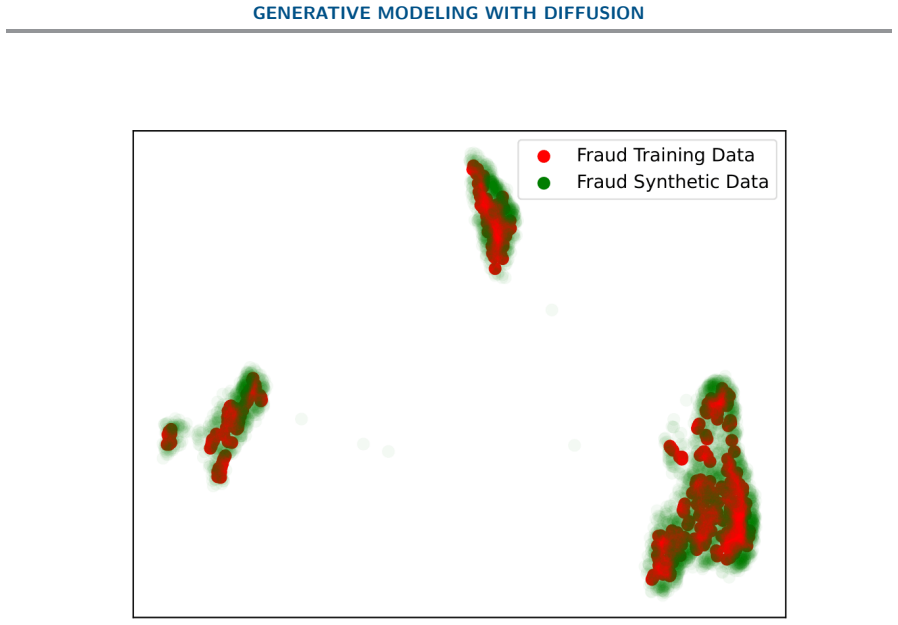
- [Section 3.3, Algorithm 3.2] The paper does not address the distribution shift between training and generation. The network in Algorithm 3.1 is trained on input-target pairs (x_{n+1}, epsilon_0) obtained by forward-noising real fraud points from known x_0, whereas Algorithm 3.2 evaluates it on trajectories starting from pure noise x_N ~ N(0,I). Because the generated samples are the basis of the augmentation experiment, the paper should provide at least one quantitative check that the synthetic fraud distribution matches the real one, such as a two-sample test or a comparison of summary statistics, rather than relying only on the qualitative UMAP plot in Figure 5.
minor comments (6)
- [Eq. (2.2)] Equation (2.2) contains a doubled plus sign in the stochastic integral term: 'X_t = e^{-t} X_0 + + sqrt{2} ...' should read 'X_t = e^{-t} X_0 + sqrt{2} ...'.
- [Section 4] The text refers to 'Table 2 and Table 3' for the classifier results, but the displayed tables are numbered Table 1 and Table 2.
- [Section 5] The closing paragraph ends with an incomplete sentence: 'Such an approach would' is followed by no continuation.
- [Appendix C] In the proof of Proposition 2.3, the phrase 'the joint density rho(x_{n+1} | x_0)' should be 'the conditional density'; the denominator is constant with respect to x_n, not a joint density.
- [Tables 1 and 2] Precision and recall for the credit-card classifier are threshold-dependent, but the decision threshold used to produce Tables 1 and 2 is not stated; this should be reported for reproducibility.
- [Figure 5] The UMAP plot would benefit from axis labels and a legend distinguishing original fraud points from synthetic fraud points.
Circularity Check
No circular reasoning found; the mathematical derivation is self-contained and the empirical claim is a held-out measurement, not a fitted prediction.
full rationale
The paper's mathematical chain is self-contained: the forward process is defined by the OU SDE (2.1), the solution (2.6) is derived using Itô integration cited to an external textbook [5], and the reverse conditional density (2.8)-(2.10) is proved in Appendix C via Bayes' theorem from the forward transition kernels, not assumed. The training target epsilon_0 is defined in Eq (3.5) by inverting the forward recursion, and the model is trained to minimize the MSE in Eq (3.6) against that target. Algorithm 3.2 then uses the same epsilon_theta to estimate the conditional mean (3.4) during generation; this is the standard DDPM construction, and no 'prediction' is obtained by re-substituting the fitted quantity. The Section 5 claim that augmentation improved recall is an empirical measurement on a held-out test set after training a diffusion model only on the training-class fraud data; no parameter is fit to the test labels, so the augmented-classifier result does not reduce by construction to the diffusion model's own training objective. The absence of error bars, multiple seeds, or a SMOTE/class-weighting baseline is a statistical robustness limitation, not circularity. There are no load-bearing self-citations: the references are to external standard works (e.g., [7], [16], [5], [13]), and no uniqueness theorem is invoked to force the chosen formulation. The manuscript does contain an incomplete final sentence ('Such an approach would') and an unsupported assertion about uniform time steps in Appendix B, but neither functions as a circular premise in the derivation.
Assumptions & free parameters
free parameters (3)
- Diffusion model hyperparameters (N, beta_1, beta_N, network architecture, training steps, learning rate) =
not reported
- Number of synthetic fraud samples generated for augmentation =
not reported
- Classifier hyperparameters for XGBoost and Random Forest =
not reported
assumptions (6)
- standard math The Ito integral is well-defined and the Ito isometry in Lemma A.1 holds.
- domain assumption The forward process is the variance-preserving OU SDE dX_t = -X_t dt + sqrt(2) dB_t, and X_t converges to N(0,I).
- standard math The discretized reverse conditional density is Gaussian and can be obtained by Bayes' theorem with known x0 (Proposition 2.3).
- domain assumption A neural network can learn the map (x_{n+1}, t_{n+1}) -> epsilon_0 sufficiently well to generate faithful samples.
- domain assumption The finite horizon N and t_N are chosen so that X_N is approximately standard normal.
- domain assumption Synthetic fraudulent transactions generated by the diffusion model follow the same distribution as real fraudulent transactions closely enough to improve classifier recall.
Cite this review
Pith. "Pith review of Generative Modeling with Diffusion." pith.science (2026). https://pith.science/paper/ZZ5M6CHN
@misc{pith2026241210948,
  author       = {Pith},
  title        = {Pith review of: Generative Modeling with Diffusion},
  year         = {2026},
  howpublished = {\url{https://pith.science/paper/ZZ5M6CHN}},
  note         = {Machine review of arXiv:2412.10948}
}
read the original abstract
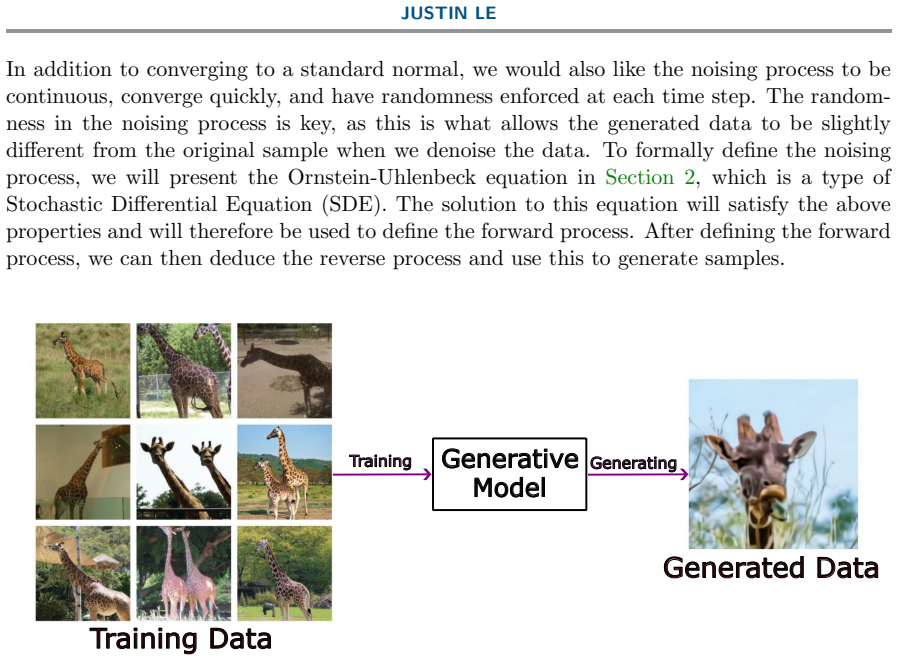
We provide an overview of the diffusion model as a method to generate new samples. Generative models have been recently adopted for tasks such as art generation (Stable Diffusion, Dall-E) and text generation (ChatGPT). Diffusion models in particular apply noise to sample data and then "reverse" this noising process to generate new samples. We will formally define these noising and denoising processes, then present algorithms to train and generate with a diffusion model. Afterward, we will explore a potential application of diffusion models in improving classifier performance on imbalanced data.
Figures


Figures from the paper (2 more)

Reference graph
Works this paper leans on
-
[1]
M. Armandpour, A. Sadeghian, H. Zheng, A. Sadeghian, and M. Zhou , Re-imagine the nega- tive prompt algorithm: Transform 2d diffusion into 3d, alleviate Janus problem and beyond , 2023, arXiv:2304.04968 [cs.CV]
arXiv 2023
-
[2]
T. Chen and C. Guestrin , Xgboost: A scalable tree boosting system , in Proceedings of the 22nd ACM SIGKDD International Conference on Knowledge Discovery and Data Mining, KDD ’16, New York, NY, USA, 2016, Association for Computing Machinery, p. 785–794, doi:10.1145/2939672.2939785, https://doi.org/10.1145/2939672.2939785
arXiv 2016
-
[3]
A. Dal Pozzolo, G. Boracchi, O. Caelen, C. Alippi, and G. Bontempi, Credit card fraud detection: A realistic modeling and a novel learning strategy, IEEE Trans. Neural Netw. Learn. Syst., PP (2017), pp. 1–14, doi:10.1109/TNNLS.2017.2736643
arXiv 2017
-
[4]
A. Dal Pozzolo, O. Caelen, Y.-A. Le Borgne, S. W aterschoot, and G. Bontempi , Learned lessons in credit card fraud detection from a practitioner perspective , Expert Syst. Appl., 41 (2014), p. 4915–4928, doi:10.1016/j.eswa.2014.02.026
-
[5]
Evans, An Introduction to Stochastic Differential Equations , American Mathematical Society, 2013
L. Evans, An Introduction to Stochastic Differential Equations , American Mathematical Society, 2013
work page 2013
-
[6]
I. Goodfellow, J. Pouget-Abadie, M. Mirza, B. Xu, D. W arde-F arley, S. Ozair, A. Courville, and Y. Bengio , Generative adversarial networks , Commun. ACM, 63 (2020), p. 139–144, doi:10. 1145/3422622, https://doi.org/10.1145/3422622
doi:10.1145/3422622 2020
-
[7]
J. Ho, A. Jain, and P. Abbeel, Denoising diffusion probabilistic models, in Advances in Neural Informa- tion Processing Systems, vol. 33, Curran Associates, Inc., 2020, pp. 6840–6851, https://proceedings. neurips.cc/paper files/paper/2020/file/4c5bcfec8584af0d967f1ab10179ca4b-Paper.pdf
work page 2020
-
[8]
T. K. Ho, Random decision forests, in Proceedings of 3rd International Conference on Document Analysis and Recognition, vol. 1, 1995, pp. 278–282 vol.1, doi:10.1109/ICDAR.1995.598994
arXiv 1995
Show all 20 references
-
[9]
Jiang, S
Y. Jiang, S. Chang, and Z. W ang , TransGAN: Two pure transformers can make one strong GAN, and that can scale up , in Advances in Neural Information Processing Systems, M. Ran- zato, A. Beygelzimer, Y. Dauphin, P. Liang, and J. W. Vaughan, eds., vol. 34, Curran As- sociates, ...
2021
-
[10]
P. D. Kingma and M. Welling , Auto-encoding variational Bayes, in Proceedings of 2nd International Conference on Learning Representations, 2014, arXiv:1312.6114 [stat.ML]
2014 arXiv
-
[11]
McInnes, J
L. McInnes, J. Healy, N. Saul, and L. Großberger , UMAP: Uniform manifold approximation and projection, J. Open Source Softw., 3 (2018), p. 861, doi:10.21105/joss.00861
2018 doi
-
[12]
Paszke, S
A. Paszke, S. Gross, F. Massa, A. Lerer, J. Bradbury, G. Chanan, T. Killeen, Z. Lin, N. Gimelshein, L. Antiga, A. Desmaison, A. Kopf, E. Yang, Z. DeVito, M. Raison, A. Te- jani, S. Chilamkurthy, B. Steiner, L. F ang, J. Bai, and S. Chintala, Pytorch: An imperative style, high-...
2019
-
[13]
Pedregosa, G
F. Pedregosa, G. V aroquaux, A. Gramfort, V. Michel, B. Thirion, O. Grisel, M. Blon- del, P. Prettenhofer, R. Weiss, V. Dubourg, J. V anderplas, A. Passos, D. Cournapeau, M. Brucher, M. Perrot, and E. Duchesnay, Scikit-learn: Machine learning in Python , J. Mach. 16 GENERATIVE...
2011
-
[14]
Radford, K
A. Radford, K. Narasimhan, T. Salimans, and I. Sutskever , Improving language understand- ing by generative pre-training, 2018, https://cdn.openai.com/research-covers/language-unsupervised/ language understanding paper.pdf
2018
-
[15]
Ramesh, M
A. Ramesh, M. Pavlov, G. Goh, S. Gray, C. Voss, A. Radford, M. Chen, and I. Sutskever , Zero-shot text-to-image generation , in Proceedings of the 38th International Conference on Machine Learning, M. Meila and T. Zhang, eds., vol. 139 of Proceedings of Machine Learning Resear...
2021
-
[16]
Sohl-Dickstein, E
J. Sohl-Dickstein, E. Weiss, N. Maheswaranathan, and S. Ganguli , Deep unsupervised learning using nonequilibrium thermodynamics, in International conference on machine learning, PMLR, 2015, pp. 2256–2265, https://proceedings.mlr.press/v37/sohl-dickstein15.html
2015
-
[17]
Thi´ery, Denoising diffusion probabilistic models (DDPM) , 2013, https://alexxthiery.github.io/notes/ DDPM/DDPM.html
A. Thi´ery, Denoising diffusion probabilistic models (DDPM) , 2013, https://alexxthiery.github.io/notes/ DDPM/DDPM.html
2013
-
[18]
V aswani, N
A. V aswani, N. Shazeer, N. Parmar, J. Uszkoreit, L. Jones, A. N. Gomez, L. u. Kaiser, and I. Polosukhin , Attention is all you need , in Advances in Neural Information Processing Systems, I. Guyon, U. V. Luxburg, S. Bengio, H. Wallach, R. Fergus, S. Vishwanathan, and R. Garne...
2017
-
[19]
W ang, C
K. W ang, C. Gou, Y. Duan, Y. Lin, X. Zheng, and F.-Y. W ang, Generative adversarial networks: introduction and outlook , IEEE/CAA J. Autom. Sin., 4 (2017), pp. 588–598, doi:10.1109/JAS.2017. 7510583
2017 doi
-
[20]
Y. Zhu, K. Zhang, J. Liang, J. Cao, B. Wen, R. Timofte, and L. V an Gool , Denoising diffusion models for plug-and-play image restoration, in Proceedings of the IEEE/CVF Conference on Computer Vision and Pattern Recognition (CVPR) Workshops, June 2023, pp. 1219–1229, arXiv:230...
2023 arXiv
Reviewed August 11, 2026 · model on record in the stance chip above.
Discussion (0). Continue with ORCID to comment.