REVIEW 4 major objections 5 minor 58 references
SHMT: Self-supervised Hierarchical Makeup Transfer via Latent Diffusion Models
T0 review · 4 major / 5 minor · reviewed 2026-08-11 · deepseek-v4-flash
Pith's one-line read SHMT transfers makeup with a self-supervised latent diffusion model, removing pseudo-paired data and beating seven baselines on realism and makeup fidelity.
desk verdict Self-supervised training without pseudo-pairs is a real departure, but the SOTA claim is undercut by metrics that reward copying reference identity; no identity metric is reported. read the letter →
The pith
A machine-rendered reading of the paper's core claim, the machinery that carries it, and where it could break.
The reading
What carries the argument
The load-bearing mechanism is a 'decoupling-and-reconstruction' pipeline built on a latent diffusion model. A pretrained face parser separates background from foreground; the makeup representation is produced by randomly cropping, rotating, and elastically distorting the foreground, on the premise that these transformations destroy identity and geometry while preserving cosmetic color and texture. The content representation is the combination of a 3D face shape from a face-reconstruction model and one level of a Laplacian pyramid, a multi-scale decomposition of an image into successively coarser high-frequency bands, computed on the grayscale foreground. Fine levels (h0) retain source details such as freckles and eyelashes, while coarse levels (h4) force the model to pull high-frequency makeup from the reference. At each denoising step, the Iterative Dual Alignment module computes a softmax correlation between content and makeup features, deforms the makeup latent with it, then blends in a second alignment computed between the noisy intermediate image and the makeup representation, with the blend weight predicted by a small MLP from the timestep; the mixed condition is injected into the U-Net encoder and the diffusion model is trained with the standard noise-prediction loss.
What would settle it
Compare the makeup representation extracted from an original foreground with the representation from its randomly distorted version on faces with strongly asymmetric makeup: if the distorted representation no longer encodes which eye carried the heavy shadow, or if the reconstruction drops that asymmetry, the self-supervised premise fails.
Extended reading notes
Core claim
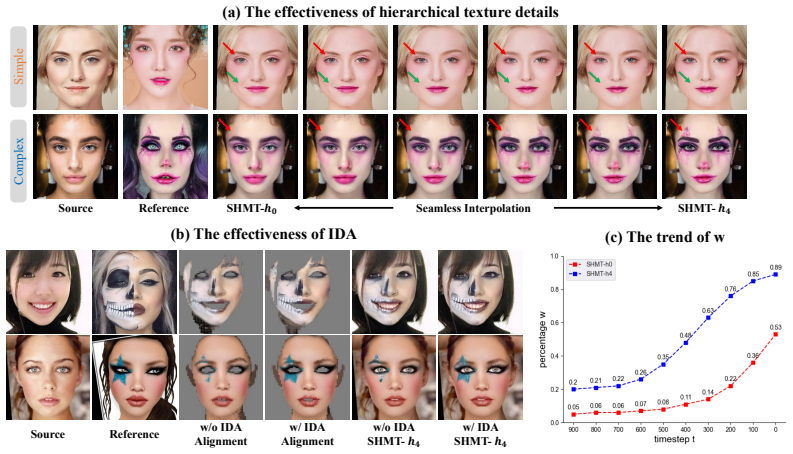
On the paper's own terms, SHMT establishes that high-fidelity makeup transfer can be learned entirely from single-image reconstruction rather than from synthesized source-reference pairs. The authors report that the variant SHMT-h4, which injects the coarsest Laplacian texture detail into the content representation, achieves the best FID and CLS values on the MT, Wild-MT, and LADN test sets, while SHMT-h0 achieves the best Key-sim, quantifying an explicit tradeoff between transferring the reference's makeup and preserving the source's content. An additional Iterative Dual Alignment module dynamically re-aligns the makeup feature against the noisy intermediate image at every denoising step, correcting the semantic alignment errors caused by the domain gap between content and makeup representations. The paper also demonstrates flexible controls: staggering SHMT-h0 and SHMT-h4 across denoising timesteps produces seamless interpolation, and mixing aligned makeup feature maps yields global or local makeup interpolation.
Load-bearing premise
Randomly cropping, rotating, and elastically warping a face erases its identity and geometry while leaving its makeup intact, and the pretrained face-parsing and 3D-reconstruction models used to separate content are accurate enough not to break the reconstruction.
Editorial extensions
If this is right
- Choosing texture level h0 preserves source details like freckles, eyelashes, and subtle expressions, while h4 reproduces heavy or high-frequency reference makeup; staggering the two models over denoising timesteps gives a seamless interpolation between those behaviors.
- The aligned makeup feature maps support global makeup interpolation between two reference faces and local interpolation restricted to lip or eye regions, with the source image serving as the neutral endpoint.
- Because IDA re-aligns against the noisy intermediate image, the model is robust to large differences in pose, expression, age, and gender between source and reference, and it generalizes to sketch and anime images outside its training distribution.
- The reported results imply that pseudo-paired data, however carefully synthesized, is not a necessary ingredient for makeup transfer; a reconstruction-only training objective can beat methods that invest in better pseudo-pair generation.
- Skin tone can be preserved by interpolating the makeup feature within the face region toward the source's own feature, with the interpolation weight at zero leaving the source skin unchanged.
Reading between the lines
- If random distortion truly cancels content while keeping makeup, the same decoupling recipe should transfer to other localized appearance edits without paired data, such as hair color changes, tattoos, or temporary age effects.
- The Laplacian level index acts as a continuous texture-transfer dial; a natural extension would be a single model conditioned on the level rather than one separately trained model per level.
- The failure mode the paper shows, face parsing labeling forehead makeup as hair, sets a ceiling on worst-case quality, suggesting that a makeup-aware segmentation module or learned foreground mask would improve robustness.
- IDA's timestep-dependent weighting learns when to trust the noisy intermediate image as an anchor; that principle could generalize to any diffusion conditioning task where the condition and the target come from different domains.
Signed reviews
Editorial analysis
A structured set of objections, weighed in public.
Referee Report
Summary. The paper proposes SHMT, a self-supervised makeup transfer method built on latent diffusion models. Following a decoupling-and-reconstruction paradigm, it extracts a content representation (3D face shape plus hierarchical texture details from a Laplacian pyramid) and a makeup representation (a spatially distorted foreground), then reconstructs the original image during training. At inference, the makeup representation comes from the reference image, and an Iterative Dual Alignment (IDA) module refines the injected condition at each denoising step. Experiments on MT, Wild-MT, and LADN report favorable FID, CLS, and Key-sim values against seven baselines, with ablations for the texture level and IDA. The code is publicly available.
Significance. If the central claims hold, the self-supervised paradigm is a relevant alternative to pseudo-paired training data for makeup transfer, and the hierarchical texture control is a useful capability that prior GAN-based methods lack. The paper provides a reasonable amount of ablative evidence (e.g., Table 3 shows IDA improves FID from 32.42 to 27.01 on LADN) and releases code, which supports reproducibility. However, the significance is tempered by the fact that the reported quantitative advantages depend on a non-standard FID usage and the absence of identity-controlled metrics, as detailed below.
major comments (4)
- [Sec. 4.2, Table 1] The central claim that SHMT-h4 achieves the highest FID and CLS may be confounded by reference-identity leakage. FID is computed between transferred results and reference images, and CLS is the cosine similarity of DINO CLS tokens between the same pairs. Since SHMT-h4 intentionally transfers high-frequency texture details from the reference foreground (Sec. 3.3 and Appendix A), the improved FID/CLS could reflect copying the reference face's identity, geometry, and skin texture rather than makeup fidelity per se. No identity-similarity metric between source and result (e.g., face-recognition cosine distance) is reported for any method, so the paper does not currently distinguish high-fidelity makeup transfer from a face-appearance-swap effect.
- [Sec. 3.3, 'Makeup Representation'] The load-bearing premise that random cropping, rotation, and elastic distortion of the foreground 'destroy content information' while 'retaining makeup information' is asserted but not demonstrated. No quantitative analysis shows that Im loses identity/geometry but preserves makeup attributes. During self-supervised training, Im is a distorted version of the same image the model must reconstruct, so the optimization does not force the network to separate makeup from skin albedo, illumination, pores, wrinkles, or identity-bearing facial texture. Without a direct evaluation of Im's content and makeup retention (e.g., face-recognition scores on Im and makeup-attribute classification), the decoupling claim is not established.
- [Sec. 4.2, Evaluation Metrics] The use of FID 'between reference images and transferred results' is non-standard and potentially misleading. FID is defined for two distributions; in this paper the reference set and the generated set are paired, and a low FID rewards any resemblance to the reference distribution, including identity and background transfer. The paper should justify this choice, and ideally supplement it with makeup-specific metrics (e.g., per-component makeup color statistics or a makeup-attribute classifier) to isolate makeup fidelity from global appearance matching.
- [Sec. 4.2, Table 1] No error bars, confidence intervals, or significance tests are reported for any metric. The metrics are computed on a random selection of 1000 source-reference pairs, and FID estimates are known to have nontrivial sampling variance. For instance, the CLS advantage of SHMT-h4 over Stable-Makeup on MT is 0.715 vs 0.682, but without variance estimates it is unclear whether such differences are stable across random subsets. Adding repeated evaluation with different seeds or bootstrapped intervals would strengthen the quantitative claims.
minor comments (5)
- [Sec. 4.1, Baselines] The baseline list says 'PSAGN [17]' but the cited work is PSGAN; please correct the typo.
- [Sec. 3.4, Eq. (2)] The notation fc(i) and fm(j) is not fully defined; please specify that i and j index spatial positions in the content and makeup feature maps, respectively.
- [Sec. 4.3, Figure 8(c)] The plot of w versus timestep t lacks axis labels and a legend for the two curves; adding these would improve readability.
- [Sec. 3.3, Implementation Details] The statement that the autoencoder with downsampling factor 4 'preserves texture details better' is not backed by a comparison; either provide a supporting ablation or soften the claim.
- [Appendix D, Limitations] The limitation regarding face parsing mislabeling forehead makeup as hair is clearly illustrated, but a short sentence on possible mitigations (e.g., retraining the parser on makeup images) would make the limitation more constructive.
Circularity Check
No circularity found: the SOTA claim rests on a self-supervised reconstruction loss and external benchmarks, not on fitted predictions or self-citation.
full rationale
The derivation chain is self-contained. Training optimizes the standard LDM loss (Eq. 1) to reconstruct the input from its own content representation (I3d, hi), background Ibg, and makeup representation Im obtained by random spatial distortion of the same foreground. This is a conventional self-supervised reconstruction objective: the network is trained to invert its own conditioning, not to match the test metrics. At inference, Im is simply replaced by the reference image; no test-set values enter training, and hyperparameters (τ=100, pyramid level h4, DDIM steps) are fixed choices, not fitted to FID/CLS. The only author self-citations (SSAT [36], SSAT++ [37]) appear in the related-work discussion and in the baseline list; they are not used to justify any premise of SHMT. The CLS/FID gains of SHMT-h4 are reported as empirical measurements from Table 1, and the trade-off with Key-sim is explicitly acknowledged (Sec. 4.2, Appendix A). While the assumption that spatial distortion retains makeup but suppresses content is an unproved premise (and the paper's own limitations show face-parsing failure modes), an unsupported premise is not circularity: no equation defines the desired FID/CLS result into the loss or the self-citation chain.
Assumptions & free parameters
free parameters (3)
- Softmax temperature tau =
100
- Laplacian pyramid level L =
4 (models for h0 to h4)
- Autoencoder downsampling factor =
4
assumptions (4)
- domain assumption The pretrained LDM autoencoder E,D provides a faithful latent space for 256x256 face reconstruction and transfer.
- domain assumption BiSeNet face parsing and 3DDFA-V2 produce sufficiently accurate masks and face shapes for the content representation.
- ad hoc to paper Random spatial transformations of the foreground remove identity and geometry information while preserving makeup information.
- domain assumption DINO CLS and Key-sim similarities are valid proxies for makeup fidelity and content preservation.
Cite this review
Pith. "Pith review of SHMT: Self-supervised Hierarchical Makeup Transfer via Latent Diffusion Models." pith.science (2026). https://pith.science/paper/TH3VYT5Q
@misc{pith2026241211058,
  author       = {Pith},
  title        = {Pith review of: SHMT: Self-supervised Hierarchical Makeup Transfer via Latent Diffusion Models},
  year         = {2026},
  howpublished = {\url{https://pith.science/paper/TH3VYT5Q}},
  note         = {Machine review of arXiv:2412.11058}
}
read the original abstract
This paper studies the challenging task of makeup transfer, which aims to apply diverse makeup styles precisely and naturally to a given facial image. Due to the absence of paired data, current methods typically synthesize sub-optimal pseudo ground truths to guide the model training, resulting in low makeup fidelity. Additionally, different makeup styles generally have varying effects on the person face, but existing methods struggle to deal with this diversity. To address these issues, we propose a novel Self-supervised Hierarchical Makeup Transfer (SHMT) method via latent diffusion models. Following a "decoupling-and-reconstruction" paradigm, SHMT works in a self-supervised manner, freeing itself from the misguidance of imprecise pseudo-paired data. Furthermore, to accommodate a variety of makeup styles, hierarchical texture details are decomposed via a Laplacian pyramid and selectively introduced to the content representation. Finally, we design a novel Iterative Dual Alignment (IDA) module that dynamically adjusts the injection condition of the diffusion model, allowing the alignment errors caused by the domain gap between content and makeup representations to be corrected. Extensive quantitative and qualitative analyses demonstrate the effectiveness of our method. Our code is available at \url{https://github.com/Snowfallingplum/SHMT}.
Figures


Figures from the paper (15 more)




Reference graph
Works this paper leans on
-
[1]
Interpretable-through-prototypes deep- fake detection for diffusion models
Agil Aghasanli, Dmitry Kangin, and Plamen Angelov. Interpretable-through-prototypes deep- fake detection for diffusion models. In Proceedings of the IEEE/CVF international conference on computer vision, pages 467–474, 2023
work page 2023
-
[2]
The laplacian pyramid as a compact image code
Peter J Burt and Edward H Adelson. The laplacian pyramid as a compact image code. In Readings in computer vision, pages 671–679. Elsevier, 1987
work page 1987
-
[3]
Pairedcyclegan: Asymmetric style transfer for applying and removing makeup
Huiwen Chang, Jingwan Lu, Fisher Yu, and Adam Finkelstein. Pairedcyclegan: Asymmetric style transfer for applying and removing makeup. In Proceedings of the IEEE conference on computer vision and pattern recognition, pages 40–48, 2018
work page 2018
-
[4]
Beautyglow: On-demand makeup transfer framework with reversible generative network
Hung-Jen Chen, Ka-Ming Hui, Szu-Yu Wang, Li-Wu Tsao, Hong-Han Shuai, and Wen-Huang Cheng. Beautyglow: On-demand makeup transfer framework with reversible generative network. In Proceedings of the IEEE/CVF Conference on computer vision and pattern recognition, pages 10042–10050, 2019
work page 2019
-
[5]
Anydoor: Zero-shot object-level image customization
Xi Chen, Lianghua Huang, Yu Liu, Yujun Shen, Deli Zhao, and Hengshuang Zhao. Anydoor: Zero-shot object-level image customization. arXiv preprint arXiv:2307.09481, 2023
arXiv 2023
-
[6]
On the detection of synthetic images generated by diffusion models
Riccardo Corvi, Davide Cozzolino, Giada Zingarini, Giovanni Poggi, Koki Nagano, and Luisa Verdoliva. On the detection of synthetic images generated by diffusion models. InICASSP 2023- 2023 IEEE International Conference on Acoustics, Speech and Signal Processing (ICASSP), pages 1–5. IEEE, 2023
2023
-
[7]
Spatially-invariant style- codes controlled makeup transfer
Han Deng, Chu Han, Hongmin Cai, Guoqiang Han, and Shengfeng He. Spatially-invariant style- codes controlled makeup transfer. In Proceedings of the IEEE/CVF Conference on computer vision and pattern recognition, pages 6549–6557, 2021
work page 2021
-
[8]
Joint 3d face reconstruction and dense alignment with position map regression network
Yao Feng, Fan Wu, Xiaohu Shao, Yanfeng Wang, and Xi Zhou. Joint 3d face reconstruction and dense alignment with position map regression network. In Proceedings of the European conference on computer vision (ECCV), pages 534–551, 2018
work page 2018
Show all 58 references
-
[9]
An image is worth one word: Personalizing text-to-image generation using textual inversion
Rinon Gal, Yuval Alaluf, Yuval Atzmon, Or Patashnik, Amit H Bermano, Gal Chechik, and Daniel Cohen-Or. An image is worth one word: Personalizing text-to-image generation using textual inversion. arXiv preprint arXiv:2208.01618, 2022
2022 arXiv
-
[10]
Generative adversarial nets
Ian Goodfellow, Jean Pouget-Abadie, Mehdi Mirza, Bing Xu, David Warde-Farley, Sherjil Ozair, Aaron Courville, and Yoshua Bengio. Generative adversarial nets. Advances in neural information processing systems, 27, 2014
2014
-
[11]
Ladn: Local adversarial disentangling network for facial makeup and de-makeup
Qiao Gu, Guanzhi Wang, Mang Tik Chiu, Yu-Wing Tai, and Chi-Keung Tang. Ladn: Local adversarial disentangling network for facial makeup and de-makeup. In Proceedings of the IEEE/CVF International conference on computer vision, pages 10481–10490, 2019
2019
-
[12]
Digital face makeup by example
Dong Guo and Terence Sim. Digital face makeup by example. In 2009 IEEE Conference on Computer Vision and Pattern Recognition, pages 73–79. IEEE, 2009
2009
-
[13]
Towards fast, accurate and stable 3d dense face alignment
Jianzhu Guo, Xiangyu Zhu, Yang Yang, Fan Yang, Zhen Lei, and Stan Z Li. Towards fast, accurate and stable 3d dense face alignment. In European Conference on Computer Vision, pages 152–168. Springer, 2020
2020
-
[14]
Gans trained by a two time-scale update rule converge to a local nash equilibrium
Martin Heusel, Hubert Ramsauer, Thomas Unterthiner, Bernhard Nessler, and Sepp Hochreiter. Gans trained by a two time-scale update rule converge to a local nash equilibrium. Advances in neural information processing systems, 30, 2017. 11
2017
-
[15]
Denoising diffusion probabilistic models
Jonathan Ho, Ajay Jain, and Pieter Abbeel. Denoising diffusion probabilistic models. Advances in neural information processing systems, 33:6840–6851, 2020
2020
-
[16]
Real-world automatic makeup via identity preservation makeup net
Zhikun Huang, Zhedong Zheng, Chenggang Yan, Hongtao Xie, Yaoqi Sun, Jianzhong Wang, and Jiyong Zhang. Real-world automatic makeup via identity preservation makeup net. In International Joint Conference on Artificial Intelligence . International Joint Conference on Artificial I...
2021
-
[17]
Psgan: Pose and expression robust spatial-aware gan for customizable makeup transfer
Wentao Jiang, Si Liu, Chen Gao, Jie Cao, Ran He, Jiashi Feng, and Shuicheng Yan. Psgan: Pose and expression robust spatial-aware gan for customizable makeup transfer. In Proceedings of the IEEE/CVF Conference on Computer Vision and Pattern Recognition, pages 5194–5202, 2020
2020
-
[18]
Glow: Generative flow with invertible 1x1 convolutions
Durk P Kingma and Prafulla Dhariwal. Glow: Generative flow with invertible 1x1 convolutions. Advances in neural information processing systems, 31, 2018
2018
-
[19]
Simulating makeup through physics-based manipulation of intrinsic image layers
Chen Li, Kun Zhou, and Stephen Lin. Simulating makeup through physics-based manipulation of intrinsic image layers. In Proceedings of the IEEE Conference on computer vision and pattern recognition, pages 4621–4629, 2015
2015
-
[20]
Learning a model of facial shape and expression from 4d scans
Tianye Li, Timo Bolkart, Michael J Black, Hao Li, and Javier Romero. Learning a model of facial shape and expression from 4d scans. ACM Trans. Graph., 36(6):194–1, 2017
2017
-
[21]
Beautygan: Instance-level facial makeup transfer with deep generative adversarial network
Tingting Li, Ruihe Qian, Chao Dong, Si Liu, Qiong Yan, Wenwu Zhu, and Liang Lin. Beautygan: Instance-level facial makeup transfer with deep generative adversarial network. In Proceedings of the 26th ACM international conference on Multimedia, pages 645–653, 2018
2018
-
[22]
Caphuman: Capture your moments in parallel universes
Chao Liang, Fan Ma, Linchao Zhu, Yingying Deng, and Yi Yang. Caphuman: Capture your moments in parallel universes. arXiv preprint arXiv:2402.00627, 2024
2024 arXiv
-
[23]
Sdxl-lightning: Progressive adversarial diffusion distillation
Shanchuan Lin, Anran Wang, and Xiao Yang. Sdxl-lightning: Progressive adversarial diffusion distillation. arXiv preprint arXiv:2402.13929, 2024
2024 arXiv
-
[24]
Psgan++: Robust detail-preserving makeup transfer and removal
Si Liu, Wentao Jiang, Chen Gao, Ran He, Jiashi Feng, Bo Li, and Shuicheng Yan. Psgan++: Robust detail-preserving makeup transfer and removal. IEEE Transactions on Pattern Analysis and Machine Intelligence, 44(11):8538–8551, 2021
2021
-
[25]
Dpm- solver++: Fast solver for guided sampling of diffusion probabilistic models
Cheng Lu, Yuhao Zhou, Fan Bao, Jianfei Chen, Chongxuan Li, and Jun Zhu. Dpm- solver++: Fast solver for guided sampling of diffusion probabilistic models. arXiv preprint arXiv:2211.01095, 2022
2022 arXiv
-
[26]
Sogan: 3d-aware shadow and occlusion robust gan for makeup transfer
Yueming Lyu, Jing Dong, Bo Peng, Wei Wang, and Tieniu Tan. Sogan: 3d-aware shadow and occlusion robust gan for makeup transfer. In Proceedings of the 29th ACM International conference on multimedia, pages 3601–3609, 2021
2021
-
[27]
Least squares generative adversarial networks
Xudong Mao, Qing Li, Haoran Xie, Raymond YK Lau, Zhen Wang, and Stephen Paul Smolley. Least squares generative adversarial networks. In Proceedings of the IEEE international conference on computer vision, pages 2794–2802, 2017
2017
-
[28]
T2i-adapter: Learning adapters to dig out more controllable ability for text-to-image diffusion models
Chong Mou, Xintao Wang, Liangbin Xie, Yanze Wu, Jian Zhang, Zhongang Qi, and Ying Shan. T2i-adapter: Learning adapters to dig out more controllable ability for text-to-image diffusion models. In Proceedings of the AAAI Conference on Artificial Intelligence, pages 4296–4304, 2024
2024
-
[29]
Lipstick ain’t enough: beyond color matching for in-the-wild makeup transfer
Thao Nguyen, Anh Tuan Tran, and Minh Hoai. Lipstick ain’t enough: beyond color matching for in-the-wild makeup transfer. In Proceedings of the IEEE/CVF Conference on computer vision and pattern recognition, pages 13305–13314, 2021
2021
-
[30]
Hierarchical text-conditional image generation with clip latents
Aditya Ramesh, Prafulla Dhariwal, Alex Nichol, Casey Chu, and Mark Chen. Hierarchical text-conditional image generation with clip latents. arXiv preprint arXiv:2204.06125, 1(2):3, 2022
2022 arXiv
-
[31]
High- resolution image synthesis with latent diffusion models
Robin Rombach, Andreas Blattmann, Dominik Lorenz, Patrick Esser, and Björn Ommer. High- resolution image synthesis with latent diffusion models. In Proceedings of the IEEE/CVF conference on computer vision and pattern recognition, pages 10684–10695, 2022
2022
-
[32]
Dreambooth: Fine tuning text-to-image diffusion models for subject-driven generation
Nataniel Ruiz, Yuanzhen Li, Varun Jampani, Yael Pritch, Michael Rubinstein, and Kfir Aberman. Dreambooth: Fine tuning text-to-image diffusion models for subject-driven generation. In Proceedings of the IEEE/CVF Conference on Computer Vision and Pattern Recognition, pages 22500...
2023
-
[33]
Photorealistic text-to-image diffusion models with deep language understanding
Chitwan Saharia, William Chan, Saurabh Saxena, Lala Li, Jay Whang, Emily L Denton, Kamyar Ghasemipour, Raphael Gontijo Lopes, Burcu Karagol Ayan, Tim Salimans, et al. Photorealistic text-to-image diffusion models with deep language understanding. Advances in neural information...
2022
-
[34]
Real-time single image and video super-resolution using an efficient sub-pixel convolutional neural network
Wenzhe Shi, Jose Caballero, Ferenc Huszár, Johannes Totz, Andrew P Aitken, Rob Bishop, Daniel Rueckert, and Zehan Wang. Real-time single image and video super-resolution using an efficient sub-pixel convolutional neural network. In Proceedings of the IEEE conference on compute...
2016
-
[35]
Denoising diffusion implicit models
Jiaming Song, Chenlin Meng, and Stefano Ermon. Denoising diffusion implicit models. arXiv preprint arXiv:2010.02502, 2020
2010 arXiv
-
[36]
Ssat: A symmetric semantic-aware transformer network for makeup transfer and removal
Zhaoyang Sun, Yaxiong Chen, and Shengwu Xiong. Ssat: A symmetric semantic-aware transformer network for makeup transfer and removal. In Proceedings of the AAAI Conference on artificial intelligence, pages 2325–2334, 2022
2022
-
[37]
Ssat++: A semantic-aware and versatile makeup transfer network with local color consistency constraint
Zhaoyang Sun, Yaxiong Chen, and Shengwu Xiong. Ssat++: A semantic-aware and versatile makeup transfer network with local color consistency constraint. IEEE Transactions on Neural Networks and Learning Systems, 2023
2023
-
[38]
Example-based cosmetic transfer
Wai-Shun Tong, Chi-Keung Tang, Michael S Brown, and Ying-Qing Xu. Example-based cosmetic transfer. In 15th Pacific Conference on Computer Graphics and Applications (PG’07), pages 211–218. IEEE, 2007
2007
-
[39]
Splicing vit features for semantic appearance transfer
Narek Tumanyan, Omer Bar-Tal, Shai Bagon, and Tali Dekel. Splicing vit features for semantic appearance transfer. In Proceedings of the IEEE/CVF Conference on Computer Vision and Pattern Recognition, pages 10748–10757, 2022
2022
-
[40]
Attention is all you need
Ashish Vaswani, Noam Shazeer, Niki Parmar, Jakob Uszkoreit, Llion Jones, Aidan N Gomez, Łukasz Kaiser, and Illia Polosukhin. Attention is all you need. Advances in neural information processing systems, 30, 2017
2017
-
[41]
Facial attribute transformers for precise and robust makeup transfer
Zhaoyi Wan, Haoran Chen, Jie An, Wentao Jiang, Cong Yao, and Jiebo Luo. Facial attribute transformers for precise and robust makeup transfer. In Proceedings of the IEEE/CVF winter conference on applications of computer vision, pages 1717–1726, 2022
2022
-
[42]
Instantstyle: Free lunch towards style-preserving in text-to-image generation
Haofan Wang, Qixun Wang, Xu Bai, Zekui Qin, and Anthony Chen. Instantstyle: Free lunch towards style-preserving in text-to-image generation. arXiv preprint arXiv:2404.02733, 2024
2024 arXiv
-
[43]
Stableidentity: Inserting anybody into anywhere at first sight
Qinghe Wang, Xu Jia, Xiaomin Li, Taiqing Li, Liqian Ma, Yunzhi Zhuge, and Huchuan Lu. Stableidentity: Inserting anybody into anywhere at first sight. arXiv preprint arXiv:2401.15975, 2024
2024 arXiv
-
[44]
Instantid: Zero-shot identity-preserving generation in seconds
Qixun Wang, Xu Bai, Haofan Wang, Zekui Qin, and Anthony Chen. Instantid: Zero-shot identity-preserving generation in seconds. arXiv preprint arXiv:2401.07519, 2024
2024 arXiv
-
[45]
Ramgan: region attentive morphing gan for region-level makeup transfer
Jianfeng Xiang, Junliang Chen, Wenshuang Liu, Xianxu Hou, and Linlin Shen. Ramgan: region attentive morphing gan for region-level makeup transfer. In European Conference on Computer Vision, pages 719–735. Springer, 2022
2022
-
[46]
Beautyrec: Robust, efficient, and content-preserving makeup transfer
Qixin Yan, Chunle Guo, Jixin Zhao, Yuekun Dai, Chen Change Loy, and Chongyi Li. Beautyrec: Robust, efficient, and content-preserving makeup transfer. arXiv preprint arXiv:2212.05855, 2022
2022 arXiv
-
[47]
Elegant: Exquisite and locally editable gan for makeup transfer
Chenyu Yang, Wanrong He, Yingqing Xu, and Yang Gao. Elegant: Exquisite and locally editable gan for makeup transfer. In European Conference on Computer Vision, pages 737–754. Springer, 2022
2022
-
[48]
Ip-adapter: Text compatible image prompt adapter for text-to-image diffusion models
Hu Ye, Jun Zhang, Sibo Liu, Xiao Han, and Wei Yang. Ip-adapter: Text compatible image prompt adapter for text-to-image diffusion models. arXiv preprint arXiv:2308.06721, 2023
2023 arXiv
-
[49]
Bisenet: Bilateral segmentation network for real-time semantic segmentation
Changqian Yu, Jingbo Wang, Chao Peng, Changxin Gao, Gang Yu, and Nong Sang. Bisenet: Bilateral segmentation network for real-time semantic segmentation. In Proceedings of the European conference on computer vision (ECCV), pages 325–341, 2018
2018
-
[50]
Dino: Detr with improved denoising anchor boxes for end-to-end object detection
Hao Zhang, Feng Li, Shilong Liu, Lei Zhang, Hang Su, Jun Zhu, Lionel M Ni, and Heung- Yeung Shum. Dino: Detr with improved denoising anchor boxes for end-to-end object detection. arXiv preprint arXiv:2203.03605, 2022. 13
2022 arXiv
-
[51]
Adding conditional control to text-to-image diffusion models
Lvmin Zhang, Anyi Rao, and Maneesh Agrawala. Adding conditional control to text-to-image diffusion models. In Proceedings of the IEEE/CVF International Conference on Computer Vision, pages 3836–3847, 2023
2023
-
[52]
Stable-makeup: When real-world makeup transfer meets diffusion model
Yuxuan Zhang, Lifu Wei, Qing Zhang, Yiren Song, Jiaming Liu, Huaxia Li, Xu Tang, Yao Hu, and Haibo Zhao. Stable-makeup: When real-world makeup transfer meets diffusion model. arXiv preprint arXiv:2403.07764, 2024
2024 arXiv
-
[53]
Fast ode-based sampling for diffusion models in around 5 steps
Zhenyu Zhou, Defang Chen, Can Wang, and Chun Chen. Fast ode-based sampling for diffusion models in around 5 steps. arXiv preprint arXiv:2312.00094, 2023
2023 arXiv
-
[54]
a woman, best quality, high quality
Mingrui Zhu, Yun Yi, Nannan Wang, Xiaoyu Wang, and Xinbo Gao. Semi-parametric makeup transfer via semantic-aware correspondence. arXiv preprint arXiv:2203.02286, 2022. 14 Appendix A The Effectiveness of Hierarchical Texture Details As the texture details go from fine to coarse...
2022 arXiv
-
[55]
We will encrypt or anonymize facial images during transmission and storage, such as using hash values instead of real image data
-
[56]
We will use the Stable diffusion safety checker 3 to conduct security checks on our generated images, so that we can identify and handle Not Safe For Work (NSFW) contents in images
-
[57]
Since our method is working on human faces, we will also employ some deep-fake detection models [1, 6] to filter the results generated by our model
-
[58]
ReferenceSource Figure 15: More qualitative results of different methods in simple makeup styles. 19 PSGANSCGANEleGANtSSATLADNCPMSHMT-!
We will ask the users to agree to a license or conform a code of ethics before accessing our model, which requires them to use our model in a more standardized manner. E.3 Responsibility to Face Images The face images in this study are taken from publicly accessible datasets, ...
Reviewed August 11, 2026 · model on record in the stance chip above.
Discussion (0). Continue with ORCID to comment.