REVIEW 6 major objections 5 minor 27 references
Unpaired Multi-Domain Histopathology Virtual Staining using Dual Path Prompted Inversion
T0 review · 6 major / 5 minor · reviewed 2026-08-11 · deepseek-v4-flash
Pith's one-line read The paper claims that unpaired multi-domain histopathology virtual staining can be performed with a single pretrained diffusion model by optimizing two null visual prompts along dual DDIM inversion trajectories, preserving tissue…
desk verdict Promising dual-path diffusion inversion idea for virtual staining, but the loss weighting is internally contradictory and the method is not reproducible as written. read the letter →
The pith
A machine-rendered reading of the paper's core claim, the machinery that carries it, and where it could break.
The reading
What carries the argument
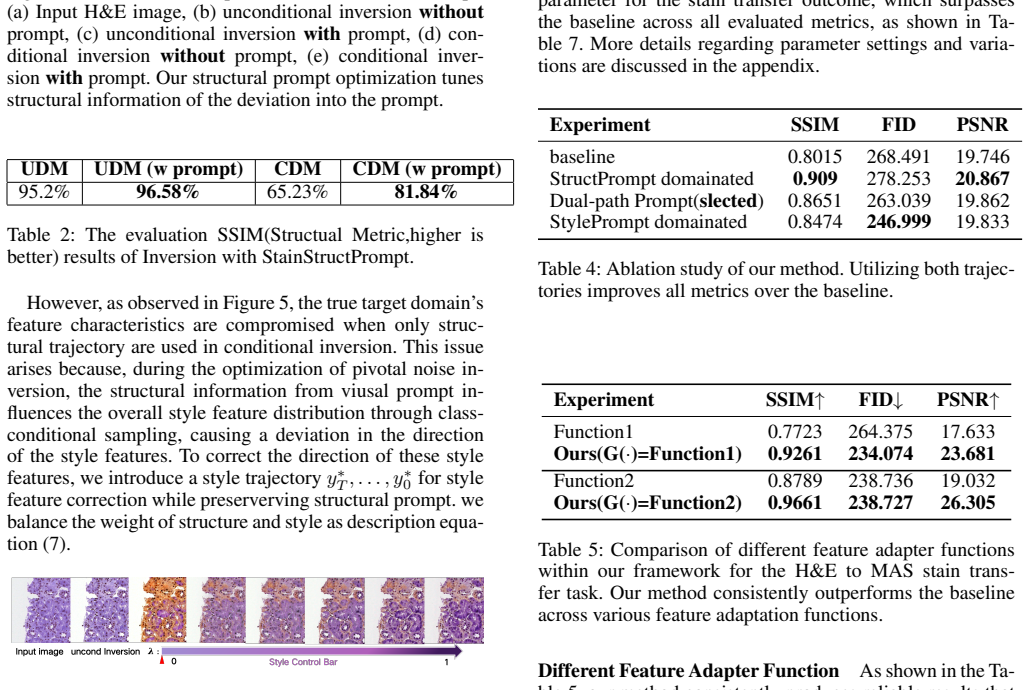
The load-bearing machinery is the pair of DDIM inversion trajectories plus null visual prompts acting as operators. The structural trajectory $\{x^*_t\}$ is the deterministic inversion of the input $x_0$; the style trajectory $\{y^*_t\}$ is built by applying a feature adapter $F(\cdot)$ to the input at each step, so $y^*_{t+1}$ is the DDIM forward step on $F(x^*_t)$. StainPrompt Optimization then optimizes the empty prompt map $\phi_t$ so that the reverse sampling step $y_{t-1}(y_t+\phi_t, C_T)$ simultaneously approximates both templates, with loss $l = \lambda l_{\mathrm{struct}} + (1-\lambda) l_{\mathrm{style}}$, where $l_{\mathrm{struct}}$ is a structural-similarity term comparing the reverse trajectory to the structural trajectory and $l_{\mathrm{style}}$ is an MSE against the style trajectory. The decreasing iteration schedule $IST_t = (1 - t/T) \cdot IST_{\mathrm{init}}$ keeps runtime bounded. This construction lets one pretrained diffusion model transfer stain style without any weight update.
What would settle it
Use the ANHIR test set's adjacent H&E and MAS sections as true paired ground truth, register them, run the virtual MAS output, and compute SSIM and PSNR between the generated and real MAS sections; if the dual-path output does not beat a simple histogram-matching color transfer on those paired metrics, the claim that it preserves diagnostic structure in actual tissue is falsified.
Extended reading notes
Core claim
On the paper's own terms, the discovery is that unpaired multi-domain virtual staining can be recast as a dual-path deterministic inversion problem. By running DDIM inversion on the input H&E image, the method builds a structural trajectory that retains complete morphology; by inverting a feature-adapter-derived reference image, it builds a style trajectory. The two trajectories are coupled only through two null visual prompts, optimized at each timestep around the pivotal noise, so the pretrained model's weights never change. The loss steers the reverse sample toward the structural trajectory with a covariance-based structural term and toward the style trajectory with an MSE term, controlled by a single $\lambda$. Experiments report SSIM $0.9233$ and PSNR $20.915$ for H&E-to-MAS, beating adversarial and energy-guided diffusion baselines, and the authors argue this is the first unpaired multi-domain stain transfer achieved with a single pretrained diffusion model.
Load-bearing premise
The result stands on the feature adapter $F(\cdot)$ producing a reference image that truly looks like the target stain: if $F$ colors regions the real stain would leave alone, the optimized style prompt faithfully injects those wrong colors, and the paper's own limitation section says exactly this.
Editorial extensions
If this is right
- The reported structural consistency means virtual stains produced this way could be used as diagnostic pre-screening or augmentation tools without visibly altering tissue morphology.
- Because inference requires no model fine-tuning, a new target stain could be added by swapping the feature adapter and the class condition, leaving the diffusion model untouched.
- The $\lambda$ weight gives an explicit, continuous control between preserving input structure and imposing target stain style, which is a practical dial for pathologists.
- Using UMDST or StainGAN as the feature adapter improved both style and structure over the adapter alone, suggesting the method acts as a post-processing enhancer for adversarial stain generators.
Reading between the lines
- Beyond the paper: the quality ceiling is set by the feature adapter, so any future improvement in adversarial or diffusion-based stain generators should directly raise the style fidelity of this method without changing its structural guarantees.
- Beyond the paper: the per-pair tuning of $\lambda$ (0.05 for MAS, 0.55 for PAS) suggests that a small calibration set could be used to choose $\lambda$ automatically for each new stain pair.
- Beyond the paper: since the method works with class-conditioned pretrained diffusion models, applying the same dual-path inversion with a medical-domain diffusion model could test whether structural consistency improves further.
- Beyond the paper: a natural extension is to apply dual-path prompted inversion to other structure-critical medical image translations, such as fluorescence-to-H&E or IHC virtual staining, where the same SSIM advantage could be measured.
Signed reviews
Editorial analysis
A structured set of objections, weighed in public.
Referee Report
Summary. The paper proposes StainPrompt, an unpaired multi-domain virtual staining method built on a single pre-trained class-conditional diffusion model. It constructs two inversion trajectories: a structural target trajectory obtained by inverting the input H&E image, and a style target trajectory obtained by inverting a style reference F(x0) produced by a feature adapter (UMDST or StainGAN). The method optimizes a null visual prompt per time step to follow both trajectories during deterministic DDIM sampling, with a user-set parameter balancing structure and style. Experiments on the ANHIR kidney dataset report high SSIM, CSS, MS-SSIM, and PSNR for H&E-to-MAS and H&E-to-PAS transfer, together with ablations and a small clinical evaluation. The paper includes a code URL and extensive comparisons against GAN-based and diffusion-based baselines.
Significance. If the formulation were internally consistent, the core idea would be valuable: it is an original way to apply DDIM-inversion prompt optimization to histopathology, it keeps the structural path independent of the trained adapter, and it reports consistent gains over several feature adapters in Table 5. The explicit code release and the ablation on different adapter functions are strengths. However, the optimization objective is currently ambiguous in several load-bearing ways, the evaluation uses consecutive but non-identical tissue sections as references for pixel-level metrics, and the style component is upper-bounded by the chosen adapter. These issues must be resolved before the results can be accepted as reproducible evidence for the stated claims.
major comments (6)
- [Method, Eq. (7) vs Algorithm 1 and Table 7] Eq. (7) defines the total loss as λ*lz_struct + (1-λ)*ly_style, so larger λ emphasizes structure. Algorithm 1, line 13, instead updates ϕ using λ*||yt(·)-y*_t||² + (1-λ)*lx_struct, so larger λ emphasizes style, and the caption of Table 7 states that 'A larger λ value improves style, while a smaller λ enhances structural integrity.' These two definitions are opposite. Since Table 1 reports λ=0.05 for H&E2MAS as a 'struct weight' and λ=0.55 for H&E2PAS, the reader cannot determine which objective was actually optimized to produce the results in Table 1. Please provide a single consistent definition and state, for every table with λ values, whether Eq. (7) or Algorithm 1 was used.
- [Method, Eq. (3)] Eq. (3) minimizes a norm of a tuple, ||(y*_{t-1}, x*_{t-1}, y_{t-1}(·))||, but no norm or weighting over this tuple of three image-sized tensors is specified. The objective is therefore not well-posed. Please replace it with an explicit sum of per-term losses with defined weights. The summation index also runs from t=1 to T while referring to y*_{t-1}; please clarify the boundary values at t=0 and t=T.
- [Method, Eq. (8)] Eq. (8) is not the standard SSIM formula: it omits the mean terms, uses σ_z σ_y in the numerator and denominator where standard SSIM uses μ terms and σ_z²+σ_y², and is dimensionally inconsistent with the stated constants c1=c2=1e-8. As written, it is not a recognizable similarity metric. Since the central structural claim depends on this loss, please quote the exact formula implemented and specify whether it is SSIM, a customized variant, or a different metric.
- [Experiment, Dataset and Evaluation Metrics] The dataset section states that the test images come from consecutive but non-identical tissue slices, which are 'pixel-level unpaired' and only 'spatially similar.' Yet SSIM, CSS, MS-SSIM, and PSNR are computed against the target-stain images as if they were ground truth for the exact input section. Because the sections are not co-registered, these metrics do not directly measure structural preservation of the same tissue. Please either co-register the consecutive sections with a stated registration protocol, or re-label the metrics as similarity to a consecutive section and temper the structural-consistency claims accordingly.
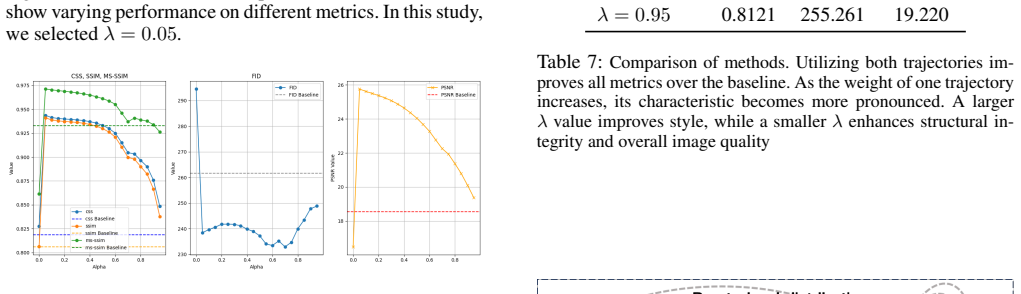
- [Experiment, Parameter Setting and Table 7] The balancing parameter is called λ in Eq. (7), Figures 8-9, and the tables, but the Experimental Details paragraph says 'we determined α' and 'α was set to 0.75 for H&E to MAS staining and 0.55 for H&E to PAS staining.' The relationship between α and λ is never stated. In addition, the parameter is selected on ten validation images, which is a very small basis for choosing different values per task. Please clarify the α/λ notation and provide a more robust sensitivity analysis, e.g., across the full test set or with confidence intervals.
- [Method, Eq. (2) and Limitation section] The style trajectory is initialized as y*0 = F(x0), where F is UMDST or StainGAN, both of which are also baselines in Table 1. Therefore the style transfer accuracy of the proposed method is at least partly inherited from the adapter, and the method cannot produce a style better than F's output. The authors acknowledge this in the Limitation section, but the abstract and comparison sections should state that Table 1 compares 'inversion over adapter output' against the raw adapter, not a fully independent style-generation method. The structural claims remain independent because the structural trajectory comes from the input image itself.
minor comments (5)
- [Abstract and throughout] The paper contains numerous typos and inconsistent symbols, e.g., 'structual', 'pivtoal', 'trasnfer', 'Parament Setting', and the use of both α and λ for the same balancing parameter.
- [Algorithm 1, line 13] The update uses yt-1(ȳ_{t-1}+ϕt, CT), but Eq. (4) defines the prompted latent as ŷt = ȳt + ϕt. The subscript on ȳ appears to be off by one, which adds to the ambiguity of the optimization loop.
- [Conclusion] The conclusion calls the method 'training-free', but the Experimental Details section reports training the diffusion model for 80k iterations. If 'training-free' means that no fine-tuning is performed during StainPrompt optimization, please state this explicitly.
- [Table 7 caption] The caption says 'Utilizing both trajectories improves all metrics over the baseline,' but the λ=0 row is worse than the baseline on SSIM, FID, and PSNR. Please rephrase the caption to describe the actual trend.
- [Table 8] The ER% metric and the protocol for eliciting pathologist scores are not defined in the experiment section; please specify how the scores were obtained and what ER denotes.
Circularity Check
No significant circularity: the style reference is an explicit input, and the structural claim is grounded in DDIM inversion of the input image.
full rationale
The paper's derivation chain does not present any prediction or first-principles result that is equivalent to its inputs by construction. The structural target path is obtained by inverting the input image x0 with the pretrained diffusion model (Eq. (1) and Algorithm 1 lines 4-8); the StainStructPrompt is then optimized to keep the reverse trajectory close to that input trajectory. The reported SSIM/CSS/MS-SSIM/PSNR improvements therefore rest on the input image's own inversion, not on any fitted baseline. The style target path is explicitly an input: Eq. (2) defines y* as the DDIM inversion of F(x0), with F declared to be UMDST or StainGAN, and Eq. (9) minimizes ||y*_t - y_t||^2. The final style is therefore inherited from the chosen adapter by design, but the paper does not disguise this as a discovery; the Limitation section acknowledges that if F produces incorrect staining, StainPrompt optimization injects those artifacts. Because the style reference is an acknowledged component rather than a hidden fit, this is a dependency, not circularity. The self-citations (Zhang et al. 2022; Chen et al. 2024) appear only as related/baseline context and are not load-bearing. The lambda inconsistency between Eq. (7) and Algorithm 1 (and the alpha/lambda terminology mismatch) is a reproducibility/correctness defect, not a circularity, since both formulations are internal to the method and neither reduces the result to its input. No self-citation supplies the core structural or style mechanism.
Assumptions & free parameters
free parameters (4)
- lambda (λ) =
0.05 (H&E->MAS), 0.55 (H&E->PAS)
- IST_init =
50
- c1, c2 =
1e-8
- Diffusion timesteps T =
100
assumptions (3)
- standard math DDIM inversion approximate equality (forward and reverse noise predictions are close at each timestep)
- domain assumption Pre-trained feature adapter F(·) produces style reference images representative of the target stain domain
- domain assumption The pre-trained diffusion model captures the target stain distribution sufficiently for inversion and conditional sampling
Cite this review
Pith. "Pith review of Unpaired Multi-Domain Histopathology Virtual Staining using Dual Path Prompted Inversion." pith.science (2026). https://pith.science/paper/4A2W67XG
@misc{pith2026241211106,
  author       = {Pith},
  title        = {Pith review of: Unpaired Multi-Domain Histopathology Virtual Staining using Dual Path Prompted Inversion},
  year         = {2026},
  howpublished = {\url{https://pith.science/paper/4A2W67XG}},
  note         = {Machine review of arXiv:2412.11106}
}
read the original abstract
Virtual staining leverages computer-aided techniques to transfer the style of histochemically stained tissue samples to other staining types. In virtual staining of pathological images, maintaining strict structural consistency is crucial, as these images emphasize structural integrity more than natural images. Even slight structural alterations can lead to deviations in diagnostic semantic information. Furthermore, the unpaired characteristic of virtual staining data may compromise the preservation of pathological diagnostic content. To address these challenges, we propose a dual-path inversion virtual staining method using prompt learning, which optimizes visual prompts to control content and style, while preserving complete pathological diagnostic content. Our proposed inversion technique comprises two key components: (1) Dual Path Prompted Strategy, we utilize a feature adapter function to generate reference images for inversion, providing style templates for input image inversion, called Style Target Path. We utilize the inversion of the input image as the Structural Target path, employing visual prompt images to maintain structural consistency in this path while preserving style information from the style Target path. During the deterministic sampling process, we achieve complete content-style disentanglement through a plug-and-play embedding visual prompt approach. (2) StainPrompt Optimization, where we only optimize the null visual prompt as ``operator'' for dual path inversion, rather than fine-tune pre-trained model. We optimize null visual prompt for structual and style trajectory around pivotal noise on each timestep, ensuring accurate dual-path inversion reconstruction. Extensive evaluations on publicly available multi-domain unpaired staining datasets demonstrate high structural consistency and accurate style transfer results.
Figures


Figures from the paper (8 more)





Reference graph
Works this paper leans on
-
[1]
, " * write output.state after.block = add.period write newline
ENTRY address archivePrefix author booktitle chapter edition editor eid eprint howpublished institution isbn journal key month note number organization pages publisher school series title type volume year label extra.label sort.label short.list INTEGERS output.state before.all mid.sentence after.sentence after.block FUNCTION init.state.consts #0 'before.a...
-
[2]
write newline
" write newline "" before.all 'output.state := FUNCTION n.dashify 't := "" t empty not t #1 #1 substring "-" = t #1 #2 substring "--" = not "--" * t #2 global.max substring 't := t #1 #1 substring "-" = "-" * t #2 global.max substring 't := while if t #1 #1 substring * t #2 global.max substring 't := if while FUNCTION word.in bbl.in capitalize " " * FUNCT...
-
[3]
Borovec, J.; Kybic, J.; Arganda-Carreras, I.; Sorokin, D. V.; Bueno, G.; Khvostikov, A. V.; Bakas, S.; Eric, I.; Chang, C.; Heldmann, S.; et al. 2020. ANHIR: automatic non-rigid histological image registration challenge. IEEE transactions on medical imaging, 39(10): 3042--3052
work page 2020
-
[4]
Chen, F.; Zhang, R.; Zheng, B.; Sun, Y.; He, J.; and Qin, W. 2024. Pathological Semantics-Preserving Learning for HE-to-IHC Virtual Staining. arXiv:2407.03655
work page Pith review arXiv 2024
-
[5]
Choi, Y.; Uh, Y.; Yoo, J.; and Ha, J.-W. 2020. StarGAN v2: Diverse Image Synthesis for Multiple Domains. In Proceedings of the IEEE Conference on Computer Vision and Pattern Recognition
work page 2020
-
[6]
de Haan, K.; Zhang, Y.; Zuckerman, J. E.; Liu, T.; Sisk, A. E.; Diaz, M. F.; Jen, K.-Y.; Nobori, A.; Liou, S.; Zhang, S.; et al. 2021. Deep learning-based transformation of H&E stained tissues into special stains. Nature communications, 12(1): 1--13
work page 2021
-
[7]
Falahkheirkhah, K.; Guo, T.; Hwang, M.; Tamboli, P.; Wood, C. G.; Karam, J. A.; Sircar, K.; and Bhargava, R. 2022. A generative adversarial approach to facilitate archival-quality histopathologic diagnoses from frozen tissue sections. Laboratory Investigation, 102(5): 554--559
work page 2022
-
[8]
Guan, X.; Wang, Y.; Lin, Y.; Li, X.; and Zhang, Y. 2024. Unsupervised Multi-Domain Progressive Stain Transfer Guided by Style Encoding Dictionary. IEEE Transactions on Image Processing
work page 2024
Show all 27 references
-
[9]
Huang, X.; Liu, M.-Y.; Belongie, S.; and Kautz, J. 2018. Multimodal Unsupervised Image-to-image Translation. In ECCV
2018
-
[10]
Ju, X.; Zeng, A.; Bian, Y.; Liu, S.; and Xu, Q. 2023. Direct Inversion: Boosting Diffusion-based Editing with 3 Lines of Code. arXiv:2310.01506
2023 arXiv
-
[11]
Kim, J.; Kim, M.; Kang, H.; and Lee, K. 2020. U-GAT-IT: Unsupervised Generative Attentional Networks with Adaptive Layer-Instance Normalization for Image-to-Image Translation. arXiv:1907.10830
2020 arXiv
-
[12]
Li, F.; Hu, Z.; Chen, W.; and Kak, A. 2023. Adaptive Supervised PatchNCE Loss for Learning HE-to-IHC Stain Translation with Inconsistent Groundtruth Image Pairs. arXiv:2303.06193
2023 arXiv
-
[13]
Li, Z.; Lin, Y.; Fang, Z.; Li, S.; and Li, X. 2024. AV-GAN: Attention-Based Varifocal Generative Adversarial Network for Uneven Medical Image Translation. arXiv preprint arXiv:2404.10714
2024 arXiv
-
[14]
Lin, Y.; Zeng, B.; Wang, Y.; Chen, Y.; Fang, Z.; Zhang, J.; Ji, X.; Wang, H.; and Zhang, Y. 2022. Unpaired multi-domain stain transfer for kidney histopathological images. In Proceedings of the AAAI Conference on Artificial Intelligence, volume 36, 1630--1637
2022
-
[15]
Ma, T.; Zhang, C.; Lu, M.; and Luo, L. 2023. AGMDT: Virtual Staining of Renal Histology Images with Adjacency-Guided Multi-Domain Transfer. arXiv preprint arXiv:2309.06421
2023 arXiv
-
[16]
Mokady, R.; Hertz, A.; Aberman, K.; Pritch, Y.; and Cohen-Or, D. 2022. Null-text Inversion for Editing Real Images using Guided Diffusion Models. arXiv:2211.09794
2022 arXiv
-
[17]
Mokady, R.; Hertz, A.; Aberman, K.; Pritch, Y.; and Cohen-Or, D. 2023. Null-text inversion for editing real images using guided diffusion models. In Proceedings of the IEEE/CVF Conference on Computer Vision and Pattern Recognition, 6038--6047
2023
-
[18]
A.; Zhang, R.; and Zhu, J.-Y
Park, T.; Efros, A. A.; Zhang, R.; and Zhu, J.-Y. 2020. Contrastive Learning for Unpaired Image-to-Image Translation. In European Conference on Computer Vision
2020
-
[19]
E.; Chong, T.; Sisk, A
Rivenson, Y.; Wang, H.; Wei, Z.; de Haan, K.; Zhang, Y.; Wu, Y.; G \"u nayd n, H.; Zuckerman, J. E.; Chong, T.; Sisk, A. E.; et al. 2019. Virtual histological staining of unlabelled tissue-autofluorescence images via deep learning. Nature biomedical engineering, 3(6): 466--477
2019
-
[20]
Shen, Y.; and Ke, J. 2023. StainDiff: Transfer Stain Styles of Histology Images with Denoising Diffusion Probabilistic Models and Self-ensemble. In International Conference on Medical Image Computing and Computer-Assisted Intervention, 549--559. Springer
2023
-
[21]
Song, J.; Meng, C.; and Ermon, S. 2022. Denoising Diffusion Implicit Models. arXiv:2010.02502
2022 arXiv
-
[22]
Wang, R.; Yang, S.; Li, Q.; and Zhong, D. 2024. CytoGAN: Unpaired staining transfer by structure preservation for cytopathology image analysis. Computers in Biology and Medicine, 180: 108942
2024
-
[23]
Xu, S.; Ma, Z.; Huang, Y.; Lee, H.; and Chai, J. 2024. Cyclenet: Rethinking cycle consistency in text-guided diffusion for image manipulation. Advances in Neural Information Processing Systems, 36
2024
-
[24]
Zeng, B.; Lin, Y.; Wang, Y.; Chen, Y.; Dong, J.; Li, X.; and Zhang, Y. 2022. Semi-supervised pr virtual staining for breast histopathological images. In International Conference on Medical Image Computing and Computer-Assisted Intervention, 232--241. Springer
2022
-
[25]
Zhang, R.; Cao, Y.; Li, Y.; Liu, Z.; Wang, J.; He, J.; Zhang, C.; Sui, X.; Zhang, P.; Cui, L.; et al. 2022. MVFStain: multiple virtual functional stain histopathology images generation based on specific domain mapping. Medical Image Analysis, 80: 102520
2022
-
[26]
Zhang, Y.; de Haan, K.; Rivenson, Y.; Li, J.; Delis, A.; and Ozcan, A. 2020. Digital synthesis of histological stains using micro-structured and multiplexed virtual staining of label-free tissue. Light: Science & Applications, 9(1): 78
2020
-
[27]
Zhao, M.; Bao, F.; Li, C.; and Zhu, J. 2022. Egsde: Unpaired image-to-image translation via energy-guided stochastic differential equations. Advances in Neural Information Processing Systems, 35: 3609--3623
2022
Reviewed August 11, 2026 · model on record in the stance chip above.
Discussion (0). Continue with ORCID to comment.