REVIEW 4 major objections 6 minor 62 references
Learning Latent Spaces for Domain Generalization in Time Series Forecasting
T0 review · 4 major / 6 minor · reviewed 2026-08-11 · deepseek-v4-flash
Pith's one-line read A plug-in framework called LTG learns latent temporal factors and reports better forecasting accuracy on unseen domains than state-of-the-art domain-generalization methods.
desk verdict Reasonable plug-in for time series DG with mixed evidence; the decoder-conditioning mechanism needs direct verification before the 'overall best' claim can hold. read the letter →
The pith
A machine-rendered reading of the paper's core claim, the machinery that carries it, and where it could break.
The reading
What carries the argument
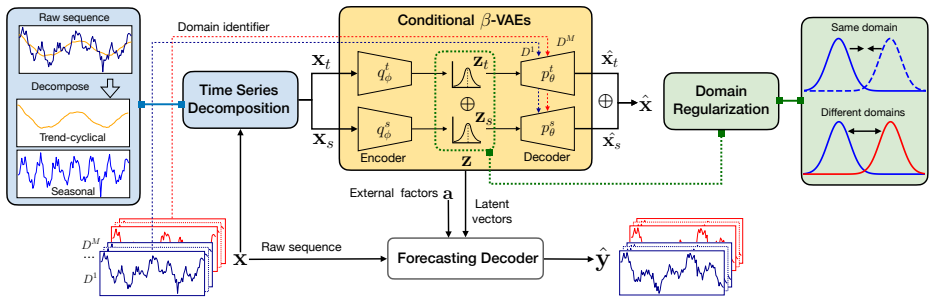
The load-bearing object is the Conditional $\beta$-VAE: an autoencoder whose encoder estimates a latent posterior $q_\phi(z|x)$ for each decomposed component, and whose decoder reconstructs the component from $z$ together with a one-hot domain identifier $\mathrm{DomID}$. Because the domain ID enters only the decoder, the encoder stays domain-agnostic and the latent vector must carry both shared and domain-specific information; a domain-regularization loss then splits $z$ into a shared part and a specific part by forcing shared parts of all samples close together and specific parts of different domains apart. A two-stage procedure pretrains the VAE and then fine-tunes its encoder while training any base forecaster on the augmented input $x' = \mathrm{Concat}(z,x)W + b$.
What would settle it
Train LTG, then at test time replace every latent vector with a version from which the supposed domain-specific half has been removed (or shuffled across domains); if quantile loss on unseen domains does not change, the domain-specific mechanism carries no information and the claimed separation is not occurring. A companion check: permute the DomID fed to the decoder during pretraining and measure whether downstream forecasting accuracy drops.
Extended reading notes
Core claim
On the paper's own terms, the central discovery is that modeling temporal dependencies in a disentangled latent space—rather than only matching feature distributions across domains—is what lets a forecaster generalize to unseen domains. LTG's conditional β-VAE learns latent vectors whose shared part encodes domain-invariant patterns and whose specific part encodes per-domain behavior, and feeding both to a forecasting decoder improves range accuracy (quantile loss) in most settings. The paper argues that prior approaches neglect these latent temporal dependencies, and demonstrates the point by showing improved performance across web traffic, retail sales, stock volume, and power consumption data.
Load-bearing premise
The weakest load-bearing premise is that conditioning the decoder on the domain ID during pretraining actually injects useful domain-specific information into the latent vector, even though the ID is absent at test time and only the encoder is used; if the domain signal lives entirely in the decoder, the forecasting gains would have to come from the shared latent part alone.
Editorial extensions
If this is right
- LTG can be bolted onto DeepAR, WaveNet, DLinear, and GPT4TS, and in most configurations it lowers quantile loss on unseen domains compared with the base model alone.
- The domain-regularized latent space separates domains visually: t-SNE plots show overlapping shared parts and separated specific parts across test domains.
- Two-stage training is necessary; training the whole pipeline end-to-end worsens results, so the latent factors must be established before the forecaster uses them.
- Using only shared latent vectors can outperform the full model on some datasets, indicating that domain-specific factors are not always beneficial.
- LTG's pretraining is cheaper than the gradient-matching baseline IDGM, and total runtime stays close to the base model.
Reading between the lines
- If the domain signal does persist in the latent vector despite being absent at test time, LTG is effectively learning a domain code; a direct comparison against simply concatenating the one-hot domain ID to the forecaster input would isolate how much of the gain is from the VAE machinery versus the ID itself.
- The hyperparameters β and the split fraction α jointly control how much information the specific half can hold; an automatic selection of α per dataset could make LTG more robust, since the Web-traffic result suggests the optimal split varies.
- Because latent factors are only used as extra input, LTG's gains are bounded by the base model's capacity to use them; the paper's own stated limitation opens the door to using the latent factors to condition the forecaster's parameters or training objective instead.
- The method is univariate only; extending to multivariate series would require deciding whether to share latent factors across channels, which is a natural next test.
Editorial analysis
A structured set of objections, weighed in public.
Referee Report
Summary. This paper proposes Latent Temporal Generalization (LTG), a plug-in framework for domain generalization in probabilistic time series forecasting. LTG first decomposes each input series into trend-cyclical and seasonal components, models each component with a conditional beta-VAE whose decoder is conditioned on a domain identifier, and adds a domain-regularization term that encourages part of the latent vector to be shared across domains and the remainder to be domain-specific. The resulting latent vector is concatenated with the raw input through a linear layer and fed into an arbitrary forecasting decoder, which is trained in a second stage while the VAE encoders are fine-tuned. Experiments on five datasets (web traffic, retail, finance, energy) compare LTG applied to DeepAR, WaveNet, DLinear, and GPT4TS against IDGM, Cedar, and UniTime. The paper reports improved range accuracy in several configurations, especially with WaveNet, and includes ablations, t-SNE latent-space visualizations, a forecast-horizon sensitivity study, and a runtime analysis.
Significance. If the main empirical claim were fully established, LTG would be a useful and modular contribution: it is architecture-agnostic, requires no label information, and adds only a lightweight pretraining stage. The experimental design is broad, covering four base forecasters and five real-world datasets, and the two-stage training scheme is simple to implement. However, the claim that LTG 'achieves the overall best performance' is currently supported only by selected comparisons of means over five seeds; several configurations show performance degradation, and no significance tests or aggregate rankings are reported. The central mechanism, namely that domain-specific information is preserved in the latent vector after the DomID-conditioned decoder is removed, is not verified, and the latent-space visualization confirms an objective that is explicitly enforced by Equation (9), so it does not independently validate disentanglement. These gaps make the evidence for the core claim conditional rather than conclusive.
major comments (4)
- [Section 5.2, Tables 2 and 3] The paper's headline claim that LTG achieves the overall best range accuracy is not substantiated by the reported results. On Web-traffic, LTG degrades both base models: DeepAR Q(0.5) increases from 0.155 +/- 0.030 to 0.172 +/- 0.014 and Q(mean) from 0.122 +/- 0.018 to 0.179 +/- 0.038; DLinear Q(0.5) increases from 0.152 +/- 0.003 to 0.172 +/- 0.032 and Q(mean) from 0.119 +/- 0.008 to 0.145 +/- 0.040. The Power-cons dataset, where LTG shows its largest gains, has only three domains total, so the 20% test split leaves one test domain per random split. No significance tests, confidence intervals, or win-rate/rank summaries are reported, so it is unclear whether the differences over five seeds support the conclusion. Please add paired significance tests across seeds, report per-configuration wins and losses, and discuss the small number of test domains.
- [Section 4.2 and Table 4] The proposed decoder-conditioning mechanism is not verified at inference time. The text states that 'we only need the encoder to generate the latent vectors' at test time, and the encoder is not given DomID; in a VAE the decoder conditions z through reconstruction, so the model can satisfy its training objective by moving domain-specific information into the decoder and leaving z largely shared. The domain-regularization loss in Eq. (9) softly encourages zspecific to differ across domains, but no quantitative measurement (e.g., a domain classifier trained on zspecific, or mutual information between zspecific and DomID) demonstrates that the encoder-only latent vectors actually carry domain-specific information. The ablation LTG(w/o Cond) is inconsistent with the proposed mechanism: removing DomID from the decoder improves DeepAR on Web-traffic Q(0.5) from 0.1717 to 0.1635, while degrading some Stock-volume metrics. The authors' own limitation statement in Section 6 that latent vectors are used only as additional input knowledge further suggests the mechanism is not load-bearing. Please provide a direct test of the information content of zspecific as used at inference.
- [Section 5.4.1 and Equation (9)] The t-SNE visualizations are presented as evidence that domain-shared and domain-specific components are separated, but Equation (9) explicitly imposes this separation: it minimizes pairwise distances among zshared samples and maximizes pairwise distances between zspecific samples from different domains. The figure therefore confirms the regularizer rather than providing independent evidence. The disentanglement claim in the abstract and contributions should be supported with a quantitative measure (e.g., MIG or DCI on the learned latents, or an evaluation of whether zspecific predicts domain labels and zshared does not).
- [Equations (6)-(8)] The pretraining objective as written is ambiguous. Equation (6) includes an L2 reconstruction term for (xhat_t + xhat_s) - x, and Equations (7)-(8) add log p_theta_t(xt|zt,DomID) and log p_theta_s(xs|zs,DomID) as separate quantities. If the log p terms are Gaussian log-likelihoods, they are themselves reconstruction terms up to scaling, so the objective double-counts the same fit; if they are intended to be the ELBO reconstruction terms, then Equation (6) duplicates them. This makes the exact training signal in Stage 1 (Section 4.5) unclear and is an obstacle to reproducing the method. Please rewrite the objective to specify one reconstruction term and state how the L2 term and the log-likelihood terms are combined.
minor comments (6)
- [Table 2] Several entries in Table 2 use a comma instead of a period as the decimal separator (e.g., '0.016, .001'), and the spacing of the mean and standard deviation is inconsistent across columns; please unify the formatting.
- [Section 4.3] The definition of the split index as index = alpha * dz should specify how non-integer values are handled (e.g., floor or round), since alpha values such as 0.25 with odd dimension dz are used in the hyperparameter search.
- [Appendix E.4, Table 5] The TimeLLM rows in Table 5 are missing Q(0.5) values for Favorita-cat and Stock-volume; please explain why those entries are absent or provide the values.
- [Section 4.5 and Abstract] There are typographical issues, including 'Contidional' in the Section 4.5 heading and inconsistent spacing in 'V AE' and 'beta-V AE' in the abstract and introduction.
- [Appendix C] The phrase 'reverse instance norm' should be 'reversible instance normalization', and the description should state whether the normalization is applied to the input of the VAE, the forecasting decoder, or both.
- [General] No code is released, and the paper does not mention a plan to do so; given the number of hyperparameters and the two-stage training procedure, releasing code or a detailed pseudocode would substantially improve reproducibility.
Circularity Check
No significant circularity: held-out test-domain evaluation grounds the central claim; self-citations to [11] for datasets, baselines, and protocols are not load-bearing.
full rationale
The paper's central claim, that LTG improves domain generalization in time series forecasting, is evaluated on held-out test domains in Tables 2 and 3, so the main result is externally grounded rather than derived from its own assumptions. The method's components—decomposition, Conditional β-VAE, domain regularization, and fine-tuning—are tested through ablations on held-out domains, and the best configuration is selected via training-domain validation. The latent-space t-SNE analysis in Section 5.4.1 is the closest to a circular check, since Eq. 9 directly encourages shared-latent similarity and specific-latent dissimilarity; however, the visualization is performed on held-out test domains and is presented as qualitative analysis, not as the basis for the forecasting performance claim. Self-citations to [11] for the common-patterns assumption, dataset preprocessing, the Cedar baseline, and model-selection protocol are pragmatic references to the authors' prior work rather than a uniqueness theorem or an unverified load-bearing premise; moreover, the paper compares against Cedar on held-out domains, giving the comparison independent content. No fitted parameter is renamed as a prediction, and no load-bearing result reduces by construction to its own inputs.
Assumptions & free parameters
free parameters (5)
- beta (VAE capacity weight) =
searched from {1, 5, 10, 15}
- alpha (shared/specific split ratio) =
searched from {0.25, 0.5, 0.75}
- moving average kernel size =
searched from {5, 9, 13}
- latent dimension dz =
inherited from base model hidden size
- learning rate and hidden size =
learning rate {0.0001, 0.0005, 0.001}; hidden {16, 32, 64}
assumptions (4)
- domain assumption Common underlying patterns assumption: shared patterns across source domains transfer to unseen domains
- standard math Standard VAE reparameterization and Gaussian prior for latents
- domain assumption Training-domain validation is a reliable model selection criterion for domain generalization
- ad hoc to paper A fixed split ratio alpha cleanly separates shared from specific latent factors
Cite this review
Pith. "Pith review of Learning Latent Spaces for Domain Generalization in Time Series Forecasting." pith.science (2026). https://pith.science/paper/PLKMRSBG
@misc{pith2026241211171,
  author       = {Pith},
  title        = {Pith review of: Learning Latent Spaces for Domain Generalization in Time Series Forecasting},
  year         = {2026},
  howpublished = {\url{https://pith.science/paper/PLKMRSBG}},
  note         = {Machine review of arXiv:2412.11171}
}
abstract
Time series forecasting is vital in many real-world applications, yet developing models that generalize well on unseen relevant domains -- such as forecasting web traffic data on new platforms/websites or estimating e-commerce demand in new regions -- remains underexplored. Existing forecasting models often struggle with domain shifts in time series data, as the temporal patterns involve complex components like trends, seasonality, etc. While some prior work addresses this by matching feature distributions across domains or disentangling domain-shared features using label information, they fail to reveal insights into the latent temporal dependencies, which are critical for identifying common patterns across domains and achieving generalization. We propose a framework for domain generalization in time series forecasting by mining the latent factors that govern temporal dependencies across domains. Our approach uses a decomposition-based architecture with a new Conditional $\beta$-Variational Autoencoder (VAE), wherein time series data is first decomposed into trend-cyclical and seasonal components, each modeled independently through separate $\beta$-VAE modules. The $\beta$-VAE aims to capture disentangled latent factors that control temporal dependencies across domains. We enhance the learning of domain-specific information with a decoder-conditional design and introduce domain regularization to improve the separation of domain-shared and domain-specific latent factors. Our proposed method is flexible and can be applied to various time series forecasting models, enabling effective domain generalization with simplicity and efficiency. We validate its effectiveness on five real-world time series datasets, covering web traffic, e-commerce, finance and power consumption, demonstrating improved generalization performance over state-of-the-art methods.
Figures


Figures from the paper (5 more)


Reference graph
Works this paper leans on
-
[1]
A. F. Ansari, L. Stella, C. Turkmen, X. Zhang, P. Mercado, H. Shen, O. Shchur, S. S. Rangapuram, S. P. Arango, S. Kapoor, et al. Chronos: Learning the language of time series. arXiv preprint arXiv:2403.07815, 2024
arXiv 2024
-
[2]
J. S. Armstrong. Long-Range Forecasting: From Crystal Ball to Computer. Wiley, 1978
work page 1978
-
[3]
D. Bahdanau, K. Cho, and Y . Bengio. Neural machine translation by jointly learning to align and translate. arXiv preprint arXiv:1409.0473, 2014
arXiv 2014
-
[4]
G. Bai, C. Ling, and L. Zhao. Temporal domain generalization with drift-aware dynamic neural networks. In The Eleventh International Conference on Learning Representations, 2023. URL https://openreview.net/ forum?id=sWOsRj4nT1n
work page 2023
-
[5]
S. Bai, J. Z. Kolter, and V . Koltun. An empirical evaluation of generic convolutional and recurrent networks for sequence modeling. arXiv preprint arXiv:1803.01271, 2018
arXiv 2018
- [6]
-
[7]
M. A. Benjamin, R. A. Rigby, and D. M. Stasinopoulos. Generalized autoregressive moving average models. Journal of the American Statistical Association, 98(461):214–223, 2003
work page 2003
-
[8]
C. P. Burgess, I. Higgins, A. Pal, L. Matthey, N. Watters, G. Desjardins, and A. Lerchner. Understanding disentangling in beta-V AE.arXiv preprint arXiv:1804.03599, 2018
arXiv 2018
Show all 62 references
-
[9]
Chung, C
J. Chung, C. Gulcehre, K. Cho, and Y . Bengio. Empirical evaluation of gated recurrent neural networks on sequence modeling. arXiv preprint arXiv:1412.3555, 2014
2014 arXiv
-
[10]
R. B. Cleveland, W. S. Cleveland, J. E. McRae, and I. Terpenning. STL: A seasonal-trend decomposition. J. of Official Statistics, 6(1):3–73, 1990
1990
-
[11]
S. Deng, O. Sprangers, M. Li, S. Schelter, and M. de Rijke. Domain generalization in time series forecasting. ACM Transactions on Knowledge Discovery from Data, 18(5):1–24, 2024
2024
-
[12]
Y . Du, J. Wang, W. Feng, S. Pan, T. Qin, R. Xu, and C. Wang. AdaRNN: Adaptive learning and forecasting of time series. In Proceedings of the 30th ACM international Conference on Information & Knowledge Management, pages 402–411, 2021
2021
-
[13]
W. Fan, P. Wang, D. Wang, D. Wang, Y . Zhou, and Y . Fu. Dish-ts: A general paradigm for alleviating distribution shift in time series forecasting. In Proceedings of the AAAI conference on artificial intelligence, volume 37, pages 7522–7529, 2023
2023
-
[14]
Gagnon-Audet, K
J.-C. Gagnon-Audet, K. Ahuja, M.-J. Darvishi-Bayazi, P. Mousavi, G. Dumas, and I. Rish. Woods: Benchmarks for out-of-distribution generalization in time series. arXiv preprint arXiv:2203.09978, 2022
2022 arXiv
-
[15]
Ganin, E
Y . Ganin, E. Ustinova, H. Ajakan, P. Germain, H. Larochelle, F. Laviolette, M. Marchand, and V . Lempitsky. Domain-adversarial training of neural networks. The Journal of Machine Learning Research, 17(1):2096–2030, 2016. 12
2016
-
[16]
E. S. Gardner Jr. Exponential smoothing: The state of the art—part ii. International Journal of Forecasting, 22(4): 637–666, 2006
2006
-
[17]
Glorot and Y
X. Glorot and Y . Bengio. Understanding the difficulty of training deep feedforward neural networks. InAISTATS, 2010
2010
-
[18]
Gneiting and M
T. Gneiting and M. Katzfuss. Probabilistic forecasting. Annual Review of Statistics and Its Application, 1:125–151, 2014
2014
-
[19]
R. Gong, W. Li, Y . Chen, and L. V . Gool. DLOW: Domain flow for adaptation and generalization. InProceedings of the IEEE/CVF Conference on Computer Vision and Pattern Recognition, pages 2477–2486, 2019
2019
-
[20]
Gulrajani and D
I. Gulrajani and D. Lopez-Paz. In search of lost domain generalization. arXiv preprint arXiv:2007.01434, 2020
2007 arXiv
-
[21]
J. D. Hamilton. Time Series Analysis. Princeton University Press, 2020
2020
-
[22]
Higgins, L
I. Higgins, L. Matthey, A. Pal, C. P. Burgess, X. Glorot, M. M. Botvinick, S. Mohamed, and A. Lerchner. beta-vae: Learning basic visual concepts with a constrained variational framework. ICLR, 3, 2017
2017
-
[23]
Hochreiter and J
S. Hochreiter and J. Schmidhuber. Long short-term memory. Neural Computation, 9(8):1735–1780, 1997
1997
-
[24]
Y . Hu, X. Jia, M. Tomizuka, and W. Zhan. Causal-based time series domain generalization for vehicle intention prediction. In 2022 International Conference on Robotics and Automation (ICRA), pages 7806–7813. IEEE, 2022
2022
-
[25]
Hupkes, M
D. Hupkes, M. Giulianelli, V . Dankers, M. Artetxe, Y . Elazar, T. Pimentel, C. Christodoulopoulos, K. Lasri, N. Saphra, A. Sinclair, et al. A taxonomy and review of generalization research in NLP. Nature Machine Intelligence, 5(10):1161–1174, 2023
2023
-
[26]
M. Ilse, J. M. Tomczak, C. Louizos, and M. Welling. Diva: Domain invariant variational autoencoders. InMedical Imaging with Deep Learning, pages 322–348. PMLR, 2020
2020
-
[27]
M. Jin, S. Wang, L. Ma, Z. Chu, J. Y . Zhang, X. Shi, P.-Y . Chen, Y . Liang, Y .-F. Li, S. Pan, and Q. Wen. Time-LLM: Time series forecasting by reprogramming large language models. In The Twelfth International Conference on Learning Representations, 2024
2024
-
[28]
G. Ke, Q. Meng, T. Finley, T. Wang, W. Chen, W. Ma, Q. Ye, and T.-Y . Liu. LightGBM: A highly efficient gradient boosting decision tree. volume 30, 2017
2017
-
[29]
T. Kim, J. Kim, Y . Tae, C. Park, J.-H. Choi, and J. Choo. Reversible instance normalization for accurate time-series forecasting against distribution shift. In International Conference on Learning Representations, 2021
2021
-
[30]
D. P. Kingma and J. Ba. Adam: A method for stochastic optimization. In International Conference on Learning Representations, volume 5, 2015
2015
-
[31]
D. P. Kingma and M. Welling. Auto-encoding variational Bayes. arXiv preprint arXiv:1312.6114, 2013
2013 arXiv
-
[32]
S. Li, X. Jin, Y . Xuan, X. Zhou, W. Chen, Y .-X. Wang, and X. Yan. Enhancing the locality and breaking the memory bottleneck of transformer on time series forecasting. Advances in Neural Information Processing Systems, 32, 2019
2019
-
[33]
Lim and S
B. Lim and S. Zohren. Time-series forecasting with deep learning: A survey. Philosophical Transactions of the Royal Society A, 379(2194):20200209, 2021
2021
-
[34]
J. Liu, Z. Shen, Y . He, X. Zhang, R. Xu, H. Yu, and P. Cui. Towards out-of-distribution generalization: A survey. arXiv preprint arXiv:2108.13624, 2021
2021 arXiv
-
[35]
X. Liu, J. Hu, Y . Li, S. Diao, Y . Liang, B. Hooi, and R. Zimmermann. Unitime: A language-empowered unified model for domain time series forecasting. In Proceedings of the ACM on Web Conference 2024, pages 4095–4106, 2024
2024
-
[36]
Z. Liu, M. Cheng, Z. Li, Z. Huang, Q. Liu, Y . Xie, and E. Chen. Adaptive normalization for non-stationary time series forecasting: A temporal slice perspective. Advances in Neural Information Processing Systems, 36, 2024
2024
-
[37]
W. Lu, J. Wang, X. Sun, Y . Chen, and X. Xie. Out-of-distribution representation learning for time series classification. In The Eleventh International Conference on Learning Representations , 2023. URL https: //openreview.net/forum?id=gUZWOE42l6Q
2023
-
[38]
Nasery, S
A. Nasery, S. Thakur, V . Piratla, A. De, and S. Sarawagi. Training for the future: A simple gradient interpolation loss to generalize along time. In A. Beygelzimer, Y . Dauphin, P. Liang, and J. W. Vaughan, editors,Advances in Neural Information Processing Systems, 2021. URL ...
2021
-
[39]
Y . Nie, N. H. Nguyen, P. Sinthong, and J. Kalagnanam. A time series is worth 64 words: Long-term forecasting with transformers. In The Eleventh International Conference on Learning Representations, 2023. URL https: //openreview.net/forum?id=Jbdc0vTOcol. 13
2023
-
[40]
A. v. d. Oord, S. Dieleman, H. Zen, K. Simonyan, O. Vinyals, A. Graves, N. Kalchbrenner, A. Senior, and K. Kavukcuoglu. Wavenet: A generative model for raw audio. arXiv preprint arXiv:1609.03499, 2016
2016 arXiv
-
[41]
Paszke, S
A. Paszke, S. Gross, F. Massa, A. Lerer, J. Bradbury, G. Chanan, T. Killeen, Z. Lin, N. Gimelshein, L. Antiga, A. Desmaison, A. Köpf, E. Yang, Z. DeVito, M. Raison, A. Tejani, S. Chilamkurthy, B. Steiner, L. Fang, J. Bai, and S. Chintala. Pytorch: An imperative style, high-per...
2019
-
[42]
Radford, J
A. Radford, J. Wu, R. Child, D. Luan, D. Amodei, I. Sutskever, et al. Language models are unsupervised multitask learners. OpenAI blog, 1(8):9, 2019
2019
-
[43]
Ragab, Z
M. Ragab, Z. Chen, W. Zhang, E. Eldele, M. Wu, C.-K. Kwoh, and X. Li. Conditional contrastive domain generalization for fault diagnosis. IEEE Transactions on Instrumentation and Measurement, 71:1–12, 2022
2022
-
[44]
Salinas, V
D. Salinas, V . Flunkert, J. Gasthaus, and T. Januschowski. Deepar: Probabilistic forecasting with autoregressive recurrent networks. International Journal of Forecasting, 36(3):1181–1191, 2020
2020
-
[45]
Y . Shi, J. Seely, P. H. Torr, N. Siddharth, A. Hannun, N. Usunier, and G. Synnaeve. Gradient matching for domain generalization. arXiv preprint arXiv:2104.09937, 2021
2021 arXiv
-
[46]
Sprangers, S
O. Sprangers, S. Schelter, and M. de Rijke. Parameter-efficient deep probabilistic forecasting. International Journal of Forecasting, 39(1):332–345, 2023
2023
-
[47]
M. Tan, M. A. Merrill, V . Gupta, T. Althoff, and T. Hartvigsen. Are language models actually useful for time series forecasting? arXiv preprint arXiv:2406.16964, 2024
2024 arXiv
-
[48]
Tibshirani
R. Tibshirani. Regression shrinkage and selection via the lasso. Journal of the Royal Statistical Society: Series B (Methodological), 58(1):267–288, 1996
1996
-
[49]
Van der Maaten and G
L. Van der Maaten and G. Hinton. Visualizing data using t-sne. Journal of Machine Learning Research, 9(11), 2008
2008
-
[50]
Vaswani, N
A. Vaswani, N. Shazeer, N. Parmar, J. Uszkoreit, L. Jones, A. N. Gomez, Ł. Kaiser, and I. Polosukhin. Attention is all you need. Advances in Neural Information Processing Systems, 30, 2017
2017
-
[51]
J. Wang, C. Lan, C. Liu, Y . Ouyang, T. Qin, W. Lu, Y . Chen, W. Zeng, and P. S. Yu. Generalizing to unseen domains: A survey on domain generalization, 2022. URL https://arxiv.org/abs/2103.03097
2022 arXiv
-
[52]
Z. Wang, C. Pei, M. Ma, X. Wang, Z. Li, D. Pei, S. Rajmohan, D. Zhang, Q. Lin, H. Zhang, et al. Revisiting V AE for unsupervised time series anomaly detection: A frequency perspective. In Proceedings of the ACM on Web Conference 2024, pages 3096–3105, 2024
2024
-
[53]
G. Woo, C. Liu, A. Kumar, C. Xiong, S. Savarese, and D. Sahoo. Unified training of universal time series forecasting transformers. arXiv preprint arXiv:2402.02592, 2024
2024 arXiv
-
[54]
H. Wu, J. Xu, J. Wang, and M. Long. Autoformer: Decomposition transformers with auto-correlation for long-term series forecasting. Advances in Neural Information Processing Systems, 34:22419–22430, 2021
2021
-
[55]
X. Yue, Y . Zhang, S. Zhao, A. Sangiovanni-Vincentelli, K. Keutzer, and B. Gong. Domain randomization and pyramid consistency: Simulation-to-real generalization without accessing target domain data. In Proceedings of the IEEE/CVF International Conference on Computer Vision, pa...
2019
-
[56]
A. Zeng, M. Chen, L. Zhang, and Q. Xu. Are transformers effective for time series forecasting? In Proceedings of the AAAI conference on artificial intelligence, volume 37, pages 11121–11128, 2023
2023
-
[57]
Zhang, M
W. Zhang, M. Ragab, and C.-S. Foo. Domain generalization via selective consistency regularization for time series classification. In 2022 26th International Conference on Pattern Recognition (ICPR), pages 2149–2156. IEEE, 2022
2022
-
[58]
W. X. Zhao, K. Zhou, J. Li, T. Tang, X. Wang, Y . Hou, Y . Min, B. Zhang, J. Zhang, Z. Dong, et al. A survey of large language models. arXiv preprint arXiv:2303.18223, 2023
2023 arXiv
-
[59]
Zhao and S
Y . Zhao and S. Linderman. Revisiting structured variational autoencoders. In International Conference on Machine Learning, pages 42046–42057. PMLR, 2023
2023
-
[60]
H. Zhou, S. Zhang, J. Peng, S. Zhang, J. Li, H. Xiong, and W. Zhang. Informer: Beyond efficient transformer for long sequence time-series forecasting. In Proceedings of the AAAI conference on artificial intelligence, volume 35, pages 11106–11115, 2021
2021
-
[61]
T. Zhou, Z. Ma, Q. Wen, X. Wang, L. Sun, and R. Jin. Fedformer: Frequency enhanced decomposed transformer for long-term series forecasting. In International conference on machine learning, pages 27268–27286. PMLR, 2022
2022
-
[62]
T. Zhou, P. Niu, L. Sun, and R. Jin. One fits all: Power general time series analysis by pretrained lm. Advances in Neural Information Processing Systems, 36:43322–43355, 2023. 14 A Ethical Considerations The research topic of this paper, domain generalization in time series f...
2023
Reviewed August 11, 2026 · model on record in the stance chip above.
Discussion (0). Continue with ORCID to comment.