REVIEW 3 major objections 6 minor 61 references
Wilson Loop and Topological Properties in 3D Woodpile Photonic Crystal
T0 review · 3 major / 6 minor · reviewed 2026-08-11 · deepseek-v4-flash
Pith's one-line read This paper claims that the 3D woodpile photonic crystal supports topologically protected 1D hinge states for light inside the complete band gap, with a selection rule based on sign flips of partial Chern number differences.
desk verdict Plausible numerical states in a realistic woodpile photonic crystal, but the Wilson-loop derivation equating quadrant windings to partial Chern numbers is invalid and the hinge-state selection rule needs a rigorous basis. read the letter →
The pith
A machine-rendered reading of the paper's core claim, the machinery that carries it, and where it could break.
The reading
What carries the argument
The central object is the Wilson loop on an arbitrary surface of the 3D crystal, generalized by replacing the primitive-cell Brillouin zone with a parallelepiped of equal volume built from the surface periodicity vectors. The winding number of this loop around each quadrant of the surface Brillouin zone is interpreted as a partial Chern number. This object carries the argument because the difference in partial Chern numbers between the before-shifting and after-shifting unit cells predicts interface states, and the sign flip of that difference between two intersecting surfaces predicts which hinges host hinge states.
What would settle it
Compute the Berry curvature directly by quadrature over each quadrant of the surface Brillouin zone for the two bands below the gap and check that the integrated values equal the ±2 windings of the Wilson loops; any mismatch or gauge dependence would falsify the selection rule.
Extended reading notes
Core claim
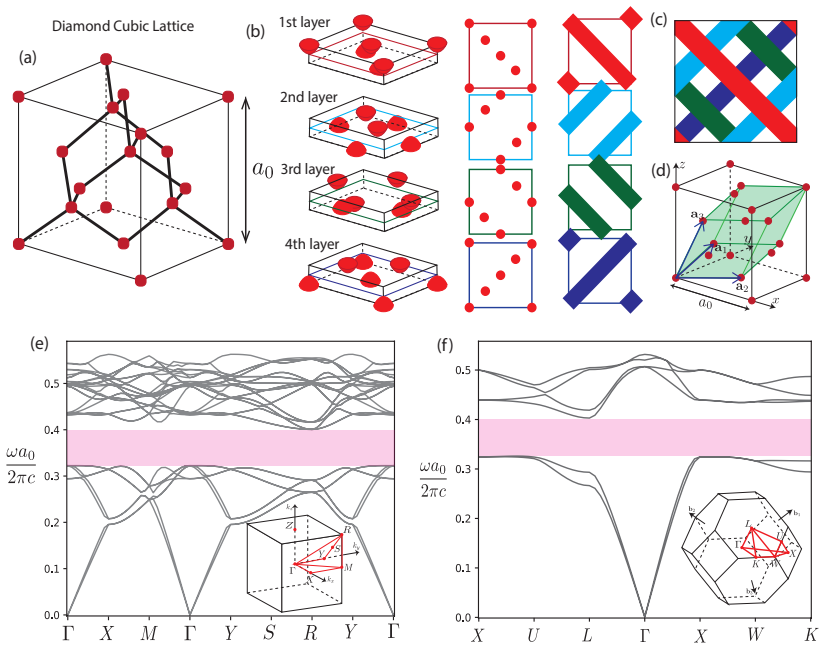
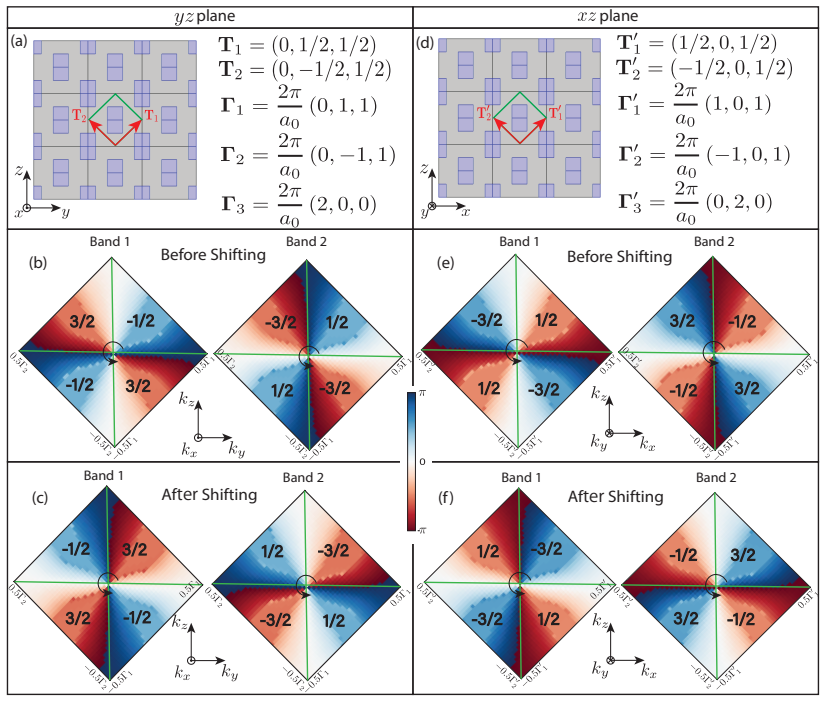
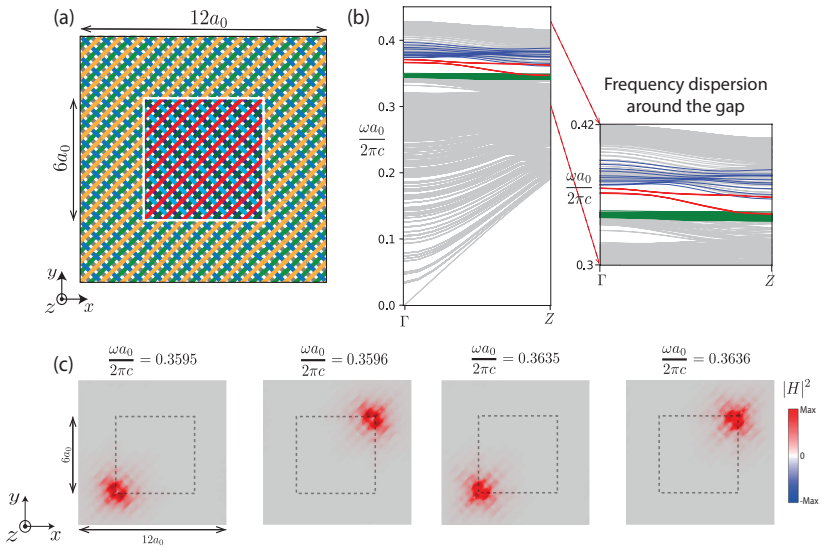
By shifting the origin of the woodpile unit cell by a0/4 in x, a0/4 in y, and a0/2 in z, one obtains two unit cells with identical band structures but opposite topological properties. The Wilson-loop spectra on the kykz and kxkz surfaces reveal that each of the two occupied bands has winding numbers of magnitude 2 on each quadrant, so the partial Chern number difference between the two unit cells is ±2. These differences produce eight interface states per surface band gap and two doubly degenerate hinge states in a supercell; the hinge states localize only at the upper-right and lower-left hinges, because only there the sign of the partial Chern number difference flips between the two surfaces. The paper states this as a selection rule: hinge states emerge at a hinge if the partial Chern number differences on the two interfaces forming the hinge have opposite signs.
Load-bearing premise
The whole selection rule rests on treating the winding of the Wilson loop around each quadrant of the surface Brillouin zone as a well-defined partial Chern number, and on assuming the two bands below the gap contribute independently; if that identification fails, the hinge rule is unsupported.
Editorial extensions
If this is right
- A woodpile photonic crystal with a shifted unit-cell boundary will exhibit two-dimensional interface states inside the complete photonic band gap, eight per surface when the folded Brillouin zone is accounted for.
- One-dimensional hinge states appear in the complete gap between interface states, so light can be guided along a hinge without leaking into bulk or surface modes.
- Whether a given hinge hosts a state is decided by the signs of the partial Chern number differences on the two interfaces: opposite signs produce a hinge state and identical signs do not.
- The Wilson-loop procedure proposed here can be applied to compute topological invariants on arbitrary crystal surfaces in other 3D photonic crystals, not only cubic ones.
Reading between the lines
- If the partial Chern numbers are genuinely gauge-invariant, the same quadrant-winding calculation could be used to search for hinge states in other dielectric photonic crystals with broken inversion symmetry but no net Chern number.
- The sign-flip selection rule for hinges suggests a natural extension to zero-dimensional corner states: at a corner where three interfaces meet, a corner state should appear when the three sign matrices have a consistent mismatch; that prediction is not tested in the paper.
- A direct experimental test would fabricate the before-shifting/after-shifting woodpile junction and measure transmission along each hinge; the hinge pair with opposite-sign interfaces should transmit in the gap frequency window while the other pair should not.
Signed reviews
Editorial analysis
A structured set of objections, weighed in public.
Referee Report
Summary. The paper numerically studies a three-dimensional woodpile photonic crystal with before- and after-shifting unit cells, proposes a Wilson-loop method for arbitrary surfaces using the primitive unit cell, and uses the resulting quadrant winding numbers to define partial Chern numbers. It then attributes the observed topological interface states and second-order hinge states to differences in these partial Chern numbers, and proposes a sign-flip selection rule for the hinge states. The numerical observations include supercell band structures and field distributions for interface and hinge states.
Significance. If the topological-invariant identification were rigorous, the paper would offer a practical Wilson-loop procedure for arbitrary surfaces in 3D photonic crystals and a concrete selection rule for hinge states, which would be valuable for waveguide applications. The supercell simulations are explicit, the Wilson-loop computation and the supercell eigenmode searches are independent (so there is no circular fitting), and the predicted hinge-state locations are falsifiable. However, the central mathematical link between the computed quadrant windings and partial Chern numbers is not established, and the per-band decomposition for the two connected bands is asserted rather than proved. These are load-bearing gaps: the hinge selection rule inherits them. The paper is therefore promising but not yet convincing as a topological explanation.
major comments (3)
- [Appendix A, Eq. (12)] The derivation of Eq. (12) does not establish the claimed equality between the kz-integral of ∂kz W(kz) and the winding number of the Wilson loop around the boundary of a slice. The left-hand side, (1/2π)∫ dkz ∂kz W(kz), is a boundary term W(kz,upper)−W(kz,lower), whereas the right-hand side is a loop integral of ∂L W(L) in the surface plane; these are different objects and are not related by Eqs. (10) and (11). Thus the identification of the quadrant winding numbers in Fig. 2 with partial Chern numbers is unsupported. Please provide a correct derivation, or compute the partial Chern numbers directly from the Berry curvature on the quadrant patches and verify that they match the winding numbers.
- [Section III, Eqs. (4)-(6), and Section IV] The two bands below the gap are connected by degeneracy points (Section II), yet Eqs. (4)-(6) diagonalize the 2×2 overlap matrix and assign the resulting eigenvalues separately to 'band 1' and 'band 2'. For touching bands, individual Wilson-loop eigenvalues are not guaranteed to be smooth or gauge-invariant, and the statement in Section IV that 'these two connected bands have orthogonal polarization' is asserted without proof. Please demonstrate the separability of the two bands in a consistent gauge, or compute the invariant for the two-band subspace using a non-Abelian Wilson loop.
- [Section V, Figs. 4 and 5] The selection rule for hinge states is built entirely on the partial Chern number differences shown in Fig. 5(a), which in turn rely on the quadrant winding numbers. Since the link between those windings and genuine partial Chern numbers is not established (comment 1) and the per-band assignment is not justified (comment 2), the hinge-state selection rule lacks a rigorous topological foundation. The red hinge states in Fig. 4 may be real, but their topological protection is not demonstrated by the present invariant calculation. Please either repair the invariant computation or provide an independent robustness check (for example, perturb the structure or vary the termination position) and adjust the claims accordingly.
minor comments (6)
- [Throughout] There are multiple typos and OCR-like artifacts, including 'primitve' (Section II), 'AfUFS' in Fig. 2, and 'half-integrer' (Section III); please proofread carefully.
- [Fig. 2] The labels 'Band 1 Band 2 Band 2Band 1' and the garbled text in the figure panels make it difficult to associate the winding numbers with the correct band and surface; please redraw the figure with clear per-panel labels.
- [Eq. (7)] Equation (7) defines w_n via an integral of ∂L W_n over a closed loop L, but the notation ∂L W_n is not defined; state explicitly how the discrete Wilson-loop data are converted into a winding number and how the quadrant boundaries in Fig. 2 are chosen.
- [Section IV] The statement 'the number of interface states equals to the partial Chern number difference [59]' cites the standard bulk-edge correspondence for Chern numbers; since partial Chern numbers on finite patches are not the same as global Chern numbers, please cite a source that establishes this relation for patch invariants, or derive it.
- [Section VI] The conclusion that the Wilson-loop method is 'first-time introduced in this paper' is too strong given Refs. [44,54]; please rephrase to describe it as an application or generalization of existing Wilson-loop approaches to the woodpile PhC with arbitrary surfaces.
- [Section III] The statement 'we try to choose a gauge choice which avoid the Γ point' is vague; specify the gauge-fixing procedure and explain how it interacts with the connected bands and with the gauge invariance of the individual Wilson-loop eigenvalues.
Circularity Check
No significant circularity in the core calculation; one minor definitional renaming of Wilson-loop windings as 'partial Chern numbers' is acknowledged but not load-bearing.
-
renaming known result
[Section III, paragraph after Eq. (7), Wilson loop results on kykz and kxkz surfaces]
"If the integration of Berry curvature is taken over a part of the first BZ, or the winding number of the Wilson loop is determined in a part of the first BZ, Chern number is re-named as partial Chern number. Based on this analysis, the winding numbers indicated as the black half-integrer numbers in Figs. 2(b), 2(c), 2(e) and 2(f) equal to the partial Chern numbers of each corresponding part in the first BZ."
The quadrant Wilson-loop windings computed from Eq. (7) are labeled 'partial Chern numbers' by explicit re-naming, so the later statement that interface and hinge states follow from partial Chern number differences is equivalent to saying they follow from those same Wilson-loop windings. The label does not supply an independently computed invariant; the bulk-boundary argument is thus a re-description of the Wilson-loop data rather than a derivation. This is a terminology step, not a fitted parameter, and the supercell simulations of the states remain independent evidence.
full rationale
The paper's central derivation is not circular: the Wilson-loop windings are computed from the periodic Bloch functions of the bulk primitive cell, and the interface and hinge states are found in separate finite-element supercell calculations, so no fitted parameter or target quantity is fed back into the invariant calculation. The only definitional soft spot is the explicit re-naming of quadrant Wilson-loop windings as 'partial Chern numbers'; this is acknowledged in the text and does not by itself force the observed state locations. The main non-circular weakness is mathematical rather than circular: Appendix A's Eq. (12) asserts an equality between a kz boundary term and a loop integral of the Wilson phase, which is not generally valid, and the per-band assignment for the two touching bands below the gap is asserted without proof. These concerns affect the rigor of the partial-Chern identification, but they do not make the argument circular, because the Wilson-loop data and the supercell spectra are independent computations.
Assumptions & free parameters
free parameters (1)
- Quadrant boundaries (green lines) in surface BZ =
not specified (hand-drawn in Fig. 2)
assumptions (4)
- domain assumption The two connected bands below the gap have orthogonal polarization, so their contributions to the topological properties are independent.
- ad hoc to paper The winding number of the Wilson loop around a quadrant of the surface BZ equals the partial Chern number of that quadrant.
- ad hoc to paper The volume-conserving choice of Gamma3 in Eq. (1) yields a valid Wilson loop integration direction for arbitrary surfaces.
- domain assumption Hatsugai's bulk-boundary correspondence extends to partial Chern number differences for counting interface states.
Cite this review
Pith. "Pith review of Wilson Loop and Topological Properties in 3D Woodpile Photonic Crystal." pith.science (2026). https://pith.science/paper/WXQJII7T
@misc{pith2026241211353,
  author       = {Pith},
  title        = {Pith review of: Wilson Loop and Topological Properties in 3D Woodpile Photonic Crystal},
  year         = {2026},
  howpublished = {\url{https://pith.science/paper/WXQJII7T}},
  note         = {Machine review of arXiv:2412.11353}
}
read the original abstract
We numerically study the first and the second order topological states of electromagnetic (EM) wave in the three-dimensional (3D) woodpile photonic crystal (PhC). The recent studies on 3D PhCs have mainly focused on the observation of the topological states. Here, we not only focus on finding the topological states but also propose a numerical calculation method for topological invariants, which is based on the Wilson loop. For the 3D woodpile PhC, the topological states emerge due to the finite difference in the winding number or partial Chern number. The selection rule for the emergence of topological hinge states is also pointed out based on the topological invariants. Our numerical calculation results are essential and put a step toward the experimental realization of topological waveguide in 3D PhCs.
Figures

Figures from the paper (3 more)


Reference graph
Works this paper leans on
-
[1]
M. Z. Hasan and C. L. Kane, Colloquium : Topological insula- tors, Rev. Mod. Phys. 82, 3045 (2010)
work page 2010
-
[2]
Qi and S.-C
X.-L. Qi and S.-C. Zhang, Topological insulators and supercon- ductors, Rev. Mod. Phys. 83, 1057 (2011)
2011
-
[3]
Ando, Topological insulator materials, J
Y . Ando, Topological insulator materials, J. Phys. Soc. Jpn.82, 102001 (2013)
2013
- [4]
-
[5]
K. Wakabayashi, Y . Takane, M. Yamamoto, and M. Sigrist, Edge effect on electronic transport properties of graphene nanoribbons and presence of perfectly conducting channel, Car- bon 47, 124 (2009)
work page 2009
-
[6]
Delplace, D
P. Delplace, D. Ullmo, and G. Montambaux, Zak phase and the existence of edge states in graphene, Phys. Rev. B 84, 195452 (2011)
2011
-
[7]
A. Yoshida, Y . Otaki, R. Otaki, and T. Fukui, Edge states, cor- ner states, and flat bands in a two-dimensionalPT -symmetric system, Phys. Rev. B 100, 125125 (2019)
work page 2019
- [8]
Show all 61 references
-
[9]
Z.-D. Song, L. Elcoro, and B. A. Bernevig, Twisted bulk- boundary correspondence of fragile topology, Science367, 794 (2020)
2020
-
[10]
Koizumi, H
K. Koizumi, H. T. Phan, K. Nishigomi, and K. Wakabayashi, Topological edge and corner states in the biphenylene network, Phys. Rev. B 109, 035431 (2024)
2024
-
[11]
J. E. Moore, Y . Ran, and X.-G. Wen, Topological surface states in three-dimensional magnetic insulators, Phys. Rev. Lett. 101, 186805 (2008)
2008
-
[12]
H. Yi, Z. Wang, C. Chen, Y . Shi, Y . Feng, A. Liang, Z. Xie, S. He, J. He, Y . Peng, X. Liu, Y . Liu, L. Zhao, G. Liu, X. Dong, J. Zhang, M. Nakatake, M. Arita, K. Shimada, H. Namatame, M. Taniguchi, Z. Xu, C. Chen, X. Dai, Z. Fang, and X. J. Zhou, Evidence of topological sur...
2014
-
[13]
W. A. Benalcazar, B. A. Bernevig, and T. L. Hughes, Electric multipole moments, topological multipole moment pumping, and chiral hinge states in crystalline insulators, Phys. Rev. B 96, 245115 (2017)
2017
-
[14]
Ezawa, Higher-order topological insulators and semimetals on the breathing kagome and pyrochlore lattices, Phys
M. Ezawa, Higher-order topological insulators and semimetals on the breathing kagome and pyrochlore lattices, Phys. Rev. Lett. 120, 026801 (2018)
2018
-
[15]
Schindler, A
F. Schindler, A. M. Cook, M. G. Vergniory, Z. Wang, S. S. P. Parkin, B. A. Bernevig, and T. Neupert, Higher-order topologi- cal insulators, Sci. Adv. 4, eaat0346 (2018)
2018
-
[16]
Nomoto, S
T. Nomoto, S. Imajo, H. Akutsu, Y . Nakazawa, and Y . Kohama, Correlation-driven organic 3d topological insulator with rela- tivistic fermions, Nat. Commun. 14, 2130 (2023)
2023
-
[17]
Schindler, Z
F. Schindler, Z. Wang, M. G. Vergniory, A. M. Cook, A. Mu- rani, S. Sengupta, A. Y . Kasumov, R. Deblock, S. Jeon, I. Droz- dov, H. Bouchiat, S. Guéron, A. Yazdani, B. A. Bernevig, and T. Neupert, Higher-order topology in bismuth, Nat. Phys. 14, 918 (2018)
2018
-
[18]
Langbehn, Y
J. Langbehn, Y . Peng, L. Trifunovic, F. von Oppen, and P. W. Brouwer, Reflection-symmetric second-order topological in- sulators and superconductors, Phys. Rev. Lett. 119, 246401 (2017)
2017
-
[19]
Z. Song, Z. Fang, and C. Fang, (d − 2)-dimensional edge states of rotation symmetry protected topological states, Phys. Rev. Lett. 119, 246402 (2017)
2017
-
[20]
Liu, H.-Y
F. Liu, H.-Y . Deng, and K. Wakabayashi, Helical topological edge states in a quadrupole phase, Phys. Rev. Lett.122, 086804 (2019)
2019
-
[21]
A. Dutt, M. Minkov, I. A. D. Williamson, and S. Fan, Higher- order topological insulators in synthetic dimensions, Light Sci. Appl. 9, 131 (2020)
2020
-
[22]
F. D. M. Haldane and S. Raghu, Possible realization of direc- tional optical waveguides in photonic crystals with broken time- reversal symmetry., Phys. Rev. Lett.100, 013904 (2008)
2008
-
[23]
Raghu and F
S. Raghu and F. D. M. Haldane, Analogs of quantum-hall- effect edge states in photonic crystals, Phys. Rev. A78, 033834 (2008)
2008
-
[24]
Chen, W.-M
X.-D. Chen, W.-M. Deng, F.-L. Shi, F.-L. Zhao, M. Chen, and J.-W. Dong, Direct observation of corner states in second-order topological photonic crystal slabs, Phys. Rev. Lett.122, 233902 (2019)
2019
-
[25]
Liu, H.-Y
F. Liu, H.-Y . Deng, and K. Wakabayashi, Topological photonic crystals with zero berry curvature, Phys. Rev. B 97, 035442 (2018)
2018
-
[26]
Y . Ota, F. Liu, R. Katsumi, K. Watanabe, K. Wakabayashi, Y . Arakawa, and S. Iwamoto, Photonic crystal nanocavity based on a topological corner state, Optica 6, 786 (2019)
2019
-
[27]
H. T. Phan, F. Liu, and K. Wakabayashi, Valley-dependent cor- ner states in honeycomb photonic crystals without inversion symmetry, Opt. Express 29, 18277 (2021)
2021
-
[28]
Vaidya, A
S. Vaidya, A. Ghorashi, T. Christensen, M. C. Rechtsman, and W. A. Benalcazar, Topological phases of photonic crystals un- der crystalline symmetries, Phys. Rev. B 108, 085116 (2023)
2023
-
[29]
Wang, H.-X
Y . Wang, H.-X. Wang, L. Liang, W. Zhu, L. Fan, Z.-K. Lin, F. Li, X. Zhang, P.-G. Luan, Y . Poo, J.-H. Jiang, and G.-Y . Guo, Hybrid topological photonic crystals, Nat. Commun. 14, 4457 (2023)
2023
-
[30]
J. Lu, C. Qiu, L. Ye, X. Fan, M. Ke, F. Zhang, and Z. Liu, Observation of topological valley transport of sound in sonic crystals, Nat. Phys. 13, 369 (2017)
2017
-
[31]
He, S.-Y
C. He, S.-Y . Yu, H. Ge, H. Wang, Y . Tian, H. Zhang, X.-C. Sun, Y . B. Chen, J. Zhou, M.-H. Lu, and Y .-F. Chen, Three- dimensional topological acoustic crystals with pseudospin- valley coupled saddle surface states, Nat. Commun. 9, 4555 (2018)
2018
-
[32]
H. Xue, Y . Yang, G. Liu, F. Gao, Y . Chong, and B. Zhang, Re- alization of an acoustic third-order topological insulator, Phys. Rev. Lett. 122, 244301 (2019)
2019
-
[33]
Zhang, B.-Y
X. Zhang, B.-Y . Xie, H.-F. Wang, X. Xu, Y . Tian, J.-H. Jiang, M.-H. Lu, and Y .-F. Chen, Dimensional hierarchy of higher- order topology in three-dimensional sonic crystals, Nat. Com- mun. 10, 5331 (2019)
2019
-
[34]
F. Meng, Y . Chen, W. Li, B. Jia, and X. Huang, Realization of multidimensional sound propagation in 3D acoustic higher- order topological insulator, Appl. Phys. Lett. 117, 151903 (2020)
2020
-
[35]
H. Xue, Y . Yang, F. Gao, Y . Chong, and B. Zhang, Acous- tic higher-order topological insulator on a kagome lattice, Nat. Mater. 18, 108 (2019)
2019
-
[36]
X. Ni, M. Weiner, A. Alù, and A. B. Khanikaev, Observation of higher-order topological acoustic states protected by gener- alized chiral symmetry, Nat. Mater. 18, 113 (2019)
2019
-
[37]
J. D. Joannopoulos, P. R. Villeneuve, and S. Fan, Photonic crys- tals: putting a new twist on light, Nature 386, 143 (1997)
1997
-
[38]
M. Butt, S. Khonina, and N. Kazanskiy, Recent advances in photonic crystal optical devices: A review, Opt. Laser Technol. 142, 107265 (2021)
2021
-
[39]
N. A. Mohammed, O. E. Khedr, E.-S. M. El-Rabaie, and A. A. M. Khalaf, Literature review: On-chip photonic crystals and photonic crystal fiber for biosensing and some novel trends, IEEE Access 10, 47419 (2022)
2022
-
[40]
H. T. Phan, K. Koizumi, F. Liu, and K. Wakabayashi, Topologi- cal edge and corner states in biphenylene photonic crystal, Opt. Express 32, 2223 (2024)
2024
-
[41]
Zak, Berry’s phase for energy bands in solids, Phys
J. Zak, Berry’s phase for energy bands in solids, Phys. Rev. Lett. 62, 2747 (1989)
1989
-
[42]
W. S. Gao, M. Xiao, C. T. Chan, and W. Y . Tam, Determination of zak phase by reflection phase in 1d photonic crystals, Opt. Lett. 40, 5259 (2015)
2015
-
[43]
Q. Wang, M. Xiao, H. Liu, S. Zhu, and C. T. Chan, Measure- ment of the zak phase of photonic bands through the inter- face states of a metasurface/photonic crystal, Phys. Rev. B 93, 041415(R) (2016)
2016
-
[44]
Blanco de Paz, C
M. Blanco de Paz, C. Devescovi, G. Giedke, J. J. Saenz, M. G. Vergniory, B. Bradlyn, D. Bercioux, and A. García-Etxarri, Tu- torial: Computing topological invariants in 2d photonic crys- tals, Adv. Quantum Technol. 3, 1900117 (2020)
2020
-
[45]
He, Y .-F
Y .-H. He, Y .-F. Gao, H.-Z. Lin, M.-C. Jin, Y . He, and X.-F. Qi, Topological edge and corner states based on the transformation and combination of photonic crystals with square lattice, Opt. Commun. 512, 128038 (2022)
2022
-
[46]
Liu and K
F. Liu and K. Wakabayashi, Novel topological phase with a zero berry curvature, Phys. Rev. Lett. 118, 076803 (2017)
2017
-
[47]
Kameda, F
T. Kameda, F. Liu, S. Dutta, and K. Wakabayashi, Topological edge states induced by the zak phase in a3B monolayers, Phys. Rev. B 99, 075426 (2019)
2019
-
[48]
Grusdt, M
F. Grusdt, M. Höning, and M. Fleischhauer, Topological edge states in the one-dimensional superlattice bose-hubbard model, Phys. Rev. Lett. 110, 260405 (2013)
2013
-
[49]
Z.-Q. Jiao, S. Longhi, X.-W. Wang, J. Gao, W.-H. Zhou, Y . Wang, Y .-X. Fu, L. Wang, R.-J. Ren, L.-F. Qiao, and X.-M. Jin, Experimentally detecting quantized zak phases without chi- ral symmetry in photonic lattices, Phys. Rev. Lett. 127, 147401 (2021)
2021
-
[50]
Takahashi, Y
S. Takahashi, Y . Ashida, H. T. Phan, K. Yamashita, T. Ueda, K. Wakabayashi, and S. Iwamoto, Microwave hinge states in a simple cubic lattice photonic crystal insulator, Phys. Rev. B 109, 125304 (2024)
2024
-
[51]
Khalaf, W
E. Khalaf, W. A. Benalcazar, T. L. Hughes, and R. Queiroz, Boundary-obstructed topological phases, Phys. Rev. Res. 3, 013239 (2021)
2021
-
[52]
Yablonovitch, Photonic band-gap structures, J
E. Yablonovitch, Photonic band-gap structures, J. Opt. Soc. Am. B 10, 283 (1993)
1993
-
[53]
Christensen, H
T. Christensen, H. C. Po, J. D. Joannopoulos, and M. Solja ˇci´c, Location and topology of the fundamental gap in photonic crys- tals, Phys. Rev. X 12, 021066 (2022)
2022
-
[54]
Devescovi, A
C. Devescovi, A. Morales-Pérez, M. B. de Paz, J. L. M. nes, B. Bradlyn, M. G. Vergniory, and A. García-Etxarri, Tutorial 2.0: computing topological invariants in 3d photonic crystals, Opt. Mater. Express 14, 2161 (2024)
2024
-
[55]
Fukui, Y
T. Fukui, Y . Hatsugai, and H. Suzuki, Chern numbers in dis- cretized brillouin zone: Efficient method of computing (spin) hall conductances, J. Phys. Soc. Jpn. 74, 1674 (2005)
2005
-
[56]
Goudarzi, H
K. Goudarzi, H. G. Maragheh, and M. Lee, Calculation of the berry curvature and chern number of topological photonic crys- tals, J. Korean Phys. Soc. 81, 386 (2022)
2022
-
[57]
Wang, G.-Y
H.-X. Wang, G.-Y . Guo, and J.-H. Jiang, Band topology in clas- sical waves: Wilson-loop approach to topological numbers and fragile topology, New J. Phys. 21, 093029 (2019)
2019
-
[58]
Chen, C.-H
H.-T. Chen, C.-H. Chang, and H. chung Kao, Connection be- tween the winding number and the chern number, Chin. J. Phys. 72, 50 (2021)
2021
-
[59]
Hatsugai, Chern number and edge states in the integer quan- tum hall effect, Phys
Y . Hatsugai, Chern number and edge states in the integer quan- tum hall effect, Phys. Rev. Lett. 71, 3697 (1993)
1993
-
[60]
Takahashi, Y
S. Takahashi, Y . Ashida, H. T. Phan, K. Yamashita, T. Ueda, K. Wakabayashi, and S. Iwamoto, Microwave Observation of a Second-Order Topological Boundary State in a Three- Dimensional Woodpile Photonic Crystal , Rep. P-34 (PECS- XIII, Tokyo, Japan, 2023)
2023
-
[61]
Bradlyn and M
B. Bradlyn and M. Iraola, Lecture notes on Berry phases and topology, SciPost Phys. Lect. Notes , 51 (2022)
2022
Reviewed August 11, 2026 · model on record in the stance chip above.
Discussion (0). Continue with ORCID to comment.