REVIEW 4 major objections 5 minor 1 cited by
Exploring More from Multiple Gait Modalities for Human Identification
T0 review · 4 major / 5 minor · reviewed 2026-08-11 · deepseek-v4-flash
Pith's one-line read This paper claims that fusing silhouettes, body parsing and optical flow via a common-versus-different fusion scheme gives the best reported gait identification accuracy on four benchmarks.
desk verdict A genuinely useful unified comparison of silhouette, parsing, and flow for gait, with a plausible fusion mechanism whose specific gain is not yet cleanly separated from added parameters. read the letter →
The pith
A machine-rendered reading of the paper's core claim, the machinery that carries it, and where it could break.
The reading
What carries the argument
The load-bearing component is the C2 module inside C2Fusion. After the appearance and motion branches produce feature maps $f_{ap}$ and $f_{mo}$, two small squeeze-excitation networks project each map to an attention map, and an element-wise softmax aligns them. The element-wise minimum of $m_{ap}$ and $m_{mo}$, followed by min-max normalization, defines a common-concern mask $m_{co}$; its complement $m_{di} = 1 - m_{co}$ marks what is different. The common branch starts from $(f_{ap}+f_{mo})/2$ multiplied by $m_{co}$, while each original branch is reweighted by its own attention times $m_{di}$. Concatenating the three resulting feature streams before the final stages forces the model to retain shared structure and amplify modality-specific signal; the paper's ablations show both masks contribute and that their combination gives the best accuracy.
What would settle it
Rerun the SUSTech1K experiment with MultiGait++ against its own naive three-branch concatenation baseline under identical training. If the C2 module does not improve overall top-match accuracy beyond 86.0 to 87.4, the paper's central claim about the fusion strategy fails. A second decisive test is to corrupt the parsing and flow inputs, for example by replacing them with low-resolution or misaligned versions, and check whether the advantage over a silhouette-only system collapses, which would confirm the gains are borrowed from the external extractors.
Extended reading notes
Core claim
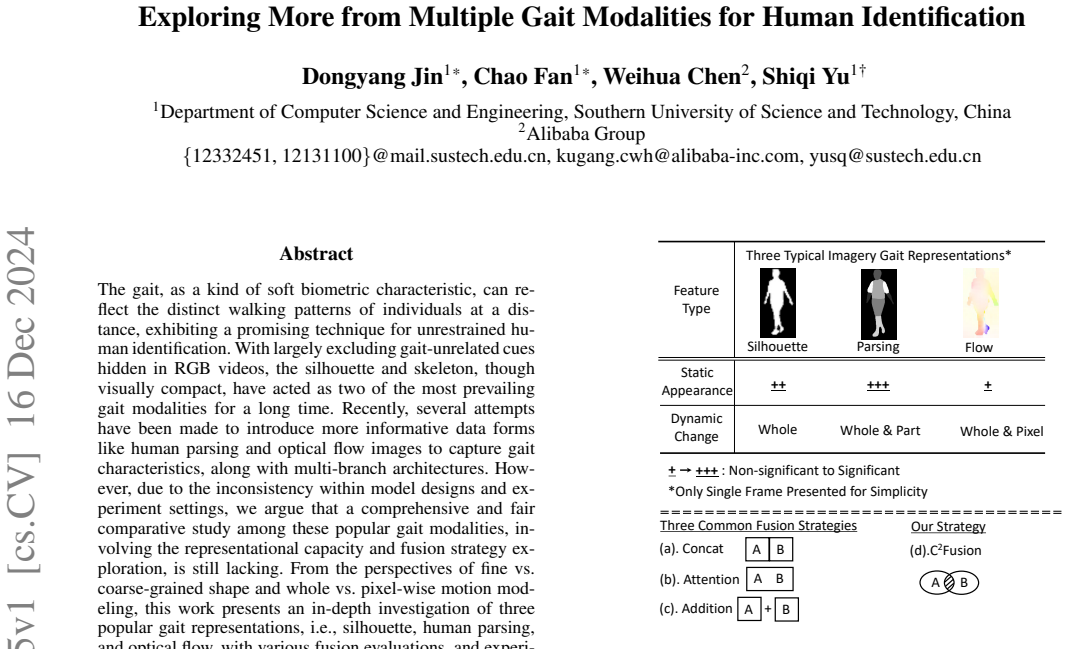
On the paper's own terms, the central discovery is that silhouette, human parsing, and optical flow are complementary, and that a fusion rule which explicitly separates shared from unique content can exploit that complementarity. The comparative study shows parsing alone does not beat silhouette, yet adding parsing to silhouette gives a large gain that is nearly independent of fusion mechanism or location; flow alone is competitive with silhouette and contributes most when fused at a high level. MultiGait++ embodies the resulting rules: an appearance branch takes silhouette and parsing concatenated at the input, a motion branch takes optical flow, and a C2 module derives a common-attention mask and a different-attention mask, forming a third common branch while sharpening the modality branches. The paper claims this integrated approach outperforms every compared method on four benchmarks, including the strongest prior multimodal baseline.
Load-bearing premise
The method depends on two external pretrained programs, one that labels body parts and one that estimates motion, to produce its extra input images; if those programs give poor results on a new dataset, the fusion gains will shrink or disappear.
Editorial extensions
If this is right
- Adding body parsing and optical flow to a strong silhouette network can raise top-match identification accuracy by several points on clothing-changing and real-world gait datasets, with only about 10–15% extra computation in the recognition stage.
- Fusion location is not a free choice: silhouette and parsing, being homogeneous, should be merged at the input, while silhouette and flow, being heterogeneous, should be merged at a high level.
- On datasets that lack parsing or flow, the same C2 strategy adapts to two-branch inputs (silhouette plus flow on GREW, silhouette plus parsing on Gait3D) and still reports the best known accuracy.
- The common-versus-different decomposition is the active mechanism: removing either mask lowers accuracy, and keeping both outperforms naive concatenation of the same three modalities.
Reading between the lines
- Because the parsing and flow inputs come from external pretrained extractors, the reported gains are only as good as those extractors; fine-tuning them on the target dataset or training the fusion end-to-end is a natural next test.
- The same common-versus-different decomposition could serve as a generic multimodal fusion prior beyond gait—for example, face-plus-body or RGB-plus-depth identification—though the paper only demonstrates it for gait.
- The paper's own experiment of appending skeleton maps by input concatenation shows saturation; a more promising route, consistent with its fusion logic, would be to feed the skeleton through a second C2-style module.
Editorial analysis
A structured set of objections, weighed in public.
Referee Report
Summary. The paper studies three image-based gait modalities—binary silhouette, human parsing, and optical flow—under a uniform DeepGaitV2 backbone. It introduces the MultiGait series of uni- and multi-modal baselines, evaluates fusion at input, middle, and high levels with concatenation, addition, and attention mechanisms, and draws conclusions about the homogeneity of silhouette+parsing versus the complementarity of silhouette+flow. Based on these observations, the authors propose C2Fusion, a module that extracts a common attention mask across branches and uses its complement to emphasize branch-specific features, leading to a three-branch model called MultiGait++. Experiments on SUSTech1K, CCPG, GREW, and Gait3D report state-of-the-art results, with additional ablations and a parameter/FLOP analysis in the supplementary material.
Significance. If the central claim holds, the paper makes a useful empirical contribution: it provides one of the first fair, apples-to-apples comparisons of three popular gait modalities and shows consistent gains from multimodal fusion on multiple benchmarks. The strength of the paper is its breadth: Table 1 alone contains 18 fusion configurations, the implementation follows official protocols, the code is released, and the supplementary reports a full pipeline cost table (Table 7) rather than only recognition FLOPs. However, the specific novelty of C2Fusion is not yet established: the main comparison is not capacity-controlled, Equation (1) is described as cross-attention despite being per-branch SE gating, and several architecture choices are selected using the same SUSTech1K test set on which the final method is evaluated. These issues are fixable and do not invalidate the empirical study, but they must be addressed before the causal claim about C2Fusion can be accepted.
major comments (4)
- [MultiGait++ / Table 6] The headline comparison MultiGait++ (row d) versus its baseline MultiGaits+p+f (row a) is not capacity-matched. MultiGait++ introduces a third learnable common branch that contains Stage2 and Stage3 (Figure 3b), whereas MultiGaits+p+f fuses only the appearance and motion branches (Figure 3c). The ablations in rows (b) and (c) remove the mco or mdi masks but keep the extra branch, so they cannot separate the effect of the C2 masking from the effect of the added parameters and FLOPs. Because the reported gains over the baseline are modest (86.0 to 87.4 on SUSTech1K, 85.5 to 87.6 on CCPG, 91.4 to 93.4 on GREW, 83.0 to 85.4 on Gait3D), a capacity-matched control is required to support the causal claim that C2Fusion, rather than additional model capacity, is responsible for the improvements. A control could be a common branch whose features are combined by plain addition or concatenation without mco/mdi, or a two-branch model matched in parameters and FLOPs.
- [Equation (1) and Figure 3(a)] The operation described as 'cross-attention' is in fact two independent squeeze-and-excitation mappings E_ap and E_mo followed by an element-wise softmax; there is no query-key interaction between the two branches. Calling this cross-attention overstates the mechanism and makes the common/different-concerns interpretation less direct. The text and figure should either be changed to 'attention' or 'gating', or a genuine cross-branch attention (for example, one branch's attention map conditioned on the other branch's features) should be used and justified.
- [Method / Table 1] The fusion-location and fusion-mechanism conclusions (input-level fusion for silhouette+parsing, high-level fusion for silhouette+flow) are read from the SUSTech1K results in Table 1, and the final MultiGait++ model is then evaluated on the same SUSTech1K test protocol in Table 3. This creates a selection-on-test risk for the architecture choices. To support the claim that the design principles generalize, the authors should either use a held-out validation split for choosing fusion locations and mechanisms, or validate the chosen configuration on an independent dataset before reporting final SUSTech1K numbers.
- [Experimental reporting / Tables 3-5] All results are single-run numbers without variance estimates. Differences of one to two rank-1 points (e.g., SUSTech1K 86.0 vs 87.4, or the CL subset 50.4 vs 44.2 in Table 3) are small relative to typical training variance in gait recognition, so the consistency of the gains cannot be assessed. The authors should report means and standard deviations over at least three random seeds, or otherwise provide a justification for why repeated-run variance is negligible under the official protocol.
minor comments (5)
- [Introduction] The Introduction refers to 'Figure 4' for the three modalities and the three fusion strategies, but Figure 4 appears in the supplementary material; the main-text figure references should be renumbered consistently (the intended references appear to be Figures 1 and 2).
- [Table 4] Table 4 contains typos: 'GaitGrapgh2' should be 'GaitGraph2', and the GaitSet row contains '65,1' instead of '65.1'.
- [Table 6] The caption of Table 6 does not define all rows: (a) is called MultiGaits+p+f and (d) MultiGait++, but rows (b) and (c) are described only in the text. Please state in the caption which components are present in each row, especially whether the common branch is retained.
- [More Results on Other Real-world Datasets] The two-branch variants MultiGait++s+f and MultiGait++s+p used on GREW and Gait3D are not specified precisely. The paper only says the model is 'modified'; please provide the exact input assignment, whether the C2 module and common branch are unchanged, and the training hyperparameters for those datasets.
- [Equation (3)] The common-branch feature is formed as (f_ap + f_mo)/2 * mco; if f_ap and f_mo have different scales after their respective refinements, the fixed averaging should be justified or replaced by a learned combination.
Circularity Check
No significant circularity: MultiGait++ is an empirical architecture paper with externally validated ablations and no derivation that reduces to its inputs.
full rationale
The paper makes no first-principles derivation. C2Fusion is defined by explicit masks (Eqs. 1-4) computed from the modality features themselves; this is a feature-reweighting construction, not a prediction that assumes its conclusion. The claimed gains are empirical comparisons against MultiGaits+p+f and other baselines on four datasets. The SUSTech1K table was used to choose fusion locations and mechanisms before reporting the final SUSTech1K evaluation, which is a test-set-selection concern rather than a definitional circularity, and the same design also improves CCPG, GREW, and Gait3D, providing external evidence. Self-citations to OpenGait/DeepGaitV2/SkeletonGait++ supply code and backbone components, but no load-bearing uniqueness theorem or fitted parameter is disguised as a prediction. Therefore no circular step can be exhibited.
Assumptions & free parameters
free parameters (1)
- SE squeeze rate =
16
assumptions (3)
- ad hoc to paper Similar attention activations between branches imply shared gait features, and their complement highlights identity-relevant differences.
- domain assumption Human parsing from QANet and optical flow from VideoFlow are accurate enough on the test datasets, and silhouette-masked flow removes background noise.
- domain assumption Silhouette masking of RGB before optical flow computation removes background noise without removing gait cues.
Cite this review
Pith. "Pith review of Exploring More from Multiple Gait Modalities for Human Identification." pith.science (2026). https://pith.science/paper/HDQ2GQOB
@misc{pith2026241211495,
  author       = {Pith},
  title        = {Pith review of: Exploring More from Multiple Gait Modalities for Human Identification},
  year         = {2026},
  howpublished = {\url{https://pith.science/paper/HDQ2GQOB}},
  note         = {Machine review of arXiv:2412.11495}
}
abstract
The gait, as a kind of soft biometric characteristic, can reflect the distinct walking patterns of individuals at a distance, exhibiting a promising technique for unrestrained human identification. With largely excluding gait-unrelated cues hidden in RGB videos, the silhouette and skeleton, though visually compact, have acted as two of the most prevailing gait modalities for a long time. Recently, several attempts have been made to introduce more informative data forms like human parsing and optical flow images to capture gait characteristics, along with multi-branch architectures. However, due to the inconsistency within model designs and experiment settings, we argue that a comprehensive and fair comparative study among these popular gait modalities, involving the representational capacity and fusion strategy exploration, is still lacking. From the perspectives of fine vs. coarse-grained shape and whole vs. pixel-wise motion modeling, this work presents an in-depth investigation of three popular gait representations, i.e., silhouette, human parsing, and optical flow, with various fusion evaluations, and experimentally exposes their similarities and differences. Based on the obtained insights, we further develop a C$^2$Fusion strategy, consequently building our new framework MultiGait++. C$^2$Fusion preserves commonalities while highlighting differences to enrich the learning of gait features. To verify our findings and conclusions, extensive experiments on Gait3D, GREW, CCPG, and SUSTech1K are conducted. The code is available at https://github.com/ShiqiYu/OpenGait.
Figures


Figures from the paper (1 more)

Forward citations
Cited by 1 Pith paper
-
On Denoising Walking Videos for Gait Recognition
DenoisingGait combines frozen Stable Diffusion features with learned direction-vector matching to create Gait Feature Fields, reporting new state-of-the-art rank-1 accuracy on CCPG and most settings of CASIA-B*, SUSTech1K.
Reference graph
Works this paper leans on
-
[1]
, " * write output.state after.block = add.period write newline
ENTRY address archivePrefix author booktitle chapter edition editor eid eprint howpublished institution isbn journal key month note number organization pages publisher school series title type volume year label extra.label sort.label short.list INTEGERS output.state before.all mid.sentence after.sentence after.block FUNCTION init.state.consts #0 'before.a...
-
[2]
write newline
" write newline "" before.all 'output.state := FUNCTION n.dashify 't := "" t empty not t #1 #1 substring "-" = t #1 #2 substring "--" = not "--" * t #2 global.max substring 't := t #1 #1 substring "-" = "-" * t #2 global.max substring 't := while if t #1 #1 substring * t #2 global.max substring 't := if while FUNCTION word.in bbl.in capitalize " " * FUNCT...
-
[3]
Butler, D. J.; Wulff, J.; Stanley, G. B.; and Black, M. J. 2012. A naturalistic open source movie for optical flow evaluation. In Computer Vision--ECCV 2012: 12th European Conference on Computer Vision, Florence, Italy, October 7-13, 2012, Proceedings, Part VI 12, 611--625. Springer
work page 2012
-
[4]
M.; Delgado-Esca \ n o, R.; Hern \'a ndez-Garc \' a, R.; Mar \' n-Jim \'e nez, M
Castro, F. M.; Delgado-Esca \ n o, R.; Hern \'a ndez-Garc \' a, R.; Mar \' n-Jim \'e nez, M. J.; and Guil, N. 2024. AttenGait: Gait recognition with attention and rich modalities. Pattern Recognition, 148: 110171
work page 2024
-
[5]
Chao, H.; Wang, K.; He, Y.; Zhang, J.; and Feng, J. 2022. GaitSet: Cross-View Gait Recognition Through Utilizing Gait As a Deep Set. IEEE Transactions on Pattern Analysis and Machine Intelligence, 44(7): 3467--3478
work page 2022
-
[6]
Fan, C.; Hou, S.; Huang, Y.; and Yu, S. 2023 a . Exploring Deep Models for Practical Gait Recognition. arXiv preprint arXiv:2303.03301
arXiv 2023
-
[7]
Fan, C.; Hou, S.; Liang, J.; Shen, C.; Ma, J.; Jin, D.; Huang, Y.; and Yu, S. 2024 a . OpenGait: A Comprehensive Benchmark Study for Gait Recognition towards Better Practicality. arXiv preprint arXiv:2405.09138
arXiv 2024
-
[8]
Fan, C.; Hou, S.; Wang, J.; Huang, Y.; and Yu, S. 2023 b . Learning gait representation from massive unlabelled walking videos: A benchmark. IEEE Transactions on Pattern Analysis and Machine Intelligence
work page 2023
Show all 53 references
-
[9]
Fan, C.; Liang, J.; Shen, C.; Hou, S.; Huang, Y.; and Yu, S. 2023 c . OpenGait: Revisiting Gait Recognition Towards Better Practicality. In Proceedings of the IEEE/CVF Conference on Computer Vision and Pattern Recognition (CVPR), 9707--9716
2023
-
[10]
Fan, C.; Ma, J.; Jin, D.; Shen, C.; and Yu, S. 2024 b . SkeletonGait: Gait Recognition Using Skeleton Maps. In Proceedings of the AAAI Conference on Artificial Intelligence, volume 38, 1662--1669
2024
-
[11]
Fan, C.; Peng, Y.; Cao, C.; Liu, X.; Hou, S.; Chi, J.; Huang, Y.; Li, Q.; and He, Z. 2020. GaitPart : Temporal part-based model for gait recognition. In Proceedings of the IEEE/CVF conference on computer vision and pattern recognition, 14225--14233
2020
-
[12]
Feng, Y.; Yuan, J.; and Fan, L. 2023. GaitFusion: Exploring the Fusion of Silhouettes and Optical Flow for Gait Recognition. In Iliadis, L.; Papaleonidas, A.; Angelov, P.; and Jayne, C., eds., Artificial Neural Networks and Machine Learning -- ICANN 2023, 88--99. Cham: Springe...
2023
-
[13]
Gong, K.; Liang, X.; Li, Y.; Chen, Y.; Yang, M.; and Lin, L. 2018. Instance-level human parsing via part grouping network. In Proceedings of the European conference on computer vision (ECCV), 770--785
2018
-
[14]
Guo, W.; Liang, Y.; Pan, Z.; Xi, Z.; Feng, J.; and Zhou, J. 2025. Camera-LiDAR Cross-modality Gait Recognition. In European Conference on Computer Vision, 439--455. Springer
2025
-
[15]
Li, W.; Hou, S.; Zhang, C.; Cao, C.; Liu, X.; Huang, Y.; and Zhao, Y. 2023. An In-Depth Exploration of Person Re-Identification and Gait Recognition in Cloth-Changing Conditions. In Proceedings of the IEEE/CVF Conference on Computer Vision and Pattern Recognition, 13824--13833
2023
-
[16]
Li, X.; Makihara, Y.; Xu, C.; Yagi, Y.; Yu, S.; and Ren, M. 2020. End-to-end model-based gait recognition. In Proceedings of the Asian Conference on Computer Vision
2020
-
[17]
Liang, J.; Fan, C.; Hou, S.; Shen, C.; Huang, Y.; and Yu, S. 2022. GaitEdge: Beyond Plain End-to-End Gait Recognition for Better Practicality. In Computer Vision -- ECCV 2022
2022
-
[18]
B.; Yu, S.; and Huang, Y
Liao, R.; Cao, C.; Garcia, E. B.; Yu, S.; and Huang, Y. 2017. Pose-based temporal-spatial network (PTSN) for gait recognition with carrying and clothing variations. In Chinese conference on biometric recognition, 474--483. Springer
2017
-
[19]
Liao, R.; Yu, S.; An, W.; and Huang, Y. 2020. A model-based gait recognition method with body pose and human prior knowledge. Pattern Recognition, 98: 107069
2020
-
[20]
Lin, B.; Zhang, S.; Wang, M.; Li, L.; and Yu, X. 2022. Gaitgl: Learning discriminative global-local feature representations for gait recognition. arXiv preprint arXiv:2208.01380
2022 arXiv
-
[21]
Lin, B.; Zhang, S.; and Yu, X. 2021. Gait recognition via effective global-local feature representation and local temporal aggregation. In Proceedings of the IEEE/CVF International Conference on Computer Vision, 14648--14656
2021
-
[22]
Luo, H.; Gu, Y.; Liao, X.; Lai, S.; and Jiang, W. 2019. Bag of tricks and a strong baseline for deep person re-identification. In Proceedings of the IEEE/CVF conference on computer vision and pattern recognition workshops, 0--0
2019
-
[23]
Menze, M.; and Geiger, A. 2015. Object scene flow for autonomous vehicles. In Proceedings of the IEEE conference on computer vision and pattern recognition, 3061--3070
2015
-
[24]
S.; and Carter, J
Nixon, M. S.; and Carter, J. N. 2006. Automatic recognition by gait. Proceedings of the IEEE, 94(11): 2013--2024
2006
-
[25]
Peng, Y.; Ma, K.; Zhang, Y.; and He, Z. 2024. Learning rich features for gait recognition by integrating skeletons and silhouettes. Multimedia Tools and Applications, 83(3): 7273--7294
2024
-
[26]
Q.; and Yu, S
Shen, C.; Fan, C.; Wu, W.; Wang, R.; Huang, G. Q.; and Yu, S. 2023 a . LidarGait: Benchmarking 3D Gait Recognition With Point Clouds. In Proceedings of the IEEE/CVF Conference on Computer Vision and Pattern Recognition (CVPR), 1054--1063
2023
-
[27]
Q.; and Yu, S
Shen, C.; Lin, B.; Zhang, S.; Yu, X.; Huang, G. Q.; and Yu, S. 2023 b . Gait recognition with mask-based regularization. In 2023 IEEE International Joint Conference on Biometrics (IJCB), 1--10. IEEE
2023
-
[28]
Q.; and Wang, L
Shen, C.; Yu, S.; Wang, J.; Huang, G. Q.; and Wang, L. 2024. A Comprehensive Survey on Deep Gait Recognition: Algorithms, Datasets, and Challenges. IEEE Transactions on Biometrics, Behavior, and Identity Science
2024
-
[29]
C.; See, S.; Qin, H.; Dai, J.; and Li, H
Shi, X.; Huang, Z.; Bian, W.; Li, D.; Zhang, M.; Cheung, K. C.; See, S.; Qin, H.; Dai, J.; and Li, H. 2023. Videoflow: Exploiting temporal cues for multi-frame optical flow estimation. arXiv preprint arXiv:2303.08340
2023 arXiv
-
[30]
Takemura, N.; Makihara, Y.; Muramatsu, D.; Echigo, T.; and Yagi, Y. 2018. Multi-view large population gait dataset and its performance evaluation for cross-view gait recognition. IPSJ Transactions on Computer Vision and Applications, 10
2018
-
[31]
Teepe, T.; Gilg, J.; Herzog, F.; H \"o rmann, S.; and Rigoll, G. 2022. Towards a deeper understanding of skeleton-based gait recognition. In Proceedings of the IEEE/CVF Conference on Computer Vision and Pattern Recognition, 1569--1577
2022
-
[32]
Teepe, T.; Khan, A.; Gilg, J.; Herzog, F.; H \"o rmann, S.; and Rigoll, G. 2021. GaitGraph: graph convolutional network for skeleton-based gait recognition. In 2021 IEEE International Conference on Image Processing (ICIP), 2314--2318. IEEE
2021
-
[33]
Q.; and Yu, S
Wang, R.; Shen, C.; Fan, C.; Huang, G. Q.; and Yu, S. 2023 a . PointGait: Boosting End-to-End 3D Gait Recognition with Point Clouds via Spatiotemporal Modeling. In 2023 IEEE International Joint Conference on Biometrics (IJCB), 1--10. IEEE
2023
-
[34]
J.; Huang, G
Wang, R.; Shen, C.; Marin-Jimenez, M. J.; Huang, G. Q.; and Yu, S. 2024 a . Cross-Modality Gait Recognition: Bridging LiDAR and Camera Modalities for Human Identification. arXiv preprint arXiv:2404.04120
2024 arXiv
-
[35]
Wang, Y.; Zhang, X.; Shen, Y.; Du, B.; Zhao, G.; Cui, L.; and Wen, H. 2022. Event-Stream Representation for Human Gaits Identification Using Deep Neural Networks. IEEE Transactions on Pattern Analysis and Machine Intelligence, 44(7): 3436--3449
2022
-
[36]
Wang, Z.; Hou, S.; Zhang, M.; Liu, X.; Cao, C.; and Huang, Y. 2023 b . GaitParsing: Human Semantic Parsing for Gait Recognition. IEEE Transactions on Multimedia
2023
-
[37]
Wang, Z.; Hou, S.; Zhang, M.; Liu, X.; Cao, C.; Huang, Y.; Li, P.; and Xu, S. 2024 b . QAGait: Revisit Gait Recognition from a Quality Perspective. In Proceedings of the AAAI Conference on Artificial Intelligence, volume 38, 5785--5793
2024
-
[38]
Xia, F.; Wang, P.; Chen, X.; and Yuille, A. L. 2017. Joint multi-person pose estimation and semantic part segmentation. In Proceedings of the IEEE conference on computer vision and pattern recognition, 6769--6778
2017
-
[39]
Xu, C.; Makihara, Y.; Li, X.; and Yagi, Y. 2023. Gait recognition from fisheye images. In Proceedings of the IEEE/CVF Conference on Computer Vision and Pattern Recognition, 1030--1040
2023
-
[40]
Xu, J.; Li, H.; and Hou, S. 2023. Attention-based gait recognition network with novel partial representation PGOFI based on prior motion information. Digital Signal Processing, 133: 103845
2023
-
[41]
Yang, L.; Song, Q.; Wang, Z.; Liu, Z.; Xu, S.; and Li, Z. 2022. Quality-aware network for human parsing. IEEE Transactions on Multimedia
2022
-
[42]
Ye, D.; Fan, C.; Ma, J.; Liu, X.; and Yu, S. 2024. BigGait: Learning Gait Representation You Want by Large Vision Models. arXiv preprint arXiv:2402.19122
2024 arXiv
-
[43]
Ye, H.; Sun, T.; and Xu, K. 2023. Gait Recognition Based on Gait Optical Flow Network with Inherent Feature Pyramid. Applied Sciences, 13(19): 10975
2023
-
[44]
Zhang, C.; Chen, X.-P.; Han, G.-Q.; and Liu, X.-J. 2023. Spatial transformer network on skeleton-based gait recognition. Expert Systems, e13244
2023
-
[45]
Zheng, J.; Liu, X.; Liu, W.; He, L.; Yan, C.; and Mei, T. 2022 a . Gait Recognition in the Wild with Dense 3D Representations and A Benchmark. In IEEE Conference on Computer Vision and Pattern Recognition (CVPR)
2022
-
[46]
Zheng, J.; Liu, X.; Liu, W.; He, L.; Yan, C.; and Mei, T. 2022 b . Gait recognition in the wild with dense 3d representations and a benchmark. In Proceedings of the IEEE/CVF Conference on Computer Vision and Pattern Recognition, 20228--20237
2022
-
[47]
Zheng, J.; Liu, X.; Wang, S.; Wang, L.; Yan, C.; and Liu, W. 2023. Parsing is All You Need for Accurate Gait Recognition in the Wild. In Proceedings of the 31st ACM International Conference on Multimedia, 116--124
2023
-
[48]
Zheng, J.; Liu, X.; Zhang, B.; Yan, C.; Zhang, J.; Liu, W.; and Zhang, Y. 2024. It Takes Two: Accurate Gait Recognition in the Wild via Cross-granularity Alignment. In Proceedings of the 32nd ACM International Conference on Multimedia, 8786--8794
2024
-
[49]
Zhou, B.; Khosla, A.; Lapedriza, A.; Oliva, A.; and Torralba, A. 2016. Learning deep features for discriminative localization. In Proceedings of the IEEE conference on computer vision and pattern recognition, 2921--2929
2016
-
[50]
Zhu, H.; Zheng, W.; Zheng, Z.; and Nevatia, R. 2023. Gaitref: Gait recognition with refined sequential skeletons. In 2023 IEEE International Joint Conference on Biometrics (IJCB), 1--10. IEEE
2023
-
[51]
Zhu, Z.; Guo, X.; Yang, T.; Huang, J.; Deng, J.; Huang, G.; Du, D.; Lu, J.; and Zhou, J. 2021. Gait Recognition in the Wild: A Benchmark. In Proceedings of the IEEE/CVF International Conference on Computer Vision, 14789--14799
2021
-
[52]
Zou, S.; Fan, C.; Xiong, J.; Shen, C.; Yu, S.; and Tang, J. 2024 a . Cross-Covariate Gait Recognition: A Benchmark. In Proceedings of the AAAI Conference on Artificial Intelligence, volume 38, 7855--7863
2024
-
[53]
Zou, S.; Xiong, J.; Fan, C.; Shen, C.; Yu, S.; and Tang, J. 2024 b . A multi-stage adaptive feature fusion neural network for multimodal gait recognition. IEEE Transactions on Biometrics, Behavior, and Identity Science
2024
Reviewed August 11, 2026 · model on record in the stance chip above.
Discussion (0). Continue with ORCID to comment.