REVIEW 2 major objections 5 minor 106 references
Fractional Langevin equation far from equilibrium: Riemann-Liouville fractional Brownian motion, spurious nonergodicity and aging
T0 review · 2 major / 5 minor · reviewed 2026-08-11 · deepseek-v4-flash
Pith's one-line read For the fractional Langevin equation far from equilibrium, the time-averaged mean-squared displacement converges to the mean-squared increment rather than the mean-squared displacement in the regime $1/2<\alpha<3/2$—spurious nonergodicity…
desk verdict Solid fractional-α results, but the 'any α>1/2' claim misses the ordinary Brownian exception at α=1. read the letter →
The pith
A machine-rendered reading of the paper's core claim, the machinery that carries it, and where it could break.
The reading
What carries the argument
The object carrying the argument is Riemann-Liouville fractional Brownian motion (RL-FBM, also called FBM II), defined as the fractional integral of white noise, $x(t)=\sqrt{2K_\alpha}\int_0^t \frac{(t-t')^{\alpha-1}}{\Gamma(\alpha)}\xi(t')dt'$, which is the zero-initial-condition solution of the FLEFE. The derivational machinery is the asymptotic expansion of the Fox H-function, reached through the hypergeometric form $_2F_1$, in Appendices A and B. The load-bearing identity is the long-time stationary limit of the MSI integral, $\int_0^\infty [(1+s)^{\alpha-1}-s^{\alpha-1}]^2\,ds+\frac{1}{2\alpha-1}=\frac{\Gamma(\alpha)^2}{\Gamma(2\alpha)|\cos(\pi\alpha)|}$ for $1/2<\alpha<3/2$, which produces the spurious-nonergodicity prefactor; the power-logarithmic variant of the H-function expansion handles the borderline case $\alpha=3/2$.
What would settle it
Simulate RL-FBM trajectories via the discretized integral in Appendix C for $\alpha=0.8$ and $\alpha=1.2$; fix a small lag $\Delta$ and measure the ratio $\langle\delta^2(\Delta)\rangle/\langle x^2(\Delta)\rangle$ as $T/\Delta$ grows. The paper's claim requires this ratio to tend to $R(\alpha)=\frac{(2\alpha-1)\Gamma(\alpha)^2}{\Gamma(2\alpha)|\cos(\pi\alpha)|}$ (about 1.12 for $\alpha=0.8$) rather than to 1. Equivalently, for $\alpha>3/2$ the mean TAMSD must scale as $T^{2\alpha-3}\Delta^2$ and not converge to the MSD; a direct evaluation of the exact H-function expression (41) that shows convergence to the MSD for large $T$ would falsify the central claim.
Extended reading notes
Core claim
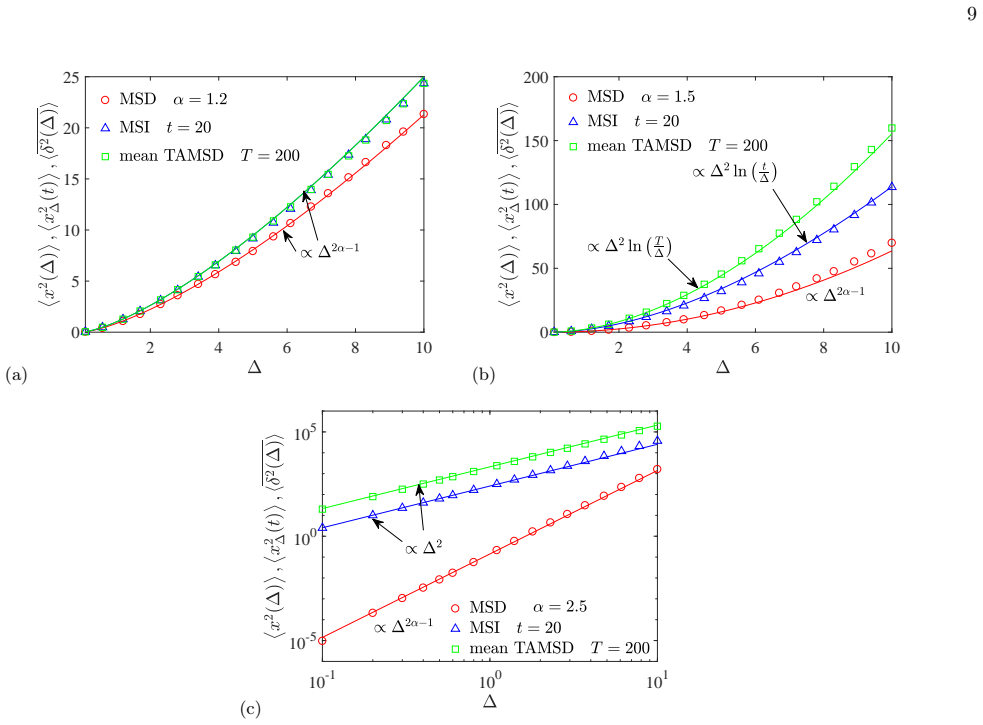
The central discovery is that RL-FBM, the solution of the FLEFE, displays spurious nonergodicity. For all $\alpha>1/2$ the mean TAMSD and the MSD do not coincide even in the limit of long trajectories; specifically, for $1/2<\alpha<3/2$ the mean TAMSD converges to the stationary MSI, $\langle\delta^2(\Delta)\rangle\sim \langle x^2_\Delta(t)\rangle\sim \frac{2K_\alpha}{\Gamma(2\alpha)|\cos(\pi\alpha)|}\Delta^{2\alpha-1}$, which differs from the MSD $\langle x^2(t)\rangle = \frac{2K_\alpha}{(2\alpha-1)\Gamma(\alpha)^2} t^{2\alpha-1}$ by the factor $R(\alpha)=\frac{(2\alpha-1)\Gamma(\alpha)^2}{\Gamma(2\alpha)|\cos(\pi\alpha)|}$. Since the increments become asymptotically stationary in this regime, the TAMSD-to-MSI convergence is the physically appropriate ergodic criterion, and the TAMSD-to-MSD mismatch is therefore spurious. For $\alpha\geq 3/2$, the first-order increments are not ergodic, but the $(n+1)$th-order increments restore stationarity in the bands $(2n+1)/2<\alpha<(2n+3)/2$; under strong aging ($t_a\gg T$) the aged MSD and aged mean TAMSD coincide for $1/2<\alpha<3/2$, restoring ergodicity.
Load-bearing premise
The load-bearing premise is that the Fox H-function asymptotic expansions in Appendix B (Eqs. B9 and B14) remain valid uniformly in $\alpha$, including the special values $\alpha=1$, $\alpha=3/2$, and integer $\alpha$, with the stated cancellations of leading terms; the paper gives no error bounds or uniformity proof, so if these expansions fail in any regime the claimed prefactor in Eq. (43), and hence the spurious-nonergodicity ratio, would be affected.
Editorial extensions
If this is right
- For single-particle-tracking data, a TAMSD that does not match the MSD is not by itself evidence of nonergodicity: for processes with asymptotically stationary increments, the structure function (MSI) is the correct reference, and RL-FBM is ergodic in that sense for 1/2 < α < 3/2.
- In the regime α ≥ 3/2, ergodicity is recovered by moving to higher-order increments: the (n+1)th-order MSI becomes stationary in each band (2n+1)/2 < α < (2n+3)/2, so differentiating (or incrementing) trajectories more times restores standard ergodicity tests.
- Strong aging (t_a ≫ T) makes the aged MSD and aged TAMSD coincide and the increment autocovariance function become lag-time-only dependent for 1/2 < α < 3/2; experiments that wait long enough after preparing a system will see apparent ergodicity even though the unaged process fails the usual test.
- The FLEFE is a minimal Langevin-type model for systems that violate the fluctuation-dissipation theorem, remaining well-defined for all α > 1/2 and thus covering subdiffusive, superdiffusive, and ballistic-like regimes within one equation.
Reading between the lines
- Because the ratio R(α)=⟨δ²⟩/⟨x²⟩ = (2α−1)Γ(α)²/[Γ(2α)|cos(πα)|] is a closed-form function of α alone, an experimenter could use an observed TAMSD/MSD ratio to estimate α and to test whether a system is better described by RL-FBM than by FBM or FLE (which have R=1); the paper derives R(α) but does not propose this estimator.
- The paper does not analyze confining potentials, but its closed-form MSI and TAMSD for the free process provide the ingredients to derive corresponding results for a harmonically trapped FLEFE, which would make contact with optical-tweezer experiments.
- The strong-aging result implies that in systems where measurements start well after preparation (e.g., long climate or financial records), apparent ergodicity may reflect the aging time rather than equilibrium; distinguishing these requires varying the delay between preparation and measurement, an experimental protocol the paper does not discuss.
Editorial analysis
A structured set of objections, weighed in public.
Referee Report
Summary. This paper analyzes the fractional Langevin equation far from equilibrium (FLEFE), whose zero-initial-condition solution is Riemann-Liouville fractional Brownian motion (RL-FBM). The authors derive exact and asymptotic expressions for the MSD, the mean-squared increment (MSI), the time-averaged MSD (TAMSD), higher-order increments, and aging effects. The central claim is that for 1/2<α<3/2 the mean TAMSD does not converge to the MSD but instead to the stationary MSI, leading to ``spurious nonergodicity,'' while for α≥3/2 the first increments are nonergodic and higher-order increments restore stationarity in appropriate intervals of α. Strong aging is claimed to restore ergodicity in 1/2<α<3/2. The main results are derived via hypergeometric and H-function expansions and are compared with numerical simulations.
Significance. If the results are properly qualified, the paper is a valuable contribution: it provides closed-form expressions for central observables of RL-FBM with no fitted parameters, it draws attention to the distinction between MSD and MSI for processes with nonstationary increments, and it offers testable predictions for single-particle-tracking data. The higher-order increment stationarity and aging analysis extend the known properties of RL-FBM. The paper is self-contained, and the simulation results support the main asymptotic formulas. However, the headline universal claim fails at α=1, which is inside the stated spurious-nonergodicity interval, and the higher-order increment derivation relies on an unproved derivative approximation; both points need to be addressed before the claims can be accepted as stated.
major comments (2)
- [Abstract; Sec. IV.C; Eq. (46)] The statement that the TAMSD and MSD differ for every α>1/2, and that spurious nonergodicity occurs throughout 1/2<α<3/2, is false at α=1. At α=1 the FLEFE reduces to ordinary Brownian motion: Eq. (27) gives ⟨x²(t)⟩=2K₁t, while Eq. (33) and Eq. (43) both give 2K₁Δ, so the TAMSD equals the MSD and the ratio is 1. This is confirmed by the special case in Appendix B: Eq. (B22) yields I₁=2K₁T(1−Δ/T), which together with Eq. (B1) gives ⟨δ²(Δ)⟩=2K₁Δ. The universal quantifiers ``any α>1/2'' and ``the entire domain'' in the abstract, Sec. IV.C, and the conclusions must therefore be qualified by excluding α=1, or α=1 must be explicitly identified as the ordinary ergodic Brownian limit.
- [Sec. V; Eq. (50)] The derivation of higher-order increment stationarity rests on the approximation Δ^{(1)}x(t;τ₁) ≈ τ₁ dx(t)/dt for t≫τ₁, stated in Eq. (50), without an error estimate. Since Eq. (53), the general higher-order increment result, is a central claim, the authors should justify this replacement in the mean-square sense, for example by showing that the neglected terms are subdominant in the appropriate limit, or by deriving the second-order increment result directly from the stochastic integral representation. The numerical agreement in Fig. 3 is encouraging, but it does not replace a bound or a rigorous statement of the approximation's validity regime.
minor comments (5)
- [Title] The title contains a typo: ``Rieman n-Liouville'' should be ``Riemann-Liouville''.
- [Sec. V, text after Eq. (52)] The word ``revels'' should be ``reveals'' in the sentence describing the stationarity of the second-order increment.
- [Appendix B] The text contains the typo ``TMASD'' where ``TAMSD'' is meant; this should be corrected.
- [Fig. 2 caption] The caption says the mean TAMSD converges to the MSI ``in the strong aging limit,'' but the surrounding text concerns the long-time limit T/Δ≫1; please clarify whether aging is involved in this figure.
- [Appendix D] The sentence ``the relation δ ≫ δ is not perfectly fulfilled'' appears to contain a typo; presumably it should read ``δ ≪ Δ'' or ``δ ≪ Δ is not perfectly fulfilled.'
Circularity Check
No significant circularity; the TAMSD/MSI comparison is derived from the model's own definitions and covariance calculations, with a non-circular correctness caveat at alpha = 1.
full rationale
The derivation chain is self-contained. The FLEFE solution (23) is taken from Eab and Lim [39], but the paper's new quantities are computed directly: the MSD in Eq. (27) follows from the two-time covariance (24) and the hypergeometric formula (26); the MSI in Eqs. (28)-(30) is an explicit covariance calculation; and the mean TAMSD in Eq. (41) is the time average of that MSI. No empirical data, fitted coefficient, or assumed prefactor enters these formulas. The asymptotic reductions in Eqs. (33), (39), (43)-(46), and (B12)-(B17) are obtained from standard H-function and hypergeometric expansions, and the simulations in Figs. 1-4 are generated from the discretized integral representation (C3), so they are independent numerical checks rather than inputs. The claim that the TAMSD converges to the MSI rather than the MSD is not circular: it follows because the MSI is first shown to become t-independent (Eqs. (32)-(33)), after which the long-time average of the MSI necessarily approaches that stationary value; the MSD is a different, separately computed quantity. Self-citations such as [15], [42], and [65] supply definitions and context, but none of the central prefactors or scaling laws is justified solely by those citations. One non-circular caveat should be recorded: the universal wording in the abstract and Section IV.C that the TAMSD and MSD 'differ in the entire domain alpha > 1/2' is false at alpha = 1, where Eq. (27) and Eq. (43) both give 2*K1*Delta and the ratio equals one; this is a correctness overstatement, not a circularity. A further rigor limitation is that the Appendix B H-function expansions are used without explicit uniform-error bounds, but that affects proof completeness rather than the direction of the derivation.
Assumptions & free parameters
free parameters (2)
- K_alpha (noise intensity) =
not fitted
- alpha (fractional derivative order) =
not fitted
assumptions (6)
- domain assumption Fractional integral representation of the solution to the Caputo FDE (Eq. 22) is taken as the starting point; zero initial conditions are assumed.
- standard math Itô isometry and Gaussianity are used to compute variances and covariances.
- domain assumption The asymptotic stationarity of RL-FBM increments for 1/2<α<3/2 is inherited from Lim [41], and the paper uses it to call the MSI stationary.
- standard math H-function and hypergeometric expansion formulas from Prudnikov and Kilbas-Saigo are used without proof in Appendices A and B.
- ad hoc to paper For higher-order increments, the approximation x(t+τ)-x(t) ≈ τ dx(t)/dt is assumed for t≫τ (Eq. 50).
- domain assumption Ergodicity is assessed via the equality of mean TAMSD and MSD (Eq. 12), the conventional single-particle-tracking criterion.
Cite this review
Pith. "Pith review of Fractional Langevin equation far from equilibrium: Riemann-Liouville fractional Brownian motion, spurious nonergodicity and aging." pith.science (2026). https://pith.science/paper/TGWE25YU
@misc{pith2026241211559,
  author       = {Pith},
  title        = {Pith review of: Fractional Langevin equation far from equilibrium: Riemann-Liouville fractional Brownian motion, spurious nonergodicity and aging},
  year         = {2026},
  howpublished = {\url{https://pith.science/paper/TGWE25YU}},
  note         = {Machine review of arXiv:2412.11559}
}
abstract
We consider the fractional Langevin equation far from equilibrium (FLEFE) to describe stochastic dynamics which do not obey the fluctuation-dissipation theorem, unlike the conventional fractional Langevin equation (FLE). The solution of this equation is Riemann-Liouville fractional Brownian motion (RL-FBM), also known in the literature as FBM II. Spurious nonergodicity, stationarity, and aging properties of the solution are explored for all admissible values $\alpha>1/2$ of the order $\alpha$ of the time-fractional Caputo derivative in the FLEFE. The increments of the process are asymptotically stationary. However when $1/2<\alpha<3/2$, the time-averaged mean-squared displacement (TAMSD) does not converge to the mean-squared displacement (MSD). Instead, it converges to the mean-squared increment (MSI) or structure function, leading to the phenomenon of spurious nonergodicity. When $\alpha\ge 3/2$, the increments of FLEFE motion are nonergodic, however the higher order increments are asymptotically ergodic. We also discuss the aging effect in the FLEFE by investigating the influence of an aging time $t_a$ on the mean-squared displacement, time-averaged mean-squared displacement and autocovariance function of the increments. We find that under strong aging conditions the process becomes ergodic, and the increments become stationary in the domain $1/2<\alpha<3/2$.
Figures


Figures from the paper (1 more)

Reference graph
Works this paper leans on
-
[1]
Case 1/ 2 < α < 3/ 2 In the long time limit t ≫ ∆ , the integral in Eq. ( 28) converges as [ 67] Lα ( t ∆ ) + 1 2α − 1 ≈ ∫ ∞ 0 [ (1 + s)α −1 − sα −1] 2 ds + 1 2α − 1 = Γ( α )2 Γ(2 α )| cos(πα )| , (32) and thus we arrive at the the stationary MSI approximated as [ 41] ⟨x2 ∆ (t)⟩ ∼ 2Kα Γ(2 α )| cos(πα )| ∆ 2α −1, (33) which depends solely on the lag time ∆...
-
[2]
Case α > 3/ 2 For α > 3/ 2, the integral in Eq. ( 28) asymptotically reads Lα ( t ∆ ) = ∫ t/ ∆ 0 s2α −2[ (1 + s−1)α −1 − 1 ] 2 ds ∼ (α − 1)2 2α − 3 ( t ∆ )2α −3 , (34) and thus the MSI is given by ⟨x2 ∆ (t)⟩ ∼ 2(α − 1)2Kα (2α − 3)Γ( α )2 t2α −3∆ 2. (35) In this range of α in the FLEFE, the MSI depends ballistically on the lag time ∆ and keeps a dependence...
-
[3]
( 33) and ( 35) that the case α = 3/ 2 needs to be discussed separately
Case α = 3/ 2 Apparently, it follows from Eqs. ( 33) and ( 35) that the case α = 3/ 2 needs to be discussed separately. In this case the MSI ( 9) can be rewritten as ⟨x2 ∆ (t)⟩ = 8K3/ 2 π [ L3/ 2 ( t ∆ ) + 1 2 ] ∆ 2, (36) where the integral L3/ 2(z) can be evaluated explicitly as L3/ 2(z) = ∫ z 0 (√ 1 + s − √s )2 ds = z2 + z + 1 2 [ sinh−1(√z) − √z √ z + ...
-
[4]
( B12) in App
Case 1/ 2 < α < 3/ 2 From the derivation of Eq. ( B12) in App. B we obtain the mean TAMSD of RL-FBM in Eq. ( 41) in the long time limit T ≫ ∆ in the form ⟨ δ2(∆) ⟩ ∼ 2Kα Γ(2 α )| cos(πα )| ∆ 2α −1. (43) The mean TAMSD in this range of α deviates from the MSD ( 27) in the prefactor but has the same form as the MSI (33)
-
[5]
( B13) in App
Case α > 3/ 2 According to the derivation of Eq. ( B13) in App. B we obtain the mean TAMSD ( 41) of RL-FBM in the long time limit T ≫ ∆ as ⟨ δ2(∆) ⟩ ∼ (α − 1)Kα (2α − 3)Γ( α )2 T 2α −3∆ 2. (44) In this case the mean TAMSD depends ballistically on the lag t ime ∆ and keeps a dependence on the measurement time T with the scaling T 2α −3
-
[6]
( B14), one can obtain the approximation of the TAMSD (see the derivation of Eq
Case α = 3/ 2 Using the explicit power-logarithmic expansion of the H-function for α = 3/ 2 as shown in Eq. ( B14), one can obtain the approximation of the TAMSD (see the derivation of Eq. ( B17) in App. B for details) when T / ∆ ≫ 1, ⟨ δ2(∆) ⟩ ∼ 2K3/ 2 π ∆ 2 ln ( T ∆ ) . (45) 9 (a) 2 4 6 8 10 0 5 10 15 20 25 (b) 2 4 6 8 10 0 50 100 150 200 (c) 10-1 100 1...
2021
-
[7]
Case 1/ 2 < α < 3/ 2 For 1/ 2 < α < 3/ 2, for strong aging ( ta ≫ ∆ ) we use the following approximation for the first integral in Eq. ( D5), ∫ ta ∆ 0 qα −1(1 + q)α −3dq ≈ ∫ ∞ 0 qα −1(1 + q)α −3dq = B(α, 3 − 2α ), (D9) 22 where the (complete) Beta function is defined by [ 64] B(a, b ) = ∫ ∞ 0 sa−1(1 + s)−a−bds = Γ( a)Γ( b) Γ( a + b) . (D10) The second integ...
-
[8]
( D5) diverges as t tends to infinity
Case α > 3/ 2 For α > 3/ 2 and strong aging ( ta ≫ ∆ ), the first integral in Eq. ( D5) diverges as t tends to infinity. We rewrite the first integral in two parts, ∫ ta ∆ 0 qα −1(1 + q)α −3dq = ∫ M 0 qα −1(1 + q)α −3dq + ∫ ta ∆ M qα −1(1 + q)α −3dq, for M ≫ 1. (D13) Then the integral in Eq. ( D13) is dominated by the second term and can be approximated as ∫...
Show all 106 references
-
[9]
Case α = 3/ 2 For α = 3 / 2 the first integral in Eq. ( D5) can be solved explicitly, and for strong aging ta ≫ ∆ we find an approximation with the leading term ∫ ta/ ∆ 0 q1/ 2(q + 1)−3/ 2dq = ln (ta ∆ ) + ln ( 1 + ∆ ta ) − 2 √ ta ta + ∆ ∼ ln (ta ∆ ) . (D16) The second term in E...
-
[10]
Langevin, Sur la théorie du mouvement brownien, C
P. Langevin, Sur la théorie du mouvement brownien, C. R. A cad. Sci. 146, 530 (1908)
1908
-
[11]
W. T. Coffey, Y. P. Kalmykov, and J. T. Waldron, The Langevi n Equation: With Applications to Stochastic Problems in Physics, Chemistry and Electrical Engineering (World Scie ntific, Singapore, 2004)
2004
-
[12]
Zwanzig, Nonequilibrium Statistical Mechanics (Oxf ord University Press, New York, 2001)
R. Zwanzig, Nonequilibrium Statistical Mechanics (Oxf ord University Press, New York, 2001)
2001
-
[13]
N. G. Van Kampen, Stochastic Processes in Physics and Che mistry (North Holland, Amsterdam, 1981)
1981
-
[14]
Kubo, The fluctuation-dissipation theorem, Rep
R. Kubo, The fluctuation-dissipation theorem, Rep. Prog . Phys. 29, 255 (1966)
1966
-
[15]
Y. L. Klimontovich, Statistical Theory of Open Systems V olume 1: A Unified Approach to Kinetic Description of Process es in Active Systems (Springer, Berlin, 1995)
1995
-
[16]
Klages, G
R. Klages, G. Radons, and I. M. Sokolov, Anomalous Transp ort (Wiley-VCH Verlag, Berlin, 2008)
2008
-
[17]
Pękalski and K
A. Pękalski and K. Sznajd-Weron, Anomalous Diffusion: Fr om Basics to Applications (Springer, Berlin, 1999)
1999
-
[18]
L. R. Evangelista and E. K. Lenzi, An Introduction to Anom alous Diffusion and Relaxation (Springer Nature, Cham, CH, 2023)
2023
-
[19]
M. M. Meerschaert and A. Sikorskii, Stochastic Models f or Fractional Calculus (Walter de Gruyter GmbH, Berlin, 201 9)
-
[20]
J. P. Bouchaud and A. Georges, Anomalous diffusion in dis ordered media: statistical mechanisms, models and physica l applications, Phys. Rep. 195, 127 (1990)
1990
-
[21]
Metzler and J
R. Metzler and J. Klafter, The random walk’s guide to ano malous diffusion: A fractional dynamics approach, Phys. Rep . 339, 1 (2000)
2000
-
[22]
I. M. Sokolov, Models of anomalous diffusion in crowded e nvironments, Soft Matter 8, 9043 (2012)
2012
-
[23]
Höfling and T
F. Höfling and T. Franosch, Anomalous transport in the cr owded world of biological cells, Rep. Prog. Phys. 76, 046602 (2013)
2013
-
[24]
Metzler, J.-H
R. Metzler, J.-H. Jeon, A. G. Cherstvy, and E. Barkai, An omalous diffusion models and their properties: nonstationa rity, non-ergodicity, and ageing at the centenary of single parti cle tracking, Phys. Chem. Chem. Phys. 16, 24128 (2014)
2014
-
[25]
A. N. Kolmogorov, Wienersche Spiralen und einige ander e interessante Kurven im Hilbertschen Raum, C. R. (Doklady) Acad. Sci. URSS (N. S.) 26, 115 (1940)
1940
-
[26]
B. B. Mandelbrot and J. W. Van Ness, Fractional Brownian motions, fractional noises and applications, SIAM Rev. 10, 422 (1968)
1968
-
[27]
Qian, Fractional Brownian motion and Fractional Gau ssian Noise, Processes with Long-Range Correlations: Theo ry and Applications, Lecture Notes in Physics Vol
H. Qian, Fractional Brownian motion and Fractional Gau ssian Noise, Processes with Long-Range Correlations: Theo ry and Applications, Lecture Notes in Physics Vol. 621 (Spring er-Verlag, Berlin, 2003)
2003
-
[28]
S. C. Weber, A. J. Spakowitz, and A. J. Theriot, Bacteria l chromosomal loci move subdiffusively through a viscoelast ic cytoplasm, Phys. Rev. Lett. 104, 238102 (2010)
2010
-
[29]
J.-H. Jeon, V. Tejedor, S. Burov, E. Barkai, C. Selhuber -Unkel, K. Berg-Sørensen, L. Oddershede, and R. Metzler, In vivo anomalous diffusion and weak ergodicity breaking of lipid gr anules, Phys. Rev. Lett. 106, 048103 (2011)
2011
-
[30]
Weiss, Single-particle tracking data reveal antico rrelated fractional Brownian motion in crowded fluids, Phys
M. Weiss, Single-particle tracking data reveal antico rrelated fractional Brownian motion in crowded fluids, Phys . Rev. E 88, 010101 (2013). 24
2013
-
[31]
Szymanski and M
J. Szymanski and M. Weiss, Elucidating the origin of ano malous diffusion in crowded fluids, Phys. Rev. Lett. 103, 038102 (2009)
2009
-
[32]
O. Vilk, E. Aghion, T. A vgar, C. Beta, O. Nagel, A. Sabri, R. Sarfati, D. K. Schwartz, M. Weiss, and D. Krapf, Unravelli ng the origins of anomalous diffusion: From molecules to migrat ing storks, Phys. Rev. Res. 4, 033055 (2022)
2022
-
[33]
Janušonis, J
S. Janušonis, J. H. Haiman, R. Metzler, and T. Vojta, Pre dicting the distribution of serotonergic axons: A supercom puting simulation of reflected fractional Brownian motion in a 3D-m ouse brain model, Front. Comput. Neurosci. 17, 1189853 (2023)
2023
-
[34]
Janušonis, N
S. Janušonis, N. Detering, R. Metzler, and T. Vojta, Ser otonergic axons as fractional brownian motion paths: insig hts into the self-organization of regional densities, Front. Compu t. Neurosci. 14, 56 (2020)
2020
-
[35]
Comte and E
F. Comte and E. Renault, Long memory in continuous-time stochastic volatility models, Math. Fin. 8, 291 (1998)
1998
-
[36]
Marinucci and P
D. Marinucci and P. M. Robinson, Alternative forms of fr actional Brownian motion, J. Stat. Plan. Infer. 80, 111 (1999)
1999
-
[37]
Gatheral, T
J. Gatheral, T. Jaisson, and M. Rosenbaum, Volatility i s rough, Quant. Fin. 18, 933 (2018)
2018
-
[38]
Mori, Transport, collective motion, and Brownian mo tion, Prog
H. Mori, Transport, collective motion, and Brownian mo tion, Prog. Theor. Phys. 33, 423 (1965)
1965
-
[39]
Panja, Generalized Langevin equation formulation f or anomalous polymer dynamics, J
D. Panja, Generalized Langevin equation formulation f or anomalous polymer dynamics, J. Stat. Mech. 2010, L02001 (2010)
2010
-
[40]
S. C. Kou, Stochastic modeling in nanoscale biophysics : Subdiffusion within proteins, Ann. Appl. Stat. 2, 501 (2008)
2008
-
[41]
Lutz, Fractional Langevin equation, Phys
E. Lutz, Fractional Langevin equation, Phys. Rev. E 64, 051106 (2001)
2001
-
[42]
W. H. Deng and E. Barkai, Ergodic properties of fraction al Brownian-Langevin motion, Phys. Rev. E 79, 011112 (2009)
2009
-
[43]
Molina-Garcia, T
D. Molina-Garcia, T. Sandev, H. Pagnini, A. Chechkin an d R. Metzler, Crossover from anomalous to normal diffusion: truncated power-law noise correlations and applications t o dynamics in lipid bilayers, New J. Phys. 20, 103027 (2008)
2008
-
[44]
Caputo, Linear models of dissipation whose Q is almost frequency independent, Ann
M. Caputo, Linear models of dissipation whose Q is almost frequency independent, Ann. Geophys. 19, 383 (1966)
1966
-
[45]
Caputo, Linear models of dissipation whose Q is almost frequency independent-II, Geophys
M. Caputo, Linear models of dissipation whose Q is almost frequency independent-II, Geophys. J. Inter. 13, 529 (1967)
1967
-
[46]
Podlubny, Fractional differential equations, mathe matics in science and engineering (Academic Press, New York , 1999)
I. Podlubny, Fractional differential equations, mathe matics in science and engineering (Academic Press, New York , 1999)
1999
-
[47]
I. M. Gel’fand and G. E. Shilov, Generalized functions, Volume 1 (Academic Press, New York, 1964)
1964
-
[48]
C. H. Eab and S. C. Lim, Fractional Langevin equations of distributed order, Phys. Rev. E 83, 031136 (2011)
2011
-
[49]
Lévy, In Random Functions: General Theory with Speci al Reference to Laplacian Random Functions (University of California Press, Berkeley, 1953)
P. Lévy, In Random Functions: General Theory with Speci al Reference to Laplacian Random Functions (University of California Press, Berkeley, 1953)
1953
-
[50]
S. C. Lim, Fractional Brownian motion and multifractio nal Brownian motion of Riemann-Liouville type, J. Phys. A: M ath. Theor. 34, 1301 (2001)
2001
-
[51]
Mardoukhi, A
Y. Mardoukhi, A. V. Chechkin, and R. Metzler, Spurious e rgodicity breaking in normal and fractional Ornstein-Uhle nbeck process, New J. Phys. 22, 073012 (2020)
2020
-
[52]
I. I. Gikhman and A. V. Skorokhod, Introduction to the Th eory of Random Processes (W. B. Saunders, Washington, 1969)
1969
-
[53]
A. N. Kolmogorov, The local structure of turbulence in i ncompressible viscous fluid for very large Reynolds numbers , Dokl. Akad. Nauk. SSSR 30, 301 (1941)
1941
-
[54]
A. N. Kolmogorov, Dissipation of energy in locally isot ropic turbulence, Dokl. Akad. Nauk. SSSR 32, 19 (1941)
1941
-
[55]
A. M. Yaglom and M.S. Pinsker, Random process with stati onary increments of order n, Dokl. Akad. Nauk. SSSR 90, 731 (1953)
1953
-
[56]
A. M. Yaglom, Correlation theory of processes with rand om stationary nth increments, Mat. Sb. 37, 141 (1955)
1955
-
[57]
A. M. Yaglom, Correlation Theory of Stationary and Rela ted Random Functions, Vol. 1, Basic Results, Vol. 2, Supple- mentary Notes and References (Springer, New York, 1987)
1987
-
[58]
Barkai, Y
E. Barkai, Y. Garini, and R. Metzler, Strange kinetics o f single molecules in living cells, Phys. Today 65, 29 (2012)
2012
-
[59]
Manzo and M
C. Manzo and M. F. Garcia-Parajo, A review of progress in single particle tracking: from methods to biophysical insi ghts, Rep. Prog. Phys. 78, 124601 (2015)
2015
-
[60]
Nathan et al., Big-data approaches lead to an increas ed understanding of the ecology of animal movement, Science 375, eabg1780 (2022)
R. Nathan et al., Big-data approaches lead to an increas ed understanding of the ecology of animal movement, Science 375, eabg1780 (2022)
2022
-
[61]
O. Vilk, R. Metzler, and M. Assaf, Non-Markovian gene ex pression, Phys. Rev. Res. 6, L022026 (2024)
2024
-
[62]
Y. He, S. Burov, R. Metzler, and E. Barkai, Random Time-S cale Invariant Diffusion and Transport Coefficients, Phys. Rev. Lett. 101, 058101 (2008)
2008
-
[63]
Meroz, I
Y. Meroz, I. M. Sokolov, and J. Klafter, Test for determi ning a subdiffusive model in ergodic systems from single traj ectories, Phys. Rev. Lett. 110, 090601 (2013)
2013
-
[64]
Magdziarz, A
M. Magdziarz, A. Weron, K. Burnecki, and J. Klafter, Fra ctional Brownian motion versus the continuous-time random walk: A simple test for subdiffusive dynamics, Phys. Rev. Let t. 103, 180602 (2009)
2009
-
[65]
Lubelski, I
A. Lubelski, I. M. Sokolov, and J. Klafter, Nonergodici ty mimics inhomogeneity in single particle tracking, Phys. Rev. Lett. 100, 250602 (2008)
2008
-
[66]
J. P. Bouchaud, Weak ergodicity breaking and aging in di sordered systems, J. Phys. I 2, 1705 (1992)
1992
-
[67]
Godec and R
A. Godec and R. Metzler, Finite-time effects and ultrawe ak ergodicity breaking in superdiffusive dynamics, Phys. Re v. Lett. 110, 020603 (2013)
2013
-
[68]
Donth, The Glass Transition (Springer, Berlin, 2 001)
E.-J. Donth, The Glass Transition (Springer, Berlin, 2 001)
-
[69]
J. H. P. Schulz, E. Barkai, and R. Metzler, Aging effects a nd population splitting in single-particle trajectory ave rages, Phys. Rev. Lett. 110, 020602 (2013)
2013
-
[70]
J. H. P Schulz, E. Barkai, and R. Metzler, Aging renewal t heory and application to random walks, Phys. Rev. X 4, 011028 (2014)
2014
-
[71]
Schwarzl, A
M. Schwarzl, A. Godec, and R. Metzler, Quantifying non- ergodicity of anomalous diffusion with higher order moments , 25 Sci. Rep. 7, 3878 (2017)
2017
-
[72]
W. Wang, A. G. Cherstvy, A. V. Chechkin, S. Thapa, F. Seno , X. B. Liu, and R. Metzler, Fractional Brownian motion with random diffusivity: emerging residual nonergodicity b elow the correlation time, J. Phys. A: Math. Theor. 53, 474001 (2020)
2020
-
[73]
Abramowitz and I
M. Abramowitz and I. A. Stegun, Handbook of Mathematica l Functions with Formulas, Graphs, and Mathematical Tables (Dover, New York, 1969)
1969
-
[74]
Q. Wei, W. Wang, H. W. Zhou, R. Metzler, and A. Chechkin, T ime-fractional Caputo derivative versus other integrodif - ferential operators in generalized Fokker-Planck and gene ralized Langevin equations, Phys. Rev. E 108, 024125 (2023)
2023
-
[75]
Prudnikov, Y
A. Prudnikov, Y. A. Brychkov, and O. Marichev, Integral s and Series. Volume 3: More Special Functions (Gordon and Breach, New York, 1990)
1990
-
[76]
Balcerek, K
M. Balcerek, K. Burnecki, S. Thapa, A. Wyłomańska, and A . V. Chechkin, Fractional Brownian motion with random Hurst exponent: Accelerating diffusion and persistence tra nsitions, Chaos 32, 093114 (2022)
2022
-
[77]
J. H. P. Schulz, A. V. Chechkin, and R. Metzler, Correlat ed continuous time random walks: combining scale-invarian ce with long-range memory for spatial and temporal dynamics, J . Phys. A: Math. Theor. 46 475001 (2013)
2013
-
[78]
A. V. Weigel, B. Simon, M. M. Tamkun, and D. Krapf, Ergodi c and Nonergodic Processes Coexist in the Plasma Membrane as Observed by Single-Molecule Tracking, Proc. Natl. Acad. Sci. USA 108, 6438 (2011)
2011
-
[79]
Sikora, K
G. Sikora, K. Burnecki, and A. Wyłomańska, Mean-square d-displacement statistical test for fractional Brownian m otion, Phys. Rev. E 95, 032110 (2017)
2017
-
[80]
Seckler, J
H. Seckler, J. Szwabiński, and R. Metzler, Machine-lea rning solutions for the analysis of single-particle diffusi on trajectories, J. Phys. Chem. Lett. 14, 7910 (2023)
2023
-
[81]
Manzo, Extreme learning machine for the characteriz ation of anomalous diffusion from single trajectories (AnDi -ELM), J
C. Manzo, Extreme learning machine for the characteriz ation of anomalous diffusion from single trajectories (AnDi -ELM), J. Phys. A: Math. Theor. 54, 334002 (2021)
2021
-
[82]
Seckler and R
H. Seckler and R. Metzler, Bayesian deep learning for er ror estimation in the analysis of anomalous diffusion, Nat. C ommun. 13, 6717 (2022)
2022
-
[83]
Kowalek, H
P. Kowalek, H. Loch-Olszewska, and J. Szwabiński, Clas sification of diffusion modes in single-particle tracking da ta: Feature-based versus deep-learning approach, Phys. Rev. E 100, 032410 (2019)
2019
-
[84]
Seckler and R
H. Seckler and R. Metzler, Change-point detection in an omalous-diffusion trajectories utilising machine-learni ng-based uncertainty estimates, J. Phys. Phot. 6, 045025 (2024)
2024
-
[85]
Muñoz-Gil et al., Objective comparison of methods to decode anomalous diffusion, Nat
G. Muñoz-Gil et al., Objective comparison of methods to decode anomalous diffusion, Nat. Commun. 12, 6253 (2021)
2021
-
[86]
Granik, L
N. Granik, L. E. Weiss, E. Nehme, M. Levin, M. Chein, E. Pe rlson, Y. Roichman, and Y. Shechtman, Single-particle diffusion characterization by deep learning, Biophys. J. 117, 185 (2019)
2019
-
[87]
Thapa, M
S. Thapa, M. A. Lomholt, J. Krog, A. G. Cherstvy, and R. Me tzler, Bayesian analysis of single-particle tracking data using the nested-sampling algorithm: maximum-likelihood model selection applied to stochastic-diffusivity data, Phys. Ch em. Chem. Phys. 20, 29018 (2018)
2018
-
[88]
Robson, K
A. Robson, K. Burrage, and M. C. Leake, Inferring diffusi on in single live cells at the single-molecule level, Phil. T rans. Roy. Soc. B 368, 20120029 (2012)
2012
-
[89]
Sabri, X
A. Sabri, X. Xu, D. Krapf, and M. Weiss, Elucidating the O rigin of Heterogeneous Anomalous Diffusion in the Cytoplasm of Mammalian Cells, Phys. Rev. Lett. 125, 058101 (2020)
2020
-
[90]
Nørregaard, R
K. Nørregaard, R. Metzler, C. Ritter, K. Berg-Sørensen , and L. Oddershede, Manipulation and motion of organelles a nd single molecules in living cells, Chem. Rev. 117, 4342 (2017)
2017
-
[91]
Korabel, D
N. Korabel, D. Han, A. Taloni, G. Pagnini, S. Fedotov, V. Allan, and T. A. Waigh, Unravelling heterogeneous transpor t of endosomes, E-print arXiv:2107.07760
-
[92]
D. Han, N. Korabel, R. Chen, M. Johnston, A. Gavrilova, V . J. Allan, S. Fedotov, and T. A. Waigh, Deciphering anomalou s heterogeneous intracellular transport with neural networ ks, ELife 9, e52224 (2020)
2020
-
[93]
V. M. Worlitzer, A. Jose, I. Grinberg, M. Bär, S. Heidenr eich, A. Eldar, G. Ariel, and A. Be’er, Biophysical aspects underlying the swarm to biofilm transition, Sci. Adv. 8, eabn8152 (2022)
2022
-
[94]
H. A. Shaban, R. Barth, L. Recoules, and K. Bystricky, Hi -D: nanoscale mapping of nuclear dynamics in single living c ells, Genome. Biol. 21, 95 (2020)
2020
-
[95]
Korabel, G
N. Korabel, G. D. Clemente, D. Han, F. Feldman, T. H. Mill ard, and T. A. Waigh, Hemocytes in Drosophila melanogaster embryos move via heterogeneous anomalous diffusion, Commun . Phys. 5, 269 (2022)
2022
-
[96]
T. A. Waigh and N. Korabel, Heterogeneous anomalous tra nsport in cellular and molecular biology, Rep. Prog. Phys. 86, 126601 (2023)
2023
-
[97]
W. Wang, M. Balcerek, K. Burnecki, A. Chechkin, S. Januš onis, J. Ślęzak, T. Vojta, A. Wyłomańska, and R. Metzler, Memory-multi-fractional Brownian motion with continuous correlations, Phys. Rev. Res. 5, L032025 (2023)
2023
-
[98]
Ślęzak and R
J. Ślęzak and R. Metzler, Minimal model of diffusion with time changing Hurst exponent, J. Phys. A: Math. Theor. 56, 35LT01 (2023)
2023
-
[99]
Tal-Friedman, A
O. Tal-Friedman, A. Pal, A. Sekhon, S. Reuveni, and Y. Ro ichman, Experimental realization of diffusion with stochas tic resetting, J. Phys. Chem. Lett. 11, 7350 (2020)
2020
-
[100]
Giuggioli, T
L. Giuggioli, T. J. McKetterick, V. M. Kenkre, and M. Cha se, Fokker-Planck description for a linear delayed Langevi n equation with additive Gaussian noise, J. Phys. A: Math. The or. 49, 384002 (2016)
2016
-
[101]
Hasselmann, Stochastic climate models Part I
K. Hasselmann, Stochastic climate models Part I. Theor y, Tellus 28, 473 (1976)
1976
-
[102]
N. W. Watkins, R. Calel, S. C. Chapman, A. Chechkin, R. Kl ages, and D. A. Stainforth, The challenge of non-Markovian energy balance models in climate, Chaos 34, 072105 (2024)
2024
-
[103]
A. M. Mathai, R. K. Saxena, and H. J. Haubold, The H-function, Theory and applications (Springer, New York, 20 10). 26
-
[104]
F. W. Olver, D. W. Lozier, R. F. Boisvert, and C. W. Clark, NIST Handbook of mathematical functions (Cambridge University Press, New York, 2010)
2010
-
[105]
A. A. Kilbas and M. Saigo, H-transforms: Theory and Appl ications (CRC Press, Boca Raton, 2004)
2004
-
[106]
Balcerek, A
M. Balcerek, A. Wyłomańska, K. Burnecki, R. Metzler, an d D. Krapf, Modelling intermittent anomalous diffusion with switching fractional Brownian motion, New J. Phys. 25, 103031 (2023)
2023
Reviewed August 11, 2026 · model on record in the stance chip above.
Discussion (0). Continue with ORCID to comment.