REVIEW 2 major objections 4 minor 96 references
The focusing complex mKdV equation with nonzero background: Large $N$-order asymptotics of multi-rational solitons and related Painlev\'{e}-III hierarchy
T0 review · 2 major / 4 minor · reviewed 2026-08-11 · deepseek-v4-flash
Pith's one-line read Large-order rational solitons of the focusing complex mKdV equation converge, after rescaling by 1/n, to a single universal profile governed by the c-mKdV equation and a Painlevé-III hierarchy.
desk verdict Genuine extension of the NLS large-order/rational-soliton program to the focusing c-mKdV equation, with a coherent asymptotic core; the real issue is a load-bearing identification gap between the determinantal family (1.19) and the RHP that is actually analyzed. read the letter →
The pith
A machine-rendered reading of the paper's core claim, the machinery that carries it, and where it could break.
The reading
What carries the argument
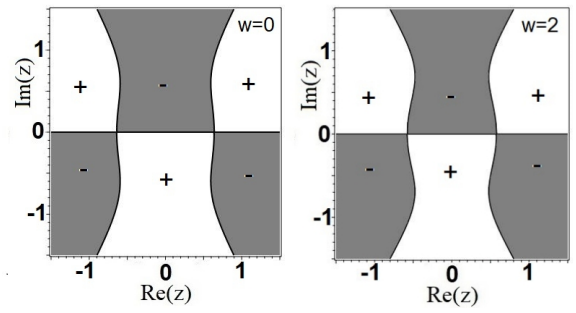
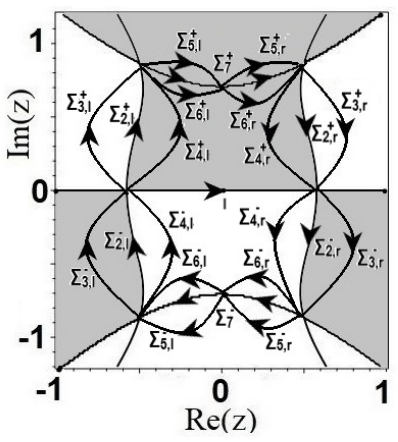
The load-bearing object is a solvable $2\times2$ matrix Riemann–Hilbert problem: find an analytic matrix $N^\pm(\Lambda;X,T)$ normalized to $I$ at infinity whose boundary values on the unit circle jump by $e^{-i(\Lambda X+4\Lambda^3T)\sigma_3}Q e^{\mp 2i\Lambda^{-1}\sigma_3}Q^{-1}e^{i(\Lambda X+4\Lambda^3T)\sigma_3}$. The argument proceeds by writing the multi-rational soliton as a transformed RHP (RHP 2), rescaling $X=nx$, $T=n^3t$, $\Lambda=\lambda/n$, and showing the jump tends to the model jump; the vanishing lemma gives existence and uniqueness of $N^\pm$, and $q$ is recovered as $2i\lim_{\Lambda\to\infty}\Lambda N^\pm_{12}(\Lambda;X,T)$. A second transformation $H=D e^{-i(\Lambda X+4\Lambda^3T+2\Lambda^{-1})\sigma_3}$ converts the jump to the constant matrix $Q$, yielding a Lax pair in $X$ and $\Lambda$ whose compatibility produces the ODEs; at $T=0$ this is the Lax pair of the first member of the Painlevé-III hierarchy. The asymptotic analysis uses nonlinear steepest descent with parabolic-cylinder and Painlevé-II model functions as local parametrices.
What would settle it
Evaluate the closed-form formula (1.19) for $n=10,20,40$ at a fixed compact set of $(X,T)$, compute $(1/n)q_k(X/n,T/n^3)$, and compare with a numerical solution of the model RHP 3: the difference should shrink like $O(1/n)$. A persistent nonzero difference would show that RHP 2 and formula (1.19) define different solution families, invalidating the application of the theorems to the explicit solitons.
Extended reading notes
Core claim
The paper claims that the $k$th-order rational soliton $q_k$ of the focusing c-mKdV equation with unit background obeys, for $k=2n$ and $k=2n-1$ respectively, $\frac1n q_{2n}(X/n,T/n^3)=\hat q_+(X,T)+O(1/n)$ and $\frac1n q_{2n-1}(X/n,T/n^3)=\hat q_-(X,T)+O(1/n)$ uniformly on compact subsets of $\mathbb R^2$, where $\hat q_\pm$ is reconstructed from a uniquely solvable model Riemann–Hilbert problem and satisfies the c-mKdV equation in $(X,T)$. The same limit functions satisfy two ordinary differential equations in $X$; at $T=0$, eliminating $\hat q$ gives Eq. (1.27), the first member of the Painlevé-III hierarchy. Theorems 1.5 and 1.6 provide the large-$X$ asymptotic behavior: for $-1/96<a\le 0$, $\hat q_+(X,aX^2)\sim \sqrt{2p}\cos(\varphi(X,a))\,X^{-3/4}/\sqrt{6ab+b^{-3}}$, and as $a\to -1/96$ with $a+1/96=O(X^{-1/3})$ the profile is $O(X^{-2/3})$ and is expressed through the Painlevé-II function $V_1$. The paper additionally proves $\hat q_+(X,T)=-\hat q_-(X,T)$, that both limits are real, and that they inherit the symmetry $\hat q_\pm(-X,-T)=\hat q_\pm(X,T)$.
Load-bearing premise
That the Riemann–Hilbert problem built in Proposition 2.3 reproduces exactly the same family of multi-rational solitons as the determinantal formula (1.19) imported from reference [21]; the large-order theorems are proved for the RHP-generated family, and any mismatch at finite order would change the object being approximated.
Editorial extensions
If this is right
- If the main theorem is correct, the $n$-scaled rational solitons $(1/n)q_k$ have a universal near-field limit $\hat q_\pm$ that no longer depends on the detailed determinantal formula used to generate them.
- The limit profile solves the c-mKdV equation in the rescaled variables, so the large-order family is not an isolated approximation but an exact solution of the same dispersive PDE.
- At $T=0$, the spatial profile is constrained by the first Painlevé-III hierarchy member, giving an explicit ODE classification of the near-field shape.
- The explicit large-$X$ formulas in Theorems 1.5 and 1.6 and Corollary 4.1 turn the universal profile into concrete oscillatory decay laws with computable phase and amplitude, including a Painlevé-II transition when $a\to -1/96$.
- The paper states that the same RHP-based route extends to higher-order c-mKdV equations, the mKdV hierarchy, and the $(2+1)$-dimensional KP equation.
Reading between the lines
- A natural extension beyond the paper's claims is to push the small-norm expansion one order further: the jump in Lemma 2.1 is $I+O(1/n)$, so the next correction to $\hat q_\pm$ should be computable and would give an $O(1/n^2)$ refinement testable against the closed-form formula.
- The self-similar master profile suggests that high-order rational solitons of c-mKdV, when generated in short-pulse optical systems with higher-order dispersion, should appear as a single rescaled waveform; this is an experimental consequence the paper does not assert.
- The partial large-$T$ results indicate that the same steepest-descent machinery, with new local models at the four endpoints, should yield full Painlevé-type asymptotics for $T\to\infty$, giving a concrete next computation.
- Because the model RHP has the same structural role as the one used for NLS large-order rogue waves, higher members of the Painlevé-III hierarchy may appear when the c-mKdV hierarchy is considered; the paper's method should transfer to those cases.
Signed reviews
Editorial analysis
A structured set of objections, weighed in public.
Referee Report
Summary. The paper studies the large-order behavior of multi-rational solitons of the focusing complex mKdV equation with nonzero background. The authors construct a Riemann-Hilbert problem (RHP 1, then RHP 2 after removing the branch-cut jump) that is claimed to reproduce the kth-order rational solitons given by the closed-form determinant formula (1.19) imported from Chen and Yan. Through the rescaling X=nx, T=n^3 t, Λ=λ/n they derive a model RHP (RHP 3), prove existence and uniqueness, and show that the reconstruction q̂±(X,T) solves the c-mKdV equation in the rescaled variables. They then derive ODEs in X and T satisfied by q̂±, identify the T=0 X-ODE with the first member of the Painlevé-III hierarchy, and give large-X and transitional-asymptotic formulas, with a partial analysis for large T. The central claim, Theorem 1.2, is that (1/n) q_{2n}(X/n,T/n^3) and (1/n) q_{2n-1}(X/n,T/n^3) converge to q̂±(X,T) uniformly on compact sets.
Significance. If the identification between the explicit determinant solutions (1.19) and the RHP-generated family is established, the paper would provide a substantial extension to the complex mKdV equation of the large-order universality program developed for the focusing NLS equation by Bilman, Buckingham, Miller, and others. The asymptotic machinery is presented in detail: the small-norm RHP argument in Section 2, the zero-curvature computations in Section 3, and the steepest-descent parametrices in Section 4 all follow the established framework, and the asymptotic constants are derived from model problems rather than fitted to the target. The authors are also appropriately explicit that the large-T analysis is only partial. These strengths make the manuscript worth serious revision rather than rejection, but the missing equivalence proof for the object whose asymptotics are computed is load-bearing.
major comments (2)
- [§2, Theorem 1.2, Propositions 2.1–2.3] Theorem 1.2 is stated for the kth-order rational solitons q_k given by the explicit deterministic formula (1.19) from Chen and Yan [21], but the proof is carried out entirely for the family defined by RHP 2. Proposition 2.3 gives the reconstruction formula q_k = 1 + 2i lim_{Λ→∞} Λ M̂^(k)_{12}(Λ;x,t) from RHP 2, but the paper does not prove that this RHP family coincides with formula (1.19). In particular, RHP 1 is a pure discrete-spectrum RHP with jump data built from ((λ−i)/(λ+i))^{nσ_3}, yet the paper does not show that the multi-gauge-transformed IST solution in [21] has exactly this scattering data and no additional data. If the two families differ at finite order, then the O(1/n) convergence in Theorem 1.2 concerns a different sequence of functions than the one named in the theorem. This gap is load-bearing for Theorem 1.2 and, through it, for the interpretation of all downstream statements about q̂±. The authors should either supply a proof of equivalence or reformulate the theorem explicitly for the RHP-2 family and state the identification with (1.19) as a separate conjecture.
- [§3.2.1, Eqs. (3.115)–(3.117)] The displayed derivation of the X-ODEs in Theorem 1.3 cannot be verified as printed. Equation (3.115) is not the X-derivative of Eq. (3.113): the expression contains a spurious '− +' before the term 6q̂_{XX}|q̂|², and the terms 6q̂²q̂* and 6|q̂|²q̂ appear without the derivative symbols that a differentiation of (3.113) would produce. Since Eqs. (3.117) and (3.120) are central to the identification of the Painlevé-III hierarchy, the authors should correct the displayed algebra and clarify each substitution used in the elimination leading to (3.120).
minor comments (4)
- [Throughout] There are numerous typographical errors that should be corrected, including 'gvien' after Eq. (1.5), 'with with' before Eq. (2.32), 'fist' for 'first' in the discussion of Eq. (1.27), 'euqations' in Section 5, 'impies' in the proof of Proposition 3.5, and 'Propositio n' in the proof of Proposition 4.3.
- [§4.2] The large-T section is presented as 'part results', but it stops abruptly after the g-function construction and the statement that new model problems are needed. The section would be clearer if it explicitly summarized which statements are proved and which are left for future work.
- [§4.1.1] The phrase 'double simple real critical points' in items (ii) and (iii) is confusing; it should be 'two simple real critical points' or 'a pair of simple real critical points'.
- [Theorem 1.1, Eq. (1.20)] The uniform bound (1.20) for N± on |Λ|≠1 over compact sets K is used in Lemma 2.1, but the proof of Theorem 1.1 via the vanishing lemma establishes uniqueness and existence and does not explicitly justify this bound; a sentence explaining how the bound follows from continuity and the normalization at infinity would help.
Circularity Check
No significant circularity: the large-order limit and the Painlevé-III connection are derived from an explicit RHP construction rather than fitted to the target asymptotics.
full rationale
The paper's central asymptotic chain is self-contained from the RHP construction onward. The limit RHP 3 (Eq. 2.45) is obtained by taking a uniform n→∞ limit of the jump matrix of RHP 2, not by fitting to the desired profile. The limit function q̂±(X,T) is defined by Eq. 1.21 from RHP 3, and its c-mKdV equation, the X/Y ODEs, the Painlevé-III identification at T=0, and the large-X asymptotic constants (p=ln2/(2π), the parabolic-cylinder coefficient γ, and the constant 64 in Eq. 3.124) are all computed from the RHP jump structure and zero-curvature identities. No parameter is fitted to the stated asymptotics, and no prediction reduces to an earlier fitted value. The paper does import the explicit multi-rational soliton formula (1.19) from Chen and Yan [21], which includes a co-author of the present work, and Proposition 2.1/2.3 asserts without proof that RHP 2 reproduces exactly that family. This is a logical completeness gap in the bridge between the explicit formula and the RHP representation, but it is not a circular reduction: the jump matrices of RHP 2 are not defined in terms of the target asymptotics, and the cited formula is explicit and externally checkable. Under the stated rules, an unproven equivalence or a self-citation is not itself circularity unless the load-bearing argument reduces to the claim being derived. That does not occur here.
Assumptions & free parameters
assumptions (6)
- domain assumption The (2n-1,2n)th-order multi-rational soliton formula (1.19) of Ref. [21] is exact.
- domain assumption The modified RHP (Lemma 1.2) for the c-mKdV equation with nonzero background is uniquely solvable with reconstruction q = 2i lim λ→∞ λ M_12.
- standard math Zhou's vanishing lemma and standard small-norm RHP theory apply to the model and error problems.
- standard math The parabolic-cylinder model RHP 7 and Painlevé-II model RHP 8 have the stated explicit solutions with asymptotics (4.146) and (4.191)-(4.196).
- domain assumption The cubic conformal mappings M1, M2 in Section 4.3 exist with the stated real-analytic properties and derivative values.
- domain assumption The level-line topology of the phase functions Θ(z;a) and θ(z;w) is as described: a Jordan component of Im Θ = 0 through the real critical points.
invented entities (1)
-
Auxiliary functions α(X,T), β(X,T) with α² + β² = 4
Cite this review
Pith. "Pith review of The focusing complex mKdV equation with nonzero background: Large $N$-order asymptotics of multi-rational solitons and related Painlev\'{e}-III hierarchy." pith.science (2026). https://pith.science/paper/6GQVRPGH
@misc{pith2026241211581,
  author       = {Pith},
  title        = {Pith review of: The focusing complex mKdV equation with nonzero background: Large $N$-order asymptotics of multi-rational solitons and related Painlev\'e-III hierarchy},
  year         = {2026},
  howpublished = {\url{https://pith.science/paper/6GQVRPGH}},
  note         = {Machine review of arXiv:2412.11581}
}
abstract
In this paper, we investigate the large-order asymptotics of multi-rational solitons of the focusing complex modified Korteweg-de Vries (c-mKdV) equation with nonzero background via the Riemann-Hilbert problems. First, based on the Lax pair, inverse scattering transform, and a series of deformations, we construct a multi-rational soliton of the c-mKdV equation via a solvable Riemann-Hilbert problem (RHP). Then, through a scale transformation, we construct a RHP corresponding to the limit function which is a new solution of the c-mKdV equation in the rescaled variables $X,\,T$, and prove the existence and uniqueness of the RHP's solution. Moreover, we also find that the limit function satisfies the ordinary differential equations (ODEs) with respect to space $X$ and time $T$, respectively. The ODEs with respect to space $X$ are identified with certain members of the Painlev\'{e}-III hierarchy. We study the large $X$ and transitional asymptotic behaviors of near-field limit solutions, and we provide some part results for the case of large $T$. These results will be useful to understand and apply the large-order rational solitons in the nonlinear wave equations.
Figures


Figures from the paper (7 more)





Reference graph
Works this paper leans on
-
[21]
S. Chen, Z. Yan, The Hirota equation: Darboux transform of the Riemann-Hilbert problem and higher-order rogue waves, Appl. Math. Lett. 95 (2019) 65
work page 2019
-
[1]
M. J. Ablowitz, P. A. Clarkson, Solitons, Nonlinear Evolution Equations and Inverse Scatt ering (Cambridge University Press, Cambridge, 1990)
1990
-
[2]
M. J. Ablowitz, D. J. Kaup, A. C. Newell, H. Segur, The inve rse scattering transform-Fourier analysis for nonlinear problems, Stud. Appl. Math. 53 (1974) 249
1974
-
[3]
Agrawal, Applications of Nonlinear Fiber Optics (5th ed.) (Elsevier, Amsterdam, 2012)
G. Agrawal, Applications of Nonlinear Fiber Optics (5th ed.) (Elsevier, Amsterdam, 2012)
2012
-
[4]
Akhmediev, A
N. Akhmediev, A. Ankiewicz, J. M. Soto-Crespo, Rogue wav es and rational solutions of the nonlinear Schr¨ odinger equation, Phys. Rev. E 80 (2009) 026601
2009
-
[5]
Ankiewicz, J.M
A. Ankiewicz, J.M. Soto-Crespo, N. Akhmediev, Rogue wav es and rational solutions of the Hirota equation, Phys. Rev. E 81 (2010) 046602
2010
-
[6]
Bertola, A
M. Bertola, A. Tovbis, Universality in the profile of the s emiclassical limit solutions to the focusing nonlinear Sch r¨ odinger equation at the first breaking curve, Inter. Math. Research N otices 11 (2010) 2119
2010
-
[7]
Bilman,R
D. Bilman,R. Buckingham, Large-order asymptotics for m ultiple-pole solitons of the focusing nonlinear Schr¨ odin ger equation, J. Nonlinear Sci. 29 (2019) 2185. 49
2019
Show all 96 references
-
[8]
Bilman, R
D. Bilman, R. Buckingham, D. S. Wang, Far-field asymptoti cs for multiple-pole solitons in the large-order limit, J. Differential Equations 297 (2021) 320
2021
-
[9]
Bilman, L
D. Bilman, L. Ling, P. D. Miller, Extreme superposition: rogue waves of infinite order and the Painlev´ e-III hierarch y, Duke Math. J. 169 (2020) 671
2020
-
[10]
Bilman, P
D. Bilman, P. D. Miller, A robust inverse scattering tra nsform for the focusing nonlinear Schr¨ odinger equation, Comm. Pure Appl. Math. 72 (2019) 1722
2019
-
[11]
Bilman, P
D. Bilman, P. D. Miller, Broader universality of rogue w aves of infinite order, Physica D 435 (2022) 133289
2022
-
[12]
Biondini, G
G. Biondini, G. Kovaci, Inverse scattering transform f or the focusing nonlinear Schr¨ odinger equation with nonze ro boundary conditions, J. Math. Phys. 55 (2014) 031506
2014
-
[13]
Biondini, S
G. Biondini, S. Li, D. Mantzavinos, Long-time asymptot ics for the focusing nonlinear Schr¨ odinger equation with nonzero boundary conditions in the presence of a discrete spectrum, Commun. Math. Phys. 382 (2021) 1495-1577
2021
-
[14]
Biondini, D
G. Biondini, D. Mantzavinos, Long-time asymptotics fo r the focusing nonlinear Schr¨ odinger equation with nonzer o boundary conditions at infinity and asymptotic stage of modu lational instability, Comm. Pure Appl. Math. 70 (2017) 2300
2017
-
[15]
Yu. V. Bludov, V. V. Konotop, and N. Akhmediev, Matter ro gue waves, Phys. Rev. A 80 (2009) 033610
2009
-
[16]
Borghese, R
M. Borghese, R. Jenkins, K. T. R. McLaughlin, Long-time asymptotic behavior of the focusing nonlinear Schr¨ odinge r equation, Ann. I. H. Poincar´ e Anal, 35 (2018) 887-920
2018
-
[17]
Boutet de Monvel, J
A. Boutet de Monvel, J. Lenells, D. Shepelsky, The focus ing NLS equation with step-like oscillating background: scenarios of long-time asymptotics, Commun. Math. Phys. 38 3 (2021) 893–952
2021
-
[18]
Boutet de Monvel, J
A. Boutet de Monvel, J. Lenells, D. Shepelsky, The Focus ing NLS Equation with Step-Like Oscillating Background: The Genus 3 Sector, Commun. Math. Phys. 390 (2022) 1081-1148
2022
-
[19]
Boutet de Monvel, V
A. Boutet de Monvel, V. P. Kotlyarov, D. Shepelsky, Focu sing NLS equation: Long-time dynamics of step-like initial data, Inter. Math. Res. Notices, 2011 (2011) 1613-1653
2011
-
[20]
Boutet de Monvel, A
A. Boutet de Monvel, A. Its, V. P. Kotlyarov, Long-time a symptotics for the focusing NLS equation with time-periodi c boundary condition on the half-line, Commun. Math. Phys. 29 0 (2009) 479-522
2009
-
[22]
Chester, B
C. Chester, B. Friedman, F. Ursell, An extension of the m ethod of steepest descents, Math. Proc. Cambridge Phil. Soc . 53 (1957) 599
1957
-
[23]
Constantin, On the existence of standing waves for th e nonlinear Schr¨ odinger equation, C
A. Constantin, On the existence of standing waves for th e nonlinear Schr¨ odinger equation, C. R. Math. Rep. Acad. Sc i. Canada 17 (1995) 22-24
1995
-
[24]
Cuccagna, R
S. Cuccagna, R. Jenkins, On asymptotic stability of N-s olitons of the defocusing nonlinear Schr¨ odinger equation , Commun. Math. Phys. 343 (2016) 921
2016
-
[25]
P. A. Deift, J. Park, Long-time asymptotics for solutio ns of the NLS equation with a Delta potential and even initial data, Lett. Math. Phys. 96 (2011) 143
2011
-
[26]
Deift, X
P. Deift, X. Zhou, A steepest descent method for oscilla tory Riemann-Hilbert problems, Asymptotics for the MKdV equation, Ann. of Math. 137 (1993) 295
1993
-
[27]
P. A. Deift, X. Zhou, Long-time behavior of the non-focu sing nonlinear Schr¨ odinger equation, a case study, Lectur es in Mathematical Sciences, New Ser, vol. 5. University of Tok yo, Graduate School of Mathematical Sciences (1994)
1994
-
[28]
P. A. Deift, X. Zhou, Long-time asymptotics for integra ble systems. Higher order theory. Commun. Math. Phys. 165 (1994) 175
1994
-
[29]
P. A. Deift, X. Zhou, Long-time asymptotics for solutio ns of the NLS equation with initial data in a weighted Sobolev space, Comm. Pure Appl. Math. 56 (2003) 1029
2003
-
[30]
Demontis, B
F. Demontis, B. Prinari, C. van der Mee, F. Vitale, The in verse scattering transform for the defocusing nonlinear Schr¨ odinger equations with nonzero boundary conditions, Stud. Appl. Math. 131 (2013) 1
2013
-
[31]
Dieng, K
M. Dieng, K. McLaughlin, Long-time asymptotics for the NLS equation via dbar methods, arXiv: 0805.2807
-
[32]
R. K. Dodd, J. C. Eilbeck, J. D. Gibbon, and H. C. Morris, Solitons and nonlinear wave equations (Academic Press, New York, 1982)
1982
-
[33]
P. G. Drazin and R. S. Johnson, Solitons: An Introduction (2nd) (Cambridge University Press, Cambridge, 1989)
1989
-
[34]
Dysthe, H
K. Dysthe, H. E. Krogstad, and P. M¨ uller, Oceanic rogue waves, Ann. Rev. Fluid Mech. 40 (2008) 287
2008
-
[35]
L. D. Faddeev and L. A. Takhtajan, Hamiltonian Methods in the Theory of Solitons (Springer, New York, 1987)
1987
-
[36]
Flaschka, A
H. Flaschka, A. C. Newell, Monodromy-and spectrum-pre serving deformations I, Commun. Math. Phys. 76 (1980) 65. 50
1980
-
[37]
A. S. Fokas, A. R. Its, L.-Y. Sung, The nonlinear Schr¨ od inger equation on the half-line, Nonlinearity 18 (2005) 177 1
2005
-
[38]
A. S. Fokas, J. Lenells, The unified method: I. nonlinear izable problem on the half-line, J. Phys. A: Math. Theor. 45 (2012) 195201
2012
-
[39]
Fromm, J
S. Fromm, J. Lenells, R. Quirchmayr, The defocusing onl inear Schr¨ odinger equation with step-like oscillatory in itial data, arXiv:2104.03714
-
[40]
A. N. Ganshin, V. B. Efimov, G. V. Kolmakov, L. P. Mezhov-D eglin, and P. V. McClintock, Observation of an inverse energy cascade in developed acoustic turbulence in superflu id helium, Phys. Rev. Lett. 101 (2008) 065303
2008
-
[41]
Gardner, J.M
C.S. Gardner, J.M. Green, M.D. Kruskal, R.M. Miura, Met hod for solving the Korteweg-de Vries equation, Phys. Rev. Lett. 19 (1967) 1095
1967
-
[42]
X.G. Geng, H. Liu, The nonlinear steepest descent metho d to long-time asymptotics of the coupled nonlinear Schr¨ odinger equation, J. Nonlinear Sci. 28 (2018) 739–763
2018
-
[43]
Gross, Hydrodynamics of a superfluid condensate, J
E.P. Gross, Hydrodynamics of a superfluid condensate, J . Math. Phys. 4 (1963) 195
1963
-
[44]
B. Guo, L. Tian, Z. Yan, L. Ling, Y. Wang, Rogue waves: Mathematical Theory and Applications in Physi cs (De Gruyter, Berlin, 2017)
2017
-
[45]
Hirota, Exact envelope-soliton solutions of a nonli near wave equation, J
R. Hirota, Exact envelope-soliton solutions of a nonli near wave equation, J. Math. Phys. 14 (1973) 805
1973
-
[46]
A. R. Its, Asymptotics of solutions of the nonlinear Sch r¨ odinger equation and isompnpdromic deformations of systems of linear equation. Sov. Math. Dokl. 24 (1981) 452
1981
-
[47]
Kartashov, B.A
Y. Kartashov, B.A. Malomed, L. Torner, Solitons in nonl inear lattices, Rev. Mod. Phys. 83 (2011) 247
2011
-
[48]
Kawata, H
T. Kawata, H. Inoue, Inverse scattering method for the n onlinear evolution equations under nonvanishing conditio ns, J. Phys. Soc. Jpn. 44 (1978) 1722
1978
-
[49]
D. J. Kedziora, A. Ankiewicz, N. Akhmediev, Circular ro gue wave clusters, Phys. Rev. E 84 (2011) 056611
2011
-
[50]
Kharif and E
C. Kharif and E. Pelinovsky, Physical mechanisms of the rogue wave phenomenon, Eur. J. Mech. B Fluids 22 (2003) 603
2003
-
[51]
Kibler, J
B. Kibler, J. Fatome, C. Finot, G. Millot, F. Dias, G. Gen ty, N. Akhmediev, J. M. Dudley, The Peregrine soliton in nonlinear fibre optics, Nature Phys. 6, 790 (2010)
2010
-
[52]
Y. S. Kivshar and G. Agrawal, Optical Solitons: From Fibers to Photonic Crystals (Academic Press, San Diego, CA, 2003)
2003
-
[53]
H. Koch, X. Liao, Conserved energies for the one dimensi onal Gross-Pitaevskii equation, Adv. Math. 377 (2021) 1074 67
2021
-
[54]
H. Koch, X. Liao, Conserved energies for the one dimensi onal Gross-Pitaevskii equation: Low regularity case, Adv. Math. 420 (2023) 108996
2023
-
[55]
H. Koch, D. Tataru, Conserved energies for the cubic non linear Schr¨ odinger equation in one dimension, Duke Math. J . 167 (2018) 3207
2018
-
[56]
Kodama, Optical solitons in a monomode fiber, J
Y. Kodama, Optical solitons in a monomode fiber, J. Stat. Phys. 39, 597 (1985)
1985
-
[57]
Kodama, A
Y. Kodama, A. Hasegawa, Nonlinear pulse propagation in a monomode dielectric guide, IEEE J. Quantum Electron. 23, 510 (1987)
1987
-
[58]
E. A. Kuznetsov, Solitons in a parametrically unstable plasma, Sov. Phys. Dokl. 22 (1977) 507-508
1977
-
[59]
P. D. Lax, Integrals of nonlinear equations of evolutio n and solitary waves, Comm. Pure Appl. Math. 21 (1968) 467
1968
-
[60]
Lenells, A
J. Lenells, A. S. Fokas, The unified method: II. NLS on the half-line t-periodic boundary conditions, J. Phys. A: Math. Theor. 45 (2012) 195202
2012
-
[61]
Lenells, A
J. Lenells, A. S. Fokas, The unified method: III. Nonline arizable problem on the interval, J. Phys. A: Math. Theor. 45 (2012) 195203
2012
-
[62]
L. Ling, X. Zhang, Large and infinite-order solitons of t he coupled nonlinear Schr¨ odinger equation, Physica D 457 (2024) 133981
2024
-
[63]
L. Ling, L. C. Zhao, Z. Y. Yang, et al, Generation mechani sms of fundamental rogue wave spatial-temporal structure, Phys. Rev. E 96 (2017) 022211
2017
-
[64]
Ma, The perturbed plane-wave solutions of the cub ic Schr¨ odinger equation, Stud
Y.-C. Ma, The perturbed plane-wave solutions of the cub ic Schr¨ odinger equation, Stud. Appl. Math. 60 (1979) 43
1979
-
[65]
Mihalache, Multidimensional localized structures in optics and Bose-Einstein condensates: a selection of rec ent studies, Rom
D. Mihalache, Multidimensional localized structures in optics and Bose-Einstein condensates: a selection of rec ent studies, Rom. J. Phys. 59 (2014) 295
2014
-
[66]
P. D. Miller, On the increasing tritronqu´ ee solutions of the Painlev´ e-II equation, SIGMA 14 (2018) 125
2018
-
[67]
W. M. Moslem, P. K. Shukla, and B. Eliasson, Surface plas ma rogue waves, Europhys. Lett. 96 (2011) 25002
2011
-
[68]
Novikov, S.V
S. Novikov, S.V. Manakov, L.P. Pitaevskii, V.E. Zakhar ov, Theory of Solitons The Inverse Scattering Method (Springer, New York, 1984). 51
1984
-
[69]
Olver, A general framework for solving Riemann-Hilb ert problems numerically, Numer
S. Olver, A general framework for solving Riemann-Hilb ert problems numerically, Numer. Math. 122 (2012) 305
2012
-
[70]
Olver, T
S. Olver, T. Trogdon, Nonlinear steepest descent and nu merical solution of Riemann-Hilbert problems, Comm. Pure Appl. Math. 67 (2014) 1353
2014
-
[71]
L. A. Ostrowskii, Propagation of wave packets and space -time self-focusing in a nonlinear medium. Sov. Phys. JETP 24 (1967) 797
1967
-
[72]
Peregrine, Water waves, nonlinear Schr¨ odinger equ ations and their solutions, J
D. Peregrine, Water waves, nonlinear Schr¨ odinger equ ations and their solutions, J. Aust. Math. Soc. B: Appl. Math . 25 (1983) 16
1983
-
[73]
Pitaevskii, Vortex lines in an imperfect Bose gas, Sov
L.P. Pitaevskii, Vortex lines in an imperfect Bose gas, Sov. Phys. JETP 13 (1961) 451
1961
-
[74]
A. H. Sakka, Linear problems and hierarchies of Painlev ´ e equations, J. Phys. A 42 (2008) 025210
2008
-
[75]
Shats, H
M. Shats, H. Punzmann, and H. Xia, Capillary rogue waves , Phys. Rev. Lett. 104 (2010) 104503
2010
-
[76]
D. R. Solli, C. Ropers, P. Koonath, and B. Jalali, Optica l rogue waves, Nature (London) 450 (2007) 1054
2007
-
[77]
J. Song, Z. Yan, Formation, propagation, and excitatio n of matter solitons and rogue waves in chiral BECs with a current nonlinearity trapped in external potentials, Chao s 33 (2023) 103132
2023
-
[78]
Toenger, T
S. Toenger, T. Godin, C. Billet, F. Dias, M. Erkintalo, G . Genty, and J. M. Dudley, Emergent rogue wave structures and statistics in spontaneous modulation instability, Sci . Rep. 5 (2015) 1
2015
-
[79]
Tovbis, X
A. Tovbis, X. Zhou, On the long-time limit of semiclassi cal solutions of focusing NLS equation: pure radiation, Com m. Pure Appl. Math. 59 (2006) 1379
2006
-
[80]
A. H. Vartanian, Long-time asymptotics of solutions to the Cauchy problem for the defocusing nonlinear Schr¨ oding er equation with finite-density initial data, Math. Phys. Anal . Geom. 5 (2002) 319
2002
-
[81]
Z. Wang, E. Fan, Defocusing NLS equation with nonzero ba ckground: Large-time asymptotics in a solitonless region, J. Differential Equations 336 (2022) 334
2022
-
[82]
Z. Wang, E. Fan, The Defocusing nonlinear Schr¨ odinger equation with a nonzero background: Painlev´ e asymptotics in two transition regions, Commun. Math. Phys. (2023) 1
2023
-
[83]
Z. Wang, K. Xu, E. Fan, The complex mKdV equation with ste p-like initial data: Large time asymptotic analysis, arXiv:2208.01856 (2022)
2022 arXiv
-
[84]
L. Wang, Z. Yan, Rogue wave formation and interactions i n the defocusing nonlinear Schr¨ odinger equation with external potentials, Appl. Math. Lett. 111 (2021) 106670
2021
-
[85]
W. Weng, G. Zhang, Z. Yan, Strong and weak interactions o f rational vector rogue waves and solitons to any n- component nonlinear Schr¨ odinger system with higher-order effects, Proc. R. Soc. A 478 (2022) 20210670
2022
-
[86]
Yan, Financial rogue waves, Commun
Z. Yan, Financial rogue waves, Commun. Theor. Phys. 54 ( 2010) 947
2010
-
[87]
Z. Yan, C. Dai, Optical rogue waves in the generalized in homogeneous higher-order nonlinear Schr¨ odinger equatio n with modulating coefficients, J. Opt. 15, 064012 (2013)
2013
-
[88]
Yang, Nonlinear Waves in Integrable and Nonintegrable Systems (SIAM, Philadelphia, 2010)
J. Yang, Nonlinear Waves in Integrable and Nonintegrable Systems (SIAM, Philadelphia, 2010)
2010
-
[89]
H. C. Yuen, B. M. Lake, Nonlinear dynamics of deep-water gravity waves, Adv. Appl. Mech. 22 (1982) 67
1982
-
[90]
V. E. Zakharov, Stability of periodic waves of finite amp litude on the surface of a deep fluid, Sov. Phys. J. Appl. Mech. Tech. Phys. 4 (1968) 190
1968
-
[91]
V. E. Zakharov, Collapse of Langmuir waves, Sov. Phys. J ETP 35 (1972) 908
1972
-
[92]
Zakharov, S
V .E. Zakharov, S. V. Manakov, Asymptotic behavior of no nlinear wave systems ntegrated by the inverse scattering method, Sov. Phys. JETP 44 (1976) 106
1976
-
[93]
V. E. Zakharov, A. B. Shabat, Exact theory of two-dimens ional self-focusing and one-dimensional self-modulation of waves in nonlinear media, Sov. Phys. JETP 34 (1972) 62-69 [Zh . Eksp. Teor. Fiz. 61 (1971) 118]
1972
-
[94]
Zhaqilao, Nth-order rogue wave solutions of the comple x modified Korteweg–de Vries equation, Phys. Scr. 87 (2013) 065401
2013
-
[95]
Zhang, Y.-F
H.-Y. Zhang, Y.-F. Zhang, Spectral analysis and long-t ime asymptotics of complex mKdV equation, J. Math. Phys. 63 (2022) 021509
2022
-
[96]
Zhou, The Riemann-Hilbert problem and inverse scatt ering, SIAM J
X. Zhou, The Riemann-Hilbert problem and inverse scatt ering, SIAM J. Math. Anal. 20 (1989) 966. 52
1989
Reviewed August 11, 2026 · model on record in the stance chip above.
Discussion (0). Continue with ORCID to comment.