REVIEW 3 major objections 8 minor 39 references
Fast single-qubit gates for continuous dynamically decoupled systems
T0 review · 3 major / 8 minor · reviewed 2026-08-11 · deepseek-v4-flash
Pith's one-line read A continuously decoupled qubit can be gated fast and faithfully using just two fixed-amplitude pulses plus waits, demonstrated at fidelity 0.9947(1) on a flux-tunable transmon.
desk verdict Strong experimental result on fast CDD-transmon gates; the three-level leakage theory is sloppier than the data, but the core demonstration is real and worth refereeing. read the letter →
The pith
A machine-rendered reading of the paper's core claim, the machinery that carries it, and where it could break.
The reading
What carries the argument
The load-bearing object is the dressed-qubit decomposition of the driven Hamiltonian: with the CDD drive along $\sigma_z$, the gate pulse $A(t)$ and detuning $\Delta(t)$ act as orthogonal transverse fields, $H/\hbar = A_{\mathrm{CDD}} \sigma_z/2 + A(t) \sigma_x/2 + \Delta(t) \sigma_y/2$. Universal control is assembled from a single two-pulse primitive, $U = R_{xz}(\pi/2,\gamma) R_z(\gamma') R_{xz}(\pi/2,\gamma) R_z(\gamma'')$, where the $R_z$ rotations are implemented for free by waiting (phase advances at rate $A_{\mathrm{CDD}}$) and negative phases use the complement time $t_c = 2\pi/A_{\mathrm{CDD}} - \gamma/A_{\mathrm{CDD}}$. On the three-level transmon, an approximate dressed-basis transformation (valid for $\beta = \hbar A_{\mathrm{CDD}}/E_C < 0.2$) exposes the leakage couplings. The pulse envelope of Eq. (5) is then chosen so that the Fourier transform has nodes at the $|\pm\rangle\leftrightarrow|f\rangle$ transition frequencies, which suppresses leakage to the $\sim 3\times 10^{-4}$ level.
What would settle it
Run the two-pulse gate sequence on a CDD-protected qubit with $\beta \geq 0.2$ while sweeping $A_{\mathrm{CDD}}$ and measuring leakage into the second excited state; if the Clifford fidelity at the designed Fourier nodes does not stay near the reported level, the dressed-basis approximation and its leakage-suppression criterion break down. A cleaner check is to port the same recipe to a non-transmon CDD platform and verify that the predicted node structure in the leakage versus $A_{\mathrm{CDD}}$ curve appears where the paper's tuning rule says it should.
Extended reading notes
Core claim
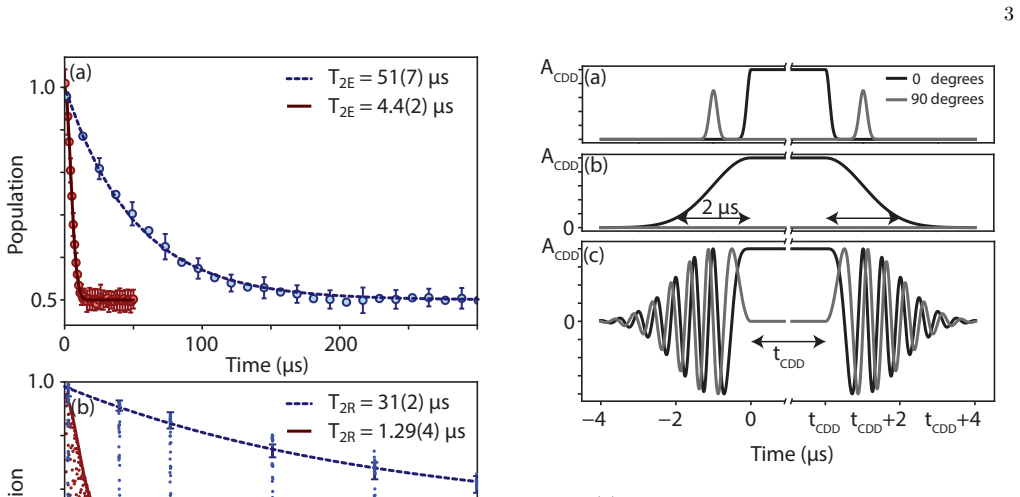
The central claim is that continuous dynamical decoupling need not be a spectator: the same drive that creates the protected dressed basis $|\pm\rangle = (|0\rangle \pm |1\rangle)/\sqrt{2}$ can be supplemented by gate pulses at the same frequency, 90 degrees out of phase, to perform universal single-qubit rotations. In an ideal two-level system, two such pulses, each with duration $t_g \approx 2\pi/A_{\mathrm{CDD}}$ and amplitude $A_g \approx A_{\mathrm{CDD}}/2$, plus a wait time $\delta t$ that advances the phase at rate $A_{\mathrm{CDD}}$, generate any unitary of the form $U(\gamma',\gamma'') = R_{xz}(\pi/2,\gamma) R_z(\gamma') R_{xz}(\pi/2,\gamma) R_z(\gamma'')$. On the transmon, the non-computational $|f\rangle$ state is kept quiet by choosing $A_{\mathrm{CDD}}$ and the pulse envelope so that the $|+\rangle\leftrightarrow|f\rangle$ and $|-\rangle\leftrightarrow|f\rangle$ transitions sit at nodes of the pulse's Fourier spectrum. With this tuning the authors measure an average Clifford fidelity of $0.9947(1)$ at gate durations near 93 ns, with the residual error dominated by slow flux drift rather than leakage or gate speed.
Load-bearing premise
The scheme depends on being able to choose the continuous-drive amplitude and the gate-pulse envelope so that transitions to the second excited state land exactly at nodes of the pulse's Fourier spectrum, and on the small-drive approximation ($\beta = \hbar A_{\mathrm{CDD}}/E_C < 0.2$) used to design that tuning; if another CDD platform cannot satisfy this condition, the claimed universality to any CDD qubit architecture fails, although the transmon demonstration could still stand.
Editorial extensions
If this is right
- Any CDD-protected qubit whose two-state transition can be isolated from other levels can be gated by the same two-pulse-plus-wait recipe, without requiring slow perturbative Rabi pulses.
- On the demonstrated transmon, Clifford gate durations of roughly 93 ns at fidelity $0.9947(1)$ leave room for hundreds of gate operations within the CDPQ Ramsey coherence time of $31(2)\,\mu$s.
- At the flux-sensitive bias point $\varphi = 0.367$, the CDD protection raises Ramsey and Hahn echo coherences from $1.29(4)\,\mu$s and $4.4(2)\,\mu$s to $31(2)\,\mu$s and $51(7)\,\mu$s, respectively.
- Because the gate speed is set by the drive amplitude $A_{\mathrm{CDD}}$ rather than by a weak Rabi rate, larger drive amplitudes offer both stronger noise protection and faster gates, with leakage managed by the Fourier-node tuning condition.
Reading between the lines
- Applied to higher-anharmonicity superconducting qubits, the same protocol could use larger $A_{\mathrm{CDD}}$ and therefore yield even faster gates and stronger noise protection than the transmon's $\beta<0.2$ tuning limit permits.
- Since slow flux drift rather than leakage or gate speed dominates the reported error, periodically measuring and correcting the flux offset—or using a fixed-frequency device, where the paper reports a Clifford fidelity of $0.9985$—could push CDPQ fidelities above $0.999$.
- If coupled CDPQs inherit the frequency insensitivity demonstrated here, two-qubit gates between CDPQs at different frequencies should exhibit suppressed $\sigma_z\sigma_z$ crosstalk, potentially eliminating tunable couplers from superconducting processor designs.
Signed reviews
Editorial analysis
A structured set of objections, weighed in public.
Referee Report
Summary. This paper develops a universal single-qubit gating scheme for qubits encoded in continuously driven, dynamically decoupled (CDD) dressed states. The scheme uses two fixed-amplitude, fixed-duration pulses separated by wait times, with the wait times implementing R_z rotations and the pulses providing Rxz(π/2) rotations. The authors give a two-level analysis, a three-level transmon analysis with a leakage-suppression criterion, a pulse-tuning procedure, and randomized benchmarking on a flux-tunable transmon, reporting Clifford fidelity F = 0.9947(1) at a flux-sensitive point while increasing Ramsey and Hahn-echo coherence times by more than a factor of ten. A second, fixed-frequency transmon gives F = 0.9985. The paper concludes that the method should be applicable to any CDD qubit architecture.
Significance. If the stated scope is confirmed, this is a useful practical advance: gating dressed CDD qubits via perturbative Rabi pulses is slow, and the proposed wait-time-plus-fixed-pulse construction is simple and minimally parameterized once ACDD is calibrated. The experimental data are a strength: randomized benchmarking over 354 sequences, explicit error bars on the tunable device, coherence measurements on two devices, and an honest discussion of the fixed-frequency transmon's CDD T2E. The two-level gate construction is internally consistent and the central empirical claim is credible. However, the analytic multi-level model used to motivate the pulse parameters is approximate and contains a quantitative inconsistency in the leakage-matching condition, so the broad 'any CDD qubit architecture' claim is not yet supported.
major comments (3)
- [Sec. III B–D, Eqs. (6)–(9)] The multi-level analysis that supports the claimed generality is explicitly approximate. The dressed-basis transformation T in Eq. (7) neglects normalization corrections, and the text states that the treatment is valid for β = ℏACDD/EC < 0.2. Consequently the leakage couplings in Eq. (9) are only leading order in β. Since the pulse-tuning procedure in Sec. III D uses this model to select ACDD and tg, the abstract's claim that the gates are 'applicable to any CDD qubit architecture' is not established for platforms with different anharmonicity or level structure. Please either restrict the scope to weakly anharmonic, transmon-like systems, or supply a unitarized higher-order dressed-basis analysis that quantifies leakage outside the β < 0.2 regime. The experimental demonstration itself is not invalidated by this issue.
- [Sec. III C–D and Sec. II B] The stated leakage-matching criterion is quantitatively inconsistent with the reported experimental parameters. The text says that suppressing leakage is 'roughly equivalent to making EC/ℏACDD = 7 an integer ratio' and later refers to 'our choice of β = 1/7.' With EC/h = 137 MHz and ACDD/2π = 23 MHz, one obtains β = ℏACDD/EC = 23/137 ≈ 0.168, i.e., EC/ℏACDD ≈ 5.96, not 7. This is not a small rounding discrepancy: it changes the node-matching condition that motivates the choice of ACDD and tg in Sec. III D. Please reconcile the analytic criterion with the data, or state clearly that the final parameters were chosen from the full numerical simulation (Fig. 5) rather than from the integer-ratio rule.
- [Sec. IV] The error budget assigns the largest contribution, 4.1 × 10^-3 out of 5.6 × 10^-3, to 'slow changes to the static value of Δ from flux drift,' but no direct measurement of this drift or a control experiment (e.g., repeated recalibration of Δ, or interleaved randomized benchmarking with active flux correction) is presented. Because this attribution is the difference between the claimed gate performance and a closed error budget, it should be supported by data or explicitly labeled as a hypothesis. The fixed-frequency transmon result strengthens the plausibility, but the error budget on the tunable device remains open.
minor comments (8)
- [Sec. III A] The definition of the 'speed limit' is vague: the text refers to the 'lowest tg along any 50:50 superposition contour in Fig. 5c-d,' but the speed limit that sets the comparison with perturbative Rabi gates should be stated quantitatively (e.g., in terms of the pulse area or the Margolus–Levitin bound).
- [Eq. (5)] The factor 1.3 in the pulse envelope is not explained; please state whether it normalizes the peak amplitude and how it was chosen.
- [Table I / Appendix A] The formula for the average Clifford time, 24(tg + tc) + 9(2π/ACDD))/24, needs a brief derivation, and the placement of the opening parenthesis should be corrected for readability.
- [Sec. IV] The fixed-frequency transmon result F = 0.9985 is quoted without an uncertainty or a description of the randomized-benchmarking protocol; please include the same analysis as for the tunable device.
- [Sec. III C] The statement that no |f⟩ population was observed in single-shot measurements after randomized benchmarking is weak evidence against leakage, because leaked population can decay back into the qubit subspace; an interleaved leakage measurement would be more convincing.
- [Sec. III A, Eq. (4)] The universal decomposition in Eq. (4) is taken from Ref. [23] without derivation in this paper; please state this provenance explicitly in the main text so the incremental contribution of the present work is clear.
- [References] Reference [13] and reference [35] are the same paper (Yan et al., Nature Communications 7, 12964 (2016)); please merge or cite them distinctly.
- [Fig. 2] The figure caption contains LaTeX artifacts ('/uni03BCs') that should be corrected; also specify whether the CDPQ Ramsey sequence included the initialization and readout pulses.
Circularity Check
No significant circularity: the experimental fidelity and coherence claims rest on independent measurements, and the cited universal-gate construction is an externally verifiable standard decomposition, not a self-referential fit.
full rationale
The paper's central experimental claims are self-contained against independent benchmarks: the randomized benchmarking fidelity F=0.9947(1) and the coherence times T2R=31(2) us and T2E=51(7) us are measured quantities, not outputs of a fitted model. The universal single-qubit gate sequence in Eq. (4) is taken from Ref. [23], which shares an author (D. L. Campbell), but this is a standard Euler-type decomposition of SU(2) into two equatorial pi/2 rotations plus z rotations; it is parameter-free, externally checkable, and not an unverified premise imported solely from the authors' prior work, so per the hard rules it does not constitute circularity. The three-level analysis in Secs. III B-D (Eqs. 6-9) is explicitly approximate: Eq. (7) states 'we neglect the contribution of beta to the normalization for notational clarity,' and Sec. III D's node-matching criterion is used only to select ACDD and tg before experimental calibration, not to predict the measured Clifford fidelity. The leakage estimate in Sec. IV (3e-4) is a simulation-based error attribution, not a fitted parameter renamed as a prediction. The paper's own caveat that the eigenenergy picture 'is approximate because the eigenenergies shift as a function of pulse amplitude Ag' is a disclosed validity limitation, and the apparent mismatch between the stated 'EC/hbar*ACDD = 7' integer-ratio condition and the experimental value 137/23 ≈ 5.96 is a quantitative approximation concern, not a circularity. No step in the derivation chain reduces by construction to its own inputs.
Assumptions & free parameters
free parameters (4)
- ACDD =
2π x 23 MHz
- Ag =
2π x 29.12 MHz
- tg =
40 ns
- tc (wait times for Rz phases) =
scanned during calibration
assumptions (7)
- standard math The rotating-wave approximation is applied to the driven transmon Hamiltonian (Eq. 1) to obtain the effective two- and three-level Hamiltonians (Eqs. 3 and 6).
- domain assumption The relevant CDPQ dynamics are confined to the lowest two (ideal) or lowest three (transmon) transmon levels; higher levels are neglected.
- standard math Universal single-qubit control can be effected by sequences of the form U(gamma', gamma'') = Rxz(pi/2,gamma) Rz(gamma') Rxz(pi/2,gamma) Rz(gamma'') (Eq. 4).
- domain assumption The amplitude noise of the microwave source that generates ACDD is low enough that replacing sensitivity to frequency noise with sensitivity to drive-amplitude noise improves coherence.
- domain assumption Adiabatic ramping of the CDD drive (Fig. 3b) prepares the dressed eigenbasis with negligible non-adiabatic excitation.
- domain assumption Randomized benchmarking recovery probability isolates gate fidelity with state preparation and measurement errors correctly accounted for.
- domain assumption Leakage into |f> is suppressed when the |+> to |f> and |-> to |f> transition frequencies coincide with nodes of the Fourier transform of the gate-pulse envelope.
Cite this review
Pith. "Pith review of Fast single-qubit gates for continuous dynamically decoupled systems." pith.science (2026). https://pith.science/paper/HNB5567T
@misc{pith2026241211821,
  author       = {Pith},
  title        = {Pith review of: Fast single-qubit gates for continuous dynamically decoupled systems},
  year         = {2026},
  howpublished = {\url{https://pith.science/paper/HNB5567T}},
  note         = {Machine review of arXiv:2412.11821}
}
abstract
Environmental noise that couples longitudinally to a quantum system dephases that system and can limit its coherence lifetime. Performance using quantum superposition in clocks, information processors, communication networks, and sensors depends on careful state and external field selection to lower sensitivity to longitudinal noise. In many cases time varying external control fields--such as the Hahn echo sequence originally developed for nuclear magnetic resonance applications--can passively correct for longitudinal errors. There also exist continuous versions of passive correction called continuous dynamical decoupling (CDD), or spin-locking depending on context. However, treating quantum systems under CDD as qubits has not been well explored. Here, we develop universal single-qubit gates that are ``fast'' relative to perturbative Rabi gates and applicable to any CDD qubit architecture. We demonstrate single-qubit gates with fidelity $\mathcal{F}=0.9947(1)$ on a frequency tunable CDD transmon superconducting circuit operated where it is strongly sensitive to longitudinal noise, thus establishing this technique as a potentially useful tool for operating qubits in applications requiring high fidelity under non-ideal conditions.
Figures


Figures from the paper (4 more)


Reference graph
Works this paper leans on
- [1]
-
[2]
The interplay be- tween Ag and tg is shown in Fig. 5c-d. ACDD sets a natural timescale for gating. Rxz(π/2, γ) pulse duration tg ∼ 2π/ACDD and amplitude Ag ∼ ACDD /2 approaches this speed limit at the cost of making the pulses non- perturbative (non-Rabi). The absolute “speed limit” for a choice of ACDD is the lowest tg along any 50:50 super- position con...
work page 2024
- [3]
- [4]
-
[5]
E. L. Hahn, Physical review 80, 580 (1950)
work page 1950
-
[6]
C. P. Slichter, Principles of magnetic resonance, Vol. 1 (Springer Science & Business Media, 2013)
work page 2013
-
[7]
Siddiqi, Nature Reviews Materials 6, 875 (2021)
I. Siddiqi, Nature Reviews Materials 6, 875 (2021)
2021
-
[8]
F. Yoshihara, Y. Nakamura, F. Yan, S. Gustavsson, J. Bylander, W. D. Oliver, and J.-S. Tsai, Physical Re- view B 89, 020503 (2014), publisher: American Physical Society
work page 2014
Show all 39 references
-
[9]
Avinadav, R
C. Avinadav, R. Fischer, P. London, and D. Gershoni, Physical Review B 89, 245311 (2014), arXiv: 1402.4234
2014 arXiv
-
[10]
Gustavsson, J
S. Gustavsson, J. Bylander, F. Yan, P. Forn-D ´ ıaz, V. Bolkhovsky, D. Braje, G. Fitch, K. Harrabi, D. Lennon, J. Miloshi, P. Murphy, R. Slattery, S. Spector, B. Turek, T. Weir, P. B. Welander, F. Yoshihara, D. G. Cory, Y. Nakamura, T. P. Orlando, and W. D. Oliver, Physical Re...
2012
-
[11]
Gustavsson, F
S. Gustavsson, F. Yan, G. Catelani, J. Bylander, A. Ka- mal, J. Birenbaum, D. Hover, D. Rosenberg, G. Samach, A. P. Sears, S. J. Weber, J. L. Yoder, J. Clarke, A. J. Kerman, F. Yoshihara, Y. Nakamura, T. P. Orlando, and W. D. Oliver, Science354, 1573 (2016), publisher: Amer- i...
2016
-
[12]
Bylander, S
J. Bylander, S. Gustavsson, F. Yan, F. Yoshihara, K. Harrabi, G. Fitch, D. G. Cory, Y. Nakamura, J.-S. Tsai, and W. D. Oliver, Nature Physics 7, 565 (2011), arXiv:1101.4707 [cond-mat, physics:quant-ph]
2011 arXiv
-
[13]
F. Yan, S. Gustavsson, J. Bylander, X. Jin, F. Yoshihara, D. G. Cory, Y. Nakamura, T. P. Orlando, and W. D. Oliver, Nature Communications 4, 2337 (2013)
2013
-
[14]
F. Yan, S. Gustavsson, A. Kamal, J. Birenbaum, A. P. Sears, D. Hover, T. J. Gudmundsen, D. Rosenberg, G. Samach, S. Weber, J. L. Yoder, T. P. Orlando, J. Clarke, A. J. Kerman, and W. D. Oliver, Nature Com- munications 7, 12964 (2016), number: 1 Publisher: Na- ture Publishing Group
2016
-
[15]
Trypogeorgos, A
D. Trypogeorgos, A. Vald´ es-Curiel, N. Lundblad, and I. B. Spielman, Phys. Rev. A 97, 013407 (2018)
2018
-
[16]
A. Y. Smirnov, Physical Review B 67, 155104 (2003), publisher: American Physical Society
2003
-
[17]
L. V. Abdurakhimov, I. Mahboob, H. Toida, K. Kakuyanagi, Y. Matsuzaki, and S. Saito, Physi- cal Review B 102, 100502 (2020), arXiv: 2006.05820
2020 arXiv
-
[18]
F. Yan, D. Campbell, P. Krantz, M. Kjaergaard, D. Kim, J. L. Yoder, D. Hover, A. Sears, A. J. Kerman, T. P. Or- lando, S. Gustavsson, and W. D. Oliver, Physical Review Letters 120, 260504 (2018), publisher: American Physi- cal Society
2018
-
[19]
von L¨ upke, F
U. von L¨ upke, F. Beaudoin, L. M. Norris, Y. Sung, R. Winik, J. Y. Qiu, M. Kjaergaard, D. Kim, J. Yo- der, S. Gustavsson, L. Viola, and W. D. Oliver, PRX Quantum 1, 010305 (2020), publisher: American Physi- cal Society
2020
-
[20]
Y. Sung, A. Veps¨ al¨ ainen, J. Braum¨ uller, F. Yan, J. I.-J. Wang, M. Kjaergaard, R. Winik, P. Krantz, A. Bengts- son, A. J. Melville, B. M. Niedzielski, M. E. Schwartz, D. K. Kim, J. L. Yoder, T. P. Orlando, S. Gustavs- son, and W. D. Oliver, Nature Communications 12, 967 (...
2021
-
[21]
Awschalom, K
D. Awschalom, K. K. Berggren, H. Bernien, S. Bhave, L. D. Carr, P. Davids, S. E. Economou, D. Englund, A. Faraon, M. Fejer, S. Guha, M. V. Gustafsson, E. Hu, L. Jiang, J. Kim, B. Korzh, P. Kumar, P. G. Kwiat, M. Lonˇ car, M. D. Lukin, D. A. Miller, C. Monroe, S. W. Nam, P. Nar...
2021
-
[22]
I. Zuk, D. Cohen, A. V. Gorshkov, and A. Retzker, Phys. Rev. Res. 6, 013217 (2024)
2024
-
[23]
Huang, P
Z. Huang, P. S. Mundada, A. Gyenis, D. I. Schuster, A. A. Houck, and J. Koch, Phys. Rev. Appl. 15, 034065 (2021)
2021
-
[24]
D. L. Campbell, Y.-P. Shim, B. Kannan, R. Winik, D. K. Kim, A. Melville, B. M. Niedzielski, J. L. Yoder, C. Tahan, S. Gustavsson, and W. D. Oliver, Physical Re- view X 10, 041051 (2020), publisher: American Physical Society
2020
-
[25]
Zhang, S
H. Zhang, S. Chakram, T. Roy, N. Earnest, Y. Lu, Z. Huang, D. K. Weiss, J. Koch, and D. I. Schuster, Phys. Rev. X 11, 011010 (2021)
2021
-
[26]
Margolus and L
N. Margolus and L. B. Levitin, Physica D: Nonlinear Phe- nomena 120, 188 (1998)
1998
-
[27]
K. C. Miao, J. P. Blanton, C. P. Anderson, A. Bourassa, A. L. Crook, G. Wolfowicz, H. Abe, T. Ohshima, and D. D. Awschalom, Science 369, 1493 (2020), publisher: American Association for the Advancement of Science
2020
-
[28]
J. Koch, M. Y. Terri, J. Gambetta, A. A. Houck, D. I. Schuster, J. Majer, A. Blais, M. H. Devoret, S. M. Girvin, and R. J. Schoelkopf, Physical Review A 76, 042319 (2007)
2007
-
[29]
J. M. Martinis and M. R. Geller, Phys. Rev. A90, 022307 (2014)
2014
-
[30]
DiCarlo, J
L. DiCarlo, J. M. Chow, J. M. Gambetta, L. S. Bishop, B. R. Johnson, D. I. Schuster, J. Majer, A. Blais, L. Frun- zio, S. M. Girvin, and R. J. Schoelkopf, Nature 460, 240 (2009)
2009
-
[31]
Magesan, J
E. Magesan, J. M. Gambetta, and J. Emerson, Phys. Rev. Lett. 106, 180504 (2011)
2011
-
[32]
Magesan, J
E. Magesan, J. M. Gambetta, and J. Emerson, Phys. Rev. A 85, 042311 (2012)
2012
-
[33]
J. P. Gaebler, A. M. Meier, T. R. Tan, R. Bowler, Y. Lin, D. Hanneke, J. D. Jost, J. P. Home, E. Knill, D. Leibfried, and D. J. Wineland, Phys. Rev. Lett.108, 260503 (2012)
2012
-
[34]
Knill, D
E. Knill, D. Leibfried, R. Reichle, J. Britton, R. B. Blakestad, J. D. Jost, C. Langer, R. Ozeri, S. Seidelin, and D. J. Wineland, Phys. Rev. A 77, 012307 (2008)
2008
-
[35]
C. A. Ryan, M. Laforest, and R. Laflamme, New Journal of Physics 11, 013034 (2009)
2009
-
[36]
F. Yan, S. Gustavsson, A. Kamal, J. Birenbaum, A. P. Sears, D. Hover, D. Rosenberg, G. Samach, T. J. Gud- mundsen, J. L. Yoder, T. P. Orlando, J. Clarke, A. J. Kerman, and W. D. Oliver, Nature Communications 7, 12964 (2016), arXiv:1508.06299 [quant-ph]. 10
2016 arXiv
-
[37]
V. E. Manucharyan, J. Koch, L. I. Glazman, and M. H. Devoret, Science 326, 113 (2009), https://www.science.org/doi/pdf/10.1126/science.1175552
2009 doi
-
[38]
Lu, J.-L
M. Lu, J.-L. Ville, J. Cohen, A. Petrescu, S. Schrep- pler, L. Chen, C. J¨ unger, C. Pelletti, A. Marchenkov, A. Banerjee, W. P. Livingston, J. M. Kreikebaum, D. I. Santiago, A. Blais, and I. Siddiqi, PRX Quantum 3, 040322 (2022)
2022
-
[39]
Guo, S.-B
Q. Guo, S.-B. Zheng, J. Wang, C. Song, P. Zhang, K. Li, W. Liu, H. Deng, K. Huang, D. Zheng, X. Zhu, H. Wang, C.-Y. Lu, and J.-W. Pan, Phys. Rev. Lett. 121, 130501 (2018)
2018
Reviewed August 11, 2026 · model on record in the stance chip above.
Discussion (0). Continue with ORCID to comment.