REVIEW 5 major objections 4 minor 42 references
Learning Equivariant Maps with Variational Quantum Circuits
T0 review · 5 major / 4 minor · reviewed 2026-08-11 · deepseek-v4-flash
Pith's one-line read A variational quantum circuit can learn the equivariant map between two group representations.
desk verdict The paper is clear and the setup is sensible, but the loss it minimizes does not learn equivariant embeddings, and the paper's own C2xC2 example shows the gap. read the letter →
The pith
A machine-rendered reading of the paper's core claim, the machinery that carries it, and where it could break.
The reading
What carries the argument
The central mechanism is the paired loop between a trainable embedding and a fixed $G$-invariant measurement: because the circuit's expectation value is invariant exactly when the embedding respects the group action, the scalar loss $L_g$ acts as a differentiable measure of equivariance. The intertwining-map extension rests on Lemma 3, which identifies equivariance of the normalized amplitude embedding with equivariance of its unnormalized linear counterpart, allowing a linear map to be trained by the same circuit-based loss.
What would settle it
After training on a fixed pair of representations, choose several points $x$ and group elements $g$, prepare the states $E_\theta(V(g)x)|0\rangle$ and $W(g)E_\theta(x)|0\rangle$, and compare them with full state tomography or a SWAP test; if the states differ while $L_g$ is near zero, the loss is not a faithful proxy for equivariance and the paper's central implication fails.
Extended reading notes
Core claim
The central claim is that the construction of symmetry-respecting variational circuits can be inverted: given two unitary representations $V$ and $W$ of a finite group $G$, a parameterized embedding $E_\theta$ can be trained to be equivariant between them by minimizing $L_g(x)=(h_\theta(V(g)x)-h_\theta(x))^2$, where $h_\theta$ is the expectation value of a circuit whose unitary and observable are $G$-invariant with respect to $W$. The paper argues that an equivariant $E_\theta$ makes $h_\theta$ $G$-invariant, and that minimizing this loss over data points and generators produces an almost-equivariant embedding usable for classification. It then shows that with amplitude embeddings, equivariance of the normalized embedding is equivalent to the unnormalized linear map being an intertwining map, so the same loss can train a true linear equivariant map.
Load-bearing premise
The load-bearing premise is that minimizing the scalar loss $L_g(x)=(h_\theta(V(g)x)-h_\theta(x))^2$ drives the embedding $E_\theta$ to be equivariant, even though the loss sees only the expectation value of one observable.
Editorial extensions
If this is right
- A learned equivariant embedding can be substituted for the hand-designed symmetric embeddings used in geometric quantum machine learning, without changing the downstream classification circuit.
- Since a learned linear equivariant map is an intertwining map, the procedure trains covariant quantum channels directly from data.
- Sampling the loss over a generating set of $G$ suffices, so training cost is governed by the size of the generating set rather than the full group.
- The loss value itself provides a quantitative score of how equivariant a given embedding is, enabling direct comparison of architectures on the same symmetry task.
Reading between the lines
- The loss $L_g$ compares only expectation values under a single observable, so a near-zero loss does not certify that the embedding operator itself is equivariant; a direct check with a tomographically complete set of observables would test that stronger claim, which the paper does not perform.
- The same training objective could be relaxed to learn approximately equivariant maps for data with approximate or partial symmetries, a direction the paper leaves implicit.
- When several parameter settings satisfy equivariance (as in the $C_2$ example), the optimizer's final choice may be influenced by initialization and architecture; an added classification objective could select among them.
Editorial analysis
A structured set of objections, weighed in public.
Referee Report
Summary. The paper proposes a variational quantum circuit (VQC) method for learning an equivariant map between two given unitary representations of a finite group. The idea is to parameterize the data embedding E_theta, append a G-invariant circuit and observable, and train by minimizing the squared difference of expectation values L_g(x) = (h_theta(V(g)x) - h_theta(x))^2 over group generators and data. The authors claim that this procedure learns an equivariant embedding that can be reused in symmetric classifiers and that it extends to learning intertwining maps and covariant channels. The paper includes a review of symmetry-preserving VQCs and presents four examples: C2, C2 x C2, D4, and S6, with numerical simulations in PennyLane.
Significance. If the central claim were correct, the paper would contribute a practical way to learn symmetric embeddings rather than imposing them by construction, which is relevant for geometric quantum machine learning and for tasks involving covariant quantum channels. The review material in Section II (Proposition 1, Lemmas 1 and 2) is correct and clearly presented, and the examples are simple enough to be reproducible. However, the central methodological claim is not established: the loss function constrains only a single scalar expectation value, and the paper's own C2 x C2 experiment shows low loss with parameters that do not satisfy the equivariance conditions. The significance of the paper therefore depends on an inference that is invalid as written.
major comments (5)
- [Section III, Eq. (28)] The central step is invalid: minimizing L_g(x) = (h_theta(V(g)x) - h_theta(x))^2 with h_theta the expectation value of a single observable does not imply that the embedding E_theta is equivariant. The zero set of L_g contains embeddings for which E_theta(V(g)x)|0> is not equal to W(g)E_theta(x)|0>, because the observable projects out almost all information about the state. No identifiability condition, completeness of the observable set, or direct equivariance error is supplied. Without such an argument, the paper does not establish that the procedure learns equivariant embeddings, despite the claim in the text that minimizing L_g learns the desired embedding.
- [Section III, C2 and C2 x C2 examples] The experimental results actually demonstrate the gap between L_g and equivariance. For the tensor-product ansatz E_theta(x) = ⊗_i Ry(theta_i + x_i) with W(F_v) = SWAP01 SWAP23 and W(F_h) = SWAP02 SWAP13, exact equivariance of the state T(x) = E_theta(x)|0> requires the parameters to be equal (up to the period of the Ry state and possible cancellations of global phases). The reported C2 x C2 parameters theta ≈ (3.24, 6.22, 4.89, 4.97) do not satisfy this condition (e.g., theta_0 - theta_2 ≈ -1.65, not a multiple of 2π), yet the validation loss is small. The paper's claim that these parameters correspond to an equivariant map is therefore contradicted by its own numbers.
- [Section III, C2 example] The statement that equivariance is achieved when each pair (theta_0, theta_1) and (theta_2, theta_3) differs by an odd multiple of π is incorrect for state or operator equivariance. For example, Ry(theta + π)|0> is not proportional to Ry(theta)|0> as a vector-valued function of theta; the two are orthogonal for theta = 0. The condition only holds for products of Z-expectation values, which is precisely the loophole that allows the scalar loss to be small without the embedding being equivariant. This strengthens the concern that the method, as presented, optimizes output invariance rather than embedding equivariance.
- [Section IV, Proposition 2 and Eq. (47)] The same gap appears in the intertwining-map setting. Proposition 2 proves that h_theta is G-invariant under the hypothesis that U_theta is an intertwining map, but the training procedure minimizes L_g over expectation values only. The proof does not supply any mechanism by which minimizing L_g drives U_theta toward the hypothesis; Eq. (47) is identical in form to Eq. (28) and suffers from the same insufficiency. The discussion of learning intertwining maps therefore inherits the central flaw.
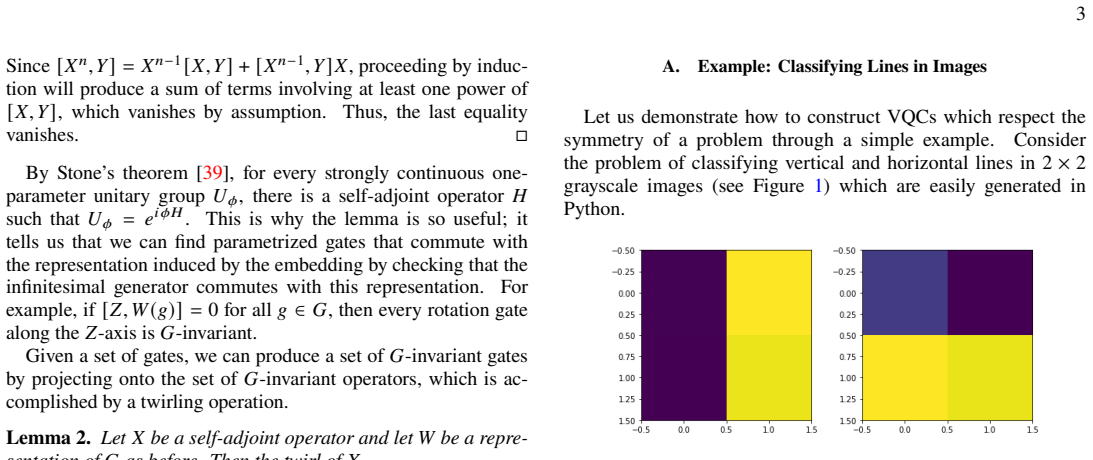
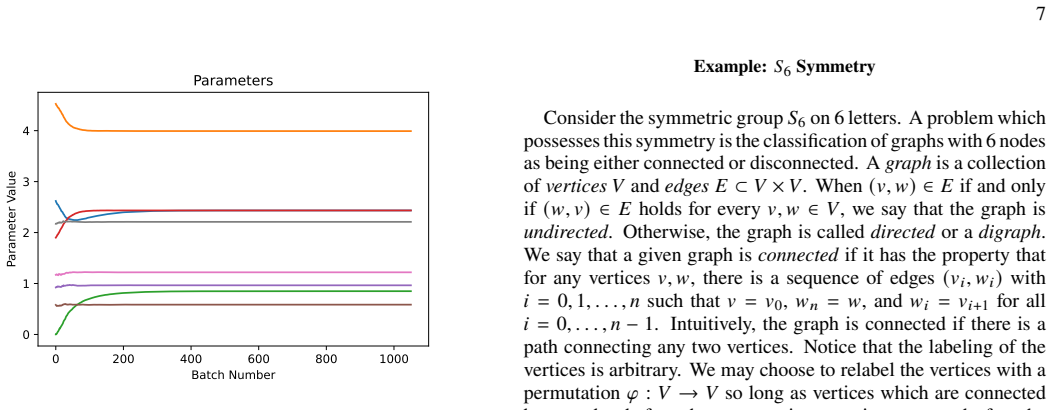
- [Section III, D4 and S6 examples] The D4 example reports nearly identical expectation values for three transformed data points and concludes that the embedding is 'nearly equivariant,' while the S6 example reports parameter convergence. Neither example provides a direct measure of equivariance of the embedding, such as the state fidelity between E_theta(V(g)x)|0> and W(g)E_theta(x)|0>, or a comparison across a tomographically complete set of observables. Given the demonstrated failure in the C2 x C2 example, the absence of such a metric means the D4 and S6 results do not support the paper's central claim.
minor comments (4)
- [Section III, text after Eq. (28)] The sentence 'the value of L_g(x) can be interpreted as a measure of how equivariant the embedding E_theta is' is misleading. L_g measures only the invariance of the chosen expectation value under the group action, not the equivariance of the embedding; this should be stated explicitly.
- [Section IV, Eq. (36)] The symbol T(x) is used for the normalized amplitude-embedding state in Eq. (36), while earlier in the paper T denotes the equivariant map from the data space to the Hilbert space. This overloading of notation should be resolved for clarity.
- [Figure 4 and Figure 7] The horizontal axis is labeled 'Batch Number' and the caption says the curves show parameter values during training, but it is unclear whether the validation loss in Figures 5 and 8 is evaluated per batch, per epoch, or on a separate validation set. A clearer description of the training and evaluation protocol would improve reproducibility.
- [Section V, Conclusion] The conclusion states that the work 'provides a method for measuring the similarity between two representations.' The loss L_g depends on the chosen observable and the data distribution and is not a well-defined metric on representations; this claim is stronger than what is demonstrated.
Circularity Check
The paper's central move equates 'learning an equivariant map' with minimizing the scalar output-invariance loss L_g of Eq. (28), and then reads the minimized loss back as evidence of embedding equivariance, making the central claim reduce to its own training objective.
-
self definitional
[Section III, 'Learning Equivariant Maps', text surrounding Eq. (28)]
"Thus, learning an equivariant map amounts to performing a regression minimizing L_g(x) for any pair (g,x) in G x R. ... It should be noted that the value of L_g(x) can be interpreted as a measure of how equivariant the embedding E_theta is; that is, how well it transfers the notion of symmetry from one representation to another. ... By minimizing this loss, we can achieve an embedding that respects the symmetry of our problem."
L_g is defined as (h_theta(V(g)x) - h_theta(x))^2, where h_theta is the expectation value of one G-invariant observable after a G-invariant circuit. This is an output-invariance condition, not the equivariance condition E_theta(V(g)x)|0> = W(g)E_theta(x)|0>. By declaring that L_g 'can be interpreted as a measure of how equivariant the embedding E_theta is,' the paper makes the training objective and the success criterion the same object. The claimed implication 'minimize L_g -> embedding is equivariant' then holds only by definition, not by the stated representation theory.
-
fitted input called prediction
[Section III, 'Example: D4 Symmetry', final paragraph]
"The resulting embedding after training is nearly equivariant. Indeed, taking the data point (0.40, 0.54), its rotation, and its reflection, and running the circuit with the trained parameters produces the nearly identical expected values -0.05429996, -0.05429986, and -0.05430002, respectively."
The evidence offered for 'nearly equivariant' is near-equality of the circuit's expectation values for g-transformed inputs. But exactly these expectation-value differences are what L_g penalizes during training. The trained parameters were fitted to make those differences small, so reporting the small differences as a demonstration of equivariance is reading back the fitted objective rather than testing an independent equivariance condition. No direct comparison of E_theta(V(g)x)|0> with W(g)E_theta(x)|0> is reported, and the D4 discussion equates 'nearly equivariant' with near-identical expectation values without an identifiability argument. The same pattern is inherited by Section IV, where Eq.
full rationale
The paper contains independent and largely correct representation-theoretic scaffolding: Proposition 1 and Lemma 3 show that genuine equivariance of the embedding or of U_theta implies invariance of the circuit output, and the gate-construction lemmas are standard. However, the paper's central claim in Section III is that minimizing Eq. (28) learns an equivariant embedding. That step is circular in the paper's own framing: L_g is defined as a scalar output difference and then asserted to be 'a measure of how equivariant the embedding E_theta is,' so the trained objective and the reported verification are the same quantity. The C2xC2 example makes the non-equivalence concrete: the learned parameters do not satisfy the state-level equivariance conditions while the loss is low. The D4 and S6 examples similarly report only the minimized loss or the corresponding expectation-value agreement. No external benchmark, direct equivariance metric, or identifiability argument is supplied. The self-citation to [38] (LaBorde et al.) is not load-bearing and does not contribute to the circularity. Because the central claim reduces to the fitted loss by definition, a partial-circularity score of 6 is appropriate.
Assumptions & free parameters
free parameters (1)
- embedding parameters theta_i =
C2: (pi, 2pi, 3pi/2, pi/2); C2xC2: (pi, 2pi, 3pi/2, 3pi/2); D4 and S6: learned values shown in figures
assumptions (4)
- ad hoc to paper The parameterized embedding family used in each example can represent at least one equivariant map between the given representations.
- ad hoc to paper Minimizing L_g(x) over scalar expectation values implies the embedding is almost equivariant.
- standard math Stone's theorem and standard representation theory of finite groups.
- domain assumption The data space representation V is unitary when needed in Section IV, Lemma 3.
Cite this review
Pith. "Pith review of Learning Equivariant Maps with Variational Quantum Circuits." pith.science (2026). https://pith.science/paper/7NTKITRG
@misc{pith2026241211889,
  author       = {Pith},
  title        = {Pith review of: Learning Equivariant Maps with Variational Quantum Circuits},
  year         = {2026},
  howpublished = {\url{https://pith.science/paper/7NTKITRG}},
  note         = {Machine review of arXiv:2412.11889}
}
read the original abstract
Geometric quantum machine learning uses the symmetries inherent in data to design tailored machine learning tasks with reduced search space dimension. The field has been well-studied recently in an effort to avoid barren plateau issues while improving the accuracy of quantum machine learning models. This work explores the related problem of learning an equivariant map given two unitary representations of a finite group, which in turn allows the symmetric embedding of the data to be learned rather than simply required. Moreover, this procedure allows the learning of covariant quantum channels, which are an essential tool in quantum information theory. We demonstrate the feasibility of this task and give examples to illustrate the procedure.
Figures


Figures from the paper (8 more)




Reference graph
Works this paper leans on
-
[1]
Cost-function embedding and dataset encoding for machine learning with parametrized quantum circuits
Shuxiang Cao, Leonard Wossnig, Brian Vlastakis, Peter Leek, and Edward Grant. Cost-function embedding and dataset encoding for machine learning with parametrized quantum circuits. Physical Re- view A, 101(5), May 2020
work page 2020
-
[2]
Edward Grant, Marcello Benedetti, Shuxiang Cao, Andrew Hallam, Joshua Lockhart, Vid Stojevic, Andrew G. Green, and Simone Sev- erini. Hierarchical quantum classifiers. npj Quantum Information, 4, 2018
work page 2018
-
[3]
M. Schuld and F. Petruccione. Supervised Learning with Quantum Computers. Quantum Science and Technology. Springer Interna- tional Publishing, 2018
work page 2018
-
[4]
Maria Schuld, Alex Bocharov, Krysta M. Svore, and Nathan Wiebe. Circuit-centric quantum classifiers. Physical Review A , 101(3), March 2020
work page 2020
-
[5]
Quantum Computing in the NISQ era and beyond
John Preskill. Quantum Computing in the NISQ era and beyond. Quantum, 2:79, August 2018
2018
-
[6]
C.M. Bishop. Pattern Recognition and Machine Learning. Informa- tion Science and Statistics. Springer, 2006
work page 2006
-
[7]
V. Vapnik. The Nature of Statistical Learning Theory. Information Science and Statistics. Springer New York, 1999
1999
-
[8]
Equivalence of quantum barren plateaus to cost concentration and narrow gorges
Andrew Arrasmith, Zo ¨e Holmes, M Cerezo, and Patrick J Coles. Equivalence of quantum barren plateaus to cost concentration and narrow gorges. Quantum Science and Technology , 7(4):045015, August 2022
work page 2022
Show all 42 references
-
[9]
Cerezo, Akira Sone, Tyler Volkoff, Lukasz Cincio, and Patrick J
M. Cerezo, Akira Sone, Tyler Volkoff, Lukasz Cincio, and Patrick J. Coles. Cost function dependent barren plateaus in shal- low parametrized quantum circuits. Nature Communications, 12(1), March 2021
2021
-
[10]
Cerezo, and Patrick J
Zo ¨e Holmes, Kunal Sharma, M. Cerezo, and Patrick J. Coles. Connecting ansatz expressibility to gradient magnitudes and barren plateaus. PRX Quantum, 3(1), January 2022
2022
-
[11]
McClean, Sergio Boixo, Vadim N
Jarrod R. McClean, Sergio Boixo, Vadim N. Smelyanskiy, Ryan Babbush, and Hartmut Neven. Barren plateaus in quantum neural network training landscapes.Nature Communications, 9(1), Novem- ber 2018
2018
-
[12]
Sbahi, Guillaume Ver- don, Patrick J
Mart ´ın Larocca, Fr´ed´eric Sauvage, Faris M. Sbahi, Guillaume Ver- don, Patrick J. Coles, and M. Cerezo. Group-invariant quantum machine learning. PRX Quantum, 3(3), September 2022
2022
-
[13]
Exploiting symmetry in variational quantum machine learning.PRX Quantum, 4(1), March 2023
Johannes Jakob Meyer, Marian Mularski, Elies Gil-Fuster, Anto- nio Anna Mele, Francesco Arzani, Alissa Wilms, and Jens Eisert. Exploiting symmetry in variational quantum machine learning.PRX Quantum, 4(1), March 2023
2023
-
[14]
Nguyen, Louis Schatzki, Paolo Braccia, Michael Ragone, Patrick J
Quynh T. Nguyen, Louis Schatzki, Paolo Braccia, Michael Ragone, Patrick J. Coles, Fr´ed´eric Sauvage, Mart´ın Larocca, and M. Cerezo. Theory for equivariant quantum neural networks. PRX Quantum, 5(2), May 2024
2024
-
[15]
Nguyen, Louis Schatzki, Patrick J
Michael Ragone, Paolo Braccia, Quynh T. Nguyen, Louis Schatzki, Patrick J. Coles, Frederic Sauvage, Martin Larocca, and M. Cerezo. Representation theory for geometric quantum machine learning. arXiv preprint arXiv:2210.07980, 2023
-
[16]
Symmetry- adapted variational quantum eigensolver
Kazuhiro Seki, Tomonori Shirakawa, and Seiji Yunoki. Symmetry- adapted variational quantum eigensolver. Physical Review A , 101:052340, May 2020
2020
-
[17]
Gard, Linghua Zhu, George S
Bryan T. Gard, Linghua Zhu, George S. Barron, Nicholas J. May- hall, Sophia E. Economou, and Edwin Barnes. Efficient symmetry- preserving state preparation circuits for the variational quantum eigensolver algorithm. NPJ Quantum Information, 6(1):10, 2020
2020
-
[18]
Barron, Bryan T
George S. Barron, Bryan T. Gard, Orien J. Altman, Nicholas J. 10 Mayhall, Edwin Barnes, and Sophia E. Economou. Preserving sym- metries for variational quantum eigensolvers in the presence of noise. Physical Review Applied, 16:034003, September 2021
2021
-
[19]
Symmetry enhanced variational quantum eigensolver
Chufan Lyu, Xusheng Xu, Manhong Yung, and Abolfazl Bayat. Symmetry enhanced variational quantum eigensolver. March 2022. arXiv:2203.02444
2022 arXiv
-
[20]
A. S. Holevo. Remarks on the classical capacity of quantum channel. arXiv preprint arXiv:0212025, 2002
2002
-
[21]
Realization schemes for quantum instruments in finite dimensions
Giulio Chiribella, Giacomo Mauro D’ Ariano, and Paolo Perinotti. Realization schemes for quantum instruments in finite dimensions. Journal of Mathematical Physics, 50(4):042101, April 2009
2009
-
[22]
Machine learning of quantum channels on nisq devices.arXiv preprint arXiv:2405.12598, 2024
Giovanni Cemin, Marcel Cech, Erik Weiss, Stanislaw Soltan, Daniel Braun, Igor Lesanovsky, and Federico Carollo. Machine learning of quantum channels on nisq devices.arXiv preprint arXiv:2405.12598, 2024
2024 arXiv
-
[23]
Quantum phase transitions
Matthias Vojta. Quantum phase transitions. Reports on Progress in Physics, 66(12):2069, 2003
2003
-
[24]
G. C. Wick, A. S. Wightman, and E. P. Wigner. The intrinsic parity of elementary particles. Physical Review, 88(1):101–105, October 1952
1952
-
[25]
Charge superselection rule
Yakir Aharonov and Leonard Susskind. Charge superselection rule. Physical Review, 155(5):1428–1431, March 1967
1967
-
[26]
Spekkens
Ivan Marvian and Robert W. Spekkens. Extending noether’s theorem by quantifying the asymmetry of quantum states. Nature Communi- cations, 5(1):3821, 2014
2014
-
[27]
B.C. Hall. Lie Groups, Lie Algebras, and Representations: An Elementary Introduction. Graduate Texts in Mathematics. Springer, 2003
2003
-
[28]
Steinberg
B. Steinberg. Representation Theory of Finite Groups: An Introduc- tory Approach. Universitext. Springer New York, 2011
2011
-
[29]
Equivariant adaptation of large pretrained models
Arnab Kumar Mondal, Siba Smarak Panigrahi, Oumar Kaba, Sai Ra- jeswar Mudumba, and Siamak Ravanbakhsh. Equivariant adaptation of large pretrained models. In A. Oh, T. Naumann, A. Globerson, K. Saenko, M. Hardt, and S. Levine, editors, Advances in Neural Information Processing ...
2023
-
[30]
van der Ouderaa, Alexander Immer, and Mark van der Wilk
Tycho F.A. van der Ouderaa, Alexander Immer, and Mark van der Wilk. Learning layer-wise equivariances automatically using gradi- ents. InThirty-seventh Conference on Neural Information Processing Systems, 2023
2023
-
[31]
Equivariant neural simulators for stochastic spatiotemporal dynam- ics
Koen Minartz, Yoeri Poels, Simon Koop, and Vlado Menkovski. Equivariant neural simulators for stochastic spatiotemporal dynam- ics. In A. Oh, T. Naumann, A. Globerson, K. Saenko, M. Hardt, and S. Levine, editors, Advances in Neural Information Processing Systems, volume 36, pa...
2023
-
[32]
Approximately equivariant networks for imperfectly symmetric dynamics
Rui Wang, Robin Walters, and Rose Yu. Approximately equivariant networks for imperfectly symmetric dynamics. InInternational Con- ference on Machine Learning, pages 23078–23091. PMLR, 2022
2022
-
[33]
Approximately equivariant graph networks
Ningyuan Huang, Ron Levie, and Soledad Villar. Approximately equivariant graph networks. In A. Oh, T. Naumann, A. Globerson, K. Saenko, M. Hardt, and S. Levine, editors, Advances in Neural Information Processing Systems , volume 36, pages 34627–34660. Curran Associates, Inc., 2023
2023
-
[34]
Learning invariances in neural networks from training data
Gregory Benton, Marc Finzi, Pavel Izmailov, and Andrew G Wilson. Learning invariances in neural networks from training data. Ad- vances in neural information processing systems, 33:17605–17616, 2020
2020
-
[35]
Dummit and Richard M
David S. Dummit and Richard M. Foote. Abstract Algebra. Wiley, 3rd edition, 2004
2004
-
[36]
Quantum embeddings for machine learning.arXiv preprint arXiv:2001.03622, 2020
Seth Lloyd, Maria Schuld, Aroosa Ijaz, Josh Izaac, and Nathan Killoran. Quantum embeddings for machine learning.arXiv preprint arXiv:2001.03622, 2020
2001 arXiv
-
[37]
Robust data encodings for quantum classifiers
Ryan LaRose and Brian Coyle. Robust data encodings for quantum classifiers. Physical Review A, 102(3), Sep 2020
2020
-
[38]
LaBorde, Soorya Rethinasamy, and Mark M
Margarite L. LaBorde, Soorya Rethinasamy, and Mark M. Wilde. Testing symmetry on quantum computers. Quantum, 7:1120, September 2023
2023
-
[39]
B.C. Hall. Quantum Theory for Mathematicians. Graduate Texts in Mathematics. Springer New York, 2013
2013
-
[40]
Sohaib Alam, Guillermo Alonso- Linaje, B
Ville Bergholm, Josh Izaac, Maria Schuld, Christian Gogolin, Shah- nawaz Ahmed, Vishnu Ajith, M. Sohaib Alam, Guillermo Alonso- Linaje, B. AkashNarayanan, Ali Asadi, and et. al. PennyLane: Au- tomatic differentiation of hybrid quantum-classical computations. arXiv preprint arX...
2018 arXiv
-
[41]
The data, which is shuffled at every epoch, is generated in Python
method, which shifts all parameters of the VQC simultane- ously and then approximates the gradient using these shifts and a finite-difference method. The data, which is shuffled at every epoch, is generated in Python. 5 Ry(θ0 +x0) × Ry(θ1 +x1) × Ry(θ2 +x2) × Ry(θ3 +x3) × FIG. ...
-
[42]
An overview of the simultaneous perturbation method for efficient optimization
James C Spall. An overview of the simultaneous perturbation method for efficient optimization. Johns Hopkins APL Technical Digest , 19(4):482–492, 1998
1998
Reviewed August 11, 2026 · model on record in the stance chip above.
Discussion (0). Continue with ORCID to comment.