REVIEW 3 major objections 5 minor 109 references
Generative AI Literacy: Twelve Defining Competencies
T0 review · 3 major / 5 minor · reviewed 2026-08-12 · deepseek-v4-flash
Pith's one-line read This paper proposes that generative AI literacy consists of twelve defined competencies, from basic AI knowledge to prompt engineering and legal awareness, and argues this set fills a gap left by generic AI literacy frameworks.
desk verdict A transparent, useful competency framework that overstates its 'defining' claim but clearly deserves constructive peer review. read the letter →
The pith
A machine-rendered reading of the paper's core claim, the machinery that carries it, and where it could break.
The reading
What carries the argument
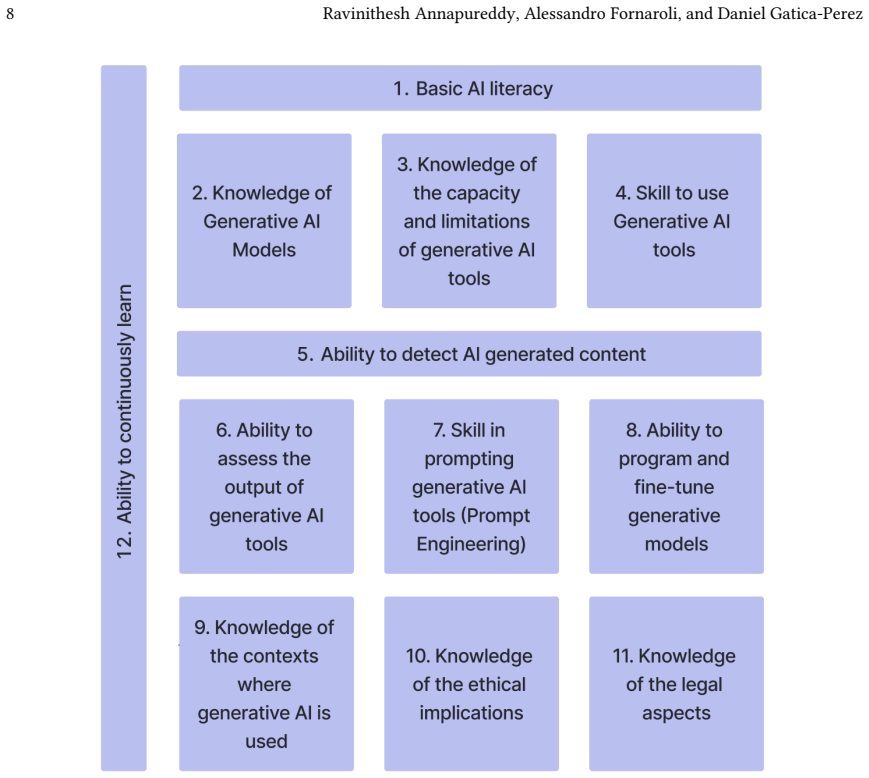
The central object is the twelve-item competency model itself, an ordered list of knowledge, skills, abilities, and behaviors arranged as a learning path. The ordering is purposeful: foundational awareness comes first, then tool use and output assessment, then prompting and programming, then context, ethics, law, and finally continuous learning, which cuts across all the others. The model works as a checklist and roadmap: it lets individuals, educators, and institutions locate themselves on the spectrum from consumer to developer.
What would settle it
A systematic search that locates a published generative AI literacy framework existing before or alongside this one, or an empirical study showing that a person can be fully competent with generative AI while lacking one of the twelve competencies, would overturn the claim that the set is defining.
Extended reading notes
Core claim
The paper's central claim is that generative AI literacy is a distinct concept from general AI literacy and is fully delineated by the twelve competencies listed here. Existing frameworks, it argues, treat literacy as generic and fail to separate generative from predictive AI, whereas these competencies cover what users need to understand, assess, interact with, and create generative AI. The list is presented as definitive: these twelve, in this order, are the defining competencies.
Load-bearing premise
The load-bearing premise is that a small database search and a non-systematic review of the literature are enough to prove that no prior generative AI literacy framework exists and that these twelve competencies are the complete, non-redundant set.
Editorial extensions
If this is right
- Educators can use the twelve competencies as the backbone of curricula that move learners from passive consumers to interpreters and creators of generative AI.
- Public institutions can benchmark employee skills against the model and use it to design training for generative AI adoption.
- Assessment designers can derive tasks and metrics from the competencies, supporting certification, proficiency levels, and educational placement.
- Policymakers can ground literacy guidelines and regulation in the competencies, including awareness of legal frameworks such as the AI Act.
Reading between the lines
- The paper does not itself build the assessment instruments it calls for; a direct next step would be to turn each competency into testable tasks and rubrics.
- The twelve-competency set could be treated as a layered extension of existing digital and data literacy frameworks, rather than a standalone construct, since many competencies (continuous learning, context, ethics) are not unique to generative AI.
- The claimed logical progression is testable: one could compare learning outcomes for groups trained in the proposed order versus a different order to see whether the sequence matters.
Editorial analysis
A structured set of objections, weighed in public.
Referee Report
Summary. This paper proposes a competency-based model of generative AI literacy, identifying twelve competencies ranging from foundational AI literacy through prompt engineering and programming to ethical, legal, and continuous-learning abilities. The authors argue that these competencies delineate a general definition of generative AI literacy and can serve as a framework for assessment, curriculum development, and policy. The method combines a non-systematic literature review with a narrow database search (six records, Section 3.1), and the potential implications are explicitly labeled as speculative in Sections 2 and 4.
Significance. If the twelve competencies were validated as complete and non-redundant, the framework could provide a useful common vocabulary for educators, policymakers, and researchers, complementing existing AI literacy frameworks such as Long and Magerko (2020). The paper's strengths are its transparency about the non-systematic method and speculative implications, and its clear, exemplified descriptions of each competency in Section 5. However, the evidence presented does not support the 'defining' status of the set, so the contribution is best read as a proposal or starting point rather than an established definition.
major comments (3)
- [Sections 2, 3.1, Table 3] The paper's central claim, stated in the title and abstract, is that the twelve competencies are 'defining' for generative AI literacy. That claim requires both completeness and non-redundancy of the set. The supporting evidence is an explicitly non-systematic literature review (Section 2) and a database search restricted to two exact phrases across five databases, yielding six records (Section 3.1). No selection criteria, coding scheme, inter-rater agreement, or external validation is reported for the list in Table 3, and Section 6.1 concedes that the framework reflects the current state of the field and may require revision. As written, the evidence cannot distinguish the twelve competencies from the authors' judgment, so the 'defining' claim is not supported. I recommend either softening the claim to 'proposed' or 'initial' competencies, or substantially strengthening the method with a systematic review and a validation step.
- [Section 1, Table 1] The Introduction states that 'no set of competencies specific to the use of generative AI had been previously proposed.' This novelty claim is contradicted by the paper's own Table 1, which lists Dadhich and Bhaumik (2023) proposing a 'Comprehensive Model' of generative AI literacy and Noh and Han (2023) implementing a 'generative AI literacy education program.' The authors dismiss these works as conflating generative AI literacy with general AI literacy, but this dismissal is asserted rather than demonstrated. Because the novelty of the contribution rests on this gap, the authors should either provide a more systematic analysis of the six records, including any competency lists they contain, or qualify the gap claim.
- [Table 3, Sections 4 and 5.12] The twelve competencies are not shown to be non-redundant, which is required if they are 'defining.' Competency 12 ('Ability to continuously learn') is explicitly described as 'transversal to all the other capabilities' in Section 4 and as applying 'to each of the other ones' in Section 5.12. Similarly, Competency 1 ('Basic AI literacy') and Competency 2 ('Knowledge of generative AI models') overlap in that the latter presupposes the former. If the model is intended as a set of independent competencies, the authors should justify the boundaries; alternatively, the model should be presented as a structured learning progression with a transversal meta-competency, which would be a different and more defensible claim.
minor comments (5)
- [Section 2] The phrase 'a long-standing review approach' is unclear; presumably 'a systematic review approach' was intended, or the sentence should be reworded for clarity.
- [Section 4] The sentence beginning 'Alongside, this paper defines...' uses an awkward transition; consider 'In addition, this paper defines...' or 'The paper also defines...'.
- [Section 5.9] The phrase 'to which extent' should be 'to what extent.'
- [Section 3.1 and Table 1] The database search was conducted in December 2023, but the manuscript was received in January 2024 and contains a March 2024 regulatory reference (the European AI Act approval) elsewhere; the authors should acknowledge that the 'state of the art' on generative AI literacy may have advanced since the search date.
- [Table 3] The positive and negative implications in Table 3 are described as mostly speculative in Section 4, but the table itself does not display this caveat; consider adding a footnote to the table so the caveat is visible without reading the main text.
Circularity Check
No significant circularity: the twelve-competency model is a literature-based synthesis, not a derivation that reduces to its own inputs.
full rationale
This is a conceptual proposal paper, not a formal derivation, so the circularity patterns that apply to fitted models or imported uniqueness theorems do not arise. The paper's central chain is: a December 2023 database search for "generative AI literacy" and "generative artificial intelligence literacy" returns six records; a non-systematic review of AI literacy, prompt engineering, generative AI applications, and competency models is used to identify twelve competencies; those competencies are then proposed as a definitional model. Each step is transparently declared. The authors do not fit a parameter to a subset of data and then claim to predict a closely related quantity; there is no equation or statistical reduction. There are no self-citations at all, so no self-citation chain is load-bearing, and no uniqueness theorem from the authors' prior work is invoked. The strongest possible circularity concern would be the self-definitional flavor of defining generative AI literacy in terms of competencies and then presenting the competency list as the model, but that is inherent to any competency framework and the paper does not pretend to derive the list from the definition; it derives the list from external literature. The weaknesses identified by the skeptic are evidentiary: Section 2 explicitly describes the review as non-systematic, Table 1 reports only six records, Section 6.1 concedes that the framework reflects the current state of the field and that revisions may be necessary, and the implications are labeled speculative in Sections 2 and 4. Those are limitations on completeness and generalizability, not circular reductions. The paper also positions the twelve competencies as a complement to, not a replacement of, the existing AI literacy framework of Long and Magerko, which further shows the model is built on external benchmarks rather than on its own conclusion. Therefore, under the rule that an honest non-finding is expected unless the specific reduction can be exhibited, the appropriate score is 0.
Assumptions & free parameters
assumptions (4)
- domain assumption Generative AI literacy is a distinct concept requiring its own competency set.
- domain assumption The NIH definition of competency (knowledge, skills, abilities, behaviors) is adopted as the foundation.
- domain assumption A non-systematic literature review is sufficient to identify a comprehensive and non-redundant set of competencies.
- domain assumption The database search with the specific query captures the current state of generative AI literacy research.
invented entities (1)
-
Twelve defining competencies for generative AI literacy
Cite this review
Pith. "Pith review of Generative AI Literacy: Twelve Defining Competencies." pith.science (2026). https://pith.science/paper/R2DJOXM4
@misc{pith2026241212107,
  author       = {Pith},
  title        = {Pith review of: Generative AI Literacy: Twelve Defining Competencies},
  year         = {2026},
  howpublished = {\url{https://pith.science/paper/R2DJOXM4}},
  note         = {Machine review of arXiv:2412.12107}
}
read the original abstract
This paper introduces a competency-based model for generative artificial intelligence (AI) literacy covering essential skills and knowledge areas necessary to interact with generative AI. The competencies range from foundational AI literacy to prompt engineering and programming skills, including ethical and legal considerations. These twelve competencies offer a framework for individuals, policymakers, government officials, and educators looking to navigate and take advantage of the potential of generative AI responsibly. Embedding these competencies into educational programs and professional training initiatives can equip individuals to become responsible and informed users and creators of generative AI. The competencies follow a logical progression and serve as a roadmap for individuals seeking to get familiar with generative AI and for researchers and policymakers to develop assessments, educational programs, guidelines, and regulations.
Figures
Reference graph
Works this paper leans on
-
[1]
Hussam Alkaissi and Samy I McFarlane. 2023. Artificial Hallucinations in ChatGPT: Implications in Scientific Writing. Cureus 15, 2 (2023), e35179. https://doi.org/10.7759/cureus.35179
-
[2]
Chen, Laurel Orr, Neel Guha, Kush Bhatia, Ines Chami, Frederic Sala, and Christopher Ré
Simran Arora, Avanika Narayan, Mayee F. Chen, Laurel Orr, Neel Guha, Kush Bhatia, Ines Chami, Frederic Sala, and Christopher Ré. 2022. Ask Me Anything: A simple strategy for prompting language models. arXiv:2210.02441 [cs.CL]
arXiv 2022
-
[3]
Sai Anirudh Athaluri, Sandeep Varma Manthena, V S R Krishna Manoj Kesapragada, Vineel Yarlagadda, Tirth Dave, and Rama Tulasi Siri Duddumpudi. 2023. Exploring the Boundaries of Reality: Investigating the Phenomenon of Artificial Intelligence Hallucination in Scientific Writing Through ChatGPT References. Cureus 15, 4 (2023), e37432. https://doi.org/10.775...
-
[4]
Ömer Aydın and Enis Karaarslan. 2022. OpenAI ChatGPT Generated Literature Review: Digital Twin in Healthcare. SSRN Electronic Journal (2022), 22–31. https://doi.org/10.2139/ssrn.4308687
-
[5]
Razvan Azamfirei, Sapna R Kudchadkar, and James Fackler. 2023. Large language models and the perils of their hallucinations. Critical Care 27, 1 (March 2023), 120. https://doi.org/10.1186/s13054-023-04393-x Manuscript submitted to ACM Generative AI Literacy: Twelve Defining Competencies 19
-
[6]
David Baidoo-Anu and Leticia Owusu Ansah. 2023. Education in the Era of Generative Artificial Intelligence (AI): Understanding the Potential Benefits of ChatGPT in Promoting Teaching and Learning. Journal of AI 7, 1 (2023), 52–62. https://doi.org/10.61969/jai.1337500
-
[7]
Maria Teresa Baldassarre, Danilo Caivano, Berenice Fernandez Nieto, Domenico Gigante, and Azzurra Ragone. 2023. The Social Impact of Generative AI: An Analysis on ChatGPT. In Proceedings of the 2023 ACM Conference on Information Technology for Social Good (Lisbon, Portugal) (GoodIT ’23). Association for Computing Machinery, New York, NY, USA, 363–373. htt...
arXiv 2023
-
[8]
Samah S. Baraheem and Tam V. Nguyen. 2023. AI vs. AI: Can AI Detect AI-Generated Images? Journal of Imaging 9, 10 (2023). https: //doi.org/10.3390/jimaging9100199
Show all 109 references
-
[9]
Paul Batalden, David Leach, Susan Swing, Hubert Dreyfus, and Stuart Dreyfus. 2002. General Competencies And Accreditation In Graduate Medical Education. Health Affairs 21, 5 (2002), 103–111. https://doi.org/10.1377/hlthaff.21.5.103 arXiv:https://doi.org/10.1377/hlthaff.21.5.103
2002 doi
-
[10]
Weyerer Bernd W
Jan C. Weyerer Bernd W. Wirtz and Carolin Geyer. 2019. Artificial Intelligence and the Public Sector—Applications and Chal- lenges. International Journal of Public Administration 42, 7 (2019), 596–615. https://doi.org/10.1080/01900692.2018.1498103 arXiv:https://doi.org/10.1080...
2019
-
[11]
Aras Bozkurt. 2023. Unleashing the potential of generative AI, conversational agents and chatbots in educational praxis: A systematic review and bibliometric analysis of GenAI in education. Open Praxis 15, 4 (Nov 2023). https://doi.org/10.55982/openpraxis.15.4.609
2023 doi
-
[12]
Enock, Saba Esnaashari, John Francis, Youmna Hashem, and Deborah Morgan
Jonathan Bright, Florence E. Enock, Saba Esnaashari, John Francis, Youmna Hashem, and Deborah Morgan. 2024. Generative AI is already widespread in the public sector. https://doi.org/10.48550/arXiv.2401.01291 arXiv:2401.01291 [cs.CY]
-
[13]
Damien Bruce, Ankit Fadia, Tom Isherwood, Chiara Marcati, Aldous Mitchell, Björn Münstermann, Gayatri Shenai, Hrishika Vuppala, and Thomas Weber. 2023. Unlocking the potential of generative AI: Three key questions for government agencies. https://www.mckinsey.com/industries/pu...
2023
-
[14]
Bamber, Jose R
Pawan Budhwar, Soumyadeb Chowdhury, Geoffrey Wood, Herman Aguinis, Greg J. Bamber, Jose R. Beltran, Paul Boselie, Fang Lee Cooke, Stephanie Decker, Angelo DeNisi, Prasanta Kumar Dey, David Guest, Andrew J. Knoblich, Ashish Malik, Jaap Paauwe, Savvas Papagiannidis, Charmi Patel...
2023
-
[15]
Lorena Casal-Otero, Alejandro Catala, Carmen Fernández-Morante, Maria Taboada, Beatriz Cebreiro, and Senén Barro. 2023. AI literacy in K-12: a systematic literature review. International Journal of STEM Education 10, 1 (19 Apr 2023), 29. https://doi.org/10.1186/s40594-023-00418-7
2023 doi
-
[16]
Lucian Cernuşca and Cristina Dima. 2007. Competency and human resource management. Revista da Faculdade de Ciências Humanas e Sociais 4 (2007), 162–171. http://hdl.handle.net/10284/357
2007
-
[17]
Yoon Chae. 2020. US AI regulation guide: legislative overview and practical considerations. The Journal of Robotics, Artificial Intelligence & Law 3 (2020)
2020
-
[18]
Chaka Chaka. 2023. Detecting AI content in responses generated by ChatGPT, YouChat, and Chatsonic: The case of five AI content detection tools. Journal of Applied Learning and Teaching 6, 2 (2023). https://doi.org/10.37074/jalt.2023.6.2.12
2023 doi
-
[19]
Contextual
Anastasia Chan. 2023. GPT-3 and InstructGPT: technological dystopianism, utopianism, and “Contextual” perspectives in AI ethics and industry. AI and Ethics 3, 1 (Feb. 2023), 53–64
2023
-
[20]
Cecilia Ka Yuk Chan and Wenjie Hu. 2023. Students’ voices on generative AI: perceptions, benefits, and challenges in higher education.International Journal of Educational Technology in Higher Education 20, 1 (July 2023), 43
2023
-
[21]
Banghao Chen, Zhaofeng Zhang, Nicolas Langrené, and Shengxin Zhu. 2023. Unleashing the potential of prompt engineering in Large Language Models: a comprehensive review. arXiv:2310.14735 [cs.CL]
2023 arXiv
-
[22]
Vikram Singh Chouhan and Sandeep Srivastava. 2014. Understanding Competencies and Competency Modeling — A Literature Survey. IOSR Journal of Business and Management 16 (2014), 14–22. https://doi.org/10.9790/487X-16111422
2014 doi
-
[23]
Ben Collins. 2023. Fake picture of explosion at Pentagon Spooks twitter. https://www.nbcnews.com/tech/misinformation/fake-picture-explosion- pentagon-spooks-twitter-rcna85659
2023
-
[24]
Antonia Creswell, Tom White, Vincent Dumoulin, Kai Arulkumaran, Biswa Sengupta, and Anil A. Bharath. 2018. Generative Adversarial Networks: An Overview. IEEE Signal Processing Magazine 35, 1 (2018), 53–65. https://doi.org/10.1109/MSP.2017.2765202
2018
-
[25]
Manish Dadhich and Amiya Bhaumik. 2023. Demystification of Generative Artificial Intelligence (AI) Literacy, Algorithmic Thinking, Cognitive Divide, Pedagogical knowledge: A Comprehensive Model. In 2023 IEEE International Conference on ICT in Business Industry & Government (IC...
2023
-
[26]
Cotton Debby R
Peter A. Cotton Debby R. E. Cotton and J. Reuben Shipway. 2023. Chatting and cheating: Ensuring academic integrity in the era of ChatGPT. Innovations in Education and Teaching International 0, 0 (2023), 1–12. https://doi.org/10.1080/14703297.2023.2190148 arXiv:https://doi.org/...
2023
-
[27]
Françoise Delamare Le Deist and Jonathan Winterton. 2005. What Is Competence? Human Resource Development International 8, 1 (2005), 27–46. https://doi.org/10.1080/1367886042000338227 arXiv:https://doi.org/10.1080/1367886042000338227
2005 doi
-
[28]
Patrick Dunleavy and Helen Margetts. 2023. Data science, artificial intelligence and the third wave of digital era governance. Public Policy and Administration (2023). https://doi.org/10.1177/09520767231198737 arXiv:https://doi.org/10.1177/09520767231198737
2023 doi
-
[29]
So what if ChatGPT wrote it?
Yogesh K. Dwivedi, Nir Kshetri, Laurie Hughes, Emma Louise Slade, Anand Jeyaraj, Arpan Kumar Kar, Abdullah M. Baabdullah, Alex Koohang, Vishnupriya Raghavan, Manju Ahuja, Hanaa Albanna, Mousa Ahmad Albashrawi, Adil S. Al-Busaidi, Janarthanan Balakrishnan, Yves Barlette, Manusc...
2023
-
[30]
Dina El-Zanfaly, Yiwei Huang, and Yanwen Dong. 2023. Sand-in-the-loop: Investigating embodied co-creation for shared understandings of generative AI. In Companion Publication of the 2023 ACM Designing Interactive Systems Conference (Pittsburgh, PA, USA) (DIS ’23 Companion). As...
2023
-
[31]
Tyna Eloundou, Sam Manning, Pamela Mishkin, and Daniel Rock. 2023. GPTs are GPTs: An Early Look at the Labor Market Impact Potential of Large Language Models. arXiv:2303.10130 [econ.GN]
2023 arXiv
-
[32]
European Parliament and Council of the European Union. 2021. Regulation of the European Parliament and of the Council Laying down harmonised rules on Artificial Intelligence (Artificial Intelligence Act) and amending certain union Legislative acts. https://eur-lex.europa.eu/le...
2021
-
[33]
Gao, Frederick M
Catherine A. Gao, Frederick M. Howard, Nikolay S. Markov, Emma C. Dyer, Siddhi Ramesh, Yuan Luo, and Alexander T. Pear- son. 2022. Comparing scientific abstracts generated by ChatGPT to original abstracts using an artificial intelligence out- put detector, plagiarism detector,...
2022 doi
-
[34]
Louie Giray. 2023. Prompt Engineering with ChatGPT: A Guide for Academic Writers. Annals of Biomedical Engineering 51, 12 (2023), 2629–2633. https://doi.org/10.1007/s10439-023-03272-4
2023 doi
-
[35]
Matthew Groh, Aruna Sankaranarayanan, Nikhil Singh, Dong Young Kim, Andrew Lippman, and Rosalind Picard. 2024. Human Detection of Political Speech Deepfakes across Transcripts, Audio, and Video. arXiv:2202.12883 [cs.HC]
2024 arXiv
-
[36]
Jindong Gu, Zhen Han, Shuo Chen, Ahmad Beirami, Bailan He, Gengyuan Zhang, Ruotong Liao, Yao Qin, Volker Tresp, and Philip Torr. 2023. A Systematic Survey of Prompt Engineering on Vision-Language Foundation Models. arXiv:2307.12980 [cs.CV]
2023 arXiv
-
[37]
Philipp Hacker, Andreas Engel, and Marco Mauer. 2023. Regulating ChatGPT and other Large Generative AI Models. In Proceedings of the 2023 ACM Conference on Fairness, Accountability, and Transparency (Chicago, IL, USA) (FAccT ’23). Association for Computing Machinery, New York,...
2023
-
[38]
Mohammed Haddad. 2023. Fake Pentagon explosion photo goes viral: How to spot an AI image. https://www.aljazeera.com/news/2023/5/23/fake- pentagon-explosion-photo-goes-viral-how-to-spot-an-ai-image
2023
-
[39]
Xavier Harding. 2023. Did AI Generate This Photo? Here’s How To Tell. https://foundation.mozilla.org/en/blog/ai-photo-how-to-tell/
2023
-
[40]
Harris and Chris Jaikaran
Laurie A. Harris and Chris Jaikaran. 2023. Highlights of the 2023 Executive Order on Artificial Intelligence for Congress. Congressional Research Service R47843 (7 11 2023). https://crsreports.congress.gov/product/details?prodcode=R47843
2023
-
[41]
Natali Helberger and Nicholas Diakopoulos. 2023. ChatGPT and the AI Act. Internet Policy Review 12, 1 (2023). https://doi.org/10.14763/2023.1.1682
2023 doi
-
[42]
Natali Helberger and Nicholas Diakopoulos. 2023. The European AI Act and How It Matters for Research into AI in Media and Journalism. Digital Journalism 11, 9 (2023), 1751–1760. https://doi.org/10.1080/21670811.2022.2082505 arXiv:https://doi.org/10.1080/21670811.2022.2082505
2023 arXiv
-
[43]
Paul Henman. 2020. Improving public services using artificial intelligence: possibilities, pitfalls, governance. Asia Pacific Journal of Public Administration 42, 4 (2020), 209–221. https://doi.org/10.1080/23276665.2020.1816188 arXiv:https://doi.org/10.1080/23276665.2020.1816188
2020
-
[44]
Terrence Hoffmann. 1999. The meanings of competency. J. Eur. Ind. Train. 23, 6 (Aug. 1999), 275–286. https://doi.org/10.1108/03090599910284650
1999 doi
-
[45]
Shehzeen Hussain, Paarth Neekhara, Malhar Jere, Farinaz Koushanfar, and Julian McAuley. 2021. Adversarial Deepfakes: Evaluating Vulnerability of Deepfake Detectors to Adversarial Examples. In 2021 IEEE Winter Conference on Applications of Computer Vision (W ACV). 3347–3356. ht...
2021
-
[46]
Yohan Hwang, Jang Ho Lee, and Dongkwang Shin. 2023. What is prompt literacy? An exploratory study of language learners’ development of new literacy skill using generative AI. arXiv:2311.05373 [cs.HC] https://arxiv.org/abs/2311.05373
2023 arXiv
-
[47]
Enkelejda Kasneci, Kathrin Sessler, Stefan Küchemann, Maria Bannert, Daryna Dementieva, Frank Fischer, Urs Gasser, Georg Groh, Stephan Günnemann, Eyke Hüllermeier, Stephan Krusche, Gitta Kutyniok, Tilman Michaeli, Claudia Nerdel, Jürgen Pfeffer, Oleksandra Poquet, Michael Sail...
2023
-
[48]
Kingma and Max Welling
Diederik P. Kingma and Max Welling. 2019. An Introduction to Variational Autoencoders. Foundations and Trends® in Machine Learning 12, 4 (2019), 307–392. https://doi.org/10.1561/2200000056
2019 doi
-
[49]
Lucas Kohnke, Benjamin Luke Moorhouse, and Di Zou. 2023. ChatGPT for Language Teaching and Learning. RELC Journal 54, 2 (2023), 537–550. https://doi.org/10.1177/00336882231162868 arXiv:https://doi.org/10.1177/00336882231162868
2023 doi
-
[50]
Takeshi Kojima, Shixiang (Shane) Gu, Machel Reid, Yutaka Matsuo, and Yusuke Iwasawa. 2022. Large Language Models are Zero-Shot Reasoners. In Advances in Neural Information Processing Systems , S. Koyejo, S. Mohamed, A. Agarwal, D. Belgrave, K. Cho, and A. Oh (Eds.), Vol. 35. M...
2022
-
[51]
Moritz Kreinsen and Sandra Schulz. 2023. Towards the Triad of Digital Literacy, Data Literacy and AI Literacy in Teacher Education – A Discussion in Light of the Accessibility of Novel Generative AI. https://doi.org/10.35542/osf.io/xguzk
2023 doi
-
[52]
Jianning Li, Amin Dada, Jens Kleesiek, and Jan Egger. 2023. ChatGPT in Healthcare: A Taxonomy and Systematic Review. medRxiv (2023). https://doi.org/10.1101/2023.03.30.23287899 arXiv:https://www.medrxiv.org/content/early/2023/03/30/2023.03.30.23287899.full.pdf
2023 doi
-
[53]
Lingyao Li, Zihui Ma, Lizhou Fan, Sanggyu Lee, Huizi Yu, and Libby Hemphill. 2023. ChatGPT in education: A discourse analysis of worries and concerns on social media. arXiv:2305.02201 [cs.CY]
2023 arXiv
-
[54]
Michael Liebrenz, Roman Schleifer, Anna Buadze, Dinesh Bhugra, and Alexander Smith. 2023. Generating scholarly content with ChatGPT: ethical challenges for medical publishing. The Lancet Digital Health 5, 3 (2023), e105–e106. https://doi.org/10.1016/S2589-7500(23)00019-5
2023 doi
-
[55]
Pengfei Liu, Weizhe Yuan, Jinlan Fu, Zhengbao Jiang, Hiroaki Hayashi, and Graham Neubig. 2023. Pre-train, Prompt, and Predict: A Systematic Survey of Prompting Methods in Natural Language Processing. ACM Comput. Surv. 55, 9, Article 195 (jan 2023), 35 pages. https://doi.org/10...
2023 doi
-
[56]
Siru Liu, Aileen P Wright, Barron L Patterson, Jonathan P Wanderer, Robert W Turer, Scott D Nelson, Allison B McCoy, Dean F Sittig, and Adam Wright. 2023. Using AI-generated suggestions from ChatGPT to optimize clinical decision support. Journal of the American Medi- cal Infor...
2023 doi
-
[57]
Vivian Liu and Lydia B Chilton. 2022. Design Guidelines for Prompt Engineering Text-to-Image Generative Models. In Proceedings of the 2022 CHI Conference on Human Factors in Computing Systems (New Orleans, LA) (CHI ’22). Association for Computing Machinery, New York, NY, USA, ...
2022
-
[58]
Chung Kwan Lo. 2023. What Is the Impact of ChatGPT on Education? A Rapid Review of the Literature. Education Sciences 13, 4 (2023). https://doi.org/10.3390/educsci13040410
2023 doi
-
[59]
Leo S. Lo. 2023. The Art and Science of Prompt Engineering: A New Literacy in the Information Age. Internet Reference Services Quarterly 27, 4 (2023), 203–210. https://doi.org/10.1080/10875301.2023.2227621 arXiv:https://doi.org/10.1080/10875301.2023.2227621
2023
-
[60]
Leo S. Lo. 2023. The CLEAR path: A framework for enhancing information literacy through prompt engineering. The Journal of Academic Librarianship 49, 4 (2023), 102720. https://doi.org/10.1016/j.acalib.2023.102720
2023
-
[61]
Duri Long and Brian Magerko. 2020. What is AI Literacy? Competencies and Design Considerations. In Proceedings of the 2020 CHI Conference on Human Factors in Computing Systems (Honolulu, HI, USA) (CHI ’20) . Association for Computing Machinery, New York, NY, USA, 1–16. https:/...
2020
-
[62]
Jieyi Long. 2023. Large Language Model Guided Tree-of-Thought. arXiv:2305.08291 [cs.AI]
2023 arXiv
-
[63]
Tambiama Madiega. 2021. Artificial intelligence act. European Parliament: European Parliamentary Research Service (2021). https://policycommons.net/artifacts/1894362/artificial-intelligence-act/2644377/#:~:text=https%3A//policycommons.net/artifacts/1894362/ artificial%2Dintell...
2021
-
[64]
Albert Meijer, Lukas Lorenz, and Martijn Wessels. 2021. Algorithmization of Bureaucratic Organizations: Using a Practice Lens to Study How Context Shapes Predictive Policing Systems. Public Administration Review 81, 5 (2021), 837–846. https://doi.org/10.1111/puar.13391 arXiv:h...
2021 doi
-
[65]
Bertalan Meskó and Eric J Topol. 2023. The imperative for regulatory oversight of large language models (or generative AI) in healthcare. npj Digital Medicine 6, 1 (July 2023), 120. https://doi.org/10.1038/s41746-023-00873-0
2023 doi
-
[66]
Fiona Fui-Hoon Nah, Ruilin Zheng, Jingyuan Cai, Keng Siau, and Langtao Chen. 2023. Generative AI and ChatGPT: Applications, challenges, and AI-human collaboration. Journal of Information Technology Case and Application Research 25, 3 (2023), 277–304. https://doi.org/10.1080/15...
2023
-
[67]
Davy Tsz Kit Ng, Jac Ka Lok Leung, Samuel Kai Wah Chu, and Maggie Shen Qiao. 2021. Conceptualizing AI literacy: An exploratory review. Computers and Education: Artificial Intelligence 2 (2021), 100041. https://doi.org/10.1016/j.caeai.2021.100041
2021
-
[68]
Nightingale and Hany Farid
Sophie J. Nightingale and Hany Farid. 2022. AI-synthesized faces are indistinguishable from real faces and more trustwor- thy. Proceedings of the National Academy of Sciences 119, 8 (2022), e2120481119. https://doi.org/10.1073/pnas.2120481119 arXiv:https://www.pnas.org/doi/pdf...
2022 doi
-
[69]
YangJin Noh and Songlee Han. 2023. Exploring perception and support strategies for Generative AI Literacy: Focusing on pre-service secondary teachers. Korean Association For Learner-Centered Curriculum And Instruction 23, 17 (2023), 317–333. https://doi.org/10.22251/jlcci.2023...
2023 doi
-
[70]
National Institute of Health. 2020. Competencies at NIH. https://hr.nih.gov/working-nih/competencies
2020
-
[71]
Eugenie Park and Risa GELLES-WATNICK. 2023. Most Americans haven’t used CHATGPT; few think it will have a major impact on their job. https: //www.pewresearch.org/short-reads/2023/08/28/most-americans-havent-used-chatgpt-few-think-it-will-have-a-major-impact-on-their-job/
2023
-
[72]
Carl Preiksaitis and Christian Rose. 2023. Opportunities, Challenges, and Future Directions of Generative Artificial Intelligence in Medical Education: Scoping Review. JMIR Med Educ 9 (20 Oct 2023), e48785. https://doi.org/10.2196/48785
2023 doi
-
[73]
Tat Putjorn and Pruet Putjorn. 2023. Augmented Imagination: Exploring Generative AI from the Perspectives of Young Learners. In 2023 15th International Conference on Information Technology and Electrical Engineering (ICITEE). 353–358. https://doi.org/10.1109/ICITEE59582.2023.10317680
2023
-
[74]
Kurtis Pykes. 2023. How to use midjourney: A comprehensive guide to ai-generated artwork creation. https://www.datacamp.com/tutorial/how- to-use-midjourney-a-comprehensive-guide-to-ai-generated-artwork-creation Manuscript submitted to ACM 22 Ravinithesh Annapureddy, Alessandro...
2023
-
[75]
Hua Qi, Qing Guo, Felix Juefei-Xu, Xiaofei Xie, Lei Ma, Wei Feng, Yang Liu, and Jianjun Zhao. 2020. DeepRhythm: Exposing DeepFakes with Attentional Visual Heartbeat Rhythms. In Proceedings of the 28th ACM International Conference on Multimedia (Seattle, WA, USA) (MM ’20). Asso...
2020
-
[76]
Han Qiao, Vivian Liu, and Lydia Chilton. 2022. Initial Images: Using Image Prompts to Improve Subject Representation in Multimodal AI Generated Art. In Proceedings of the 14th Conference on Creativity and Cognition (Venice, Italy) (C&C ’22). Association for Computing Machinery...
2022
-
[77]
Mizanur Rahman, Harold Jan R Terano, Nafizur Rahman, Aidin Salamzadeh, and Saidur Rahaman. 2023. ChatGPT and Academic Research: A Review and Recommendations Based on Practical Examples. Journal of Education, Management and Development Studies 3, 1 (Mar. 2023), 1–12. https://do...
2023 doi
-
[78]
Partha Pratim Ray. 2023. ChatGPT: A comprehensive review on background, applications, key challenges, bias, ethics, limitations and future scope. Internet of Things and Cyber-Physical Systems 3 (2023), 121–154. https://doi.org/10.1016/j.iotcps.2023.04.003
2023 doi
-
[79]
Laria Reynolds and Kyle McDonell. 2021. Prompt Programming for Large Language Models: Beyond the Few-Shot Paradigm. In Extended Abstracts of the 2021 CHI Conference on Human Factors in Computing Systems (Yokohama, Japan) (CHI EA ’21). Association for Computing Machinery, New Y...
2021
-
[80]
Suebsarn Ruksakulpiwat, Ayanesh Kumar, and Anuoluwapo Ajibade. 2023. Using ChatGPT in Medical Research: Current Status and Future Directions. Journal of Multidisciplinary Healthcare 16 (2023), 1513–1520. https://doi.org/10.2147/jmdh.s413470
2023 doi
-
[81]
Malik Sallam. 2023. ChatGPT Utility in Healthcare Education, Research, and Practice: Systematic Review on the Promising Perspectives and Valid Concerns. Healthcare 11, 6 (2023). https://doi.org/10.3390/healthcare11060887
2023 doi
-
[82]
Elvis Saravia. 2022. Prompt Engineering Guide. https://github.com/dair-ai/Prompt-Engineering-Guide
2022
-
[83]
Eric Sarrion. 2023. Parameters Used in ChatGPT . Apress, Berkeley, CA, 87–106. https://doi.org/10.1007/978-1-4842-9804-6_6
2023 doi
-
[84]
Katharina Schüller, Florian Rampelt, Henning Koch, and Johannes Schleiss. 2023. Better ready than just aware: Data and AI Literacy as an enabler for informed decision making in the data age. (2023). https://doi.org/10.18420/inf2023_49
2023 doi
-
[85]
Richard J Shavelson. 2010. On the measurement of competency. Empirical Research in Vocational Education and Training 2, 1 (July 2010), 41–63. https://doi.org/10.1007/BF03546488
2010 doi
-
[86]
Logan IV, Eric Wallace, and Sameer Singh
Taylor Shin, Yasaman Razeghi, Robert L. Logan IV, Eric Wallace, and Sameer Singh. 2020. AutoPrompt: Eliciting Knowledge from Language Models with Automatically Generated Prompts. In Proceedings of the 2020 Conference on Empirical Methods in Natural Language Processing (EMNLP),...
2020 doi
-
[87]
Chenglei Si, Zhe Gan, Zhengyuan Yang, Shuohang Wang, Jianfeng Wang, Jordan Boyd-Graber, and Lijuan Wang. 2023. Prompting GPT-3 To Be Reliable. arXiv:2210.09150 [cs.CL]
2023 arXiv
-
[88]
Sarin Sok and Kimkong Heng. 2023. ChatGPT for Education and Research: A Review of Benefits and Risks. SSRN Electronic Journal (2023). https://doi.org/10.2139/ssrn.4378735
2023 doi
-
[89]
Chris Stokel-Walker. 2023. ChatGPT listed as author on research papers: many scientists disapprove. Nature 613, 7945 (2023), 620–621. doi:https: //doi.org/10.1038/d41586-023-00107-z
2023 doi
-
[90]
Chris Stokel-Walker and Richard Van Noorden. 2023. What ChatGPT and generative AI mean for science. Nature 614, 7947 (2023), 214–216
2023
-
[91]
Bilal Succar, Willy Sher, and Anthony Williams. 2013. An integrated approach to BIM competency assessment, acquisition and application. Automation in Construction 35 (2013), 174–189. https://doi.org/10.1016/j.autcon.2013.05.016
2013 doi
-
[92]
Arun James Thirunavukarasu, Darren Shu Jeng Ting, Kabilan Elangovan, Laura Gutierrez, Ting Fang Tan, and Daniel Shu Wei Ting. 2023. Large language models in medicine. Nature Medicine 29, 8 (Aug. 2023), 1930–1940
2023
-
[93]
Raju Vaishya, Anoop Misra, and Abhishek Vaish. 2023. ChatGPT: Is this version good for healthcare and research? Diabetes & Metabolic Syndrome: Clinical Research & Reviews 17, 4 (2023), 102744. https://doi.org/10.1016/j.dsx.2023.102744
2023
-
[94]
Eva A M van Dis, Johan Bollen, Willem Zuidema, Robert van Rooij, and Claudi L Bockting. 2023. ChatGPT: five priorities for research. Nature 614, 7947 (Feb. 2023), 224–226. https://doi.org/10.1038/d41586-023-00288-7
2023 doi
-
[95]
Colin van Noordt and Gianluca Misuraca. 2022. Artificial intelligence for the public sector: results of landscaping the use of AI in government across the European Union. Government Information Quarterly 39, 3 (2022), 101714. https://doi.org/10.1016/j.giq.2022.101714
2022
-
[96]
Jiaqi Wang, Zhengliang Liu, Lin Zhao, Zihao Wu, Chong Ma, Sigang Yu, Haixing Dai, Qiushi Yang, Yiheng Liu, Songyao Zhang, Enze Shi, Yi Pan, Tuo Zhang, Dajiang Zhu, Xiang Li, Xi Jiang, Bao Ge, Yixuan Yuan, Dinggang Shen, Tianming Liu, and Shu Zhang. 2023. Review of large vision...
2023
-
[97]
Debora Weber-Wulff, Alla Anohina-Naumeca, Sonja Bjelobaba, Tomáš Foltýnek, Jean Guerrero-Dib, Olumide Popoola, Petr Šigut, and Lorna Waddington. 2023. Testing of detection tools for AI-generated text. International Journal for Educational Integrity 19, 1 (Dec. 2023), 26
2023
-
[98]
Jason Wei, Xuezhi Wang, Dale Schuurmans, Maarten Bosma, brian ichter, Fei Xia, Ed Chi, Quoc V Le, and Denny Zhou. 2022. Chain-of-Thought Prompting Elicits Reasoning in Large Language Models. In Advances in Neural Information Processing Systems , S. Koyejo, S. Mohamed, A. Agarw...
2022
-
[99]
Myrtille Wendling. 2023. Élections Fédérales 2023 – une affiche du PLR, générée par une ia, crée La Polémique. https://www.24heures.ch/une- affiche-du-plr-generee-par-une-ia-cree-la-polemique-758569233102 Manuscript submitted to ACM Generative AI Literacy: Twelve Defining Comp...
2023
-
[100]
Jules White, Quchen Fu, Sam Hays, Michael Sandborn, Carlos Olea, Henry Gilbert, Ashraf Elnashar, Jesse Spencer-Smith, and Douglas C. Schmidt
-
[101]
Thomas Wolf, Lysandre Debut, Victor Sanh, Julien Chaumond, Clement Delangue, Anthony Moi, Pierric Cistac, Tim Rault, Remi Louf, Morgan Funtowicz, Joe Davison, Sam Shleifer, Patrick von Platen, Clara Ma, Yacine Jernite, Julien Plu, Canwen Xu, Teven Le Scao, Sylvain Gugger, Mari...
2020
-
[102]
Charles Woodruffe. 1993. What is meant by a competency? Leadersh. Organ. Dev. J. 14, 1 (Jan. 1993), 29–36. https://doi.org/10.1108/eb053651
1993 doi
-
[103]
Tianyu Wu, Shizhu He, Jingping Liu, Siqi Sun, Kang Liu, Qing-Long Han, and Yang Tang. 2023. A Brief Overview of ChatGPT: The History, Status Quo and Potential Future Development. IEEE/CAA Journal of Automatica Sinica 10, 5 (2023), 1122–1136. https://doi.org/10.1109/JAS.2023.123618
2023
-
[104]
Griffiths, Yuan Cao, and Karthik Narasimhan
Shunyu Yao, Dian Yu, Jeffrey Zhao, Izhak Shafran, Thomas L. Griffiths, Yuan Cao, and Karthik Narasimhan. 2023. Tree of Thoughts: Deliberate Problem Solving with Large Language Models. arXiv:2305.10601 [cs.CL]
2023 arXiv
-
[105]
Yumi Yi. 2021. Establishing the concept of AI literacy. Jahr–European Journal of Bioethics 12, 2 (2021), 353–368. https://doi.org/10.21860/j.12.2.8
2021 doi
-
[106]
Xiaoming Zhai and Matthew Nyaaba. 2023. Professional Development Needs of Teacher Educators for Generative AI Literacy and Application in Ghana. Journal of AI, available at SSRN (2023). https://doi.org/10.2139/ssrn.4628126
2023 doi
-
[107]
Zhuosheng Zhang, Aston Zhang, Mu Li, Hai Zhao, George Karypis, and Alex Smola. 2023. Multimodal Chain-of-Thought Reasoning in Language Models. arXiv:2302.00923 [cs.CL]
2023 arXiv
-
[108]
Kaiyang Zhou, Jingkang Yang, Chen Change Loy, and Ziwei Liu. 2022. Learning to Prompt for Vision-Language Models. International Journal of Computer Vision 130, 9 (Sept. 2022), 2337–2348. Received 28 January 2024; revised 01 April 2024; accepted 18 May 2024 Manuscript submitted to ACM
2022
-
[2023]
arXiv:2302.11382 [cs.SE]
A Prompt Pattern Catalog to Enhance Prompt Engineering with ChatGPT. arXiv:2302.11382 [cs.SE]
Reviewed August 12, 2026 · model on record in the stance chip above.
Discussion (0). Continue with ORCID to comment.