REVIEW 3 major objections 4 minor 87 references
Emergent electrostatics in planar XY spin models: the bridge connecting topological order with broken $U(1)$ symmetry
T0 review · 3 major / 4 minor · reviewed 2026-08-11 · deepseek-v4-flash
Pith's one-line read This review claims that topological order, understood as the freezing of the global topological sector, induces broken U(1) symmetry in the low-temperature 2D XY model, in a generalized dynamical sense.
desk verdict A coherent, well-documented review of the author's own program on broken U(1) symmetry and topological nonergodicity in XY models, but the causal bridge is conditional for the physical 2DXY model. read the letter →
The pith
A machine-rendered reading of the paper's core claim, the machinery that carries it, and where it could break.
The reading
What carries the argument
The central object is the emergent lattice electric field $E(r)$, obtained by rotating the phase-difference field of the spins; it satisfies a lattice Gauss law $\hat{\nabla}\cdot E=J\rho$ whose divergences are vortices. The field is decomposed by Helmholtz–Hodge into an irrotational Coulomb part $-\nabla\phi$, a uniform harmonic mode $\bar{E}$, and a purely rotational gauge field $\hat{\nabla}\times Q$; the harmonic mode splits into a low-energy polarization field $\bar{E}_p$ and a topological sector $2\pi J w/L$, where $w\in\mathbb{Z}^2$ counts internal global spin twists around the torus. The topological sector is the workhorse of the argument: it is the additional degree of freedom missing from the BKT and Salzberg–Prager pictures, its freezing defines topological nonergodicity through the long-time topological stability $\gamma_w$, and its restoration by global-twist Monte Carlo moves restores both topological ergodicity and U(1) symmetry. The exact map to the augmented electrostatic Boltzmann distribution is derived for the harmonic XY model; in the physical 2DXY model the same Coulomb physics holds to first order, softened by the cosine couplings.
What would settle it
Run the local Metropolis simulation of the 2DXY model at $\beta>\beta_{\mathrm{BKT}}$ and measure the directional mixing timescale $\tau_{\rm mix}$ from the Cramér–von Mises statistic together with the variance of the topological sector $w$ as functions of system size $N$; if $\tau_{\rm mix}$ grows slower than any positive power of $N$, or if $w$ changes on timescales that do not diverge, the claimed topological nonergodicity and topology-induced symmetry breaking are absent.
Extended reading notes
Core claim
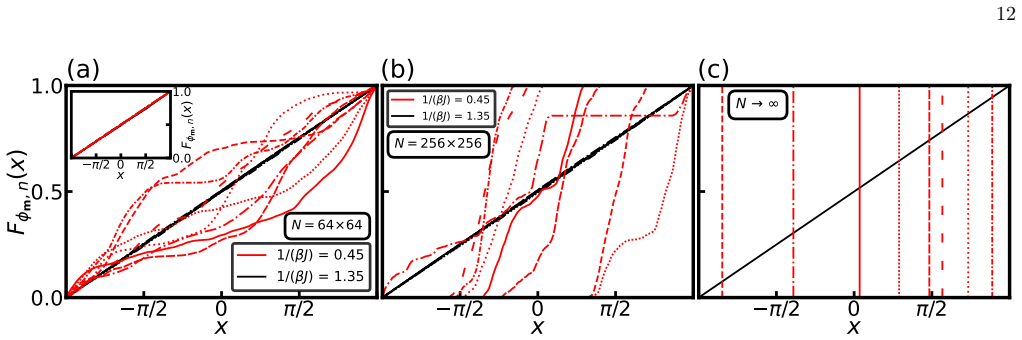
The paper's central claim is that low-temperature topological order in the planar XY model is a dynamical phenomenon: the topological sector $w\in\mathbb{Z}^2$, the integer pair describing internal global twists of the spin field around the torus, has zero fluctuations in the thermodynamic limit under local Brownian dynamics below the transition, even though the Boltzmann measure assigns it nonzero variance at every nonzero temperature. This frozen sector is the same mechanism that breaks the U(1) symmetry: the global phase $\varphi_m$ of the order parameter mixes on a timescale that diverges with system size, while the expected norm $E\lVert m\rVert$ decays only as a slow power of $N$, so the directional fluctuations are asymptotically smaller than the norm. The emergent electrostatic field theory carries the argument because it contains both the local topological defects (vortices as charges in the Gauss law $\hat{\nabla}\cdot E=J\rho$) and the global topological sector in the harmonic mode $\bar{E}=\bar{E}_p+2\pi J w/L$, making explicit how a charged vortex that winds around the torus changes the global twist. The paper concludes that topological order defined by topological nonergodicity induces the broken U(1) symmetry, with supplemental global-twist dynamics restoring both symmetry and ergodicity on non-divergent timescales at all nonzero temperatures.
Load-bearing premise
The load-bearing step is the transfer of the exact emergent-electrolyte field theory from the harmonic XY model to the physical 2DXY model: if the non-linear cosine couplings change the global topological-sector dynamics rather than merely softening the Coulomb interactions, the claimed bridge between topological order and broken U(1) symmetry in the physical model is weakened.
Editorial extensions
If this is right
- Below the BKT transition, the topological sector is confined and frozen: a neutral vortex pair cannot separate by more than half the system through local dynamics, so $w$ does not change; above the transition, topological-sector fluctuations turn on at $\beta_{\mathrm{BKT}}$.
- The symmetry-breaking phase of the 2DXY model is real in the generalized sense: the order-parameter direction is arbitrarily chosen and stable on timescales diverging with system size, explaining persistent phase coherence in experimental BKT systems without invoking spontaneous symmetry breaking.
- Critical slowing down should accompany the transition in local dynamics: the flattening of the order-parameter distribution near $\beta_{\mathrm{BKT}}$ and the slow phase dynamics explain strongly autocorrelated resistance in superconducting films near the transition.
- Global-defect moves, such as global spin twists or shifts of the harmonic mode, are practical tools: they restore ergodicity and symmetry on non-divergent timescales and provide unbiased estimators of the topological susceptibility.
- The short-range–long-range paradox is resolved: long-range Coulomb interactions among vortices emerge from short-range spin interactions through local propagation by the auxiliary gauge field, so the model is a local theory of an emergent electrolyte.
Reading between the lines
- If the topological sector is the physical cause of the frozen phase direction, then any local dynamics, including the Brownian motion of real vortices in films, should show a divergence of the phase-mixing time with system size below $T_{\mathrm{BKT}}$; this could be tested in Josephson-junction arrays with tunable linear size.
- The same general-symmetry-breaking criterion, directional fluctuations asymptotically smaller than the expected norm, could be transferred to other two-dimensional continuous symmetries, such as hexatic orientational order in two-dimensional melting, predicting topology-induced orientational freezing; the paper does not itself apply it there.
- Because the exact mapping holds for the harmonic XY model, the cleanest quantitative tests of the bridge would use the generalized lattice-field electrolyte, where the predicted freezing of the topological sector is exact; deviations in the physical 2DXY model would localize where the cosine nonlinearity matters.
Editorial analysis
A structured set of objections, weighed in public.
Referee Report
Summary. This review paper proposes a unified framework connecting topological order and broken U(1) symmetry in planar XY models. The author reviews prior work on general symmetry breaking in the 2DXY model, in which low-temperature order corresponds to asymptotically slow directional mixing of the order parameter, and then develops an emergent electrostatic field theory. The exact mapping is constructed for the 2D harmonic XY (HXY) model, whose Boltzmann distribution is expressed as a constrained lattice-field electrolyte, and is compared with the Maggs–Rossetto generalized lattice-field electrolyte. A new measure, long-time topological stability, is introduced to characterize topological order as topological nonergodicity. The paper argues that supplemental global-twist dynamics restore both topological ergodicity and U(1) symmetry on non-divergent timescales, and concludes that topological order induces broken U(1) symmetry at low temperature. The appendices contain careful derivations of the discrete vector calculus, polarization formulas, and lattice Green's function, and the paper provides code and data archives.
Significance. If the central claim holds, the paper provides a conceptually important unification: the BKT transition would simultaneously be a vortex-unbinding transition, an ergodicity-breaking transition, and the onset of a generalized form of symmetry breaking, with emergent electrostatics as the connecting mechanism. The review also offers a plausible explanation for strongly autocorrelated experimental signals near BKT transitions. The strengths of the manuscript include detailed appendices with explicit derivations, reproducible code with fixed commit hashes, deposited simulation data, and a clear discussion of the relation between the HXY model, the Villain model, and the generalized lattice-field electrolyte. However, the exact electrolyte mapping is established only for the HXY model, and the manuscript's own caveats state that the corresponding 2DXY expressions hold only approximately; the central causal claim for the physical 2DXY model therefore rests on evidence that is weaker than the appendix-level rigor.
major comments (3)
- [Section V H, Eq. (70), Figure 16] The central step-function claim gamma_w^local(beta)=1 for beta>beta_BKT and 0 otherwise is supported by Figure 16, whose caption states that errors are large and not shown because each estimate is a ratio of two simulation estimates. Without error bars or a quantitative criterion for the step, the sharpness and location of the transition in the topological-stability measure are not established, especially in the transition region where the text itself notes noisy estimates and possible critical slowing down. The text subsequently treats Eq. (70) as established when it concludes at the end of Section V H that topological order induces broken U(1) symmetry, so a load-bearing numerical claim currently lacks uncertainty quantification.
- [Sections V C, V E, and IV C] The exact emergent-electrostatic mapping is derived for the 2DHXY model, while Section V E states that Eq. (51) cannot be written exactly in the 2DXY case and Section V C states that the 2DXY global twist-relaxation field does not always correspond to the global topological defects. The 2DXY conclusions in Sections V G and V H are therefore supported by 'mimic' dynamics, renormalization-group arguments, and first-order mappings rather than by the exact electrolyte field theory. In addition, a zero-cost global rotation of all spins would restore U(1) phase mixing on a non-divergent timescale without changing the topological sector, and the paper does not report this control, nor the topological-sector behavior under event-chain dynamics that it claims restores U(1) symmetry. The causal statement that topological nonergodicity 'induces' broken U(1) in the physical 2DXY model requires either an explicit demonstration of a shared mechanism or a restriction of the claim to the HXY/electrolyte representation.
- [Section V H, definition below Eq. (68)] Topological order is defined as long-time topological stability, with the text stating 'This equivalently defines topological order within the present framework.' Because topological nonergodicity is incorporated into the definition, the statement that topological order induces broken U(1) symmetry is partly a consequence of the chosen definitions rather than an independently demonstrated connection. The paper should separate the definitional equivalence from the physical assertion that the standard notion of topological order, e.g., the spin-stiffness universal jump of Section V F, coincides with the new nonergodicity measure; otherwise the central 'bridge' conclusion risks circularity.
minor comments (4)
- [Section IV D] The phrase 'em sombrero potential' appears to be a typographical error for 'the sombrero potential'.
- [Appendix A] The Dryad data DOI is written as https://doi.org/0.5061/dryad.v15dv427n, which appears to be missing a digit; it should likely be https://doi.org/10.5061/dryad.v15dv427n.
- [Figure 16 caption] The statement that errors are large and not shown should also appear in the main text near Eq. (70), since the figure is the primary numerical support for the topological nonergodicity claim.
- [Section IV C] The sentence 'This confirmed equation (23) and the singular thermodynamic limit of the low-temperature phase fluctuations, due to nonzero long-time directional stability' is dense; splitting it would clarify that the confirmation applies to the Metropolis dynamics case.
Circularity Check
No significant circularity: the review's synthesis traces to reproducible prior results and explicit definitions, not to a fit or to a self-citation chain that makes the conclusion equal to its inputs.
full rationale
No circular step can be exhibited. The central quantity 'topological order' is explicitly redefined as topological nonergodicity (Section II.D.14: 'topological nonergodicity is defined by long-time topological stability. This equivalently defines topological order within the present framework'), but this is a definition, not a derived prediction. Broken U(1) symmetry is defined independently as asymptotically slow directional mixing of the order-parameter phase (Section II.D.5), so topological order is not defined in terms of the U(1) result. The paper's 'therefore induces' claim (Section V.H) rests on the empirical and renormalization-group observation that both topological-sector fluctuations and U(1) phase fluctuations freeze under local Metropolis dynamics and are both restored by the same supplemental global-twist moves. Co-occurrence of two nonergodicities is a substantive, debatable inference about mechanism, not an equation reducing to a definition. The HXY-to-electrolyte mapping is derived explicitly, while the 2DXY extension is flagged as approximate ('equation (51) cannot be written exactly in the 2DXY case'), so the approximation is stated as a limitation rather than smuggled in as a prediction. The author's prior works [44,45,46] are load-bearing for the review, but they carry released code, data repositories, and external anchors (Vallat-Beck, Maggs-Rossetto, Bramwell-Holdsworth), which count as independent evidence under the review rubric. No fitted parameter is renamed as a prediction, no uniqueness theorem is imported from the authors, and no known result is merely renamed as a new derivation. The causal 'induces' inference may be challenged on logical or approximation grounds, but it is not circular.
Assumptions & free parameters
free parameters (2)
- c =
1.8456
- sigma_noise =
tuned for acceptance rate about 0.6
assumptions (8)
- domain assumption Mermin-Wagner-Hohenberg theorem: no spontaneous symmetry breaking at nonzero temperature in the 2D XY model
- domain assumption BKT theory of vortex unbinding and algebraic correlations
- domain assumption The 2DHXY model retains a BKT transition at 1/(beta^elec_BKT) approximately 1.351J
- standard math Helmholtz-Hodge decomposition of lattice vector fields into irrotational, harmonic, and rotational parts
- domain assumption Local Metropolis dynamics converge to Brownian dynamics for harmonic oscillators and, by extension, for this model
- domain assumption Renormalization-group arguments extend 2DHXY/electrolyte topological-sector results to the 2DXY model
- ad hoc to paper The directional simulation variance obeys <s^2_phi> proportional to tau/tau_mix for tau < tau_mix under diffusive Metropolis dynamics
- domain assumption Expected topological-sector variance Var[w] is finite and nonzero at all nonzero temperatures
Cite this review
Pith. "Pith review of Emergent electrostatics in planar XY spin models: the bridge connecting topological order with broken $U(1)$ symmetry." pith.science (2026). https://pith.science/paper/J7P63OL2
@misc{pith2026241212186,
  author       = {Pith},
  title        = {Pith review of: Emergent electrostatics in planar XY spin models: the bridge connecting topological order with broken $U(1)$ symmetry},
  year         = {2026},
  howpublished = {\url{https://pith.science/paper/J7P63OL2}},
  note         = {Machine review of arXiv:2412.12186}
}
read the original abstract
Topological phases have been a central focus of condensed-matter physics for over 50 years. Along with many experimental applications, they have provided much intellectual interest due to their characterization via some form of topological ordering, as opposed to the symmetry-breaking ordering of conventional continuous phase transitions. This distinction is most subtle in the case of the Berezinskii-Kosterlitz-Thouless (BKT) transition as its experimental realizations appear to break U(1) symmetry at low temperature. It also presents two further paradoxes: i) its prototypical short-range interacting planar XY spin model behaves as an emergent long-range interacting electrolyte; ii) its topological ordering is not accompanied by a topological nonergodicity within the BKT picture. This review paper addresses these three interconnected questions. We review a series of papers that demonstrate that U(1) symmetry is indeed broken, but within a broader framework than that traditionally used to characterize broken symmetry. We discuss recovery of this symmetry by breaking velocity-symmetry in a deterministic Markov process. We then expand on a modern field theory of the emergent electrolyte that maps directly from the spin field to an emergent lattice electric field governed by an augmented electrostatic Boltzmann distribution. This local model of electrolyte physics resolves both the short-range-long-range paradox and the question of topological nonergodicity - as in contrast with the BKT picture, it describes global topological defects and their nonergodic freezing by the topological ordering. It also connects the broken U(1) symmetry with the topological ordering, providing a comprehensive framework for broken symmetry at the transition. We introduce long-time topological stability as a measure of topological nonergodicity - within a general framework for weakly broken ergodicity.
Figures


Figures from the paper (14 more)




Reference graph
Works this paper leans on
-
[44]
M. F. Faulkner, S. T. Bramwell, and P. C. W. Holdsworth, “Topological-sector fluctuations and er- godicity breaking at the Berezinskii-Kosterlitz-Thouless transition,” Phys. Rev. B , vol. 91, p. 155412, 2015
work page 2015
-
[46]
Symmetry breaking at a topological phase transition,
M. F. Faulkner, “Symmetry breaking at a topological phase transition,” Phys. Rev. B, vol. 109, p. 085405, 2024
work page 2024
-
[1]
Magnetic monopoles in spin ice,
C. Castelnovo, R. Moessner, and S. L. Sondhi, “Magnetic monopoles in spin ice,” Nature, vol. 451, p. 42, 2008
2008
-
[2]
Signature of magnetic monopole and Dirac string dynamics in spin ice,
L. D. C. Jaubert and P. C. W. Holdsworth, “Signature of magnetic monopole and Dirac string dynamics in spin ice,” Nat. Phys. , vol. 5, p. 258, 2009
2009
-
[3]
Measurement of the charge and current of magnetic monopoles in spin ice,
S. T. Bramwell, S. R. Giblin, S. Calder, R. Aldus, D. Prabhakaran, and T. Fennell, “Measurement of the charge and current of magnetic monopoles in spin ice,” Nature, vol. 461, p. 956, 2009
2009
-
[4]
Geometrical Frustration in the Ferromagnetic Pyrochlore Ho 2Ti2O7,
M. J. Harris, S. T. Bramwell, D. F. McMorrow, T. Zeiske, and K. W. Godfrey, “Geometrical Frustration in the Ferromagnetic Pyrochlore Ho 2Ti2O7,” Phys. Rev. Lett. , vol. 79, p. 2554, 1997
1997
-
[5]
Deviations from Ohm’s Law in Weak Elec- trolytes,
L. Onsager, “Deviations from Ohm’s Law in Weak Elec- trolytes,” J. Chem. Phys. , vol. 2, p. 599, 1934
1934
-
[6]
Onsager’s Wien effect on a lattice,
V. Kaiser, S. T. Bramwell, P. C. W. Holdsworth, and R. Moessner, “Onsager’s Wien effect on a lattice,” Nat. Mater., vol. 12, p. 1033, 2013
2013
Show all 87 references
-
[7]
ac Wien Effect in Spin Ice, Manifest in Nonlinear, Nonequilibrium Susceptibility,
V. Kaiser, S. T. Bramwell, P. C. W. Holdsworth, and R. Moessner, “ac Wien Effect in Spin Ice, Manifest in Nonlinear, Nonequilibrium Susceptibility,” Phys. Rev. Lett., vol. 115, p. 037201, 2015
2015
-
[8]
Destruction of Long-range Order in One-dimensional and Two-dimensional Systems having a Continuous Symmetry Group I. Classical Systems,
V. L. Berezinskii, “Destruction of Long-range Order in One-dimensional and Two-dimensional Systems having a Continuous Symmetry Group I. Classical Systems,” Sov. Phys.–JETP, vol. 32, p. 493, 1971
1971
-
[9]
Ordering, metasta- bility and phase transitions in two-dimensional systems,
J. M. Kosterlitz and D. J. Thouless, “Ordering, metasta- bility and phase transitions in two-dimensional systems,” J. Phys. C: Solid State Phys. , vol. 6, p. 1181, 1973
1973
-
[10]
Theory of Two- Dimensional Melting,
B. I. Halperin and D. R. Nelson, “Theory of Two- Dimensional Melting,” Phys. Rev. Lett. , vol. 41, p. 121, 1978
1978
-
[11]
Melting and the vector Coulomb gas in two dimensions,
A. P. Young, “Melting and the vector Coulomb gas in two dimensions,” Phys. Rev. B , vol. 19, p. 1855, 1979
1979
-
[12]
Two-step melting in two dimensions: First-order liquid-hexatic transition,
E. P. Bernard and W. Krauth, “Two-step melting in two dimensions: First-order liquid-hexatic transition,” Phys. Rev. Lett., vol. 107, p. 155704, 2011
2011
-
[13]
Two-Dimensional Melting of Colloidal Hard Spheres,
A. L. Thorneywork, J. L. Abbott, D. G. A. L. Aarts, and R. P. A. Dullens, “Two-Dimensional Melting of Colloidal Hard Spheres,” Phys. Rev. Lett. , vol. 118, p. 158001, 2017
2017
-
[14]
Transport signatures of fragile-glass dynamics in the melting of the two-dimensional vortex lattice,
I. Maccari, B. K. Pokharel, J. Terzic, S. Dutta, J. Je- sudasan, P. Raychaudhuri, J. Lorenzana, C. De Michele, C. Castellani, L. Benfatto, and D. Popovi´ c, “Transport signatures of fragile-glass dynamics in the melting of the two-dimensional vortex lattice,” Phys. Rev. B , vo...
2023
-
[15]
From quantum to thermal topological-sector fluctuations of strongly interacting bosons in a ring lattice,
T. Roscilde, M. F. Faulkner, S. T. Bramwell, and P. C. W. Holdsworth, “From quantum to thermal topological-sector fluctuations of strongly interacting bosons in a ring lattice,” New J. Phys., vol. 18, p. 075003, 2016
2016
-
[16]
Observation of topological phenomena in a pro- grammable lattice of 1,800 qubits,
A. D. King, J. Carrasquilla, J. Raymond, I. Ozfidan, E. Andriyash, A. Berkley, M. Reis, T. Lanting, R. Har- ris, F. Altomare, K. Boothby, P. I. Bunyk, C. En- derud, A. Fr´ echette, E. Hoskinson, N. Ladizinsky, T. Oh, G. Poulin-Lamarre, C. Rich, Y. Sato, A. Y. Smirnov, L. J. Sw...
2018
-
[17]
Two-Dimensional Phase Tran- sition in Granular NbN Films,
S. A. Wolf, D. U. Gubser, W. W. Fuller, J. C. Gar- land, and R. S. Newrock, “Two-Dimensional Phase Tran- sition in Granular NbN Films,” Phys. Rev. Lett., vol. 47, p. 1071, 1981
1981
-
[18]
Kosterlitz-Thouless Transition in Proximity-Coupled Superconducting Arrays,
D. J. Resnick, J. C. Garland, J. T. Boyd, S. Shoemaker, and R. S. Newrock, “Kosterlitz-Thouless Transition in Proximity-Coupled Superconducting Arrays,” Phys. Rev. Lett., vol. 47, p. 1542, 1981
1981
-
[19]
Observable signature of the Berezinskii-Kosterlitz-Thouless transi- tion in a planar lattice of Bose-Einstein condensates,
A. Trombettoni, A. Smerzi, and P. Sodano, “Observable signature of the Berezinskii-Kosterlitz-Thouless transi- tion in a planar lattice of Bose-Einstein condensates,” New J. Phys. , vol. 7, p. 57, 2005
2005
-
[20]
Study of the Superfluid Transition in Two-Dimensional 4He Films,
D. J. Bishop and J. D. Reppy, “Study of the Superfluid Transition in Two-Dimensional 4He Films,” Phys. Rev. Lett., vol. 40, p. 1727, 1978
1978
-
[21]
Phase order in superfluid helium films,
S. T. Bramwell, M. F. Faulkner, P. C. W. Holdsworth, and A. Taroni, “Phase order in superfluid helium films,” EPL (Europhys. Lett.) , vol. 112, p. 56003, 2015
2015
-
[22]
Effective two-dimensional thickness for the Berezinskii- Kosterlitz-Thouless-like transition in a highly under- doped La2−xSrxCuO4,
P. G. Baity, X. Shi, Z. Shi, L. Benfatto, and D. Popovi´ c, “Effective two-dimensional thickness for the Berezinskii- Kosterlitz-Thouless-like transition in a highly under- doped La2−xSrxCuO4,” Phys. Rev. B, vol. 93, p. 024519, 2016
2016
-
[23]
Evidence for corre- 34 lated dynamics near the Berezinskii-Kosterlitz-Thouless- like transition in highly underdoped La 2−xSrxCuO4,
Z. Shi, X. Shi, and D. Popovi´ c, “Evidence for corre- 34 lated dynamics near the Berezinskii-Kosterlitz-Thouless- like transition in highly underdoped La 2−xSrxCuO4,” Phys. Rev. B , vol. 94, p. 134503, 2016
2016
-
[24]
Magnetization and universal sub-critical behaviour in two-dimensional XY magnets,
S. T. Bramwell and P. C. W. Holdsworth, “Magnetization and universal sub-critical behaviour in two-dimensional XY magnets,” J. Phys.: Condens. Matter , vol. 5, p. L53, 1993
1993
-
[25]
Magnetism in the few-monolayers limit: A surface magneto-optic Kerr-effect study of the magnetic behavior of ultrathin films of Co, Ni, and Co-Ni alloys on Cu(100) and Cu(111),
F. Huang, M. T. Kief, G. J. Mankey, and R. F. Willis, “Magnetism in the few-monolayers limit: A surface magneto-optic Kerr-effect study of the magnetic behavior of ultrathin films of Co, Ni, and Co-Ni alloys on Cu(100) and Cu(111),” Phys. Rev. B , vol. 49, p. 3962, 1994
1994
-
[26]
Critical phenomena in the two-dimensional XY magnet Fe(100) on W(100),
H. J. Elmers, J. Hauschild, G. H. Liu, and U. Gradmann, “Critical phenomena in the two-dimensional XY magnet Fe(100) on W(100),” J. Appl. Phys. , vol. 79, p. 4984, 1996
1996
-
[27]
Intrinsic 2D-XY ferromagnetism in a van der Waals monolayer,
A. Bedoya-Pinto, J.-R. Ji, A. K. Pandeya, P. Gargiani, M. Valvidares, P. Sessi, J. M. Taylor, F. Radu, K. Chang, and S. S. P. Parkin, “Intrinsic 2D-XY ferromagnetism in a van der Waals monolayer,” Science, vol. 374, p. 616, 2021
2021
-
[28]
Berezinskii–Kosterlitz–Thouless crossover in a trapped atomic gas,
Z. Hadzibabic, P. Kr¨ uger, M. Cheneau, B. Battelier, and J. Dalibard, “Berezinskii–Kosterlitz–Thouless crossover in a trapped atomic gas,” Nature, vol. 441, p. 1118, 2006
2006
-
[29]
Connecting Berezinskii-Kosterlitz-Thouless and BEC Phase Transitions by Tuning Interactions in a Trapped Gas,
R. J. Fletcher, M. Robert-de Saint-Vincent, J. Man, N. Navon, R. P. Smith, K. G. H. Viebahn, and Z. Hadz- ibabic, “Connecting Berezinskii-Kosterlitz-Thouless and BEC Phase Transitions by Tuning Interactions in a Trapped Gas,” Phys. Rev. Lett., vol. 114, p. 255302, 2015
2015
-
[30]
Observation of first and second sound in a BKT superfluid,
P. Christodoulou, M. Ga lka, N. Dogra, R. Lopes, J. Schmitt, and Z. Hadzibabic, “Observation of first and second sound in a BKT superfluid,” Nature, vol. 594, p. 191, 2021
2021
-
[31]
SU(2) orienta- tional ordering in restricted dimensions: evidence for a Berezinskii-Kosterlitz-Thouless transition of topological point defects in four dimensions,
C. S. Gorham and D. E. Laughlin, “SU(2) orienta- tional ordering in restricted dimensions: evidence for a Berezinskii-Kosterlitz-Thouless transition of topological point defects in four dimensions,” J. Phys. Commun. , vol. 2, p. 075001, 2018
2018
-
[32]
Equation of State for a Two-Dimensional Electrolyte,
A. M. Salzberg and S. Prager, “Equation of State for a Two-Dimensional Electrolyte,” J. Chem. Phys. , vol. 38, p. 2587, 1963
1963
-
[33]
Theory of one-and two-dimensional magnets with an easy magnetization plane. II. The planar, classi- cal, two-dimensional magnet,
J. Villain, “Theory of one-and two-dimensional magnets with an easy magnetization plane. II. The planar, classi- cal, two-dimensional magnet,” J. Phys. , vol. 36, p. 581, 1975
1975
-
[34]
Renormalization, vortices, and symmetry-breaking perturbations in the two-dimensional planar model,
J. V. Jos´ e, L. P. Kadanoff, S. Kirkpatrick, and D. R. Nel- son, “Renormalization, vortices, and symmetry-breaking perturbations in the two-dimensional planar model,” Phys. Rev. B , vol. 16, p. 1217, 1977
1977
-
[35]
Universal jump in the superfluid density of two-dimensional superfluids,
D. R. Nelson and J. M. Kosterlitz, “Universal jump in the superfluid density of two-dimensional superfluids,” Phys. Rev. Lett., vol. 39, p. 1201, 1977
1977
-
[36]
Broken ergodicity,
R. G. Palmer, “Broken ergodicity,” Adv. Phys. , vol. 31, p. 669, 1982
1982
-
[37]
Absence of Ferro- magnetism or Antiferromagnetism in One- or Two- Dimensional Isotropic Heisenberg Models,
N. D. Mermin and H. Wagner, “Absence of Ferro- magnetism or Antiferromagnetism in One- or Two- Dimensional Isotropic Heisenberg Models,” Phys. Rev. Lett., vol. 17, p. 1133, 1966
1966
-
[38]
Existence of long-range order in one and two dimensions,
P. C. Hohenberg, “Existence of long-range order in one and two dimensions,” Phys. Rev., vol. 158, p. 383, 1967
1967
-
[39]
Magnetic fluctuations in a finite two- dimensional XY model,
P. Archambault, S. T. Bramwell, and P. C. W. Holdsworth, “Magnetic fluctuations in a finite two- dimensional XY model,” J. Phys. A , vol. 30, p. 8363, 1997
1997
-
[40]
Universality of rare fluctuations in turbulence and crit- ical phenomena,
S. T. Bramwell, P. C. W. Holdsworth, and J.-F. Pinton, “Universality of rare fluctuations in turbulence and crit- ical phenomena,” Nature, vol. 396, p. 552, 1998
1998
-
[41]
Essential finite-size effect in the two- dimensional XY model,
S. G. Chung, “Essential finite-size effect in the two- dimensional XY model,” Phys. Rev. B , vol. 60, p. 11761, 1999
1999
-
[42]
Renormalization group analysis of the finite two-dimensional XY model with fourfold anisotropy: Ap- plication to the magnetic susceptibility of a ferromagnetic ultrathin film,
D. Venus, “Renormalization group analysis of the finite two-dimensional XY model with fourfold anisotropy: Ap- plication to the magnetic susceptibility of a ferromagnetic ultrathin film,” Phys. Rev. B , vol. 105, p. 235440, 2022
2022
-
[43]
Coulomb-gas representation of the two-dimensional XY model on a torus,
A. Vallat and H. Beck, “Coulomb-gas representation of the two-dimensional XY model on a torus,” Phys. Rev. B, vol. 50, p. 4015, 1994
1994
-
[45]
An electric-field representation of the har- monic XY model,
M. F. Faulkner, S. T. Bramwell, and P. C. W. Holdsworth, “An electric-field representation of the har- monic XY model,” J. Phys.: Condens. Matter , vol. 29, p. 085402, 2017
2017
-
[47]
The two-dimensional Coulomb gas, vor- tex unbinding, and superfluid-superconducting films,
P. Minnhagen, “The two-dimensional Coulomb gas, vor- tex unbinding, and superfluid-superconducting films,” Rev. Mod. Phys. , vol. 59, p. 1001, 1987
1987
-
[48]
Electromagnetic theory on a lattice,
W. C. Chew, “Electromagnetic theory on a lattice,” J. Appl. Phys. , vol. 75, p. 4843, 1994
1994
-
[49]
Discussion (comment on the spontaneous magnetisation of the two-dimensional Ising model),
L. Onsager, “Discussion (comment on the spontaneous magnetisation of the two-dimensional Ising model),” Nuovo Cimento , vol. 6, p. 251, 1949
1949
-
[50]
The Spontaneous Magnetization of a Two- Dimensional Ising Model,
C. N. Yang, “The Spontaneous Magnetization of a Two- Dimensional Ising Model,” Phys. Rev. , vol. 85, p. 808, 1952
1952
-
[51]
Equation of state calcu- lations by fast computing machines,
N. Metropolis, A. W. Rosenbluth, M. N. Rosenbluth, A. H. Teller, and E. Teller, “Equation of state calcu- lations by fast computing machines,” J. Chem. Phys. , vol. 21, p. 1087, 1953
1953
-
[52]
Nonuniversal critical dynamics in Monte Carlo simulations,
R. H. Swendsen and J.-S. Wang, “Nonuniversal critical dynamics in Monte Carlo simulations,” Phys. Rev. Lett., vol. 58, p. 86, 1987
1987
-
[53]
Sampling algorithms in statistical physics: a guide for statistics and machine learning,
M. F. Faulkner and S. Livingstone, “Sampling algorithms in statistical physics: a guide for statistics and machine learning,” Statist. Sci. , vol. 39, p. 137, 2024
2024
-
[54]
Chaos and the semiclassical limit of quantum mechanics (is the moon there when somebody looks?),
M. V. Berry, “Chaos and the semiclassical limit of quantum mechanics (is the moon there when somebody looks?),” in Quantum Mechanics: Scientific perspectives on divine action (R. J. Rusell, P. Clayton, K. Wegter- McNelly, and J. Polkinghorne, eds.), p. 41, Vatican Ob- servator...
2001
-
[55]
Monte Carlo study of the planar spin model,
J. Tobochnik and G. V. Chester, “Monte Carlo study of the planar spin model,” Phys. Rev. B , vol. 20, p. 3761, 1979
1979
-
[56]
Magne- tization: A characteristic of the Kosterlitz-Thouless- Berezinskii transition,
S. T. Bramwell and P. C. W. Holdsworth, “Magne- tization: A characteristic of the Kosterlitz-Thouless- Berezinskii transition,” Phys. Rev. B , vol. 49, p. 8811, 1994
1994
-
[57]
Event-chain Monte Carlo for classical continuous spin models,
M. Michel, J. Mayer, and W. Krauth, “Event-chain Monte Carlo for classical continuous spin models,” EPL (Europhys. Lett.), vol. 112, p. 20003, 2015
2015
-
[58]
Weak con- vergence and optimal scaling of random walk Metropolis algorithms,
G. O. Roberts, A. Gelman, and W. R. Gilks, “Weak con- vergence and optimal scaling of random walk Metropolis algorithms,” Ann. Appl. Probab., vol. 7, p. 110, 1997
1997
-
[59]
Optimal scaling for par- 35 tially updating MCMC algorithms,
P. Neal and G. Roberts, “Optimal scaling for par- 35 tially updating MCMC algorithms,” Ann. Appl. Probab., vol. 16, p. 475, 2006
2006
-
[60]
Metropolis Monte Carlo method as a numerical technique to solve the Fokker—Planck equation,
K. Kikuchi, M. Yoshida, T. Maekawa, and H. Watan- abe, “Metropolis Monte Carlo method as a numerical technique to solve the Fokker—Planck equation,” Chem. Phys. Lett., vol. 185, p. 335, 1991
1991
-
[61]
Dynamic Monte Carlo ver- sus Brownian dynamics: A comparison for self-diffusion and crystallization in colloidal fluids,
E. Sanz and D. Marenduzzo, “Dynamic Monte Carlo ver- sus Brownian dynamics: A comparison for self-diffusion and crystallization in colloidal fluids,” J. Chem. Phys. , vol. 132, p. 194102, 2010
2010
-
[62]
Methods and applications of PDMP samplers with boundary conditions,
J. Bierkens, S. Grazzi, G. O. Roberts, and M. Schauer, “Methods and applications of PDMP samplers with boundary conditions,” arXiv preprint arXiv:2303.08023 , 2023
2023 arXiv
-
[63]
A general perspective on the Metropolis–Hastings kernel,
C. Andrieu, A. Lee, and S. Livingstone, “A general perspective on the Metropolis–Hastings kernel,” arXiv preprint arXiv:2012.14881, 2020
2012 arXiv
-
[64]
Peskun–Tierney order- ing for Markovian Monte Carlo: Beyond the reversible scenario,
C. Andrieu and S. Livingstone, “Peskun–Tierney order- ing for Markovian Monte Carlo: Beyond the reversible scenario,” Ann. Statist., vol. 49, p. 1958, 2021
1958
-
[65]
PDMP Characterisation of Event-Chain Monte Carlo Algo- rithms for Particle Systems,
A. Monemvassitis, A. Guillin, and M. Michel, “PDMP Characterisation of Event-Chain Monte Carlo Algo- rithms for Particle Systems,” J. Stat. Phys. , vol. 190, p. 66, 2023
2023
-
[66]
Ergodicity of the zigzag process,
J. Bierkens, G. O. Roberts, and P.-A. Zitt, “Ergodicity of the zigzag process,” Ann. Appl. Probab., vol. 29, p. 2266, 2019
2019
-
[67]
Event- chain Monte Carlo algorithms for hard-sphere systems,
E. P. Bernard, W. Krauth, and D. B. Wilson, “Event- chain Monte Carlo algorithms for hard-sphere systems,” Phys. Rev. E , vol. 80, p. 056704, 2009
2009
-
[68]
All-atom computations with irreversible Markov chains,
M. F. Faulkner, L. Qin, A. C. Maggs, and W. Krauth, “All-atom computations with irreversible Markov chains,” J. Chem. Phys. , vol. 149, p. 064113, 2018
2018
-
[69]
Monte Carlo determina- tion of the critical temperature for the two-dimensional XY model,
H. Weber and P. Minnhagen, “Monte Carlo determina- tion of the critical temperature for the two-dimensional XY model,” Phys. Rev. B , vol. 37, p. 5986(R), 1988
1988
-
[70]
On the composition of elementary errors,
H. Cram´ er, “On the composition of elementary errors,” Scand. Actuar. J. , vol. 1928, p. 13, 1928
1928
-
[71]
von Mises, Wahrscheinlichkeit Statistik und Wahrheit
R. von Mises, Wahrscheinlichkeit Statistik und Wahrheit . Springer Vienna, 1952
1952
-
[72]
Classical frustrated XY model: Continuity of the ground-state energy as a function of the frustration,
A. Vallat and H. Beck, “Classical frustrated XY model: Continuity of the ground-state energy as a function of the frustration,” Phys. Rev. Lett. , vol. 68, p. 3096, 1992
1992
-
[73]
Local Simulation Al- gorithms for Coulomb Interactions,
A. C. Maggs and V. Rossetto, “Local Simulation Al- gorithms for Coulomb Interactions,” Phys. Rev. Lett. , vol. 88, p. 196402, 2002
2002
-
[74]
Rossetto, M´ ecanique statistique de syst` emes sous constraintes : topologie de l’ADN et simulations ´ electrostatiques
V. Rossetto, M´ ecanique statistique de syst` emes sous constraintes : topologie de l’ADN et simulations ´ electrostatiques. Deuxi` eme partie : Simulations locales d’interactions coulombiennes . PhD thesis, l’universit´ e Pierre-et-Marie-Curie, 2002
2002
-
[75]
Part I. The 2D Classical Coulomb Gas near the Zero-Density Kosterlitz–Thouless Critical Point: Correlations and Critical Line,
A. Alastuey and F. Cornu, “Part I. The 2D Classical Coulomb Gas near the Zero-Density Kosterlitz–Thouless Critical Point: Correlations and Critical Line,” J. Stat. Phys., vol. 89, p. 6, 1997
1997
-
[76]
Direct evidence of the dis- continuous character of the Kosterlitz-Thouless jump,
P. Minnhagen and B. J. Kim, “Direct evidence of the dis- continuous character of the Kosterlitz-Thouless jump,” Phys. Rev. B , vol. 67, p. 172509, 2003
2003
-
[77]
Weak ergodicity breaking in optical sensing,
V. G. Ramesh and S. R. K. Rodriguez, “Weak ergodicity breaking in optical sensing,” Phys. Rev. Research, vol. 6, p. 033245, 2024
2024
-
[78]
Collective Monte Carlo updating for spin sys- tems,
U. Wolff, “Collective Monte Carlo updating for spin sys- tems,” Phys. Rev. Lett. , vol. 62, p. 361, 1989
1989
-
[79]
Irreversible Markov chains in spin models: Topological excitations,
Z. Lei and W. Krauth, “Irreversible Markov chains in spin models: Topological excitations,” EPL (Europhys. Lett.), vol. 121, p. 10008, 2018
2018
-
[80]
Anomalous diffusion analy- sis of the lifting events in the event-chain Monte Carlo for the classical XY models,
K. Kimura and S. Higuchi, “Anomalous diffusion analy- sis of the lifting events in the event-chain Monte Carlo for the classical XY models,” EPL (Europhys. Lett.) , vol. 120, p. 30003, 2017
2017
-
[81]
A piecewise determin- istic scaling limit of lifted Metropolis–Hastings in the Curie–Weiss model,
J. Bierkens and G. O. Roberts, “A piecewise determin- istic scaling limit of lifted Metropolis–Hastings in the Curie–Weiss model,” Ann. Appl. Probab., vol. 27, p. 846, 2017
2017
-
[82]
Event-chain Monte Carlo with factor fields,
Z. Lei, W. Krauth, and A. C. Maggs, “Event-chain Monte Carlo with factor fields,” Phys. Rev. E, vol. 99, p. 043301, 2019
2019
-
[83]
Hamiltonian Monte Carlo vs. event-chain Monte Carlo: an appraisal of sampling strategies beyond the diffusive regime,
W. Krauth, “Hamiltonian Monte Carlo vs. event-chain Monte Carlo: an appraisal of sampling strategies beyond the diffusive regime,” arXiv preprint arXiv:2411.11690 , 2024
2024 arXiv
-
[84]
super-aLby software package
M. F. Faulkner and S. Livingstone, “super-aLby software package.” https://github.com/michaelfaulkner/super- aLby, 2024
2024
-
[85]
xy-type-models software package
M. F. Faulkner, “xy-type-models software package.” https://github.com/michaelfaulkner/xy-type-models, 2024
2024
-
[86]
Emergent electrostatics in planar XY spin models: the bridge connecting topological order with broken U (1) symmetry (data deposit)
M. F. Faulkner, “Emergent electrostatics in planar XY spin models: the bridge connecting topological order with broken U (1) symmetry (data deposit).” https://doi.org/10.5061/dryad.v15dv427n, 2025
2025 doi
-
[87]
General symmetry breaking at a topological phase transition (data deposit)
M. F. Faulkner, “General symmetry breaking at a topological phase transition (data deposit).” https://doi.org/10.5523/bris.3ov1rl6xtshwv2iuixrbs6f39q, 2023
2023 doi
Reviewed August 11, 2026 · model on record in the stance chip above.
Discussion (0). Continue with ORCID to comment.