REVIEW 3 major objections 6 minor 65 references
Leveraging Group Classification with Descending Soft Labeling for Deep Imbalanced Regression
T0 review · 3 major / 6 minor · reviewed 2026-08-11 · deepseek-v4-flash
Pith's one-line read Group-first decomposition cuts deep imbalanced regression error below prior methods.
desk verdict A well-ablated empirical recipe for deep imbalanced regression whose theoretical motivation doesn't survive contact with the loss; referee it for the recipe, not the lemma. read the letter →
The pith
A machine-rendered reading of the paper's core claim, the machinery that carries it, and where it could break.
The reading
What carries the argument
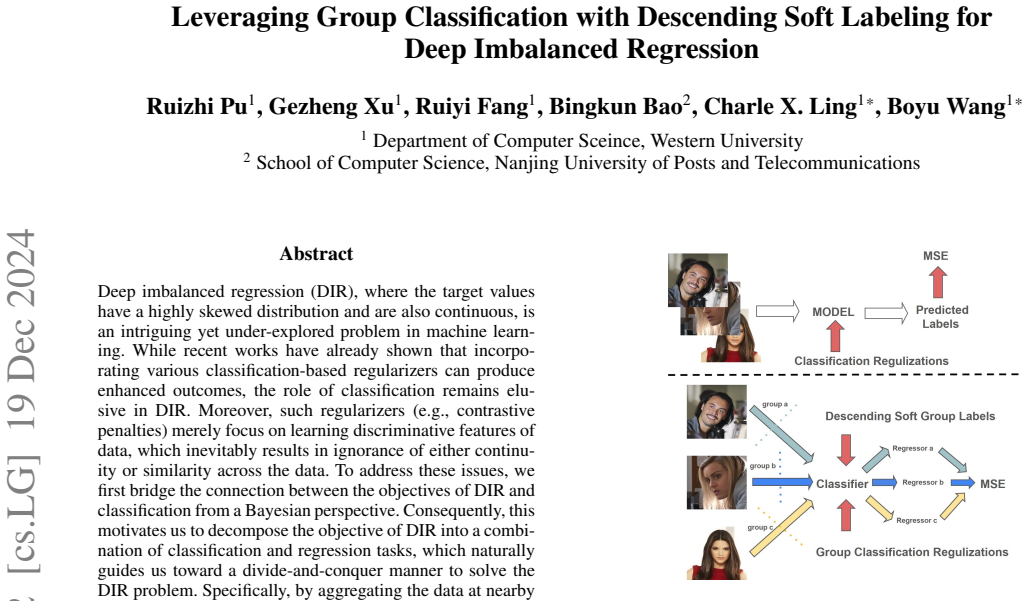
The load-bearing object is the Bayesian decomposition in Lemma 1: $p_{tr}(y|x)=\sum_{g} p_{tr}(g|x)p_{tr}(y|x,g)$, which turns DIR into a sum of a group classification loss and a within-group regression loss. The method operationalizes this with three components: an ordinal group-aware contrastive loss that pulls same-group features together and pushes apart groups in proportion to their label distance; a multi-experts regressor that trains one regression head per group and selects the head by the predicted group at test time; and a symmetric descending soft labeling scheme that replaces the one-hot group label with a vector peaking at the true group and descending symmetrically toward both ends, so the classifier is trained to respect label similarity rather than only discriminative boundaries.
What would settle it
On AgeDB-DIR, retrain the full model with the same ordinal contrastive loss and multi-experts regressor but replace the symmetric descending soft label with a one-hot cross-entropy loss. The paper's thesis predicts a clear MAE degradation; if the MAE stays within noise of 6.87, the soft-label mechanism is not the driver of the reported gains.
Extended reading notes
Core claim
On its own terms, the paper claims that the DIR objective is a sum of a group-classification objective and a per-group regression objective, and that a model built to reflect that structure outperforms prior DIR methods. The concrete evidence is a set of results across three benchmarks: on AgeDB-DIR the method reaches MAE 6.87, below the previous best VIR at 6.99; on IMDB-WIKI-DIR it improves the median MAE (11.42 versus 11.81) and few-shot MAE (20.25 versus 20.96) relative to VIR; and on STS-B-DIR it improves few-shot Pearson correlation (85.8 versus 84.5). The paper interprets these gains as showing that explicit group classification with similarity-aware soft labels helps regression more than classification-based regularizers used only as auxiliary losses.
Load-bearing premise
The load-bearing premise is Lemma 1: the training density $p_{tr}(y|x)$ equals the sum over groups of $p_{tr}(g|x)p_{tr}(y|x,g)$, and the inequality $\log(a+b)\ge\log a+\log b$ applies to those terms; with continuous labels the per-group term is a density, so neither the equality's interpretability nor the inequality is guaranteed as stated.
Editorial extensions
If this is right
- If the decomposition holds, any imbalanced regression dataset can be handled by choosing a group width, training a classifier over groups, and assigning each group its own regressor, without changing the backbone.
- The ordinal contrastive loss encourages the feature space to preserve the ordering of labels, which should transfer to other ordinal regression problems such as depth estimation or medical scoring.
- The symmetric descending soft label offers an alternative to logit adjustment for imbalanced ordinal classification: it encodes label similarity instead of only class priors.
- On the reported benchmarks the largest gains appear in the median and few-shot slices, suggesting the method's benefit is concentrated in under-represented but not extreme tail regions.
- The group count is a tunable hyper-parameter; the ablations show MAE stays competitive across 15 to 40 groups, so practitioners can trade off classification accuracy against regression granularity.
Reading between the lines
- The paper's formal motivation, Lemma 1, is presented as the reason for the design, but the implemented training loss regresses only with the ground-truth group, not the sum over all groups; a reader can treat the Bayesian story as motivation and the soft-label plus contrastive recipe as the empirical contribution.
- On IMDB-WIKI-DIR the overall MAE is 7.22 versus VIR's 7.19, so the reported superiority is carried by the median and few-shot slices; the method's practical value may be strongest precisely where imbalance is hardest.
- The symmetric soft label assumes that similarity between label groups is symmetric and falls off linearly; for target spaces where similarity is one-sided, such as medical severity scores, an asymmetric variant would be a natural extension the paper does not explore.
- A stress test with overlapping or soft group boundaries would separate the contribution of the hard divide-and-conquer assignment from the soft-label classifier, since the current design conflates them.
Editorial analysis
A structured set of objections, weighed in public.
Referee Report
Summary. The paper proposes Group-DIR, a divide-and-conquer framework for deep imbalanced regression. Labels are partitioned into ordinal groups; an ordinal group-aware contrastive loss is trained on features; a classifier predicts groups with a symmetric descending soft-label cross-entropy; and a multi-expert regressor regresses each sample using the expert of its group (ground-truth group at training, predicted group at test). The method is motivated by a Bayesian decomposition in Lemma 1 and evaluated on AgeDB-DIR, IMDB-WIKI-DIR, and STS-B-DIR against a wide range of baselines.
Significance. If the empirical results are reproducible, the method is a useful addition to the DIR toolbox: it combines several known ingredients (contrastive learning, multi-expert regression, label smoothing) in a simple recipe, releases code, and is evaluated on three standard benchmarks with many baselines. The main weakness is the theoretical motivation: Lemma 1's upper-bound inequality is invalid for continuous densities and hard group partitions, and as written it does not connect to the actual loss in Eq. (3). The exact decomposition -log p(y|x) = -log p(g*|x) - log p(y|x,g*) would support the method, but the paper needs to be revised accordingly. Several empirical SOTA claims are also overstated relative to the tables.
major comments (3)
- [Motivation, Lemma 1 and Eq. (1)] The stated upper bound is not valid as written. The footnote justifies -log p(y|x) <= sum_g [-log p(g|x) - log p(y|x,g)] by log(a+b) >= log a + log b for a,b in (0,1), but in a continuous regression problem p(y|x,g) is a conditional density and may exceed 1; in addition, since the groups form a hard partition, for any y exactly one group has p(y|x,g)>0 and the remaining terms are zero, so the sum on the right contains terms equal to +infinity and the inequality is vacuous. The exact identity -log p(y|x) = -log p(g*|x) - log p(y|x,g*) for the group g* containing y is sufficient to motivate the classification-plus-regression objective and matches Eq. (3); please replace the upper-bound argument with this exact decomposition or a correctly regularized bound.
- [Result Analysis, Tables 2 and 3] The text overstates the empirical results. On IMDB-WIKI-DIR, Table 2 lists Ours with All MAE 7.22 and All GM 3.88, whereas VIR is 7.19 and 3.85; only the Med and Few rows improve. On STS-B-DIR, Table 3 lists Ours with All Pearson 77.4 and Many 74.9, below VIR's 77.6 and 75.2. Since the reported margins are small and experiments are averaged over five seeds without standard deviations, please correct these SOTA claims and report variance or significance.
- [Ablation Study and analysis on Classification Criterion, Table 5] Table 5 compares group-classification accuracy for soft labels against three imbalance-classification losses, but the paper's claim is that soft labeling improves regression. Please report end-to-end MAE (and ideally GM) for CE, LA, and soft-label variants under the same Group-DIR pipeline; otherwise the link between the better group accuracy and the final regression performance is only indirect.
minor comments (6)
- [Throughout] There are many typos, including 'Sceince' in the affiliations, 'constrastive' in the methodology heading, 'classificaiton' in the abstract, 'porblem' in the appendix, 'oroder' in the model architecture description, 'TSN-E' in Figure 8, and 'V ANILLA' in Table 1; please proofread the manuscript.
- [Methodology, Eq. (3)] The summation in Eq. (3) is ambiguous: the condition y in [g] should be made explicit by indexing samples (e.g., y_i in [g]), and the notation \hat{y}^{\phi_g} should indicate the sample index.
- [Experiments, Table 4] The columns MAE-GT and G-Mean-GT are not defined in the caption; state explicitly that GT means routing each sample to its ground-truth expert at test time.
- [References and Table 5] The reference list contains duplicate entries for Zha et al. 2023a and 2023b, and Table 5 cites 'NC (Yang 2022)', 'DO (Cong 2024)', and 'ReBAT (Wang 2024)' with incomplete author lists in the corresponding reference entries; please complete these citations.
- [Appendix Implementation Details] The sentence 'Therefore, we do not need balance the three losses in the final loss in the fine tuning' is unclear; specify how lambda1 and lambda2 are set (e.g., grid search) and whether they are tuned per dataset or group count.
- [Figures 2 and 4] The captions for Figures 2 and 4 should state which color corresponds to the ground-truth distribution and which to the model's estimates; the current captions only say 'GT CE' and 'GT LA'.
Circularity Check
No significant circularity: the empirical recipe is benchmarked externally, and the Bayesian motivation, while formally loose, is not constructed from its own outputs.
full rationale
The paper's central claim is an empirical method evaluated on AgeDB-DIR, IMDB-WIKI-DIR, and STS-B-DIR against many external baselines, with SOTA MAE 6.87 on AgeDB-DIR. This result is not obtained by fitting a parameter to the benchmark outcome. Lemma 1 is a standard conditioning identity, and Eq. (1) is an upper bound; although the footnote's treatment of continuous densities as probabilities is mathematically questionable and Eq. (3) only uses the ground-truth group rather than the sum over all groups, that is a correctness gap, not a circular reduction. The symmetric descending soft labeling is a design choice with hyper-parameters (β, λ1, λ2) tuned on validation data, not a prediction renamed from a fitted input. The only self-citation with overlapping authors (Shui et al. 2023) appears in related work as a general pointer and is not load-bearing for the derivation or the empirical claims.
Assumptions & free parameters
free parameters (5)
- Number of groups |G| =
25 for AgeDB-DIR, 20 for IMDB-WIKI-DIR (selected per dataset)
- Loss weights lambda1, lambda2 =
lambda1=0.5, lambda2=1 for AgeDB (from Table 6)
- Temperature t =
2.5
- Soft-label decay beta =
1 (default)
- Training epochs =
not fixed
assumptions (3)
- domain assumption The training distribution can be decomposed as p_tr(y|x) = sum_g p_tr(g|x) p_tr(y|x,g) with per-group conditional distributions (Lemma 1).
- ad hoc to paper The inequality log(a+b) >= log a + log b holds for the terms in Eq. (1).
- domain assumption The group label similarity is captured by a symmetric linear descending soft label (l_soft).
Cite this review
Pith. "Pith review of Leveraging Group Classification with Descending Soft Labeling for Deep Imbalanced Regression." pith.science (2026). https://pith.science/paper/CUMHE2WF
@misc{pith2026241212327,
  author       = {Pith},
  title        = {Pith review of: Leveraging Group Classification with Descending Soft Labeling for Deep Imbalanced Regression},
  year         = {2026},
  howpublished = {\url{https://pith.science/paper/CUMHE2WF}},
  note         = {Machine review of arXiv:2412.12327}
}
read the original abstract
Deep imbalanced regression (DIR), where the target values have a highly skewed distribution and are also continuous, is an intriguing yet under-explored problem in machine learning. While recent works have already shown that incorporating various classification-based regularizers can produce enhanced outcomes, the role of classification remains elusive in DIR. Moreover, such regularizers (e.g., contrastive penalties) merely focus on learning discriminative features of data, which inevitably results in ignorance of either continuity or similarity across the data. To address these issues, we first bridge the connection between the objectives of DIR and classification from a Bayesian perspective. Consequently, this motivates us to decompose the objective of DIR into a combination of classification and regression tasks, which naturally guides us toward a divide-and-conquer manner to solve the DIR problem. Specifically, by aggregating the data at nearby labels into the same groups, we introduce an ordinal group-aware contrastive learning loss along with a multi-experts regressor to tackle the different groups of data thereby maintaining the data continuity. Meanwhile, considering the similarity between the groups, we also propose a symmetric descending soft labeling strategy to exploit the intrinsic similarity across the data, which allows classification to facilitate regression more effectively. Extensive experiments on real-world datasets also validate the effectiveness of our method.
Figures


Figures from the paper (7 more)


Reference graph
Works this paper leans on
-
[1]
, " * write output.state after.block = add.period write newline
ENTRY address archivePrefix author booktitle chapter edition editor eid eprint howpublished institution isbn journal key month note number organization pages publisher school series title type volume year label extra.label sort.label short.list INTEGERS output.state before.all mid.sentence after.sentence after.block FUNCTION init.state.consts #0 'before.a...
-
[2]
write newline
" write newline "" before.all 'output.state := FUNCTION n.dashify 't := "" t empty not t #1 #1 substring "-" = t #1 #2 substring "--" = not "--" * t #2 global.max substring 't := t #1 #1 substring "-" = "-" * t #2 global.max substring 't := while if t #1 #1 substring * t #2 global.max substring 't := if while FUNCTION word.in bbl.in capitalize " " * FUNCT...
-
[3]
Amini, A.; Schwarting, W.; Soleimany, A.; and Rus, D. 2020. Deep evidential regression. Advances in Neural Information Processing Systems, 33: 14927--14937
work page 2020
-
[4]
Branco, P.; Torgo, L.; and Ribeiro, R. P. 2017. SMOGN: a pre-processing approach for imbalanced regression. In First international workshop on learning with imbalanced domains: Theory and applications, 36--50. PMLR
work page 2017
-
[5]
Branco, P.; Torgo, L.; and Ribeiro, R. P. 2018. REBAGG: REsampled BAGGing for Imbalanced Regression. In Torgo, L.; Matwin, S.; Japkowicz, N.; Krawczyk, B.; Moniz, N.; and Branco, P., eds., Proceedings of the Second International Workshop on Learning with Imbalanced Domains: Theory and Applications, volume 94 of Proceedings of Machine Learning Research, 67...
work page 2018
-
[6]
Chen, Q.; and Marchand, M. 2023. Algorithm-Dependent Bounds for Representation Learning of Multi-Source Domain Adaptation. In Ruiz, F.; Dy, J.; and van de Meent, J.-W., eds., Proceedings of The 26th International Conference on Artificial Intelligence and Statistics, volume 206 of Proceedings of Machine Learning Research, 10368--10394. PMLR
work page 2023
-
[7]
Chou, H.-P.; Chang, S.-C.; Pan, J.-Y.; Wei, W.; and Juan, D.-C. 2020. Remix: Rebalanced Mixup. European Conference on Computer VisionWorkshop
work page 2020
-
[8]
Chu, P.; Bian, X.; Liu, S.; and Ling, H. 2020. Feature Space Augmentation for Long-Tailed Data. In Vedaldi, A.; Bischof, H.; Brox, T.; and Frahm, J.-M., eds., Computer Vision -- ECCV 2020, 694--710. Cham: Springer International Publishing
work page 2020
Show all 65 references
-
[9]
Cong, C. e. a. 2024. Decoupled Optimisation for Long-Tailed Visual Recognition. Proceedings of the AAAI Conference on Artificial Intelligence
2024
-
[10]
Cui, Y.; Jia, M.; Lin, T.-Y.; Song, Y.; and Belongie, S. 2019. Class-Balanced Loss Based on Effective Number of Samples. In 2019 IEEE/CVF Conference on Computer Vision and Pattern Recognition (CVPR), 9260--9269
2019
-
[11]
Dong, Q.; Gong, S.; and Zhu, X. 2017. Class Rectification Hard Mining for Imbalanced Deep Learning. In 2017 IEEE International Conference on Computer Vision (ICCV), 1869--1878
2017
-
[12]
Díaz, R.; and Marathe, A. 2019. Soft Labels for Ordinal Regression. In 2019 IEEE/CVF Conference on Computer Vision and Pattern Recognition (CVPR), 4733--4742
2019
-
[13]
Gong, Y.; Mori, G.; and Tung, F. 2022. R ank S im: Ranking Similarity Regularization for Deep Imbalanced Regression. In International Conference on Machine Learning (ICML)
2022
-
[14]
Han, S.; Zhu, K.; Zhou, M.; Alhumade, H.; and Abusorrah, A. 2022. Locating multiple equivalent feature subsets in feature selection for imbalanced classification. IEEE Transactions on Knowledge and Data Engineering
2022
-
[15]
He, H.; and Garcia, E. A. 2009. Learning from Imbalanced Data. IEEE Transactions on Knowledge and Data Engineering, 21(9): 1263--1284
2009
-
[16]
C.; and Tang, X
Huang, C.; Li, Y.; Loy, C. C.; and Tang, X. 2016. Learning deep representation for imbalanced classification. In Proceedings of the IEEE conference on computer vision and pattern recognition, 5375--5384
2016
-
[17]
A.; Brown, M.; Yang, M.-H.; Wang, L.; and Gong, B
Jamal, M. A.; Brown, M.; Yang, M.-H.; Wang, L.; and Gong, B. 2020. Rethinking Class-Balanced Methods for Long-Tailed Visual Recognition From a Domain Adaptation Perspective. In 2020 IEEE/CVF Conference on Computer Vision and Pattern Recognition (CVPR), 7607--7616
2020
-
[18]
Jiang, Y.; Garnot, V. S. F.; Schindler, K.; and Wegner, J. D. 2023. Mixture of Experts with Uncertainty Voting for Imbalanced Deep Regression Problems. arXiv preprint arXiv:2305.15178
2023 arXiv
-
[19]
Kang, B.; Xie, S.; Rohrbach, M.; Yan, Z.; Gordo, A.; Feng, J.; and Kalantidis, Y. 2020. Decoupling representation and classifier for long-tailed recognition. In Eighth International Conference on Learning Representations (ICLR)
2020
-
[20]
Keramati, M.; Meng, L.; and Evans, R. D. 2023. ConR: Contrastive Regularizer for Deep Imbalanced Regression. arXiv preprint arXiv:2309.06651
2023 arXiv
-
[21]
Kim, J.; Jeong, J.; and Shin, J. 2020. M2m: Imbalanced Classification via Major-to-Minor Translation. 2020 IEEE/CVF Conference on Computer Vision and Pattern Recognition (CVPR), 13893--13902
2020
-
[22]
P.; and Welling, M
Kingma, D. P.; and Welling, M. 2013. Auto-encoding variational bayes. arXiv preprint arXiv:1312.6114
2013 arXiv
-
[23]
S.; Indyk, P.; and Katabi, D
Li, T.; Cao, P.; Yuan, Y.; Fan, L.; Yang, Y.; Feris, R. S.; Indyk, P.; and Katabi, D. 2022. Targeted Supervised Contrastive Learning for Long-Tailed Recognition. In Proceedings of the IEEE/CVF Conference on Computer Vision and Pattern Recognition (CVPR), 6918--6928
2022
-
[24]
Liang, R.; Zhang, G.; Zhang, K.; Lei, Z.; and Zhang, S. 2022. Bilateral-Branch Network for Imbalanced Visual Regression. In 2022 IEEE 34th International Conference on Tools with Artificial Intelligence (ICTAI), 140--147
2022
-
[25]
Lin, T.-Y.; Goyal, P.; Girshick, R.; He, K.; and Doll \'a r, P. 2017. Focal loss for dense object detection. In Proceedings of the IEEE international conference on computer vision, 2980--2988
2017
-
[26]
Z.; Gaidon, A.; and Ma, T
Liu, H.; HaoChen, J. Z.; Gaidon, A.; and Ma, T. 2021. Self-supervised Learning is More Robust to Dataset Imbalance. In NeurIPS 2021 Workshop on Distribution Shifts: Connecting Methods and Applications
2021
-
[27]
Liu, J.; Sun, Y.; Han, C.; Dou, Z.; and Li, W. 2020. Deep Representation Learning on Long-Tailed Data: A Learnable Embedding Augmentation Perspective. In Proceedings of the IEEE/CVF Conference on Computer Vision and Pattern Recognition (CVPR)
2020
-
[28]
Liu, Z.; Miao, Z.; Zhan, X.; Wang, J.; Gong, B.; and Yu, S. X. 2019. Large-Scale Long-Tailed Recognition in an Open World. arXiv:1904.05160
2019 arXiv
-
[29]
K.; Jayasumana, S.; Rawat, A
Menon, A. K.; Jayasumana, S.; Rawat, A. S.; Jain, H.; Veit, A.; and Kumar, S. 2021. Long-tail learning via logit adjustment. In International Conference on Learning Representations
2021
-
[30]
Moschoglou, S.; Papaioannou, A.; Sagonas, C.; Deng, J.; Kotsia, I.; and Zafeiriou, S. 2017. AgeDB: The First Manually Collected, In-the-Wild Age Database. In 2017 IEEE Conference on Computer Vision and Pattern Recognition Workshops (CVPRW), 1997--2005
2017
-
[31]
Pan, H.; Han, H.; Shan, S.; and Chen, X. 2018. Mean-Variance Loss for Deep Age Estimation from a Face. In 2018 IEEE/CVF Conference on Computer Vision and Pattern Recognition, 5285--5294
2018
-
[32]
L.; Lin, Y.; Dijkstra, J.; and van Gemert, J
Pintea, S. L.; Lin, Y.; Dijkstra, J.; and van Gemert, J. C. 2023. A step towards understanding why classification helps regression. In Proceedings of the IEEE/CVF International Conference on Computer Vision, 19972--19981
2023
-
[33]
Ren, J.; Yu, C.; Ma, X.; Zhao, H.; Yi, S.; et al. 2020. Balanced meta-softmax for long-tailed visual recognition. Advances in neural information processing systems, 33: 4175--4186
2020
-
[34]
Ren, J.; Zhang, M.; Yu, C.; and Liu, Z. 2022. Balanced mse for imbalanced visual regression. In Proceedings of the IEEE/CVF Conference on Computer Vision and Pattern Recognition, 7926--7935
2022
-
[35]
Rothe, R.; Timofte, R.; and Van Gool, L. 2018. Deep Expectation of Real and Apparent Age from a Single Image Without Facial Landmarks. International Journal of Computer Vision, 126
2018
-
[36]
Shi, X.; Cao, W.; and Raschka, S. 2023. Deep neural networks for rank-consistent ordinal regression based on conditional probabilities. Pattern Analysis and Applications, 26(3): 941--955
2023
-
[37]
Shi, Y.; ValizadehAslani, T.; Wang, J.; Ren, P.; Zhang, Y.; Hu, M.; Zhao, L.; and Liang, H. 2022. Improving imbalanced learning by pre-finetuning with data augmentation. In Fourth International Workshop on Learning with Imbalanced Domains: Theory and Applications, 68--82. PMLR
2022
-
[38]
X.; and Wang, B
Shui, C.; Pu, R.; Xu, G.; Wen, J.; Zhou, F.; Gagné, C.; Ling, C. X.; and Wang, B. 2023. Towards More General Loss and Setting in Unsupervised Domain Adaptation. IEEE Transactions on Knowledge and Data Engineering, 35(10): 10140--10150
2023
-
[39]
L.; Bruss, C
Shwartz-Ziv, R.; Goldblum, M.; Li, Y. L.; Bruss, C. B.; and Wilson, A. G. 2023. Simplifying Neural Network Training Under Class Imbalance. In Thirty-seventh Conference on Neural Information Processing Systems
2023
-
[40]
P.; and Moniz, N
Silva, A.; Ribeiro, R. P.; and Moniz, N. 2022. Model Optimization in Imbalanced Regression. In International Conference on Discovery Science, 3--21. Springer
2022
-
[41]
Steininger, M.; Kobs, K.; Davidson, P.; Krause, A.; and Hotho, A. 2021. Density-based weighting for imbalanced regression. Machine Learning, 110: 1--25
2021
-
[42]
Stocksieker, S.; Pommeret, D.; and Charpentier, A. 2023. Data Augmentation for Imbalanced Regression. arXiv preprint arXiv:2302.09288
2023 arXiv
-
[43]
Tian, J.; Liu, Y.-C.; Glaser, N.; Hsu, Y.-C.; and Kira, Z. 2020. Posterior re-calibration for imbalanced datasets. Advances in Neural Information Processing Systems, 33: 8101--8113
2020
-
[44]
P.; Pfahringer, B.; and Branco, P
Torgo, L.; Ribeiro, R. P.; Pfahringer, B.; and Branco, P. 2013. Smote for regression. In Portuguese conference on artificial intelligence, 378--389. Springer
2013
-
[45]
Wang, A.; Singh, A.; Michael, J.; Hill, F.; Levy, O.; and Bowman, S. 2018. GLUE : A Multi-Task Benchmark and Analysis Platform for Natural Language Understanding. In Proceedings of the 2018 EMNLP Workshop B lackbox NLP : Analyzing and Interpreting Neural Networks for NLP , 353...
2018
-
[46]
Wang, P.; Han, K.; Wei, X.-S.; Zhang, L.; and Wang, L. 2021. Contrastive Learning based Hybrid Networks for Long-Tailed Image Classification. In 2021 IEEE/CVF Conference on Computer Vision and Pattern Recognition (CVPR), 943--952
2021
-
[47]
Wang, Y.; Zhang, P.; Bai, L.; and Xue, J. 2023. FEND: A Future Enhanced Distribution-Aware Contrastive Learning Framework for Long-tail Trajectory Prediction. In Proceedings of the IEEE/CVF Conference on Computer Vision and Pattern Recognition, 1400--1409
2023
-
[48]
Wang, Y. e. a. 2024. Balance, imbalance, and rebalance: Understanding robust overfitting from a minimax game perspective. Advances in neural information processing systems
2024
-
[49]
Wang, Z.; and Wang, H. 2023. Variational Imbalanced Regression: Fair Uncertainty Quantification via Probabilistic Smoothing. In Thirty-seventh Conference on Neural Information Processing Systems
2023
-
[50]
Wu, Y.; Dong, Z.; Chen, C.; Zhou, W.; and Zhou, J. H. 2023. Mixup Your Own Pairs. arXiv preprint arXiv:2309.16633
2023 arXiv
-
[51]
Xiao, Y.; Zhang, L.; Liu, B.; Cai, R.; and Hao, Z. 2023. Multi-task ordinal regression with labeled and unlabeled data. Information Sciences, 649: 119669
2023
-
[52]
Xiong, H.; and Yao, A. 2023. Deep Imbalanced Regression via Hierarchical Classification Adjustment. arXiv preprint arXiv:2310.17154
2023 arXiv
-
[53]
Xiong, H.; and Yao, A. 2024. Deep Imbalanced Regression via Hierarchical Classification Adjustment
2024
-
[54]
Yang, S.; Xiao, W.; Zhang, M.; Guo, S.; Zhao, J.; and Shen, F. 2022. Image Data Augmentation for Deep Learning: A Survey. arXiv:2204.08610
2022 arXiv
-
[55]
Yang, X.; Liu, Y.; Zhou, S.; Wang, S.; Tu, W.; Zheng, Q.; Liu, X.; Fang, L.; and Zhu, E. 2023. Cluster-guided Contrastive Graph Clustering Network. In Proceedings of the AAAI conference on artificial intelligence, volume 37, 10834--10842
2023
-
[56]
Yang, Y.; Zha, K.; Chen, Y.; Wang, H.; and Katabi, D. 2021. Delving into Deep Imbalanced Regression. In Meila, M.; and Zhang, T., eds., Proceedings of the 38th International Conference on Machine Learning, volume 139 of Proceedings of Machine Learning Research, 11842--11851. PMLR
2021
-
[57]
Yang, Y. e. a. 2022. Inducing neural collapse in imbalanced learning: Do we really need a learnable classifier at the end of deep neural network? Advances in neural information processing systems
2022
-
[58]
Y.; and Finn, C
Yao, H.; Wang, Y.; Zhang, L.; Zou, J. Y.; and Finn, C. 2022. C-mixup: Improving generalization in regression. Advances in Neural Information Processing Systems, 35: 3361--3376
2022
-
[59]
Yu, S.; Guo, J.; Zhang, R.; Fan, Y.; Wang, Z.; and Cheng, X. 2022. A Re-Balancing Strategy for Class-Imbalanced Classification Based on Instance Difficulty. In 2022 IEEE/CVF Conference on Computer Vision and Pattern Recognition (CVPR), 70--79
2022
-
[60]
Zha, K.; Cao, P.; Son, J.; Yang, Y.; and Katabi, D. 2023 a . Rank-N-Contrast: Learning Continuous Representations for Regression. In Thirty-seventh Conference on Neural Information Processing Systems
2023
-
[61]
Zha, K.; Cao, P.; Son, J.; Yang, Y.; and Katabi, D. 2023 b . Rank-N-Contrast: Learning Continuous Representations for Regression. In Thirty-seventh Conference on Neural Information Processing Systems
2023
-
[62]
B.; Zheng, X.; and Yao, A
Zhang, S.; Yang, L.; Mi, M. B.; Zheng, X.; and Yao, A. 2023 a . Improving Deep Regression with Ordinal Entropy. In The Eleventh International Conference on Learning Representations
2023
-
[63]
Zhang, Y.; Kang, B.; Hooi, B.; Yan, S.; and Feng, J. 2023 b . Deep long-tailed learning: A survey. IEEE Transactions on Pattern Analysis and Machine Intelligence
2023
-
[64]
M.; Chen, z.; Le, Q
Zhou, Y.; Lei, T.; Liu, H.; Du, N.; Huang, Y.; Zhao, V.; Dai, A. M.; Chen, z.; Le, Q. V.; and Laudon, J. 2022. Mixture-of-Experts with Expert Choice Routing. In Koyejo, S.; Mohamed, S.; Agarwal, A.; Belgrave, D.; Cho, K.; and Oh, A., eds., Advances in Neural Information Proces...
2022
-
[65]
Zhu, H.; Zhou, M.; Liu, G.; Xie, Y.; Liu, S.; and Guo, C. 2023. NUS: Noisy-Sample-Removed Undersampling Scheme for Imbalanced Classification and Application to Credit Card Fraud Detection. IEEE Transactions on Computational Social Systems
2023
Reviewed August 11, 2026 · model on record in the stance chip above.
Discussion (0). Continue with ORCID to comment.