REVIEW 4 major objections 5 minor 25 references
Prediction of Toponium Levels Using a Logarithmic Potential Modeel
T0 review · 4 major / 5 minor · reviewed 2026-08-11 · deepseek-v4-flash
Pith's one-line read A logarithmic mass formula predicts toponium resonance levels at 347 GeV and above, reachable by a 270 GeV e+e- collider.
desk verdict A clean empirical fit to bottomonium is extrapolated to toponium, but the top width kills the predicted discrete levels before n=2. read the letter →
The pith
A machine-rendered reading of the paper's core claim, the machinery that carries it, and where it could break.
The reading
What carries the argument
The load-bearing object is the empirical logarithmic mass formula $M(n) = a\ln(n) + M_0$, obtained by plotting measured resonance masses on a semi-logarithmic scale and fitting a straight line; for the Upsilon family the fit yields $a = 0.81$ GeV and the paper applies the same $a$ to toponium with $M_0 = 347$ GeV. The accompanying mechanism is a two-dimensional Schrödinger equation with potential $V(r) = q^2\ln(r)$, whose solutions give the state ordering and motivate treating $n$ and $\ell$ as equivalent quantum numbers, and which is used to interpret the OZI rule as a continuity problem of resonance planes.
What would settle it
Measure the $e^+e^- \to$ hadrons cross-section from roughly 340 to 530 GeV with resolution finer than a few hundred MeV. The formula predicts a first peak at 347.0 GeV, a second at about 347.56 GeV, and a ladder of progressively closer peaks; seeing no such sequence, or a single broad threshold caused by the top quark's fast decay, would settle that the logarithmic toponium ladder is not realized.
Extended reading notes
Core claim
The central claim is that quark-antiquark resonance families are logarithmically spaced, not linearly spaced. Fitting the Upsilon family gives a slope of $0.81$ GeV per unit $\ln n$ with a correlation coefficient close to one, and the paper transfers that slope to the top quark pair, setting $M(1)=347.0$ GeV and obtaining $M(n)=0.81\ln(n)+347$ GeV. The authors predict the first toponium resonance near 347 GeV, a ladder of increasingly close excited states up to roughly 524.5 GeV, and an $e^+e^-$ collider with each beam at 270 GeV as the experimental test. They further argue that the level spacing reflects motion under a logarithmic potential in a two-dimensional plane, so that the quantum numbers $n$ and $\ell$ can be combined as $(n+\ell)$, and that the OZI suppression is the need to erase one resonance plane and create another.
Load-bearing premise
The whole prediction rests on assuming the Upsilon-family slope carries over to top quarks and that toponium survives long enough to form sharp resonance levels.
Editorial extensions
If this is right
- A 270 GeV × 270 GeV $e^+e^-$ collider can directly test the prediction; the lowest toponium state should appear near 347 GeV with a cross-section on the order of $10^{-9}$ mb.
- The excited toponium states become denser as $n$ grows, with spacing below 10 MeV above $n \approx 80$, so experimenters should expect a continuous-looking rise toward 524.5 GeV rather than resolvable peaks at high $n$.
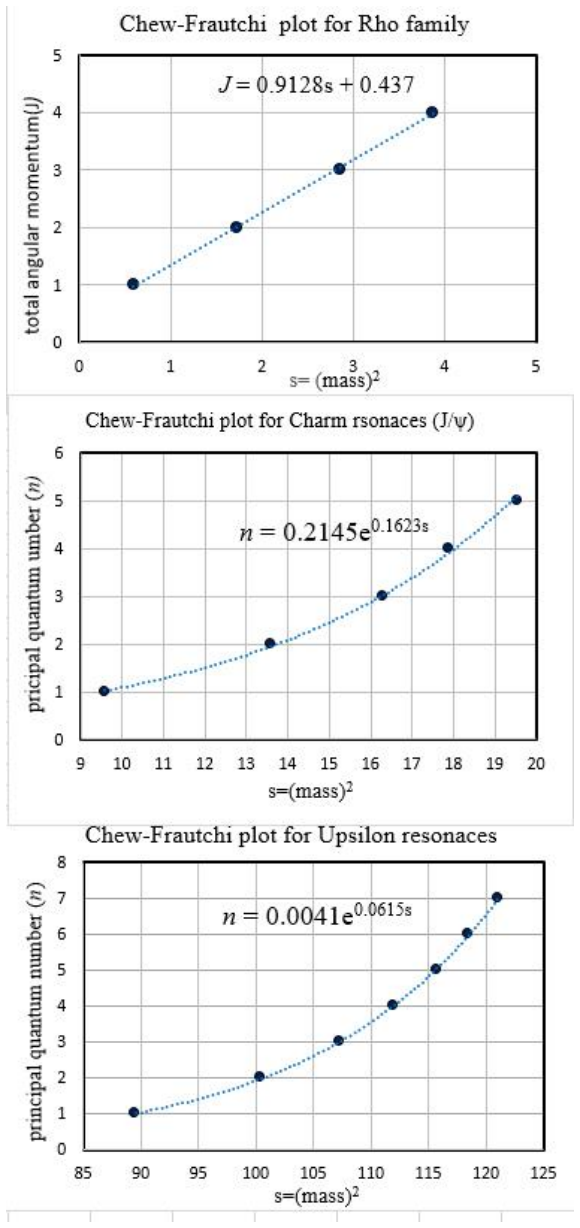
- If the same logarithmic slope describes the $\rho$, charmonium, and bottomonium families, then the logarithmic spacing law is a general property of quark-antiquark confinement rather than an accident of one quark mass.
- Baryon resonances also fall on logarithmic lines with slopes close to those of mesons, though the paper reports a roughly $3\sigma$ difference between the $N^*$ and Upsilon slopes that constrains how quarks pair inside baryons.
- The plane-based interpretation predicts that resonances requiring the destruction of a quark pair, such as $J/\psi$, have narrow widths because the original resonance plane must be annihilated, while same-plane decays such as $\psi(3770)$ are broad.
Reading between the lines
- The paper's own numbers imply the first toponium spacing is only $0.81\ln 2 \approx 0.56$ GeV, which is comparable to the top quark's natural decay width; a realistic observation may therefore look like a broad bump rather than sharp peaks, a consequence the paper only partially acknowledges.
- Because the same logarithmic slope is used for charm and bottom quarks, the model makes a testable universality prediction: any other newly discovered quark-antiquark system should show the same slope in a $\ln n$ mass plot, a check the paper does not carry out.
- The treatment of $n$ and $\ell$ as equivalent quantum numbers suggests near-degeneracies between states with the same $n+\ell$ in the Upsilon spectrum; searching for such pairs in existing data would provide a direct test of the two-dimensional-plane picture.
Editorial analysis
A structured set of objections, weighed in public.
Referee Report
Summary. The paper proposes an empirical logarithmic mass formula M(n) = a ln n + b for hadron resonance families, fits it to the rho, J/psi, Upsilon, and baryon spectra, and then extrapolates the Upsilon slope to toponium, predicting M(n) = 0.81 ln n + 347 GeV. It further claims that toponium should be observable in e+e- collisions with a cross-section on the order of 10^-9 mb and that a collider with 270 GeV x 270 GeV beams would be needed. The paper also offers a two-dimensional-plane interpretation of the OZI rule.
Significance. If the toponium prediction were reliable, it would be a clean, falsifiable prediction for future e+e- colliders. The paper's empirical bottomonium fit is genuinely impressive (R = 0.99997 in Table 2), and the predicted Upsilon(5,6,7) masses agree with data. The interpretation of the OZI rule via two-dimensional resonance planes is speculative but does not affect the main numerical claims. However, the central toponium prediction is not supported by any error analysis or microscopic derivation, and it conflicts with standard-model facts about the top-quark width and the t-tbar threshold.
major comments (4)
- [Section 4] The slope transfer from bottomonium to toponium is asserted, not derived. The sentence "the same slope of 0.81 GeV as for the Upsilon family is applied" is the entire basis for the toponium mass formula, but no justification is given for why the logarithmic slope should be flavor-independent. The fitted slope has an error (Table 2 gives 809.2 ± 4.2 MeV or, in the weighted fit, 810.50 ± 0.39 MeV), and this uncertainty is not propagated to M(n). A prediction with no error bar and no theoretical argument for the extrapolation is not a quantitative prediction.
- [Section 4] The predicted discrete toponium levels are not consistent with standard-model top-quark physics. With m_t ≈ 172.7 GeV, 2m_t ≈ 345.4 GeV, so T(1) = 347 GeV has essentially zero binding and every state with n > 1 lies above the t-tbar threshold, where the system is a scattering continuum rather than a discrete bound spectrum. The top-quark width Γ_t ≈ 1.3–1.4 GeV implies a resonance width of order 2Γ_t, while the level spacing ΔM(n) = 0.81 ln(1 + 1/n) is 0.56 GeV at n = 2 and falls below 2Γ_t already there. The paper's caveat that intervals become narrower than 10 MeV above n = 80 sets the resolution problem roughly two orders of magnitude too high. No mechanism is proposed to suppress t → Wb, so the predicted many sharp resonances are not observable under the standard model.
- [Abstract and Section 4] The production cross-section is quoted as 3 × 10^-9 mb in the abstract and as 7 × 10^-9 mb in Section 4, and no derivation is given for either value. Because the observability claim depends on this cross-section, the discrepancy and the absent calculation are load-bearing issues.
- [Section 4] The collider energy requirement is internally inconsistent. A symmetric e+e- collider with 270 GeV beams has √s = 540 GeV, not 347 GeV; to produce the claimed T(1) = 347 GeV state one needs beams of about 173.5 GeV. The text does not distinguish beam energy from center-of-mass energy. In addition, the stated maximum mass 524.5 GeV = 177.5 GeV + 347 GeV appears to use a top mass of 177.5 GeV that differs from the 173 GeV quoted earlier in the same section; this inconsistency needs clarification.
minor comments (5)
- [Abstract] The formula is typeset as "0.81ln}(n)" with a stray closing brace.
- [Introduction and References] Several names and terms are misspelled: "Tang and Northbury" should be Tan and Norbury, "Okubo-Zwig-lizuka" should be Okubo-Zweig-Iizuka, "Zwing" should be Zweig, "uark" should be quark, and "botomnium" / "botomonium" are inconsistent spellings of bottomonium.
- [Figure 9] Figure 9 is described as showing the expected cross-section, but the manuscript contains no calculation, axis normalization, or tabulated values to support the plotted curve.
- [Section 4] The text quotes the top-quark mass as 173 GeV and also uses 177.5 GeV in the maximum-mass formula; a single consistent value with a PDG reference should be used.
- [Throughout] The mass formula in Section 4 is not numbered, which makes precise citation difficult.
Circularity Check
One fitted-input-called-prediction in the Upsilon validation; the toponium extrapolation itself is not circular.
-
fitted input called prediction
[Section 2-2, 'Mass plot on the logarithmic scale for mesons' (paragraph after Table 2)]
"For Υ 5 (10753), Υ 6 (10885), and Υ 7 (11020), our empirical curve predicts correct resonance masses as Υ5(10754±4), Υ6(10900±4), and Υ7(11023±4MeV) respectively."
Table 2 reports the Upsilon trajectory as a least-squares fit with 7 data points (slope 809.2±4.2 MeV, R=0.99997(4), '7 points'). The same fitted line is then used to 'predict' Υ5, Υ6, and Υ7. Since these states are part of the data set on which the fit was performed, the agreement is guaranteed by construction and is not an independent confirmation of the logarithmic law. This is the fitted-input-called-prediction pattern: the fit is presented as if it were a successful out-of-sample prediction. It does not, by itself, make the toponium extrapolation circular, because no toponium resonance data enter the fit, but it does inflate the empirical evidence that the toponium prediction inherits.
full rationale
The paper's central claim, M(n)=0.81 ln(n)+347 GeV for toponium, is obtained by transferring the logarithmic slope fitted to the Upsilon family and fixing the intercept from the measured top-quark mass (2m_t about 347 GeV). No toponium resonance data are used in the fit, so the n-dependence is an out-of-sample extrapolation rather than a tautology. The clearest circular step is in Section 2-2, where the paper calls the values of its own Upsilon fit 'predictions' for Υ5, Υ6, and Υ7; those agree because they lie on the fitted line, making that particular validation circular by construction. The application of the same 0.81 GeV slope to toponium is an explicit ansatz rather than a derived result, and the potential washout of discrete states by the top-quark width is a physical correctness concern, not a circularity. Overall score 4: one construction-reducing 'prediction' appears in the supporting empirical law, while the central toponium claim remains an extrapolation with independent content.
Assumptions & free parameters
free parameters (2)
- Logarithmic slope s (bottomonium fit) =
0.81 GeV (810.50 +/- 0.39 MeV, Table 2)
- T(1) mass =
347.0 GeV
assumptions (4)
- domain assumption Hadron resonance masses satisfy M(n) = m0 + s ln(n) for each quarkonium family.
- ad hoc to paper The logarithmic slope s is universal across quark flavors (0.81 GeV for bottomonium applies to toponium).
- domain assumption Toponium bound states are narrow enough to display discrete levels despite top quark weak decay.
- domain assumption Quark-antiquark motion is confined to a two-dimensional plane, so n and l are equivalent and the argument is (n+l).
invented entities (1)
-
Two-dimensional resonance plane
Cite this review
Pith. "Pith review of Prediction of Toponium Levels Using a Logarithmic Potential Modeel." pith.science (2026). https://pith.science/paper/NIIENA6S
@misc{pith2026241212574,
  author       = {Pith},
  title        = {Pith review of: Prediction of Toponium Levels Using a Logarithmic Potential Modeel},
  year         = {2026},
  howpublished = {\url{https://pith.science/paper/NIIENA6S}},
  note         = {Machine review of arXiv:2412.12574}
}
read the original abstract
In this paper, the energy levels of the resonant states of toponium, composed of top quark and anti-top quark, are given on the basis of an empirical law. We predict that the mass of the n-th resonant state of toponium is given by Mass(n)=0.81ln}(n) + 347GeV from the empirical law on the resonance level of the bottomonium. The cross-section produced by electron-positron collisions is 3X10^{-9}mb and an electron-positron collider would need an energy of 270GeV X 270 GeV to find out the resonance state of toponium. This prediction is based on the empirical law that the energy levels of hadron resonance states are expressed in logarithms. An interpretation of the appearance of quark resonance states in logarithmic intervals is also given in the paper. An application of this model, we present that the Okubo-Zwig-lizuka law can be viewed as a creation 11and annihilation problem of the two-dimensional resonance planes.
Figures


Figures from the paper (5 more)


Reference graph
Works this paper leans on
-
[1]
G. F. Chew and S.C. Frautschi, Physical Review Letters, 5 (1960) 580. Unified approach to high-and low-energy strong interactions on the basis of the Mandelstam representation. DOI:https://doi.org/10.1103/PhysRevLett.5.580 G. F. Chew and S.C. Frautschi, Physical Review, 123 (1961) 1478. Dynamical theory for strong interactions at low momentum transfers bu...
-
[2]
G. F. Chew and S.C. Frautschi, Physical Review Letters 7 (1961) 394. Principle of equiva- lence for all strongly interacting particles within the S-matrix framework DOI: https://doi.org/10.1103/PhysRevLett.7.394
-
[3]
G. F. Chew and S.C. Frautschi, Physical Review Letters, 8 (1961) 41, Regge Trajectories and the principle of maximum strength for strong interactions. DOI: https://doi.org/10.1103/PhysRevLett.8.41
-
[4]
Regge, Nuovo Cimento 14 (1959) 951, 18 (1960) 947
T. Regge, Nuovo Cimento 14 (1959) 951, 18 (1960) 947. https://doi.org/10.1007/BF02728177
-
[5]
A. Tang and J. W. Norbury, Physical Review D62 (2000), 016006. https://doi.org/10.1103/PhysRevD.62.016006
-
[6]
Y. Muraki, Prog. Theo. Phys. 41 (1969) 473. A new mass formula of elementary particles, DOI: 10.1143/PTP.41.473. Y. Muraki, Soryusiron Kenkyuu Electronnics Vol.38-1 (1968) 34-42 in English. https://doi.org/10.24532/soken.38.1.34
-
[7]
S. Iida and Y. Muraki, Proceed. 11 th of Int. Conf. on Cosmic Rays (Budapest) (1969). Acta Physica Hungarica Supplement 29 pp 271-277 (1970)
work page 1969
-
[8]
J.D. Jackson, C. Quigg, and L.L. Rosner, New Particles, Theoretical Proceeding of the 19 th International Conference on High Energy Physics (Tokyo) 1978 B8. (ICHEP78), CERN Document Server p391, New Particles, Theoretical, by Jakson, David
work page 1978
Show all 25 references
-
[9]
Machacek and Y
M. Machacek and Y. Tomozawa, Psi Phenomenology and nature of Quark Confinment, Annals of Physics, 110 (1978) 407-420. 9 http://dx.dvi.org/10.1016/0003-4916(78)90037-4
1978 doi
-
[10]
Quigg and J
C. Quigg and J. L. Rosner, Quarkonium Level Spacings, Physics Letters B71 (1977) 153. DOI: 10.1016/0370-2693(77)90765-1
1977 doi
-
[11]
Quigg and J
C. Quigg and J. L. Rosner, Quantum Mechanics with Applications to Quarkonium, Physics Reports, 56 No. 4 (1979) 167-235. https://doi.org/10.1016/0370-1573(79)90095-4
1979 doi
-
[12]
Martin, Potential Models of Hadrons, Nuclear Physics B (Proc
A. Martin, Potential Models of Hadrons, Nuclear Physics B (Proc. Suppl.) 23B (1991) 316-327. https://doi.org/10.1016/0920-5632(91)90698-E
1991 doi
-
[13]
Jean-Marc Richard, An introduction to the quark model, arXiv:1205.4326v2, [hep-ph] 24 May 2012
2012 arXiv
-
[14]
Okubo, Physics Leters 5(2) (1963) 165-168
S. Okubo, Physics Leters 5(2) (1963) 165-168. doi:10.1016/s0375-9601(63)925-48-9
1963 doi
-
[15]
Zwing (1964) CERN report No.8419/TH412(Report)
G. Zwing (1964) CERN report No.8419/TH412(Report)
1964
-
[16]
Iizuka, Progr.Theor.Phys
J. Iizuka, Progr.Theor.Phys. Suppl. 37-38(1966) 21-34. https://doi.org/10.1143/PTPS.37.21
1966 doi
-
[17]
Eichten and K
E. Eichten and K. Gottfried, Physics Letters B66 (1977) 286. https://doi.org/10.1016/0370-2693(77)90882-6 18)A. Tang and J.W. Norbury, Physical Review D62 (20009 016006. https://doi/10.1103/PhysRev.D.62.016006
1977 doi
-
[19]
Klempt and B
E. Klempt and B. Ch. Metsch, Multiplet classification of light-uark baryons, Eur. Phys. J. A 48(2012) 127 DOI:10.1140/epja/i2012-12127-1
2012 doi
-
[20]
Atsbek, C
O. Atsbek, C. Deutsch, and M. Lavaud, Physical Review A9 (1974) 2617. Schr¨ odinger equation for the two-dimensional Coulomb potential
1974
-
[21]
Abe et al
F. Abe et al. (CDF collaboration), Phys. Rev. Lett., 74 (1996) 2626. https://doi.org/10.1103/PhysRevLet.742626
1996 doi
-
[22]
Abachi et al
S. Abachi et al. (D0 collaboration), Phys. Rev. Lett. 74 (1996) 2632-2637. DOI:10.1103/PhysRevLett. 742632
1996 doi
-
[23]
Aabound et al
M. Aabound et al. (ATLAS collaboration) Eur. Phys. J. C79 (2019) 290. arXiv:1810.01772 [hep ex]
2019 arXiv
-
[24]
Hachatryan et al., Phys.Rev
V.K. Hachatryan et al., Phys.Rev. D93 7 (2016) 072004. arXiv:1509.04044
2016 arXiv
-
[25]
Brunner et al., The CLIC project, ar Xiv:2203.09186v2 [physics.acc-ph] 18 Apr 2022
O. Brunner et al., The CLIC project, ar Xiv:2203.09186v2 [physics.acc-ph] 18 Apr 2022
2022 arXiv
-
[26]
Particle Data Group, Progr. Theor. Exp. Phys. 2020 083c01 (2020) 741-761. DOI:10.1093/ptep/ptaa104 Appendix I In the paper by Atabek, Deutsch, and lavaud, the Schr¨ odinger equation in the two-dimensional space is discussed under the logarithmic potential; ∆ ψ + [λ - V(r)] ψ= ...
2020 doi
Reviewed August 11, 2026 · model on record in the stance chip above.
Discussion (0). Continue with ORCID to comment.