REVIEW 4 major objections 6 minor 111 references
ShiftedBronzes: Benchmarking and Analysis of Domain Fine-Grained Classification in Open-World Settings
T0 review · 4 major / 6 minor · reviewed 2026-08-11 · deepseek-v4-flash
Pith's one-line read ShiftedBronzes tests bronze ware dating against seven real-world distribution shifts, and finds VLM-based OOD detection consistently ahead of post-hoc and generation-based methods.
desk verdict A useful niche OOD benchmark for bronze dating, but the transferred OOD categories are generated from the same test-set images as the ID evaluation, which muddies the paper's main difficulty-ranking claim. read the letter →
The pith
A machine-rendered reading of the paper's core claim, the machinery that carries it, and where it could break.
The reading
What carries the argument
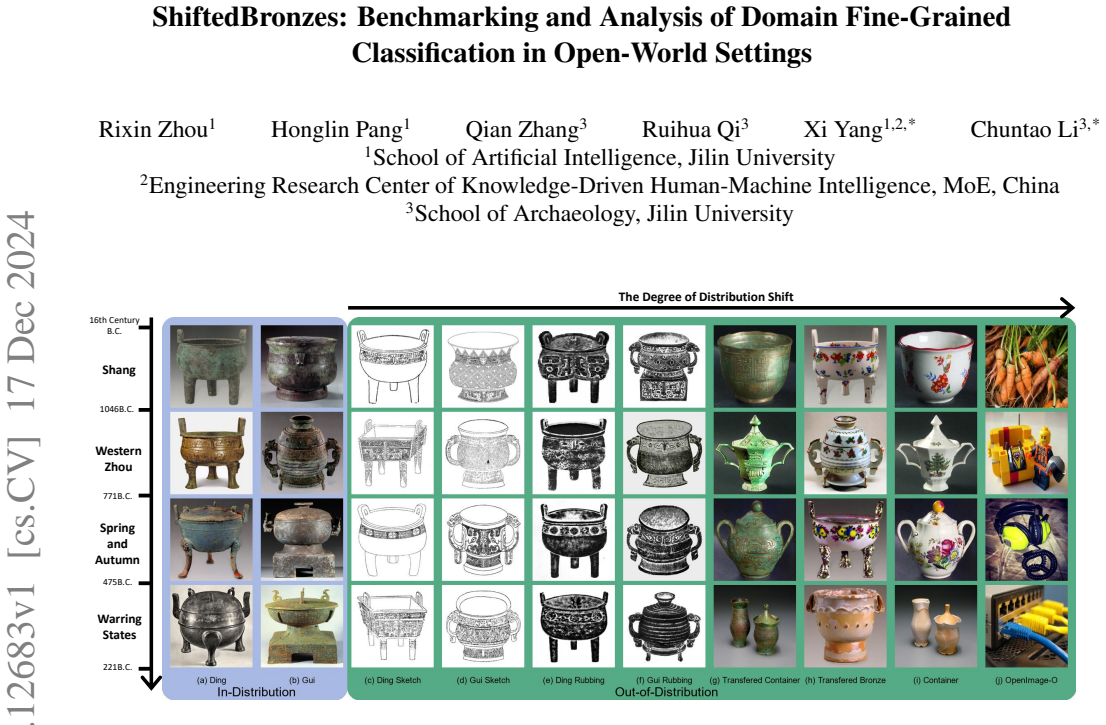
The central object is the ShiftedBronzes dataset itself, constructed by expanding the bronze Ding dataset to include Gui vessels, sketches, rubbings, and 51,023 container images, and by using a zero-shot material transfer technique to create transferred container and transferred bronze images. The mechanism that carries the argument is the pairing of ID data (bronze ware color photographs dated by experts into four dynasties) with OOD data arranged on a spectrum of distribution shift, from close (sketch and rubbing) to far (general ImageNet-derived datasets). The benchmark's analytical leverage comes from comparing eighteen OOD detection methods in three families—post-hoc, VLM-based, and generation-based—on both this spectrum and five general OOD datasets, which lets the paper separate domain-specific behavior from conclusions already established on general OOD data.
What would settle it
Ask a panel of bronze experts to inspect a random sample of transferred container and transferred bronze images and classify them as realistic or artifact-laden; if a substantial fraction show material-transfer artifacts, or if a detector's ranking on ShiftedBronzes changes when evaluated on a held-out set of real photos with analogous shifts, the benchmark's empirical claims would be undermined.
Extended reading notes
Core claim
The central claim is that ShiftedBronzes is a valid and useful benchmark for bronze ware dating under distribution shift, and that on it, VLM-based OOD detection methods consistently outperform post-hoc and generation-based methods. The paper also reports that current OOD detectors find domain-specific OOD samples with small distribution shifts—sketches, rubbings, transferred images—harder than general OOD images, and that among post-hoc methods those combining multiple feature sources do best. A further finding is that pre-trained diffusion-model-based methods are especially sensitive to color distribution shifts and perform well on sketch and rubbing data, indicating a possible route for improving generation-based detection.
Load-bearing premise
The benchmark's conclusions depend on the assumption that the material-transferred images (51,023 per type) are realistic proxies for the distribution shifts faced in real bronze ware dating, and that the expert era labels are reliable enough to serve as ground truth.
Editorial extensions
If this is right
- Bronze ware dating systems deployed in the field can be evaluated against realistic OOD inputs, including sketches, rubbings, and container-like objects, rather than only clean color photographs.
- VLM-based OOD detection, especially prompt-learning methods with trainable ID prompts, becomes the recommended starting point for open-world archaeology applications.
- The finding that small distribution shifts are hardest implies that specialized domains need OOD benchmarks with near-distribution negatives, not only easy general OOD sets.
- Diffusion-model-based detectors that are sensitive to color shifts could be improved by training or selecting them on domain-specific color distributions.
- The benchmark provides a reusable testbed for future OOD detection methods, so progress can be measured against a fixed, expert-annotated reference.
Reading between the lines
- A natural next step the paper does not take is to validate the generated transferred images with archaeologist raters; if experts flag material-transfer artifacts, the benchmark's difficulty ranking could change, so such a human study would strengthen or revise the conclusions.
- The benchmark's design could transfer to other fine-grained heritage and materials domains—ceramics, coins, manuscripts—where sketches, rubbings, and material-transfer negatives are equally natural OOD types.
- The observed 1-shot advantage for VLM prompt learning on specialized data suggests that few-shot regimes may be the default operating point for domain OOD detection, a pattern worth testing on other specialized benchmarks.
- Because the paper finds the best post-hoc methods combine multiple feature sources, a testable extension is to combine the two top post-hoc scores into a single detector and measure whether it closes part of the gap to VLM methods.
Signed reviews
Editorial analysis
A structured set of objections, weighed in public.
Referee Report
Summary. The paper introduces ShiftedBronzes, a benchmark for fine-grained bronze-ware dating under open-world distribution shifts. The benchmark consists of two in-distribution (ID) bronze-ware categories (Ding and Gui) with expert era annotations, and seven OOD data types: sketches, rubbings, two types of ZeST-generated material-transferred images, and container images from ImageNet-21K. The authors benchmark six FGVC methods for the dating task and eighteen OOD detection methods (post-hoc, VLM-based, and generation-based) on ShiftedBronzes and five general OOD datasets. The main empirical findings are that VLM-based methods, especially ID-like, outperform other categories; that detection is harder on domain-specific OOD data with small distribution shifts (the 'hard OOD' split) than on general OOD data; and that diffusion-based methods are comparatively strong on sketch/rubbing data. The paper also analyzes the effect of few-shot training size on VLM methods.
Significance. If the benchmark is valid, it fills a real gap: there is no existing OOD benchmark for archaeological bronze-ware dating, and the dataset includes expert-annotated fine-grained era labels and a variety of OOD types that plausibly occur in archaeological practice. The paper benchmarks a broad set of eighteen OOD methods, and the finding that VLM-based methods are more robust on this specialized domain, as well as the sensitivity analysis of few-shot prompt learning, are useful to the OOD detection community. The dataset and code are promised, and the scale (over 50k images per transferred/container category) is substantial. At the same time, the benchmark's validity depends on the realism of the ZeST-generated images and on the absence of leakage between the generated OOD data and the ID evaluation set; these issues are not adequately addressed in the current manuscript.
major comments (4)
- [Section 3.3 and Section 4.1] The transferred container and transferred bronze OOD categories are generated from the 2,861 bronze images that constitute the ID test set defined in Section 4.1. Consequently, every transferred OOD image shares exact material and texture content with at least one ID evaluation image. The small-shift difficulty finding in Section 4.4.2(6) may therefore be an artifact of this artificial content overlap rather than a genuine property of real bronze-ware distribution shifts. This is a load-bearing issue for the benchmark's central claim to model shifts 'commonly encountered in bronze ware dating scenarios.' Please add a control experiment in which transferred OOD images are generated from bronze images held out from the ID evaluation split (e.g., from the training/validation portions), and re-run the key comparisons; alternatively, report a sensitivity analysis that quantifies the effect of this overlap.
- [Section 4.4.1] For the VLM-based methods ID-like and LoCoOp, the text states that the authors selected the best-performing configuration across varying training sample sizes, but the chosen shot count is not reported in Table 3, Figure 7, or the text. Since Figure 7 shows substantial performance variation with the number of shots (e.g., best OOD performance at 1-shot, with declines as shots increase), the reported rankings are not reproducible and the comparison may be cherry-picked. Please report the exact few-shot configuration used for each method and dataset in Table 3, and provide results for all shot counts in an appendix. In addition, the paper reports no error bars or repeated runs for any of the Table 3 results, which makes it difficult to assess whether the reported differences are significant.
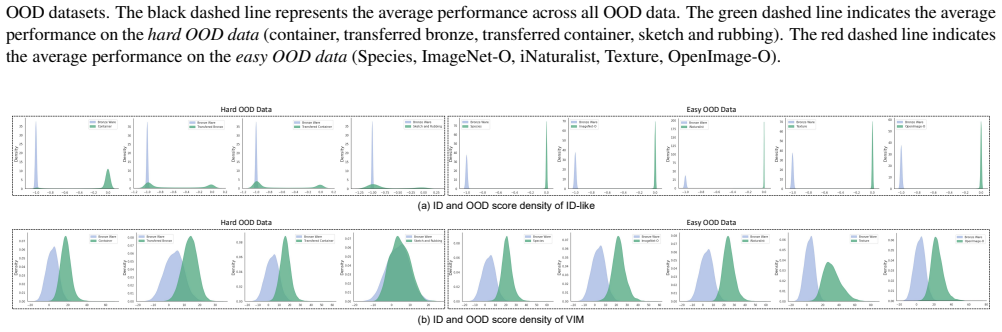
- [Section 4.1 and Section 3.4] The split of OOD data into 'hard' (the seven ShiftedBronzes OOD types) and 'easy' (the five general OOD datasets) is based on expert judgment and a t-SNE visualization of 200 random images per type (Figure 2c). This split is load-bearing for the paper's central finding (Section 4.4.2(6)) that current methods struggle more with small distribution shifts. The t-SNE plot is only illustrative and does not provide a quantitative measure of distribution shift. Please add quantitative shift estimates, such as FID, MMD, or class-conditional feature distances computed with the same backbone(s), and show that the hard/easy ordering is robust to the choice of feature extractor.
- [Section 3.3] The ZeST-generated OOD images are never validated for realism or for their correspondence to distribution shifts actually encountered in bronze-ware dating. If the generated images contain material-transfer artifacts (e.g., unrealistic texture bleeding, lighting inconsistencies, or structural distortions), the benchmark conclusions may not transfer to real archaeological workflows. At minimum, the paper should include a human evaluation (e.g., expert raters judging whether the generated images look like real bronze artifacts or crafts) or a quantitative artifact analysis (e.g., comparison against real sketches/rubbings, or detection of obvious generation artifacts). Without this validation, the benchmark's key assumption that the generated OOD data are realistic proxies remains unsupported.
minor comments (6)
- [Abstract] The abstract contains a duplicated phrase: 'for bronze ware dating and the and the development of OOD detection methods.'
- [Table 3] The table header says 'AUPOC' in multiple places; this should be 'AUROC.'
- [Section 4.4.2] The text refers to 'Table 1' and 'Figure 4' when presenting top-2 results; these should be 'Table 3' and likely 'Figure 5' or a different figure number.
- [References] References [1]-[4] and [49]-[50] appear to be leftover placeholder entries (e.g., 'Alpher' and 'Frobnication') and should be removed or replaced with actual citations before any public release.
- [Section 4.4.2(1)] The statement that DiffGuard performs 'just below ID-like' on sketch/rubbing data is vague; please report the exact FPR@95 and AUROC values (37.4/87.37 vs. 24.55/94.94 according to Table 3).
- [Table 2] HRN achieves an overall accuracy of 39.57%, far lower than the other methods; the paper does not comment on this, and such a large gap may indicate a bug in the evaluation setting. Please verify and briefly explain.
Circularity Check
Main benchmark comparisons are not circular, but the small-shift OOD difficulty result is partly built into the OOD construction from ID test images.
-
self definitional
[Section 3.3 (Transferred OOD Data) and Section 4.1 (Data Preparation)]
"To prevent information leakage from the training data, we used 2861 bronze ware images from the test set to perform material transfers on 51023 container images ... Consequently, the transferred container data can also be correlated with each era based on the corresponding bronze ware images. ... Considering the degree of distribution shift from the ID data, we classified the seven OOD data types in ShiftedBronzes as hard OOD data and the five general OOD datasets as easy OOD data."
The two 'small distribution shift' OOD categories (transferred container and transferred bronze) are constructed by applying material transfer to the exact 2,861 bronze images that form the ID test set. Thus every transferred OOD sample contains the material/texture of an ID evaluation image, making the small-shift property true by construction rather than an independent property of real bronze-ware distribution shifts. The Section 4.4.2 finding that hard/small-shift OOD is more difficult is therefore partly an artifact of the ID-OOD overlap built into the dataset definition, not a free-standing empirical discovery.
full rationale
The paper's central OOD conclusions are benchmarked against external general datasets (Species, ImageNet-O, iNaturalist, Texture, OpenImage-O), so the main performance rankings are not circular. The one definitional weakness is the construction of the transferred OOD categories from the ID test set: the 'small distribution shift' for these categories is guaranteed by using the ID test images as the material source, which confounds the reported result that small-shift domain OOD is harder. The hard/easy labeling in Section 4.1 also carries some tautological weight, though the FPR@95 and AUROC measurements themselves are empirical. Self-citations to the authors' prior bronze Ding dataset and AKG model are used as tools and baselines but are not load-bearing in a circular way. Overall, partial circularity appears in one sub-claim, not in the benchmark as a whole.
Assumptions & free parameters
free parameters (2)
- VLM few-shot training configuration =
1-shot (best per Figure 7, exact choice not reported in Table 3)
- hard/easy OOD assignment =
hard = all seven ShiftedBronzes OOD types; easy = five general OOD datasets
assumptions (3)
- domain assumption Expert annotations of era for bronze ware images are reliable (four dynasties, eleven fine-grained periods).
- ad hoc to paper ZeST zero-shot material transfer produces realistic OOD images that simulate real bronze ware and counterfeit items.
- domain assumption t-SNE feature distances reflect semantic distribution shift relevant to OOD difficulty.
Cite this review
Pith. "Pith review of ShiftedBronzes: Benchmarking and Analysis of Domain Fine-Grained Classification in Open-World Settings." pith.science (2026). https://pith.science/paper/XAWQWXFY
@misc{pith2026241212683,
  author       = {Pith},
  title        = {Pith review of: ShiftedBronzes: Benchmarking and Analysis of Domain Fine-Grained Classification in Open-World Settings},
  year         = {2026},
  howpublished = {\url{https://pith.science/paper/XAWQWXFY}},
  note         = {Machine review of arXiv:2412.12683}
}
read the original abstract
In real-world applications across specialized domains, addressing complex out-of-distribution (OOD) challenges is a common and significant concern. In this study, we concentrate on the task of fine-grained bronze ware dating, a critical aspect in the study of ancient Chinese history, and developed a benchmark dataset named ShiftedBronzes. By extensively expanding the bronze Ding dataset, ShiftedBronzes incorporates two types of bronze ware data and seven types of OOD data, which exhibit distribution shifts commonly encountered in bronze ware dating scenarios. We conduct benchmarking experiments on ShiftedBronzes and five commonly used general OOD datasets, employing a variety of widely adopted post-hoc, pre-trained Vision Large Model (VLM)-based and generation-based OOD detection methods. Through analysis of the experimental results, we validate previous conclusions regarding post-hoc, VLM-based, and generation-based methods, while also highlighting their distinct behaviors on specialized datasets. These findings underscore the unique challenges of applying general OOD detection methods to domain-specific tasks such as bronze ware dating. We hope that the ShiftedBronzes benchmark provides valuable insights into both the field of bronze ware dating and the and the development of OOD detection methods. The dataset and associated code will be available later.
Figures


Figures from the paper (4 more)



Reference graph
Works this paper leans on
-
[1]
Alpher, F. (2002). Frobnication. IEEE TPAMI, 12(1):234– 778
2002
-
[2]
and Fotheringham-Smythe, F
Alpher, F. and Fotheringham-Smythe, F. (2003). Frobnication revisited. Journal of Foo, 13(1):234–778
2003
-
[3]
Alpher, F., Fotheringham-Smythe, F., and Gamow, F. (2004). Can a machine frobnicate? Journal of Foo, 14(1):234–778
2004
-
[4]
and Gamow, F
Alpher, F. and Gamow, F. (2005). Can a computer frobnicate? In CVPR, pages 234–778
2005
-
[5]
Bai, Y ., Han, Z., Cao, B., Jiang, X., Hu, Q., and Zhang, C. (2024). Id-like prompt learning for few-shot out-of- distribution detection. In Proceedings of the IEEE/CVF Con- ference on Computer Vision and Pattern Recognition , pages 17480–17489. 3, 6, 7, 8
2024
-
[6]
Basart, S., Mantas, M., Mohammadreza, M., Jacob, S., and Dawn, S. (2022). Scaling out-of-distribution detection for real- world settings. In International Conference on Machine Learn- ing. 5, 6, 8
2022
-
[7]
Ben-David, S., Blitzer, J., Crammer, K., Kulesza, A., Pereira, F., and Vaughan, J. W. (2010). A theory of learning from dif- ferent domains. Machine learning, 79:151–175
2010
-
[8]
and Boult, T
Bendale, A. and Boult, T. E. (2016). Towards open set deep networks. In Proceedings of the IEEE conference on computer vision and pattern recognition, pages 1563–1572. 6
2016
Show all 111 references
-
[9]
C., Lu, L., and Tommasi, T
Borlino, F. C., Lu, L., and Tommasi, T. (2024). Foundation models and fine-tuning: A benchmark for out of distribution detection. IEEE Access
2024
-
[10]
Y .-T., and Cohen, J
Cao, T., Huang, C.-W., Hui, D. Y .-T., and Cohen, J. P. (2020). A benchmark of medical out of distribution detection. arXiv preprint arXiv:2007.04250. 2, 3
2020 arXiv
-
[11]
CAPPIO BORLINO, F. (2024). Addressing distributional shift challenges in computer vision for real-world applications
2024
-
[12]
C., PLF de Carvalho, A
Cerri, R., Barros, R. C., PLF de Carvalho, A. C., and Jin, Y . (2016). Reduction strategies for hierarchical multi-label clas- sification in protein function prediction. BMC bioinformatics, 17(1):1–24
2016
-
[13]
Chang, D., Pang, K., Zheng, Y ., Ma, Z., Song, Y .-Z., and Guo, J. (2021). Your” flamingo” is my” bird”: Fine-grained, or not. In Proceedings of the IEEE/CVF Conference on Computer Vision and Pattern Recognition, pages 11476–11485. 3, 5, 6
2021
-
[14]
Chen, J., Wang, P., Liu, J., and Qian, Y . (2022). Label re- lation graphs enhanced hierarchical residual network for hier- archical multi-granularity classification. In Proceedings of the IEEE/CVF Conference on Computer Vision and Pattern Recog- nition, pages 4858–4867. 3, 5, 6
2022
-
[15]
Chen, T., Wu, W., Gao, Y ., Dong, L., Luo, X., and Lin, L. (2018). Fine-grained representation learning and recognition by exploiting hierarchical semantic embedding. InProceedings of the 26th ACM international conference on Multimedia, pages 2023–2031
2018
-
[16]
Cheng, T.-Y ., Sharma, P., Markham, A., Trigoni, N., and Jampani, V . (2025). Zest: Zero-shot material transfer from a single image. In European Conference on Computer Vision , pages 370–386. Springer. 5
2025
-
[17]
Deng, J., Ding, N., Jia, Y ., Frome, A., Murphy, K., Bengio, S., Li, Y ., Neven, H., and Adam, H. (2014). Large-scale object classification using label relation graphs. In European confer- ence on computer vision, pages 48–64. Springer
2014
-
[18]
Deng, J., Dong, W., Socher, R., Li, L.-J., Li, K., and Fei- Fei, L. (2009). Imagenet: A large-scale hierarchical image database. In 2009 IEEE conference on computer vision and pattern recognition, pages 248–255. Ieee
2009
-
[19]
Dom ´enech-Carb´o, A., Dom ´enech-Carb´o, M., Redondo- Marug´an, J., Osete-Cortina, L., Barrio, J., Fuentes, A., Vivancos-Ram´on, M., Al Sekhaneh, W., Mart ´ınez, B., Mart´ınez-L´azaro, I., et al. (2018). Electrochemical character- ization and dating of archaeological leaded b...
2018
-
[20]
T., Capelo, S., Pas´ıes, T., and Mart´ınez-L´azaro, I
Dom ´enech-Carb´o, A., Dom ´enech-Carb´o, M. T., Capelo, S., Pas´ıes, T., and Mart´ınez-L´azaro, I. (2014). Dating archaeolog- ical copper/bronze artifacts by using the voltammetry of mi- croparticles. Angewandte Chemie, 126(35):9416–9420. 3
2014
-
[21]
Dosovitskiy, A., Beyer, L., Kolesnikov, A., Weissenborn, D., Zhai, X., Unterthiner, T., Dehghani, M., Minderer, M., Heigold, G., Gelly, S., Uszkoreit, J., and Houlsby, N. (2021). An image is worth 16x16 words: Transformers for image recognition at scale. In International Confe...
2021
-
[22]
and Shearer, R
Drummond, N. and Shearer, R. (2006). The open world as- sumption. In eSI Workshop: The Closed World of Databases meets the Open World of the Semantic Web, volume 15, page 1
2006
-
[23]
Du, X., Sun, Y ., Zhu, J., and Li, Y . (2024). Dream the im- possible: Outlier imagination with diffusion models. Advances in Neural Information Processing Systems, 36. 3
2024
-
[24]
Dubey, A., Gupta, O., Guo, P., Raskar, R., Farrell, R., and Naik, N. (2018a). Pairwise confusion for fine-grained visual classification. In Proceedings of the European conference on computer vision (ECCV), pages 70–86
2018
-
[25]
Dubey, A., Gupta, O., Raskar, R., and Naik, N. (2018b). Maximum-entropy fine grained classification.Advances in neu- ral information processing systems, 31
2018
-
[26]
Galil, I., Dabbah, M., and El-Yaniv, R. (2023). A frame- work for benchmarking class-out-of-distribution detection and its application to imagenet. In The Eleventh International Con- ference on Learning Representations
2023
-
[27]
Gao, R., Zhao, C., Hong, L., and Xu, Q. (2023). Diffguard: Semantic mismatch-guided out-of-distribution detection using pre-trained diffusion models. In Proceedings of the IEEE/CVF International Conference on Computer Vision , pages 1579–
2023
-
[28]
Gardner, J., Popovic, Z., and Schmidt, L. (2024). Bench- marking distribution shift in tabular data with tableshift. Ad- vances in Neural Information Processing Systems, 36
2024
-
[29]
and Lukasiewicz, T
Giunchiglia, E. and Lukasiewicz, T. (2020). Coherent hierar- chical multi-label classification networks. Advances in Neural Information Processing Systems, 33:9662–9673
2020
-
[30]
S., Pinaya, W
Graham, M. S., Pinaya, W. H., Tudosiu, P.-D., Nachev, P., Ourselin, S., and Cardoso, J. (2023). Denoising diffusion mod- els for out-of-distribution detection. In Proceedings of the IEEE/CVF Conference on Computer Vision and Pattern Recog- nition, pages 2948–2957. 3
2023
-
[31]
and Wood, J
Greenacre, M. and Wood, J. R. (2024). A comprehen- sive workflow for compositional data analysis in archaeometry, with code in r. Archaeological and Anthropological Sciences, 16(10):171
2024
-
[32]
Gui, S., Li, X., Wang, L., and Ji, S. (2022). Good: A graph out-of-distribution benchmark. Advances in Neural Informa- tion Processing Systems, 35:2059–2073
2022
-
[33]
He, J., Zhu, Q., Chen, Y ., and Nie, F. (2020). Bronze in- scriptions classification algorithm on imbalanced dataset. In 2020 5th International Conference on Mechanical, Control and Computer Engineering (ICMCCE), pages 1715–1718. IEEE
2020
-
[34]
He, K., Zhang, X., Ren, S., and Sun, J. (2015). Delving deep into rectifiers: Surpassing human-level performance on ima- genet classification. In Proceedings of the IEEE international conference on computer vision, pages 1026–1034. 2
2015
-
[35]
He, K., Zhang, X., Ren, S., and Sun, J. (2016a). Deep resid- ual learning for image recognition. In Proceedings of the IEEE conference on computer vision and pattern recognition , pages 770–778
2016
-
[36]
He, K., Zhang, X., Ren, S., and Sun, J. (2016b). Deep resid- ual learning for image recognition. In Proceedings of the IEEE conference on computer vision and pattern recognition , pages 770–778. 5
2016
-
[37]
and Gimpel, K
Hendrycks, D. and Gimpel, K. (2017). A baseline for de- tecting misclassified and out-of-distribution examples in neural networks. In International Conference on Learning Represen- tations. 3, 6, 8
2017
-
[38]
Hendrycks, D., Zhao, K., Basart, S., Steinhardt, J., and Song, D. (2021). Natural adversarial examples. In Proceedings of the IEEE/CVF conference on computer vision and pattern recogni- tion, pages 15262–15271. 5
2021
-
[39]
Huang, R., Geng, A., and Li, Y . (2021a). On the importance of gradients for detecting distributional shifts in the wild. Ad- vances in Neural Information Processing Systems, 34:677–689. 3, 6
2021
-
[40]
and Li, Y
Huang, R. and Li, Y . (2021). Mos: Towards scaling out-of- distribution detection for large semantic space. In Proceedings of the IEEE/CVF Conference on Computer Vision and Pattern Recognition, pages 8710–8719. 5
2021
-
[41]
Huang, S., Wang, X., and Tao, D. (2021b). Stochastic par- tial swap: Enhanced model generalization and interpretability for fine-grained recognition. In Proceedings of the IEEE/CVF International Conference on Computer Vision, pages 620–629. 3, 5, 6
2021
-
[42]
Huang, S., Xu, Z., Tao, D., and Zhang, Y . (2016). Part- stacked cnn for fine-grained visual categorization. In Proceed- ings of the IEEE conference on computer vision and pattern recognition, pages 1173–1182
2016
-
[43]
Humblot-Renaux, G., Escalera, S., and Moeslund, T. B. (2024). A noisy elephant in the room: Is your out-of- distribution detector robust to label noise? In Proceedings of the IEEE/CVF Conference on Computer Vision and Pattern Recognition, pages 22626–22636
2024
-
[44]
Ji, Y ., Zhang, L., Wu, J., Wu, B., Huang, L.-K., Xu, T., Rong, Y ., Li, L., Ren, J., Xue, D., et al. (2022). Drugood: Out-of-distribution (ood) dataset curator and benchmark for ai- aided drug discovery–a focus on affinity prediction problems with noise annotations. arXiv pre...
2022 arXiv
-
[45]
and Ramanan, D
Kong, S. and Ramanan, D. (2021). Opengan: Open- set recognition via open data generation. In Proceedings of the IEEE/CVF International Conference on Computer Vision , pages 813–822. 3, 6
2021
-
[46]
Krizhevsky, A., Sutskever, I., and Hinton, G. E. (2012). Im- agenet classification with deep convolutional neural networks. Advances in neural information processing systems, 25. 2
2012
-
[47]
Kuang, B., Chen, Y ., and Su, B. (2020). Detecting for bronze inscriptions. In Proceedings of the 2020 4th International Con- ference on Electronic Information Technology and Computer Engineering, pages 555–559
2020
-
[48]
Kylberg, G. (2011). Kylberg texture dataset v. 1.0. Centre for Image Analysis, Swedish University of Agricultural Sciences and . . . . 5
2011
-
[49]
LastName, F. (2014a). The frobnicatable foo filter. Face and Gesture submission ID 324. Supplied as supplemental material fg324.pdf
2014
-
[50]
LastName, F. (2014b). Frobnication tutorial. Supplied as supplemental material tr.pdf
2014
-
[51]
Lee, K., Lee, K., Lee, H., and Shin, J. (2018). A simple uni- fied framework for detecting out-of-distribution samples and adversarial attacks. Advances in neural information process- ing systems, 31. 3, 6, 7, 8
2018
-
[52]
Li, C., Qi, R., Tang, C., Wei, J., Yang, X., Zhang, Q., and Zhou, R. (2023). Ai mobile application for archaeological dat- ing of bronze dings. arXiv preprint arXiv:2401.01002. 3
2023 arXiv
-
[53]
Li, D., Yang, Y ., Song, Y .-Z., and Hospedales, T. M. (2017). Deeper, broader and artier domain generalization. In Proceed- ings of the IEEE international conference on computer vision , pages 5542–5550
2017
-
[54]
Li, F., Andreeto, M., Ranzato, M., and Perona, P. (2022). Caltech 101 (1.0)[data set]. caltechdata
2022
-
[55]
Li, L., Wang, Y ., Sitawarin, C., and Spratling, M. (2024). OODRobustbench: a benchmark and large-scale analysis of adversarial robustness under distribution shift. In ICLR 2024 Workshop on Data-centric Machine Learning Research (DMLR): Harnessing Momentum for Science. 2, 3
2024
-
[56]
Liang, S., Li, Y ., and Srikant, R. (2018). Enhancing the relia- bility of out-of-distribution image detection in neural networks. In International Conference on Learning Representations. 3, 6
2018
-
[57]
Lin, T.-Y ., RoyChowdhury, A., and Maji, S. (2015). Bilinear cnn models for fine-grained visual recognition. In Proceedings of the IEEE international conference on computer vision, pages 1449–1457
2015
-
[58]
Ling, H., Qingrong, Z., and Min, G. (2007). Characterization of corroded bronze ding from the yin ruins of china. Corrosion science, 49(6):2534–2546. 3
2007
-
[59]
Liu, W., Wang, X., Owens, J., and Li, Y . (2020). Energy- based out-of-distribution detection. Advances in neural infor- mation processing systems, 33:21464–21475. 3, 6
2020
-
[60]
Liu, X. (2014). Identification and collection of bronze dings of all ages. Oriental Collection, (8):121–124
2014
-
[61]
Liu, Z., Luo, P., Qiu, S., Wang, X., and Tang, X. (2016). Large-scale fashion (deepfashion) database. Xiaoou TangMul- timedia Laboratory, The Chinese University of Hong Kong, Category and Attribute Prediction Benchmark. https://url. kr/dfQWlV. 5
2016
-
[62]
J., and Wolf, F
Lotfollahi, M., Naghipourfar, M., Theis, F. J., and Wolf, F. A. (2020). Conditional out-of-distribution generation for unpaired data using transfer vae. Bioinformatics, 36(Supple- ment 2):i610–i617
2020
-
[63]
S., Li, J., Yang, J., and Lim, S.-N
Luo, W., Yang, X., Mo, X., Lu, Y ., Davis, L. S., Li, J., Yang, J., and Lim, S.-N. (2019). Cross-x learning for fine-grained visual categorization. In Proceedings of the IEEE/CVF inter- national conference on computer vision, pages 8242–8251
2019
-
[64]
Mao, X., Chen, Y ., Zhu, Y ., Chen, D., Su, H., Zhang, R., and Xue, H. (2023). Coco-o: A benchmark for object detectors un- der natural distribution shifts. In Proceedings of the IEEE/CVF International Conference on Computer Vision , pages 6339–
2023
-
[65]
Ming, Y ., Cai, Z., Gu, J., Sun, Y ., Li, W., and Li, Y . (2022). Delving into out-of-distribution detection with vision-language representations. Advances in neural information processing systems, 35:35087–35102. 3
2022
-
[66]
and Li, Y
Ming, Y . and Li, Y . (2024). How does fine-tuning impact out-of-distribution detection for vision-language models? In- ternational Journal of Computer Vision, 132(2):596–609. 8
2024
-
[67]
G., Sabokrou, M., and Rohban, M
Mirzaei, H., Salehi, M., Shahabi, S., Gavves, E., Snoek, C. G., Sabokrou, M., and Rohban, M. H. (2022). Fake it un- til you make it: Towards accurate near-distribution novelty de- tection. In The eleventh international conference on learning representations. 3
2022
-
[68]
Misra, I., Shrivastava, A., Gupta, A., and Hebert, M. (2016). Cross-stitch networks for multi-task learning. In Proceedings of the IEEE conference on computer vision and pattern recog- nition, pages 3994–4003
2016
-
[69]
Miyai, A., Yu, Q., Irie, G., and Aizawa, K. (2024). Locoop: Few-shot out-of-distribution detection via prompt learning.Ad- vances in Neural Information Processing Systems, 36. 3, 6, 7, 8
2024
-
[70]
Moonshot AI Technology Co., L. (2024). Kimi: Your ai companion. https://moonshot.cn/kimi . Accessed: 2024-11-11. 4
2024
-
[71]
Nascetti, A., Yadav, R., Brodt, K., Qu, Q., Fan, H., Shendryk, Y ., Shah, I., and Chung, C. (2024). Biomassters: A benchmark dataset for forest biomass estimation using multi-modal satel- lite time-series. Advances in Neural Information Processing Systems, 36
2024
-
[72]
S., Fu, N., Dong, R., Hu, M., and Hu, J
Omee, S. S., Fu, N., Dong, R., Hu, M., and Hu, J. (2024). Structure-based out-of-distribution (ood) materials property prediction: a benchmark study. npj Computational Materials, 10(1):144. 2, 3
2024
-
[73]
W., Hallacy, C., Ramesh, A., Goh, G., Agarwal, S., Sastry, G., Askell, A., Mishkin, P., Clark, J., et al
Radford, A., Kim, J. W., Hallacy, C., Ramesh, A., Goh, G., Agarwal, S., Sastry, G., Askell, A., Mishkin, P., Clark, J., et al. (2021). Learning transferable visual models from natural lan- guage supervision. In International conference on machine learning, pages 8748–8763. PMLR. 3
2021
-
[74]
Ridnik, T., Ben-Baruch, E., Noy, A., and Zelnik-Manor, L. (2021). Imagenet-21k pretraining for the masses. In Thirty- fifth Conference on Neural Information Processing Systems Datasets and Benchmarks Track (Round 1). 1
2021
-
[75]
R., Vandermeulen, R
Ruff, L., Kauffmann, J. R., Vandermeulen, R. A., Montavon, G., Samek, W., Kloft, M., Dietterich, T. G., and M ¨uller, K.- R. (2021). A unifying review of deep and shallow anomaly detection. Proceedings of the IEEE, 109(5):756–795
2021
-
[76]
Ruiz, N., Li, Y ., Jampani, V ., Pritch, Y ., Rubinstein, M., and Aberman, K. (2023). Dreambooth: Fine tuning text-to-image diffusion models for subject-driven generation. In Proceedings of the IEEE/CVF conference on computer vision and pattern recognition, pages 22500–22510
2023
-
[77]
L., Ghasemipour, K., Gontijo Lopes, R., Karagol Ayan, B., Salimans, T., et al
Saharia, C., Chan, W., Saxena, S., Li, L., Whang, J., Denton, E. L., Ghasemipour, K., Gontijo Lopes, R., Karagol Ayan, B., Salimans, T., et al. (2022). Photorealistic text-to-image diffu- sion models with deep language understanding. Advances in neural information processing s...
2022
-
[78]
Sastry, C. S. and Oore, S. (2020). Detecting out-of- distribution examples with Gram matrices. In III, H. D. and Singh, A., editors, Proceedings of the 37th International Con- ference on Machine Learning , volume 119 of Proceedings of Machine Learning Research, pages 8491–8501...
2020
-
[79]
M., Schmidt-Erfurth, U., and Langs, G
Schlegl, T., Seeb ¨ock, P., Waldstein, S. M., Schmidt-Erfurth, U., and Langs, G. (2017). Unsupervised anomaly detection with generative adversarial networks to guide marker discov- ery. In International conference on information processing in medical imaging, pages 146–157. Sp...
2017
-
[80]
F., and Luque, J
Serr `a, J., ´Alvarez, D., G ´omez, V ., Slizovskaia, O., N ´u˜nez, J. F., and Luque, J. (2020). Input complexity and out-of- distribution detection with likelihood-based generative models. In International Conference on Learning Representations. 3
2020
-
[81]
Sharma, P., Ding, N., Goodman, S., and Soricut, R. (2018). Conceptual captions: A cleaned, hypernymed, image alt-text dataset for automatic image captioning. In Proceedings of the 56th Annual Meeting of the Association for Computational Lin- guistics (Volume 1: Long Papers), p...
2018
-
[82]
R., Tian, J., Chai, S., Lin, Z., Vasudevan, A
Shi, J., Gare, G. R., Tian, J., Chai, S., Lin, Z., Vasudevan, A. B., Feng, D., Ferroni, F., Kong, S., and Ramanan, D. (2024). LCA-on-the-line: Benchmarking out of distribution generaliza- tion with class taxonomies. In NeurIPS 2023 Workshop on Dis- tribution Shifts: New Fronti...
2024
-
[83]
and Lee, S
Shi, X. and Lee, S. (2024). Benchmarking out-of-distribution detection in visual question answering. In Proceedings of the IEEE/CVF Winter Conference on Applications of Computer Vi- sion, pages 5485–5495
2024
-
[84]
Sickman, L. (1948). A descriptive and illustrative catalogue of chinese bronzes acquired during the administration of john ellerton lodge
1948
-
[85]
and Zisserman, A
Simonyan, K. and Zisserman, A. (2014). Very deep con- volutional networks for large-scale image recognition. arXiv preprint arXiv:1409.1556
2014 arXiv
-
[86]
and Srivastava, A
Sricharan, K. and Srivastava, A. (2018). Building robust classifiers through generation of confident out of distribution examples. NeurIPS-W. 3
2018
-
[87]
Sun, M., Yuan, Y ., Zhou, F., and Ding, E. (2018). Multi- attention multi-class constraint for fine-grained image recogni- tion. In Proceedings of the European Conference on Computer Vision (ECCV), pages 805–821
2018
-
[88]
Sun, Y ., Guo, C., and Li, Y . (2021). React: Out-of- distribution detection with rectified activations. Advances in Neural Information Processing Systems, 34:144–157. 6
2021
-
[89]
and Li, Y
Sun, Y . and Li, Y . (2022). Dice: Leveraging sparsification for out-of-distribution detection. In European Conference on Computer Vision, pages 691–708. 3, 6
2022
-
[90]
Sun, Y ., Ming, Y ., Zhu, X., and Li, Y . (2022). Out-of- distribution detection with deep nearest neighbors. In Interna- tional Conference on Machine Learning , pages 20827–20840. PMLR. 6, 8
2022
-
[91]
Vaze, S., Han, K., Vedaldi, A., and Zisserman, A. (2022). Open-set recognition: A good closed-set classifier is all you need? In International Conference on Learning Representa- tions (ICLR)
2022
-
[92]
Vernekar, S., Gaurav, A., Abdelzad, V ., Denouden, T., Salay, R., and Czarnecki, K. (2019). Out-of-distribution detection in classifiers via generation. NeurIPS-W. 3
2019
-
[93]
Wang, H., Li, Y ., Yao, H., and Li, X. (2023). Clipn for zero- shot ood detection: Teaching clip to say no. In Proceedings of the IEEE/CVF International Conference on Computer Vision , pages 1802–1812. 3, 6, 7
2023
-
[94]
Wang, H., Li, Z., Feng, L., and Zhang, W. (2022). Vim: Out-of-distribution with virtual-logit matching. In Proceedings of the IEEE/CVF conference on computer vision and pattern recognition, pages 4921–4930. 1, 2, 5, 6, 7, 8
2022
-
[95]
Wang, S., Chen, G., and Zhang, C. (2019). A study of the phasing and dating of western zhou bronzes. Artifacts, (9):96– 96
2019
-
[96]
Wang, Y ., Wei, G., Li, Q., Zheng, X., and Wang, D. (2021). Provenance of zhou dynasty bronze vessels unearthed from zongyang county, anhui province, china: determined by lead isotopes and trace elements. Heritage Science, 9(1):1–12. 3
2021
-
[97]
Wei, X.-S., Song, Y .-Z., Mac Aodha, O., Wu, J., Peng, Y ., Tang, J., Yang, J., and Belongie, S. (2021). Fine-grained image analysis with deep learning: A survey. IEEE Transactions on Pattern Analysis and Machine Intelligence
2021
-
[98]
Wei, X.-S., Xie, C.-W., Wu, J., and Shen, C. (2018). Mask- cnn: Localizing parts and selecting descriptors for fine-grained bird species categorization. Pattern Recognition, 76:704–714
2018
-
[99]
Wu, Z. (2012). A collection of shang and zhou bronze in- scriptions and images. Shanghai Ancient Books Publishing House
2012
-
[100]
Yang, J., Wang, P., Zou, D., Zhou, Z., Ding, K., Peng, W., Wang, H., Chen, G., Li, B., Sun, Y ., et al. (2022a). Openood: Benchmarking generalized out-of-distribution detection. Ad- vances in Neural Information Processing Systems , 35:32598– 32611. 2, 3, 5
2022
-
[101]
Yang, X., Wang, Y ., Chen, K., Xu, Y ., and Tian, Y . (2022b). Fine-grained object classification via self-supervised pose alignment. In Proceedings of the IEEE/CVF Confer- ence on Computer Vision and Pattern Recognition, pages 7399–
2022
-
[102]
Yang, Z., Luo, T., Wang, D., Hu, Z., Gao, J., and Wang, L. (2018). Learning to navigate for fine-grained classification. In Proceedings of the European Conference on Computer Vision (ECCV), pages 420–435. 3, 5, 6
2018
-
[103]
Yuan, L., Chen, Y ., Cui, G., Gao, H., Zou, F., Cheng, X., Ji, H., Liu, Z., and Sun, M. (2023). Revisiting out-of- distribution robustness in nlp: Benchmarks, analysis, and llms evaluations. Advances in Neural Information Processing Sys- tems, 36:58478–58507
2023
-
[104]
Zhang, C., Niwa, T., and Hirokawa, M. (2016a). On the piece mold-casting technology of the bronze gui-tureens in the shang and zhou dynasties. Chinese Archaeology, 16(1):162– 167
2016
-
[105]
Zhang, H., Xu, T., Elhoseiny, M., Huang, X., Zhang, S., Elgammal, A., and Metaxas, D. (2016b). Spda-cnn: Unifying semantic part detection and abstraction for fine-grained recog- nition. In Proceedings of the IEEE conference on computer vision and pattern recognition, pages 1143–1152
2016
-
[106]
Zhang, N., Donahue, J., Girshick, R., and Darrell, T. (2014). Part-based r-cnns for fine-grained category detection. In European conference on computer vision , pages 834–849. Springer
2014
-
[107]
Zhao, B., Yu, S., Ma, W., Yu, M., Mei, S., Wang, A., He, J., Yuille, A., and Kortylewski, A. (2022). Ood-cv: A bench- mark for robustness to individual nuisances in real-world out- of-distribution shifts. In ICML 2022 Shift Happens Workshop. 2, 3
2022
-
[108]
Zhao, Y ., Yan, K., Huang, F., and Li, J. (2021). Graph-based high-order relation discovery for fine-grained recognition. In Proceedings of the IEEE/CVF Conference on Computer Vision and Pattern Recognition, pages 15079–15088
2021
-
[109]
Zheng, Y ., Yan, Y ., and Qi, D. (2022). Bronze inscrip- tion recognition with distribution calibration based on few-shot learning. In 4th International Conference on Informatics Engi- neering & Information Science (ICIEIS2021) , volume 12161, pages 150–158. SPIE
2022
-
[110]
Zhou, D.-W., Ye, H.-J., and Zhan, D.-C. (2021). Learning placeholders for open-set recognition. In Proceedings of the IEEE/CVF conference on computer vision and pattern recogni- tion, pages 4401–4410. 3
2021
-
[111]
Zhou, R., Wei, J., Zhang, Q., Qi, R., Yang, X., and Li, C. (2023). Multi-granularity archaeological dating of chinese bronze dings based on a knowledge-guided relation graph. In Proceedings of the IEEE/CVF Conference on Computer Vision and Pattern Recognition, pages 3103–3113....
2023
Reviewed August 11, 2026 · model on record in the stance chip above.
Discussion (0). Continue with ORCID to comment.