REVIEW 4 major objections 6 minor 1 cited by
CondiMen: Conditional Multi-Person Mesh Recovery
T0 review · 4 major / 6 minor · reviewed 2026-08-11 · deepseek-v4-flash
Pith's one-line read CondiMen models multi-person mesh recovery as a joint distribution over camera intrinsics, poses, shapes, and 3D locations, and its mode predictions match or beat deterministic baseline methods while accepting extra test-time cues.
desk verdict CondiMen is a smart probabilistic head for multi-person HMR, but the showcased test-time conditioning gains are demonstrated with oracle ground-truth inputs, so the practical capability needs a robustness check. read the letter →
The pith
A machine-rendered reading of the paper's core claim, the machinery that carries it, and where it could break.
The reading
What carries the argument
The load-bearing mechanism is the Bayesian network head: a cascade of multi-layer perceptrons (MLPs) that map image features and parent variables into the parameters of conditional distributions, followed at inference by greedy mode extraction. The named identities that carry the argument are the matrix Fisher density $p_{\boldsymbol{F}}(\mathbf{R}) = c(\boldsymbol{F})\exp(\operatorname{tr}(\boldsymbol{F}^\top \mathbf{R}))$ over $SO(3)$ rotations, which makes pose distributions normalized and cheap to evaluate; the encoded-depth variable $\ln(d/f)$, which keeps distance positive and makes the model strongly responsive to camera intrinsics; and the binary detection variable $s_{u,v}$ per image grid cell, with the head as reference keypoint, which turns detection into a per-cell classification problem. The Fisher parameterization also yields the closed-form Procrustes solution used to fuse shared bone orientations across views. The conditional dependencies among these variables are what let known test-time information propagate through the graph, and the joint log-likelihood training objective is what ties the conditionals together so that greedy mode extraction approximates the joint mode.
What would settle it
Take an image containing two people standing one behind the other so that their heads fall in the same 14-by-14 patch at the 518-by-518 input resolution used by the model, and count how many meshes CondiMen emits. The one-person-per-cell assumption predicts exactly one detection: seeing two meshes would show the stated limitation does not bind, while seeing one would confirm it and bound the multi-person claim by cell occupancy.
Extended reading notes
Core claim
On its own terms, CondiMen claims that multi-person mesh recovery is better posed as inference over a joint density $p(K,\mathbf{t},\theta,\beta,\gamma|I)$, with camera intrinsics $K$, absolute 3D location $\mathbf{t}$, pose $\theta$, body shape $\beta$, and facial expression $\gamma$ conditioned on image features $I$, than as regression to a single mesh. The joint density is factorized as a Bayesian network of conditional parametric distributions: diagonal Gaussians for shape, expression, and 2D location, a log-normal on the focal length with a Gaussian principal point for the camera, a Gaussian on encoded depth $\ln(d/f)$, and a product of matrix Fisher distributions on $SO(3)$ for the 53 bone rotations. The network is trained end-to-end with the empirical joint log-likelihood (Eq. 4) plus two mode-guiding losses: a vertex reprojection loss and a human-centered mesh vertex loss (Eq. 5). At inference, the mode of each conditional distribution is extracted greedily in a feed-forward pass; known values of any variable can be injected in place of its sampled mode, and multi-view inputs are combined by maximizing the product of per-view densities, which for each shared bone orientation reduces to a closed-form Procrustes orthonormalization. The paper reports that this procedure yields predictions on par with or better than deterministic single-view and multi-view state-of-the-art methods on the benchmarks it evaluates, while keeping inference around 50 ms per image with its largest backbone.
Load-bearing premise
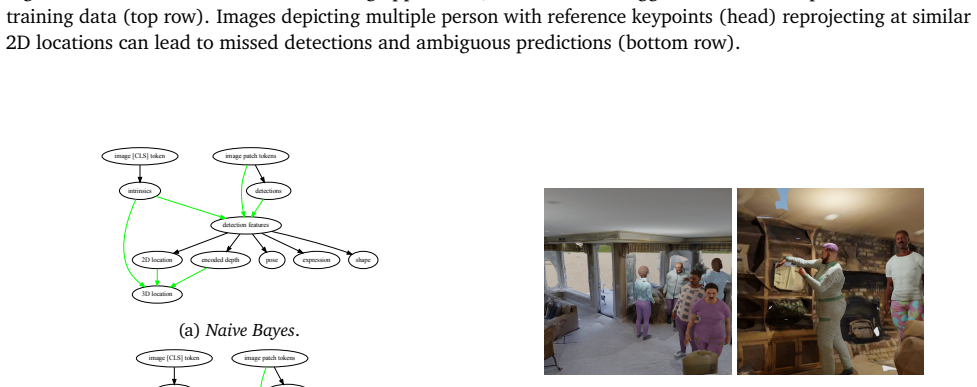
The load-bearing assumption is that at most one person's head projects into each 14-by-14 image grid cell; two people whose heads land in the same cell cannot both be detected, and the paper's own failure-case section shows exactly this missed-detection ambiguity.
Editorial extensions
If this is right
- If CondiMen's central claim is right, a model trained only on synthetic monocular images can be deployed with camera calibration from image metadata, and the paper reports this cuts absolute position error by roughly half on 3DPW with no retraining.
- Adding a measured distance or a known body shape at test time compounds the gain: on the multi-view benchmarks, position errors drop from hundreds of millimeters to tens of millimeters when intrinsics, shape, and distance are all supplied.
- Multi-view fusion becomes a test-time operation on a monocular model: after matching predictions across views, each shared bone orientation is obtained in closed form by Procrustes orthonormalization of a sum of matrix Fisher parameters, so no multi-view training data is required.
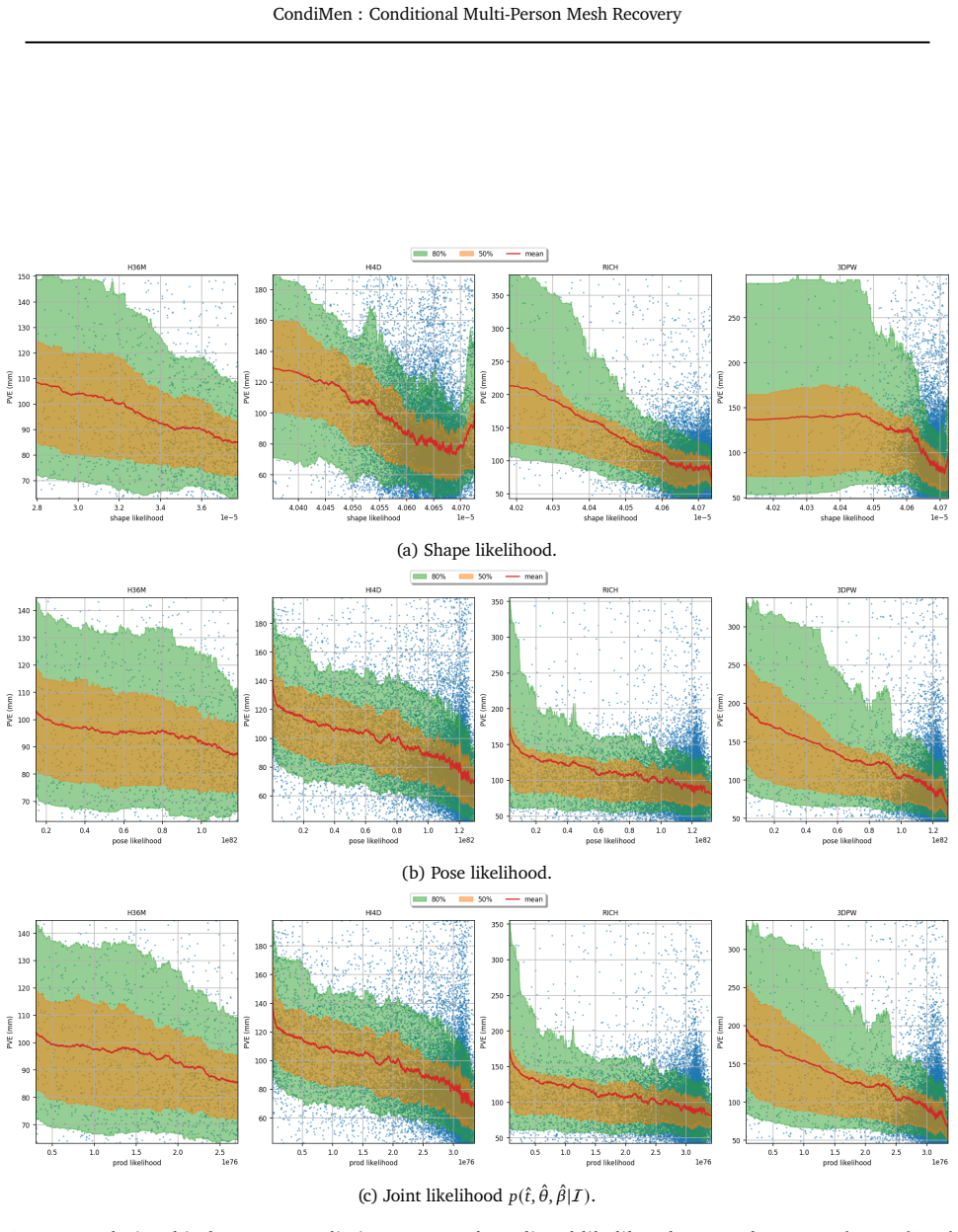
- The predicted joint likelihood is empirically correlated with actual prediction error, so the same head can serve as a confidence signal for downstream applications.
- Because inference is a sequence of MLP forward passes, the method remains near real-time: roughly 50 ms per image with the largest backbone used in the paper.
Reading between the lines
- Editorial inference: the one-head-per-cell detection assumption sets a hard ceiling on crowd recall; replacing the binary per-cell variable with multiple reference keypoints or a finer, adaptive grid is the natural next step, and the paper's own failure case of overlapping heads points to it.
- Editorial inference: the same Bayesian head can generate diverse hypotheses by sampling from the conditionals instead of taking modes, which would support ambiguity-aware planning; the paper describes the sampling procedure but evaluates only mode-based metrics.
- Editorial inference: the closed-form fusion of matrix Fisher posteriors is not specific to bodies and could transfer to hand, face, or object pose estimation whenever per-view posteriors have the same functional form.
- Editorial inference: a testable personalization pipeline is suggested by the zero-shot shape conditioning: estimate a person's shape from a short video, then feed it as a known variable to improve all subsequent single-view predictions; the paper validates the conditioning with ground-truth shapes, not with shapes estimated upstream.
Signed reviews
Editorial analysis
A structured set of objections, weighed in public.
Referee Report
Summary. The paper proposes CondiMen, a multi-person whole-body mesh recovery method that replaces deterministic output heads with a Bayesian network over camera intrinsics, detections, pose, shape, expression, and 3D location. The model is trained end-to-end from synthetic data (BEDLAM plus custom renderings) with a joint log-likelihood objective augmented by mode-guiding losses. At inference, predictions are extracted greedily, optionally conditioned on externally provided quantities such as camera calibration, body shape, or distance, and fused across multiple views via a product-of-posteriors formulation. The empirical sections compare CondiMen to a matched Naive-Bayes variant, to Multi-HMR (retrained on the same data), and to published methods on 3DPW, MuPoTS, Human3.6M, HI4D, and RICH, in both monocular and multi-view settings, and report competitive or better performance together with an uncertainty-error correlation.
Significance. The core contribution is a practical probabilistic formulation for a task where most recent work outputs deterministic single predictions. If the claims hold, the method offers three concrete benefits: calibrated uncertainty estimates (correlated with error), zero-shot incorporation of camera/shape/depth side information, and multi-view fusion without multi-view training data. The controlled comparison to a Naive Bayes baseline with parametric distributions is a particular strength, as is the synthetic-only training protocol and the real-time inference speed (50 ms/frame on ViT-L). The main risks are the oracle-based evaluation of the conditioning capability and the unmatched protocol in the state-of-the-art table; both should be addressable in revision.
major comments (4)
- [Sec. 4 and Supp. E.2 (Fig. 4, Table 3)] The 'additional information' experiments inject ground-truth camera intrinsics, body shape, and distance values, where the shape and distance are taken from the closest ground-truth annotation (Supp. E.2). The abstract's claim that CondiMen can 'exploit additional information at test time' in practical applications is therefore not supported by a realistic protocol: no experiment adds noise, uses estimated rather than oracle values, or tests sensitivity to inaccurate side information. Please add a robustness study (e.g., corrupt the conditioning inputs with increasing noise and report PVE/PE) or explicitly bound the claims to perfect side information.
- [Sec. 3.3 (multi-view prior)] Eq. (3) treats beta, gamma, and per-view locations as variables in the joint posterior, but the described greedy inference only explains rigid alignment and closed-form fusion of the intrinsic bone orientations via Procrustes orthonormalization. The paper does not state how shape, expression, and per-view absolute translations are combined across views, even though the multi-view experiments report improved PVE and PE. Please provide the complete greedy algorithm for all variables to make the method reproducible.
- [Sec. 3.2 and Supp. C (Fig. 9)] The detection head assumes at most one person per image grid cell with the head as reference keypoint. This places a hard ceiling on multi-person recall in overlapping-head scenes, a failure case the authors acknowledge but never quantify. Because the paper's scope is explicitly multi-person mesh recovery, please report a detection/recall metric (for instance on MuPoTS or a crowded subset) and state the impact of this assumption on the headline performance.
- [Sec. 4 (Table 1)] For Human3.6M, HI4D, and RICH, the paper reports results after fine-tuning on the corresponding training set and using ground-truth camera intrinsics, while several listed baselines (MUC, Yu et al., Calib-free PaFF, OUVR) are uncalibrated methods taken from their original papers. The 'on par with or better than state-of-the-art' claim is therefore not protocol-matched across rows. Please either include a version of CondiMen evaluated without ground-truth intrinsics in the same table, restrict the comparison to methods that use the same calibration protocol, or clearly annotate which rows use which protocol.
minor comments (6)
- [Sec. 3.2, Eq. (2)] The normalization constant c(F) is evaluated on a fixed 36,864-rotation SO(3) grid; please report the numerical error of this quadrature or a sensitivity check over grid sizes.
- [Sec. 3.4] The random field-of-view sampling range (5–170 degrees) is very wide; a sensitivity analysis on this range would help understand the robustness of the mode-guiding loss.
- [Table 1c] MuPoTS PCK-All drops from 82.7 (Multi-HMR) to 74.0 (Ours) while PCK-Matched increases; please discuss this trade-off, e.g., in relation to the detection threshold.
- [Sec. 3.1] The variable d is referenced in the dimension list (dim(d)=1) before being defined; please define it at first use.
- [References] The reference list contains duplicate entries for SMPL-X ([47] and [48] are the same paper); please deduplicate.
- [Figure 4] The bar labels are small and the exact values are hard to read; consider tabulating the numbers in the main text.
Circularity Check
No significant circularity found: the probabilistic model is trained with a likelihood objective and evaluated on held-out benchmarks; oracle conditioning experiments are an honest limitation, not a circular reduction.
full rationale
The central derivation is not circular. CondiMen is trained with Eq. (4)-(5), maximizing the log-likelihood of ground-truth variables plus mode-guiding losses, and is evaluated on held-out benchmarks (Tables 1-3, Fig. 4); no reported metric is obtained by plugging the target quantity back into the model as a fitted parameter. The 'additional information' experiments are oracle-conditioning demonstrations: Supp. E.2 states 'we associate to each prediction the shape (resp. distance) of the closest ground truth annotation', and the paper explicitly says it leverages 'known ground-truth quantities'. This is an upper-bound capability study, not a prediction of those quantities, and it does not make the benchmark mesh-recovery numbers circular. The absence of noisy or estimated conditioning inputs is a robustness limitation, not a circular step. Self-citations to Multi-HMR [4] are architectural and baseline-related: the paper retrains Multi-HMR for comparison and does not invoke its own prior work to justify the probabilistic contribution. No uniqueness theorem is imported, and no fitted parameter is renamed as a prediction. The one-person-per-cell detection assumption is acknowledged in Supp. C and Fig. 9 as a failure mode; again, this is a limitation of the method, not a circularity in the derivation.
Assumptions & free parameters
free parameters (5)
- lambda (Fisher dispersion scaling) =
2
- Random field-of-view sampling range for mode-guiding =
5-170 degrees
- Detection score threshold =
0.5
- Non-maximum suppression window =
3x3 patches
- Matrix Fisher normalization grid size =
36,864 rotations
assumptions (9)
- domain assumption Pinhole camera model with focal length and principal point.
- domain assumption SMPL-X body model is a sufficient representation of human mesh.
- domain assumption At most one person per image grid cell, head as reference keypoint.
- ad hoc to paper Conditional distributions are diagonal Gaussians for shape, expression, 2D location, and encoded depth, and product of independent matrix Fisher for pose.
- ad hoc to paper Greedy mode extraction approximates the MAP solution of Eq. (1).
- standard math Matrix Fisher normalization constants from numerical integration on 36,864 rotations are accurate.
- domain assumption Synthetic-only training transfers to real-world benchmarks.
- ad hoc to paper The chosen dependency order in the Bayesian network is a beneficial inductive bias.
- ad hoc to paper Mode-guiding losses with random FoV sampling encourage correct conditional behavior.
Cite this review
Pith. "Pith review of CondiMen: Conditional Multi-Person Mesh Recovery." pith.science (2026). https://pith.science/paper/P3A4MPR3
@misc{pith2026241213058,
  author       = {Pith},
  title        = {Pith review of: CondiMen: Conditional Multi-Person Mesh Recovery},
  year         = {2026},
  howpublished = {\url{https://pith.science/paper/P3A4MPR3}},
  note         = {Machine review of arXiv:2412.13058}
}
read the original abstract
Multi-person human mesh recovery (HMR) consists in detecting all individuals in a given input image, and predicting the body shape, pose, and 3D location for each detected person. The dominant approaches to this task rely on neural networks trained to output a single prediction for each detected individual. In contrast, we propose CondiMen, a method that outputs a joint parametric distribution over likely poses, body shapes, intrinsics and distances to the camera, using a Bayesian network. This approach offers several advantages. First, a probability distribution can handle some inherent ambiguities of this task -- such as the uncertainty between a person's size and their distance to the camera, or simply the loss of information when projecting 3D data onto the 2D image plane. Second, the output distribution can be combined with additional information to produce better predictions, by using e.g. known camera or body shape parameters, or by exploiting multi-view observations. Third, one can efficiently extract the most likely predictions from the output distribution, making our proposed approach suitable for real-time applications. Empirically we find that our model i) achieves performance on par with or better than the state-of-the-art, ii) captures uncertainties and correlations inherent in pose estimation and iii) can exploit additional information at test time, such as multi-view consistency or body shape priors. CondiMen spices up the modeling of ambiguity, using just the right ingredients on hand.
Figures


Figures from the paper (8 more)




Forward citations
Cited by 1 Pith paper
-
Human Mesh Modeling for Anny Body
A scan-free, interpretable body model built from MakeHuman artist assets matches scan-trained SMPL-X models for human mesh recovery and scan fitting.
Reference graph
Works this paper leans on
-
[1]
Blender.https://www.blender.org/. 13
-
[2]
Humgen3d.https://www.humgen3d.com/. 13
-
[3]
Poly haven.https://polyhaven.com/. 13
-
[4]
Multi-hmr: Multi-person whole- body human mesh recovery in a single shot
Fabien Baradel, Matthieu Armando, Salma Galaaoui, Romain Brégier, Philippe Weinzaepfel, Grégory Rogez, and Thomas Lucas. Multi-hmr: Multi-person whole- body human mesh recovery in a single shot. InECCV,
-
[5]
Benjamin Biggs, David Novotny, Sebastien Ehrhardt, Hanbyul Joo, Ben Graham, and Andrea Vedaldi. 3d 8 CondiMen : Conditional Multi-Person Mesh Recovery Method MV Human3.6M↓ HI4D↓ PJE PA-PJE PVE PA-PVE PVE PA-PVE ProHMR [35] 65.1 43.7 – – ROMP [63] – – – – 215.3 – BEV [64] – – – – 153.9 – HMR2.0 [23] 50.0 32.4– – 141.2 – Yu et al. [77] – 41.6 – 46.4 – – SMP...
2020
-
[6]
Christopher M Bishop and Nasser M Nasrabadi.Pattern recognition and machine learning. Springer, 2006. 2
work page 2006
-
[7]
Bedlam: A synthetic dataset of bodies exhibiting detailed lifelike animated motion
Michael J Black, Priyanka Patel, Joachim Tesch, and Jinlong Yang. Bedlam: A synthetic dataset of bodies exhibiting detailed lifelike animated motion. InCVPR,
-
[8]
Keep it smpl: Automatic estimation of 3d human pose and shape from a single image
Federica Bogo, Angjoo Kanazawa, Christoph Lassner, Peter Gehler, Javier Romero, and Michael J Black. Keep it smpl: Automatic estimation of 3d human pose and shape from a single image. InECCV, 2016. 2
work page 2016
Show all 85 references
-
[9]
Deep regression on manifolds: a 3D rotation case study
Romain Brégier. Deep regression on manifolds: a 3D rotation case study. In3DV, 2021. 4
2021
-
[10]
Language models are few-shot learners
Tom Brown, Benjamin Mann, Nick Ryder, Melanie Sub- biah, Jared D Kaplan, Prafulla Dhariwal, Arvind Nee- lakantan, Pranav Shyam, Girish Sastry, Amanda Askell, et al. Language models are few-shot learners. In NeurIPS, 2020. 3
2020
-
[11]
Smpler-x: Scaling up expressive human pose and shape estimation
Zhongang Cai, Wanqi Yin, Ailing Zeng, Chen Wei, Qingping Sun, Yanjun Wang, Hui En Pang, Haiyi Mei, Mingyuan Zhang, Lei Zhang, et al. Smpler-x: Scaling up expressive human pose and shape estimation. In NeurIPS, 2023. 2, 9
2023
-
[12]
Matterport3D: Learning from RGB-D data in indoor environments
Angel Chang, Angela Dai, Thomas Funkhouser, Maciej Halber, Matthias Niessner, Manolis Savva, Shuran Song, Andy Zeng, and Yinda Zhang. Matterport3D: Learning from RGB-D data in indoor environments. In3DV, 2017. 13
2017
-
[13]
Synthesizing training images for boosting human 3d pose estimation
Wenzheng Chen, Huan Wang, Yangyan Li, Hao Su, Zhenhua Wang, Changhe Tu, Dani Lischinski, Daniel Cohen-Or, and Baoquan Chen. Synthesizing training images for boosting human 3d pose estimation. In3DV,
-
[14]
Tempo: Efficient multi-view pose estimation, tracking, and forecasting
Rohan Choudhury, Kris M Kitani, and László A Jeni. Tempo: Efficient multi-view pose estimation, tracking, and forecasting. InICCV, 2023. 2
2023
-
[15]
Monocular expressive body regression through body-driven atten- tion
Vasileios Choutas, Georgios Pavlakos, Timo Bolkart, Dimitrios Tzionas, and Michael J Black. Monocular expressive body regression through body-driven atten- tion. InECCV, 2020. 2, 3, 6
2020
-
[16]
Up- ose3d: Uncertainty-aware 3d human pose estimation with cross-view and temporal cues
Vandad Davoodnia, Saeed Ghorbani, Marc-André Car- bonneau, Alexandre Messier, and Ali Etemad. Up- ose3d: Uncertainty-aware 3d human pose estimation with cross-view and temporal cues. InECCV, 2024. 2
2024
-
[17]
An image is worth 16x16 words: Transformers for image recognition at scale
Alexey Dosovitskiy, Lucas Beyer, Alexander Kolesnikov, Dirk Weissenborn, Xiaohua Zhai, Thomas Unterthiner, Mostafa Dehghani, Matthias Minderer, Georg Heigold, Sylvain Gelly, et al. An image is worth 16x16 words: Transformers for image recognition at scale. InICLR,
-
[18]
Poco: 3d pose and shape estimation with confidence
Sai Kumar Dwivedi, Cordelia Schmid, Hongwei Yi, Michael J Black, and Dimitrios Tzionas. Poco: 3d pose and shape estimation with confidence. In3DV, 2024. 2, 9 9 CondiMen : Conditional Multi-Person Mesh Recovery
2024
-
[19]
Tokenhmr: Advancing human mesh recovery with a tokenized pose representation
Sai Kumar Dwivedi, Yu Sun, Priyanka Patel, Yao Feng, and Michael J Black. Tokenhmr: Advancing human mesh recovery with a tokenized pose representation. In CVPR, 2024. 2
2024
-
[20]
Tam- ing transformers for high-resolution image synthesis
Patrick Esser, Robin Rombach, and Bjorn Ommer. Tam- ing transformers for high-resolution image synthesis. In CVPR, 2021. 3
2021
-
[21]
Collaborative regression of expressive bodies using moderation
Yao Feng, Vasileios Choutas, Timo Bolkart, Dimitrios Tzionas, and Michael J Black. Collaborative regression of expressive bodies using moderation. In3DV, 2021. 2
2021
-
[22]
Vq-hps: Humanposeandshapeestimationinavector-quantized latent space.ECCV, 2024
Guénolé Fiche, Simon Leglaive, Xavier Alameda-Pineda, Antonio Agudo, and Francesc Moreno-Noguer. Vq-hps: Humanposeandshapeestimationinavector-quantized latent space.ECCV, 2024. 3
2024
-
[23]
Hu- mans in 4d: Reconstructing and tracking humans with transformers
Shubham Goel, Georgios Pavlakos, Jathushan Ra- jasegaran, Angjoo Kanazawa, and Jitendra Malik. Hu- mans in 4d: Reconstructing and tracking humans with transformers. InICCV, 2023. 2, 9
2023
-
[24]
Look ma, no markers: holistic perfor- mance capture without the hassle
Charlie Hewitt, Fatemeh Saleh, Sadegh Aliakbarian, Lo- hit Petikam, Shideh Rezaeifar, Louis Florentin, Zafiirah Hosenie, Thomas J Cashman, Julien Valentin, Darren Cosker, et al. Look ma, no markers: holistic perfor- mance capture without the hassle. InSIGGRAPH Asia,
-
[25]
Closely interactive hu- man reconstruction with proxemics and physics-guided adaption
Buzhen Huang, Chen Li, Chongyang Xu, Liang Pan, Yan- gang Wang, and Gim Hee Lee. Closely interactive hu- man reconstruction with proxemics and physics-guided adaption. InCVPR, 2024. 3
2024
-
[26]
Huang, Hongwei Yi, Markus Höschle, Matvey Safroshkin, Tsvetelina Alexiadis, Senya Po- likovsky, Daniel Scharstein, and Michael J
Chun-Hao P. Huang, Hongwei Yi, Markus Höschle, Matvey Safroshkin, Tsvetelina Alexiadis, Senya Po- likovsky, Daniel Scharstein, and Michael J. Black. Cap- turing and inferring dense full-body human-scene con- tact. InCVPR, 2022. 2, 6
2022
-
[27]
Human3.6m: Large scale datasets and predictive methods for 3d human sensing in natural environments.IEEE Trans
Catalin Ionescu, Dragos Papava, Vlad Olaru, and Cris- tian Sminchisescu. Human3.6m: Large scale datasets and predictive methods for 3d human sensing in natural environments.IEEE Trans. PAMI, 2014. 2, 6
2014
-
[28]
Learnable triangulation of human pose
Karim Iskakov, Egor Burkov, Victor Lempitsky, and Yury Malkov. Learnable triangulation of human pose. In ICCV, 2019. 2
2019
-
[29]
Generating multiple diverse hypotheses for human 3d pose consistent with 2d joint detections
Ehsan Jahangiri and Alan L Yuille. Generating multiple diverse hypotheses for human 3d pose consistent with 2d joint detections. InICCVW, 2017. 2
2017
-
[30]
Delv- ing deep into pixel alignment feature for accurate multi- view human mesh recovery
Kai Jia, Hongwen Zhang, Liang An, and Yebin Liu. Delv- ing deep into pixel alignment feature for accurate multi- view human mesh recovery. InAAAI, 2023. 2, 9
2023
-
[31]
Exemplar fine-tuning for 3d human model fitting to- wards in-the-wild 3d human pose estimation
Hanbyul Joo, Natalia Neverova, and Andrea Vedaldi. Exemplar fine-tuning for 3d human model fitting to- wards in-the-wild 3d human pose estimation. In3DV,
-
[32]
Black, David W
Angjoo Kanazawa, Michael J. Black, David W. Jacobs, and Jitendra Malik. End-to-end recovery of human shape and pose. InCVPR, 2018. 1, 2
2018
-
[33]
Kingma and Jimmy Ba
Diederik P. Kingma and Jimmy Ba. Adam: A method for stochastic optimization. InICLR, 2015. 6
2015
-
[34]
Learningtoreconstruct3dhuman pose and shape via model-fitting in the loop
Nikos Kolotouros, Georgios Pavlakos, Michael J Black, andKostasDaniilidis. Learningtoreconstruct3dhuman pose and shape via model-fitting in the loop. InICCV,
-
[35]
Probabilistic modeling for human mesh recovery
Nikos Kolotouros, Georgios Pavlakos, Dinesh Jayara- man, and Kostas Daniilidis. Probabilistic modeling for human mesh recovery. InICCV, 2021. 2, 3, 5, 9
2021
-
[36]
Generating multiple hypothe- ses for 3d human pose estimation with mixture density network
Chen Li and Gim Hee Lee. Generating multiple hypothe- ses for 3d human pose estimation with mixture density network. InCVPR, 2019. 2
2019
-
[37]
Human pose regres- sion with residual log-likelihood estimation
Jiefeng Li, Siyuan Bian, Ailing Zeng, Can Wang, Bo Pang, Wentao Liu, and Cewu Lu. Human pose regres- sion with residual log-likelihood estimation. InICCV,
-
[38]
3d human pose and shape estimation through collabo- rative learning and multi-view model-fitting
Zhongguo Li, Magnus Oskarsson, and Anders Heyden. 3d human pose and shape estimation through collabo- rative learning and multi-view model-fitting. InWACV,
-
[39]
Cliff: Carrying location informa- tion in full frames into human pose and shape estima- tion
Zhihao Li, Jianzhuang Liu, Zhensong Zhang, Songcen Xu, and Youliang Yan. Cliff: Carrying location informa- tion in full frames into human pose and shape estima- tion. InECCV, 2022. 2
2022
-
[40]
One-stage 3d whole-body mesh recovery with component aware transformer
Jing Lin, Ailing Zeng, Haoqian Wang, Lei Zhang, and Yu Li. One-stage 3d whole-body mesh recovery with component aware transformer. InCVPR, 2023. 2
2023
-
[41]
MatthewLoper,NaureenMahmood,JavierRomero,Ger- ard Pons-Moll, and Michael J. Black. SMPL: A skinned multi-person linear model.ACM Trans. Graphics, 2015. 2
2015
-
[42]
Single-shot multi-person 3d pose estimation from monocular rgb
Dushyant Mehta, Oleksandr Sotnychenko, Franziska Mueller, WeipengXu, SrinathSridhar, GerardPons-Moll, and Christian Theobalt. Single-shot multi-person 3d pose estimation from monocular rgb. In3DV, 2018. 2, 6
2018
-
[43]
Accurate 3d hand pose estimation for whole-body 3d human mesh estimation
Gyeongsik Moon, Hongsuk Choi, and Kyoung Mu Lee. Accurate 3d hand pose estimation for whole-body 3d human mesh estimation. InCVPRW, 2022. 2
2022
-
[44]
Generative Proxemics: A Prior for 3D Social Interaction from Images
Lea Müller, Vickie Ye, Georgios Pavlakos, Michael Black, and Angjoo Kanazawa. Generative Proxemics: A Prior for 3D Social Interaction from Images. InCVPR, 2024. 2, 3
2024
-
[45]
Dinov2: Learning robust visual features without supervision.TMLR, 2024
Maxime Oquab, Timothée Darcet, Théo Moutakanni, Huy Vo, Marc Szafraniec, Vasil Khalidov, Pierre Fer- nandez, Daniel Haziza, Francisco Massa, Alaaeldin El- Nouby, et al. Dinov2: Learning robust visual features without supervision.TMLR, 2024. 6
2024
-
[46]
Agora: Avatars in geography optimized for re- gression analysis
Priyanka Patel, Chun-Hao P Huang, Joachim Tesch, David T Hoffmann, Shashank Tripathi, and Michael J Black. Agora: Avatars in geography optimized for re- gression analysis. InCVPR, 2021. 2, 6
2021
-
[47]
Expressive body capture: 3d hands, face, and body from a single image
Georgios Pavlakos, Vasileios Choutas, Nima Ghorbani, TimoBolkart,AhmedAAOsman,DimitriosTzionas,and Michael J Black. Expressive body capture: 3d hands, face, and body from a single image. InCVPR, 2019. 2
2019
-
[48]
Expressive body capture: 3d hands, face, and body from a single image
Georgios Pavlakos, Vasileios Choutas, Nima Ghorbani, TimoBolkart,AhmedAAOsman,DimitriosTzionas,and Michael J Black. Expressive body capture: 3d hands, face, and body from a single image. InCVPR, 2019. 2 10 CondiMen : Conditional Multi-Person Mesh Recovery
2019
-
[49]
Human mesh recovery from multiple shots
Georgios Pavlakos, Jitendra Malik, and Angjoo Kanazawa. Human mesh recovery from multiple shots. InCVPR, 2022. 2
2022
-
[50]
Cross view fusion for 3d human pose estimation
Haibo Qiu, Chunyu Wang, Jingdong Wang, Naiyan Wang, and Wenjun Zeng. Cross view fusion for 3d human pose estimation. InICCV, 2019. 2
2019
-
[51]
Psvt: End-to-end multi-person 3d pose and shape estimation with progressive video transformers
Zhongwei Qiu, Qiansheng Yang, Jian Wang, Haocheng Feng, Junyu Han, Errui Ding, Chang Xu, Dongmei Fu, and Jingdong Wang. Psvt: End-to-end multi-person 3d pose and shape estimation with progressive video transformers. InCVPR, 2023. 2, 3
2023
-
[52]
Lcr-net: Localization-classification-regression for human pose
Gregory Rogez, Philippe Weinzaepfel, and Cordelia Schmid. Lcr-net: Localization-classification-regression for human pose. InCVPR, 2017. 2
2017
-
[53]
Frankmo- cap: A monocular 3d whole-body pose estimation sys- tem via regression and integration
Yu Rong, Takaaki Shiratori, and Hanbyul Joo. Frankmo- cap: A monocular 3d whole-body pose estimation sys- tem via regression and integration. InICCV, 2021. 2
2021
-
[54]
Neural localizer fields for continuous 3d human pose and shape estima- tion.NeurIPS, 2024
István Sárándi and Gerard Pons-Moll. Neural localizer fields for continuous 3d human pose and shape estima- tion.NeurIPS, 2024. 2
2024
-
[55]
Habitat: A platform for embodied ai research
ManolisSavva, AbhishekKadian, OleksandrMaksymets, Yili Zhao, Erik Wijmans, Bhavana Jain, Julian Straub, Jia Liu, Vladlen Koltun, Jitendra Malik, et al. Habitat: A platform for embodied ai research. InICCV, 2019. 13
2019
-
[56]
Hierarchical kinematic probability distributions for 3d human shape and pose estimation from images in the wild
Akash Sengupta, Ignas Budvytis, and Roberto Cipolla. Hierarchical kinematic probability distributions for 3d human shape and pose estimation from images in the wild. InICCV, 2021. 3
2021
-
[57]
Probabilistic 3d human shape and pose estimation from multiple unconstrained images in the wild
Akash Sengupta, Ignas Budvytis, and Roberto Cipolla. Probabilistic 3d human shape and pose estimation from multiple unconstrained images in the wild. InCVPR,
-
[58]
Humaniflow: Ancestor-conditioned normalising flows on so (3) manifolds for human pose and shape distribu- tion estimation
Akash Sengupta, Ignas Budvytis, and Roberto Cipolla. Humaniflow: Ancestor-conditioned normalising flows on so (3) manifolds for human pose and shape distribu- tion estimation. InCVPR, 2023. 3, 5
2023
-
[59]
Wham: Reconstructing world-grounded humans with accurate 3d motion
Soyong Shin, Juyong Kim, Eni Halilaj, and Michael J Black. Wham: Reconstructing world-grounded humans with accurate 3d motion. InCVPR, 2024. 2
2024
-
[60]
Stochastic tracking of 3d human figures using 2d image motion
Hedvig Sidenbladh, Michael J Black, and David J Fleet. Stochastic tracking of 3d human figures using 2d image motion. InECCV, 2000. 2
2000
-
[61]
Covariancescaled sampling for monocular 3d body tracking
CristianSminchisescuandBillTriggs. Covariancescaled sampling for monocular 3d body tracking. InCVPR,
-
[62]
Aios: All-in-one-stage expres- sive human pose and shape estimation
Qingping Sun, Yanjun Wang, Ailing Zeng, Wanqi Yin, Chen Wei, Wenjia Wang, Haiyi Mei, Chi-Sing Leung, Ziwei Liu, Lei Yang, et al. Aios: All-in-one-stage expres- sive human pose and shape estimation. InCVPR, 2024. 2
2024
-
[63]
Monocular, one-stage, regression of multiple 3d people
Yu Sun, Qian Bao, Wu Liu, Yili Fu, Michael J Black, and Tao Mei. Monocular, one-stage, regression of multiple 3d people. InICCV, 2021. 1, 2, 3, 6, 9
2021
-
[64]
Putting people in their place: Monoc- ular regression of 3d people in depth
Yu Sun, Wu Liu, Qian Bao, Yili Fu, Tao Mei, and Michael J Black. Putting people in their place: Monoc- ular regression of 3d people in depth. InCVPR, 2022. 1, 2, 3, 6, 9
2022
-
[65]
Voxel- pose: Towards multi-camera 3d human pose estimation in wild environment
Hanyue Tu, Chunyu Wang, and Wenjun Zeng. Voxel- pose: Towards multi-camera 3d human pose estimation in wild environment. InECCV, 2020. 2
2020
-
[66]
Conditional image generation with pixelcnn decoders
Aaron Van den Oord, Nal Kalchbrenner, Lasse Espeholt, Oriol Vinyals, Alex Graves, et al. Conditional image generation with pixelcnn decoders. InNeurIPS, 2016. 3
2016
-
[67]
Black, Bodo Rosenhahn, and Gerard Pons-Moll
Timo von Marcard, Roberto Henschel, Michael J. Black, Bodo Rosenhahn, and Gerard Pons-Moll. Recovering accurate 3d human pose in the wild using imus and a moving camera. InECCV, 2018. 2, 6
2018
-
[68]
Tram: Global trajectory and motion of 3d humans from in-the-wild videos
Yufu Wang, Ziyun Wang, Lingjie Liu, and Kostas Dani- ilidis. Tram: Global trajectory and motion of 3d humans from in-the-wild videos. InECCV, 2024. 2
2024
-
[69]
Probabilistic monocular 3d human pose estimation with normalizing flows
Tom Wehrbein, Marco Rudolph, Bodo Rosenhahn, and Bastian Wandt. Probabilistic monocular 3d human pose estimation with normalizing flows. InICCV, 2021. 3
2021
-
[70]
Dope: Dis- tillation of part experts for whole-body 3d pose estima- tion in the wild
Philippe Weinzaepfel, Romain Brégier, Hadrien Com- baluzier, Vincent Leroy, and Grégory Rogez. Dope: Dis- tillation of part experts for whole-body 3d pose estima- tion in the wild. InECCV, 2020. 2
2020
-
[71]
Zamir, Zhi-Yang He, Alexander Sax, Jitendra Malik, and Silvio Savarese
Fei Xia, Amir R. Zamir, Zhi-Yang He, Alexander Sax, Jitendra Malik, and Silvio Savarese. Gibson Env: real- world perception for embodied agents. InCVPR, 2018. 13
2018
-
[72]
Visibility-guided human body reconstruction from uncalibrated multi-view cameras
Zhenyu Xie, Huanyu He, Gui Zou, Jie Wu, Guoliang Liu, Jun Zhao, Yingxue Wang, Hui Lin, and Weiyao Lin. Visibility-guided human body reconstruction from uncalibrated multi-view cameras. InICMR, 2024. 2, 9
2024
-
[73]
Ghum & ghuml: Generative 3d human shape and articulated pose models
Hongyi Xu, Eduard Gabriel Bazavan, Andrei Zanfir, William T Freeman, Rahul Sukthankar, and Cristian Sminchisescu. Ghum & ghuml: Generative 3d human shape and articulated pose models. InCVPR, 2020. 2
2020
-
[74]
Faster voxelpose: Real-time 3d human pose estimation by orthographic projection
Hang Ye, Wentao Zhu, Chunyu Wang, Rujie Wu, and Yizhou Wang. Faster voxelpose: Real-time 3d human pose estimation by orthographic projection. InECCV,
-
[75]
Generating uniform incremental grids on so (3) using the hopf fibration.IJRR, 2010
Anna Yershova, Swati Jain, Steven M Lavalle, and Julie C Mitchell. Generating uniform incremental grids on so (3) using the hopf fibration.IJRR, 2010. 4
2010
-
[76]
Hi4d: 4d instance seg- mentation of close human interaction
Yifei Yin, Chen Guo, Manuel Kaufmann, Juan Zarate, Jie Song, and Otmar Hilliges. Hi4d: 4d instance seg- mentation of close human interaction. InCVPR, 2023. 2
2023
-
[77]
Mul- tiview human body reconstruction from uncalibrated cameras
Zhixuan Yu, Linguang Zhang, Yuanlu Xu, Chengcheng Tang, Luan Tran, Cem Keskin, and Hyun Soo Park. Mul- tiview human body reconstruction from uncalibrated cameras. InNeurIPS, 2022. 2, 9
2022
-
[78]
Physdiff: Physics-guided human motion diffusion model
Ye Yuan, Jiaming Song, Umar Iqbal, Arash Vahdat, and Jan Kautz. Physdiff: Physics-guided human motion diffusion model. InICCV, 2023. 3
2023
-
[79]
Py- maf: 3d human pose and shape regression with pyra- midal mesh alignment feedback loop
Hongwen Zhang, Yating Tian, Xinchi Zhou, Wanli Ouyang, Yebin Liu, Limin Wang, and Zhenan Sun. Py- maf: 3d human pose and shape regression with pyra- midal mesh alignment feedback loop. InICCV, 2021. 2 11 CondiMen : Conditional Multi-Person Mesh Recovery
2021
-
[80]
Pymaf-x: Towards well-aligned full-body model regres- sion from monocular images.IEEE Trans
Hongwen Zhang, Yating Tian, Yuxiang Zhang, Mengcheng Li, Liang An, Zhenan Sun, and Yebin Liu. Pymaf-x: Towards well-aligned full-body model regres- sion from monocular images.IEEE Trans. PAMI, 2023. 2
2023
-
[81]
Uncertainty- aware3dhumanposeestimationfrommonocularvideo
Jinlu Zhang, Yujin Chen, and Zhigang Tu. Uncertainty- aware3dhumanposeestimationfrommonocularvideo. InACMMM, 2022. 2, 3
2022
-
[82]
Probabilistic human mesh recovery in 3d scenes from egocentric views
Siwei Zhang, Qianli Ma, Yan Zhang, Sadegh Aliakbar- ian, Darren Cosker, and Siyu Tang. Probabilistic human mesh recovery in 3d scenes from egocentric views. In ICCV, 2023. 2
2023
-
[83]
Objects as points
Xingyi Zhou, Dequan Wang, and Philipp Krähenbühl. Objects as points. InarXiv preprint arXiv:1904.07850,
1904 arXiv
-
[84]
Monoc- ular real-time full body capture with inter-part correla- tions
Yuxiao Zhou, Marc Habermann, Ikhsanul Habibie, Ayush Tewari, Christian Theobalt, and Feng Xu. Monoc- ular real-time full body capture with inter-part correla- tions. InCVPR, 2021. 2
2021
-
[85]
Muc: Mixture of uncalibrated cameras for ro- bust 3d human body reconstruction.arXiv preprint arXiv:2403.05055, 2024
Yitao Zhu, Sheng Wang, Mengjie Xu, Zixu Zhuang, Zhixin Wang, Kaidong Wang, Han Zhang, and Qian Wang. Muc: Mixture of uncalibrated cameras for ro- bust 3d human body reconstruction.arXiv preprint arXiv:2403.05055, 2024. 2, 7, 9 12 CondiMen : Conditional Multi-Person Mesh Recove...
2024 arXiv
Reviewed August 11, 2026 · model on record in the stance chip above.
Discussion (0). Continue with ORCID to comment.