REVIEW 5 major objections 7 minor 81 references
Level-Set Parameters: Novel Representation for 3D Shape Analysis
T0 review · 5 major / 7 minor · reviewed 2026-08-11 · deepseek-v4-flash
Pith's one-line read SDF network weights can serve directly as a 3D shape representation, matching or exceeding point-cloud methods under arbitrary rotations and enabling correspondence-free 6D pose estimation.
desk verdict A genuinely new representation for 3D shapes with strong pose-robust results, but a few reproducibility gaps keep it from being fully convincing. read the letter →
The pith
A machine-rendered reading of the paper's core claim, the machinery that carries it, and where it could break.
The reading
What carries the argument
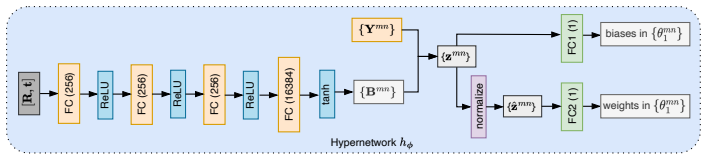
The load-bearing identity is the pseudo-normal decomposition $\theta = \mu + \Delta\theta$, which reparameterizes SDF network weights as a shared mean $\mu$ plus per-shape residual $\Delta\theta$, emulating a normal distribution with identity covariance. The mean is learned in two stages: first a pose-conditioned hypernetwork (HyperSE3-SDF) trains $\mu$ and small latent matrices on a few shapes per category; then each shape's SDF is fit by training only $\Delta\theta$ from zero. The hypernetwork generates the first-layer weights and biases from $(R, t)$ through normalized linear combinations of latent matrices, satisfying the geometric initialization that SDF training needs and letting the same $\mu$ serve all poses. The encoder consumes three tensors formed from the layer parameters, and pose estimation optimizes $R$ and $t$ directly against the SDF reconstruction loss while the reference parameters stay frozen.
What would settle it
Retrain the two-stage construction with $\mu$ learned only from some categories and test classification on a held-out category; if accuracy collapses toward chance, the shared mean does not generalize across categories as claimed. A direct numerical check is to fit a multivariate normal to the empirical distribution of $\Delta\theta$ per category and measure its deviation from $\mathcal{N}(0, I)$: large deviations or category-dependent means would show the pseudo-normal assumption is not actually established by the data.
Extended reading notes
Core claim
On the paper's own terms, the discovery is that a shape's identity and pose are recoverable from the weights of its individually overfit SDF network once those weights are put in a common coordinate frame. The authors construct this frame by learning a shared pose-dependent mean $\mu$ with a hypernetwork-augmented 8-layer SDF, then representing each shape by its residual $\Delta\theta = \theta - \mu$. Training an encoder on these residuals gives the highest accuracy among compared methods on Manifold40 under arbitrary rotations (87.02% OA versus 84.61% for a rotation-equivariant point-cloud baseline) and competitive results on ShapeNet. The same level-set parameters, kept frozen, let an optimizer recover a 6D pose from a partial point cloud by minimizing the SDF reconstruction loss, reporting errors below 1.4 degrees in rotation even with added noise and 30% outliers. The paper frames this as extending 3D analysis from discrete input data to a continuous parameter modality.
Load-bearing premise
The load-bearing premise is that a shared mean $\mu$ learned from a small number of shapes per category puts all shapes into a common parameter-space coordinate frame, so the residual parameters $\Delta\theta$, rather than the raw parameters $\theta$, carry the shape semantics; if that alignment fails, the classification and pose estimation built on $\Delta\theta$ would break.
Editorial extensions
If this is right
- If level-set parameters carry shape semantics, classification and retrieval can be performed without point clouds or meshes, avoiding discrete-resolution artifacts and exhaustive rotation augmentation.
- Because pose-dependent parameters are confined to the first SDF layer, a single shared mean supports arbitrary rotations, so training data can be augmented in parameter space rather than in 3D coordinate space.
- 6D pose estimation reduces to optimizing rotation and translation against the SDF reconstruction loss, requiring no correspondences, global shape features, or training data for registration.
- The same continuous representation should make shape analysis robust to input resolution and sampling density, since the surface is defined by a function's zero level set rather than by discrete samples.
- The per-shape fitting cost drops substantially with the learned mean (about 4 minutes per shape versus 1 hour without it), making the construction of large level-set-parameter datasets practical.
Reading between the lines
- Editorial inference: if $\theta = \mu + \Delta\theta$ truly aligns categories, the same alignment may power cross-category tasks such as few-shot classification or shape analogies, because residuals would live in a common parameter space.
- Editorial inference: the pose-conditioning approach could extend to other neural field types, such as occupancy fields or radiance fields, whose parameters have known transformation behavior, though the paper only demonstrates SDFs.
- Editorial inference: the paper's pose estimator assumes reference level-set parameters are already available; a testable extension is to jointly optimize a shape code and pose from a raw partial scan, removing that assumption.
- Editorial inference: the method's reliance on a shared mean learned from 7 to 20 shapes per category could be stress-tested by learning the mean on one set of categories and evaluating on held-out categories, which the paper does not report.
Signed reviews
Editorial analysis
A structured set of objections, weighed in public.
Referee Report
Summary. The paper proposes using the weights of an 8-layer SDF MLP (called 'level-set parameters') as a standalone 3D shape representation. It decomposes these weights as θ = μ + Δθ, learns a shared pose-dependent mean μ with a small number of shapes via a hypernetwork, and treats the residual Δθ as the instance-level representation. An encoder trained on the three tensors derived from Δθ is used for classification and retrieval, and an SDF-reconstruction-loss optimization is used for 6D pose estimation from partial point clouds. Experiments on ShapeNet and Manifold40 report competitive or superior accuracy versus point-cloud baselines, notably 87.02% OA versus 84.61% for VN-DGCNN on Manifold40 under SO(3)/SO(3), and low rotation/translation errors on a 300-pair pose-estimation benchmark.
Significance. If sustained, the central proposal is significant: it extends 3D shape analysis to neural-network weight space and enables pose-conditioned reasoning without point-cloud augmentation or equivariant architectures. The strongest evidence is the external-baseline comparison in Table 3, the random-versus-learned μ ablation in Table 1, and the correspondence-free pose-estimation result in Table 4. The hypernetwork design that explicitly satisfies SAL initialization constraints is a principled construction. However, the lack of direct validation of the pseudo-normal residual model and the very small set of shapes used to train the shared mean μ leave the generalizability of the main mechanism under-supported.
major comments (5)
- [Section 3.2, Eq. (6)] The paper labels θ = μ + Δθ a 'pseudo-normal distribution' with identity covariance, but this is not compatible with the parameterization actually used: each component of Δθ is defined through tanh or a normalized inner product, so it is bounded in [-1,1] and cannot be a standard normal variable. Please report empirical diagnostics, including marginal histograms of Δθ, diagonal versus off-diagonal covariance energy, and per-category and per-pose variance, to show that the identity-covariance assumption is a reasonable approximation. This is not a philosophical objection: the normalization of θ by μ and the interpretation of Δθ as the instance-specific semantic content both depend on this assumption.
- [Section 3.2 and Section 5.1] The shared mean μ is trained on 20 shapes per class on ShapeNet and 7 per class on Manifold40, which is a very small sample from which to infer a category-wide, pose-generic alignment of a high-dimensional parameter space. The current validation is indirect: t-SNE in Fig. 3, Table 1, and downstream classification accuracy. Please add (a) a repeated-subset sensitivity analysis of μ, (b) the variance and geometry of Δθ on held-out shapes, and (c) results obtained when the μ-training shapes are excluded from the encoder training set. Without such evidence, the possibility that the gains over random μ reflect memorization of the few training shapes rather than a generalizable parameter-space alignment is not excluded.
- [Section 5.2, Tables 2-3] The empirical evaluation compares LSPData only against point-cloud networks. Since the paper positions level-set parameters as an alternative to other continuous neural-field representations, the classification and retrieval claims should also be benchmarked against at least one neural-field weight-space or modulation-vector baseline, such as the modulation vectors of Functa [65], HyperDiffusion [16], or DeepSDF latent codes [7], under the same train/test protocol. This comparison is needed to substantiate the claim that the proposed residual Δθ is a particularly effective continuous representation for shape semantics.
- [Section 4.2, Table 4] The pose-estimation experiment is a proof of concept rather than a systematic evaluation: it uses 10 shapes per category, 300 pairs, and only three classical optimization-based baselines. The setting also assumes that ground-truth reference level-set parameters θ are provided, which is a strong practical assumption. Please report per-category results, characterize failure cases, evaluate sensitivity to the Chamfer-filter threshold and SDF fit quality, and include at least one learning-based registration comparison. The current table is suggestive but too narrow to support the general conclusion in Section 6.
- [Section 1 and Section 5] A motivating advantage claimed for level-set parameters is robustness to variations in input resolution, but no experiment varies the number of sampled surface points or the resolution of the input point cloud. Adding a resolution sweep, or explicitly qualifying this claim in the text, would align the experiments with the paper's stated motivation.
minor comments (7)
- [Section 5.2] The heading 'Retrival' should be 'Retrieval'.
- [References, [17]] The text repeatedly refers to 'Ramirez et al. [17]', but the reference list entry [17] is attributed to De Luigi, Cardace, and Spezialetti; please correct the citation and the in-text attribution.
- [Section 3.2] 'This facilities the acquisition' should read 'This facilitates the acquisition'.
- [Section 5.2] The exact train/validation/test split for classification and retrieval, the number of encoder training epochs, and the selected values of λ1-λ4 and λreg are not stated; these details are needed for reproducibility.
- [Figure 3] Please state the number of points shown per category in the t-SNE plot and whether the parameters are visualized at a fixed pose or averaged over poses.
- [Table 5] Table 5 has a formatting problem: the columns under 'Method' are not readable as printed; please restructure the table.
- [Section 3.1] The statement that Eq. (4) yields 'shape semantics incomparable' to HyperSE3-SDF is vague; please specify the quantitative criterion, such as classification accuracy or reconstruction quality, used for the comparison.
Circularity Check
No significant circularity: the level-set parameter representation is benchmarked against external baselines and the pose results are obtained by test-time optimization, not by reusing fitted constants.
full rationale
Walking the derivation chain: per-shape SDF parameters θ are obtained by unsupervised reconstruction; the decomposition θ = μ + Δθ defines Δθ as the residual after a shared, unsupervised alignment mean μ. The encoder is trained on Δθ and evaluated on classification/retrieval against external point-cloud baselines (PointNet, DGCNN, VN-DGCNN) under held-out pose conditions, so the reported accuracies are not forced by construction. The ablation in Table 1 (random μ: 41.77 vs learned μ: 97.0) is an empirical comparison, not a tautology; a memorized μ that failed to generalize would show up as poor held-out accuracy. The pose-estimation section optimizes the SDF reconstruction loss at test time with the reference θ frozen, and is evaluated on separately generated partial point clouds with noise and outliers against ICP, FGR, and TEASER++; the small RRE/RTE values are optimization outcomes, not fitted predictions. The SAL initialization constraint (Eq. 15 and the text 'satisfy the geometric initializations recommended by SAL') is an external, parameter-free initialization rule, not an assertion of the paper's central claims. The only author self-citations ([4], [38]) appear in related-work enumerations and are not load-bearing. The stated limitation that level-set parameters are unsuitable for local features is a scope restriction, not a circular step. In short, no equation or fitted quantity is reused as its own prediction.
Assumptions & free parameters
free parameters (8)
- Shared mean µ =
learned from 20 shapes/class (ShapeNet), 7/class (Manifold40)
- Loss weights λ1-λ4
- Regularization weight λreg
- Latent matrix dimensions I, J =
I=2, J=8
- Training epochs and batch size for stage one =
50000 epochs, batch 50
- Pose search grid T, S, N, M =
T=15, S=20, N=20, M=10
- Augmentation sigmas and dropout =
σ1=0.2, σ2=0.05, dropout 0.5, σc=0.1
- Chamfer distance filter threshold
assumptions (5)
- domain assumption An 8-layer MLP SDF network can represent each 3D shape accurately enough for classification and pose estimation.
- domain assumption A shared mean µ learned from a few shapes per category generalizes across all categories and poses.
- standard math Rotations and translations can be absorbed by modifying only the first layer of the SDF MLP.
- ad hoc to paper The decomposition θ = µ + ∆θ with identity covariance is a meaningful alignment of shapes.
- domain assumption Chamfer-distance filtering removes only low-quality reconstructions and does not bias the semantic or pose comparisons.
Cite this review
Pith. "Pith review of Level-Set Parameters: Novel Representation for 3D Shape Analysis." pith.science (2026). https://pith.science/paper/T4S2E4AA
@misc{pith2026241213502,
  author       = {Pith},
  title        = {Pith review of: Level-Set Parameters: Novel Representation for 3D Shape Analysis},
  year         = {2026},
  howpublished = {\url{https://pith.science/paper/T4S2E4AA}},
  note         = {Machine review of arXiv:2412.13502}
}
read the original abstract
3D shape analysis has been largely focused on traditional 3D representations of point clouds and meshes, but the discrete nature of these data makes the analysis susceptible to variations in input resolutions. Recent development of neural fields brings in level-set parameters from signed distance functions as a novel, continuous, and numerical representation of 3D shapes, where the shape surfaces are defined as zero-level-sets of those functions. This motivates us to extend shape analysis from the traditional 3D data to these novel parameter data. Since the level-set parameters are not Euclidean like point clouds, we establish correlations across different shapes by formulating them as a pseudo-normal distribution, and learn the distribution prior from the respective dataset. To further explore the level-set parameters with shape transformations, we propose to condition a subset of these parameters on rotations and translations, and generate them with a hypernetwork. This simplifies the pose-related shape analysis compared to using traditional data. We demonstrate the promise of the novel representations through applications in shape classification (arbitrary poses), retrieval, and 6D object pose estimation.
Figures


Figures from the paper (6 more)


Reference graph
Works this paper leans on
-
[65]
From data to functa: Your data point is a function and you can treat it like one
Emilien Dupont, Hyunjik Kim, SM Eslami, Danilo Rezende, and Dan Rosenbaum. From data to functa: Your data point is a function and you can treat it like one. arXiv preprint arXiv:2201.12204, 2022
arXiv 2022
-
[16]
Hyperdiffusion: Generating im- plicit neural fields with weight-space diffusion
Ziya Erkoç, Fangchang Ma, Qi Shan, Matthias Nießner, and Angela Dai. Hyperdiffusion: Generating im- plicit neural fields with weight-space diffusion. In Proceedings of the IEEE/CVF International Conference on Computer Vision, pages 14300–14310, 2023
work page 2023
-
[7]
Deepsdf: Learning continuous signed distance functions for shape representation
Jeong Joon Park, Peter Florence, Julian Straub, Richard Newcombe, and Steven Lovegrove. Deepsdf: Learning continuous signed distance functions for shape representation. In Proceedings of the IEEE/CVF conference on computer vision and pattern recognition, pages 165–174, 2019
2019
-
[1]
Pointnet: Deep learning on point sets for 3d classification and segmentation
Charles R Qi, Hao Su, Kaichun Mo, and Leonidas J Guibas. Pointnet: Deep learning on point sets for 3d classification and segmentation. In Proceedings of the IEEE conference on computer vision and pattern recognition, pages 652–660, 2017
2017
-
[2]
Dynamic graph cnn for learning on point clouds
Yue Wang, Yongbin Sun, Ziwei Liu, Sanjay E Sarma, Michael M Bronstein, and Justin M Solomon. Dynamic graph cnn for learning on point clouds. ACM Transactions on Graphics (tog), 38(5):1–12, 2019
2019
-
[3]
PointCNN: Convolution on x-transformed points
Yangyan Li, Rui Bu, Mingchao Sun, Wei Wu, Xinhan Di, and Baoquan Chen. PointCNN: Convolution on x-transformed points. In Advances in Neural Information Processing Systems, pages 820–830, 2018
work page 2018
-
[4]
Spherical kernel for efficient graph convolution on 3d point clouds
Huan Lei, Naveed Akhtar, and Ajmal Mian. Spherical kernel for efficient graph convolution on 3d point clouds. IEEE transactions on pattern analysis and machine intelligence, 43(10):3664–3680, 2020
work page 2020
-
[5]
MeshCNN: a network with an edge
Rana Hanocka, Amir Hertz, Noa Fish, Raja Giryes, Shachar Fleishman, and Daniel Cohen-Or. MeshCNN: a network with an edge. ACM Transactions on Graphics (ToG), 38(4):1–12, 2019
work page 2019
Show all 81 references
-
[6]
Subdivision-based mesh convolution networks
Shi-Min Hu, Zheng-Ning Liu, Meng-Hao Guo, Jun-Xiong Cai, Jiahui Huang, Tai-Jiang Mu, and Ralph R Martin. Subdivision-based mesh convolution networks. ACM Transactions on Graphics (TOG), 41(3): 1–16, 2022
2022
-
[8]
Implicit neural representations with periodic activation functions
Vincent Sitzmann, Julien Martel, Alexander Bergman, David Lindell, and Gordon Wetzstein. Implicit neural representations with periodic activation functions. Advances in neural information processing systems, 33:7462–7473, 2020
2020
-
[9]
Neural fields in visual computing and beyond
Yiheng Xie, Towaki Takikawa, Shunsuke Saito, Or Litany, Shiqin Yan, Numair Khan, Federico Tombari, James Tompkin, Vincent Sitzmann, and Srinath Sridhar. Neural fields in visual computing and beyond. In Computer Graphics Forum, volume 41, pages 641–676. Wiley Online Library, 2022
2022
-
[10]
Occupancy networks: Learning 3d reconstruction in function space
Lars Mescheder, Michael Oechsle, Michael Niemeyer, Sebastian Nowozin, and Andreas Geiger. Occupancy networks: Learning 3d reconstruction in function space. In Proceedings of the IEEE/CVF conference on computer vision and pattern recognition, pages 4460–4470, 2019
2019
-
[11]
Points2surf learning implicit surfaces from point clouds
Philipp Erler, Paul Guerrero, Stefan Ohrhallinger, Niloy J Mitra, and Michael Wimmer. Points2surf learning implicit surfaces from point clouds. In European Conference on Computer Vision, pages 108–124. Springer, 2020
2020
-
[12]
Learning implicit fields for generative shape modeling
Zhiqin Chen and Hao Zhang. Learning implicit fields for generative shape modeling. In Proceedings of the IEEE/CVF conference on computer vision and pattern recognition, pages 5939–5948, 2019
2019
-
[13]
Convolutional occupancy networks
Songyou Peng, Michael Niemeyer, Lars Mescheder, Marc Pollefeys, and Andreas Geiger. Convolutional occupancy networks. In Computer Vision–ECCV 2020: 16th European Conference, Glasgow, UK, August 23–28, 2020, Proceedings, Part III 16, pages 523–540. Springer, 2020
2020
-
[14]
Implicit functions in feature space for 3d shape reconstruction and completion
Julian Chibane, Thiemo Alldieck, and Gerard Pons-Moll. Implicit functions in feature space for 3d shape reconstruction and completion. In Proceedings of the IEEE/CVF conference on computer vision and pattern recognition, pages 6970–6981, 2020
2020
-
[15]
MetaSDF: Meta- learning signed distance functions
Vincent Sitzmann, Eric Chan, Richard Tucker, Noah Snavely, and Gordon Wetzstein. MetaSDF: Meta- learning signed distance functions. Advances in Neural Information Processing Systems, 33:10136–10147, 2020
2020
-
[17]
Deep learning on 3D neural fields
Luca De Luigi, Adriano Cardace, and Riccardo Spezialetti. Deep learning on 3D neural fields. 2023
2023
-
[18]
Vector neurons: A general framework for so (3)-equivariant networks
Congyue Deng, Or Litany, Yueqi Duan, Adrien Poulenard, Andrea Tagliasacchi, and Leonidas J Guibas. Vector neurons: A general framework for so (3)-equivariant networks. In Proceedings of the IEEE/CVF International Conference on Computer Vision, pages 12200–12209, 2021
2021
-
[19]
Learning so (3) equivariant representations with spherical cnns
Carlos Esteves, Christine Allen-Blanchette, Ameesh Makadia, and Kostas Daniilidis. Learning so (3) equivariant representations with spherical cnns. In Proceedings of the European Conference on Computer Vision (ECCV), pages 52–68, 2018. 10
2018
-
[20]
Spherical cnns
Taco S Cohen, Mario Geiger, Jonas Köhler, and Max Welling. Spherical cnns. arXiv preprint arXiv:1801.10130, 2018
2018 arXiv
-
[21]
Tensor field networks: Rotation-and translation-equivariant neural networks for 3D point clouds
Nathaniel Thomas, Tess Smidt, Steven Kearnes, Lusann Yang, Li Li, Kai Kohlhoff, and Patrick Riley. Tensor field networks: Rotation-and translation-equivariant neural networks for 3D point clouds. arXiv preprint arXiv:1802.08219, 2018
2018 arXiv
-
[22]
A functional approach to rotation equivariant non-linearities for tensor field networks
Adrien Poulenard and Leonidas J Guibas. A functional approach to rotation equivariant non-linearities for tensor field networks. In Proceedings of the IEEE/CVF Conference on Computer Vision and Pattern Recognition, pages 13174–13183, 2021
2021
-
[23]
Shapenet: An information-rich 3d model repository
Angel X Chang, Thomas Funkhouser, Leonidas Guibas, Pat Hanrahan, Qixing Huang, Zimo Li, Silvio Savarese, Manolis Savva, Shuran Song, Hao Su, et al. Shapenet: An information-rich 3d model repository. arXiv preprint arXiv:1512.03012, 2015
2015 arXiv
-
[24]
3d shapenets: A deep representation for volumetric shapes
Zhirong Wu, Shuran Song, Aditya Khosla, Fisher Yu, Linguang Zhang, Xiaoou Tang, and Jianxiong Xiao. 3d shapenets: A deep representation for volumetric shapes. In Proceedings of the IEEE conference on computer vision and pattern recognition, pages 1912–1920, 2015
1912
-
[25]
Learning-based point cloud registration for 6d object pose estimation in the real world
Zheng Dang, Lizhou Wang, Yu Guo, and Mathieu Salzmann. Learning-based point cloud registration for 6d object pose estimation in the real world. In European conference on computer vision, pages 19–37. Springer, 2022
2022
-
[26]
Escape from cells: Deep kd-networks for the recognition of 3d point cloud models
Roman Klokov and Victor Lempitsky. Escape from cells: Deep kd-networks for the recognition of 3d point cloud models. In Proceedings of the IEEE International Conference on Computer Vision, pages 863–872. IEEE, 2017
2017
-
[27]
PointNet++: Deep hierarchical feature learning on point sets in a metric space
Charles R Qi, Li Yi, Hao Su, and Leonidas J Guibas. PointNet++: Deep hierarchical feature learning on point sets in a metric space. Advances in Neural Information Processing Systems, 2017
2017
-
[28]
Graph attention convolution for point cloud semantic segmentation
Lei Wang, Yuchun Huang, Yaolin Hou, Shenman Zhang, and Jie Shan. Graph attention convolution for point cloud semantic segmentation. In Proceedings of the IEEE/CVF conference on computer vision and pattern recognition, pages 10296–10305, 2019
2019
-
[29]
Pointconv: Deep convolutional networks on 3d point clouds
Wenxuan Wu, Zhongang Qi, and Li Fuxin. Pointconv: Deep convolutional networks on 3d point clouds. In Proceedings of the IEEE Conference on Computer Vision and Pattern Recognition, pages 9621–9630, 2019
2019
-
[30]
Qi, Jean-Emmanuel Deschaud, Beatriz Marcotegui, François Goulette, and Leonidas J
Hugues Thomas, Charles R. Qi, Jean-Emmanuel Deschaud, Beatriz Marcotegui, François Goulette, and Leonidas J. Guibas. Kpconv: Flexible and deformable convolution for point clouds. Proceedings of the IEEE International Conference on Computer Vision, 2019
2019
-
[31]
Point transformer
Hengshuang Zhao, Li Jiang, Jiaya Jia, Philip HS Torr, and Vladlen Koltun. Point transformer. In Proceedings of the IEEE/CVF international conference on computer vision, pages 16259–16268, 2021
2021
-
[32]
PCT: Point cloud transformer
Meng-Hao Guo, Jun-Xiong Cai, Zheng-Ning Liu, Tai-Jiang Mu, Ralph R Martin, and Shi-Min Hu. PCT: Point cloud transformer. Computational Visual Media, 7:187–199, 2021
2021
-
[33]
Point transformer V2: Grouped vector attention and partition-based pooling
Xiaoyang Wu, Yixing Lao, Li Jiang, Xihui Liu, and Hengshuang Zhao. Point transformer V2: Grouped vector attention and partition-based pooling. Advances in Neural Information Processing Systems, 35: 33330–33342, 2022
2022
-
[34]
V oxnet: A 3d convolutional neural network for real-time object recognition
Daniel Maturana and Sebastian Scherer. V oxnet: A 3d convolutional neural network for real-time object recognition. In 2015 IEEE/RSJ international conference on intelligent robots and systems (IROS), pages 922–928. IEEE, 2015
2015
-
[35]
Octnet: Learning deep 3d representations at high resolutions
Gernot Riegler, Ali Osman Ulusoy, and Andreas Geiger. Octnet: Learning deep 3d representations at high resolutions. In Proceedings of the IEEE conference on computer vision and pattern recognition, pages 3577–3586, 2017
2017
-
[36]
3d semantic segmentation with submanifold sparse convolutional networks
Benjamin Graham, Martin Engelcke, and Laurens van der Maaten. 3d semantic segmentation with submanifold sparse convolutional networks. CVPR, 2018
2018
-
[37]
Hodgenet: Learning spectral geometry on triangle meshes
Dmitriy Smirnov and Justin Solomon. Hodgenet: Learning spectral geometry on triangle meshes. ACM Transactions on Graphics (TOG), 40(4):1–11, 2021
2021
-
[38]
Mesh convolution with continuous filters for 3-d surface parsing
Huan Lei, Naveed Akhtar, Mubarak Shah, and Ajmal Mian. Mesh convolution with continuous filters for 3-d surface parsing. IEEE Transactions on Neural Networks and Learning Systems, 2023. 11
2023
-
[39]
Deep object pose estimation for semantic robotic grasping of household objects.arXiv preprint arXiv:1809.10790, 2018
Jonathan Tremblay, Thang To, Balakumar Sundaralingam, Yu Xiang, Dieter Fox, and Stan Birchfield. Deep object pose estimation for semantic robotic grasping of household objects.arXiv preprint arXiv:1809.10790, 2018
2018 arXiv
-
[40]
Pose estimation for augmented reality: a hands-on survey
Eric Marchand, Hideaki Uchiyama, and Fabien Spindler. Pose estimation for augmented reality: a hands-on survey. IEEE transactions on visualization and computer graphics, 22(12):2633–2651, 2015
2015
-
[41]
Are we ready for autonomous driving? the kitti vision benchmark suite
Andreas Geiger, Philip Lenz, and Raquel Urtasun. Are we ready for autonomous driving? the kitti vision benchmark suite. In 2012 IEEE conference on computer vision and pattern recognition, pages 3354–3361. IEEE, 2012
2012
-
[42]
Densefusion: 6d object pose estimation by iterative dense fusion
Chen Wang, Danfei Xu, Yuke Zhu, Roberto Martín-Martín, Cewu Lu, Li Fei-Fei, and Silvio Savarese. Densefusion: 6d object pose estimation by iterative dense fusion. In Proceedings of the IEEE/CVF conference on computer vision and pattern recognition, pages 3343–3352, 2019
2019
-
[43]
Normal- ized object coordinate space for category-level 6d object pose and size estimation
He Wang, Srinath Sridhar, Jingwei Huang, Julien Valentin, Shuran Song, and Leonidas J Guibas. Normal- ized object coordinate space for category-level 6d object pose and size estimation. In Proceedings of the IEEE/CVF Conference on Computer Vision and Pattern Recognition, pages...
2019
-
[44]
PVnet: Pixel-wise voting network for 6dof pose estimation
Sida Peng, Yuan Liu, Qixing Huang, Xiaowei Zhou, and Hujun Bao. PVnet: Pixel-wise voting network for 6dof pose estimation. In Proceedings of the IEEE/CVF conference on computer vision and pattern recognition, pages 4561–4570, 2019
2019
-
[45]
Pix2pose: Pixel-wise coordinate regression of objects for 6d pose estimation
Kiru Park, Timothy Patten, and Markus Vincze. Pix2pose: Pixel-wise coordinate regression of objects for 6d pose estimation. In Proceedings of the IEEE/CVF International Conference on Computer Vision, pages 7668–7677, 2019
2019
-
[46]
Center-based decoupled point-cloud registration for 6d object pose estimation
Haobo Jiang, Zheng Dang, Shuo Gu, Jin Xie, Mathieu Salzmann, and Jian Yang. Center-based decoupled point-cloud registration for 6d object pose estimation. In Proceedings of the IEEE/CVF International Conference on Computer Vision, pages 3427–3437, 2023
2023
-
[47]
3dmatch: Learning local geometric descriptors from rgb-d reconstructions
Andy Zeng, Shuran Song, Matthias Nießner, Matthew Fisher, Jianxiong Xiao, and Thomas Funkhouser. 3dmatch: Learning local geometric descriptors from rgb-d reconstructions. In Proceedings of the IEEE conference on computer vision and pattern recognition, pages 1802–1811, 2017
2017
-
[48]
Fully convolutional geometric features
Christopher Choy, Jaesik Park, and Vladlen Koltun. Fully convolutional geometric features. InProceedings of the IEEE/CVF international conference on computer vision, pages 8958–8966, 2019
2019
-
[49]
Deep closest point: Learning representations for point cloud registration
Yue Wang and Justin M Solomon. Deep closest point: Learning representations for point cloud registration. In Proceedings of the IEEE/CVF international conference on computer vision, pages 3523–3532, 2019
2019
-
[50]
Predator: Registration of 3d point clouds with low overlap
Shengyu Huang, Zan Gojcic, Mikhail Usvyatsov, Andreas Wieser, and Konrad Schindler. Predator: Registration of 3d point clouds with low overlap. InProceedings of the IEEE/CVF Conference on computer vision and pattern recognition, pages 4267–4276, 2021
2021
-
[51]
Buffer: Balancing accuracy, efficiency, and generalizability in point cloud registration
Sheng Ao, Qingyong Hu, Hanyun Wang, Kai Xu, and Yulan Guo. Buffer: Balancing accuracy, efficiency, and generalizability in point cloud registration. In Proceedings of the IEEE/CVF Conference on Computer Vision and Pattern Recognition, pages 1255–1264, 2023
2023
-
[52]
Feature-metric registration: A fast semi-supervised approach for robust point cloud registration without correspondences
Xiaoshui Huang, Guofeng Mei, and Jian Zhang. Feature-metric registration: A fast semi-supervised approach for robust point cloud registration without correspondences. In Proceedings of the IEEE/CVF conference on computer vision and pattern recognition, pages 11366–11374, 2020
2020
-
[53]
Pointnetlk: Robust & efficient point cloud registration using pointnet
Yasuhiro Aoki, Hunter Goforth, Rangaprasad Arun Srivatsan, and Simon Lucey. Pointnetlk: Robust & efficient point cloud registration using pointnet. In Proceedings of the IEEE/CVF conference on computer vision and pattern recognition, pages 7163–7172, 2019
2019
-
[54]
Method for registration of 3-d shapes
Paul J Besl and Neil D McKay. Method for registration of 3-d shapes. In Sensor fusion IV: control paradigms and data structures, volume 1611, pages 586–606. Spie, 1992
1992
-
[55]
Fast global registration
Qian-Yi Zhou, Jaesik Park, and Vladlen Koltun. Fast global registration. In Computer Vision–ECCV 2016: 14th European Conference, Amsterdam, The Netherlands, October 11-14, 2016, Proceedings, Part II 14, pages 766–782. Springer, 2016
2016
-
[56]
Teaser: Fast and certifiable point cloud registration
Heng Yang, Jingnan Shi, and Luca Carlone. Teaser: Fast and certifiable point cloud registration. IEEE Transactions on Robotics, 37(2):314–333, 2020
2020
-
[57]
Go-icp: A globally optimal solution to 3d icp point-set registration
Jiaolong Yang, Hongdong Li, Dylan Campbell, and Yunde Jia. Go-icp: A globally optimal solution to 3d icp point-set registration. IEEE transactions on pattern analysis and machine intelligence , 38(11): 2241–2254, 2015. 12
2015
-
[58]
SAL: Sign agnostic learning of shapes from raw data
Matan Atzmon and Yaron Lipman. SAL: Sign agnostic learning of shapes from raw data. In Proceedings of the IEEE/CVF Conference on Computer Vision and Pattern Recognition, pages 2565–2574, 2020
2020
-
[59]
Implicit geometric regularization for learning shapes
Amos Gropp, Lior Yariv, Niv Haim, Matan Atzmon, and Yaron Lipman. Implicit geometric regularization for learning shapes. In International Conference on Machine Learning, pages 3789–3799. PMLR, 2020
2020
-
[60]
Nerf in the wild: Neural radiance fields for unconstrained photo collections
Ricardo Martin-Brualla, Noha Radwan, Mehdi SM Sajjadi, Jonathan T Barron, Alexey Dosovitskiy, and Daniel Duckworth. Nerf in the wild: Neural radiance fields for unconstrained photo collections. In Proceedings of the IEEE/CVF Conference on Computer Vision and Pattern Recognitio...
2021
-
[61]
Neus: Learning neural implicit surfaces by volume rendering for multi-view reconstruction
Peng Wang, Lingjie Liu, Yuan Liu, Christian Theobalt, Taku Komura, and Wenping Wang. Neus: Learning neural implicit surfaces by volume rendering for multi-view reconstruction. 34:27171–27183, 2021
2021
-
[62]
MonoSDF: Exploring monocular geometric cues for neural implicit surface reconstruction
Zehao Yu, Songyou Peng, Michael Niemeyer, Torsten Sattler, and Andreas Geiger. MonoSDF: Exploring monocular geometric cues for neural implicit surface reconstruction. Advances in neural information processing systems, 35:25018–25032, 2022
2022
-
[63]
V olume rendering of neural implicit surfaces
Lior Yariv, Jiatao Gu, Yoni Kasten, and Yaron Lipman. V olume rendering of neural implicit surfaces. Advances in Neural Information Processing Systems, 34:4805–4815, 2021
2021
-
[64]
Digs: Divergence guided shape implicit neural representation for unoriented point clouds
Yizhak Ben-Shabat, Chamin Hewa Koneputugodage, and Stephen Gould. Digs: Divergence guided shape implicit neural representation for unoriented point clouds. In Proceedings of the IEEE/CVF Conference on Computer Vision and Pattern Recognition, pages 19323–19332, 2022
2022
-
[66]
Modulated periodic activations for generalizable local functional representations
Ishit Mehta, Michaël Gharbi, Connelly Barnes, Eli Shechtman, Ravi Ramamoorthi, and Manmohan Chan- draker. Modulated periodic activations for generalizable local functional representations. In Proceedings of the IEEE/CVF International Conference on Computer Vision, pages 14214–...
2021
-
[67]
pi-gan: Periodic implicit generative adversarial networks for 3d-aware image synthesis
Eric R Chan, Marco Monteiro, Petr Kellnhofer, Jiajun Wu, and Gordon Wetzstein. pi-gan: Periodic implicit generative adversarial networks for 3d-aware image synthesis. In Proceedings of the IEEE/CVF conference on computer vision and pattern recognition, pages 5799–5809, 2021
2021
-
[68]
Model-agnostic meta-learning for fast adaptation of deep networks
Chelsea Finn, Pieter Abbeel, and Sergey Levine. Model-agnostic meta-learning for fast adaptation of deep networks. In International conference on machine learning, pages 1126–1135. PMLR, 2017
2017
-
[69]
Learned initializations for optimizing coordinate-based neural representations
Matthew Tancik, Ben Mildenhall, Terrance Wang, Divi Schmidt, Pratul P Srinivasan, Jonathan T Barron, and Ren Ng. Learned initializations for optimizing coordinate-based neural representations. In Proceedings of the IEEE/CVF Conference on Computer Vision and Pattern Recognition...
2021
-
[70]
An introduction to variational autoencoders
Diederik P Kingma, Max Welling, et al. An introduction to variational autoencoders. Foundations and Trends® in Machine Learning, 12(4):307–392, 2019
2019
-
[71]
Gensdf: Two-stage learning of generalizable signed distance functions
Gene Chou, Ilya Chugunov, and Felix Heide. Gensdf: Two-stage learning of generalizable signed distance functions. Advances in Neural Information Processing Systems, 35:24905–24919, 2022
2022
-
[72]
Batch normalization: Accelerating deep network training by reducing internal covariate shift
Sergey Ioffe and Christian Szegedy. Batch normalization: Accelerating deep network training by reducing internal covariate shift. In International conference on machine learning, pages 448–456. pmlr, 2015
2015
-
[73]
Srinivasan, Matthew Tancik, Jonathan T
Ben Mildenhall, Pratul P. Srinivasan, Matthew Tancik, Jonathan T. Barron, Ravi Ramamoorthi, and Ren Ng. NeRF: Representing scenes as neural radiance fields for view synthesis. In European conference on computer vision, pages 405–421, 2020
2020
-
[74]
Visualizing data using t-sne
Laurens Van der Maaten and Geoffrey Hinton. Visualizing data using t-sne. Journal of machine learning research, 9(11), 2008
2008
-
[75]
Direct visibility of point sets
Sagi Katz, Ayellet Tal, and Ronen Basri. Direct visibility of point sets. In ACM SIGGRAPH 2007 papers, pages 24–es. 2007
2007
-
[76]
Spatial functa: Scaling functa to imagenet classification and generation
Matthias Bauer, Emilien Dupont, Andy Brock, Dan Rosenbaum, Jonathan Richard Schwarz, and Hyun- jik Kim. Spatial functa: Scaling functa to imagenet classification and generation. arXiv preprint arXiv:2302.03130, 2023
2023 arXiv
-
[77]
Generative neural fields by mixtures of neural implicit functions
Tackgeun You, Mijeong Kim, Jungtaek Kim, and Bohyung Han. Generative neural fields by mixtures of neural implicit functions. Advances in Neural Information Processing Systems, 36, 2024. 13
2024
-
[78]
Machine learning: a probabilistic perspective
Kevin P Murphy. Machine learning: a probabilistic perspective. MIT press, 2012
2012
-
[79]
Deep neural networks as gaussian processes
Jaehoon Lee, Yasaman Bahri, Roman Novak, Samuel S Schoenholz, Jeffrey Pennington, and Jascha Sohl-Dickstein. Deep neural networks as gaussian processes. international conference on learning representations, 2017
2017
-
[80]
Adam: A method for stochastic optimization
Diederik P Kingma and Jimmy Ba. Adam: A method for stochastic optimization. arXiv preprint arXiv:1412.6980, 2014
2014 arXiv
-
[81]
Rotation and translation invariant representation learning with implicit neural representations
Sehyun Kwon, Joo Young Choi, and Ernest K Ryu. Rotation and translation invariant representation learning with implicit neural representations. In International Conference on Machine Learning, pages 18037–18056. PMLR, 2023. 14 A The SDF Network A.1 Tensors of Level-set Paramet...
2023
Reviewed August 11, 2026 · model on record in the stance chip above.
Discussion (0). Continue with ORCID to comment.