REVIEW 3 major objections 4 minor 1 cited by
Plug-and-Play Tri-Branch Invertible Block for Image Rescaling
T0 review · 3 major / 4 minor · reviewed 2026-08-11 · deepseek-v4-flash
Pith's one-line read The paper claims that separating the low-frequency branch into luminance and chrominance, and feeding an all-zero tensor for high frequencies at upscaling, improves invertible image rescaling by up to 1.3 dB over IRN and up to 0.6 dB over…
desk verdict A modest but real architectural improvement; the headline gain is mostly the all-zero trick, so the claims need trimming. read the letter →
The pith
A machine-rendered reading of the paper's core claim, the machinery that carries it, and where it could break.
The reading
What carries the argument
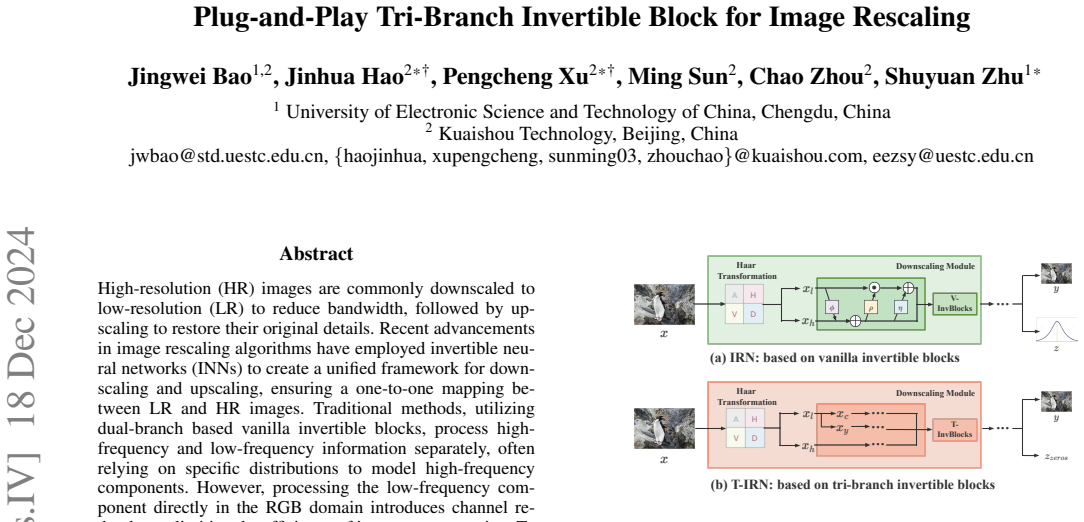
The T-InvBlock is the central object: a tri-branch invertible coupling block that operates on three variables, the luminance component $x_y$, the chrominance component $x_c$, and the high-frequency wavelet detail $x_h$, with coupling functions $\phi, \theta, \nu, \pi, \rho, \epsilon, \eta, \mu$ parameterized by densely connected convolutional blocks. Its forward map (Equation 2) updates $x_c$ then $x_y$ then $x_h$ using all previously updated branches, and its inverse (Equation 3) unwinds those updates, so the block is exactly invertible. The all-zero mapping strategy sets the latent $z$ to $0$ during upscaling, removing the distribution-matching loss and the GMM sampler; the paper argues this forces the LR image to be the sole carrier of information across the rescaling pipeline.
What would settle it
Train or evaluate T-IRN at ×4 scale and compare per-image PSNR against IRN on Urban100, where the paper's own table shows T-IRN trailing on average (31.19 vs 31.41 dB); if the deficit concentrates in images with dense repetitive textures, then the all-zero mapping is losing high-frequency information that a sampled latent preserves. A direct control experiment—sampling $z$ from the trained GMM or Gaussian during upscaling instead of using zeros and measuring the PSNR difference—would separate the benefit of the tri-branch block from the benefit of the zero strategy.
Extended reading notes
Core claim
The central claim is that the high-frequency latent variable in an invertible rescaling network does not need a learned or fixed probability model: setting $z = 0$ at upscaling time, together with a tri-branch block that treats luminance, chrominance, and high-frequency detail as separate interacting streams, produces better reconstruction than sampling from a Gaussian (IRN) or a learned Gaussian mixture (SAIN). The paper reports that the resulting T-IRN outperforms IRN by about 0.9–1.3 dB PSNR at ×2 scale across Set5, Set14, BSD100, Urban100, and DIV2K, and that T-SAIN beats SAIN by 0.2–0.6 dB under JPEG compression at quality factors 30–90. At ×4 scale the gains are smaller and not universal, with T-IRN trailing IRN on Urban100 PSNR, which the paper acknowledges as a partial exception. The discovery is framed as a plug-and-play architectural result: replacing the existing invertible block in IRN or SAIN with T-InvBlock and switching to the all-zero strategy yields the improvement without changing the overall network design.
Load-bearing premise
The load-bearing premise is that setting the high-frequency latent to zeros during upscaling discards no information needed for reconstruction, meaning the invertible block can push all essential high-frequency detail into the low-resolution image itself.
Editorial extensions
If this is right
- Any invertible rescaling model that currently samples high-frequency latents can replace its invertible blocks with T-InvBlocks and disable the sampler, obtaining reconstruction gains without increasing parameter count.
- Training becomes simpler: the distribution-matching loss used by IRN and the GMM-based latent model used by SAIN can be dropped entirely.
- In lossy-compression scenarios the YCbCr decomposition aligns the network's internal color space with JPEG's, so robustness to compression artifacts improves most at low quality factors.
- At ×4 scale, the benefit shrinks and is inconsistent across datasets, so the method's advantage is strongest for ×2 rescaling.
Reading between the lines
- The zero-latent result points toward a reinterpretation of invertible rescaling as deterministic learned compression: if the LR image can carry all needed detail, then the latent space is a code rather than a generative prior.
- Because the all-zero strategy makes upscaling deterministic and removes the GMM, inference should be faster and more reproducible; a timing comparison would test this directly.
- The ×4 gap on Urban100 suggests a testable boundary: images with dense, repetitive textures may be exactly where the LR image cannot absorb all high-frequency information, so comparing per-image PSNR against texture-density metrics would reveal the failure mode.
- The YCbCr benefit is likely to transfer to other compression codecs that operate in chroma-separated color spaces, such as HEVC or AVIF, but that transfer is not tested in the paper.
Editorial analysis
A structured set of objections, weighed in public.
Referee Report
Summary. This paper presents a plug-and-play tri-branch invertible block (T-InvBlock) for learned image rescaling. The block replaces the dual-branch additive/affine coupling in IRN by splitting the Haar low-frequency component into luminance (Y) and chrominance (Cb/Cr) channels and coupling them with the high-frequency branch through three invertible update equations (Eqs. 2-3). The authors also replace the latent high-frequency variable with an all-zero tensor during upscaling, which removes the distribution-matching loss. They insert T-InvBlock into IRN and SAIN, producing T-IRN and T-SAIN, and report PSNR/SSIM gains on Set5, Set14, BSD100, Urban100, and DIV2K for both x2 and x4 rescaling, as well as on DIV2K with JPEG compression at quality factors 30 to 90. The paper claims a 0.9 to 1.3 dB improvement over IRN at x2 and 0.4 to 0.6 dB over SAIN under lossy compression.
Significance. The manuscript is a competent empirical architecture paper in a well-studied area. The invertibility of Eqs. (2)-(3) is correctly constructed as a sequential coupling with an unambiguous inverse, and the parameter count is nearly unchanged. The JPEG-compression results in Table 2 are consistently positive across all tested quality factors and both scales, which is the strongest evidence for practical value. The ablation design in Table 3 is a useful first step, and the paper promises code via GitHub. The main weakness is attribution: the method varies the architecture and the training objective jointly, and the paper does not retrain the original IRN or SAIN with the all-zero objective, so the headline gain is not cleanly attributable to T-InvBlock alone. If the missing baseline is added, the paper would make a clean and useful contribution.
major comments (3)
- [Section 4.2, Table 3] The claimed 0.9 to 1.3 dB gain over IRN at x2 conflates two interventions. Table 3 shows that IRN with an all-zero latent at test time (IRN (all-zero)) already improves PSNR over the standard IRN by 0.58 dB on Set14, 0.63 dB on Urban100, and 0.86 dB on DIV2K, without retraining. Comparing T-IRN with this row leaves only 0.33, 0.50, and 0.28 dB of residual gain. Because IRN (all-zero) is not retrained with the distribution-loss-free objective used for T-IRN, even this residual is not an unbiased estimate of the block's contribution. Please retrain IRN with the same all-zero objective, training schedule, and loss weights, and report it as the primary baseline. The same issue affects T-SAIN: Table 4 does not state whether SAIN (all-zero) is retrained, even though T-SAIN changes both the block and the GMM.
- [Section 3.3] The all-zero strategy is motivated by an assertion about SAIN's official GMM weights, namely that the 'GMM actually learns a near-zero mean unimodal distribution.' No plot, variance value, or other quantitative evidence is provided for this load-bearing claim. If the claim is used to justify discarding the learned latent model, it should be substantiated. Similarly, the paper's appeal to IRN's ablation studies should cite the specific table or section in Xiao et al. (2023) rather than a general reference. Otherwise, the motivation should be stated as a hypothesis, not as an established fact.
- [Abstract and Section 4.2, Table 1] The unqualified 'state of the art' claim in the abstract is not supported by the paper's own x4 results. In Table 1, T-IRN underperforms IRN on Urban100 at x4 (PSNR 31.19 vs 31.41, SSIM 0.9132 vs 0.9157) and ties IRN on BSD100 PSNR (31.64). The text acknowledges this by saying 'some datasets do not fully surpass,' but the abstract and conclusion do not carry the necessary qualification. Please either qualify the claim to x2 and to most x4 datasets, or report an aggregate statistic over the full benchmark set that justifies the state-of-the-art phrasing.
minor comments (4)
- [Section 4.2] The reported RGB-PSNR improvement of 0.6 to 1.1 dB over IRN is not shown in any table or figure; please provide these numbers explicitly, either in the main text or in supplementary material.
- [Section 3.2, Figure 2] The notation x_c for chrominance is easy to confuse with the concatenation of the Cb and Cr channels; consider using a more explicit label such as x_chroma or x_cbcr throughout.
- [Section 4.1, Tables 1 and 2] Please state explicitly what the 'Param' column counts, since T-IRN uses 1.57M vs IRN's 1.67M at x2 but 4.67M vs 4.35M at x4; calling this 'similar' is acceptable but should be accompanied by the exact numbers and the model footprint definition.
- [Section 3.4, Eq. (4)] The loss weights lambda1 = 1 and lambda2 = 0.25 are hand-chosen. Please state whether identical weights and training schedules were used for the IRN and SAIN baselines, or whether those baselines were tuned separately.
Circularity Check
No significant circularity: the paper's claims are empirical, benchmark-based, and its architectural equations are exact inverses by construction.
full rationale
This is an empirical architecture paper with no derivation chain that reduces to its own inputs. The proposed T-InvBlock is defined by invertible coupling equations (Eqs. 2 and 3), which are exact algebraic inverses by construction; this is a definition, not a prediction derived from fitted parameters. The all-zero mapping strategy is a training/testing choice, and its motivation cites IRN's published ablation (Xiao et al. 2023) and SAIN's official weights, both of which are external artifacts rather than self-citations by the present authors. The central performance claims are evaluated on held-out benchmark datasets (Set5, Set14, BSD100, Urban100, DIV2K, and JPEG quality-factor sweeps) against published baselines under fixed, hand-chosen loss weights (lambda1=1, lambda2=0.25); those weights are not fitted to the evaluation data, so no fitted parameter is renamed as a prediction. The skeptical concern that the reported 0.9-1.3 dB improvement over IRN conflates the tri-branch block with the all-zero strategy is a legitimate experimental-attribution question, but it is not circularity: the paper's ablation in Table 3 explicitly separates IRN, IRN(YCbCr), IRN(all-zero), and full T-IRN, even if the all-zero IRN baseline was not retrained under identical conditions. No quantity is defined in terms of another quantity it is meant to predict, and no load-bearing premise is justified only by a self-citation. The verification is self-contained against external benchmarks, so the circularity score is 0.
Assumptions & free parameters
free parameters (2)
- λ1 (HR loss weight) =
1
- λ2 (LR loss weight) =
0.25
assumptions (4)
- domain assumption Densely connected convolutional blocks are sufficiently expressive to learn the transformation functions φ, θ, ν, π, ρ, ε, η, μ in the T-InvBlock.
- domain assumption Converting low-frequency image content from RGB to YCbCr and processing luminance and chrominance separately reduces inter-channel redundancy and improves reconstruction.
- domain assumption An all-zero tensor for the high-frequency latent during upscaling preserves the information needed for HR reconstruction.
- ad hoc to paper SAIN's official GMM weights produce a near-zero mean unimodal distribution for the latent.
Cite this review
Pith. "Pith review of Plug-and-Play Tri-Branch Invertible Block for Image Rescaling." pith.science (2026). https://pith.science/paper/BUBZVMUI
@misc{pith2026241213508,
  author       = {Pith},
  title        = {Pith review of: Plug-and-Play Tri-Branch Invertible Block for Image Rescaling},
  year         = {2026},
  howpublished = {\url{https://pith.science/paper/BUBZVMUI}},
  note         = {Machine review of arXiv:2412.13508}
}
read the original abstract
High-resolution (HR) images are commonly downscaled to low-resolution (LR) to reduce bandwidth, followed by upscaling to restore their original details. Recent advancements in image rescaling algorithms have employed invertible neural networks (INNs) to create a unified framework for downscaling and upscaling, ensuring a one-to-one mapping between LR and HR images. Traditional methods, utilizing dual-branch based vanilla invertible blocks, process high-frequency and low-frequency information separately, often relying on specific distributions to model high-frequency components. However, processing the low-frequency component directly in the RGB domain introduces channel redundancy, limiting the efficiency of image reconstruction. To address these challenges, we propose a plug-and-play tri-branch invertible block (T-InvBlocks) that decomposes the low-frequency branch into luminance (Y) and chrominance (CbCr) components, reducing redundancy and enhancing feature processing. Additionally, we adopt an all-zero mapping strategy for high-frequency components during upscaling, focusing essential rescaling information within the LR image. Our T-InvBlocks can be seamlessly integrated into existing rescaling models, improving performance in both general rescaling tasks and scenarios involving lossy compression. Extensive experiments confirm that our method advances the state of the art in HR image reconstruction.
Figures


Figures from the paper (2 more)


Forward citations
Cited by 1 Pith paper
-
Learning Arbitrary-Scale RAW Image Downscaling with Wavelet-based Recurrent Reconstruction
A wavelet-based recurrent network performs arbitrary-scale downscaling directly on RAW images, outperforming sRGB and interpolation baselines on new and existing benchmarks.
Reference graph
Works this paper leans on
-
[1]
Agustsson, E.; and Timofte, R. 2017. Ntire 2017 challenge on single image super-resolution: Dataset and study. In Proceedings of the IEEE conference on computer vision and pattern recognition workshops, 126--135
2017
-
[2]
Bevilacqua, M.; Roumy, A.; Guillemot, C.; and Alberi-Morel, M. L. 2012. Low-complexity single-image super-resolution based on nonnegative neighbor embedding. In Proceedings of the British Machine Vision Conference, 135.1--135.10
work page 2012
-
[3]
Chen, H.; Hao, J.; Zhao, K.; Yuan, K.; Sun, M.; Zhou, C.; and Hu, W. 2024. CasSR: Activating Image Power for Real-World Image Super-Resolution. arXiv preprint arXiv:2403.11451
work page Pith review arXiv 2024
-
[4]
Dai, T.; Cai, J.; Zhang, Y.; Xia, S.-T.; and Zhang, L. 2019. Second-order attention network for single image super-resolution. In Proceedings of the IEEE/CVF conference on computer vision and pattern recognition, 11065--11074
2019
-
[5]
Dinh, L.; Krueger, D.; and Bengio, Y. 2014. Nice: Non-linear independent components estimation. arXiv preprint arXiv:1410.8516
arXiv 2014
-
[6]
Dinh, L.; Sohl-Dickstein, J.; and Bengio, S. 2016. Density estimation using real nvp. arXiv preprint arXiv:1605.08803
arXiv 2016
-
[7]
Dong, C.; Loy, C. C.; He, K.; and Tang, X. 2015. Image super-resolution using deep convolutional networks. IEEE transactions on pattern analysis and machine intelligence, 38(2): 295--307
work page 2015
-
[8]
Guo, M.; Zhao, S.; Li, Y.; Li, J.; Zhang, L.; and Wang, Y. 2022. Invertible Single Image Rescaling via Steganography. In 2022 IEEE International Conference on Multimedia and Expo (ICME), 1--6. IEEE
work page 2022
Show all 45 references
-
[9]
Huang, J.-B.; Singh, A.; and Ahuja, N. 2015. Single image super-resolution from transformed self-exemplars. In Proceedings of the IEEE conference on computer vision and pattern recognition, 5197--5206
2015
-
[10]
Jain, A. K. 1989. Fundamentals of digital image processing. Prentice-Hall, Inc
1989
-
[11]
Kim, H.; Choi, M.; Lim, B.; and Lee, K. M. 2018. Task-aware image downscaling. In Proceedings of the European Conference on Computer Vision (ECCV), 399--414
2018
-
[12]
P.; and Ba, J
Kingma, D. P.; and Ba, J. 2014. Adam: A method for stochastic optimization. arXiv preprint arXiv:1412.6980
2014 arXiv
-
[13]
J.; and Brubaker, M
Kobyzev, I.; Prince, S. J.; and Brubaker, M. A. 2020. Normalizing flows: An introduction and review of current methods. IEEE transactions on pattern analysis and machine intelligence, 43(11): 3964--3979
2020
-
[14]
Li, Y.; Liu, D.; Li, H.; Li, L.; Li, Z.; and Wu, F. 2018. Learning a convolutional neural network for image compact-resolution. IEEE Transactions on Image Processing, 28(3): 1092--1107
2018
-
[15]
Liang, J.; Lugmayr, A.; Zhang, K.; Danelljan, M.; Van Gool, L.; and Timofte, R. 2021. Hierarchical conditional flow: A unified framework for image super-resolution and image rescaling. In Proceedings of the IEEE/CVF International Conference on Computer Vision, 4076--4085
2021
-
[16]
Lienhart, R.; and Maydt, J. 2002. An extended set of haar-like features for rapid object detection. In Proceedings. international conference on image processing, volume 1, I--I. IEEE
2002
-
[17]
Lim, B.; Son, S.; Kim, H.; Nah, S.; and Mu Lee, K. 2017. Enhanced deep residual networks for single image super-resolution. In Proceedings of the IEEE conference on computer vision and pattern recognition workshops, 136--144
2017
-
[18]
Liu, Y.; Qin, Z.; Anwar, S.; Ji, P.; Kim, D.; Caldwell, S.; and Gedeon, T. 2021. Invertible denoising network: A light solution for real noise removal. In Proceedings of the IEEE/CVF conference on computer vision and pattern recognition, 13365--13374
2021
-
[19]
Lu, Y.; Li, X.; Pei, Y.; Yuan, K.; Xie, Q.; Qu, Y.; Sun, M.; Zhou, C.; and Chen, Z. 2024. Kvq: Kwai video quality assessment for short-form videos. In Proceedings of the IEEE/CVF Conference on Computer Vision and Pattern Recognition, 25963--25973
2024
-
[20]
Martin, D.; Fowlkes, C.; Tal, D.; and Malik, J. 2001. A database of human segmented natural images and its application to evaluating segmentation algorithms and measuring ecological statistics. In Proceedings Eighth IEEE International Conference on Computer Vision. ICCV 2001, ...
2001
-
[21]
Mo, Q.; Ding, Y.; Hao, J.; Zhu, Q.; Sun, M.; Zhou, C.; Chen, F.; and Zhu, S. 2025. OAPT: Offset-Aware Partition Transformer for Double JPEG Artifacts Removal. In European Conference on Computer Vision, 38--56. Springer
2025
-
[22]
Pan, Z.; Li, B.; He, D.; Wu, W.; and Ding, E. 2023. Effective invertible arbitrary image rescaling. In Proceedings of the IEEE/CVF Winter Conference on Applications of Computer Vision, 5416--5425
2023
-
[23]
Pan, Z.; Li, B.; He, D.; Yao, M.; Wu, W.; Lin, T.; Li, X.; and Ding, E. 2022. Towards bidirectional arbitrary image rescaling: Joint optimization and cycle idempotence. In Proceedings of the IEEE/CVF Conference on Computer Vision and Pattern Recognition, 17389--17398
2022
-
[24]
Poynton, C. 2012. Digital video and HD: Algorithms and Interfaces. Elsevier
2012
-
[25]
Qin, R.; Sun, M.; Zhou, C.; and Wang, B. 2025. A New Dataset and Framework for Real-World Blurred Images Super-Resolution. In European Conference on Computer Vision, 56--75. Springer
2025
-
[26]
Qu, Y.; Yuan, K.; Zhao, K.; Xie, Q.; Hao, J.; Sun, M.; and Zhou, C. 2025. Xpsr: Cross-modal priors for diffusion-based image super-resolution. In European Conference on Computer Vision, 285--303. Springer
2025
-
[27]
Quan, Y.; Tan, X.; Huang, Y.; Xu, Y.; and Ji, H. 2024. Enhancing Underwater Images via Asymmetric Multi-Scale Invertible Networks. In Proceedings of the 32nd ACM International Conference on Multimedia, 6182--6191
2024
-
[28]
Rezende, D.; and Mohamed, S. 2015. Variational inference with normalizing flows. In International conference on machine learning, 1530--1538. PMLR
2015
-
[29]
Son, H.; Kim, T.; Lee, H.; and Lee, S. 2021. Enhanced standard compatible image compression framework based on auxiliary codec networks. IEEE Transactions on Image Processing, 31: 664--677
2021
-
[30]
Sun, W.; and Chen, Z. 2020. Learned image downscaling for upscaling using content adaptive resampler. IEEE Transactions on Image Processing, 29: 4027--4040
2020
-
[31]
Wallace, G. K. 1991. The JPEG still picture compression standard. Communications of the ACM, 34(4): 30--44
1991
-
[32]
Wang, X.; Yu, K.; Wu, S.; Gu, J.; Liu, Y.; Dong, C.; Qiao, Y.; and Change Loy, C. 2018. Esrgan: Enhanced super-resolution generative adversarial networks. In Proceedings of the European conference on computer vision (ECCV) workshops, 0--0
2018
-
[33]
C.; Sheikh, H
Wang, Z.; Bovik, A. C.; Sheikh, H. R.; and Simoncelli, E. P. 2004. Image quality assessment: from error visibility to structural similarity. IEEE transactions on image processing, 13(4): 600--612
2004
-
[34]
Xiao, M.; Zheng, S.; Liu, C.; Lin, Z.; and Liu, T.-Y. 2023. Invertible rescaling network and its extensions. International Journal of Computer Vision, 131(1): 134--159
2023
-
[35]
Xiao, M.; Zheng, S.; Liu, C.; Wang, Y.; He, D.; Ke, G.; Bian, J.; Lin, Z.; and Liu, T.-Y. 2020. Invertible image rescaling. In European Conference on Computer Vision, 126--144. Springer
2020
-
[36]
Xie, Q.; Yuan, K.; Qu, Y.; Wu, M.; Sun, M.; Zhou, C.; and Zhu, J. 2024. QPT-V2: Masked Image Modeling Advances Visual Scoring. In Proceedings of the 32nd ACM International Conference on Multimedia, 2709--2718
2024
-
[37]
Xing, J.; Hu, W.; Xia, M.; and Wong, T.-T. 2023. Scale-arbitrary invertible image downscaling. IEEE Transactions on Image Processing
2023
-
[38]
Yang, J.; Guo, M.; Zhao, S.; Li, J.; and Zhang, L. 2023. Self-asymmetric invertible network for compression-aware image rescaling. In Proceedings of the AAAI Conference on Artificial Intelligence, volume 37, 3155--3163
2023
-
[39]
Yuan, K.; Liu, H.; Li, M.; Sun, M.; Sun, M.; Gong, J.; Hao, J.; Zhou, C.; and Tang, Y. 2024. PTM-VQA: Efficient Video Quality Assessment Leveraging Diverse PreTrained Models from the Wild. In Proceedings of the IEEE/CVF Conference on Computer Vision and Pattern Recognition, 2835--2845
2024
-
[40]
Zeyde, R.; Elad, M.; and Protter, M. 2010. On single image scale-up using sparse-representations. In International conference on curves and surfaces, 711--730. Springer
2010
-
[41]
Zhang, Y.; Li, K.; Li, K.; Wang, L.; Zhong, B.; and Fu, Y. 2018 a . Image super-resolution using very deep residual channel attention networks. In Proceedings of the European conference on computer vision (ECCV), 286--301
2018
-
[42]
Zhang, Y.; Tian, Y.; Kong, Y.; Zhong, B.; and Fu, Y. 2018 b . Residual dense network for image super-resolution. In Proceedings of the IEEE conference on computer vision and pattern recognition, 2472--2481
2018
-
[43]
Zhu, Q.; Hao, J.; Ding, Y.; Liu, Y.; Mo, Q.; Sun, M.; Zhou, C.; and Zhu, S. 2024. CPGA: Coding Priors-Guided Aggregation Network for Compressed Video Quality Enhancement. In Proceedings of the IEEE/CVF Conference on Computer Vision and Pattern Recognition, 2964--2974
2024
-
[44]
, " * write output.state after.block = add.period write newline
ENTRY address archivePrefix author booktitle chapter edition editor eid eprint howpublished institution isbn journal key month note number organization pages publisher school series title type volume year label extra.label sort.label short.list INTEGERS output.state before.all...
-
[45]
write newline
" write newline "" before.all 'output.state := FUNCTION n.dashify 't := "" t empty not t #1 #1 substring "-" = t #1 #2 substring "--" = not "--" * t #2 global.max substring 't := t #1 #1 substring "-" = "-" * t #2 global.max substring 't := while if t #1 #1 substring * t #2 gl...
Reviewed August 11, 2026 · model on record in the stance chip above.
Discussion (0). Continue with ORCID to comment.