REVIEW 4 major objections 4 minor 54 references
Learning Causal Transition Matrix for Instance-dependent Label Noise
T0 review · 4 major / 4 minor · reviewed 2026-08-11 · deepseek-v4-flash
Pith's one-line read Instance-dependent label noise becomes identifiable when each input is split into a noise-resistant component and a noise-sensitive component and the latter is recovered.
desk verdict New causal graph and training framework for instance-dependent label noise, but the central identifiability proof is invalid because conditioning on the collider X2 opens a backdoor path. read the letter →
The pith
A machine-rendered reading of the paper's core claim, the machinery that carries it, and where it could break.
The reading
What carries the argument
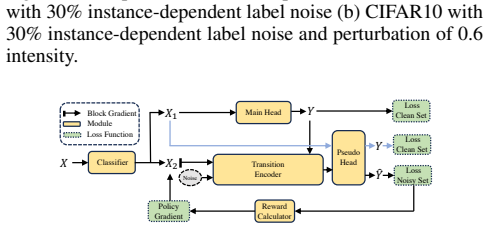
The central object is the causal transition matrix $T_{cau}=P(\hat{Y}\mid do(Y),X)$: the distribution of the noisy label after an intervention forces the clean label, conditioning on the instance. The paper's graph gives it a two-part structure; $do(Y)$ removes the incoming edges of $Y$, so $X_1$, the noise-resistant parent of $Y$, drops out of the transition, while conditioning on $X_2$, the noise-sensitive component, converts the intervention distribution into the observational one $P(\hat{Y}\mid Y,X_2)$. The proof machinery is d-separation in the manipulated graphs $G_{\bar{Y}}$ and $G_Y$, using the backdoor criterion. The training machinery is a separation model that extracts $X_1$, a policy model $\pi$ that outputs $X_2$, a transition model $f_{tran}$ with Gumbel-Softmax merging, co-teaching to make $Y$ partially observable, and a policy-gradient reward that pushes $X_2$ to reduce prediction error on noisy labels.
What would settle it
Build a synthetic dataset with known clean component $X_1$ and known noise component $X_2$, generate $Y$ from $X_1$ and $\hat{Y}$ from $(Y,X_2)$ with a known transition, then train the framework without revealing $X_2$. If the estimated $P(\hat{Y}\mid do(Y),X)$ deviates systematically from the known $P(\hat{Y}\mid Y,X_2)$, or if the learned $X_2$ fails the conditional independence $\hat{Y}\perp X_1\mid Y,X_2$ on held-out data, the central identifiability claim would be falsified.
Extended reading notes
Core claim
On the paper's own terms, the discovery is that the transition matrix does not have to be assumed instance-independent if the data generation is modeled causally. In the proposed graph, an unobservable variable $Z$ affects one or both of the input $X$ and the noisy label $\hat{Y}$; $X$ is therefore separated into $X_1$, which is independent of $Z$ and determines $Y$, and $X_2$, which interacts with $Z$ and $Y$ to produce $\hat{Y}$. Theorem 1 states that $P(\hat{Y}\mid do(Y),X)=P(\hat{Y}\mid do(Y),X_2)=P(\hat{Y}\mid Y,X_2)$, so the instance-dependent causal transition matrix is identifiable whenever the noise predictive factor $X_2$ is recovered. Theorem 2 states that $P(Y\mid do(X_1))=P(Y\mid X_1)$, so a classifier built on $X_1$ alone is unbiased. These two results together say that learning with instance-dependent label noise can be reduced to recovering the two components of $X$, and the paper proposes an end-to-end framework that does this by treating $X_2$ as the action of a policy optimized by reward.
Load-bearing premise
The load-bearing premise is that each observed instance really splits into a noise-resistant part and a noise-sensitive part with the exact independencies drawn in the paper's causal graph, and that the noise-sensitive part can actually be recovered from the noisy data; if either condition fails, the causal transition matrix is not identifiable.
Editorial extensions
If this is right
- Instance-dependent label noise can be handled without the instance-independent assumption $P(\hat{Y}\mid Y,X)=P(\hat{Y}\mid Y)$, as long as the noise-sensitive component of the input can be learned.
- A clean classifier can be trained from the noise-resistant component alone, because $P(Y\mid do(X_1))=P(Y\mid X_1)$ removes the confounding effect of the latent noise variable.
- The causal graph unifies three previously separate noise scenarios, since $Z$ may affect the instance, the annotation, or both, and all three are captured by the same transition model.
- The same component-splitting idea transfers to semi-supervised denoising pipelines, where the paper's adaptation improves or matches a strong baseline on the CIFAR-N datasets.
Reading between the lines
- The identifiability guarantee is a reduction: it says the causal transition matrix is identified once $X_2$ is recovered, but the paper gives no separate proof that the fitted policy network recovers the true $X_2$; we would read Theorem 1 as conditional on that recovery.
- The authors' own ablation without the policy model remains competitive in most settings, which suggests to us that much of the accuracy gain may come from learning a noise-resistant $X_1$ rather than from the estimated causal transition matrix; an experiment with known $X_2$ would separate the two effects.
- If the reduction view is right, instance-dependent label-noise learning becomes a missing-component problem, and the same causal split could be tried for other weakly supervised settings such as partial labels, crowd-sourced annotations, or noisy medical labels, though the paper does not test those.
- A skeptical check would be to verify the key conditional independence $\hat{Y}\perp X_1\mid Y,X_2$ on the learned components; in the paper's own graph this independence is what makes Theorem 1 go through.
Editorial analysis
A structured set of objections, weighed in public.
Referee Report
Summary. The paper proposes a causal-graph view of instance-dependent label noise in which the observed instance X is decomposed into a noise-resistant component X1 and a noise-sensitive component X2, with an unobserved latent Z affecting X2 and the noisy label Y-hat. On this basis it defines a 'causal transition matrix' P(Y-hat | do(Y), X), claims in Theorem 1 that this object is identifiable once X2 is recovered, and designs an end-to-end training framework combining co-teaching, a transition model, a decorrelation regularizer, and a policy-gradient objective for X2. Experiments on FashionMNIST, SVHN, CIFAR-10/100, Food101, and Clothing1M report competitive accuracy. The main theoretical claim, however, is not supported: the d-separation steps in the proof of Theorem 1 fail under the paper's own graph, and the recovery of X2 is not established as an identification result.
Significance. If the identifiability claim were valid, the paper would offer a meaningful relaxation of the instance-independent transition-matrix assumption, and the proposed framework is a plausible engineering contribution: it is end-to-end trainable, avoids generative models, and the experiments are extensive, including real-world noise and an ablation. The paper also deserves credit for explicitly modeling three noise-generation scenarios in one graph and for discussing limitations. Unfortunately, the central theoretical guarantee is unsound: the proof of Theorem 1 misapplies d-separation, and the 'identifiability' is conditional on a learned representation whose recovery is not guaranteed. The empirical results, while often strong, do not compensate for the absence of a valid identifiability theorem, so the paper's headline contribution is not established.
major comments (4)
- [Causal Viewpoint for Denoising, Theorem 1 proof] The proof asserts two conditional independences that are false in the graph of Figure 2(a). First, it claims Ŷ ⊥ X1 | Y, X2 in G_Ȳ. But the path X1 ← X → X2 ← Z → Ŷ contains the collider X2, and conditioning on X2 opens this path, so X1 and Ŷ are d-connected given (Y, X2); conditioning on Y does not block the path. Second, it claims Ŷ ⊥ Y | X2 in G_Y, and the same collider path Y ← X1 ← X → X2 ← Z → Ŷ connects Y to Ŷ once X2 is conditioned on. Therefore the equalities P(Ŷ|do(Y),X) = P(Ŷ|do(Y),X2) and P(Ŷ|do(Y),X2) = P(Ŷ|Y,X2) are not justified by the graph, and Theorem 1 is unproven.
- [Theorem 1 statement and Section 'Training Framework for Denoising'] The theorem is conditional on 'recovering' the noise predictive factor X2, but no identifiability result for X2 from the observed distribution (X, Ŷ) is provided. In the framework, X2 is the output of a policy network g2 trained by the policy-gradient loss of Eq. (7), whose reward is computed from the same cross-entropy LCE used by the transition model. Any representation that minimizes that cross-entropy could serve as X2, and the paper gives no argument that the optimized g2(X) coincides with the true noise-sensitive component of the proposed causal graph. The claimed identification is therefore a property of the fitted network, not of the data-generating process.
- [Eq. (3), 'Training Framework for Denoising'] The decorrelation loss is written as Reg(X1) = −Σ_i \tilde{y}_{x1} log softmax(1_k). Since 1_k is the all-one vector, softmax(1_k) is the uniform distribution and log softmax(1_k) is a constant vector that does not depend on the model parameters. As written, the loss does not push the transition model's output toward a uniform distribution over class labels; it merely penalizes the sum of the output logits (or is constant if \tilde{y}_{x1} is already normalized). If the intended objective is a cross-entropy between the model's prediction and the uniform distribution, the first argument should be softmax(\tilde{y}_{x1}), not the raw output. As published, Eq. (3) does not implement the decorrelation between X1 and Ŷ that the causal-graph assumptions require.
- [Causal Viewpoint for Denoising, definition of T_cau] The paper motivates T_cau = P(Ŷ|do(Y),X) as an approximation of the true transition matrix P(Ŷ|Y,X), but no statement or proof connects the interventional distribution to the observational transition matrix used in loss correction. Intervening on Y removes incoming edges of Y, whereas the transition matrix is a conditional distribution given Y and X; equality or a bounded approximation error between T_cau and T(X) is never shown. Even if Theorem 1 were correct, it would identify a do-probability, and the paper would still need an argument that training with T_cau yields consistent clean-label inference.
minor comments (4)
- [Table 2] The table header reads 'Results on SVNH'; the dataset name should be 'SVHN'.
- [Conclusion] The sentence 'we approa the problem from a causal viewpoint' is missing 'ch' in 'approach'.
- [Analysis of the Framework] The paragraph beginning 'What our framework does?' refers to 'Theories 1 and 2'; the standard terminology is 'Theorems 1 and 2'.
- [Table 1] The ablation 'Ours w.o/ pg' outperforms the full method on SYM-80 (75.8 vs 71.5) and IDN-20 (91.3 vs 91.0); the text's claim that the ablation achieves the best performance in the symmetric and asymmetric scenarios is not consistent with all entries in the table and should be qualified.
Circularity Check
Theorem 1's identifiability guarantee is conditional on the policy-gradient 'recovery' of X2, which is the same noisy-label fit used to train the transition model, so the causal transition matrix prediction reduces to the training objective.
-
fitted input called prediction
[Method: Causal Viewpoint for Denoising (Theorem 1); Training Framework, Policy model (Eqs. 6-7)]
"Theorem 1 The instance-dependent causal transition matrix P(Ŷ|do(Y), X) is identifiable if we recover the noise predictive factor X2. ... The transition model can be optimized using the following equation: LCE = −Σ ỹ log ŷ. (6) ... we use the policy gradient ... to obtain the noise-sensitive component X2. ... R = 1/(1−ỹ log ŷ). This reward function ensures that the reward is always greater than zero and increases as the cross-entropy decreases. ... The policy model is trained using the following loss function: Lpg = −Σ R log π(xi). (7)"
The identifiability guarantee is stated conditionally on 'recover[ing] the noise predictive factor X2.' In the framework, X2 is not obtained by an independent identification procedure; it is trained by Eq. (7), whose reward R = 1/(1−ỹ log ŷ) increases exactly as the transition model's cross-entropy to the observed noisy labels decreases. That same transition model is fit to the same noisy labels by Eq. (6), and its output is what the paper presents as the causal transition matrix P(Ŷ|do(Y),X). Thus the theorem's antecedent ('recover X2') is satisfied precisely by fitting the transition model to Ŷ, and the consequent (the causal transition matrix) is the same fitted model.
full rationale
The central circularity is in the conditional identifiability claim: Theorem 1 promises identification of the causal transition matrix if X2 is recovered, but X2 is operationalized as the representation that minimizes the same cross-entropy to the noisy labels used to fit the transition model. The guarantee is therefore conditional on the very fit it is supposed to justify, which matches the fitted-input-called-prediction pattern. Separately, the proof of Theorem 1 relies on two d-separation assertions (Ŷ ⊥⊥ X1 | Y, X2 in G_Ȳ and Ŷ ⊥⊥ Y | X2 in G_Y); in the proposed graph X2 is a collider on the path X1 ← X → X2 ← Z → Ŷ, so conditioning on X2 opens a path and the asserted independences are not supported by the graph. That is a correctness risk rather than a circularity, but it reinforces that the theorem does not provide an independent identifiability argument. The empirical benchmark results are external and could support the method's practical value, but they do not repair the circular conditional guarantee. No load-bearing self-citation chain is present; the score reflects the reduction of the theoretical claim to the training objective, not any citation practice.
Assumptions & free parameters
free parameters (4)
- α1 =
0.1
- α2 =
0.1 (0.01 for perturbed datasets)
- α3 =
0.1 (synthetic and Food101), 0.01 (CIFAR-100N in semi-supervised)
- β =
0.2
assumptions (4)
- ad hoc to paper A latent variable Z exists and influences X2 and Ŷ as in Figure 2(a).
- ad hoc to paper X can be separated into a noise-resistant component X1 and a noise-sensitive component X2 satisfying the conditional independences used in Theorems 1 and 2 (e.g., Ŷ ⊥ X1 | Y, X2, Y ⊥ X2 | X1).
- domain assumption Confidently sampled noisy labels are treated as clean labels Y (partial observability of Y via co-teaching).
- standard math The backdoor criterion and do-calculus are validly applied to the proposed graph to derive P(Y|do(X1)) and P(Ŷ|do(Y),X).
invented entities (3)
-
X1 (noise-resistant component)
-
X2 (noise-sensitive component)
-
Z (latent confounder)
Cite this review
Pith. "Pith review of Learning Causal Transition Matrix for Instance-dependent Label Noise." pith.science (2026). https://pith.science/paper/JHGTMQ5P
@misc{pith2026241213516,
  author       = {Pith},
  title        = {Pith review of: Learning Causal Transition Matrix for Instance-dependent Label Noise},
  year         = {2026},
  howpublished = {\url{https://pith.science/paper/JHGTMQ5P}},
  note         = {Machine review of arXiv:2412.13516}
}
read the original abstract
Noisy labels are both inevitable and problematic in machine learning methods, as they negatively impact models' generalization ability by causing overfitting. In the context of learning with noise, the transition matrix plays a crucial role in the design of statistically consistent algorithms. However, the transition matrix is often considered unidentifiable. One strand of methods typically addresses this problem by assuming that the transition matrix is instance-independent; that is, the probability of mislabeling a particular instance is not influenced by its characteristics or attributes. This assumption is clearly invalid in complex real-world scenarios. To better understand the transition relationship and relax this assumption, we propose to study the data generation process of noisy labels from a causal perspective. We discover that an unobservable latent variable can affect either the instance itself, the label annotation procedure, or both, which complicates the identification of the transition matrix. To address various scenarios, we have unified these observations within a new causal graph. In this graph, the input instance is divided into a noise-resistant component and a noise-sensitive component based on whether they are affected by the latent variable. These two components contribute to identifying the ``causal transition matrix'', which approximates the true transition matrix with theoretical guarantee. In line with this, we have designed a novel training framework that explicitly models this causal relationship and, as a result, achieves a more accurate model for inferring the clean label.
Figures


Figures from the paper (5 more)



Reference graph
Works this paper leans on
-
[1]
, " * write output.state after.block = add.period write newline
ENTRY address archivePrefix author booktitle chapter edition editor eid eprint howpublished institution isbn journal key month note number organization pages publisher school series title type volume year label extra.label sort.label short.list INTEGERS output.state before.all mid.sentence after.sentence after.block FUNCTION init.state.consts #0 'before.a...
-
[2]
write newline
" write newline "" before.all 'output.state := FUNCTION n.dashify 't := "" t empty not t #1 #1 substring "-" = t #1 #2 substring "--" = not "--" * t #2 global.max substring 't := t #1 #1 substring "-" = "-" * t #2 global.max substring 't := while if t #1 #1 substring * t #2 global.max substring 't := if while FUNCTION word.in bbl.in capitalize " " * FUNCT...
-
[3]
Bae, H.; Shin, S.; Na, B.; Jang, J.; Song, K.; and Moon, I.-C. 2022. From noisy prediction to true label: Noisy prediction calibration via generative model. In International Conference on Machine Learning, 1277--1297. PMLR
work page 2022
-
[4]
Berthon, A.; Han, B.; Niu, G.; Liu, T.; and Sugiyama, M. 2021. Confidence scores make instance-dependent label-noise learning possible. In International conference on machine learning, 825--836. PMLR
work page 2021
-
[5]
Bossard, L.; Guillaumin, M.; and Van Gool, L. 2014. Food-101--mining discriminative components with random forests. In Computer Vision--ECCV 2014: 13th European Conference, Zurich, Switzerland, September 6-12, 2014, Proceedings, Part VI 13, 446--461. Springer
work page 2014
-
[6]
Charoenphakdee, N.; Cui, Z.; Zhang, Y.; and Sugiyama, M. 2021. Classification with rejection based on cost-sensitive classification. In International Conference on Machine Learning, 1507--1517. PMLR
work page 2021
-
[7]
Cheng, J.; Liu, T.; Ramamohanarao, K.; and Tao, D. 2020. Learning with bounded instance and label-dependent label noise. In International conference on machine learning, 1789--1799. PMLR
work page 2020
-
[8]
Daniely, A.; and Granot, E. 2019. Generalization bounds for neural networks via approximate description length. Advances in Neural Information Processing Systems, 32
work page 2019
Show all 54 references
-
[9]
El-Yaniv, R.; et al. 2010. On the Foundations of Noise-free Selective Classification. Journal of Machine Learning Research, 11(5)
2010
-
[10]
Han, B.; Niu, G.; Yu, X.; Yao, Q.; Xu, M.; Tsang, I.; and Sugiyama, M. 2020. Sigua: Forgetting may make learning with noisy labels more robust. In International Conference on Machine Learning, 4006--4016. PMLR
2020
-
[11]
Han, B.; Yao, Q.; Yu, X.; Niu, G.; Xu, M.; Hu, W.; Tsang, I.; and Sugiyama, M. 2018. Co-teaching: Robust training of deep neural networks with extremely noisy labels. Advances in neural information processing systems, 31
2018
-
[12]
He, K.; Zhang, X.; Ren, S.; and Sun, J. 2016. Deep residual learning for image recognition. In Proceedings of the IEEE conference on computer vision and pattern recognition, 770--778
2016
-
[13]
Jiang, L.; Zhou, Z.; Leung, T.; Li, L.-J.; and Fei-Fei, L. 2018. Mentornet: Learning data-driven curriculum for very deep neural networks on corrupted labels. In International conference on machine learning, 2304--2313. PMLR
2018
-
[14]
P.; and Ba, J
Kingma, D. P.; and Ba, J. 2014. Adam: A method for stochastic optimization. arXiv preprint arXiv:1412.6980
2014 arXiv
-
[15]
P.; and Welling, M
Kingma, D. P.; and Welling, M. 2013. Auto-encoding variational bayes. arXiv preprint arXiv:1312.6114
2013 arXiv
-
[16]
Krizhevsky, A.; Hinton, G.; et al. 2009. Learning multiple layers of features from tiny images
2009
-
[17]
Li, J.; Socher, R.; and Hoi, S. C. 2020. Dividemix: Learning with noisy labels as semi-supervised learning. arXiv preprint arXiv:2002.07394
2020 arXiv
-
[18]
Li, J.; Wong, Y.; Zhao, Q.; and Kankanhalli, M. S. 2019. Learning to learn from noisy labeled data. In Proceedings of the IEEE/CVF conference on computer vision and pattern recognition, 5051--5059
2019
-
[19]
Li, S.; Xia, X.; Ge, S.; and Liu, T. 2022. Selective-supervised contrastive learning with noisy labels. In Proceedings of the IEEE/CVF Conference on Computer Vision and Pattern Recognition, 316--325
2022
-
[20]
Liu, T.; and Tao, D. 2015. Classification with noisy labels by importance reweighting. IEEE Transactions on pattern analysis and machine intelligence, 38(3): 447--461
2015
-
[21]
Lukasik, M.; Bhojanapalli, S.; Menon, A.; and Kumar, S. 2020. Does label smoothing mitigate label noise? In International Conference on Machine Learning, 6448--6458. PMLR
2020
-
[22]
Ma, X.; Huang, H.; Wang, Y.; Romano, S.; Erfani, S.; and Bailey, J. 2020. Normalized loss functions for deep learning with noisy labels. In International conference on machine learning, 6543--6553. PMLR
2020
-
[23]
Mirzasoleiman, B.; Cao, K.; and Leskovec, J. 2020. Coresets for robust training of deep neural networks against noisy labels. Advances in Neural Information Processing Systems, 33: 11465--11477
2020
-
[24]
Mozannar, H.; and Sontag, D. 2020. Consistent estimators for learning to defer to an expert. In International Conference on Machine Learning, 7076--7087. PMLR
2020
-
[25]
S.; Ravikumar, P
Natarajan, N.; Dhillon, I. S.; Ravikumar, P. K.; and Tewari, A. 2013. Learning with noisy labels. Advances in neural information processing systems, 26
2013
-
[26]
T.; Mummadi, C
Nguyen, D. T.; Mummadi, C. K.; Ngo, T. P. N.; Nguyen, T. H. P.; Beggel, L.; and Brox, T. 2019. Self: Learning to filter noisy labels with self-ensembling. arXiv preprint arXiv:1910.01842
2019 arXiv
-
[27]
Patrini, G.; Rozza, A.; Krishna Menon, A.; Nock, R.; and Qu, L. 2017. Making deep neural networks robust to label noise: A loss correction approach. In Proceedings of the IEEE conference on computer vision and pattern recognition, 1944--1952
2017
-
[28]
Pearl, J. 1995. Causal diagrams for empirical research. Biometrika, 82(4): 669--688
1995
-
[29]
Shu, J.; Xie, Q.; Yi, L.; Zhao, Q.; Zhou, S.; Xu, Z.; and Meng, D. 2019. Meta-weight-net: Learning an explicit mapping for sample weighting. Advances in neural information processing systems, 32
2019
-
[30]
S.; and Barto, A
Sutton, R. S.; and Barto, A. G. 2018. Reinforcement learning: An introduction. MIT press
2018
-
[31]
Tanaka, D.; Ikami, D.; Yamasaki, T.; and Aizawa, K. 2018. Joint optimization framework for learning with noisy labels. In Proceedings of the IEEE conference on computer vision and pattern recognition, 5552--5560
2018
-
[32]
Thulasidasan, S.; Bhattacharya, T.; Bilmes, J.; Chennupati, G.; and Mohd-Yusof, J. 2019. Combating label noise in deep learning using abstention. arXiv preprint arXiv:1905.10964
2019 arXiv
-
[33]
Vahdat, A. 2017. Toward robustness against label noise in training deep discriminative neural networks. Advances in neural information processing systems, 30
2017
-
[34]
Wang, X.; Wu, Z.; Lian, L.; and Yu, S. X. 2022. Debiased learning from naturally imbalanced pseudo-labels. In Proceedings of the IEEE/CVF Conference on Computer Vision and Pattern Recognition, 14647--14657
2022
-
[35]
Wang, Y.; Ma, X.; Chen, Z.; Luo, Y.; Yi, J.; and Bailey, J. 2019. Symmetric cross entropy for robust learning with noisy labels. In Proceedings of the IEEE/CVF international conference on computer vision, 322--330
2019
-
[36]
Wei, H.; Feng, L.; Chen, X.; and An, B. 2020. Combating noisy labels by agreement: A joint training method with co-regularization. In Proceedings of the IEEE/CVF conference on computer vision and pattern recognition, 13726--13735
2020
-
[37]
Wei, J.; Zhu, Z.; Cheng, H.; Liu, T.; Niu, G.; and Liu, Y. 2021. Learning with noisy labels revisited: A study using real-world human annotations. arXiv preprint arXiv:2110.12088
2021 arXiv
-
[38]
Wu, P.; Zheng, S.; Goswami, M.; Metaxas, D.; and Chen, C. 2020. A topological filter for learning with label noise. Advances in neural information processing systems, 33: 21382--21393
2020
-
[39]
Xia, X.; Liu, T.; Han, B.; Gong, C.; Wang, N.; Ge, Z.; and Chang, Y. 2020 a . Robust early-learning: Hindering the memorization of noisy labels. In International conference on learning representations
2020
-
[40]
Xia, X.; Liu, T.; Han, B.; Wang, N.; Gong, M.; Liu, H.; Niu, G.; Tao, D.; and Sugiyama, M. 2020 b . Part-dependent label noise: Towards instance-dependent label noise. Advances in Neural Information Processing Systems, 33: 7597--7610
2020
-
[41]
Xia, X.; Liu, T.; Wang, N.; Han, B.; Gong, C.; Niu, G.; and Sugiyama, M. 2019. Are anchor points really indispensable in label-noise learning? Advances in neural information processing systems, 32
2019
-
[42]
Xiao, H.; Rasul, K.; and Vollgraf, R. 2017. Fashion-mnist: a novel image dataset for benchmarking machine learning algorithms. arXiv preprint arXiv:1708.07747
2017 arXiv
-
[43]
Xiao, R.; Dong, Y.; Wang, H.; Feng, L.; Wu, R.; Chen, G.; and Zhao, J. 2023. ProMix: combating label noise via maximizing clean sample utility. In Proceedings of the Thirty-Second International Joint Conference on Artificial Intelligence, 4442--4450
2023
-
[44]
Xiao, T.; Xia, T.; Yang, Y.; Huang, C.; and Wang, X. 2015. Learning from massive noisy labeled data for image classification. In Proceedings of the IEEE conference on computer vision and pattern recognition, 2691--2699
2015
-
[45]
Yang, S.; Yang, E.; Han, B.; Liu, Y.; Xu, M.; Niu, G.; and Liu, T. 2022. Estimating instance-dependent bayes-label transition matrix using a deep neural network. In International Conference on Machine Learning, 25302--25312. PMLR
2022
-
[46]
Yao, Q.; Yang, H.; Han, B.; Niu, G.; and Kwok, J. T.-Y. 2020 a . Searching to exploit memorization effect in learning with noisy labels. In International Conference on Machine Learning, 10789--10798. PMLR
2020
-
[47]
Yao, Y.; Liu, T.; Gong, M.; Han, B.; Niu, G.; and Zhang, K. 2021. Instance-dependent label-noise learning under a structural causal model. Advances in Neural Information Processing Systems, 34: 4409--4420
2021
-
[48]
Yao, Y.; Liu, T.; Han, B.; Gong, M.; Deng, J.; Niu, G.; and Sugiyama, M. 2020 b . Dual t: Reducing estimation error for transition matrix in label-noise learning. Advances in neural information processing systems, 33: 7260--7271
2020
-
[49]
Yu, X.; Han, B.; Yao, J.; Niu, G.; Tsang, I.; and Sugiyama, M. 2019. How does disagreement help generalization against label corruption? In International Conference on Machine Learning, 7164--7173. PMLR
2019
-
[50]
Yuval, N. 2011. Reading digits in natural images with unsupervised feature learning. In Proceedings of the NIPS Workshop on Deep Learning and Unsupervised Feature Learning
2011
-
[51]
N.; and Lopez-Paz, D
Zhang, H.; Cisse, M.; Dauphin, Y. N.; and Lopez-Paz, D. 2018. mixup: Beyond Empirical Risk Minimization. In International Conference on Learning Representations
2018
-
[52]
Zhang, R.; Cao, Z.; Yang, S.; Si, L.; Sun, H.; Xu, L.; and Sun, F. 2024. Cognition-Driven Structural Prior for Instance-Dependent Label Transition Matrix Estimation. IEEE Transactions on Neural Networks and Learning Systems
2024
-
[53]
Zhang, Y.; Niu, G.; and Sugiyama, M. 2021. Learning noise transition matrix from only noisy labels via total variation regularization. In International Conference on Machine Learning, 12501--12512. PMLR
2021
-
[54]
Zhang, Z.; and Sabuncu, M. 2018. Generalized cross entropy loss for training deep neural networks with noisy labels. Advances in neural information processing systems, 31
2018
Reviewed August 11, 2026 · model on record in the stance chip above.
Discussion (0). Continue with ORCID to comment.