REVIEW 3 major objections 4 minor 28 references
Learning Quadrupedal Robot Locomotion for Narrow Pipe Inspection
T0 review · 3 major / 4 minor · reviewed 2026-08-11 · deepseek-v4-flash
Pith's one-line read The paper claims that reinforcement learning with bidirectional height scanning as privileged visual information, a centerline-based reward, and three-stage curriculum training can make a quadrupedal robot cross narrow pipes with…
desk verdict A plausible and partially demonstrated sim-to-real pipe-crossing result, with clean simulation ablations but thin real-world evidence that fails to support the obstacle-handling claim. read the letter →
The pith
A machine-rendered reading of the paper's core claim, the machinery that carries it, and where it could break.
The reading
What carries the argument
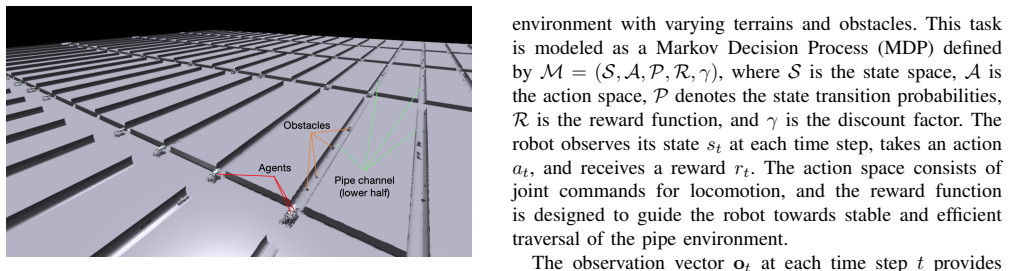
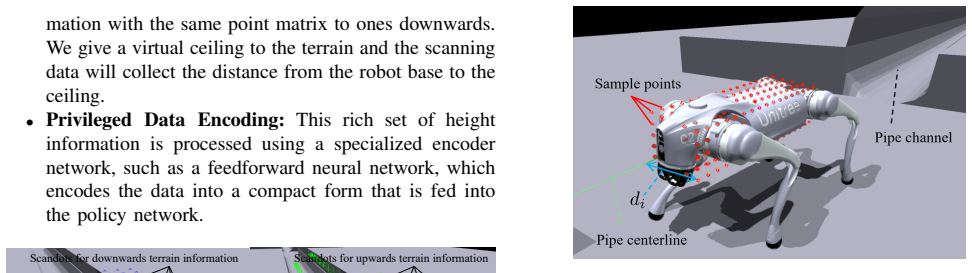
The key machinery is bidirectional height scanning, called bidirectional scandots: an 11x12 grid of sample points around the robot that measures distances both downward to the pipe floor and upward to the pipe ceiling, producing a 296-dimensional privileged observation vector when combined with base velocity and environment parameters. This vector is encoded by a neural network during the first training stage, giving the policy simultaneous awareness of both surfaces that constrain motion inside a narrow pipe. The reward function's centerline-distance term, which penalizes deviation from the pipe's central axis, is what keeps the robot from scraping the walls, and the three-stage curriculum is what lets the policy first learn a stable gait before it is forced into tighter geometry and obstacle avoidance.
What would settle it
Run the trained policy on a 10 m or longer pipe of radius 0.192 m over at least ten trials and count every success and failure, including the failures; the paper reports only selected successes, so a complete trial log that shows a success rate far below the simulated 93.75% would directly undermine the claim of adaptive pipe-crossing.
Extended reading notes
Core claim
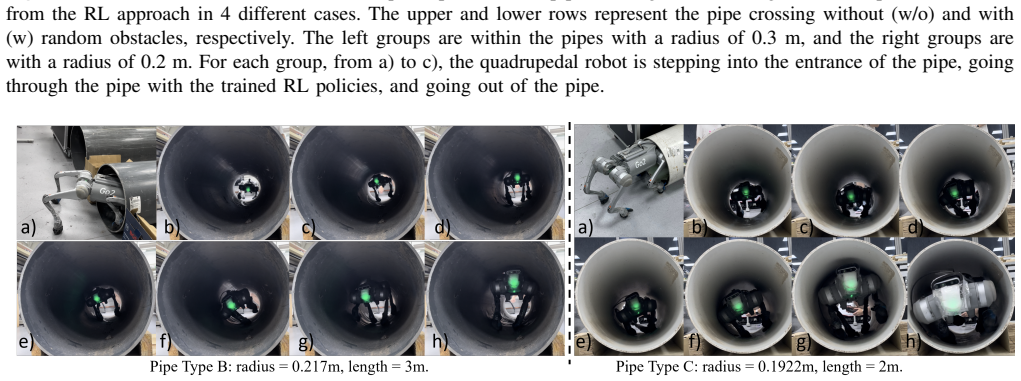
The central claim is that a reinforcement-learned policy can adaptively cross narrow pipes when given a new form of privileged visual information: an 11x12 grid of height samples taken both below and above the robot, capturing the pipe floor and ceiling, which is encoded and used during training before being distilled into a policy that runs on depth-camera input alone. Combined with a three-stage curriculum (wide pipe, narrow pipe, narrow pipe with obstacles) and a reward that combines velocity tracking, energy penalties, collision avoidance, and a centerline-distance penalty, the policy reaches a 93.75% success rate over 16 trials in a simulated 0.2 m radius pipe with random obstacles. In the real world, the same policy crossed PVC pipes with radii of 0.242 m, 0.217 m, and 0.192 m, including a pipe with obstacles at a 46.5% traversing percentage, with the robot adjusting its gait and restoring balance despite slipping.
Load-bearing premise
The load-bearing premise is that the simulation's height-field pipe, with its randomized friction, mass, and bidirectional scans, is faithful enough to the real PVC pipe that a policy trained only in simulation keeps working on hardware.
Editorial extensions
If this is right
- A standard quadruped with a depth camera could perform narrow-pipe inspection without custom wheeled or tracked mechanisms, lowering the cost of adapting robots to confined industrial environments.
- The three-stage curriculum and bidirectional scan representation may transfer to other confined spaces with similar geometry, such as tunnels, ducts, or rubble voids.
- The policy is stated to degrade under large visual noise or unseen obstacles, so practical deployment would need stronger perception robustness or LiDAR-based input.
- Because the real-world success rate is reported to be much lower than in simulation, further work is needed on domain randomization or online adaptation before the method is reliable enough for routine inspection.
Reading between the lines
- An implication left implicit is that the real-world statistics are based on selected successful trials rather than a complete trial count; a full account of failures would be needed to turn the demonstration into a deployment claim.
- The paper's test pipes are only 2–3 m long, whereas the training task is 18 m; whether the gait and stability hold over longer distances real pipelines remains untested.
- The reported 46.5% traversing percentage on the obstacle pipe suggests that the current policy is not yet dependable at the narrowest radius with obstructions, and combining the scandot encoder with a rapid-adaptation module could close the sim-to-real gap.
- The bidirectional scan idea could be extended to full 360-degree rangefinding inside the pipe, which would supply the missing side-wall information the current grid only partially captures.
Signed reviews
Editorial analysis
A structured set of objections, weighed in public.
Referee Report
Summary. The paper proposes a three-stage reinforcement-learning curriculum that trains a Unitree Go2 policy to traverse narrow pipes. The method introduces a custom height-field pipe terrain (Eq. 1), a privileged bidirectional scandots observation (Section II-B), and a reward function combining velocity tracking, energy penalties, collision avoidance, and a centerline-distance penalty (Section II-C). Training is performed in Isaac Gym with PPO, and simulation results in Table IV show that the final-stage policy reaches 93.75% success on 0.2 m radius pipes with random obstacles. Real-world experiments on 2-3 m PVC pipes are reported in Table V, and the paper claims the robot can cross pipes even with obstacles inside.
Significance. If the claims are fully validated, this would be a useful application of learned legged locomotion to narrow-pipe inspection, a domain where classical in-pipe robots are highly specialized. The simulation results are internally consistent and show a clear curriculum effect: success on the hardest simulated condition rises from 0% (Stage 1) and 0% (Stage 2) to 93.75% (Stage 3) in Table IV, which is credible evidence of learning. The bidirectional scandots idea is plausible and the reward formulation is standard enough to be reproducible. However, the real-world evidence is currently too weak to support the headline claim, and the absence of any baselines or ablations means the paper's stated contributions are not isolated. I found no equation-level circularity in the reward design; the main risks are empirical and reporting-related.
major comments (3)
- [Section III-D, Table V] The only real-world evidence for the headline claim of traversing pipes 'even with unexpected obstacles inside' is the Table V row for Pipe C with obstacles, which reports 'Traversing Percentage' 46.5% with no definition, no total trial count, and no failure breakdown. The reported average speed (0.078 m/s over 12 s) is numerically consistent with traversing 46.5% of the 2 m pipe (0.93 m), which suggests the metric is the average fraction of pipe length traversed rather than a success rate; under that reading the robot did not complete the obstacle pipe. The surrounding text also calls Table V the 'statistical results of the selected success real-world experiments,' implying data selection, which further undermines any success-rate interpretation. Since Section IV itself concedes that the method 'may deteriorate when the visual input has a large noise or the robot is stuck by some unseen obstacles,' the obstacle-handling claim needs additional real-world trials with complete denominators, a precise metric definition, and a breakdown of failure modes.
- [Section III-D] The real-world validation does not test the task as trained. The policy is trained and evaluated in simulation on 18 m pipes (Table IV), but the real pipes are only 2-3 m long, so the learned behavior is not shown to persist over the full training distance. The text states that the real success rate is 'much lower' than in simulation but gives no quantitative real success rate, and the physical factors (slippery PVC, unfixed pipe sway, noisy sensors) are only described qualitatively. Without a quantitative success rate or a complete trial log, the sim-to-real transfer claim is not established, especially because the real obstacle configuration is not specified in a way that can be matched to the simulated obstacle sampling.
- [Section II-C and Table IV] No ablation or baseline is provided for the claimed contributions. Table IV compares the same method at different curriculum stages, but there is no comparison without the bidirectional scandots, without the centerline-distance penalty, with different reward weights, or against an existing quadruped locomotion method. Because the reward function in Section II-C combines several standard LeggedGym terms with new terms, the current experiments do not isolate which component enables pipe crossing, so the stated contributions are not yet validated.
minor comments (4)
- [Eq. (2) and Table I] The observation vector is declared o_t ∈ R^49, but the listed components sum to 3+2+3+3+12+12+12=47, and adding the privileged vector ξ_t ∈ R^296 gives R^343; please correct the dimension or the component list.
- [Section I and Section III-D] There are several typographical errors: 'deply' should be 'deploy' in the contribution list, 'trails' should be 'trials' in Section III-D, 'robot'current' should be 'robot's current' in Section II-B, and the capitalization in 'In the first stage, We introduce' is inconsistent.
- [Section II-A, Eq. (1)] The height-field formula is said to be 'unrelated to x,' which is fine, but the notation would be clearer if the domain of y and the meaning of z0 (height of the pipe centerline) were stated explicitly before the equation.
- [Table V] The column 'Traversing Percentage' is not defined anywhere in the text, and 'Completion Time' is ambiguous for the obstacle row; please define these metrics and state how they are computed over the trials.
Circularity Check
No significant circularity: the pipe-crossing policy is validated against an external traversal metric, and the only self-citations are background and non-load-bearing.
full rationale
The paper's derivation chain is not circular. The method is an RL training pipeline (terrain in Eq. 1, observation in Eqs. 2-3, reward in Eqs. 4-10), and the claimed capability is evaluated by an external task metric: success rate in completing an 18 m pipe in simulation (Table IV) and traversing percentage/speed in real PVC pipes (Table V). None of these metrics is a term in the reward function, and no test outcome is used to fit or redefine the reward weights or terrain parameters; the reward weights in Table II are fixed hyperparameters, and the sim-to-real gap is acknowledged in Section III-D rather than concealed. The only author-overlap citations, [12] and [13], appear in the introduction as generic examples of remote-controlled inspection robots and do not support any load-bearing premise of the method; the learning framework builds on the external, open-source Legged Gym framework [28] and standard PPO, which are independent support. The paper's admitted limitation that 'the success rate of the real experiments is much lower than that of simulation tests' and the poorly specified 46.5% obstacle row in Table V are empirical-reporting weaknesses, not circular derivations. Therefore no step reduces a predicted quantity to an input by construction.
Assumptions & free parameters
free parameters (12)
- Velocity tracking reward weight lambda_lin_vel =
1.5
- Angular velocity reward weight lambda_ang_vel =
0.5
- Torque penalty weight lambda_torque =
1e-5
- Torque difference penalty weight lambda_delta_torques =
1e-7
- Joint acceleration penalty weight lambda_dof_acc =
2.5e-7
- Collision penalty weight lambda_collision =
10
- Centerline distance penalty weight lambda_centerline =
0.3
- Reward denominator constant C =
1e-5
- Curriculum level-up and level-down thresholds =
0.8 and 0.4 times vx*T
- Sim-to-real randomization ranges =
friction [0.6,2], added mass [0,3 kg], pipe wall friction f_static=0.2, f_dynamic=0.1, entrance height 0.1 m
- Obstacle sampling parameters =
0-4 obstacles, height 0.1-0.3 m, length 0.2-0.5 m, width 0.1 m
- Depth image crop and clip =
58x87 image, depth clipped to [-0.5, 0.5]
assumptions (5)
- domain assumption The Isaac Gym height-field terrain is a faithful model of the narrow pipe environment.
- domain assumption Domain randomization over friction and mass, plus reduced pipe-wall friction, closes the sim-to-real gap sufficiently.
- domain assumption Bidirectional scandots with a virtual ceiling provide sufficient privileged information, and distillation to the depth-image policy loses no task-critical information.
- domain assumption The shaped reward correlates with successful pipe crossing, and the chosen PPO hyperparameters are adequate.
- standard math The height field z(y) = sqrt(r^2 - (y-y0)^2) + z0 models a cylinder whose center line is parallel to the x axis.
invented entities (1)
-
Virtual ceiling for upward scandots
Cite this review
Pith. "Pith review of Learning Quadrupedal Robot Locomotion for Narrow Pipe Inspection." pith.science (2026). https://pith.science/paper/K3UANPTE
@misc{pith2026241213621,
  author       = {Pith},
  title        = {Pith review of: Learning Quadrupedal Robot Locomotion for Narrow Pipe Inspection},
  year         = {2026},
  howpublished = {\url{https://pith.science/paper/K3UANPTE}},
  note         = {Machine review of arXiv:2412.13621}
}
read the original abstract
Various pipes are extensively used in both industrial settings and daily life, but the pipe inspection especially those with narrow sizes are still very challenging with tremendous time and manufacturing consumed. Quadrupedal robots, inspired from patrol dogs, can be a substitution of traditional solutions but always suffer from navigation and locomotion difficulties. In this paper, we introduce a Reinforcement Learning (RL) based method to train a policy enabling the quadrupedal robots to cross narrow pipes adaptively. A new privileged visual information and a new reward function are defined to tackle the problems. Experiments on both simulation and real world scenarios were completed, demonstrated that the proposed method can achieve the pipe-crossing task even with unexpected obstacles inside.
Figures

Figures from the paper (2 more)

Reference graph
Works this paper leans on
-
[1]
A review of quadruped robots: Structure, control, and autonomous motion,
Y . Fan, Z. Pei, C. Wang, M. Li, Z. Tang, and Q. Liu, “A review of quadruped robots: Structure, control, and autonomous motion,” Advanced Intelligent Systems , p. 2300783, 2024
2024
-
[2]
Managing structural integrity of pipelines utilising inline inspection data,
C. N. Mbele, H. H. Malik, and J. H. C. Pretorius, “Managing structural integrity of pipelines utilising inline inspection data,” in 2022 IEEE 28th International Conference on Engineering, Technology and Innovation (ICE/ITMC) & 31st International Association For Management of Technology (IAMOT) Joint Conference, 2022, pp. 1–7
work page 2022
-
[3]
Localization, mapping, navigation, and inspection methods in in-pipe robots: A review,
S. Kazeminasab, N. Sadeghi, V . Janfaza, M. Razavi, S. Ziyadidegan, and M. K. Banks, “Localization, mapping, navigation, and inspection methods in in-pipe robots: A review,” IEEE Access , vol. 9, pp. 162 035–162 058, 2021
work page 2021
-
[4]
P. Chen, R. Li, G. Jia, H. Lan, K. Fu, and X. Liu, “A decade review of the art of inspection and monitoring technologies for long-distance oil and gas pipelines in permafrost areas. energies 2023, 16, 1751,” 2023
work page 2023
-
[5]
Advances in the inspection of unpiggable pipelines,
G. H. Mills, A. E. Jackson, and R. C. Richardson, “Advances in the inspection of unpiggable pipelines,” Robotics, vol. 6, no. 4, p. 36, 2017
work page 2017
-
[6]
Robots for pipeline inspection tasks—a survey of design philosophy and implementation technologies,
M. Wang, J. Yuan, S. Bao, L. Du, and S. Ma, “Robots for pipeline inspection tasks—a survey of design philosophy and implementation technologies,” in 2021 5th Asian Conference on Artificial Intelligence Technology (ACAIT), 2021, pp. 427–432
work page 2021
-
[7]
A review: technological trends and development direction of pipeline robot systems,
H. Jang, T. Y . Kim, Y . C. Lee, Y . S. Kim, J. Kim, H. Y . Lee, and H. R. Choi, “A review: technological trends and development direction of pipeline robot systems,” Journal of Intelligent & Robotic Systems , vol. 105, no. 3, p. 59, 2022
work page 2022
-
[8]
A review on pipeline inspection robot,
P. Ambati, K. Raj, and A. Joshuva, “A review on pipeline inspection robot,” in AIP Conference Proceedings , vol. 2311, no. 1. AIP Publishing, 2020
work page 2020
Show all 28 references
-
[9]
Analysis of in-pipe inspection robot structure design,
M. Han, J. Zhou, X. Chen, and L. Li, “Analysis of in-pipe inspection robot structure design,” in Proceedings of the 2016 2nd Workshop on Advanced Research and Technology in Industry Applications. Atlantis Press, 2016/05, pp. 987–991. [Online]. Available: https://doi.org/10.299...
2016 doi
-
[10]
Study of robots to pipelines, math- ematical models and simulation,
J. F. Archila and M. Becker, “Study of robots to pipelines, math- ematical models and simulation,” in 2013 Latin American Robotics Symposium and Competition . IEEE, 2013, pp. 18–23
2013
-
[11]
Differential-drive in-pipe robot for moving inside urban gas pipelines,
S. gon Roh and H. R. Choi, “Differential-drive in-pipe robot for moving inside urban gas pipelines,” IEEE Transactions on Robotics , vol. 21, no. 1, pp. 1–17, 2005
2005
-
[12]
Multiple-pilot collaboration for advanced remote intervention using reinforcement learning,
Z. Wang, W. Bai, Z. Chen, B. Xiao, B. Liang, and E. M. Yeatman, “Multiple-pilot collaboration for advanced remote intervention using reinforcement learning,” in IECON 2021–47th Annual Conference of the IEEE Industrial Electronics Society . IEEE, 2021, pp. 1–6
2021
-
[13]
Hand-eye coordinative remote maintenance in a tokamak vessel,
Q. Qiu, K. Gu, P. Wang, W. Bai, and Q. Cao, “Hand-eye coordinative remote maintenance in a tokamak vessel,” Fusion Engineering and Design, vol. 104, pp. 93–100, 2016
2016
-
[14]
Development of in-pipe inspection robot: A review,
I. N. Ismail, A. Anuar, K. S. M. Sahari, M. Z. Baharuddin, M. Fairuz, A. Jalal, and J. M. Saad, “Development of in-pipe inspection robot: A review,” in 2012 IEEE Conference on Sustainable Utilization and Development in Engineering and Technology (STUDENT) . IEEE, 2012, pp. 310–315
2012
-
[15]
Hierarchical terrain-aware control for quadrupedal locomotion by combining deep reinforcement learning and optimal control,
Q. Yao, J. Wang, D. Wang, S. Yang, H. Zhang, Y . Wang, and Z. Wu, “Hierarchical terrain-aware control for quadrupedal locomotion by combining deep reinforcement learning and optimal control,” in 2021 IEEE/RSJ International Conference on Intelligent Robots and Systems (IROS), 2...
2021
-
[16]
Real-time replanning and control of quadruped robots for blind locomotion on uneven terrain,
H. Sun, C.-h. Wang, and H. An, “Real-time replanning and control of quadruped robots for blind locomotion on uneven terrain,” in 2020 3rd International Conference on Unmanned Systems (ICUS) . IEEE, 2020, pp. 401–406
2020
-
[17]
Learning agile, robust locomotion skills for quadruped robot,
Z. Zhang, Q. Wei, X. Chang, L. Lang, H. Ma, and H. An, “Learning agile, robust locomotion skills for quadruped robot,” in 2022 Interna- tional Conference on Advanced Robotics and Mechatronics (ICARM) , 2022, pp. 1011–1016
2022
-
[18]
Robust predictive control for quadrupedal locomotion: Learning to close the gap between reduced-and full-order models,
A. Pandala, R. T. Fawcett, U. Rosolia, A. D. Ames, and K. A. Hamed, “Robust predictive control for quadrupedal locomotion: Learning to close the gap between reduced-and full-order models,” IEEE Robotics and Automation Letters , vol. 7, no. 3, pp. 6622–6629, 2022
2022
-
[19]
Dynamic locomotion and whole-body control for quadrupedal robots,
C. D. Bellicoso, F. Jenelten, P. Fankhauser, C. Gehring, J. Hwangbo, and M. Hutter, “Dynamic locomotion and whole-body control for quadrupedal robots,” in 2017 IEEE/RSJ International Conference on Intelligent Robots and Systems (IROS) . IEEE, 2017, pp. 3359–3365
2017
-
[20]
Walking in narrow spaces: Safety-critical locomotion control for quadrupedal robots with duality-based optimization,
Q. Liao, Z. Li, A. Thirugnanam, J. Zeng, and K. Sreenath, “Walking in narrow spaces: Safety-critical locomotion control for quadrupedal robots with duality-based optimization,” in 2023 IEEE/RSJ Interna- tional Conference on Intelligent Robots and Systems (IROS) . IEEE, 2023, p...
2023
-
[21]
Actuation mechanism and control of quadrupedal robots: A review,
H. Fang, “Actuation mechanism and control of quadrupedal robots: A review,” in 2023 4th International Seminar on Artificial Intelligence, Networking and Information Technology (AINIT) . IEEE, 2023, pp. 27–31
2023
-
[22]
Robust high-speed running for quadruped robots via deep reinforcement learning,
G. Bellegarda, Y . Chen, Z. Liu, and Q. Nguyen, “Robust high-speed running for quadruped robots via deep reinforcement learning,” in 2022 IEEE/RSJ International Conference on Intelligent Robots and Systems (IROS). IEEE, 2022, pp. 10 364–10 370
2022
-
[23]
Learning advanced loco- motion for quadrupedal robots: A distributed multi-agent reinforce- ment learning framework with riemannian motion policies,
Y . Wang, R. Sagawa, and Y . Yoshiyasu, “Learning advanced loco- motion for quadrupedal robots: A distributed multi-agent reinforce- ment learning framework with riemannian motion policies,” Robotics, vol. 13, no. 6, p. 86, 2024
2024
-
[24]
Anymal parkour: Learning agile navigation for quadrupedal robots,
D. Hoeller, N. Rudin, D. Sako, and M. Hutter, “Anymal parkour: Learning agile navigation for quadrupedal robots,” Science Robotics , vol. 9, no. 88, p. eadi7566, 2024
2024
-
[25]
Rma: Rapid motor adaptation for legged robots,
A. Kumar, Z. Fu, D. Pathak, and J. Malik, “Rma: Rapid motor adaptation for legged robots,” arXiv preprint arXiv:2107.04034, 2021
2021 arXiv
-
[26]
Extreme parkour with legged robots,
X. Cheng, K. Shi, A. Agarwal, and D. Pathak, “Extreme parkour with legged robots,” in 2024 IEEE International Conference on Robotics and Automation (ICRA) . IEEE, 2024, pp. 11 443–11 450
2024
-
[27]
Robot parkour learning,
Z. Zhuang, Z. Fu, J. Wang, C. Atkeson, S. Schwertfeger, C. Finn, and H. Zhao, “Robot parkour learning,” arXiv preprint arXiv:2309.05665, 2023
2023 arXiv
-
[28]
Learning to walk in minutes using massively parallel deep reinforcement learning,
N. Rudin, D. Hoeller, P. Reist, and M. Hutter, “Learning to walk in minutes using massively parallel deep reinforcement learning,” in Conference on Robot Learning . PMLR, 2022, pp. 91–100
2022
Reviewed August 11, 2026 · model on record in the stance chip above.
Discussion (0). Continue with ORCID to comment.