REVIEW 3 major objections 4 minor 13 references
Achieving Balanced Representation in School Choice with Diversity Goals
T0 review · 3 major / 4 minor · reviewed 2026-08-11 · deepseek-v4-flash
Pith's one-line read A simple greedy choice function is the unique school-choice rule that simultaneously achieves maximal diversity, balanced representation across overlapping student types, non-wastefulness, and justified envy-freeness.
desk verdict Nice, well-motivated intersectional balance criterion, but the rank-maximal/min-cost-flow equivalence and the floor-based crucial vector are both wrong, so the headline uniqueness and implementation claims do not hold as written. read the letter →
The pith
A machine-rendered reading of the paper's core claim, the machinery that carries it, and where it could break.
The reading
What carries the argument
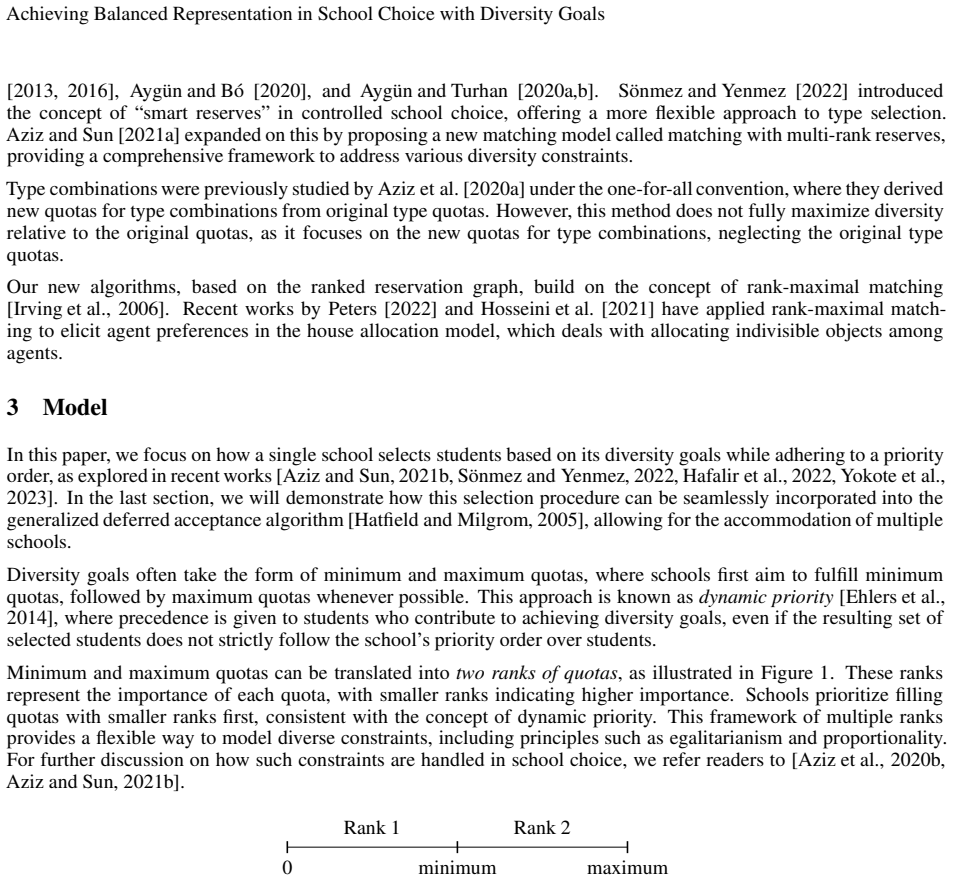
Three pieces carry the argument. Balanced representation is defined through the selection ratio $|M_u|/|S_u|$ for each type-combination group $u$, with the requirement to maximize the minimum ratio subject to maximal diversity; a supporting definition of a general selection ratio lets the same algorithms handle proportional, egalitarian, or other targets. The greedy choice function (Algorithm 1) processes students in descending priority order and admits a student exactly when the set of previously admitted higher-priority students together with the candidate can still be extended to a matching of size at most $q$ that achieves maximal diversity and balanced representation—this greedy rule is the object whose uniqueness Theorem 2 establishes. The flow network is a four-layer directed graph whose nodes are group, type, (type, rank) quota, and capacity nodes; all edges have capacities, and only edges from a type to its ranked quota nodes carry cost equal to the rank index. The paper's Theorem 1 claims that a minimum-cost maximum flow in this network is exactly a rank-maximal matching, and this equivalence is what lets flow solvers replace bipartite matching algorithms in the implementation.
What would settle it
Build a small instance with three quota ranks whose two candidate selections have signatures $\langle 0,2,0\rangle$ and $\langle 1,0,1\rangle$—the counts of matched seats at ranks 1, 2, and 3. With ranks priced at 1, 2, and 3, both selections have total cost 4, so a minimum-cost maximum-flow solver can return the $\langle 0,2,0\rangle$ selection even though $\langle 1,0,1\rangle$ is the rank-maximal one. Running the paper's flow-network algorithm on such an instance and checking whether its output is rank-maximal would settle whether Theorem 1, and with it the maximal-diversity guarantee of the flow-based algorithms, holds.
Extended reading notes
Core claim
The central claim is a uniqueness theorem for a single school choosing students under the one-to-one convention, where each applicant has several types but fills a seat of exactly one type. The new property, balanced representation, requires the chosen set to be matchable in a way that maximizes the minimum selection ratio $\min_{u\in U} |M_u|/|S_u|$ over all type-combination groups, subject to the prior requirement of maximal diversity, meaning the chosen set must extend to a rank-maximal matching in the ranked reservation graph. The proposed choice function, Algorithm 1, scans students in decreasing priority order and keeps a student whenever the previously kept students together with this student can still be matched within the school's capacity while satisfying maximal diversity and balanced representation. The paper's Theorem 2 asserts that this greedy rule is the unique choice function satisfying non-wastefulness, maximal diversity, justified envy-freeness, and balanced representation. To implement it, the paper introduces a four-layer flow network whose nodes are groups, types, ranked quotas, and the capacity node, and asserts (Theorem 1) that minimum-cost maximum flows in this network correspond exactly to rank-maximal matchings, yielding strongly polynomial running times independent of the number of students.
Load-bearing premise
Everything the flow-based algorithms promise rests on the claim that minimizing the total of the quota ranks always produces the matching that is best at the most important quotas first; that equivalence is not guaranteed, since two different student selections can have the same total rank cost even when one of them is strictly better at the high-priority quotas.
Editorial extensions
If this is right
- A school computing the greedy choice function resolves every fairness dispute over who gets in: its selection is the only one that satisfies non-wastefulness, maximal diversity, justified envy-freeness, and balanced representation simultaneously.
- Because the flow network has one node per group, type, and ranked type quota rather than per student, the running times—$O(m\log n\,(m+n\log n))$ per feasibility check and $O(|S|m\log n\,(m+n\log n))$ overall—become strongly polynomial and essentially independent of the number of students whenever the number of privilege types is small, as in Brazilian, Indian, and Chilean admissions.
- Balanced representation is reached in two stages: binary search over target quotas computes the maximum equalized selection ratio, then a second pass admits students in priority order while preserving it; both stages reduce to repeated min-cost max-flow computations.
- The algorithms are not tied to the percentage selection ratio: any choice of lower and upper group targets from the general selection ratio definition works with the same feasibility machinery, covering proportional and egalitarian balance goals.
- Plugging the choice function into the generalized deferred acceptance algorithm yields a multi-school market, but the function does not satisfy substitutability, so the standard matching-with-contracts stability guarantee is not available for that market.
Reading between the lines
- The uniqueness theorem is tied to the exact maximin definition of balance: a school that wanted to break ties beyond the maximin level—say by then maximizing the second-smallest ratio, or minimizing variance—would get a different rule, so the characterization does not cover these neighboring fairness goals.
- The claimed flow-to-matching equivalence holds only if minimizing total rank cost is the same as lexicographic optimization of the rank counts; replacing the rank-index costs with superincreasing weights (growing so fast in the rank that any rank-1 edge outweighs all lower-priority edges) would make the correspondence exact, at the price of large numeric costs.
- The imbalance the paper identifies is a general phenomenon of one-to-one quota systems: vaccine rationing, affirmative-action admissions, and reserved-seat elections can all meet per-category quotas while silently excluding intersectional groups, so balanced representation reads as a template for intersectional fairness beyond school choice.
- The substitutability failure leaves the multi-school extension without a stability theorem; the paper does not ask which weaker stability or incentive guarantees the deferred-acceptance outcome still possesses, which is a natural next question.
Signed reviews
Editorial analysis
A structured set of objections, weighed in public.
Referee Report
Summary. The paper studies how a single school should select students when applicants have multiple attributes and diversity goals are expressed as ranked minimum/maximum quotas under the one-to-one convention. It defines groups as type combinations, introduces balanced representation (maximizing the minimum group selection ratio among rank-maximal matchings), and proposes a greedy choice function (Algorithm 1). The paper claims this function is the unique rule satisfying non-wastefulness, maximal diversity, justified envy-freeness, and balanced representation (Theorem 2), and presents polynomial algorithms based on ranked reservation graphs (Algorithms 2 and 3) and on a new four-layer flow network (Algorithms 4 and 5, Theorems 1 and 6-8). Section 9 shows that the choice function violates substitutability in the generalized deferred acceptance setting.
Significance. The motivation is genuinely relevant: real affirmative-action systems count a student under one category, and intersectional groups can be left out even when aggregate type quotas are met. Balanced representation is a natural addition to the smart-reserves literature, and the flow-network compactness idea is attractive when the number of types is small but the applicant pool is large. The paper is honest about relying on prior algorithms, has no fitted parameters, and the greedy choice function is a plausible route to the four stated axioms. However, the current version contains two load-bearing technical errors: the claimed equivalence between rank-maximal matchings and minimum-cost flows is false for three or more ranks, and the floor-based crucial vector does not characterize balanced representation. The algorithmic claims in Sections 7 and 8 are therefore not established, and the main theorems are either false as stated or only sketched.
major comments (3)
- [Section 4.2, Theorem 1] The equivalence in Theorem 1 is false for r >= 3 because an edge cost equal to the rank index minimizes the sum of ranks, not the lexicographic signature. For signatures (0,2,0) and (1,0,1) with capacity q=2, the total costs are both 4 when rank costs are 1, 2, 3, while (1,0,1) is lexicographically better. Such signatures are realizable in the network of Section 4.2: take one student with types {t1,t0}, one student with type {t0}, and two students with type {t2}; give one rank-1 seat for t1, two rank-2 seats for t2, and rank-3 general seats for t0. A minimum-cost maximum flow can then return a matching that is not rank-maximal, so the flow-based algorithms may fail maximal diversity. All of Theorems 6, 7, and 8 rely on this equivalence.
- [Section 6.1, Definition 13 and Algorithm 4] The condition for a matching to have minimum selection ratio at least alpha is |M_u| >= ceil(alpha |S_u|), not |M_u| >= floor(alpha |S_u|). The floor construction is strictly weaker, and the binary search in Algorithm 4 computes the wrong threshold. Concretely, let |S_A|=3, |S_B|=5, q=4, with no special type quotas (only general seats). Balanced representation requires counts (2,2), giving max-min ratio 0.4. For every alpha < 2/3, Algorithm 4 sets delta=(1,3), which is feasible; for alpha >= 2/3, it sets delta=(2,3), which is infeasible. The search therefore converges to the discontinuity at 2/3 and returns delta=(1,3). Algorithm 5, initialized with the top 1 student from A and the top 3 from B, returns counts (1,3) with minimum selection ratio 1/3 < 0.4. Thus Algorithm 5 fails to implement balanced representation. This also invalidates Theorem 3 and the balanced-representation claim in Theorem 8. The correct target vector should use ceilings rather than floors.
- [Section 6, Theorem 2] The uniqueness proof is an outline rather than a rigorous proof and depends on the two defective ingredients above. The claim that 'any student from the same group as s1 cannot be selected by lambda' is asserted without proving that the exchange preserves maximal diversity and balanced representation, and the disconnected case ('if doing so were to violate maximal diversity... contradiction') presupposes the flow equivalence of Theorem 1. As a result, the central characterization is not established even independently of the algorithmic bugs.
minor comments (4)
- [Section 8.1, Theorem 7] The proof says the binary search requires O(sqrt(|S|)) iterations, while the preceding paragraph and Algorithm 4 suggest O(log |S|); the iteration bound and termination condition need to be made precise and consistent.
- [Algorithm 3] Algorithm 3 presumes that the input matching has the top delta*_u students matched in each group, but no pseudocode step enforces this; Example 8 describes an update ('We first update M...') that is not part of the algorithm.
- [Section 8.2, Theorem 8] In the proof of justified envy-freeness, the sentence 'suppose an unmatched student s in S*' should read s not in S*, since the argument concerns a student who was not initially selected.
- [Throughout] There are typographical issues, including 'critical vector' for 'crucial vector', 'non-wasfulness' in Theorem 8, and 'studetns' in Section 8.2; these should be corrected in any revision.
Circularity Check
No circularity found: the new choice function and its uniqueness theorem are derived from the stated axioms, not assumed, and the prior-work dependencies are independent subroutines.
full rationale
The paper's central derivation is not circular. Algorithm 1 is a greedy rule that checks, for each student in priority order, whether adding the student preserves the existence of a matching satisfying maximal diversity and balanced representation; this is an implicit definition, and Theorem 2 proves uniqueness among all choice functions satisfying the four axioms rather than assuming it. The rank-reservation algorithms depend on Aziz and Sun [2021a] for computing rank-maximal matchings and on Irving et al. [2006] for the underlying concept; those are prior external results with stated assumptions that do not include balanced representation, so citing them is a dependency, not a circular reduction. The new property balanced representation (Definition 8) and the crucial vector (Definition 13) are genuinely new constructions, not renamed versions of the input quotas or of the prior algorithms. The one self-citation to Sun et al. [2021] for the general selection ratio is explicitly set aside by the paper, which states that it focuses on Definition 8 rather than Definition 9. There are serious correctness concerns in the paper: Theorem 1's equivalence between rank-maximal matchings and minimum-cost maximum flows is false as stated because signature lexicographic order is not equivalent to summed edge costs, and the floor-based crucial vector computed in Algorithm 4 can fail to represent the true max-min selection ratio. These are mathematical errors in the execution of the derivation, not cases where a claimed prediction reduces by construction to its own inputs. The derivation chain is therefore self-contained with respect to circularity.
Assumptions & free parameters
assumptions (4)
- domain assumption Rank-maximal matchings in a ranked reservation graph can be computed by the algorithm of Aziz and Sun [2021a] in O(r|E|sqrt(|V|)) and used as a primitive for validity checks.
- ad hoc to paper A minimum-cost maximum flow with costs equal to rank indices identifies a rank-maximal matching.
- domain assumption All applicants are acceptable, so non-wastefulness reduces to matching min(|S|, q) students.
- ad hoc to paper Balanced representation targets can be checked using floor(alpha * |S_u|) as in Definition 13.
Cite this review
Pith. "Pith review of Achieving Balanced Representation in School Choice with Diversity Goals." pith.science (2026). https://pith.science/paper/CEEV5DSL
@misc{pith2026241213622,
  author       = {Pith},
  title        = {Pith review of: Achieving Balanced Representation in School Choice with Diversity Goals},
  year         = {2026},
  howpublished = {\url{https://pith.science/paper/CEEV5DSL}},
  note         = {Machine review of arXiv:2412.13622}
}
read the original abstract
Student placements under diversity constraints are a common practice globally. This paper addresses the selection of students by a single school under a \emph{one-to-one convention}, where students can belong to multiple types but are counted only once based on one type. While existing algorithms in economics and computer science aim to help schools meet diversity goals and priorities, we demonstrate that these methods can result in significant imbalances among students with different type combinations. To address this issue, we introduce a new property called \emph{balanced representation}, which ensures fair representation across all types and type combinations. We propose a straightforward choice function that uniquely satisfies four fundamental properties: maximal diversity, non-wastefulness, justified envy-freeness, and balanced representation. While previous research has primarily focused on algorithms based on bipartite graphs, we take a different approach by utilizing flow networks. This method provides a more compact formalization of the problem and significantly improves computational efficiency. Additionally, we present efficient algorithms for implementing our choice function within both the bipartite graph and flow network frameworks.
Figures


Figures from the paper (1 more)

Reference graph
Works this paper leans on
-
[4]
H. Aziz, S. Gaspers, and Z. Sun. Mechanism design for school c hoice with soft diversity constraints. In Proceedings of the Twenty-Ninth International Joint Conference on Arti ficial Intelligence, IJCAI 2020 , pages 153–159, 2020a. H. Aziz, S. Gaspers, Z. Sun, and M. Y okoo. Multiple levels of i mportance in matching with distributional constraints. In Pro...
work page 2020
- [9]
-
[10]
19 Achieving Balanced Representation in School Choice with Di versity Goals P . A. Pathak, T. Sönmez, M. U. Ünver, and M. B. Y enmez. Fair all ocation of vaccines, ventilators and antiviral treatments: Leaving no ethical value behind in health care r ationing. In Proceedings of the 22nd ACM Conference on Economics and Computation, Budapest, Hungary, July ...
work page 2021
-
[11]
J. Peters. Online elicitation of necessarily optimal match ings. In Thirty-Sixth AAAI Conference on Artificial Intelli- gence, Virtual Event, February 22 - March 1, 2022 , pages 5164–5172. AAAI Press,
work page 2022
-
[12]
Z. Sun, T. Todo, and T. Walsh. Fair pairwise exchange among gr oups. In Proceedings of the Thirtieth International Joint Conference on Artificial Intelligence, IJCAI 2021, Vi rtual Event / Montreal, Canada, 19-27 August 2021, pages 419–425,
work page 2021
-
[13]
Rationalizing Path-Independent Choice Rules
K. Y okote, I. Hafalir, F. Kojima, and B. Y enmez. Representat ion theorems for path-independent choice rules. arXiv preprint arXiv:2303.00892,
-
[2005]
H. Hosseini, V . Menon, N. Shah, and S. Sikdar. Necessarily op timal one-sided matchings. In Thirty-Fifth AAAI Conference on Artificial Intelligence, Virtual Event, Febr uary 2-9, 2021 , pages 5481–5488. AAAI Press,
work page 2021
-
[2012]
S. D. Kominers and T. Sönmez. Designing for diversity in matching. In Proceedings of the fourteenth ACM Conference on Electronic Commerce, EC 2013, Philadelphia, PA, USA, Jun e 16-20, 2013 , pages 603–604,
work page 2013
Show all 13 references
-
[2016]
Hafalir, F
I. Hafalir, F. Kojima, B. Y enmez, and K. Y okote. Design on mat roids: Diversity vs. meritocracy. arXiv preprint arXiv:2301.00237,
-
[2017]
A ygün and B
O. A ygün and B. Turhan. Dynamic reserves in matching markets : Theory and applications. Journal of Economic Theory, 188, 2020a. O. A ygün and B. Turhan. Designing Direct Matching Mechanism for India with Comprehensive Affirmative Action. Papers 2004.13264, arXiv.org, April 202...
2004 arXiv
-
[2019]
Aziz and F
H. Aziz and F. Brandl. Efficient, fair, and incentive-compat ible healthcare rationing. In Proceedings of the 22nd ACM Conference on Economics and Computation, Budapest, Hun gary, July 18-23, EC 2021, pages 103–104. ACM,
2021
-
[2021]
Aziz and Z
H. Aziz and Z. Sun. Multi-rank smart reserves. In Proceedings of the 22nd ACM Conference on Economics and Computation, Budapest, Hungary, July 18-23, EC 2021 , pages 105–124, 2021a. H. Aziz, S. Gaspers, Z. Sun, and T. Walsh. From matching with d iversity constraints to matchin...
2021
-
[2022]
J. R. Correa, R. Epstein, J. Escobar, I. Rios, B. Bahamondes, C. Bonet, N. Epstein, N. Aramayo, M. Castillo, A. Cristi, and B. Epstein. School Choice in Chile. In Proceedings of the 2019 ACM Conference on Economics and Comp uta- tion, EC 2019, Phoenix, AZ, USA, June 24-28, 201...
2019
Reviewed August 11, 2026 · model on record in the stance chip above.
Discussion (0). Continue with ORCID to comment.