REVIEW 3 major objections 5 minor 60 references
Model-independent measurement of isospin diffusion in Ni-Ni systems at intermediate energy
T0 review · 3 major / 5 minor · reviewed 2026-08-11 · deepseek-v4-flash
Pith's one-line read The paper establishes a model-independent measurement of isospin diffusion in $^{58,64}\mathrm{Ni}+^{58,64}\mathrm{Ni}$ collisions at 32 MeV/nucleon, showing that the isospin transport ratio $R(\langle N/Z\rangle)$ evolves steadily toward…
desk verdict A useful benchmark for isospin diffusion, but the 'model-independent' label overstates the centrality reconstruction. read the letter →
The pith
A machine-rendered reading of the paper's core claim, the machinery that carries it, and where it could break.
The reading
What carries the argument
The load-bearing objects are the isospin transport ratio and the model-independent impact-parameter reconstruction. The ratio is $R(x_i)=2x_i-x_{AA}-x_{BB}\over x_{AA}-x_{BB}$, built from the four projectile-target combinations so that common systematic effects cancel; $R=\pm1$ marks the non-equilibrated limits and converging $R$ values between the mixed systems signal equilibration. The centrality reconstruction, from Ref. [36], models the conditional probability $P(M|b)$ with a gamma distribution as the fluctuation kernel and fits the inclusive multiplicity distribution; the true impact-parameter distribution is assumed to be the Fermi form $P(b)\propto 2\pi b/[1+\exp((b-b_0)/\Delta_b)]$ with $\Delta_b=0.4$ fm and $b_0$ fixed by the measured total reaction cross section, and Bayes' theorem yields the $b$ distribution for each measured multiplicity. Each event is then assigned an impact parameter randomly drawn from its multiplicity's $b$ distribution, preserving the intrinsic centrality fluctuations.
What would settle it
Reconstruct $R(\langle N/Z\rangle)$ versus $b$ after replacing the multiplicity $M$ with a different centrality observable, such as total transverse energy, using the same model-independent method, and compare the two centrality scales; if the trend toward equilibration shifts beyond the quoted uncertainties, the assumed $P(b)$ shape or the cross-system rescaling is falsified.
Extended reading notes
Core claim
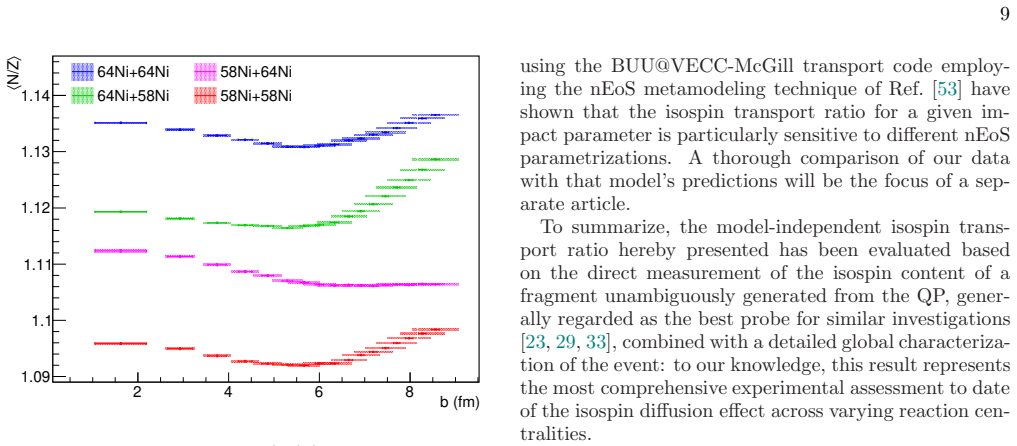
The paper's central claim, stated on its own terms, is that it provides a model-independent experimental evaluation of isospin equilibration in the four reactions $^{58,64}\mathrm{Ni}+^{58,64}\mathrm{Ni}$ at 32 MeV/nucleon. Using the isospin transport ratio $R(x_i)=2x_i-x_{AA}-x_{BB}\over x_{AA}-x_{BB}$ with $x=\langle N/Z\rangle$ of the quasiprojectile remnant, it shows in Fig. 7 that for the two mixed systems $R$ evolves monotonically from peripheral values toward the equilibrated common value as the impact parameter decreases, and that even at the most central collisions full equilibration is not reached, suggesting the interaction time is never sufficient for complete $N/Z$ mixing. The novelty is the centrality axis: instead of using a transport-model prediction for an order parameter, the impact parameter is reconstructed by fitting the inclusive multiplicity distribution with a gamma-distribution fluctuation kernel and an assumed Fermi-function $P(b)$, calibrated on the $^{58}\mathrm{Ni}+^{58}\mathrm{Ni}$ INDRA data and transferred to the other systems by a linear multiplicity rescaling. The result is consistent with the authors' earlier, more exclusive analyses but extends to more central collisions, and is intended as a benchmark for any transport model.
Load-bearing premise
The load-bearing premise is that the detected charged-particle multiplicity can be converted into an impact parameter using a fixed Fermi-function shape for the impact-parameter distribution, calibrated on one system and stretched linearly to the other three; if that conversion is wrong, the horizontal axis of the result is wrong.
Editorial extensions
If this is right
- Because the centrality scale no longer depends on a transport model, the measured $R(\langle N/Z\rangle)$ versus $b$ can be compared directly with predictions of any transport code, for primary or secondary quasiprojectile fragments.
- The result extends the collaboration's previous analyses, which used model-dependent centrality from AMD+Gemini++ simulations, to more central collisions and validates the earlier centrality transformation within the overlapping $b$ range.
- The clear progression toward equilibration with decreasing $b$, together with the incomplete equilibration at the most central points, provides a target that models must reproduce, making the result usable to constrain the symmetry energy at sub-saturation densities.
- Ongoing comparisons with BUU@VECC-McGill calculations using different equation-of-state parametrizations indicate the ratio preserves sensitivity to the symmetry-energy density dependence.
Reading between the lines
- One could use the same reconstruction on a second centrality observable, for example total transverse energy or quasiprojectile momentum, as a cross-check; if the resulting $R(b)$ trend changes, the multiplicity-based calibration is the cause.
- A natural extension would be to repeat the measurement at other beam energies and with larger projectile-target isospin asymmetries; the evolution of the equilibration slope with interaction time would quantify how the symmetry-energy term controls the pace of $N/Z$ mixing.
- The incomplete convergence at central collisions could be read as an upper limit on the isospin-equilibration timescale for medium-mass nuclei, a quantity transport models currently determine through their symmetry-energy parametrization.
- Because the centrality fluctuations are propagated event-by-event, the published data points could be re-binned or unfolded to other centrality definitions without re-analysis, easing comparison with models that predict different multiplicity distributions.
Signed reviews
Editorial analysis
A structured set of objections, weighed in public.
Referee Report
Summary. The paper combines two datasets, INDRA and INDRA-FAZIA, for 58,64Ni+58,64Ni collisions at 32 MeV/nucleon to measure the isospin transport ratio R(⟨N/Z⟩) as a function of impact parameter b. The impact parameter is reconstructed from the charged-particle multiplicity M using the method of Ref. [36], which assumes a Fermi-function form for P(b) with fixed Δb = 0.4 fm, a gamma-distributed fluctuation kernel, and a b0 derived from a measured total reaction cross section. The calibration, obtained for 58Ni+58Ni, is transferred to the other three systems by a linear rescaling of M (Eq. 5). The resulting R(b) for the two mixed systems shows a clear evolution toward isospin equilibration for increasing centrality. The authors claim that the analysis is completely model-independent and can serve as a benchmark for transport-model predictions of the symmetry energy.
Significance. If the centrality reconstruction is reliable, this is a valuable experimental benchmark: it provides one of the most complete maps of isospin equilibration versus impact parameter at Fermi energies, and the use of the isospin transport ratio reduces sensitivity to evaporation and detection systematics. The paper's strengths include the creative combination of two complementary datasets, the random assignment of b according to the full P(b|M) distribution, the explicit propagation of the b0 uncertainty, and the consistency check against earlier analyses in Appendix A. The central qualitative trend is physically plausible and consistent with previous results. The main weakness is that the label 'completely model-independent' is not fully justified because the b axis depends on several parametric assumptions that are not systematically tested.
major comments (3)
- [III A, Eq. (5)] The linear multiplicity rescaling of Eq. (5) is calibrated only on the high-multiplicity tails (M > 10) of the four systems and then applied to the full multiplicity range. The manuscript provides no test that, after rescaling, events with a given Mresc in 58Ni+64Ni or 64Ni+58Ni have the same true impact-parameter distribution as those in 58Ni+58Ni. Because R(b) is built from the two asymmetric systems, a systematic, system-dependent bias in the assigned b would shift the two branches of Fig. 7 in opposite directions and could create or suppress the observed convergence toward equilibration. A validation using filtered transport-model events (e.g., comparing the b distributions for fixed Mresc across all four systems) or a variation of the fitted range and of α, β should be added before the claim can stand.
- [III, Eqs. (3)-(4); Abstract; V] The paper repeatedly calls the analysis 'completely model-independent,' but the reconstruction explicitly depends on a Fermi-function parametrization of P(b), a fixed width Δb = 0.4 fm, a gamma-distributed fluctuation kernel, and a b0 obtained through a chain of normalizations. Appendix A itself concedes that the reconstruction is 'not entirely free of assumptions,' which conflicts with the abstract and conclusions. This is not merely a wording issue: the x-axis of Fig. 7 and the quantitative degree of equilibration depend on these assumptions. I request either tempering the claims to 'transport-model independent' with an explicit list of residual assumptions, or adding sensitivity tests (e.g., varying Δb over a reasonable range and testing an alternative kernel shape) to show that the R(b) trend is robust.
- [Appendix A] The consistency check in Appendix A validates the new centrality reconstruction only for the QP evaporation channel and only in the semiperipheral/peripheral region (b ≳ 5 fm) where the present analysis overlaps with the previous results of Ref. [31]. The inclusive analysis of the present paper extends to more central collisions and includes QP breakup events, and Fig. 8 does not validate the reconstruction in this newly probed range. Since the central bins are precisely the ones that drive the conclusion of evolution toward equilibration, the paper should provide an additional cross-check for the inclusive selection at central impact parameters, for example a comparison with a transport-model prediction or a closure test based on the same data.
minor comments (5)
- [Fig. 4] The y-axis label 'σd/db x 1/2' is easy to misread; please clarify the meaning of the factor 1/2, for example by writing 'divided by 2' or renormalizing the curves in the figure.
- [III A] The sentence 'The reduced χ² is 20.1, in line with what obtained in Ref. [36]' is vague; please state explicitly why such a large reduced χ² is considered acceptable and whether the fit was performed over the entire M range or only the tail.
- [IV B, Fig. 7] The caption and text should specify that the horizontal shaded rectangles and error bars combine the width of the P(b|Mresc) distribution with the b0 uncertainty, and whether the x-uncertainties of the two branches of R in Fig. 7 are correlated.
- [Eq. (4)] Please define the dilogarithm function Li2 explicitly or give the convention used, since it may be unfamiliar to some readers.
- [III A] The procedure for obtaining the absolute normalization from the Rutherford cross section and transferring it from the INDRA-FAZIA dataset to the INDRA dataset is described in words; a short equation or a dedicated step list would improve reproducibility.
Circularity Check
No circularity found: R(b) is computed directly from the four measured N/Z curves, and the centrality calibration, though assumption-laden and partly self-cited, is not fitted to the R(b) result.
full rationale
The derivation chain is not circular. The observable R(⟨N/Z⟩) is defined by Eq. (1) from the measured ⟨N/Z⟩ of QP remnants in the four systems; no parameter of the transport ratio is fitted to any model. The b-axis is obtained from the INDRA multiplicity distribution through the method of Ref. [36], using the assumed P(b) of Eq. (3), the fixed Δb=0.4 fm, the measured σR, and the linear M-rescaling of Eq. (5). The final R(b) is not used to adjust any of these calibration parameters, so the trend in Fig. 7 is not forced by the fit. The centrality reconstruction does contain assumptions (the paper concedes in Appendix A that it is 'not entirely free of assumptions'), and the transfer of the 58Ni+58Ni calibration to the asymmetric systems via Eq. (5) is a legitimate systematic concern for the x-axis; but concern about the correctness of the centrality axis is not circularity, because there is no reduction of the predicted equilibration trend to the fitted inputs. The self-citations to Refs. [21, 31, 36] provide the method and previous data analyses; they are not invoked as an unverified uniqueness theorem, and Appendix A checks the new centrality treatment against the earlier AMD-based centrality results. Therefore no circular step can be exhibited.
Assumptions & free parameters
free parameters (4)
- Delta b (impact parameter distribution width parameter) =
0.4 fm (fixed, from Ref. [36])
- b0 (impact parameter distribution cutoff) =
9.8 +/- 0.7 fm
- alpha, beta (multiplicity rescaling parameters) =
not quoted, fitted to the high-multiplicity tails
- Gamma kernel parameters for P(M|cb) =
not quoted, from fit to inclusive P(M)
assumptions (5)
- domain assumption The true impact parameter distribution for the minimum-bias INDRA dataset follows the Fermi function of Eq. (3) with Delta b = 0.4 fm.
- ad hoc to paper The conditional probability P(M|cb) is adequately described by a gamma distribution.
- domain assumption The multiplicity M of charged particles in INDRA rings 6 to 17 behaves consistently in the two experimental datasets.
- ad hoc to paper The linear rescaling of Eq. (5) can map the multiplicity of the three other systems to the 58Ni+58Ni scale for all centralities.
- domain assumption The isospin transport ratio R(x) cancels apparatus systematics and is largely insensitive to statistical evaporation.
Cite this review
Pith. "Pith review of Model-independent measurement of isospin diffusion in Ni-Ni systems at intermediate energy." pith.science (2026). https://pith.science/paper/IFFTRCP6
@misc{pith2026241213648,
  author       = {Pith},
  title        = {Pith review of: Model-independent measurement of isospin diffusion in Ni-Ni systems at intermediate energy},
  year         = {2026},
  howpublished = {\url{https://pith.science/paper/IFFTRCP6}},
  note         = {Machine review of arXiv:2412.13648}
}
abstract
In this work we provide a model-independent experimental evaluation of the degree of isospin equilibration taking place in $^{58,64}$Ni+$^{58,64}$Ni collisions at 32 MeV/nucleon across varying reaction centralities. This result has been obtained by combining the complementary information provided by two different datasets, sharing common characteristics. The first dataset has been acquired with the INDRA setup and has been used to implement a model-independent reconstruction of the impact parameter. The second dataset has been acquired in the first experimental campaign of the coupled INDRA-FAZIA apparatus at GANIL. The neutron-to-proton content of the quasiprojectile remnant measured by FAZIA has been employed as isospin observable. The effect of isospin diffusion has been evidenced by means of the isospin transport ratio, reported as a function of the impact parameter of the collision. The evolution towards isospin equilibration from semiperipheral to more central collisions is clearly extracted. This experimental result, expanding our previous works (Phys. Rev. C 106, 024603 (2022) and Phys. Rev. C 108, 054611 (2023)), can be compared with the predictions of any transport model, and can thus be used to set constraints on the behavior of the symmetry energy term of the nuclear Equation of State at sub- to saturation densities.
Figures


Figures from the paper (5 more)



Reference graph
Works this paper leans on
-
[36]
C. Ciampi, S. Piantelli, G. Casini, A. Ono, J. D. Frank- 13 land, L. Baldesi, S. Barlini, B. Borderie, R. Bougault, A. Camaiani, A. Chbihi, J. A. Due˜ nas, Q. Fa- ble, D. Fabris, C. Frosin, T. G´ enard, F. Gramegna, D. Gruyer, M. Henri, B. Hong, S. Kim, A. Kordyasz, T. Kozik, M. J. Kweon, N. Le Neindre, I. Lombardo, O. Lopez, T. Marchi, K. Mazurek, S. H. ...
work page 2023
-
[31]
L.-W. Chen, C. M. Ko, and B.-A. Li, Phys. Rev. Lett. 94, 032701 (2005)
work page 2005
-
[1]
A. Sorensen, K. Agarwal, K. W. Brown, Z. Chajecki, P. Danielewicz, C. Drischler, S. Gandolfi, J. W. Holt, M. Kaminski, C.-M. Ko, R. Kumar, B.-A. Li, W. G. Lynch, A. B. McIntosh, W. G. Newton, S. Pratt, O. Savchuk, M. Stefaniak, I. Tews, M. B. Tsang, R. Vogt, H. Wolter, H. Zbroszczyk, N. Abbasi, J. Aiche- lin, A. Andronic, S. A. Bass, F. Becattini, D. Blasc...
work page 2024
-
[2]
Roca-Maza and N
X. Roca-Maza and N. Paar, Progress in Particle and Nuclear Physics 101, 96 (2018)
2018
-
[3]
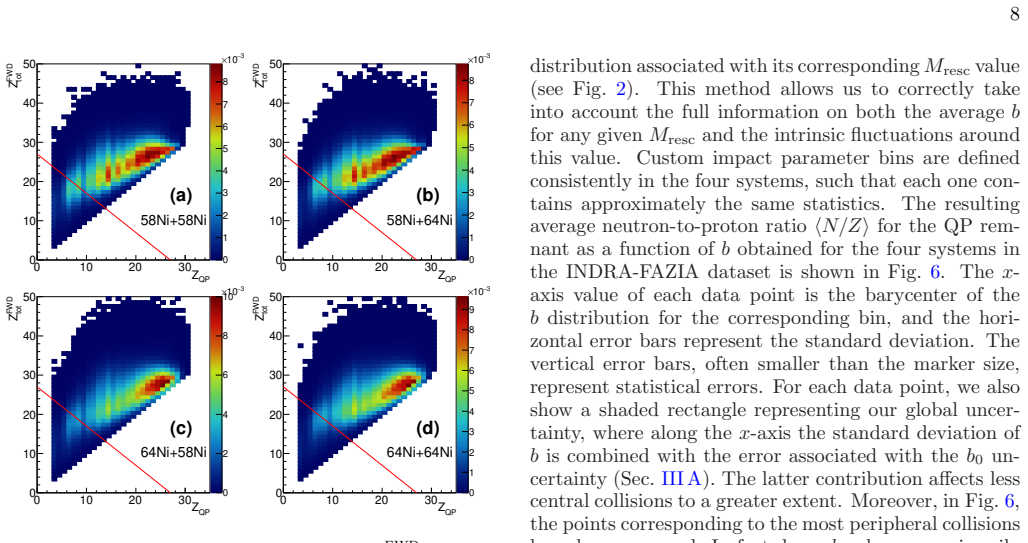
with the aforementioned parameter settings. This plot shows the important role of the intrinsic fluctuations, as relatively different selec- tions of our centrality observable can populate partly (or entirely) superimposed b intervals, particularly for less peripheral collisions. These results are valid for the reaction 58Ni+58Ni at 32 MeV/nucleon. However,...
-
[4]
in the four systems and the impact parameter b, extracted model-independently as explained in Sec. III. More specifically, in our analysis, each event is assigned an impact parameter value randomly drawn from the b distribution associated with its corresponding Mresc value (see Fig. 2). This method allows us to correctly take into account the full informat...
-
[5]
allows in all three cases to reproduce remarkably well the shape of the right tail of the 58Ni+58Ni M distri- bution. These rescaled multiplicities are then treated as the M for the 58Ni+58Ni reaction, and the information on the relationship between M and the impact parame- ter extracted for the latter is applied to all systems. Fig- ure 4 presents the co...
-
[6]
The vertical error bars, often smaller than the marker size, represent statistical errors
The x- axis value of each data point is the barycenter of the b distribution for the corresponding bin, and the hori- zontal error bars represent the standard deviation. The vertical error bars, often smaller than the marker size, represent statistical errors. For each data point, we also show a shaded rectangle representing our global uncer- tainty, wher...
Show all 60 references
-
[7]
completeness
Here the regular trend towards equilibration for increasing centrality is further highlighted, and is in general agreement with other observations available in the literature [ 20, 52], including our previous results of Refs. [ 21, 31], as detailed in Appendix A. The system de...
2023
-
[8]
Colonna, Progress in Particle and Nuclear Physics 113, 103775 (2020)
M. Colonna, Progress in Particle and Nuclear Physics 113, 103775 (2020)
2020
-
[9]
Yasin, S
H. Yasin, S. Sch¨ afer, A. Arcones, and A. Schwenk, Phys. Rev. Lett. 124, 092701 (2020)
2020
-
[10]
Margueron, R
J. Margueron, R. Hoffmann Casali, and F. Gulminelli, Phys. Rev. C 97, 025806 (2018)
2018
-
[11]
Burgio, H.-J
G. Burgio, H.-J. Schulze, I. Vida˜ na, and J.-B. Wei, Progress in Particle and Nuclear Physics 120, 103879 (2021)
2021
-
[12]
J. M. Lattimer and M. Prakash, Physics Reports 333-334, 121 (2000)
2000
-
[13]
S. Huth, P. T. H. Pang, I. Tews, T. Dietrich, A. Le F` evre, A. Schwenk, W. Trautmann, K. Agarwal, M. Bulla, M. W. Coughlin, and C. Van Den Broeck, Nature 606, 276 (2022)
2022
-
[14]
W. G. Lynch and M. B. Tsang, Physics Letters B 830, 137098 (2022)
2022
-
[15]
P. T. H. Pang, T. Dietrich, M. W. Coughlin, M. Bulla, I. Tews, M. Almualla, T. Barna, R. W. Kiendrebeogo, N. Kunert, G. Mansingh, B. Reed, N. Sravan, A. Toivo- nen, S. Antier, R. O. VandenBerg, J. Heinzel, V. Nedora, P. Salehi, R. Sharma, R. Somasundaram, and C. Van Den Broeck...
2023
-
[16]
C. Y. Tsang, M. B. Tsang, W. G. Lynch, R. Kumar, and C. J. Horowitz, Nature Astronomy 8, 328 (2024). 12
2024
-
[17]
Baran, M
V. Baran, M. Colonna, M. Di Toro, M. Zielinska-Pfab´ e, and H. H. Wolter, Phys. Rev. C 72, 064620 (2005)
2005
-
[18]
A. B. McIntosh and S. J. Yennello, Progress in Particle and Nuclear Physics 108, 103707 (2019)
2019
-
[19]
Lionti, V
R. Lionti, V. Baran, M. Colonna, and M. Di Toro, Phys. Lett. B 625, 33 (2005)
2005
-
[20]
Lombardo, C
I. Lombardo, C. Agodi, R. Alba, F. Amorini, A. An- zalone, I. Berceanu, G. Cardella, S. Cavallaro, M. B. Chatterjee, E. De Filippo, A. Di Pietro, P. Figuera, E. Geraci, G. Giuliani, L. Grassi, A. Grzeszczuk, J. Han, E. La Guidara, G. Lanzalone, N. Le Neindre, C. Maiolino, A. P...
2010
-
[21]
Barlini, S
S. Barlini, S. Piantelli, G. Casini, P. R. Mauren- zig, A. Olmi, M. Bini, S. Carboni, G. Pasquali, G. Poggi, A. A. Stefanini, R. Bougault, E. Bonnet, B. Borderie, A. Chbihi, J. D. Frankland, D. Gruyer, O. Lopez, N. Le Neindre, M. Pˆ arlog, M. F. Rivet, E. Vient, E. Rosato, G. ...
2013
-
[22]
Piantelli, G
S. Piantelli, G. Casini, A. Ono, G. Poggi, G. Pastore, S. Barlini, M. Bini, A. Boiano, E. Bonnet, B. Bor- derie, R. Bougault, M. Bruno, A. Buccola, A. Cama- iani, A. Chbihi, C. Ciampi, M. Cicerchia, M. Cinausero, M. Degerlier, J. A. Due˜ nas, Q. Fable, D. Fabris, J. D. Frankla...
2021
-
[23]
Fable, A
Q. Fable, A. Chbihi, J. D. Frankland, P. Napoli- tani, G. Verde, E. Bonnet, B. Borderie, R. Bougault, E. Galichet, T. G´ enard, D. Gruyer, M. Henri, M. La Commara, A. Le F` evre, J. Lemari´ e, N. Le Nein- dre, O. Lopez, P. Marini, M. Pˆ arlog, A. Rebillard-Souli´ e, W. Trautma...
2023
-
[24]
Johnston, T
H. Johnston, T. White, J. Winger, D. Rowland, B. Hurst, F. Gimeno-Nogues, D. O’Kelly, and S. Yen- nello, Physics Letters B 371, 186 (1996)
1996
-
[25]
Camaiani, G
A. Camaiani, G. Casini, S. Piantelli, A. Ono, E. Bon- net, R. Alba, S. Barlini, B. Borderie, R. Bougault, C. Ciampi, A. Chbihi, M. Cicerchia, M. Cinausero, J. A. Due˜ nas, D. Dell’Aquila, Q. Fable, D. Fabris, C. Frosin, J. D. Frankland, F. Gramegna, D. Gruyer, K. I. Hahn, M. H...
2021
-
[26]
Ciampi, S
C. Ciampi, S. Piantelli, G. Casini, G. Pasquali, J. Qu- icray, L. Baldesi, S. Barlini, B. Borderie, R. Bougault, A. Camaiani, A. Chbihi, D. Dell’Aquila, M. Cicerchia, J. A. Due˜ nas, Q. Fable, D. Fabris, J. D. Frankland, C. Frosin, T. G´ enard, F. Gramegna, D. Gruyer, M. Henri...
2022
-
[27]
Wolter, M
H. Wolter, M. Colonna, D. Cozma, P. Danielewicz, C. M. Ko, R. Kumar, A. Ono, M. B. Tsang, J. Xu, Y.-X. Zhang, E. Bratkovskaya, Z.-Q. Feng, T. Gaitanos, A. Le F` evre, N. Ikeno, Y. Kim, S. Mallik, P. Napolitani, D. Oli- inychenko, T. Ogawa, M. Papa, J. Su, R. Wang, Y.-J. Wang, ...
2022
-
[28]
Napolitani, M
P. Napolitani, M. Colonna, F. Gulminelli, E. Galichet, S. Piantelli, G. Verde, and E. Vient, Phys. Rev. C 81, 044619 (2010)
2010
-
[29]
F. Rami, Y. Leifels, B. de Schauenburg, A. Gobbi, B. Hong, J. P. Alard, A. Andronic, R. Averbeck, V. Bar- ret, Z. Basrak, N. Bastid, I. Belyaev, A. Bendarag, G. Berek, R. ˇCaplar, N. Cindro, P. Crochet, A. De- vismes, P. Dupieux, M. Dˇ zelalija, M. Eskef, C. Finck, Z. Fodor, H...
2000
-
[30]
M. B. Tsang, T. X. Liu, L. Shi, P. Danielewicz, C. K. Gelbke, X. D. Liu, W. G. Lynch, W. P. Tan, G. Verde, A. Wagner, H. S. Xu, W. A. Friedman, L. Beaulieu, B. Davin, R. T. de Souza, Y. Larochelle, T. Lefort, R. Yanez, V. E. Viola, R. J. Charity, and L. G. Sobotka, Phys. Rev. ...
2004
-
[32]
T. X. Liu, W. G. Lynch, M. B. Tsang, X. D. Liu, R. Shomin, W. P. Tan, G. Verde, A. Wag- ner, H. F. Xi, H. S. Xu, B. Davin, Y. Larochelle, R. T. de Souza, R. J. Charity, and L. G. Sobotka, Phys. Rev. C 76, 034603 (2007)
2007
-
[33]
M. B. Tsang, Y. Zhang, P. Danielewicz, M. Fami- ano, Z. Li, W. G. Lynch, and A. W. Steiner, Phys. Rev. Lett. 102, 122701 (2009)
2009
-
[34]
D. D. S. Coupland, W. G. Lynch, M. B. Tsang, P. Danielewicz, and Y. Zhang, Phys. Rev. C 84, 054603 (2011)
2011
-
[35]
Camaiani, S
A. Camaiani, S. Piantelli, A. Ono, G. Casini, B. Bor- derie, R. Bougault, C. Ciampi, J. A. Due˜ nas, C. Frosin, J. D. Frankland, D. Gruyer, N. LeNeindre, I. Lombardo, G. Mantovani, P. Ottanelli, M. Parlog, G. Pasquali, S. Upadhyaya, S. Valdr´ e, G. Verde, and E. Vient, Phys. R...
2020
-
[37]
Fable, L
Q. Fable, L. Baldesi, S. Barlini, E. Bonnet, B. Bor- derie, R. Bougault, A. Camaiani, G. Casini, A. Chbihi, C. Ciampi, J. A. Due˜ nas, J. D. Frankland, T. G´ enard, D. Gruyer, M. Henri, B. Hong, S. Kim, A. J. Kordyasz, T. Kozik, A. Le F` evre, N. Le Neindre, I. Lombardo, O. Lo...
2024
-
[38]
Mallik, F
S. Mallik, F. Gulminelli, and D. Gruyer, J. Phys. G: Nucl. Part. Phys. 49, 015102 (2021)
2021
-
[39]
Piantelli, A
S. Piantelli, A. Olmi, P. R. Maurenzig, A. Ono, M. Bini, G. Casini, G. Pasquali, A. Mangiarotti, G. Poggi, A. A. Stefanini, S. Barlini, A. Camaiani, C. Ciampi, C. Frosin, P. Ottanelli, and S. Valdr´ e, Phys. Rev. C 99, 064616 (2019)
2019
-
[40]
L. Li, Y. Zhang, Z. Li, N. Wang, Y. Cui, and J. Winkel- bauer, Phys. Rev. C 97, 044606 (2018)
2018
-
[41]
J. D. Frankland, D. Gruyer, E. Bonnet, B. Borderie, R. Bougault, A. Chbihi, J. E. Ducret, D. Durand, Q. Fa- ble, M. Henri, J. Lemari´ e, N. Le Neindre, I. Lom- bardo, O. Lopez, L. Manduci, M. Pˆ arlog, J. Quicray, G. Verde, E. Vient, and M. Vigilante (INDRA Collabo- ration), P...
2021
-
[42]
Cavata, M
C. Cavata, M. Demoulins, J. Gosset, M.-C. Lemaire, D. L’Hˆ ote, J. Poitou, and O. Valette, Phys. Rev. C 42, 1760 (1990)
1990
-
[43]
S. J. Das, G. Giacalone, P.-A. Monard, and J.-Y. Olli- trault, Phys. Rev. C 97, 014905 (2018)
2018
-
[44]
Rogly, G
R. Rogly, G. Giacalone, and J.-Y. Ollitrault, Phys. Rev. C 98, 024902 (2018)
2018
-
[45]
X. Chen, L. Li, Y. Cui, J. Yang, Z. Li, and Y. Zhang, Phys. Rev. C 108, 034613 (2023)
2023
-
[46]
Pouthas, B
J. Pouthas, B. Borderie, R. Dayras, E. Plagnol, M. Rivet, F. Saint-Laurent, J. Steckmeyer, G. Auger, C. Bacri, S. Barbey, A. Barbier, A. Benkirane, J. Ben- lliure, B. Berthier, E. Bougamont, P. Bourgault, P. Box, R. Bzyl, B. Cahan, Y. Cassagnou, D. Charlet, J. Charvet, A. Chbi...
1995
-
[47]
Pouthas, A
J. Pouthas, A. Bertaut, B. Borderie, P. Bour- gault, B. Cahan, G. Carles, D. Charlet, D. Cussol, R. Dayras, M. Engrand, O. Jouniaux, P. Le Botlan, A. Leconte, P. Lelong, L. Martina, P. Mosrin, L. Olivier, J. Passerieux, B. Piquet, E. Plagnol, E. Plaige, B. Raine, A. Richard, F...
1996
-
[48]
Cussol, T
D. Cussol, T. Lefort, J. P´ eter, G. Auger, C. O. Bacri, F. Bocage, B. Borderie, R. Bougault, R. Brou, P. Buchet, J. L. Charvet, A. Chbihi, J. Colin, R. Dayras, A. De- meyer, D. Dor´ e, D. Durand, P. Eudes, E. de Filippo, J. D. Frankland, E. Galichet, E. Genouin-Duhamel, E. Ge...
2002
-
[49]
Bougault, G
R. Bougault, G. Poggi, S. Barlini, B. Borderie, G. Casini, A. Chbihi, N. Le Neindre, M. Pˆ arlog, G. Pasquali, S. Pi- antelli, Z. Sosin, G. Ademard, R. Alba, A. Anastasio, S. Barbey, L. Bardelli, M. Bini, A. Boiano, M. Boisjoli, E. Bonnet, R. Borcea, B. Bougard, G. Brulin, M. ...
2014
-
[50]
Valdr´ e, G
S. Valdr´ e, G. Casini, N. Le Neindre, M. Bini, A. Boiano, B. Borderie, P. Edelbruck, G. Poggi, F. Salomon, G. Tor- tone, R. Alba, S. Barlini, E. Bonnet, B. Bougard, R. Bougault, G. Brulin, M. Bruno, A. Buccola, A. Ca- maiani, A. Chbihi, C. Ciampi, M. Cicerchia, M. Cin- ausero...
2019
-
[51]
Casini and N
G. Casini and N. Le Neindre, Nuclear Physics News 32, 24 (2022)
2022
-
[52]
Wittwer, Clock event number transmitter receiver uni- 14 versal module, user’s manual, GANIL (2004)
G. Wittwer, Clock event number transmitter receiver uni- 14 versal module, user’s manual, GANIL (2004)
2004
-
[53]
J. D. Frankland, N. Le Neindre, M. Henri, A. Chbihi, Q. Fable, C. Gouyet, R. Revenko, Q. Beau- douin, R. Bougault, P. Bourgault, T. Genard, V. Godefroid, D. Gruyer, J. Lemari´ e, L. Leterrier, O. Lopez, E. Loubeau, F. Marie-Saillenfest, C. Nicolle, F. Noury, J. Perronnel, M. P...
2022
-
[54]
Vient, L
E. Vient, L. Manduci, E. Legou´ ee, L. Augey, E. Bon- net, B. Borderie, R. Bougault, A. Chbihi, D. Dell’Aquila, Q. Fable, L. Francalanza, J. D. Frankland, E. Galichet, D. Gruyer, D. Guinet, M. Henri, M. La Commara, G. Lehaut, N. Le Neindre, I. Lombardo, O. Lopez, P. Marini, M....
2018
-
[55]
Sihver, M
L. Sihver, M. Lantz, and A. Kohama, Phys. Rev. C 89, 067602 (2014)
2014
-
[56]
Lombardo, C
I. Lombardo, C. Agodi, F. Amorini, A. Anzalone, L. Auditore, I. Berceanu, G. Cardella, S. Cavallaro, M. B. Chatterjee, E. De Filippo, E. Geraci, G. Giu- liani, L. Grassi, J. Han, E. La Guidara, D. Lo- ria, G. Lanzalone, C. Maiolino, A. Pagano, M. Papa, S. Pirrone, G. Politi, F...
2011
-
[57]
Z. Y. Sun, M. B. Tsang, W. G. Lynch, G. Verde, F. Amorini, L. Andronenko, M. Andronenko, G. Cardella, M. Chatterje, P. Danielewicz, E. De Filippo, P. Dinh, E. Galichet, E. Geraci, H. Hua, E. La Guidara, G. Lanzalone, H. Liu, F. Lu, S. Lukyanov, C. Maiolino, A. Pagano, S. Piant...
2010
-
[58]
Margueron, R
J. Margueron, R. Hoffmann Casali, and F. Gulminelli, Phys. Rev. C 97, 025805 (2018)
2018
-
[59]
A. Ono, H. Horiuchi, T. Maruyama, and A. Ohnishi, Prog. Theor. Phys. 87, 1185 (1992)
1992
-
[60]
R. J. Charity, Phys. Rev. C 82, 014610 (2010)
2010
Reviewed August 11, 2026 · model on record in the stance chip above.
Discussion (0). Continue with ORCID to comment.