REVIEW 4 major objections 5 minor 63 references
Open Superclusters II. Discovery of an Inactive Supercluster Including a New Star Cluster in the Solar Neighborhood
T0 review · 4 major / 5 minor · reviewed 2026-08-11 · deepseek-v4-flash
Pith's one-line read A previously unknown supercluster, HC8, lies within 500 pc of the Sun and includes a new cluster, Duvia 1.
desk verdict Plausible new supercluster and a genuinely new cluster with a public member list, but the grouping rests on untested thresholds; worth refereeing with a request for a randomized-catalog null test. read the letter →
The pith
A machine-rendered reading of the paper's core claim, the machinery that carries it, and where it could break.
The reading
What carries the argument
The central object is the open supercluster (OSC), defined as a primordial group of six or more star clusters that share spatial proximity and kinematic coherence and are presumed to have formed from the same giant molecular cloud. The identification rests on a three-step procedure: a by-eye overdensity search of the HR24 cluster catalog built from Gaia astrometry; filtering of candidates with thresholds of a maximum radius of 150 pc from the group center, a maximum tangential-velocity deviation of 10 km/s, and a radial-velocity span below 20 km/s; and a consistency check using ages and backward orbital integration with the galpy galactic model. The machinery converts a sparse set of cluster positions and velocities into a claim about a common birth cloud, with the 7 Myr minimum in the supercluster's characteristic size serving as the direct dynamical evidence for a common origin.
What would settle it
Apply the paper's grouping criteria (150 pc radius, 10 km/s tangential-velocity offset, 20 km/s radial-velocity span) to Monte-Carlo shuffled versions of the HR24 catalog with the same spatial and kinematic distributions; if random catalogs produce HC8-like groupings at a non-negligible rate, the supercluster could be a chance alignment, while a near-zero rate would support its reality. A complementary observational check is to measure radial velocities of the fainter members of Duvia 1: if the true 3D velocity dispersion substantially exceeds the paper's 0.58 km/s estimate, the cluster is even more clearly unbound, whereas a much lower dispersion would reopen the question of whether it is bound.
Extended reading notes
Core claim
The central claim is that HC8 is a newly identified open supercluster (OSC), a primordial group of six or more clusters sharing a common origin, located in the second Galactic quadrant within 500 pc of the Sun. The group comprises eleven member clusters – OCSN 40, OCSN 41, CWNU 523, Alessi 20, NGC 7429, Stock 12, Theia 391, HSC 899, RSG 8, RSG 7, and the newly discovered Duvia 1 – spanning distances of 0.33 to 0.48 kpc, ages from roughly 7 to 150 Myr, and radial velocities from $-17$ to $-3$ km/s. The paper establishes the supercluster's coherence through spatial proximity, kinematic coherence in proper motion and radial velocity, and age consistency: despite age not being a selection criterion, all likely members are younger than about 150 Myr. Backward orbital integration of the eleven clusters shows they were significantly more compact about 7 Myr ago, matching the photometric ages of the youngest subgroup, and the region contains no O- or early-B stars or H ii regions, indicating that star formation has been inactive for several million years. The paper also introduces Duvia 1, a 53-member moving group at 0.43 kpc with an age of $8\pm2$ Myr and an estimated virial mass at least an order of magnitude above its stellar mass, so it is unbound and dispersing.
Load-bearing premise
HC8's reality rests on the paper's adopted grouping thresholds – a maximum radius of 150 pc, a maximum tangential-velocity offset of 10 km/s, and a radial-velocity span under 20 km/s; if these thresholds are too permissive, the eleven clusters could be a chance alignment of unrelated objects in the same spiral arm rather than a single primordial group.
Editorial extensions
If this is right
- HC8 adds a sixth open supercluster within 500 pc of the Sun, strengthening the picture that the local Galactic disk is threaded by hierarchical, co-moving groups of clusters with a shared origin.
- Because HC8 contains no massive O/B stars and no H ii regions, open superclusters can remain detectable as kinematic entities well after star formation has ceased, extending the lifetime over which such structures can be found to a few hundred Myr.
- The age spread of roughly 7 to 150 Myr among HC8 members, with at least three distinct generations visible in the composite color–magnitude diagram, implies that a single giant molecular cloud can form stars episodically for about 100 Myr.
- The new cluster Duvia 1 is unbound by an order of magnitude, supporting the view that most young clusters in the solar neighborhood are transient moving groups that dissolve within tens of Myr, leaving only a few bound clusters such as Stock 12, Alessi 20, and RSG 8.
Reading between the lines
- The selection thresholds (150 pc, 10 km/s, 20 km/s) are adopted from prior literature, so a natural test is to measure how often random catalogs with the same spatial and velocity distributions produce groupings as tight as HC8; if the false-positive rate is comparable to one, the supercluster identification would be weakened. This is the editor's check, not the paper's.
- If HC8 is real, similar 'inactive' superclusters with no ongoing star formation should be discoverable elsewhere in the Gaia catalogs; searching for clusters that are kinematically coherent but lack young massive stars could reveal a larger population of primordial groups.
- The mass–member-count proportionality found for HR24 clusters in the relevant parallax range suggests a cheap way to estimate masses of sparse clusters beyond HC8, provided the systematic distance–mass trend noted by the authors is corrected.
- The three-generation age pattern in HC8 invites comparison with the age spreads seen in the Vela and Orion star-forming regions, and a testable prediction is that other superclusters will show similar episodic star formation histories rather than a single burst.
Signed reviews
Editorial analysis
A structured set of objections, weighed in public.
Referee Report
Summary. This manuscript reports the discovery of HC8, a new open supercluster (OSC) within about 500 pc of the Sun, and of Duvia 1, a new cluster inside it. The authors select HC8 candidates by eye from an overdensity plot of clusters younger than 25 Myr in the HR24 catalog, then apply fixed kinematic and spatial thresholds: a maximum radius of 150 pc, a maximum tangential-velocity deviation of 10 km/s, an RV span below 20 km/s, and 2-sigma agreement in five astrometric dimensions (Section 2, Eqs. 1-2). They characterize the 11 adopted members with ages, distances, extinctions, and kinematics, derive a membership list for Duvia 1, estimate its mass and virial state, and use backward orbital integration with galpy to argue that the system was more compact about 7 Myr ago. The paper concludes that HC8 is the remnant of a hierarchically structured primordial group that formed stars over roughly 100 Myr and is now dispersing.
Significance. If HC8 is a genuine primordial group, it is a valuable nearby example of hierarchical star formation: a system spanning 0.33-0.48 kpc, with ages from about 7 to 150 Myr and 11 clusters or moving groups that plausibly share a common origin. The paper has real strengths: a reproducible member table for Duvia 1 (Table A.1), consistency of its distance from four independent methods, use of pre-existing cluster catalogs as independent checks, and a clear statement of the derived parameters in Table 1. The significance is, however, conditional on the statistical robustness of the group identification. The central claim rests on a by-eye overdensity selection and fixed thresholds that are never tested against a null model, and the dynamical convergence is not compared with random realizations. These are load-bearing gaps that a revision can address with randomized-catalog and synthetic-cluster tests.
major comments (4)
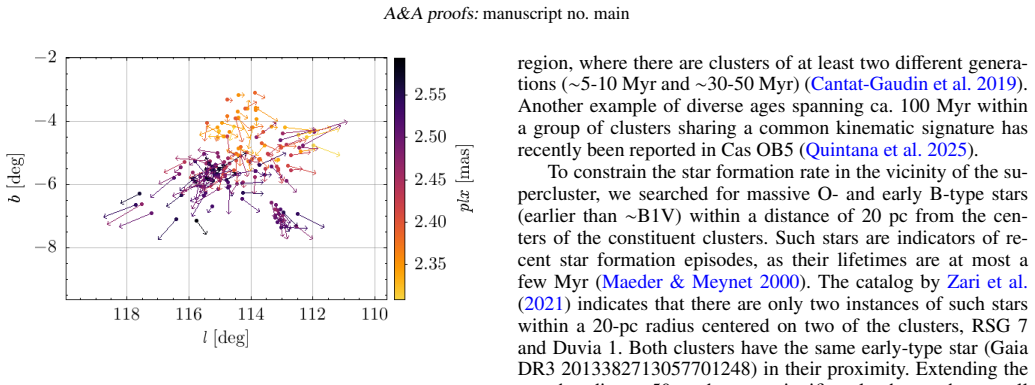
- [§2, Eqs. (1)-(2), Fig. 1] The central claim that HC8 is a physical primordial group is not tested against a null hypothesis. Candidates are first selected by eye from an overdensity plot and then retained using fixed thresholds (R <= 150 pc, |Δv_tan| <= 10 km/s, RV span < 20 km/s, 2 sigma in five dimensions) that are adopted from the literature. HR24 contains thousands of clusters concentrated in the Galactic plane; a 150 pc and 10 km/s box around a few clusters can plausibly capture unrelated clusters that merely share Galactic rotation. The manuscript provides no estimate of the false-positive rate of the full selection on randomized cluster catalogs, such as scrambled positions or PMs, or synthetic cluster populations. I request a null test that measures how often the same procedure produces a comparable 11-member OSC from random data, and a statement of the expected number of chance superclusters in the surveyed volume.
- [§3.4, Fig. 9] The backward-integration minimum at approximately -7 Myr is presented as evidence of common origin, but only an internal 68% confidence interval is shown. The Monte Carlo sampling of the observed quantities and the bootstrap resampling quantify the uncertainty in the measured positions and velocities; they do not answer whether a comparable minimum occurs for random sets of clusters drawn from the same catalog and integrated in the same potential. A significance estimate should compare the observed minimum depth and location with an ensemble of unrelated cluster configurations, for example clusters matched in distance and velocity dispersion but not selected as a spatial overdensity. As written, the convergence test is suggestive but cannot by itself certify that HC8 was more compact in the past.
- [§2 and §3.1, Fig. 1] The statement in Section 2 that age consistency is independent evidence for membership is weakened by the selection procedure. The overdensity search in Fig. 1 was seeded with clusters younger than or equal to 25 Myr, and the membership filtering then retained only clusters within 150 pc and 10 km/s. The subsequent finding that the selected candidates are young is therefore in part a consequence of the input selection. The paper should quantify the age distribution of HR24 clusters in the same volume that are not selected, or otherwise demonstrate that the young ages of HC8 members exceed what is expected from the parent catalog.
- [§3.3, Fig. 8] The mass estimate for Duvia 1 relies on a parallax-range cut (plx = 2-3 mas) that is introduced post hoc because the HR24 masses increase significantly with distance, which the text itself calls unphysical. The choice of cut directly determines the N-mass relation used to infer roughly 50 solar masses for Duvia 1, and no independent calibration of the cut is given. Because the virial argument for unbound status compares this mass with the approximate 750 solar mass required for binding, the paper should (a) justify or independently calibrate the plx cut, (b) show the N-mass relation without the cut and with alternative cuts, and (c) state the resulting range of Duvia 1 masses. The conclusion that Duvia 1 is unbound is robust only if it survives that range.
minor comments (5)
- [Table 1, 'Clump' row] The row for the additional moving group reports 'too few members' for several columns, but Section 3.3 states that the constraints defining its members are summarized in Table 1; please either provide the measured values with uncertainties or remove the row and refer to the text.
- [§2, Eqs. (3)-(5)] The notation mixes cluster indices i, star indices n, and unsubscripted l, b, plx in the expected-PM equations; please write the coordinates and parallax with explicit indices to make the formulas unambiguous and reproducible.
- [§3.4] The text says 'we have generate 1000 bootstrapped samples'; this should be corrected, and the description should state whether resampling is performed over clusters or over stars so that the procedure is reproducible.
- [§3.2 and §3.3] The list of less likely HC8 candidates (ASCC 123, ASCC 127, CWNU 1055, LISC 3534, Theia 322, Theia 446, Theia 1232, OCSN 28, OCSN 36, HSC 873, HSC 895, HSC 931) is given only in prose; a small table or annotated figure would make the filtering transparent.
- [Eq. (7)] Equation (7) appears to have a missing symbol between 'M' and 'v2×R/G'; the intended expression is presumably M ≈ v^2 R / G, and the typesetting should be fixed.
Circularity Check
Mild self-definitional confirmation: HC8's fit to the Section 2 thresholds restates its own selection criteria, but the common-origin claim retains independent support.
-
self definitional
[Section 2 (Eqs. 1–2) and Section 3.2, after Fig. 4]
"The span in RV of 14 km/s also matches our estimated span in tangential velocity (16 km/s) obtained from the PMs of the clusters’ stars (Figure 4). All these values are typical of OSCs (Casado & Hendy 2024) and fit comfortably within the constraints detailed in Section 2."
The 'constraints detailed in Section 2' (maximum radius 150 pc, maximum tangential-velocity deviation 10 km/s, RV span <20 km/s, and 2σ agreement) are the same criteria used to select the HC8 candidate clusters in the first place. Reporting that HC8's measured spans fall inside these limits is therefore a restatement of the selection procedure rather than an independent test that HC8 is an OSC. The adjacent appeal to 'typical of OSCs (Casado & Hendy 2024)' invokes a self-citation to the paper that defined OSCs using these very thresholds.
full rationale
The paper's central claim—that HC8 is a newly identified open supercluster with a common primordial origin—does not reduce entirely to its own inputs. The candidate list is assembled from external Gaia-based cluster catalogs (HR24, He et al. 2022a, Cantat-Gaudin et al. 2020), the by-eye overdensity search is applied to the published catalog data, and the new cluster Duvia 1 is characterized independently by vector-point-diagram overdensity, isochrone fitting, and multi-wavelength distance checks. The dynamical backward-integration minimum and the age-dynamics agreement for Alessi 20, HSC 899, and Duvia 1 are genuine post-selection tests that could in principle have failed. The main circularity is confined to one validation sentence where the membership constraints used for selection (Eqs. 1–2 plus the RV cut) are quoted as evidence that HC8 'fits' the definition of an OSC; this is a self-definitional consistency check, not an independent confirmation. The reliance on Casado & Hendy (2024) for what counts as 'typical' OSC parameters is a self-citation, but it is not load-bearing for the physical-common-origin argument. The absence of a randomized-catalog false-positive test is a correctness risk rather than a circularity, since the thresholds come from external literature and are not fitted to the target group. Overall, the central claim retains independent content, so the circularity score is moderate rather than severe.
Assumptions & free parameters
free parameters (5)
- Duvia 1 age (log t) =
6.9 ± 0.1 (about 8 ± 2 Myr)
- Duvia 1 extinction A_V =
0.90 ± 0.12 mag
- Duvia 1 distance modulus (m-M)0 =
8.14 mag (d_phot = 425 pc)
- OSC selection thresholds (R_max, Δv_tan,max, ΔRV_max) =
150 pc, 10 km/s, 20 km/s
- Mass calibration parallax range =
2 to 3 mas
assumptions (4)
- domain assumption An OSC is a primordial group of six or more clusters that are spatially proximate and kinematically coherent (Casado & Hendy 2024).
- domain assumption The thresholds of 150 pc, 10 km/s, and 20 km/s separate physical groupings from chance alignments.
- domain assumption Backward integration of cluster centers as point masses in a smooth, static Milky Way potential (galpy) adequately approximates their past orbits over about 20 Myr.
- domain assumption Solar metallicity Z=0.0152 is appropriate for fitting Duvia 1 and the HC8 clusters.
invented entities (2)
-
Duvia 1
independent evidence
-
HC8
independent evidence
Cite this review
Pith. "Pith review of Open Superclusters II. Discovery of an Inactive Supercluster Including a New Star Cluster in the Solar Neighborhood." pith.science (2026). https://pith.science/paper/AAZIELOV
@misc{pith2026241213727,
  author       = {Pith},
  title        = {Pith review of: Open Superclusters II. Discovery of an Inactive Supercluster Including a New Star Cluster in the Solar Neighborhood},
  year         = {2026},
  howpublished = {\url{https://pith.science/paper/AAZIELOV}},
  note         = {Machine review of arXiv:2412.13727}
}
read the original abstract
The number of known star clusters, associations, and moving groups in the vicinity of the Sun has increased significantly due to the use of Gaia data. We investigated the existence and properties of open superclusters (OSC) within 500 pc of the Sun, with a particular focus on a newly identified OSC, designated HC8. Using advanced Gaia-derived astrometric data and star cluster catalogs, we identify and analyze member stars of various clusters, deriving key parameters such as ages, distances, extinctions, and kinematic properties. Our findings reveal that HC8, a previously unrecognized OSC, encompasses several young clusters, including the newly discovered cluster Duvia 1. We provide a detailed examination of HC8's star formation history and its spatial and kinematic characteristics. This study contributes to the growing body of evidence supporting the existence of highly populated primordial groups and enhances our understanding of the formation and evolution of star clusters in the Galaxy.
Figures


Figures from the paper (6 more)


Reference graph
Works this paper leans on
-
[1]
, " * write output.state after.block = add.period write newline
ENTRY address archiveprefix author booktitle chapter edition editor howpublished institution eprint journal key month note number organization pages publisher school series title type volume year label extra.label sort.label short.list INTEGERS output.state before.all mid.sentence after.sentence after.block FUNCTION init.state.consts #0 'before.all := #1 ...
-
[2]
write newline
" write newline "" before.all 'output.state := FUNCTION n.dashify 't := "" t empty not t #1 #1 substring "-" = t #1 #2 substring "--" = not "--" * t #2 global.max substring 't := t #1 #1 substring "-" = "-" * t #2 global.max substring 't := while if t #1 #1 substring * t #2 global.max substring 't := if while FUNCTION word.in bbl.in " " * FUNCTION format....
-
[3]
Am \^o res , E. B., Jesus , R. M., Moitinho , A., et al. 2021, , 508, 1788
work page 2021
-
[4]
Anders , F., Khalatyan , A., Queiroz , A. B. A., et al. 2022, , 658, A91
work page 2022
-
[5]
Bailer-Jones , C. A. L., Rybizki , J., Fouesneau , M., Demleitner , M., & Andrae , R. 2021, , 161, 147
2021
-
[6]
Beccari , G., Boffin , H. M. J., & Jerabkova , T. 2020, , 491, 2205
work page 2020
-
[7]
2015, , 216, 29
Bovy , J. 2015, , 216, 29
2015
-
[8]
2012, , 427, 127
Bressan , A., Marigo , P., Girardi , L., et al. 2012, , 427, 127
2012
Show all 63 references
-
[9]
& Chanam \'e , J
Brice \ n o-Morales , G. & Chanam \'e , J. 2023, , 522, 1288
2023
-
[10]
2016, , 455, 3126
Camargo , D., Bica , E., & Bonatto , C. 2016, , 455, 3126
2016
-
[11]
2020, , 640, A1
Cantat-Gaudin , T., Anders , F., Castro-Ginard , A., et al. 2020, , 640, A1
2020
-
[12]
J., et al
Cantat-Gaudin , T., Jordi , C., Wright , N. J., et al. 2019, , 626, A17
2019
-
[13]
2021, Astronomy Reports, 65, 755
Casado , J. 2021, Astronomy Reports, 65, 755
2021
-
[14]
2022, Universe, 8, 113
Casado , J. 2022, Universe, 8, 113
2022
-
[15]
& Hendy , Y
Casado , J. & Hendy , Y. 2023, , 521, 1399
2023
-
[16]
& Hendy , Y
Casado , J. & Hendy , Y. 2024, , 687, A52
2024
-
[17]
2020, , 635, A45
Castro-Ginard , A., Jordi , C., Luri , X., et al. 2020, , 635, A45
2020
-
[18]
2018, , 618, A59
Castro-Ginard , A., Jordi , C., Luri , X., et al. 2018, , 618, A59
2018
-
[19]
D., Kharchenko , N
Conrad , C., Scholz , R. D., Kharchenko , N. V., et al. 2017, , 600, A106
2017
-
[20]
& de la Fuente Marcos , C
de la Fuente Marcos , R. & de la Fuente Marcos , C. 2009, , 700, 436
2009
-
[21]
Efremov , Y. N. & Sitnik , T. G. 1988, Soviet Astronomy Letters, 14, 347
1988
-
[22]
Elmegreen , B. G. 2009, , 324, 83
2009
-
[23]
M., Elmegreen , B
Elmegreen , D. M., Elmegreen , B. G., Adamo , A., et al. 2014, , 787, L15
2014
-
[24]
& Kroupa , P
Fellhauer , M. & Kroupa , P. 2005, , 630, 879
2005
-
[25]
Gaia Collaboration , Prusti , T., de Bruijne , J. H. J., et al. 2016, , 595, A1
2016
-
[26]
Gaia Collaboration , Vallenari , A., Brown , A. G. A., et al. 2023, , 674, A1
2023
-
[27]
M., Schlafly , E., Zucker , C., Speagle , J
Green , G. M., Schlafly , E., Zucker , C., Speagle , J. S., & Finkbeiner , D. 2019, , 887, 93
2019
-
[28]
Gusev , A. S. & Efremov , Y. N. 2013, , 434, 313
2013
-
[29]
J., Xu , Y., Wu , Z
Hao , C. J., Xu , Y., Wu , Z. Y., et al. 2022, , 660, A4
2022
-
[30]
2022 a , , 260, 8
He , Z., Li , C., Zhong , J., et al. 2022 a , , 260, 8
2022
-
[31]
2022 b , , 262, 7
He , Z., Wang , K., Luo , Y., et al. 2022 b , , 262, 7
2022
-
[32]
Hunt , E. L. & Reffert , S. 2023, , 673, A114
2023
-
[33]
Hunt , E. L. & Reffert , S. 2024, , 686, A42
2024
-
[34]
A., Berczik , P., et al
Ishchenko , M., Kovaleva , D. A., Berczik , P., et al. 2024, , 686, A225
2024
-
[35]
V., Piskunov , A
Kharchenko , N. V., Piskunov , A. E., R \"o ser , S., Schilbach , E., & Scholz , R. D. 2005, , 438, 1163
2005
-
[36]
Kovaleva , D. A. 2023, Astronomy Reports, 67, 938
2023
-
[37]
Lada , C. J. & Lada , E. A. 2003, , 41, 57
2003
-
[38]
L., et al
Lallement , R., Babusiaux , C., Vergely , J. L., et al. 2019, , 625, A135
2019
-
[39]
A., Hern \'a ndez , J., et al
Lindegren , L., Klioner , S. A., Hern \'a ndez , J., et al. 2021, , 649, A2
2021
-
[40]
& Pang , X
Liu , L. & Pang , X. 2019, , 245, 32
2019
-
[41]
Luhman , K. L. 2022, , 163, 24
2022
-
[42]
& Meynet, G
Maeder, A. & Meynet, G. 2000, Annual Review of Astronomy and Astrophysics, 38, 143
2000
-
[43]
Miret-Roig , N., Galli , P. A. B., Olivares , J., et al. 2022, , 667, A163
2022
-
[44]
2022, , 931, 156
Pang , X., Tang , S.-Y., Li , Y., et al. 2022, , 931, 156
2022
-
[45]
2021, , 923, 20
Pang , X., Yu , Z., Tang , S.-Y., et al. 2021, , 923, 20
2021
-
[46]
Pavlidou , T., Scholz , A., & Teixeira , P. S. 2021, , 503, 3232
2021
-
[47]
I., Pera , M
Perren , G. I., Pera , M. S., Navone , H. D., & V \'a zquez , R. A. 2023, , 526, 4107
2023
-
[48]
I., V \'a zquez , R
Perren , G. I., V \'a zquez , R. A., & Piatti , A. E. 2015, , 576, A6
2015
-
[49]
& Paunzen , E
Piecka , M. & Paunzen , E. 2021, , 649, A54
2021
-
[50]
E., Kharchenko , N
Piskunov , A. E., Kharchenko , N. V., R \"o ser , S., Schilbach , E., & Scholz , R. D. 2006, , 445, 545
2006
-
[51]
F., McMillan , S
Portegies Zwart , S. F., McMillan , S. L. W., & Gieles , M. 2010, , 48, 431
2010
-
[52]
2023, , 265, 12
Qin , S., Zhong , J., Tang , T., & Chen , L. 2023, , 265, 12
2023
-
[53]
L., Negueruela , I., & Berlanas , S
Quintana , A. L., Negueruela , I., & Berlanas , S. R. 2025, , 697, A47
2025
-
[54]
E., Kharchenko , N
R \"o ser , S., Schilbach , E., Piskunov , A. E., Kharchenko , N. V., & Scholz , R. D. 2011, , 531, A92
2011
-
[55]
2024, , 534, 2566
S \'a nchez-Sanju \'a n , S., Hern \'a ndez , J., P \'e rez-Villegas , \'A ., et al. 2024, , 534, 2566
2024
-
[56]
H., Ann , H
Sim , G., Lee , S. H., Ann , H. B., & Kim , S. 2019, Journal of Korean Astronomical Society, 52, 145
2019
-
[57]
2006, , 132, 1645
Steinmetz , M., Zwitter , T., Siebert , A., et al. 2006, , 132, 1645
2006
-
[58]
2024, , 631, 49
Swiggum , C., Alves , J., Benjamin , R., et al. 2024, , 631, 49
2024
-
[59]
2021, , 917, 21
Swiggum , C., D'Onghia , E., Alves , J., et al. 2021, , 917, 21
2021
-
[60]
Taylor , M. B. 2005, in Astronomical Society of the Pacific Conference Series, Vol. 347, Astronomical Data Analysis Software and Systems XIV, ed. P. Shopbell , M. Britton , & R. Ebert , 29
2005
-
[61]
Vallado , D. A. 2007, Fundamentals of Astrodynamics and Applications
2007
-
[62]
Vereshchagin , S. V. & Chupina , N. V. 2023, Astronomy Reports, 67, 336
2023
-
[63]
W., Frankel , N., et al
Zari , E., Rix , H. W., Frankel , N., et al. 2021, , 650, A112
2021
Reviewed August 11, 2026 · model on record in the stance chip above.
Discussion (0). Continue with ORCID to comment.