REVIEW 3 major objections 4 minor 2 cited by
Tensor-network decoders for process tensor descriptions of non-Markovian noise
T0 review · 3 major / 4 minor · reviewed 2026-08-11 · deepseek-v4-flash
Pith's one-line read The paper shows that for a stabiliser code driven by process-tensor noise, the maximum-likelihood decoder and its logical failure rate follow from one tensor-network contraction, and that an MPS approximation reproduces exact results in…
desk verdict A genuinely new tensor-network construction for ML decoding under process-tensor noise, but the success metric in Eq. (45) is missing a normalization that the authors need to fix before the reported failure rates can be trusted. read the letter →
The pith
A machine-rendered reading of the paper's core claim, the machinery that carries it, and where it could break.
The reading
What carries the argument
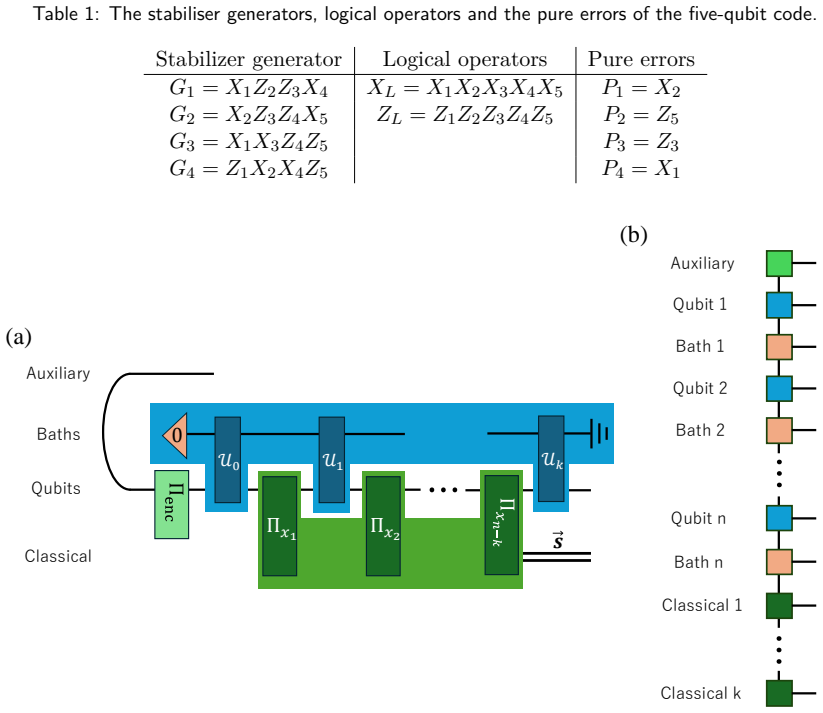
The load-bearing objects are the process tensor and the tester. The process tensor is a multi-time generalisation of a quantum channel: a single Choi state over a chain of input and output Hilbert spaces that encodes the device's full spatiotemporal noise correlations, including memory and crosstalk. The tester is the corresponding generalisation of a measurement instrument: a sequence of completely positive maps with a classical memory, which is what lets the recovery operation depend on the earlier syndrome outcomes. The argument combines these with the encoder and decoder through the link product, producing one tensor network whose contraction equals $\chi_{HS}(L,\vec{s})$; the maximum-likelihood decoder is obtained by reading off the $L$ that maximises this quantity for each syndrome, and $p_{\mathrm{fail}}$ is obtained from the same contraction. The efficient variant approximates the process tensor and tester by matrix product states, truncating small singular values in canonical form, so that the computational cost is controlled by a bond dimension rather than by the full Hilbert space.
What would settle it
Simulate the same five-qubit code under the same process-tensor noise model twice: once by contracting the paper's tensor network for $p_{\mathrm{fail}}$, and once by a direct state-vector Monte Carlo simulation that applies the recovered correction and counts how often the logical state returns to the codespace. If the two logical failure rates disagree, the interpretation of $\chi_{HS}$ as a success probability is wrong. A cheaper check is to compute $\sum_{\vec{s}} \chi_{HS}(\bar{L}(\vec{s}),\vec{s})$ for increasing noise strengths and test whether it stays in $[0,1]$ and decreases monotonically as expected of a probability.
Extended reading notes
Core claim
On the paper's own terms, the central claim is that decoding can be posed as a single tensor-network contraction. For a stabiliser code $C$ with pure errors $P(\vec{s})$ and logical operators $L$, the recovery operation is $R(\vec{s}) = \bar{L} P(\vec{s})$, where $\bar{L} = \operatorname{argmax}_L \chi_{HS}(L,\vec{s})$ and $\chi_{HS}(L,\vec{s})$ is the Hilbert-Schmidt inner product between the encoded, measured, recovered process (built from the process tensor $\Upsilon$, the syndrome tester $C_{L,\vec{s}}$, the encoder $\Pi_{\mathrm{enc}}$, and the logical identity channel) and the Choi state of the logical identity. The logical failure rate is then $p_{\mathrm{fail}} = 1 - \sum_{\vec{s}} \chi_{HS}(\bar{L}(\vec{s}),\vec{s})$. Replacing the inner product by a 2-norm channel distance gives a second metric that the paper reports numerically but notes does not obey probability axioms. When the process tensor and tester are written as matrix product states, the same contraction can be approximated by truncating small Schmidt values; in low-noise regimes the approximation reproduces the exact logical failure rates while running in much less time, because unlikely syndrome outcomes carry little entanglement and are automatically discarded.
Load-bearing premise
The whole reported failure rate rests on treating the Hilbert-Schmidt inner product $\chi_{HS}(L,\vec{s})$ as a true success probability, so that subtracting its syndrome-summed maximum from one gives a legitimate logical failure probability; the paper does not prove this normalisation, and its own alternative distance metric is admitted not to be a probability.
Editorial extensions
If this is right
- For any stabiliser code whose noise is characterised by a process tensor, the optimal recovery map and the logical failure rate are available from one contraction, with no Monte Carlo sampling of error histories.
- The numerical results show that non-Markovian bath coupling and ZZ crosstalk degrade the five-qubit code's logical failure rate, with bath coupling adding effective noise beyond information scrambling.
- For the Steane code, matrix-product-state approximation with moderate bond dimension reproduces the exact logical failure rate and decoder performance in low-noise regimes, with a substantial speed-up; at high noise the approximation can become slower than exact contraction.
- Because the decoder is defined from the measured process tensor, the same construction applies to whatever noise the device actually has, and it gives a direct metric for optimising tensor-network code blueprints.
Reading between the lines
- If the normalisation issue is resolved, the tester formalism already carries classical memory, so the same single-contraction prescription should extend to multi-round and circuit-level syndrome decoding, where the parity of syndrome histories matters.
- The MPS speed-up is tied to syndrome-outcome bias: in low noise, rare syndromes carry little Schmidt weight and are truncated. The approach should therefore be most efficient for codes whose syndrome distribution is strongly peaked, and index ordering could be tuned per noise model.
- The single-contraction formula turns logical failure rate into a differentiable function of the process tensor, so it could serve as a training objective for optimising the seed tensors of tensor-network codes against measured hardware noise.
- One could test the decoder on process tensors obtained by process-tensor tomography of real devices, rather than the synthetic bath-and-crosstalk model used here, giving an experimentally anchored comparison against lookup-table or matching decoders.
Editorial analysis
A structured set of objections, weighed in public.
Referee Report
Summary. The paper integrates the process-tensor framework with stabilizer quantum error correction, following the recently proposed 'strategic code' idea, and constructs a decoder by maximizing a closeness metric between the effective logical process and the identity channel. The authors define two metrics, the Hilbert-Schmidt inner product in Eq. (43) and a channel-distance metric in Eq. (47), and use them to define the logical failure rate in Eqs. (45) and (49). They implement the resulting tensor-network contractions numerically for the five-qubit code under depolarizing noise, non-Markovian Heisenberg interactions, and ZZ crosstalk, and they propose a matrix-product-state (MPS) approximation of the process tensor and tester for larger codes such as the Steane code. Numerical results compare exact tensor-network contraction with MPS approximations at various bond dimensions and report timing and fidelity data.
Significance. If the central claim is correct, the paper provides a general tensor-network recipe for constructing decoders and evaluating logical failure rates for quantum error correction under non-iid, spatiotemporally correlated noise, going beyond the usual iid Pauli-error assumptions. This would be a useful step toward realistic noise-aware decoding and code evaluation. The paper has clear strengths: it gives explicit tensor-network diagrams and equations for the full contraction, it implements exact and approximate numerical experiments with reproducible open-source tensor libraries, and it carefully identifies limitations such as the non-probabilistic nature of the distance metric and the regime-dependence of the MPS approximation. The main reservation is that the quantity called the logical failure rate in Eq. (45) is not proven to be a normalized probability, so the reported numerical failure rates are not yet established as probabilities.
major comments (3)
- [Sec. 3.2, Eqs. (43)-(45)] The central output of the paper, the logical failure rate p_fail in Eq. (45), is not established as a probability. The Choi states used throughout are built from the unnormalized maximally entangled state in Eq. (9), so the Hilbert-Schmidt inner product in Eq. (43) carries a dimension-dependent normalization factor. For example, for a logical qubit the identity Choi state has norm-squared d^2 = 4, and an identity strategic-code process would not yield sum_s chi_HS = 1 without an explicit normalization. The paper neither inserts such a factor nor proves that sum_s chi_HS(Lbar(s), s) equals 1 in the noiseless limit. This is load-bearing because the single-shot contraction is claimed to yield the logical failure rate, and the values in Figs. 9 and Table 2 depend on this identification. Please add an explicit normalization argument, or re-label chi_HS and p_fail as an unnormalized score and the corresponding heuristic failure estimate.
- [Sec. 3.2, Eq. (49) and Fig. 9] The paper acknowledges after Eq. (49) that the channel-distance metric does not satisfy the axioms of probability, yet the dashed curves in Fig. 9 are still plotted and described as logical failure rates. As a heuristic performance indicator this is acceptable, but the text should either relabel these curves as a non-probabilistic score or provide a quantitative statement of how they relate to a true failure probability, such as an upper or lower bound. Without this, the comparison between the solid and dashed curves in Fig. 9 is ambiguous.
- [Sec. 4.3.2, Table 2] The 'exact' reference values in Table 2 are compared with the MPS estimates p_est and p_perf, but the text does not state explicitly which of the two metrics, Eq. (45) or Eq. (49)/(54), is used to generate the exact column. Since the two metrics are not interchangeable, this should be stated in the table caption or in the surrounding text to allow the reader to verify the 'accuracy comparable to exact contraction' claim.
minor comments (4)
- [Sec. 4.3.1] The notation for k is inconsistent with the earlier use of k for the number of logical qubits. In Sec. 4.3.1 the classical system is said to consist of k bits and the Steane code is described with k = 6, whereas earlier [[n,k,d]] notation uses k = 1 for the Steane code. Please rename one of these quantities (e.g., use m for the number of syndrome bits).
- [Conclusion] There are several typos and infelicities, including 'concrete the better construction' and 'algoirhtms'. A careful language pass is needed.
- [General] The manuscript would benefit from a data and code availability statement, since the tensor-network contractions are implemented with quimb and cotengra and the numerical claims are central to the paper.
- [Fig. 8 and Sec. 4.2] The description of Fig. 8(b) says the contraction returns the success probability 'as a matrix of dangling legs on the first four-round syndrome measurements and logical recovery operation.' This wording is unclear; the figure captions should more precisely specify which indices are left open and which are contracted.
Circularity Check
No significant circularity: the decoder and failure-rate metric are computed from the same process tensor, and the MPS approximation is benchmarked against exact contraction.
full rationale
The paper's derivation chain is self-contained. Given a process tensor and a syndrome tester, the ML decoder is defined in Eq. (44) by maximizing the tensor-network contraction in Eq. (43), and the logical failure rate is then the complementary quantity in Eq. (45). No parameter is fitted to the reported failure rates; the decoder and the failure rate both derive from the same process-tensor contraction, which is standard for ML decoding. The MPS approximation is explicitly benchmarked against exact tensor-network contraction in Table 2 and Fig. 12, providing an in-paper external check of the approximation. Self-citations appear (e.g., process-tensor references and tensor-network-code references), but they establish background formalism or future-work motivation and are not load-bearing for the present construction; no uniqueness theorem or ansatz is imported from the authors' own prior work to force the result. The one substantive weakness is that χ_HS in Eq. (43) is declared to be the success rate without proving normalization, so p_fail in Eq. (45) is not rigorously established as a probability; this is a correctness or definitional concern, not circularity, because the failure rate is not an independently predicted quantity being reproduced from a fitted input. The paper itself flags that the alternative metric in Eq. (49) does not satisfy probability axioms, further showing that the metrics are presented as constructions rather than as fitted predictions.
Assumptions & free parameters
free parameters (4)
- J_NM (non-Markovian coupling) =
varied from 0 to 0.1
- J_CT (crosstalk coupling) =
varied from 0 to 0.1
- p_err (depolarizing error rate) =
varied from 1e-6 to 1e-1
- MPS bond dimension chi =
128, 256, 512, 1024
assumptions (4)
- domain assumption Process tensor framework accurately captures spatiotemporal noise correlations on a device.
- domain assumption The noise model with depolarizing, Heisenberg, and ZZ crosstalk interactions is representative of real hardware noise.
- ad hoc to paper The inner-product success metric chi_HS in Eq. (43) equals the success probability of the recovery operation.
- domain assumption The state has low entanglement between quantum and classical degrees of freedom in low-noise regimes, enabling accurate MPS approximation.
Cite this review
Pith. "Pith review of Tensor-network decoders for process tensor descriptions of non-Markovian noise." pith.science (2026). https://pith.science/paper/6RTPOCOG
@misc{pith2026241213739,
  author       = {Pith},
  title        = {Pith review of: Tensor-network decoders for process tensor descriptions of non-Markovian noise},
  year         = {2026},
  howpublished = {\url{https://pith.science/paper/6RTPOCOG}},
  note         = {Machine review of arXiv:2412.13739}
}
read the original abstract
Quantum error correction (QEC) is essential for fault-tolerant quantum computation. Often in QEC errors are assumed to be independent and identically distributed and can be discretised to a random Pauli error during the execution of a quantum circuit. In real devices, however, the noise profile is much more complex and contains non-trivial spatiotemporal correlations, such as cross-talk, non-Markovianity, and their mixtures. Here, we examine the performance of two paradigmatic QEC codes in the presence of complex noise by using process tensors to represent spatiotemporal correlations beyond iid errors. This integration is an instance of the recently proposed \textit{strategic code}, which combines QEC with process tensors. In particular, we construct the maximum likelihood (ML) decoder for a quantum error correction code with a process tensor. To understand the computational overhead and implications of this approach, we implement our framework numerically for small code instances and evaluate its performance. We also propose a method to evaluate the performance of strategic codes and construct the ML decoder with an efficient tensor network approximation. Our results highlight the possible detrimental effects of correlated noise and potential pathways for designing decoders that account for such effects.
Figures


Figures from the paper (9 more)




Forward citations
Cited by 2 Pith papers
-
Quantum Circuit Fragments and Link Products in Continuous Variables
A continuous-variable link product for quantum circuit fragments is defined, with an efficient Gaussian covariance-matrix algorithm and demonstrations on non-Markovian and agent-environment processes.
-
Markovian Embeddings of Non-Markovian Open System Dynamics
Different Markovian embedding schemes for non-Markovian open quantum systems are shown to be different unravelings of the same Gaussian bath self-energy, related by Bogoliubov transformations.
Reference graph
Works this paper leans on
-
[1]
W P Livingston, M S Blok, E Flurin, J Dressel, A N Jordan and I Siddiqi, Experimental demonstration of continuous quantum error correction, Nature Com- munications 13, 2307 (2022) (Preprint arXiv:2107.11398)
arXiv 2022
-
[2]
V V Sivak, A Eickbusch, B Royer, S Singh, I Tsioutsios, S Ganjam, A Miano, B L Brock, A Z Ding, L Frunzio, S M Girvin, R J Schoelkopf and M H Devoret, Real-time quantum error correction beyond break-even, Nature 616, 50–55 (2023) (Preprint arXiv:2211.09116)
arXiv 2023
-
[3]
S Krinner, N Lacroix, A Remm, A Di Paolo, E Genois, C Leroux, C Hellings, S Lazar, F Swiadek, J Herrmann, G J Norris, C K Andersen, M M¨ uller, A Blais, C Eichler and A Wallraff, Realizing repeated quantum error correction in a distance-three surface code, Nature 605, 669–674 (2022) (Preprint arXiv:2112.03708)
arXiv 2022
-
[4]
Google Quantum AI and Collaborators, Suppressing quantum errors by scaling a surface code logical qubit, Nature 614, 676–681 (2023) (Preprint arXiv:2207.06431)
arXiv 2023
-
[5]
Google Quantum AI and Collaborators, Quantum error correction below the surface code threshold, Nature (2024) (Preprint arXiv:2408.13687)
arXiv 2024
-
[6]
E Campbell, A series of fast-paced advances in Quantum Error Correction, Nature Reviews Physics 6, 160–161 (2024)
work page 2024
-
[7]
K Rudinger, T Proctor, D Langharst, M Sarovar, K Young and R Blume-Kohout, Probing Context-Dependent Errors in Quantum Processors, Phys. Rev. X 9, 021045 (2019) (Preprint arXiv:1810.05651)
arXiv 2019
-
[8]
G A L White, C D Hill, F A Pollock, L C L Hollenberg and K Modi, Demonstration of non-Markovian process characterisation and control on a quantum processor, Nature Communications 11, 6301 (2020) (Preprint arXiv:2004.14018)
work page Pith review arXiv 2020
Show all 57 references
-
[9]
M Sarovar, T Proctor, K Rudinger, K Young, E Nielsen and R Blume-Kohout, Detecting crosstalk errors in quantum information processors, Quantum 4, 321 (2020) (Preprint arXiv:1908.09855)
2020 arXiv
-
[10]
G A L White, F A Pollock, L C L Hollenberg, C D Hill and K Modi, From many-body to many-time physics (2021) (Preprint arXiv:2107.13934)
2021 arXiv
-
[11]
P Parrado-Rodr ´ ıguez, C Ryan-Anderson, A Bermudez and M M¨ uller, Crosstalk Suppression for Fault-tolerant Quantum Error Correction with Trapped Ions, Quan- tum 5, 487 (2021) (Preprint arXiv:2012.11366)
2021 arXiv
-
[12]
G A L White, F A Pollock, L C L Hollenberg, K Modi and C D Hill, Non-markovian quantum process tomography, PRX Quantum 3 (2022) (Preprint arXiv:2106.11722)
2022 arXiv
-
[13]
R Blume-Kohout, M P Silva, E Nielsen, T Proctor, K Rudinger, M Sarovar and K Young, A Taxonomy of Small Markovian Errors, PRX Quantum 3, 020335 (2022) (Preprint arXiv:2103.01928)
2022 arXiv
-
[14]
G A L White, K Modi and C D Hill, Filtering Crosstalk from Bath Non-Markovianity via Spacetime Classical Shadows, Phys. Rev. Lett. 130, 160401 (2023) (Preprint arXiv:2210.15333) 24
2023 arXiv
-
[15]
R Harper and S T Flammia, Learning Correlated Noise in a 39-Qubit Quantum Processor, PRX Quantum 4, 040311 (2023) (Preprint arXiv:2303.00780)
2023 arXiv
-
[16]
G A L White, P Jurcevic, C D Hill and K Modi, Unifying non-Markovian characterisation with an efficient and self-consistent framework (2023) (Preprint arXiv:2312.08454)
2023 arXiv
-
[17]
F A Pollock, C Rodr ´ ıguez-Rosario, T Frauenheim, M Paternostro and K Modi, Operational Markov Condition for Quantum Processes, Phys. Rev. Letts. 120, 040405 (2018) (Preprint arXiv:1801.09811)
2018 arXiv
-
[18]
F A Pollock, C Rodr ´ ıguez-Rosario, T Frauenheim, M Paternostro and K Modi, Non-Markovian quantum processes: Complete framework and efficient characterization, Phys. Rev. A 97, 012127 (2018) (Preprint arXiv:1512.00589)
2018 arXiv
-
[19]
S Milz, F Sakuldee, F A Pollock and K Modi, Kolmogorov extension theorem for (quantum) causal modelling and general probabilistic theories, Quantum 4, 255 (2020) (Preprint arXiv:1712.02589)
2020 arXiv
-
[21]
A Tanggara, M Gu and K Bharti, Strategic Code: A Unified Spatio-Temporal Framework for Quantum Error-Correction (2024) (Preprint arXiv:2405.17567)
2024 arXiv
-
[22]
R Laflamme, C Miquel, J P Paz and W H Zurek, Perfect Quantum Error Correction Code, Phys. Rev. Lett., 198 (1996) (Preprint arXiv:quant-ph/9602019)
1996 arXiv
-
[23]
Series A: Mathematical, Physical and Engineering Sciences 452, 2551-2577 (1996) (Preprint arXiv:quant-ph/9601029)
A Steane, Multiple-particle interference and quantum error correction, Proceedings of the Royal Society of London. Series A: Mathematical, Physical and Engineering Sciences 452, 2551-2577 (1996) (Preprint arXiv:quant-ph/9601029)
1996 arXiv
-
[24]
Comput, 401 (2007) (Preprint arXiv:quant-ph/0608197)
D Perez-Garcia, F Verstraete, M M Wolf and J I Cirac, Matrix Product State Representations, Quantum Inf. Comput, 401 (2007) (Preprint arXiv:quant-ph/0608197)
2007 arXiv
-
[25]
U Schollwoeck, The Density-Matrix Renormalization Group in the Age of Matrix Product States, Annals of Physics 326, 96–192 (2011) (Preprint arXiv:1008.3477)
2011 arXiv
-
[26]
A Gilchrist, D R Terno and C J Wood, Vectorization of quantum operations and its use (2009) (Preprint arXiv:0911.2539)
2009 arXiv
-
[27]
J Watrous, The theory of quantum information(Cambridge university press) (2018)
2018
-
[28]
S Milz and K Modi, Quantum Stochastic Processes and Quantum Non-Markovian Phenomena, PRX Quantum 2, 030201 (2021) (Preprint arXiv:2012.01894)
2021 arXiv
-
[29]
E Novais and H U Baranger, Decoherence by Correlated Noise and Quantum Error Correction, Phys. Rev. Lett. 97, 040501 (2006) (Preprint arXiv:quant-ph/0508228)
2006 arXiv
-
[30]
E Novais and E R Mucciolo, Surface Code Threshold in the Presence of Correlated Errors, Phys. Rev. Lett. 110, 010502 (2013) (Preprint arXiv:1209.2157)
2013 arXiv
-
[31]
A G Fowler and J M Martinis, Quantifying the effects of local many-qubit errors and nonlocal two-qubit errors on the surface code, Phys. Rev. A 89 (2014) (Preprint arXiv:1401.2466)
2014 arXiv
-
[32]
Institut Henri Poincar´ e D 8, 269–321 (2021) (Preprint arXiv:1809.10704) 25
C T Chubb and S T Flammia, Statistical mechanical models for quantum codes with correlated noise, Ann. Institut Henri Poincar´ e D 8, 269–321 (2021) (Preprint arXiv:1809.10704) 25
2021 arXiv
-
[33]
J F Kam, S Gicev, K Modi, A Southwell and M Usman, Detrimental non-Markovian errors for surface code memory (2024) (Preprint arXiv:2410.23779)
2024 arXiv
-
[34]
D Gottesman, Stabilizer Codes and Quantum Error Correction (1997) (Preprint arXiv:quant-ph/9705052)
1997 arXiv
-
[35]
M A Nielsen and I L Chuang, Quantum Computation and Quantum Information (Cambridge University Press) (2000)
2000
-
[36]
A J Ferris and D Poulin, Tensor networks and quantum error correction, Phys. Rev. Lett. 113, 030501 (2014) (Preprint arXiv:1312.4578)
2014 arXiv
-
[37]
S Bravyi, M Suchara and A Vargo, Efficient algorithms for maximum likelihood decoding in the surface code, Phys. Rev. A 90 (2014) (Preprint arXiv:1405.4883)
2014 arXiv
-
[38]
C T Chubb, General tensor network decoding of 2D Pauli codes (2021) (Preprint arXiv:2101.04125)
2021 arXiv
-
[39]
P Iyer and D Poulin, Hardness of decoding quantum stabilizer codes, IEEE Trans. Inf. Theory 61, 5209–5223 (2015) (Preprint arXiv:1310.3235)
2015 arXiv
-
[40]
T Farrelly, R J Harris, N A McMahon and T M Stace, Tensor-Network Codes, Phys. Rev. Lett. 127, 040507 (2021) (Preprint arXiv:2009.10329)
2021 arXiv
-
[41]
T Farrelly, D K Tuckett and T M Stace, Local tensor-network codes, New J. Phys. 24, 043015 (2022) (Preprint arXiv:2109.11996)
2022 arXiv
-
[42]
G Chiribella, G M D’Ariano and P Perinotti, Theoretical framework for quantum networks, Phys. Rev. A 80, 022339 (2009) (Preprint arXiv:0904.4483)
2009 arXiv
-
[43]
A S Darmawan and D Poulin, Tensor-Network Simulations of the Surface Code under Realistic Noise, Phys. Rev. Lett. 119, 040502 (2017) (Preprint arXiv:1607.06460)
2017 arXiv
-
[44]
Y Nakata, T Matsuura and M Koashi, Constructing quantum decoders based on complementarity principle (2022) (Preprint arXiv:2210.06661)
2022 arXiv
-
[45]
J Gray, quimb: a python library for quantum information and many-body calculations, Journal of Open Source Software 3, 819 (2018)
2018
-
[46]
J Gray and S Kourtis, Hyper-Optimized Tensor Network Contraction, Quantum 5, 410 (2021) (Preprint arXiv:2002.01935)
2021 arXiv
-
[47]
Commun., 3322 (2018) (Preprint arXiv:1711.09641)
A Strathearn, P Kirton, D Kilda, J Keeling and B W Lovett, Efficient Non-Markovian Quantum Dynamics Using Time-Evolving Matrix Product Operators, Nat. Commun., 3322 (2018) (Preprint arXiv:1711.09641)
2018 arXiv
-
[48]
M R Jørgensen and F A Pollock, Exploiting the Causal Tensor Network Structure of Quantum Processes to Efficiently Simulate Non-Markovian Path Integrals, Phys. Rev. Lett. 123, 240602 (2019) (Preprint arXiv:1902.00315)
2019 arXiv
-
[49]
T Lacroix, B L D´ e, A Riva, A J Dunnett and A W Chin, MPSDynamics.Jl: Tensor Network Simulations for Finite-Temperature (Non-Markovian) Open Quantum System Dynamics, J. Chem. Phys., 084116 (2024) (Preprint arXiv:2406.07052)
2024 arXiv
-
[50]
M Cygorek and E M Gauger, ACE: A General-Purpose Non-Markovian Open Quantum Systems Simulation Toolkit Based on Process Tensors, J. Chem. Phys., 074111 (2024) (Preprint arXiv:2405.19319)
2024 arXiv
-
[51]
G E Fux, P Fowler-Wright, J Beckles, E P Butler, P R Eastham, D Gribben, J Keel- ing, D Kilda, P Kirton, E D C Lawrence, B W Lovett, E O’Neill, A Strathearn and R Wit, OQuPy: A Python Package to Efficiently Simulate Non-Markovian Open 26 Quantum Systems with Process Tensors, J...
2024 arXiv
-
[52]
E Dennis, A Kitaev, A Landahl and J Preskill, Topological quantum memory, J. Math. Phys. 43, 4452–4505 (2002) (Preprint arXiv:quant-ph/0110143)
2002 arXiv
-
[53]
J Gray and G K-L Chan, Hyper-Optimized Compressed Contraction of Tensor Networks with Arbitrary Geometry (2022) (Preprint arXiv:2206.07044)
2022 arXiv
-
[54]
R Alkabetz and I Arad, Tensor Networks Contraction and the Belief Propagation Algorithm, Physical Review Research 3, 023073 (2021)
2021
-
[55]
J Tindall and M T Fishman, Gauging Tensor Networks with Belief Propagation, SciPost Physics 15, 222 (2023) (Preprint arXiv:2306.17837)
2023 arXiv
-
[56]
C Cao and B Lackey, Quantum Lego: Building quantum error correction codes from tensor networks, PRX Quantum 3 (2022) (Preprint arXiv:2109.08158)
2022 arXiv
-
[57]
V P Su, C Cao, H-Y Hu, Y Yanay, C Tahan and B Swingle, Discovery of Optimal Quantum Error Correcting Codes via Reinforcement Learning (2023) (Preprint arXiv:2305.06378)
2023 arXiv
-
[58]
C Mauron, T Farrelly and T M Stace, Optimization of tensor network codes with reinforcement learning, New J. Phys. 26, 023024 (2024) (Preprint arXiv:2305.11470) 27
2024 arXiv
Reviewed August 11, 2026 · model on record in the stance chip above.
Discussion (0). Continue with ORCID to comment.