REVIEW 5 major objections 5 minor 39 references
Object Style Diffusion for Generalized Object Detection in Urban Scene
T0 review · 5 major / 5 minor · reviewed 2026-08-11 · deepseek-v4-flash
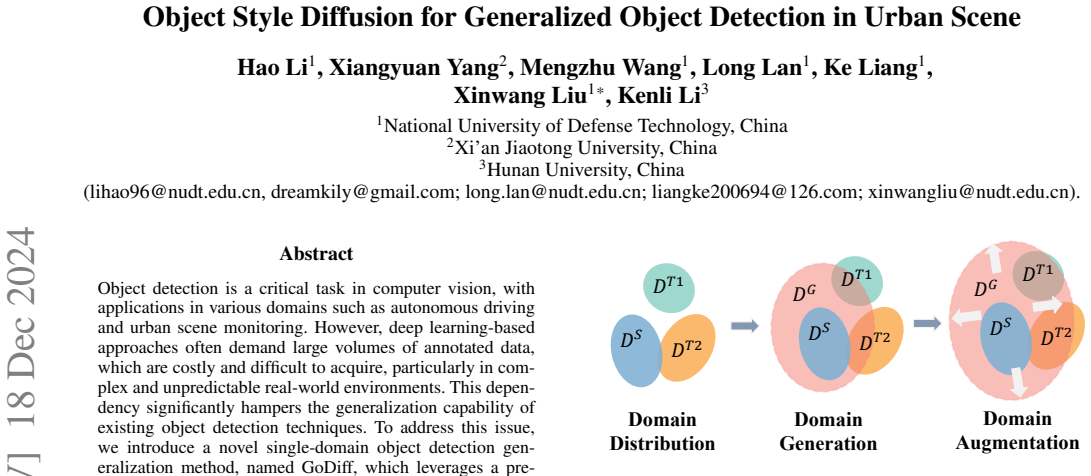
Pith's one-line read GoDiff re-renders annotated urban images in new weather styles with boxes and labels intact, then swaps style statistics during training, improving object detection in unseen conditions.
desk verdict Plausible diffusion-based augmentation for S-DG detection, but the object filter equations contradict the text and the SOTA claim outruns the paper's own tables. read the letter →
The pith
A machine-rendered reading of the paper's core claim, the machinery that carries it, and where it could break.
The reading
What carries the argument
The load-bearing machinery is the Pseudo Target Data Generation (PTDG) pipeline built on an InstanceDiffusion model fine-tuned on the source domain. It uses a dual-prompt strategy: an image-level prompt assembled from Tag2Text tags plus target descriptors such as 'foggy' or 'night', and per-box object-level prompts sampled from randomized templates. Generation preserves bounding boxes and labels, and the CLIP-RBF filter, $D_{\mathrm{RBF}}(f_S(b_i),f_{PS}(b_i))=\exp(-\gamma\|f_S(b_i)-f_{PS}(b_i)\|^2)$, drops boxes whose CLIP features in a re-rendered 'virtual source' image are too far from the source, with threshold $\tau$. On the feature side, Cross Style Normalization (CSN) swaps $\mu$ and $\sigma$ between feature maps of image pairs, and the Covariance Matching Loss $\mathcal{L}_{CM}=\|\Sigma_{X_A,X_A}^i - \Sigma_{X_B,X_B}^i\|_2$ aligns inter-domain covariance statistics, together pushing the detector toward style-invariant representations.
What would settle it
Re-run the DWD experiment with the object filter inverted, keeping boxes the CLIP-RBF check rejects and discarding the boxes it keeps; if mean performance under corruption does not drop, object filtering is not doing the work the paper assigns to it.
Extended reading notes
Core claim
The central claim is that single-domain generalization in object detection can be achieved by combining image-level and feature-level augmentation. The PTDG module fine-tunes an instance-level latent diffusion model on the source domain, prompts it with an image-level sentence built from extracted tags plus target descriptors and per-box object-level prompts, and generates pseudo-target images whose annotations are inherited from the source. A CLIP-RBF object filter removes boxes whose objects are not semantically consistent between the source image and a re-rendered copy. The CSN module then exchanges the mean and variance of feature maps from different styles during training, together with a covariance matching loss, to make the detector learn style-invariant features. The paper reports that this raises Faster R-CNN mean performance under corruption on DWD from 25.5 to 29.6, improves Mask R-CNN and DINO by about 4 to 5 points, and, when combined with OA-DG, achieves the best reported results on DWD and Cityscapes-C.
Load-bearing premise
The whole gain rests on the assumption that an object which survives a similarity check between a source image and one re-rendered copy, under filter strictness settings the paper does not report, will be generated faithfully in every other target style, so that its original label and box stay valid.
Editorial extensions
If this is right
- A detector trained on source images plus four generated pseudo-target domains improves mean performance under corruption on DWD from 25.5 to 29.6 for Faster R-CNN, with the largest gains in Dusk-Rainy and Night-Rainy.
- The same generated data and style-exchange training can be bolted onto an existing object-aware domain generalization method, raising its DWD mPC from 31.8 to 32.6 and its Cityscapes-C mPC from 21.8 to 22.8.
- The benefit transfers across detector architectures: Faster R-CNN, Mask R-CNN, and DINO each gain roughly 4 to 5 mPC points, including the strongest relative gains in adverse conditions like Night-Rainy and Daytime-Foggy.
- Each generated pseudo-domain helps most on its matching target condition; for example, generated Daytime-Foggy data raises Daytime-Foggy mAP from 32.0 to 35.0, and training on all generated domains together gives the best overall result.
- Fine-tuning the diffusion model on source-domain data lowers the distribution gap between generated and real target data, and the paper reports that lower gap correlates with larger detector gains.
Reading between the lines
- If the CLIP-RBF consistency check is as transferable as the paper assumes, the same filtering idea could be applied to other box-conditioned generation pipelines for tasks like instance segmentation, where a bad generated mask would otherwise corrupt training.
- Because the filter depends on two unstated control settings, $\tau$ and $\gamma$, a sensitivity study sweeping those values would show how much of the reported gain comes from filtering rather than from sheer data diversity.
- The weaker results on digital corruptions suggest the pipeline is tuned toward natural condition shifts; mixing corruption-specific descriptors into the image-level prompts could be a direct test of whether synthetic noise robustness can be improved the same way.
- The randomized object-level templates could be repurposed to rebalance long-tailed detection datasets by sampling rare categories more often, which the paper does not explore.
Editorial analysis
A structured set of objections, weighed in public.
Referee Report
Summary. The paper proposes GoDiff, a single-domain generalization method for object detection in urban scenes. It contains two main components: a Pseudo Target Data Generation (PTDG) module that uses an instance-conditioned latent diffusion model (InstanceDiffusion) to generate stylized pseudo-target images from a single annotated source domain, and a Cross-Style instance Normalization (CSN) module that mixes feature statistics across source and pseudo-target domains during training, together with a Covariance Matching Loss. Experiments are reported on the Diverse Weather Dataset (DWD) and Cityscapes-C, with claims that GoDiff improves multiple detectors and, when attached to OA-DG, achieves state-of-the-art performance. The paper also includes ablations, class-wise analyses, and a qualitative appendix.
Significance. If the claims held, the paper would make a useful contribution by showing that modern instance-level controllable diffusion models can generate pseudo-target data for single-domain object detection while preserving annotations, and that feature-level style mixing further helps. The paper ships an anonymous code link, provides ablations in Table 3 that broadly support the contribution of each component, and demonstrates consistent mPC gains when GoDiff is applied to three detectors (Table 4). These are real strengths. However, the central claims contain a technical inconsistency in the object filter (Eqs. 6-7), an unsupported SOTA claim relative to the paper's own Table 1, and a benchmark-awareness concern because the pseudo-target domain descriptors exactly name the test domains. These issues materially affect the validity of the core message as currently written.
major comments (5)
- [Object Filter, Eqs. (6)-(7)] The CLIP-RBF filter is internally inconsistent. Eq. (6) defines D_RBF(fS(bi), fPS(bi)) = exp(-gamma * ||fS(bi) - fPS(bi)||^2), which is a similarity kernel: it is maximal at 1 for identical features and decreases as the feature distance grows. The text then says a box is filtered out when D_RBF exceeds a threshold tau, and Eq. (7) retains boxes with D_RBF <= tau. Under the stated definition, Eq. (7) retains the least similar objects, not the most similar ones, exactly reversing the intended semantics. If the implementation actually removes low-similarity boxes, then Eq. (7) is wrong. Because neither tau nor gamma is reported, this is not a harmless typo: the direction of the inequality determines whether the filter removes malformed objects or preferentially keeps them. Since the reliability of the pseudo-labels is the load-bearing claim of PTDG, the method as written does not specify a coherent rule for quality filtering.
- [Comparison Results, Table 1] The paper's claim that GoDiff 'consistently outperforms others across all target domains' and the abstract's claim of state-of-the-art performance are contradicted by Table 1. GoDiff alone achieves an mPC of 29.6, which is lower than OA-DG's 31.8 and equal to SRCD's 29.6; in individual domains OA-DG is substantially better (e.g., Night Sunny 38.0 vs 35.4, Dusk 33.9 vs 32.1, Daytime Foggy 38.3 vs 35.9). The only configuration that sets a new SOTA is OA-DG + GoDiff (32.6 mPC). The claims should be reworded to state that the plug-and-play combination with OA-DG reaches SOTA, and the standalone method should not be described as globally superior.
- [Implementation Details / Pseudo-Target Domain Generation] The pseudo-target domain descriptors Td exactly name the test target domains: Night-Sunny, Night-Rainy, Daytime-Foggy, and Dusk-Rainy. This means the method uses knowledge of the evaluation domains at training time, which is inconsistent with the stated goal of generalizing to 'unseen domains' from a single source domain. The paper should clarify whether the target descriptors are available during training. If they are, the method is better characterized as target-aware augmentation, not single-domain generalization, and the claim of generalization to unseen domains should be dropped or tested on held-out domains. If they are not, the experimental protocol needs to be described with generic descriptors and validated on domains not named in the descriptors.
- [Object Filter scope] The object filter compares features from the source image Xs with features from a 'virtual source domain' image XPS (also Daytime-Sunny), and the retained boxes are then used as labels for all pseudo-target domains. This checks only whether the generator is stable under the source domain descriptor; it does not verify that objects survive the stylistic transformation into Night-Sunny, Dusk-Rainy, Night-Rainy, or Daytime-Foggy. The stated conclusion that 'this approach ensures that the generated pseudo-labels are more accurate and consistent' is therefore not supported by the described procedure. The filter should either be applied to each generated pseudo-target domain or an experiment should be added showing that source-to-virtual-source consistency predicts preservation in the actual target-style generations.
- [Reproducibility] The object filter's two key hyperparameters, the threshold tau and the RBF width gamma, are not reported anywhere in the main text or appendix. The number of generated pseudo-target images per source image, and the full CSN insertion scheme (beyond the appendix's 0.1 activation probability and two-layer cap), are also unspecified. This makes the pseudo-target dataset construction and the CSN training procedure impossible to reproduce, which is especially problematic given the Eq. (6)-(7) inconsistency in the same filter.
minor comments (5)
- [Pseudo-Target Domain Generation, Eq. (5)] Equation (5) writes Xt as z minus a sum of denoising outputs over all timesteps, which is not the standard reverse-diffusion sampling update. This notation confuses the iterative nature of denoising and should be replaced with the recursive update (e.g., z_{t-1} = ... ) to be technically correct.
- [Method, Object Conditioned Image Generation] The text cites 'InstanceDiffusion (Jia et al. 2023)' but the reference list entry for Jia et al. (2023) is DGInStyle, a different paper. The InstanceDiffusion model is correctly cited as Wang et al. (2024) in the introduction; the in-text citation in the method section should be corrected.
- [Ablation Study, Table 3] The statement that 'omitting any component results in a performance decline' is not strictly true for all domains: the CSN-only row has Night Sunny 29.0 versus the baseline 31.8, and adding CML to PT+CSN slightly decreases Day Sunny from 55.4 to 55.0. The text should acknowledge these domain-specific exceptions or report variance across seeds.
- [Comparison Results, Table 2] On Cityscapes-C, GoDiff alone achieves mPC 20.3, which is lower than OA-DG's 21.8 and also lower than FSCE (21.0) and SupCon (20.9). The sentence 'GoDiff is less effective against digital corruption types' should be strengthened to state clearly that the standalone method does not outperform OA-DG on this benchmark.
- [Conclusion and Table 6] The heading 'Conlusion' is a typo for 'Conclusion'. The class-wise numbers in Table 6 contain apparent Unicode artifacts and are very hard to parse; the table should be regenerated with clean formatting.
Circularity Check
The headline DWD 'unseen-domain' gain is partially built in: the pseudo-target generation is conditioned on the exact test-domain descriptors (Night-Sunny, Night-Rainy, Daytime-Foggy, Dusk-Rainy), so the improvement is not an independent prediction; a separate Eq. 6/7 sign flaw affects the filter but is not circularity.
-
fitted input called prediction
[Method: Pseudo-Target Domain Generation (Eqs. 2-4); Experiment: Implementation Details; Table 1]
"We introduce a set of domain descriptors Td = {td1, td2, . . . , tdm}, including weather, time, and specific scenes. ... The training is conducted on the Daytime-Sunny dataset and generated pseudo-target domains, including Night-Sunny, Night-Rainy, Daytime-Foggy, and Dusk-Rainy."
The domain descriptors Td are inserted into the prompt Pw = Dec(Taug) that conditions the generator in Eqs. 4-5, and the paper's implementation instantiates Td with exactly the four target test domains of DWD: Night-Sunny, Night-Rainy, Daytime-Foggy, and Dusk-Rainy. Table 1 then reports GoDiff's 'generalization' on those same four domains. The claimed unseen-domain prediction is therefore constructed from the test-condition names: the detector is trained on synthetic images whose style prompts name the evaluation domains, so the DWD improvement is in part a fitted input renamed as a generalization result. The Cityscapes-C benchmark (whose 15 corruptions are not used as descriptors) remains an external check, which is why the circularity is partial rather than total.
full rationale
No load-bearing self-citations or imported-uniqueness arguments were found: the paper's references to InstanceDiffusion, CLIP, Tag2Text, CMMD, and OA-DG are external components, not this author group's prior claims. The main circular step is the target-domain descriptor leakage: the pseudo-target domains are generated from prompts containing the names/conditions of the exact DWD test domains, then the method is evaluated by improving on those domains. That makes the central DWD claim partially circular by construction. A separate correctness flaw should be noted but is not circularity: Eq. 6 defines D_RBF as an RBF similarity kernel (maximal at identical features), while the text and Eq. 7 treat it as a distance and retain boxes with D_RBF <= tau, which would keep the least similar boxes; since tau and gamma are unspecified, the filter's behavior is undefined as written. This undermines the pseudo-label reliability claim but does not fit the circularity categories. Overall score 6 reflects one load-bearing 'prediction' on DWD reducing by construction, with Cityscapes-C and the CSN feature-level augmentation retaining independent content.
Assumptions & free parameters
free parameters (6)
- Object filter threshold tau
- RBF kernel width gamma
- Pseudo-target domain descriptors T_d =
Night-Sunny, Night-Rainy, Daytime-Foggy, Dusk-Rainy
- Number of generated pseudo-target images per source image
- CSN activation probability and layer cap =
0.1 probability, max 2 layers
- InstanceDiffusion fine-tuning epochs =
40
assumptions (4)
- domain assumption The fine-tuned InstanceDiffusion model preserves object bounding-box locations while changing style.
- ad hoc to paper CLIP-RBF distance between source and generated object crops is a reliable proxy for semantic consistency and thus for object quality.
- domain assumption Channel-wise mean and variance statistics (Eqs. 9-10) are a sufficient style representation for object detection feature maps, so random exchange (Eqs. 11-12) yields valid augmented styles.
- domain assumption The dual-prompt scheme with random object attributes (Eq. 3) produces diverse and coherent object descriptions without creating unrealistic object-scene combinations.
Cite this review
Pith. "Pith review of Object Style Diffusion for Generalized Object Detection in Urban Scene." pith.science (2026). https://pith.science/paper/HNLGOAJ5
@misc{pith2026241213815,
  author       = {Pith},
  title        = {Pith review of: Object Style Diffusion for Generalized Object Detection in Urban Scene},
  year         = {2026},
  howpublished = {\url{https://pith.science/paper/HNLGOAJ5}},
  note         = {Machine review of arXiv:2412.13815}
}
read the original abstract
Object detection is a critical task in computer vision, with applications in various domains such as autonomous driving and urban scene monitoring. However, deep learning-based approaches often demand large volumes of annotated data, which are costly and difficult to acquire, particularly in complex and unpredictable real-world environments. This dependency significantly hampers the generalization capability of existing object detection techniques. To address this issue, we introduce a novel single-domain object detection generalization method, named GoDiff, which leverages a pre-trained model to enhance generalization in unseen domains. Central to our approach is the Pseudo Target Data Generation (PTDG) module, which employs a latent diffusion model to generate pseudo-target domain data that preserves source domain characteristics while introducing stylistic variations. By integrating this pseudo data with source domain data, we diversify the training dataset. Furthermore, we introduce a cross-style instance normalization technique to blend style features from different domains generated by the PTDG module, thereby increasing the detector's robustness. Experimental results demonstrate that our method not only enhances the generalization ability of existing detectors but also functions as a plug-and-play enhancement for other single-domain generalization methods, achieving state-of-the-art performance in autonomous driving scenarios.
Figures


Figures from the paper (4 more)


Reference graph
Works this paper leans on
-
[1]
, " * write output.state after.block = add.period write newline
ENTRY address archivePrefix author booktitle chapter edition editor eid eprint howpublished institution isbn journal key month note number organization pages publisher school series title type volume year label extra.label sort.label short.list INTEGERS output.state before.all mid.sentence after.sentence after.block FUNCTION init.state.consts #0 'before.a...
-
[2]
write newline
" write newline "" before.all 'output.state := FUNCTION n.dashify 't := "" t empty not t #1 #1 substring "-" = t #1 #2 substring "--" = not "--" * t #2 global.max substring 't := t #1 #1 substring "-" = "-" * t #2 global.max substring 't := while if t #1 #1 substring * t #2 global.max substring 't := if while FUNCTION word.in bbl.in capitalize " " * FUNCT...
-
[3]
Ahn, W.-J.; Yang, G.-Y.; Choi, H.-D.; and Lim, M.-T. 2024. Style Blind Domain Generalized Semantic Segmentation via Covariance Alignment and Semantic Consistence Contrastive Learning. In Proceedings of the IEEE/CVF Conference on Computer Vision and Pattern Recognition, 3616--3626
work page 2024
-
[4]
R.; Peng, S.; Shahbazi, M.; Obukhov, A.; Van Gool, L.; and Wetzstein, G
Cai, S.; Chan, E. R.; Peng, S.; Shahbazi, M.; Obukhov, A.; Van Gool, L.; and Wetzstein, G. 2023. Diffdreamer: Towards consistent unsupervised single-view scene extrapolation with conditional diffusion models. In Proceedings of the IEEE/CVF International Conference on Computer Vision, 2139--2150
work page 2023
-
[5]
Choi, S.; Jung, S.; Yun, H.; Kim, J. T.; Kim, S.; and Choo, J. 2021. Robustnet: Improving domain generalization in urban-scene segmentation via instance selective whitening. In CVPR, 11580--11590
work page 2021
-
[6]
Fukumizu, K.; Gretton, A.; Sch \"o lkopf, B.; and Sriperumbudur, B. K. 2008. Characteristic kernels on groups and semigroups. Advances in neural information processing systems, 21
work page 2008
-
[7]
A.; Ecker, A
Gatys, L. A.; Ecker, A. S.; and Bethge, M. 2016. Image style transfer using convolutional neural networks. In Proceedings of the IEEE conference on computer vision and pattern recognition, 2414--2423
2016
-
[8]
Geirhos, R.; Rubisch, P.; Michaelis, C.; Bethge, M.; Wichmann, F. A.; and Brendel, W. 2018. ImageNet-trained CNNs are biased towards texture; increasing shape bias improves accuracy and robustness. arXiv preprint arXiv:1811.12231
arXiv 2018
Show all 39 references
-
[9]
D.; and Van Gool, L
Gong, R.; Danelljan, M.; Sun, H.; Mangas, J. D.; and Van Gool, L. 2023. Prompting diffusion representations for cross-domain semantic segmentation. arXiv preprint arXiv:2307.02138
2023 arXiv
-
[10]
M.; Rasch, M
Gretton, A.; Borgwardt, K. M.; Rasch, M. J.; Sch \"o lkopf, B.; and Smola, A. 2012. A kernel two-sample test. The Journal of Machine Learning Research, 13(1): 723--773
2012
-
[11]
D.; Zoph, B.; Gilmer, J.; and Lakshminarayanan, B
Hendrycks, D.; Mu, N.; Cubuk, E. D.; Zoph, B.; Gilmer, J.; and Lakshminarayanan, B. 2019. Augmix: A simple data processing method to improve robustness and uncertainty. arXiv preprint arXiv:1912.02781
2019 arXiv
-
[12]
Huang, L.; Zhou, Y.; Zhu, F.; Liu, L.; and Shao, L. 2019. Iterative normalization: Beyond standardization towards efficient whitening. In CVPR, 4874--4883
2019
-
[13]
Huang, X.; Zhang, Y.; Ma, J.; Tian, W.; Feng, R.; Zhang, Y.; Li, Y.; Guo, Y.; and Zhang, L. 2023. Tag2text: Guiding vision-language model via image tagging. arXiv preprint arXiv:2303.05657
2023 arXiv
-
[14]
Jayasumana, S.; Ramalingam, S.; Veit, A.; Glasner, D.; Chakrabarti, A.; and Kumar, S. 2024. Rethinking fid: Towards a better evaluation metric for image generation. In Proceedings of the IEEE/CVF Conference on Computer Vision and Pattern Recognition, 9307--9315
2024
-
[15]
Jia, Y.; Hoyer, L.; Huang, S.; Wang, T.; Van Gool, L.; Schindler, K.; and Obukhov, A. 2023. DGInStyle: Domain-Generalizable Semantic Segmentation with Image Diffusion Models and Stylized Semantic Control. In Synthetic Data for Computer Vision Workshop@ CVPR 2024
2023
-
[16]
Jiang, J.; Chen, B.; Wang, J.; and Long, M. 2022. Decoupled Adaptation for Cross-Domain Object Detection. In ICLR
2022
-
[17]
Lee, W.; Hong, D.; Lim, H.; and Myung, H. 2024. Object-Aware Domain Generalization for Object Detection. In Proceedings of the AAAI Conference on Artificial Intelligence, volume 38, 2947--2955
2024
-
[19]
S.; Bethge, M.; and Brendel, W
Michaelis, C.; Mitzkus, B.; Geirhos, R.; Rusak, E.; Bringmann, O.; Ecker, A. S.; Bethge, M.; and Brendel, W. 2019 b . Benchmarking robustness in object detection: Autonomous driving when winter is coming. arXiv preprint arXiv:1907.07484
2019 arXiv
-
[20]
Modas, A.; Rade, R.; Ortiz-Jim \'e nez, G.; Moosavi-Dezfooli, S.-M.; and Frossard, P. 2022. Prime: A few primitives can boost robustness to common corruptions. In European Conference on Computer Vision, 623--640. Springer
2022
-
[21]
M.; and Fingscheidt, T
Niemeijer, J.; Schwonberg, M.; Term \"o hlen, J.-A.; Schmidt, N. M.; and Fingscheidt, T. 2024. Generalization by adaptation: Diffusion-based domain extension for domain-generalized semantic segmentation. In Proceedings of the IEEE/CVF Winter Conference on Applications of Compu...
2024
-
[22]
Pan, X.; Luo, P.; Shi, J.; and Tang, X. 2018. Two at once: Enhancing learning and generalization capacities via ibn-net. In ECCV, 464--479
2018
-
[23]
Pan, X.; Zhan, X.; Shi, J.; Tang, X.; and Luo, P. 2019. Switchable whitening for deep representation learning. In ICCV, 1863--1871
2019
-
[24]
W.; Hallacy, C.; Ramesh, A.; Goh, G.; Agarwal, S.; Sastry, G.; Askell, A.; Mishkin, P.; Clark, J.; Krueger, G.; and Sutskever, I
Radford, A.; Kim, J. W.; Hallacy, C.; Ramesh, A.; Goh, G.; Agarwal, S.; Sastry, G.; Askell, A.; Mishkin, P.; Clark, J.; Krueger, G.; and Sutskever, I. 2021. Learning Transferable Visual Models From Natural Language Supervision. In ICML, volume 139, 8748--8763
2021
-
[25]
Rao, Z.; Guo, J.; Tang, L.; Huang, Y.; Ding, X.; and Guo, S. 2023. Srcd: Semantic reasoning with compound domains for single-domain generalized object detection. arXiv preprint arXiv:2307.01750
2023 arXiv
-
[26]
B.; and Sun, J
Ren, S.; He, K.; Girshick, R. B.; and Sun, J. 2017. Faster R-CNN: Towards Real-Time Object Detection with Region Proposal Networks. IEEE TPAMI , 39(6): 1137--1149
2017
-
[27]
Rombach, R.; Blattmann, A.; Lorenz, D.; Esser, P.; and Ommer, B. 2022. High-resolution image synthesis with latent diffusion models. In Proceedings of the IEEE/CVF conference on computer vision and pattern recognition, 10684--10695
2022
-
[28]
Schuhmann, C.; Beaumont, R.; Vencu, R.; Gordon, C.; Wightman, R.; Cherti, M.; Coombes, T.; Katta, A.; Mullis, C.; Wortsman, M.; et al. 2022. Laion-5b: An open large-scale dataset for training next generation image-text models. Advances in Neural Information Processing Systems,...
2022
-
[29]
Song, J.; Meng, C.; and Ermon, S. 2020. Denoising diffusion implicit models. arXiv preprint arXiv:2010.02502
2020 arXiv
-
[30]
A.; and Najarian, K
Thurnhofer-Hemsi, K.; L \'o pez-Rubio, E.; Molina-Cabello, M. A.; and Najarian, K. 2020. Radial basis function kernel optimization for support vector machine classifiers. arXiv preprint arXiv:2007.08233
2020 arXiv
-
[31]
Ulyanov, D.; Vedaldi, A.; and Lempitsky, V. 2016. Instance normalization: The missing ingredient for fast stylization. arXiv preprint arXiv:1607.08022
2016 arXiv
-
[32]
Vidit, V.; Engilberge, M.; and Salzmann, M. 2023. CLIP the Gap: A Single Domain Generalization Approach for Object Detection. In CVPR, 3219--3229
2023
-
[33]
S.; Girdhar, R.; and Misra, I
Wang, X.; Darrell, T.; Rambhatla, S. S.; Girdhar, R.; and Misra, I. 2024. Instancediffusion: Instance-level control for image generation. In Proceedings of the IEEE/CVF Conference on Computer Vision and Pattern Recognition, 6232--6242
2024
-
[34]
Wang, Z.; Luo, Y.; Qiu, R.; Huang, Z.; and Baktashmotlagh, M. 2021. Learning to diversify for single domain generalization. In Proceedings of the IEEE/CVF International Conference on Computer Vision, 834--843
2021
-
[35]
Wilson, G.; and Cook, D. J. 2020. A survey of unsupervised deep domain adaptation. ACM Transactions on Intelligent Systems and Technology (TIST), 11(5): 1--46
2020
-
[36]
Wu, A.; and Deng, C. 2022. Single-domain generalized object detection in urban scene via cyclic-disentangled self-distillation. In CVPR, 847--856
2022
-
[37]
Wu, F.; Gao, J.; Hong, L.; Wang, X.; Zhou, C.; and Ye, N. 2024. G-NAS: Generalizable Neural Architecture Search for Single Domain Generalization Object Detection. In Proceedings of the AAAI Conference on Artificial Intelligence, volume 38, 5958--5966
2024
-
[38]
Z.; and Shen, C
Wu, W.; Zhao, Y.; Chen, H.; Gu, Y.; Zhao, R.; He, Y.; Zhou, H.; Shou, M. Z.; and Shen, C. 2023. Datasetdm: Synthesizing data with perception annotations using diffusion models. Advances in Neural Information Processing Systems, 36: 54683--54695
2023
-
[39]
Xiao, Y.; Tian, Z.; Yu, J.; Zhang, Y.; Liu, S.; Du, S.; and Lan, X. 2020. A review of object detection based on deep learning. Multimedia Tools and Applications, 79: 23729--23791
2020
-
[40]
Zheng, G.; Huai, M.; and Zhang, A. 2024. AdvST: Revisiting Data Augmentations for Single Domain Generalization. In Proceedings of the AAAI Conference on Artificial Intelligence, volume 38, 21832--21840
2024
Reviewed August 11, 2026 · model on record in the stance chip above.
Discussion (0). Continue with ORCID to comment.