REVIEW 4 major objections 6 minor 32 references
Two-photon interference at a telecom wavelength for quantum networking
T0 review · 4 major / 6 minor · reviewed 2026-08-11 · deepseek-v4-flash
Pith's one-line read Two independent telecom sources interfere with 91.9 percent visibility while running without a shared clock.
desk verdict Solid asynchronous HOM demonstration at telecom, but the spectral-overlap mechanism in Sec. 3 is physically wrong as written and needs a rewrite before this is publishable. read the letter →
The pith
A machine-rendered reading of the paper's core claim, the machinery that carries it, and where it could break.
The reading
What carries the argument
The load-bearing element is the heralding-triggered intensity modulator that shapes the otherwise continuous coherent laser into 4 ns pulses, combined with a 540 MHz spectral filter on the photon-pair source. The paper also relies on a reciprocal-filtering argument: the effective interfering spectrum is taken to be the inverse Fourier transform of the detection jitter, whose bandwidth (~GHz, since jitter is 150 ps) exceeds the filter bandwidth, thereby justifying spectral overlap between the ~10 kHz coherent laser and the 540 MHz filtered photon. The visibility is computed with a beam-splitter model using density matrices, a POVM detection operator, and the formula V_HOM = 1 - N_indis/N_dis.
What would settle it
Measure the Hong-Ou-Mandel visibility while artificially increasing the detection jitter (for example by adding electronic noise to the time-to-digital converter or using slower detectors) with the laser detuning and the 4 ns gate unchanged. Under the reciprocal-filtering claim, the effective spectral overlap and thus the visibility should drop as jitter rises; under the standard picture, where the photon spectra at the beam splitter are fixed by the filter and the gate pulse, the visibility should remain essentially unchanged. A second check would be a direct measurement of the joint spectral intensity of the two interfering paths.
Extended reading notes
Core claim
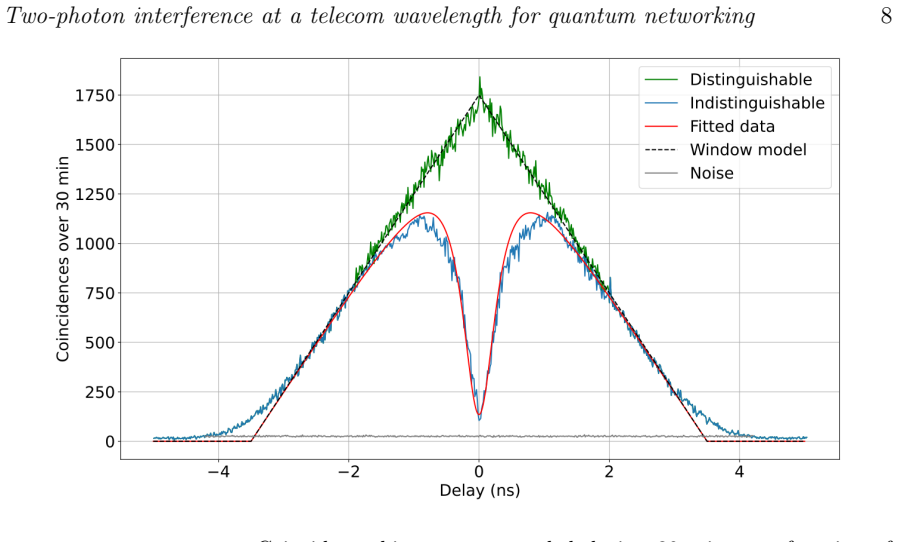
The central claim is that a weak coherent state and a heralded single photon can be made to interfere with near-ideal visibility even when the sources are free-running continuous-wave emitters. By spectrally filtering the down-converted photons to 540 MHz and gating the coherent laser into 4 ns square pulses triggered by the heralding detection, the authors bring the two photons into a common spacetime mode. When the laser is detuned by 6 GHz, the coincidence histogram shows a flat triangular profile; when it is tuned to the degenerate wavelength, a dip appears whose width (914 ps measured vs 925 ps fitted) matches the model. The fits give V_HOM,raw = 90.7(5)% and V_HOM,net = 91.9(5)%, in agreement with the simulated V_HOM(0.01,0.01) = 92.4%.
Load-bearing premise
The claim that the two photons actually overlap in frequency depends on an asserted but underived mechanism in which detection jitter, rather than the sources' intrinsic emission spectra, sets the effective interfering spectrum; if that mechanism is wrong, the engineered-indistinguishability story is unsupported, even though the measured dip might still come from the 4 ns gating pulse.
Editorial extensions
If this is right
- At the reported net visibility, time-bin qubit teleportation could reach fidelities above 95 percent, as the paper estimates.
- Asynchronous operation removes the need for a common master clock and enables network nodes built from independent, free-running sources.
- The telecom-compatible, all-fiber design and the compatibility with quantum memories with hundreds-of-MHz bandwidth support light-to-matter teleportation.
- Gating the weak coherent source by the heralding signal suppresses stray light and permits the use of efficient superconducting nanowire detectors.
Reading between the lines
- If the reciprocal-filtering mechanism holds, detection jitter becomes a tunable resource for spectral matching, suggesting experiments could deliberately shape jitter to control indistinguishability; this is not tested in the paper.
- The same asynchrony and gating principle could be applied to entanglement swapping between two independent heralded sources, potentially extending the approach of asynchronous pair-source swapping already cited.
- The model's visibility-versus-emission-parameter trade-off could be used as a design chart for balancing count rate and visibility in future relay demonstrations.
Signed reviews
Editorial analysis
A structured set of objections, weighed in public.
Referee Report
Summary. The paper reports a Hong-Ou-Mandel (HOM) interference experiment between a weak coherent state (WCS) and a heralded single-photon source (HSPS), both at telecom wavelength and operated asynchronously in the continuous-wave regime. A herald detection gates an intensity modulator that carves 4 ns pulses from the coherent laser, and the authors record a HOM dip with raw visibility 90.7(5)% and net visibility 91.9(5)%. They compare the dip shape with a model based on the spectral filter bandwidth, obtaining agreement within 2%, and they present a simulation of the three-fold coincidence statistics as a function of the coherent amplitude alpha and the mean pair number n_bar. The claimed result is positioned as a scalable, clock-free building block for hybrid quantum networks.
Significance. If the measured visibility is correct, this is a useful demonstration: it shows >90% HOM visibility between two independent, asynchronous telecom sources using fiber-coupled components, and the herald-triggered gating is an interesting way to suppress the continuous background from the WCS. The paper reports error bars, a fit to the dip shape, and an explicit comparison with a simulation. However, the theoretical explanation of how spectral overlap is achieved (Section 3) is not credible as written, and the simulation's agreement relies on parameters chosen to match the data rather than on an independent prediction. The central experimental result should therefore be treated as a strong but incompletely explained measurement.
major comments (4)
- [Section 3 (paragraph after Eq. (7))] The claim that spectral overlap between the ~10 kHz coherent laser and the 540 MHz-filtered SPDC photon is 'managed through reciprocal filtering in the time domain, governed by the detection timing jitter' is asserted without derivation. As stated, it is not consistent with standard quantum optics: detection jitter adds classical timing uncertainty to the recorded detection times, but it does not alter the spectral wave functions of the photons at the beam splitter. The 4 ns intensity-modulator gate, whose Fourier-limited bandwidth is ~250 MHz, is the physically plausible source of spectral overlap and is already present in the setup. Please either derive the reciprocal-filtering statement from a model of the two-photon interference amplitude, or replace it with an explanation in terms of the gate pulse; the current text is load-bearing for the 'precise spectral and temporal shaping' narrative.
- [Sections 2 and 3 (Fig. 4; text near V_HOM(0.01,0.01)=92.4%)] The simulation in Section 2 models only the effect of multi-photon statistics on the visibility; it assumes perfect spectral and temporal indistinguishability and contains no description of the mode-overlap or gating mechanism. The parameters alpha and n_bar are then set to ~0.01 with the stated aim of obtaining >90% visibility, so the agreement of the simulation with the measured 91.9(5)% is a consistency check, not an independent prediction. This distinction should be stated explicitly, and the simulation should not be presented as validating the measured visibility.
- [Section 3 and Fig. 6] The manuscript reports V_HOM,raw and V_HOM,net but does not give the exact definition of the accidental subtraction used to obtain the net value, nor how the grey 'total noise' background is independently measured. Since the central claim depends on these numbers, please specify whether the background is taken from the side bins of the histogram, from dark-count and ASE measurements, or from a fit, and propagate the corresponding uncertainty into the 0.5% error bars.
- [Section 3, Eq. (7) and following paragraph] Equation (7) states the standard condition that the photon coherence time 1/Delta_nu_filter (1900 ps) must greatly exceed the detection jitter (150 ps) in order to select one temporal mode. The next paragraph then invokes the same jitter as the mechanism that broadens the effective spectrum of the interfering photons. These two statements attribute opposite roles to the detection jitter and should be reconciled; as written they are in tension.
minor comments (6)
- [Abstract and main text] 'State-of-art' should be 'state-of-the-art' in the abstract and in Section 4.
- [Eq. (2)] The beam-splitter operator is written as e(i theta(...)); using exp(i theta(...)) would improve clarity.
- [Reference [2]] 'A VS Quantum Science' should be 'AVS Quantum Science'.
- [References [11] and [32]] References [11] and [32] are the same paper and should be merged or clearly distinguished.
- [Before Eq. (5)] The phrase 'It comes :' should be corrected to a complete sentence.
- [Data Availability] The statement 'Data are available from the authors on reasonable request' is very limited; providing the raw histograms as supplemental material would strengthen reproducibility.
Circularity Check
No circularity: the reported HOM visibility is measured from coincidence data, not derived from fitted inputs; self-citations are contextual and no load-bearing premise reduces to its own input.
full rationale
Section 2's HOM-visibility model (Eqs. 4-5) is a forward calculation from the coherent-state amplitude α and the mean pair number n̄; the paper does not fit these parameters to the measured V_HOM,raw=90.7(5)% or V_HOM,net=91.9(5)%. The visibility values are extracted by fitting the coincidence histogram, and the simulated V_HOM(0.01,0.01)=92.4% is compared with, rather than used to generate, the measured result. The statement that α=n̄≃0.01 were 'kept low ... to obtain a visibility above 90%' describes a source-intensity operating-point choice, not a fitting of model parameters to the experimental visibility; a poor spectral or temporal overlap would still have produced a low measured visibility, so the agreement is not forced by construction. The self-citations (e.g., Refs. [11,13,32]) are contextual and are not load-bearing premises; no uniqueness theorem is invoked to exclude alternative mechanisms. The Section 3 reciprocal-filtering claim is underived and physically questionable, but that is a correctness/support concern, not circularity: the central experimental visibility claim does not reduce to that assertion. No circular step can be exhibited, so the score is 0.
Assumptions & free parameters
free parameters (2)
- alpha (coherent state amplitude) =
≈ 0.01
- n_bar (mean photon pair number) =
≈ 0.01
assumptions (4)
- standard math Beam splitter transformation and POVM detection model
- domain assumption Single temporal mode condition 1/Delta_nu_filter >> tau_jitter (Eq. 7)
- ad hoc to paper Reciprocal filtering: effective spectral overlap governed by detection jitter
- domain assumption Detectors do not resolve photon number
Cite this review
Pith. "Pith review of Two-photon interference at a telecom wavelength for quantum networking." pith.science (2026). https://pith.science/paper/B5GRTW6Y
@misc{pith2026241213900,
  author       = {Pith},
  title        = {Pith review of: Two-photon interference at a telecom wavelength for quantum networking},
  year         = {2026},
  howpublished = {\url{https://pith.science/paper/B5GRTW6Y}},
  note         = {Machine review of arXiv:2412.13900}
}
read the original abstract
The interference between two independent photons stands as a crucial aspect of numerous quantum information protocols and technologies. In this work, we leverage fiber-coupled devices, which encompass fibered photon pair-sources and off-the-shelf optics, to demonstrate Hong-Ou-Mandel interference. We employ two distinct single photon sources, namely an heralded single-photon source and a weak coherent laser source, both operating asynchronously in continuous-wave regime. We record two-photon coincidences, showing a state-of-art visibility of 91.9(5)\%. This work, compliant with telecom technology provides realistic backbones for establishing long-range communication based on quantum teleportation in hybrid quantum networks.
Figures


Figures from the paper (3 more)


Reference graph
Works this paper leans on
-
[31]
Aojie Xu, Lifeng Duan, Lirong Wang, and Yun Zhang. Characterization of two-photon interference between a weak coherent state and a heralded single photon state. Optics Express, 31(4):5662– 5669, 2023
work page 2023
-
[1]
Integrated photonics for quantum communications and metrology
Laurent Labont´ e, Olivier Alibart, Virginia D’Auria, Florent Doutre, Jean Etesse, Gregory Sauder, Anthony Martin, ´Eric Picholle, and S´ ebastien Tanzilli. Integrated photonics for quantum communications and metrology. PRX Quantum , 5(1):010101, 2024
work page 2024
-
[2]
Designing tomorrow’s quantum internet
William J Munro, Nicolo’Lo Piparo, Josephine Dias, Michael Hanks, and Kae Nemoto. Designing tomorrow’s quantum internet. A VS Quantum Science, 4(2), 2022
work page 2022
-
[3]
Device-independent security of quantum cryptography against collective attacks
Antonio Ac ´ ın, Nicolas Brunner, Nicolas Gisin, Serge Massar, Stefano Pironio, and Valerio Scarani. Device-independent security of quantum cryptography against collective attacks. Physical Review Letters, 98(23):230501, 2007
work page 2007
-
[4]
Device-independent quantum key distribution secure against collective attacks
Stefano Pironio, Antonio Ac ´ ın, Nicolas Brunner, Nicolas Gisin, Serge Massar, and Valerio Scarani. Device-independent quantum key distribution secure against collective attacks. New Journal of Physics, 11(4):045021, 2009
work page 2009
-
[5]
Quantum key distribution over 658 km fiber with distributed vibration sensing
Jiu-Peng Chen, Chi Zhang, Yang Liu, Cong Jiang, Dong-Feng Zhao, Wei-Jun Zhang, Fa-Xi Chen, Hao Li, Li-Xing You, Zhen Wang, et al. Quantum key distribution over 658 km fiber with distributed vibration sensing. Physical Review Letters, 128(18):180502, 2022
work page 2022
-
[6]
Quantum teleportation between remote qubit memories with only a single photon as a resource
Stefan Langenfeld, Stephan Welte, Lukas Hartung, Severin Daiss, Philip Thomas, Olivier Morin, Emanuele Distante, and Gerhard Rempe. Quantum teleportation between remote qubit memories with only a single photon as a resource. Physical Review Letters , 126(13):130502, 2021
work page 2021
-
[7]
Unconditional quantum teleportation between distant solid-state quantum bits
Wolfgang Pfaff, Bas J Hensen, Hannes Bernien, Suzanne B van Dam, Machiel S Blok, Tim H Taminiau, Marijn J Tiggelman, Raymond N Schouten, Matthew Markham, Daniel J Twitchen, et al. Unconditional quantum teleportation between distant solid-state quantum bits. Science, 345(6196):532–535, 2014
work page 2014
Show all 32 references
-
[8]
Teleportation systems toward a quantum internet
Raju Valivarthi, Samantha I Davis, Cristi´ an Pe˜ na, Si Xie, Nikolai Lauk, Lautaro Narv´ aez, Jason P Allmaras, Andrew D Beyer, Yewon Gim, Meraj Hussein, et al. Teleportation systems toward a quantum internet. PRX Quantum , 1(2):020317, 2020
2020
-
[9]
Quantum teleportation over 100 km of fiber using highly efficient superconducting nanowire single-photon detectors
Hiroki Takesue, Shellee D Dyer, Martin J Stevens, Varun Verma, Richard P Mirin, and Sae Woo Nam. Quantum teleportation over 100 km of fiber using highly efficient superconducting nanowire single-photon detectors. Optica, 2(10):832–835, 2015
2015
-
[10]
Long distance quantum teleportation
Xiu-Xiu Xia, Qi-Chao Sun, Qiang Zhang, and Jian-Wei Pan. Long distance quantum teleportation. Quantum Science and Technology, 3(1):014012, 2017. Two-photon interference at a telecom wavelength for quantum networking 11
2017
-
[12]
A photonic quantum information interface
Sebastien Tanzilli, Wolfgang Tittel, Matthaeus Halder, Olivier Alibart, Pascal Baldi, Nicolas Gisin, and Hugo Zbinden. A photonic quantum information interface. Nature, 437(7055):116–120, 2005
2005
-
[13]
Two-photon interference between disparate sources for quantum networking
AR McMillan, L Labont´ e, AS Clark, B Bell, O Alibart, A Martin, WJ Wadsworth, S Tanzilli, and JG Rarity. Two-photon interference between disparate sources for quantum networking. Scientific reports, 3(1):2032, 2013
2013
-
[14]
High-visibility two-photon interference in a single-mode-fibre interferometer
JG Rarity, J Burnett, PR Tapster, and R Paschotta. High-visibility two-photon interference in a single-mode-fibre interferometer. Europhysics Letters, 22(2):95, 1993
1993
-
[15]
A quantum relay chip based on telecommunication integrated optics technology
Anthony Martin, Olivier Alibart, MP De Micheli, DB Ostrowsky, and S´ ebastien Tanzilli. A quantum relay chip based on telecommunication integrated optics technology. New Journal of Physics, 14(2):025002, 2012
2012
-
[16]
Interference of single photons from two separate semiconductor quantum dots
Edward B Flagg, Andreas Muller, Sergey V Polyakov, Alex Ling, Alan Migdall, and Glenn S Solomon. Interference of single photons from two separate semiconductor quantum dots. Physical Review Letters, 104(13):137401, 2010
2010
-
[17]
Two-photon interference of the emission from electrically tunable remote quantum dots
Raj B Patel, Anthony J Bennett, Ian Farrer, Christine A Nicoll, David A Ritchie, and Andrew J Shields. Two-photon interference of the emission from electrically tunable remote quantum dots. Nature photonics, 4(9):632–635, 2010
2010
-
[18]
Indistinguishable photons from a single-photon device
Charles Santori, David Fattal, Jelena Vuˇ ckovi´ c, Glenn S Solomon, and Yoshihisa Yamamoto. Indistinguishable photons from a single-photon device. nature, 419(6907):594–597, 2002
2002
-
[19]
Stable solid-state source of single photons
Christian Kurtsiefer, Sonja Mayer, Patrick Zarda, and Harald Weinfurter. Stable solid-state source of single photons. Physical review letters , 85(2):290, 2000
2000
-
[20]
Quantum interference between two single photons emitted by independently trapped atoms
Jones Beugnon, Matthew PA Jones, Jos Dingjan, Beno ˆ ıt Darqui´ e, Ga¨ etan Messin, Antoine Browaeys, and Philippe Grangier. Quantum interference between two single photons emitted by independently trapped atoms. Nature, 440(7085):779–782, 2006
2006
-
[21]
Conditional control of the quantum states of remote atomic memories for quantum networking
Daniel Felinto, Chin-Wen Chou, Julien Laurat, EW Schomburg, Hugues De Riedmatten, and H Jeff Kimble. Conditional control of the quantum states of remote atomic memories for quantum networking. Nature Physics, 2(12):844–848, 2006
2006
-
[22]
Quantum interference of photon pairs from two remote trapped atomic ions
Peter Maunz, DL Moehring, Steven Olmschenk, Kelly Cooper Younge, DN Matsukevich, and Christopher Monroe. Quantum interference of photon pairs from two remote trapped atomic ions. Nature Physics, 3(8):538–541, 2007
2007
-
[23]
Hong–ou–mandel interference of two independent continuous-wave coherent photons
Heonoh Kim, Danbi Kim, Jiho Park, and Han Seb Moon. Hong–ou–mandel interference of two independent continuous-wave coherent photons. Photonics Research, 8(9):1491–1495, 2020
2020
-
[24]
Quantum-dot based telecom-wavelength quantum relay
J Huwer, M Felle, RM Stevenson, J Skiba-Szymanska, MB Ward, I Farrer, R V Penty, DA Ritchie, and AJ Shields. Quantum-dot based telecom-wavelength quantum relay. arXiv preprint arXiv:1704.07765, 2017
2017 arXiv
-
[25]
An entangled-led-driven quantum relay over 1 km
Christiana Varnava, R Mark Stevenson, Jonas Nilsson, Joanna Skiba-Szymanska, Branislav Dzurˇ n´ ak, Marco Lucamarini, Richard V Penty, Ian Farrer, David A Ritchie, and Andrew J Shields. An entangled-led-driven quantum relay over 1 km. Npj Quantum Information , 2(1):1– 7, 2016
2016
-
[26]
Non-classical interference between independent sources
JG Rarity, PR Tapster, and R Loudon. Non-classical interference between independent sources. Journal of Optics B: Quantum and Semiclassical Optics , 7(7):S171, 2005
2005
-
[27]
Quantum teleportation from a telecom-wavelength photon to a solid-state quantum memory
F´ elix Bussi` eres, Christoph Clausen, Alexey Tiranov, Boris Korzh, Varun B Verma, Sae Woo Nam, Francesco Marsili, Alban Ferrier, Philippe Goldner, Harald Herrmann, et al. Quantum teleportation from a telecom-wavelength photon to a solid-state quantum memory. Nature Photonics...
2014
-
[28]
Entangling independent photons by time measurement
Matth¨ aus Halder, Alexios Beveratos, Nicolas Gisin, Valerio Scarani, Christoph Simon, and Hugo Zbinden. Entangling independent photons by time measurement. Nature physics , 3(10):692– 695, 2007. Two-photon interference at a telecom wavelength for quantum networking 12
2007
-
[29]
Quantum storage of entangled telecom-wavelength photons in an erbium-doped optical fibre
Erhan Saglamyurek, Jeongwan Jin, Varun B Verma, Matthew D Shaw, Francesco Marsili, Sae Woo Nam, Daniel Oblak, and Wolfgang Tittel. Quantum storage of entangled telecom-wavelength photons in an erbium-doped optical fibre. Nature Photonics, 9(2):83–87, 2015
2015
-
[30]
Deterministic storage and retrieval of telecom quantum dot photons interfaced with an atomic quantum memory
SE Thomas, L Wagner, R Joos, R Sittig, C Nawrath, P Burdekin, T Huber-Loyola, S Sagona- Stophel, S H¨ ofling, M Jetter, et al. Deterministic storage and retrieval of telecom quantum dot photons interfaced with an atomic quantum memory. arXiv preprint arXiv:2303.04166 , 2023
2023 arXiv
-
[32]
Entanglement swapping between independent and asynchronous integrated photon-pair sources
Farid Samara, Nicolas Maring, Anthony Martin, Arslan S Raja, Tobias J Kippenberg, Hugo Zbinden, and Rob Thew. Entanglement swapping between independent and asynchronous integrated photon-pair sources. Quantum Science and Technology, 6(4):045024, 2021
2021
-
[33]
Near- optimal single-photon sources in the solid state
Niccolo Somaschi, Valerian Giesz, Lorenzo De Santis, JC Loredo, Marcelo P Almeida, Gaston Hornecker, S Luca Portalupi, Thomas Grange, Carlos Anton, Justin Demory, et al. Near- optimal single-photon sources in the solid state. Nature Photonics, 10(5):340–345, 2016
2016
Reviewed August 11, 2026 · model on record in the stance chip above.
Discussion (0). Continue with ORCID to comment.