REVIEW 4 major objections 4 minor 30 references
Real Classification by Description: Extending CLIP's Limits of Part Attributes Recognition
T0 review · 4 major / 4 minor · reviewed 2026-08-11 · deepseek-v4-flash
Pith's one-line read CLIP classifies by class name, not by description: removing the name collapses zero-shot accuracy on six fine-grained benchmarks, and training on name-free attribute descriptions substantially recovers it.
desk verdict A useful empirical paper: name-free description benchmark plus a fine-tuning recipe that consistently improves CLIP, but the PACO gain likely benefits from train/test category overlap and prompt-style matching. read the letter →
The pith
A machine-rendered reading of the paper's core claim, the machinery that carries it, and where it could break.
The reading
What carries the argument
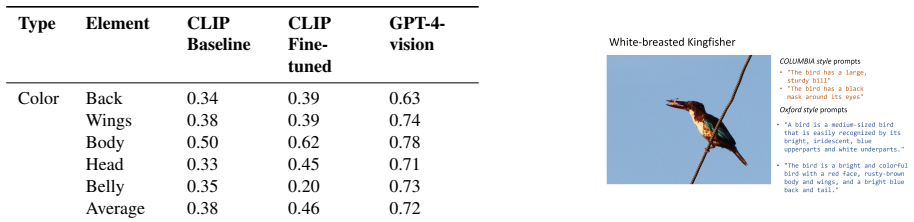
The load-bearing mechanism is the combination of name-free description data and fine-tuning on it. Descriptions are generated by an LLM from two prompt styles—Oxford, free-form narrative sentences, and Columbia, concise single-attribute sentences—and then passed through Algorithm 1, which replaces the object name with a super-category placeholder such as 'bird.' Training pairs K=50 images per class with N=10 name-free sentences for 4,700 ImageNet21k classes that are disjoint from the test classes. The architecture modification takes a 448×448 image, splits it into four 224×224 slices, runs each through the frozen CLIP ViT, averages the patch representations across slices, concatenates the average with the original patches, and feeds the result through a learnable linear layer and an extra ViT layer; the final embedding is blended with the backbone's CLS token via a learnable weight α. This forces the model to encode attribute content without relying on the class-name shortcut.
What would settle it
Fine-tune the same pipeline on ImageNet21k using LLM descriptions, but with the attribute words replaced by random words while keeping the same name-free structure (a WaffleCLIP-style control), and measure PACO and zero-shot accuracy; if the gains persist, the improvement is not attributable to attribute-content learning. Alternatively, fine-tune on descriptions written in a third, non-Oxford/non-Columbia prompt style and test on the Oxford/Columbia benchmarks: if accuracy does not transfer, the gains come from style overlap rather than general part-attribute understanding.
Extended reading notes
Core claim
The paper's central claim is that CLIP, despite strong zero-shot classification performance, does not genuinely understand object part attributes from free-form descriptions; it relies on class names as shortcuts. To establish this, the authors construct descriptions for six fine-grained datasets using two LLM prompt styles, then remove the class name with a text-processing algorithm. Accuracy drops from roughly 55–93% with names to 3–65% without names, depending on dataset and style. They then hypothesize that training on a diverse set of attribute descriptions whose class names are also removed—drawn from ImageNet21k classes disjoint from the test sets—forces the model to learn attributes rather than names, and they show consistent held-out gains. The multi-resolution CLIP variant, which aggregates patch features across four 224×224 slices of a 448×448 image and passes them through an extra ViT layer, adds a further large improvement on PACO part-attribute classification (49.84% vs. baseline 33.22%), while contributing only modest gains in zero-shot image classification.
Load-bearing premise
The weakest load-bearing premise is that LLM-generated descriptions in the Oxford and Columbia styles are representative of attribute descriptions in general, and that the name-removal algorithm strips out all class-name leakage while preserving attribute content; if either fails, the measured 'real' classification gains could be inflated by prompt-style matching or residual name information.
Editorial extensions
If this is right
- Classification-by-description results that embed the class name in the prompt overstate what CLIP understands; reporting name-removed accuracy gives a truer measure of attribute comprehension.
- Attribute-focused fine-tuning on name-free descriptions transfers to unseen classes, so large synthetically captioned image corpora can improve fine-grained zero-shot performance without test-class leakage.
- The released name-free description sets for CUB, Flowers, Cars, Food, Dogs, and Oxford Pets establish a benchmark for genuine zero-shot classification by description.
- Multi-resolution patch aggregation helps most for part-level attribute tasks (PACO) and less for whole-image classification, suggesting it mainly sharpens fine-detail encoding.
- The large gap between name-included and name-free accuracy can be substantially mitigated by training on diverse attribute descriptions, narrowing CLIP's reliance on names.
Reading between the lines
- A natural check the paper does not run: fine-tuning on a third, unfamiliar description style would test whether the gains come from general attribute understanding or from matching the Oxford/Columbia prompt styles used in both training and evaluation.
- The super-category placeholders (such as 'bird') may leak coarse class information; replacing them with non-semantic tokens would give a stricter estimate of true name-free classification.
- The multi-resolution module's largest gains on PACO, where a single phrase describes one part, suggest it could combine with spatially localized CLIP variants to test whether explicit grounding of phrases to image regions further improves attribute recognition.
- The released name-free benchmarks could serve as a probe for other vision-language models beyond CLIP, revealing whether class-name reliance is a general VLM property or specific to contrastive late-fusion training.
Editorial analysis
A structured set of objections, weighed in public.
Referee Report
Summary. The paper defines a zero-shot 'real' classification by description task, in which LLM-generated class descriptions have object class names removed, and documents a large CLIP accuracy drop when class names are absent (Tables 1-2). To mitigate this gap, the authors fine-tune CLIP on synthetic attribute descriptions for ImageNet21k classes and add a multi-resolution vision encoder (Section 4), reporting gains on six fine-grained benchmarks (Tables 5-6) and on PACO part-attribute classification (Table 4). They also release name-removed description data for the six benchmarks.
Significance. The paper addresses a genuine limitation of CLIP and contributes a useful task formulation, a released description dataset, and an open-source training recipe. If the empirical claims hold, the proposed fine-tuning and multi-resolution fusion are valuable steps toward attribute-level generalization. The main strengths are the concrete benchmark resource, the consistent directional gains across several datasets, and the attention to excluding test classes from the fine-tuning set. However, the evaluation controls are not yet tight enough to support the central attribution claim that the gains reflect improved part-attribute understanding rather than category overlap or style matching.
major comments (4)
- [§4.2, §5.2, Table 4] The PACO result is not established as zero-shot. Section 4.2 says training excluded 'classes appearing on our test benchmarks,' but the enumerated benchmarks in Section 5.3 are the six fine-grained datasets, and PACO's common object categories are not mentioned. ImageNet21k almost certainly contains several PACO categories (e.g., dog, car, bottle, airplane, backpack), so the 16-point PACO gain in Table 4 could come from category-level visual associations learned on overlapping training images rather than from a generalizable part-attribute representation. Please re-evaluate PACO after removing all ImageNet21k training classes that share a WordNet synset with PACO categories, or report PACO results stratified by category overlap with the training set.
- [§5.1, Tables 4-6] The paper states that results are averaged over three seeds but reports no standard deviations or per-seed values. Several Oxford-style gains are small (e.g., Cars196 from 9.4 to 10.1 and Food101 from 55.7 to 59.0 in Table 5), so without variance estimates the claim of 'consistent improvements across all datasets' is not statistically supported. Please report standard deviations or per-seed accuracies for all main result tables.
- [§4.1, §5.3, §5.4] Training and evaluation descriptions are generated with the same two LLM prompt styles, Oxford and Columbia. The improvements may therefore reflect matching the stylistic surface of LLM-generated text rather than improved attribute semantics. The Section 5.4 assertion that the gains are due to 'enhanced attribute recognition rather than generic latent class features' would be substantially more convincing with a held-out description style in the evaluation, for example human-written descriptions, a different LLM, or paraphrase-augmented test descriptions.
- [§4.1, Algorithm 1 (Supplementary)] No validation of the name-removal step is reported. Because the task definition and the released dataset both depend on class names being absent, the paper should quantify leakage, for example by automatic name detection, manual inspection of a sample, and an ablation comparing processed descriptions with and without the supercategory placeholder. Without such validation, the claim that the benchmarks enable 'real' classification by description is not fully supported.
minor comments (4)
- [Table 1] In the Food-101 row for CLIP-ViT-B-16, '7T1.4' appears to be a typo for 71.4.
- [§4.1] The style attribution is inconsistent with Section 3.2: Section 4.1 says the two prompt styles are 'suggested by [9] (theOxford style) and [4] (The Columbia style)', whereas Section 3.2 attributes Oxford to [4] and Columbia to [9]. Please correct the reference mapping and the 'theOxford' typo.
- [§5.4] The sentence reporting gains is ambiguous: '3.2% on the Dogs120, OxfordPets, CUB, and Flowers102 datasets' could be read as one joint number or four separate values; please restructure for clarity.
- [Tables 5-6] Consider adding standard deviations directly in the tables rather than only mentioning seed averaging in the text, so the reader can judge the stability of small gains.
Circularity Check
No circularity found: the central claim rests on held-out class generalization, with benchmark-validity caveats rather than by-construction reductions.
full rationale
This is an empirical paper whose claimed derivation chain is: (1) generate attribute descriptions for ImageNet21k classes with an LLM while removing class names (Sec. 4.1); (2) fine-tune CLIP on those synthetic image–description pairs using classes not present in the six fine-grained test sets (Sec. 4.2); (3) add a multi-resolution vision layer (Sec. 4.3); and (4) evaluate zero-shot classification on six fine-grained benchmarks and attribute classification on PACO (Sec. 5). No step defines a quantity in terms of the quantity it is supposed to predict, and no equation reduces to a fitted parameter renamed as a prediction. The fine-tuning classes are disjoint from the six benchmark classes, so the six-benchmark gains are genuine held-out-class results, even though the training and test descriptions share the same Oxford/Columbia prompt styles—a distribution-overlap confound but not a circularity. The PACO evaluation is the closest concern: Section 4.2 states that classes appearing on the test benchmarks were excluded, but Section 5.3 enumerates only the six fine-grained datasets, and PACO is introduced separately in Section 5.2; if PACO object categories overlap the ImageNet21k training classes, the PACO result would not demonstrate attribute generalization to unseen classes. However, the paper does not claim PACO is class-disjoint, and the PACO attribute labels are not training targets, so this is a missing-control or benchmark-validity risk rather than a by-construction circular step. There are no load-bearing self-citations; the cited prior works [4, 9, 20] are external. Accordingly, the appropriate finding is no significant circularity.
Assumptions & free parameters
free parameters (6)
- K (images per class) =
50
- N (descriptions per class) =
10
- Training class count =
4,700
- Learning rate =
one of 1e-5, 5e-6, 1e-6
- Alpha fusion weight =
trained, converges near 0.3
- Unfreezing strategy =
last two image layers, or all layers for PACO
assumptions (5)
- domain assumption LLM-generated descriptions are a valid proxy for real attribute-based descriptions.
- domain assumption The name-removal algorithm removes all class-name occurrences without removing attribute information.
- domain assumption Training classes from ImageNet21k do not overlap with test classes, so gains are due to attribute generalization.
- domain assumption Averaging patch embeddings from four image slices preserves enough fine-grained information for the added ViT layer.
- standard math CLIP's pretrained text and vision encoders provide a suitable base for fine-tuning.
Cite this review
Pith. "Pith review of Real Classification by Description: Extending CLIP's Limits of Part Attributes Recognition." pith.science (2026). https://pith.science/paper/HL523GK5
@misc{pith2026241213947,
  author       = {Pith},
  title        = {Pith review of: Real Classification by Description: Extending CLIP's Limits of Part Attributes Recognition},
  year         = {2026},
  howpublished = {\url{https://pith.science/paper/HL523GK5}},
  note         = {Machine review of arXiv:2412.13947}
}
read the original abstract
In this study, we define and tackle zero shot "real" classification by description, a novel task that evaluates the ability of Vision-Language Models (VLMs) like CLIP to classify objects based solely on descriptive attributes, excluding object class names. This approach highlights the current limitations of VLMs in understanding intricate object descriptions, pushing these models beyond mere object recognition. To facilitate this exploration, we introduce a new challenge and release description data for six popular fine-grained benchmarks, which omit object names to encourage genuine zero-shot learning within the research community. Additionally, we propose a method to enhance CLIP's attribute detection capabilities through targeted training using ImageNet21k's diverse object categories, paired with rich attribute descriptions generated by large language models. Furthermore, we introduce a modified CLIP architecture that leverages multiple resolutions to improve the detection of fine-grained part attributes. Through these efforts, we broaden the understanding of part-attribute recognition in CLIP, improving its performance in fine-grained classification tasks across six popular benchmarks, as well as in the PACO dataset, a widely used benchmark for object-attribute recognition. Code is available at: https://github.com/ethanbar11/grounding_ge_public.
Figures


Figures from the paper (1 more)

Reference graph
Works this paper leans on
-
[1]
Food-101 – mining discriminative components with random forests
Lukas Bossard, Matthieu Guillaumin, and Luc Van Gool. Food-101 – mining discriminative components with random forests. In European Conference on Computer Vision, 2014. 7
work page 2014
-
[2]
Crossvit: Cross-attention multi-scale vision transformer for image classification, 2021
Chun-Fu Chen, Quanfu Fan, and Rameswar Panda. Crossvit: Cross-attention multi-scale vision transformer for image classification, 2021. 2
work page 2021
-
[3]
Ovarnet: Towards open- vocabulary object attribute recognition
Keyan Chen, Xiaolong Jiang, Yao Hu, Xu Tang, Yan Gao, Jianqi Chen, and Weidi Xie. Ovarnet: Towards open- vocabulary object attribute recognition. In Proceedings of the IEEE/CVF Conference on Computer Vision and Pattern Recognition, pages 23518–23527, 2023. 3
work page 2023
-
[4]
Multi- modal classifiers for open-vocabulary object detection
Prannay Kaul, Weidi Xie, and Andrew Zisserman. Multi- modal classifiers for open-vocabulary object detection. In ICML, 2023. 1, 2, 3, 4, 5
work page 2023
-
[5]
Novel dataset for fine-grained image categorization: Stanford dogs
Aditya Khosla, Nityananda Jayadevaprakash, Bangpeng Yao, and Li Fei-Fei. Novel dataset for fine-grained image categorization: Stanford dogs. In Proc. CVPR Workshop on Fine-Grained Visual Categorization (FGVC), 2011. 7
work page 2011
-
[6]
3d object representations for fine-grained categorization
Jonathan Krause, Michael Stark, Jia Deng, and Li Fei-Fei. 3d object representations for fine-grained categorization. In 4th International IEEE Workshop on 3D Representation and Recognition (3dRR-13), 2013. 7
work page 2013
-
[7]
Christopher Liao, Theodoros Tsiligkaridis, and Brian Kulis. Descriptor and word soups: Overcoming the parameter ef- ficiency accuracy tradeoff for out-of-distribution few-shot learning. arXiv preprint arXiv:2311.13612, 2023. 2
work page Pith review arXiv 2023
-
[8]
Feature pyramid networks for object detection, 2017
Tsung-Yi Lin, Piotr Doll ´ar, Ross Girshick, Kaiming He, Bharath Hariharan, and Serge Belongie. Feature pyramid networks for object detection, 2017. 2
work page 2017
Show all 30 references
-
[9]
Visual classification via description from large language models
Sachit Menon and Carl V ondrick. Visual classification via description from large language models. arXiv preprint arXiv:2210.07183, 2022. 1, 2, 3, 4, 5
2022 arXiv
-
[10]
Automated flower classification over a large number of classes
Maria-Elena Nilsback and Andrew Zisserman. Automated flower classification over a large number of classes. In Proceedings of the Indian Conference on Computer Vision, Graphics and Image Processing, 2008. 7
2008
-
[11]
Parkhi, Andrea Vedaldi, Andrew Zisserman, and C
Omkar M. Parkhi, Andrea Vedaldi, Andrew Zisserman, and C. V . Jawahar. Cats and dogs. InIEEE Conference on Com- puter Vision and Pattern Recognition, 2012. 7
2012
-
[12]
What does a platypus look like? generating customized prompts for zero-shot image classification
Sarah Pratt, Ian Covert, Rosanne Liu, and Ali Farhadi. What does a platypus look like? generating customized prompts for zero-shot image classification. In Proceedings of the IEEE/CVF International Conference on Computer Vision , pages 15691–15701, 2023. 1, 2, 3
2023
-
[13]
What is the limitation of multimodal llms? a deeper look into multimodal llms through prompt prob- ing
Shuhan Qi, Zhengying Cao, Jun Rao, Lei Wang, Jing Xiao, and Xuan Wang. What is the limitation of multimodal llms? a deeper look into multimodal llms through prompt prob- ing. Information Processing & Management, 60(6):103510,
-
[14]
Learning transferable visual models from natural language supervi- sion
Alec Radford, Jong Wook Kim, Chris Hallacy, Aditya Ramesh, Gabriel Goh, Sandhini Agarwal, Girish Sastry, Amanda Askell, Pamela Mishkin, Jack Clark, et al. Learning transferable visual models from natural language supervi- sion. In International conference on machine learning, ...
2021
-
[15]
Paco: Parts and attributes of common objects, 2023
Vignesh Ramanathan, Anmol Kalia, Vladan Petrovic, Yi Wen, Baixue Zheng, Baishan Guo, Rui Wang, Aaron Mar- quez, Rama Kovvuri, Abhishek Kadian, Amir Mousavi, Yi- wen Song, Abhimanyu Dubey, and Dhruv Mahajan. Paco: Parts and attributes of common objects, 2023. 6, 7
2023
-
[16]
Imagenet-21k pretraining for the masses
Tal Ridnik, Emanuel Ben-Baruch, Asaf Noy, and Lihi Zelnik-Manor. Imagenet-21k pretraining for the masses. In Thirty-fifth Conference on Neural Information Processing Systems Datasets and Benchmarks Track (Round 1) , 2021. 5
2021
-
[17]
U-net: Convolutional networks for biomedical image segmentation,
Olaf Ronneberger, Philipp Fischer, and Thomas Brox. U-net: Convolutional networks for biomedical image segmentation,
-
[18]
Waffling around for performance: Visual classification with random words and broad concepts
Karsten Roth, Jae Myung Kim, A Koepke, Oriol Vinyals, Cordelia Schmid, and Zeynep Akata. Waffling around for performance: Visual classification with random words and broad concepts. In ICCV, 2023. 1, 2, 3
2023
-
[19]
Conceptual captions: A cleaned, hypernymed, im- age alt-text dataset for automatic image captioning
Piyush Sharma, Nan Ding, Sebastian Goodman, and Radu Soricut. Conceptual captions: A cleaned, hypernymed, im- age alt-text dataset for automatic image captioning. In Pro- ceedings of ACL, 2018. 2, 6
2018
-
[20]
When do we not need larger vision models?, 2024
Baifeng Shi, Ziyang Wu, Maolin Mao, Xin Wang, and Trevor Darrell. When do we not need larger vision models?, 2024. 2, 4, 5, 6
2024
-
[21]
Alpha- clip: A clip model focusing on wherever you want
Zeyi Sun, Ye Fang, Tong Wu, Pan Zhang, Yuhang Zang, Shu Kong, Yuanjun Xiong, Dahua Lin, and Jiaqi Wang. Alpha- clip: A clip model focusing on wherever you want. arXiv preprint arXiv:2312.03818, 2023. 8
2023 arXiv
-
[22]
Argue: Attribute-guided prompt tuning for vision-language models
Xinyu Tian, Shu Zou, Zhaoyuan Yang, and Jing Zhang. Argue: Attribute-guided prompt tuning for vision-language models. arXiv preprint arXiv:2311.16494, 2023. 2
2023 arXiv
-
[23]
Efficient object localization using convolutional networks, 2015
Jonathan Tompson, Ross Goroshin, Arjun Jain, Yann LeCun, and Christopher Bregler. Efficient object localization using convolutional networks, 2015. 2
2015
-
[24]
C. Wah, S. Branson, P. Welinder, P. Perona, and S. Belongie. The caltech-ucsd birds-200-2011 dataset. Computation & Neural Systems Technical Report, 2011. 7
2011
-
[25]
Learning concise and descriptive attributes for visual recognition
An Yan, Yu Wang, Yiwu Zhong, Chengyu Dong, Zexue He, Yujie Lu, William Yang Wang, Jingbo Shang, and Julian McAuley. Learning concise and descriptive attributes for visual recognition. In Proceedings of the IEEE/CVF Inter- national Conference on Computer Vision, pages 3090–3100,
-
[26]
Focal self-attention for local-global interactions in vision transformers, 2021
Jianwei Yang, Chunyuan Li, Pengchuan Zhang, Xiyang Dai, Bin Xiao, Lu Yuan, and Jianfeng Gao. Focal self-attention for local-global interactions in vision transformers, 2021. 2
2021
-
[27]
Language in a bottle: Language model guided concept bottlenecks for interpretable image classification
Yue Yang, Artemis Panagopoulou, Shenghao Zhou, Daniel Jin, Chris Callison-Burch, and Mark Yatskar. Language in a bottle: Language model guided concept bottlenecks for interpretable image classification. In Proceedings of the IEEE/CVF Conference on Computer Vision and Pattern R...
2023
-
[28]
When and why vision- language models behave like bags-of-words, and what to do about it? In The Eleventh International Conference on Learning Representations, 2022
Mert Yuksekgonul, Federico Bianchi, Pratyusha Kalluri, Dan Jurafsky, and James Zou. When and why vision- language models behave like bags-of-words, and what to do about it? In The Eleventh International Conference on Learning Representations, 2022. 1, 2, 3
2022
-
[29]
Prompt, generate, then cache: Cascade of foundation models makes strong few-shot learners
Renrui Zhang, Xiangfei Hu, Bohao Li, Siyuan Huang, Han- qiu Deng, Yu Qiao, Peng Gao, and Hongsheng Li. Prompt, generate, then cache: Cascade of foundation models makes strong few-shot learners. In Proceedings of the IEEE/CVF Conference on Computer Vision and Pattern Recognitio...
2023
-
[30]
Vl- checklist: Evaluating pre-trained vision-language models with objects, attributes and relations, 2023
Tiancheng Zhao, Tianqi Zhang, Mingwei Zhu, Haozhan Shen, Kyusong Lee, Xiaopeng Lu, and Jianwei Yin. Vl- checklist: Evaluating pre-trained vision-language models with objects, attributes and relations, 2023. 1 10
2023
Reviewed August 11, 2026 · model on record in the stance chip above.
Discussion (0). Continue with ORCID to comment.