Tunable Enhancement of Magnetization Dynamics by Crystal Cut at Interface Exchange Coupled α-Fe₂O₃/NiFe Heterostructures
Pith reviewed 2026-05-23 06:40 UTC · model grok-4.3
The pith
Interfacial coupling to the Néel vector allows tunable control of FMR frequencies in α-Fe₂O₃/NiFe stacks via temperature, field, and crystal orientation.
A machine-rendered reading of the paper's core claim, the machinery that carries it, and where it could break.
Core claim
The interfacial exchange coupling between the Néel vector of α-Fe₂O₃ and the magnetization of the Py layer is highly tunable across the Morin transition temperature. Distinct resonance behaviors appear for different crystal orientations, with the coupling strength dictating the FMR frequencies based on the relative alignment of the Néel vector and ferromagnetic magnetization. Significant modulation of FMR frequencies is achieved by manipulating the Néel vector configuration through temperature variations, applied magnetic fields, and crystal orientation adjustments.
What carries the argument
The interfacial exchange coupling between the Néel vector and the Py magnetization, which controls FMR frequencies depending on their relative alignment.
If this is right
- Temperature variations across the Morin transition reconfigure the Néel vector and thereby change FMR frequencies.
- Applied magnetic fields provide additional control over the coupling.
- Crystal orientation adjustments alter the coupling strength and resulting resonance behavior.
- The mechanism supports dynamic control of spin interactions in AFM/FM heterostructures.
Where Pith is reading between the lines
- This approach might enable temperature-responsive magnetoelectronic sensors or oscillators.
- Similar effects could appear in other antiferromagnets with spin-reorientation transitions.
- Device performance could be optimized by selecting specific crystal cuts during fabrication.
Load-bearing premise
The observed changes in FMR frequencies are caused primarily by the interfacial exchange coupling to the Néel vector rather than other effects like anisotropy changes or strain.
What would settle it
If FMR frequency shifts disappear when the sample is rotated to different crystal orientations while holding temperature and field constant, or if no shift occurs when crossing the Morin transition, the role of tunable Néel vector coupling would be ruled out.
Figures


read the original abstract
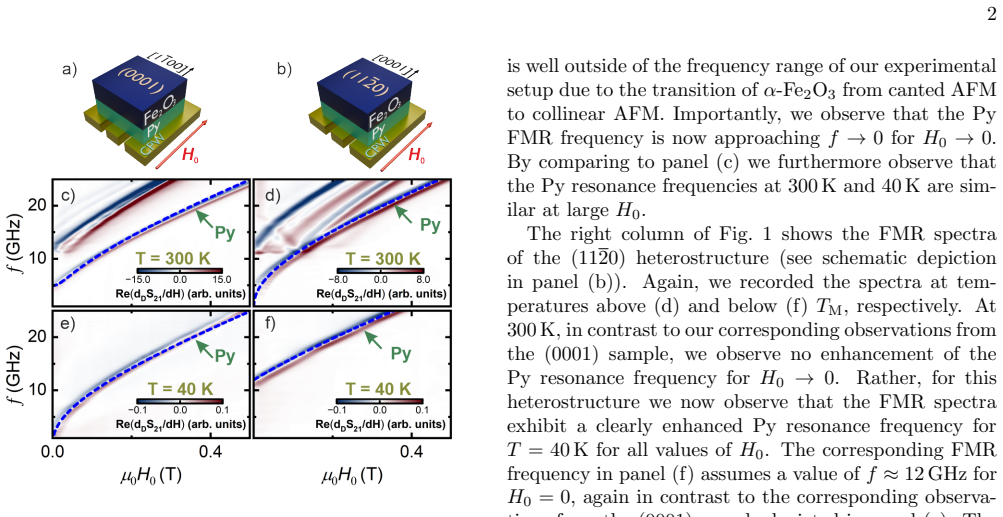
We investigate spin dynamics in $\alpha$-Fe$_{2}$O$_{3}$/Ni$_{80}$Fe$_{20}$ (Py) heterostructures, uncovering a robust mechanism for in-situ modulation of ferromagnetic resonance (FMR) through precise control of temperature, applied magnetic field and crystal orientation. Employing cryogenic ferromagnetic resonance spectroscopy, we demonstrate that the interfacial coupling between the N\'eel vector of $\alpha$-Fe$_{2}$O$_{3}$ and the magnetization of the Py layer is highly tunable across the Morin transition temperature $(T_M)$. Our experiments reveal distinct resonance behavior for different crystal orientations, highlighting the pivotal role of exchange coupling strength in dictating FMR frequencies. Theoretical modeling corroborates the experimental findings, elucidating the dependence of coupling on the relative alignment of the N\'eel vector and ferromagnetic magnetization. Notably, we achieve significant modulation of FMR frequencies by manipulating the N\'eel vector configuration, facilitated by temperature variations, applied magnetic fields and crystal orientation adjustments. These advancements demonstrate the potential for dynamic control of spin interactions in AFM/FM heterostructures, paving the way for the development of advanced spintronic devices with tunable magnetic properties. Our work provides critical insights into the fundamental interactions governing hybrid spin systems and opens new avenues for the design of versatile, temperature-responsive magnetoelectronic applications.
Editorial analysis
A structured set of objections, weighed in public.
Referee Report
Summary. The manuscript investigates spin dynamics in α-Fe₂O₃/Ni₈₀Fe₂₀ (Py) heterostructures using cryogenic FMR spectroscopy. It reports that FMR frequencies can be modulated in situ by temperature (across the Morin transition T_M), applied magnetic field, and crystal orientation, attributing the effect to tunable interfacial exchange coupling between the Néel vector of α-Fe₂O₃ and the Py magnetization. Theoretical modeling is presented as corroborating the experimental observations of distinct resonance behavior for different crystal cuts.
Significance. If the attribution to tunable Néel-vector exchange coupling holds after controls, the work identifies a practical route for dynamic control of FMR in AFM/FM heterostructures, with potential device implications. The combination of cryogenic FMR across multiple crystal orientations and modeling is a constructive element of the study.
major comments (1)
- [Results and modeling discussion] The central claim requires that observed FMR shifts are controlled by the interfacial exchange coupling rather than independent temperature/field effects on Py magnetization, damping, or anisotropy, or by crystal-cut-dependent strain/interface quality. The manuscript does not appear to include thickness-scaling data, spacer-layer controls, or explicit model decomposition that isolates the exchange term; without these the attribution remains the weakest link (see skeptic note on dominance of interfacial exchange).
minor comments (1)
- [Abstract] Abstract states qualitative agreement between experiment and modeling but supplies no quantitative metrics, error bars, or fit parameters; this reduces verifiability of the reported modulation.
Simulated Author's Rebuttal
We thank the referee for the detailed review and constructive feedback on our manuscript. The central concern regarding isolation of the interfacial exchange coupling contribution is well-taken. Below we address this point directly, clarifying how our crystal-cut, temperature, and field-dependent data, combined with modeling, support the attribution while acknowledging where further controls would be beneficial.
read point-by-point responses
-
Referee: [Results and modeling discussion] The central claim requires that observed FMR shifts are controlled by the interfacial exchange coupling rather than independent temperature/field effects on Py magnetization, damping, or anisotropy, or by crystal-cut-dependent strain/interface quality. The manuscript does not appear to include thickness-scaling data, spacer-layer controls, or explicit model decomposition that isolates the exchange term; without these the attribution remains the weakest link (see skeptic note on dominance of interfacial exchange).
Authors: We agree that explicit isolation of the exchange term strengthens the central claim. Our data show that FMR frequency shifts occur sharply across the Morin transition (TM) of α-Fe₂O₃, a feature absent in standalone Py films; this temperature dependence is inconsistent with intrinsic Py magnetization or damping changes alone. Distinct resonance behaviors for (0001) versus (11-20) cuts further tie the effect to Néel-vector orientation, as crystal-cut-dependent strain or interface quality would not produce the observed correlation with AFM reorientation. The theoretical model incorporates the interfacial exchange energy term explicitly and reproduces the measured frequency shifts only when this term is included with the correct Néel-vector alignment. We will add an explicit decomposition of contributions (exchange vs. anisotropy/damping) in a revised modeling section. Thickness-dependent or spacer-layer experiments are not present in the current dataset; performing them would require new sample growth and would be a valuable extension but lies beyond the scope of the present study. revision: partial
Circularity Check
No circularity: experimental claims rest on data and external modeling
full rationale
The manuscript describes cryogenic FMR measurements on α-Fe₂O₃/Py heterostructures across the Morin transition and for different crystal cuts, with temperature, field, and orientation used to tune the Néel-vector alignment. The abstract and provided text contain no equations, no fitted parameters renamed as predictions, and no self-citations invoked as uniqueness theorems or ansatzes. Theoretical modeling is cited only as corroboration of observed frequency shifts; no derivation chain reduces the reported modulation to a self-defined quantity or to a prior result by the same authors. The attribution to interfacial exchange coupling is an interpretive claim supported by the data rather than a tautological re-expression of inputs.
Axiom & Free-Parameter Ledger
Lean theorems connected to this paper
-
IndisputableMonolith/Cost/FunctionalEquation.leanwashburn_uniqueness_aczel unclear?
unclearRelation between the paper passage and the cited Recognition theorem.
We assume a parallel interface coupling between the Néel vector (n) of α-Fe2O3 and the Py magnetization vector (mF) with the corresponding interface energy contribution wint = −Jintξn · mF
-
IndisputableMonolith/Foundation/AbsoluteFloorClosure.leanreality_from_one_distinction unclear?
unclearRelation between the paper passage and the cited Recognition theorem.
f(H0) = µ0γ/2π √[Hint(H0) + H0](MF + H0)
What do these tags mean?
- matches
- The paper's claim is directly supported by a theorem in the formal canon.
- supports
- The theorem supports part of the paper's argument, but the paper may add assumptions or extra steps.
- extends
- The paper goes beyond the formal theorem; the theorem is a base layer rather than the whole result.
- uses
- The paper appears to rely on the theorem as machinery.
- contradicts
- The paper's claim conflicts with a theorem or certificate in the canon.
- unclear
- Pith found a possible connection, but the passage is too broad, indirect, or ambiguous to say the theorem truly supports the claim.
Reference graph
Works this paper leans on
-
[1]
Li, K. et al. Exchange coupling and its applications in magnetic data storage. J. Nanosci. Nanotechnol. 7, 13– 45 (2007)
work page 2007
-
[2]
Chappert, C., Fert, A. & Van Dau, F. N. The emergence of spin electronics in data storage. Nat. Mater. 6, 813– 823 (2007)
work page 2007
-
[3]
Dieny, B. et al. Giant magnetoresistive in soft ferromag- netic multilayers. Physical Review B 43, 1297 (1991)
work page 1991
-
[4]
Nogu´ es, J. & Schuller, I. K. Exchange bias. J. Magn. Magn. Mater. 192, 203–232 (1999)
work page 1999
-
[5]
Skumryev, V. et al. Beating the superparamagnetic limit with exchange bias. Nature 423, 850–853 (2003)
work page 2003
-
[6]
Nguyen, A. T. et al. Magnetoresistive performances in exchange-biased spin valves and their roles in low-field magnetic sensing applications. J. Adv. Mater 3, 399–405 (2018)
work page 2018
-
[7]
Huang, Y.-H. et al. A spin-orbit torque ratchet at fer- romagnet/antiferromagnet interface via exchange spring. Adv. Funct. Mater. 32, 2111653 (2022)
work page 2022
-
[8]
Lau, Y.-C., Betto, D., Rode, K., Coey, J. & Stamenov, P. Spin–orbit torque switching without an external field using interlayer exchange coupling.Nat. Nanotechnol 11, 758–762 (2016)
work page 2016
- [9]
-
[10]
Takano, K., Kodama, R., Berkowitz, A., Cao, W. & Thomas, G. Interfacial uncompensated antiferromag- netic spins: Role in unidirectional anisotropy in poly- crystalline Ni 81Fe19/CoO bilayers. Phys. Rev. Lett. 79, 1130 (1997)
work page 1997
-
[11]
N´ eel, L. Propri´ et´ es magn´ etiques de l’´ etat m´ etallique et ´ energie d’interaction entre atomes magn´ etiques. Ann. Phys. 11, 232–279 (1936)
work page 1936
- [12]
-
[13]
Rezende, S. M., Azevedo, A. & Rodr´ ıguez-Su´ arez, R. L. Introduction to antiferromagnetic magnons. J. Appl. Phys. 126 (2019)
work page 2019
-
[14]
Meiklejohn, W. H. & Bean, C. P. New magnetic anisotropy. Phys. Rev. 102, 1413 (1956)
work page 1956
-
[15]
Interface coupling in a ferromag- net/antiferromagnet bilayer
Finazzi, M. Interface coupling in a ferromag- net/antiferromagnet bilayer. Phys. Rev. B 69, 064405 (2004)
work page 2004
-
[16]
McMichael, R. D., Stiles, M. D., Chen, P. & Egelhoff Jr, W. F. Ferromagnetic resonance studies of nio-coupled thin films of ni 80 fe 20. Phys. Rev. B 58, 8605 (1998)
work page 1998
-
[17]
Schlenker, M. C. ´Etude des pertes par hyst´ er´ esis oscil- lante dans des couches minces multiples avec couplage ferro-antiferromagn´ etique.J. Phys. Colloq. 29, C2–157 (1968)
work page 1968
-
[18]
Lamirand, A. D. et al. Robust perpendicular exchange coupling in an ultrathin CoO/PtFe double layer: Strain and spin orientation. Phys. Rev. B 88, 140401 (2013)
work page 2013
-
[19]
Mishra, S. et al. Dual behavior of antiferromagnetic un- compensated spins in NiFe/IrMn exchange biased bilay- ers. Phys. Rev. B 81, 212404 (2010)
work page 2010
- [20]
-
[21]
Lommel, J. & Graham Jr, C. Rotatable anisotropy in composite films. J. Appl. Phys. 33, 1160–1161 (1962)
work page 1962
-
[22]
Al-Hamdo, H., Wagner, T. et al. Coupling of fer- romagnetic and antiferromagnetic spin dynamics in Mn2Au/NiFe thin film bilayers. Phys. Rev. Lett. 131, 046701 (2023)
work page 2023
-
[23]
Kohlhepp, J. & de Jonge, W. Influence of the fm/afm interface morphology on the exchange coupling in epitax- ial Co (001)/fct-Mn (001). J. Appl. Phys. 95, 6840–6842 (2004)
work page 2004
-
[24]
Jung, H., Traistaru, O. & Fujiwara, H. Effect of the kinds of ferromagnetic layers on exchange coupling strength in IrMn/FM films. J. Appl. Phys. 95, 6849–6851 (2004)
work page 2004
-
[25]
Singh, A. K. & Chandra, R. Thickness dependent inter- facial magnetic coupling in [La2NiMnO6/LaMnO3] mul- tilayers. J. Magn. Magn. Mater. 448, 180–185 (2018)
work page 2018
-
[26]
Beiranvand, A. & Liedke, M. O. Tuned AFM-FM coupling by the formation of vacancy complex in Gd0.6Ca0.4MnO3 thin film lattice you may also like tuned AFM-FM coupling by the formation of vacancy complex in Gd0.6Ca0.4MnO3 thin film lattice. J. Con- dens. Matter Phys 33, 9 (2021)
work page 2021
-
[27]
Pokhil, T., Song, D. & Linville, E. Magnetic force mi- croscope study of antiferromagnet–ferromagnet exchange coupled films. J. Appl. Phys. 91, 6887–6889 (2002)
work page 2002
-
[28]
Beik Mohammadi, J. et al. Broadband ferromagnetic resonance characterization of anisotropies and relaxation 6 in exchange-biased IrMn/CoFe bilayers. Phys. Rev. B 95, 064414 (2017)
work page 2017
-
[29]
Stoecklein, W., Parkin, S. & Scott, J. Ferromagnetic res- onance studies of exchange-biased permalloy thin films. Phys. Rev. B 38, 6847 (1988)
work page 1988
-
[30]
Ferromagnetic resonance studies in the bilayer system Ni0.80Fe0.20/Mn0.50Fe0.50: Exchange anisotropy
Scott, J. Ferromagnetic resonance studies in the bilayer system Ni0.80Fe0.20/Mn0.50Fe0.50: Exchange anisotropy. J. Appl. Phys. 57, 3681–3683 (1985)
work page 1985
-
[31]
Speriosu, V., Parkin, S. & Wilts, C. Standing spinwaves in FeMn/NiFe/FeMn exchange-bias structures. IEEE Trans. Magn. 23, 2999–3001 (1987)
work page 1987
-
[32]
Curry, N., Johnston, G., Besser, P. & Morrish, A. Neutron diffraction measurements on pure and doped synthetic hematite crystals. Philos. Mag. 12, 221–228 (1965)
work page 1965
-
[33]
Besser, P., Morrish, A. & Searle, C. Magnetocrystalline anisotropy of pure and doped hematite. Phys. Rev. 153, 632 (1967)
work page 1967
-
[34]
Muench, G., Arajs, S. & Matijevi´ c, E. The morin tran- sition in small α-Fe2O3 particles. Phys. Status Solidi A 92, 187–192 (1985)
work page 1985
-
[35]
Propri´ et´ es magn´ etiques de l’oxyde ferrique rhombo´ edriqueα − Fe2O3
Chevallier, R. Propri´ et´ es magn´ etiques de l’oxyde ferrique rhombo´ edriqueα − Fe2O3. J. phys. radium 12, 172–188 (1951)
work page 1951
-
[36]
Magnetic susceptibility of α-Fe2O3 and α-Fe2O3 with added titanium.Phys
Morin, F. Magnetic susceptibility of α-Fe2O3 and α-Fe2O3 with added titanium.Phys. Rev. 78, 819 (1950)
work page 1950
-
[37]
Magnetic properties of iron oxide α-Fe2O3
Guillaud, C. Magnetic properties of iron oxide α-Fe2O3. J. Phys. Radium 12, 489 (1951)
work page 1951
-
[38]
Schroeer, D. & Nininger Jr, R. Morin transition in α-Fe2O3 microcyrstals. Phys. Rev. Lett. 19, 632 (1967)
work page 1967
-
[39]
Flanders, P. & Remeika, J. Magnetic properties of hematite single crystals. Philos. Mag.-J. Theor. Exp. Appl. Phys. 11, 1271–1288 (1965)
work page 1965
-
[40]
Popov, N. et al. Influence of sn doping on the struc- tural, magnetic, optical and photocatalytic properties of hematite ( α-Fe2O3) nanoparticles. J. Phys. Chem. Sol. 161, 110372 (2022)
work page 2022
-
[41]
Krehula, S., Risti´ c, M., Reissner, M., Kubuki, S. & Musi´ c, S. Synthesis and properties of indium-doped hematite. J. Alloys Compd. 695, 1900–1907 (2017)
work page 1900
-
[42]
Shimomura, N. et al. Morin transition temperature in (0001)-oriented α-Fe2O3 thin film and effect of ir doping. J. Appl. Phys. 117 (2015)
work page 2015
-
[43]
See SI at URL for details about the sample preparation, modeling, experimental techniques and evaluation, and additional data, which includes References [33, 36, 48]
-
[44]
Maier-Flaig, H. et al. Note: Derivative divide, a method for the analysis of broadband ferromagnetic resonance in the frequency domain. Rev. Sci. Instrum. 89 (2018)
work page 2018
-
[45]
Damon, R. & Eshbach, J. Magnetostatic modes of a ferromagnetic slab. J. Appl. Phys. 31, S104–S105 (1960)
work page 1960
-
[46]
Zhao, Y. et al. Experimental investigation of temperature-dependent gilbert damping in permalloy thin films. Sci. Rep. 6, 22890 (2016)
work page 2016
-
[47]
Klemmer, T., Ellis, K. & Van Dover, B. Ferromagnetic resonance frequency of a thin mo-permalloy film.J. Appl. Phys. 87, 5846–5848 (2000)
work page 2000
-
[48]
Lebrun, R. et al. Long-distance spin-transport across the Morin phase transition up to room temperature in ultra-low damping single crystals of the antiferromagnet α-Fe2O3. Nat. Commun. 11, 6332 (2020)
work page 2020
discussion (0)
Sign in with ORCID, Apple, or X to comment. Anyone can read and Pith papers without signing in.