REVIEW 3 major objections 3 minor 38 references
Quantum Optimization for Optimal Power Flow: CVQLS-Augmented Interior Point Method
T0 review · 3 major / 3 minor · reviewed 2026-08-11 · deepseek-v4-flash
Pith's one-line read A coherent variational quantum linear solver can replace the hard linear solve inside interior-point optimal power flow.
desk verdict Small-system CVQLS-IPM integration is genuine and the mu-correction heuristic is sensible, but the 118/300-bus scalability evidence is a classical noise-injection proxy, not a CVQLS execution, so the scaling claims do not follow. read the letter →
The pith
A machine-rendered reading of the paper's core claim, the machinery that carries it, and where it could break.
The reading
What carries the argument
The workhorse is CVQLS used as a drop-in replacement for the direct linear solve inside IPM: a variational circuit $V(\omega)$ prepares the state $|\Delta x_k\rangle$ such that $H_k|\Delta x_k\rangle$ is proportional to $|-r_k\rangle$, with the cost function evaluated through local Hadamard tests. The supporting machinery is the Pauli decomposition of the Hermitian Hessian into controlled unitaries, a shallow $R_y$–$CZ$ ansatz chosen empirically, sequential initialization of the variational parameters from the previous IPM iteration, and a central-path correction that freezes the barrier parameter $\mu$ when the averaged objective shows large fluctuations.
What would settle it
Run the same CVQLS-augmented IPM on a real noisy quantum processor, or on a hardware-validated noise model calibrated with measured gate errors, crosstalk, and readout errors, for a system of at least ten buses. If the objective value or the KKT residuals deviate sharply from the paper's noise-injected simulations while the classical IPM converges, the central scalability claim is falsified.
Extended reading notes
Core claim
The central claim is that the Newton-step linear system $H_k \Delta x_k = -r_k$ arising at each IPM iteration can be solved by CVQLS, with the Hermitian matrix $H_k$ encoded through Pauli decomposition and the solution prepared by a shallow variational circuit. On this basis, the paper claims that CVQLS outperforms HHL and VQLS for OPF because of its stability with ill-conditioned matrices, that a shallow ansatz with sequential parameter initialization converges reliably while deeper ansatzes overfit or hit barren plateaus, that the Adam optimizer works best for CVQLS, and that a modified $\mu$-update is necessary to keep inexact quantum solves on the central path. The paper further claims that without this $\mu$-correction, more than 60% of one thousand random demand scenarios fail to converge, and that with it, the quantum-augmented IPM tracks the classical IPM objective on systems up to 300 buses under simulated device noise.
Load-bearing premise
The large-system scalability results rest on the assumption that injecting simulated device noise into the classical Hessian and right-hand side reproduces what CVQLS would actually do on noisy quantum hardware; if that proxy is wrong, the 118- and 300-bus results do not demonstrate the method scales.
Editorial extensions
If this is right
- Every expensive linear solve inside IPM-based OPF can be replaced by a quantum subroutine, leaving the classical parts of IPM at roughly $O(n)$ per iteration.
- CVQLS becomes the preferred quantum linear solver for ill-conditioned power-system matrices, so future quantum OPF work can focus on it rather than on HHL or VQLS.
- Warm-starting variational parameters across IPM iterations turns a sequence of slowly changing linear systems into a tractable variational task.
- The $\mu$-correction is a necessary ingredient for inexact or noisy linear solvers; without it, most random demand scenarios fail optimality or feasibility tests.
- Under ideal fault-tolerant hardware assumptions, the per-iteration quantum solve complexity grows polynomially in condition number and accuracy but only logarithmically in system size.
Reading between the lines
- Beyond the paper's own claims: if the noise-injection proxy used for the 118- and 300-bus cases does not faithfully reproduce real hardware noise, those large-system results do not demonstrate scalability; the genuine quantum evidence is the 2-bus hardware run and the small simulator runs.
- Beyond the paper: the sequential warm-starting and central-path correction are general recipes that could benefit other variational quantum algorithms applied to ill-conditioned optimization problems.
- Beyond the paper: the complexity analysis assumes fault-tolerant hardware, so the paper does not establish a near-term speedup; real queue times, gate errors, and measurement overhead could erase any theoretical gain.
- Beyond the paper: a direct comparison of CVQLS against classical sparse direct solvers on the same KKT systems, measuring wall-clock time and accuracy, would clarify when the quantum route actually wins.
Editorial analysis
A structured set of objections, weighed in public.
Referee Report
Summary. The paper proposes a quantum-augmented interior point method (QIPM) for optimal power flow (OPF), replacing the classical Newton linear solve with a coherent variational quantum linear solver (CVQLS). It argues that CVQLS is preferable to HHL and VQLS for OPF because of its stability with ill-conditioned matrices, and it introduces three enhancements: an OPF-tailored ansatz, sequential parameter initialization across IPM iterations, and a μ-correction rule that stabilizes the central path under inexact quantum solves. The method is tested on a 2-bus system on real IBMQ hardware, on 3- and 5-bus systems with the PennyLane simulator, and on 118- and 300-bus systems using Qiskit noise simulation. The small-system trajectories match classical IPM, and an ablation over 1,000 random load cases suggests that removing the μ-correction causes frequent convergence failures. The paper concludes that CVQLS-augmented QIPM provides reliable OPF solutions while acknowledging current hardware limitations.
Significance. If the scalability evidence were valid, this would be a useful practical integration of a variational quantum linear solver into power-system optimization, and the real-hardware 2-bus demonstration (192 circuits) is a genuine contribution. The paper also credits its own limitations honestly and provides an ablation of the μ-correction, which is a constructive step. However, the central scalability claim currently rests on a noise-injection proxy that does not execute CVQLS on the large systems, so the contribution at present is best viewed as a small-system feasibility study plus a classical sensitivity analysis. The comparison of VQLS and CVQLS on a few IPM matrices is suggestive but not a systematic validation of the ill-conditioning stability claim.
major comments (3)
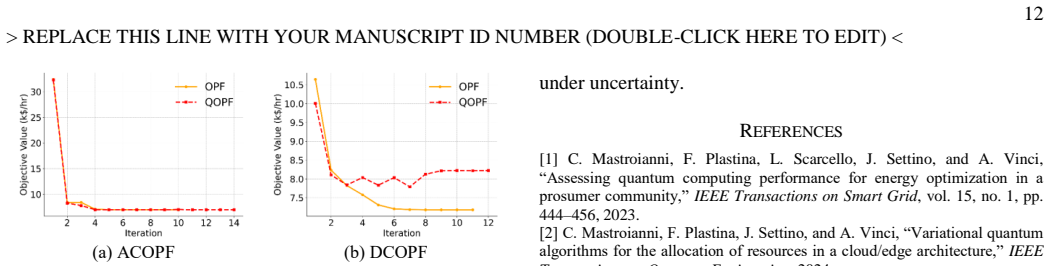
- [V.A and V.F] The 118- and 300-bus results in Figs. 15 and 16 are not CVQLS simulations. Section V.A states that encoding large Hessians caused out-of-memory errors and that 'we modeled quantum errors and noise using the Qiskit noise simulator and incorporated these into the computations,' and Section V.F says this simulator 'introduced noise into our linear system's matrix H_k and vector r_k.' This replaces the variational circuit, the ansatz, the classical-quantum optimization loop, and measurement shot noise with an unspecified additive perturbation of the classical Newton data. Such a proxy cannot validate the paper's claims about barren-plateau avoidance, ansatz expressibility, or stability with ill-conditioned matrices. The abstract's statement 'We use a quantum noise simulator to test scalability' is therefore misleading: the large-system experiments demonstrate only that a classical IPM tolerates some perturbation of H_k and r_k. To support the scalability claim, the authors should either run actual CVQLS circuits for intermediate systems (e.g., 14-, 30-, or 57-bus) or explicitly reframe the large-system experiments as a classical sensitivity analysis, with the quantum experiments limited to the small systems.
- [IV.F, Eq. (21)] The complexity expression in Eq. (21) is presented as the time complexity of the CVQLS-augmented IPM, but CVQLS is a variational algorithm whose runtime is not established by a theorem in this paper. The cited bounds in [13] hold under assumptions (e.g., block-encodings, effective condition number, state-preparation guarantees) that the authors do not verify for OPF KKT matrices. Moreover, the numerical results show QIPM requiring more IPM iterations than classical IPM, which is inconsistent with assuming O(log(1/ε)) outer iterations with exact Newton steps. The authors should either derive Eq. (21) from explicitly stated assumptions or replace it with a carefully qualified statement that separates the quantum linear-solve step from the outer IPM loop and notes the absence of a proven variational convergence guarantee.
- [II.C and V.C] The central motivation for selecting CVQLS is its 'stability with ill-conditioned matrices.' The supporting evidence in Section V.C consists of a few runs where VQLS fails with Adam or COBYLA (Figs. 5, 7) and CVQLS succeeds (Figs. 8, 9). No experiment varies the condition number of the KKT matrix, nor is there a systematic comparison of VQLS and CVQLS on the same sequence of IPM iterations with reported condition numbers and solution errors. Since the entire approach is justified by this advantage, please add a controlled comparison across a range of condition numbers and IPM iterations, or explicitly soften the claim to 'empirically observed on the tested cases.'
minor comments (3)
- [V.G / Table VIII] The μ-correction ablation reports 'more than 60% of the simulations failed to converge' in every test system, with exact percentages said to be in Table VIII, but Table VIII is not populated in the manuscript text provided. Please ensure the table (or equivalent numbers) appears, since this is the only quantitative support for the necessity of the μ-correction.
- [IV.B] The heading 'Varaitional Quantum Optimization Landscape' contains a typo; it should read 'Variational.' Also, the plural 'ansatzs' appears twice in Section IV.B and should be 'ansatze' or 'ansatz circuits.'
- [IV.C and V] The text contains 'roper initialization' (missing 'P') and a duplicate section numbering: both Section V and the Conclusion are labeled 'V.' Please correct these formatting issues.
Circularity Check
No significant circularity; the main scalability weakness is an unvalidated noise-injection proxy, not a circular reduction.
full rationale
The paper's claimed derivation is not circular. The central claim, that a CVQLS-augmented interior point method can produce reliable OPF solutions, is evaluated against MATPOWER's classical IPM as an external benchmark (Section V.E), so the target solutions are not inputs to the method. The selection of CVQLS over HHL/VQLS is an empirical and qualitative comparison (Tables I and Section V.C), not a result derived from the OPF objective itself. The tailored ansatz and sequential initialization are presented as engineering choices validated by solution error on IPM-extracted linear systems, not as fitted parameters later relabeled as predictions. The mu-correction heuristic is supported by an ablation (Section V.G) showing that removing it causes failures; its thresholds are empirical but are not defined in terms of the reported optimal values. The most significant weakness is the scalability evidence: for 118- and 300-bus cases the paper does not execute CVQLS but instead injects Qiskit noise into the classical H_k and r_k (Sections V.A and V.F). This is a serious validity limitation for the scalability claim, because the proxy does not reproduce the variational circuit, measurement shot noise, or barren-plateau behavior. However, it is not circularity: no fitted parameter is renamed as a prediction, and the comparison remains against an external classical result. The self-citations [15], [22], [27] position the authors' prior QIPM work but are not load-bearing; the present derivation rests on the experimental comparison and the standard IPM formulation.
Assumptions & free parameters
free parameters (4)
- mu-correction threshold =
Not reported (described as a relDif threshold and a ±20% sudden-deviation criterion)
- averaging window tau =
Not reported
- Ansatz depth (number of layers) =
'shallow' (exact layer count not given)
- CVQLS optimizer hyperparameters (e.g., Adam learning rate) =
Not reported
assumptions (6)
- standard math Pauli matrices form a complete basis for Hermitian matrices, allowing matrix encoding in quantum circuits.
- standard math The local cost function of CVQLS converges to the same solution as the global cost function.
- domain assumption Consecutive IPM iteration Hessians are structurally similar, so previous CVQLS parameters are a good starting point.
- ad hoc to paper Injecting noise into the matrix and vector accurately models running CVQLS on noisy quantum hardware.
- ad hoc to paper The mu-correction thresholds (relDif, ±20% deviation) are robust across systems and load cases.
- domain assumption The chosen shallow ansatz is sufficiently expressive to approximate the solution of the Newton system.
Cite this review
Pith. "Pith review of Quantum Optimization for Optimal Power Flow: CVQLS-Augmented Interior Point Method." pith.science (2026). https://pith.science/paper/S5DIUYW7
@misc{pith2026241214095,
  author       = {Pith},
  title        = {Pith review of: Quantum Optimization for Optimal Power Flow: CVQLS-Augmented Interior Point Method},
  year         = {2026},
  howpublished = {\url{https://pith.science/paper/S5DIUYW7}},
  note         = {Machine review of arXiv:2412.14095}
}
read the original abstract
This paper presents a quantum-enhanced optimization approach for solving optimal power flow (OPF) by integrating the interior point method (IPM) with a coherent variational quantum linear solver (CVQLS). The objective is to explore the applicability of quantum computing to power systems optimization and address the associated challenges. A comparative analysis of state-of-the-art quantum linear solvers - Harrow-Hassidim-Lloyd (HHL), variational quantum linear solver (VQLS), and CVQLS - revealed that CVQLS is most suitable for OPF due to its stability with ill-conditioned matrices, such as the Hessian in IPM. To ensure high-quality solutions, prevent suboptimal convergence, and avoid the barren plateau problem, we propose a quantum circuit parameter initialization technique along with a method to guide the IPM along the central path. Moreover, we design an ansatz tailored for OPF, optimizing the expressibility and trainability of the quantum circuit to ensure efficient convergence and robustness in solving quantum OPF. Various optimizers are also tested for quantum circuit parameter optimization to select the best one. We evaluate our approaches on multiple systems to show their effectiveness in providing reliable OPF solutions. Simulations for the 2-bus system are conducted on a commercial IBMQ quantum device, while simulations for the other larger cases are performed using the IBM quantum simulator. While promising, CVQLS is limited by current quantum hardware, especially for larger systems. We use a quantum noise simulator to test scalability.
Figures


Figures from the paper (10 more)



Reference graph
Works this paper leans on
-
[13]
Variational quantum linear solver,
C. Bravo -Prieto, R. LaRose, M. Cerezo, Y. Subasi, L. Cincio, and P. J. Coles, “Variational quantum linear solver,” Quantum, vol. 7, p. 1188, 2023
work page 2023
-
[1]
Assessing quantum computing performance for energy optimization in a prosumer community,
C. Mastroianni, F. Plastina, L. Scarcello, J. Settino, and A. Vinci, “Assessing quantum computing performance for energy optimization in a prosumer community,” IEEE Transactions on Smart Grid, vol. 15, no. 1, pp. 444–456, 2023
work page 2023
-
[2]
Variational quantum algorithms for the allocation of resources in a cloud/edge architecture,
C. Mastroianni, F. Plastina, J. Settino, and A. Vinci, “Variational quantum algorithms for the allocation of resources in a cloud/edge architecture,” IEEE Transactions on Quantum Engineering, 2024
work page 2024
-
[3]
Evaluating quantum optimization for dynamic self-reliant community detection,
D. Bucher, D. Porawski, B. Wimmer, J. Nüßlein, C. O’Meara, N. Mohseni, G. Cortiana, and C. Linnhoff -Popien, “Evaluating quantum optimization for dynamic self-reliant community detection,” IEEE Transactions on Smart Grid, 2024
work page 2024
-
[4]
Op portunities for quantum computing within net-zero power system optimization,
T. Morstyn and X. Wang, “Op portunities for quantum computing within net-zero power system optimization,” Joule, 2024
work page 2024
-
[5]
Annealing -based quantum computing for combinatorial optimal power flow,
T. Morstyn, “Annealing -based quantum computing for combinatorial optimal power flow,” IEEE Transactions on Smart Grid , vol. 14, no. 2, pp. 1093–1102, 2022
work page 2022
-
[6]
J. Zhu, X. Mo, Y. Xia, Y. Guo, J. Chen, and M. Liu, “Fully -decentralized optimal power flow of multi-area power systems based on parallel dual dynamic programming,” IEEE Transactions on Power Systems, vol. 37, no. 2, pp. 927– 941, 2021
work page 2021
-
[7]
A deterministic linear program solver in current matrix multiplication time,
J. van den Brand, “A deterministic linear program solver in current matrix multiplication time,” in Proc. 14th ACM-SIAM Symp. Discrete Algorithms, pp. 259–278, SIAM, 2020
work page 2020
Show all 38 references
-
[8]
Newton Raphson method,
S. Akram and Q. U. Ann, “Newton Raphson method,” Int. J. Sci. & Eng. Res., vol. 6, no. 7, pp. 1748–1752, 2015
2015
-
[9]
A parallel quadratic programming method for dynamic optimization problems,
J. V. Frasch, S. Sager, and M. Diehl, “A parallel quadratic programming method for dynamic optimization problems,” Math. Program. Comput., vol. 7, pp. 289–329, 2015
2015
-
[10]
Power flow analysis using deep neural networks in three -phase unbalanced smart distribution grids,
D. Tiwari, M. J. Zideh, V. Talreja, V. Verma, S. K. Solanki, and J. Solanki, “Power flow analysis using deep neural networks in three -phase unbalanced smart distribution grids,” IEEE Access, 2024
2024
-
[11]
Interior point methods 25 years later,
J. Gondzio, “Interior point methods 25 years later,” Eur. J. Oper. Res., vol. 218, no. 3, pp. 587–601, 2012
2012
-
[12]
Quantum algorithm for linear systems of equations,
A. W. Harrow, A. Hassidim, and S. Lloyd, “Quantum algorithm for linear systems of equations,” Phys. Rev. Lett., vol. 103, no. 15, p. 150502, 2009
2009
-
[14]
Information-theoretic bounds on quantum advantage in machine learning,
H.-Y. Huang, R. Kueng, and J. Preskill, “Information-theoretic bounds on quantum advantage in machine learning,” Phys. Rev. Lett., vol. 126, no. 19, p. 190505, 2021
2021
-
[15]
Quantum -inspired optimal power flow,
F. Amani and A. Kargarian, “Quantum -inspired optimal power flow,” in Proc. IEEE Texas Power and Energy Conf. (TPEC), pp. 1–6, 2024
2024
-
[16]
Noisy intermediate-scale quantum algorithms,
K. Bharti et al., “Noisy intermediate-scale quantum algorithms,” Rev. Mod. Phys., vol. 94, no. 1, p. 015004, 2022
2022
-
[17]
Variational quantum algorithms,
M. Cerezo et al., “Variational quantum algorithms,” Nat. Rev. Phys., vol. 3, no. 9, pp. 625–644, 2021
2021
-
[18]
Machine learning assisted construction of a shallow depth dynamic ansatz for noisy quantum hardware,
S. Halder, A. Dey, C. Shrikhande, and R. Maitra, “Machine learning assisted construction of a shallow depth dynamic ansatz for noisy quantum hardware,” Chem. Sci., vol. 15, no. 9, pp. 3279–3289, 2024
2024
-
[19]
Exploring information for quantum machine learning models,
M. Telahun, “Exploring information for quantum machine learning models,” 2020
2020
-
[20]
A variational quantum linear solver application to discrete finite-element methods,
C. J. Trahan, M. Loveland, N. Davis, and E. Ellison, “A variational quantum linear solver application to discrete finite-element methods,” Entropy, vol. 25, no. 4, p. 580, 2023
2023
-
[21]
Noise-resilient quantum power flow,
F. Feng, Y.-F. Zhou, and P. Zhang, “Noise-resilient quantum power flow,” iEnergy, vol. 2, no. 1, pp. 63–70, 2023
2023
-
[22]
Quantum-enhanced DC optimal power flow,
F. Amani, R. Mahroo, and A. Kargarian, “Quantum-enhanced DC optimal power flow,” in Proc. IEEE Texas Power and Energy Conf. (TPEC), pp. 1–6, 2023
2023
-
[23]
Cost function dependent barren plateaus in shallow parametrized quantum circuits,
M. Cerezo, A. Sone, T. Volkoff, L. Cincio, and P. J. Coles, “Cost function dependent barren plateaus in shallow parametrized quantum circuits,” Nat. Commun., vol. 12, no. 1, p. 1791, 2021
2021
-
[24]
[Online]
Coherent Varia tional Quantum Linear Solver. [Online]. Available: https://pennylane.ai/qml/demos/tutorial_coherent_vqls
-
[25]
Optimal power flow methods: A comprehensive survey,
A. K. Khamees, N. Badra, and A. Y. Abdelaziz, “Optimal power flow methods: A comprehensive survey,” Int. Electr. Eng. J. (IEEJ) , vol. 7, no. 4, pp. 2228–2239, 2016
2016
-
[26]
Matpower 6.0 user’s manual,
R. D. Zimmerman and C. E. Murillo -Sánchez, “Matpower 6.0 user’s manual,” Power Syst. Eng. Res. Center, vol. 9, pp. 65–66, 2016. 13 > REPLACE THIS LINE WITH YOUR MANUSCRIPT ID NUMBER (DOUBLE -CLICK HERE TO EDIT) <
2016
-
[27]
Optimal power flow solution via noise - resilient quantum interior-point methods,
F. Amani and A. Kargarian, “Optimal power flow solution via noise - resilient quantum interior-point methods,” Electr. Power Syst. Res., vol. 240, p. 111216, 2025
2025
-
[28]
An interior point method based optimal power flow,
F. Capitanescu, M. Glavic, and L. Wehenkel, “An interior point method based optimal power flow,” in Proc. 3rd ACOMEN Conf., 2005
2005
-
[29]
Qubit- efficient encoding scheme for quantum simulations of electronic structure,
Y. Shee , P.-K. Tsai, C. -L. Hong, H.-C. Cheng, and H. -S. Goan, “Qubit- efficient encoding scheme for quantum simulations of electronic structure,” Phys. Rev. Res., vol. 4, no. 2, p. 023154, 2022
2022
-
[30]
H2zixy: Pauli spin matrix decomposition of real symmetric matrices,
R. M. N. Pesce and P. D. Stevenson, “H2zixy: Pauli spin matrix decomposition of real symmetric matrices,” arXiv preprint arXiv:2111.00627, 2021
2021 arXiv
-
[31]
Mitigating barren plateaus of variational quantum eigensolvers,
X. Liu, G. Liu, H. -K. Zhang, J. Huang, and X. Wang, “Mitigating barren plateaus of variational quantum eigensolvers,” IEEE Trans. Quantum Eng. , 2024
2024
-
[32]
An initialization strategy for addressing barren plateaus in parametrized quantum circuits,
E. Grant, L. Wo ssnig, M. Ostaszewski, and M. Benedetti, “An initialization strategy for addressing barren plateaus in parametrized quantum circuits,” Quantum, vol. 3, p. 214, 2019
2019
-
[33]
Variational quantum simulation: a case study for understanding warm starts,
R. Puig, M. Drudis, S. Thanasilp, and Z. Holmes, “Variational quantum simulation: a case study for understanding warm starts,” PRX Quantum, vol. 6, no. 1, p. 010317, 2025
2025
-
[34]
Warm-starting and quantum computing: A systematic mapping study,
F. Truger, J. Barzen, M. Bechtold, M. Beisel, F. Leymann, A. Mandl, and V. Yussupov, “Warm-starting and quantum computing: A systematic mapping study,” ACM Comput. Surveys, vol. 56, no. 9, pp. 1–31, 2024
2024
-
[35]
Stochastic gradient descent for hybrid quantum-classical optimization,
R. Sweke et al., “Stochastic gradient descent for hybrid quantum-classical optimization,” Quantum, vol. 4, p. 314, 2020
2020
-
[36]
Advances in interior point methods for large -scale linear programming,
M. Colombo, “Advances in interior point methods for large -scale linear programming,” 2007
2007
-
[37]
Efficient interior point methods for multistage problems arising in receding horizon control,
A. Domahidi, A. U. Zgraggen, M. N. Zeilinger, M. Morari, and C. N. Jones, “Efficient interior point methods for multistage problems arising in receding horizon control,” in Proc. IEEE Conf. Decision and Control (CDC) , pp. 668–674, 2012
2012
-
[38]
[Online]
Qiskit Documentation: Device Noise Simulation. [Online]. Available: https://qiskit.org/documentation/stable/0.19/tutorials/simulators/2_device_nois e_simulation.html Farshad Amani (Graduate Student Member, IEEE) received his B.Sc. degree in Electrical Engineering from the Iran...
2017
Reviewed August 11, 2026 · model on record in the stance chip above.
Discussion (0). Continue with ORCID to comment.