REVIEW 3 major objections 5 minor 17 references
Color Enhancement for V-PCC Compressed Point Cloud via 2D Attribute Map Optimization
T0 review · 3 major / 5 minor · reviewed 2026-08-11 · deepseek-v4-flash
Pith's one-line read A 2D U-Net, pretrained on portraits, removes color artifacts from V-PCC compressed point clouds.
desk verdict A plausible 2D attribute-map enhancer for V-PCC with consistent small gains, but the transfer-learning claim is undercut by possible fine-tuning/test overlap and a missing from-scratch baseline. read the letter →
The pith
A machine-rendered reading of the paper's core claim, the machinery that carries it, and where it could break.
The reading
What carries the argument
The central mechanism is the LDC-Unet, a 2D U-Net whose lightweight residual (LR) blocks replace standard convolutions with depthwise separable convolutions and halve the number of residual blocks per scale, cutting parameters from DRUNet's 32.6M to about 4.0M. The second key mechanism is the transfer learning pipeline: a customized dataset of masked, background-filled, HEVC-compressed natural portrait images is used as a proxy for V-PCC occupancy and attribute maps in Phase 1, and a small batch of V-PCC projection maps is used for fine-tuning in Phase 2. The attribute maps are optimized in 2D and then back-projected to 3D to reconstruct the enhanced point cloud, following $y' = M(C(P(x)))$ and $x' = P^{-1}(y')$, where the network $M$ optimizes the compressed attribute maps before back-projection.
What would settle it
Training the same LDC-Unet from scratch on only the small V-PCC projection-map dataset (Phase 2 data) and comparing final 3D Y-PSNR: if Phase-2-only training matches or beats the Phase 1+Phase 2 model, the natural-image transfer is not load-bearing. Similarly, applying the pipeline to non-human point clouds (e.g., LiDAR street scenes) would test whether the portrait-pretraining generalizes or is domain-specific.
Extended reading notes
Core claim
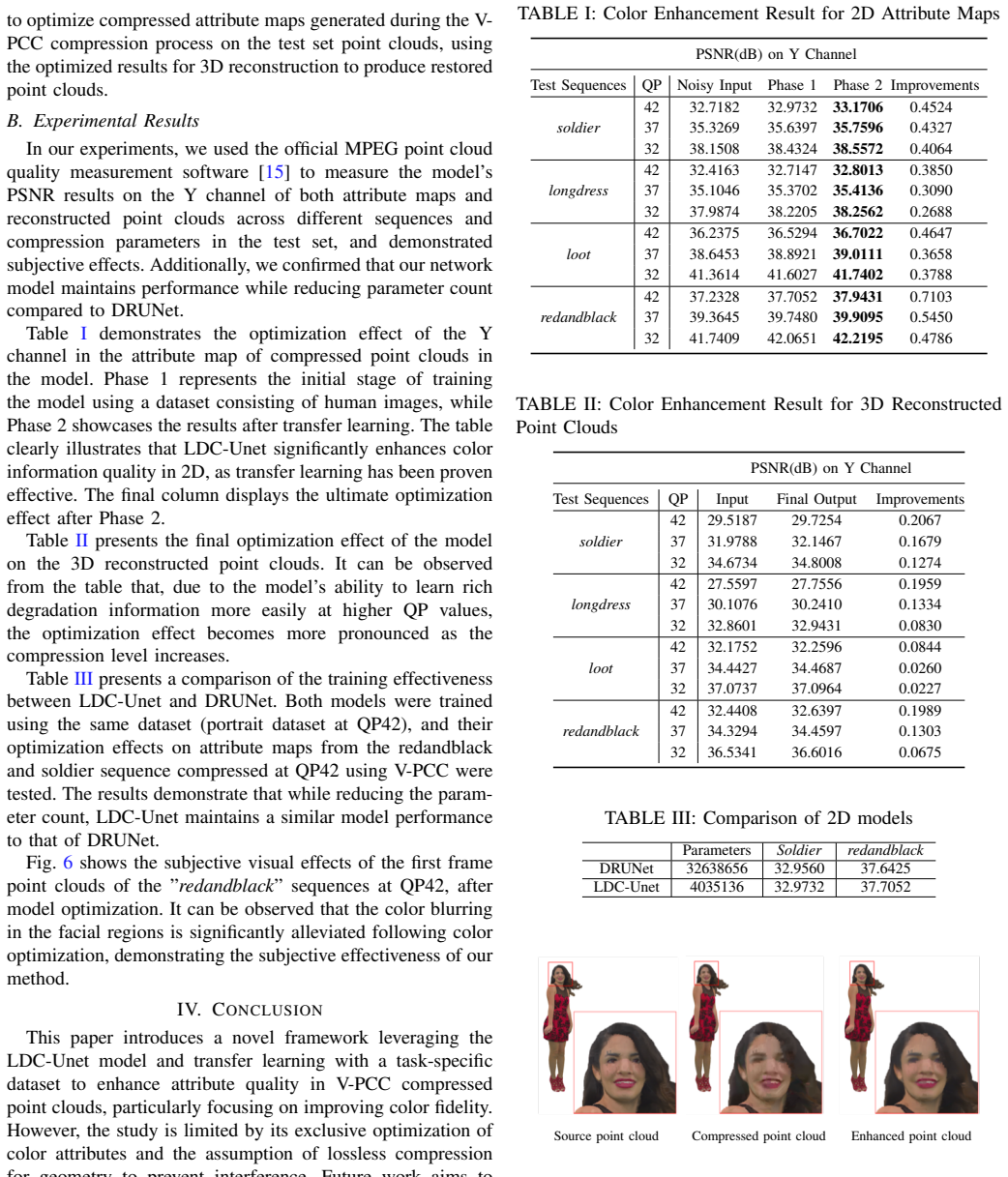
The paper's central claim is that optimizing V-PCC's 2D attribute maps with a lightweight de-compression U-Net (LDC-Unet) improves the color quality of the reconstructed point cloud once the maps are back-projected. The authors show that a two-phase transfer learning strategy works: first, LDC-Unet is trained on compressed natural portrait images with occupancy-like masks, and second, it is fine-tuned on projection maps extracted from a small point cloud dataset. They report that this raises Y-channel PSNR on attribute maps by 0.27 dB to 0.71 dB and on the final 3D reconstructed point clouds by 0.02 dB to 0.21 dB under lossless geometry, with the largest gains occurring at the highest compression (QP 42). They also report that LDC-Unet (about 4.0M parameters) slightly outperforms DRUNet (about 32.6M parameters) on the same test, emphasizing the parameter-efficiency of the lightweight residual blocks.
Load-bearing premise
The method assumes that masked, background-filled, HEVC-compressed natural portrait images are close enough to V-PCC occupancy and attribute maps that pretraining on them transfers useful denoising knowledge to point cloud color reconstruction.
Editorial extensions
If this is right
- At higher compression (lower bit rates, QP 42), the method yields larger gains, so it is most useful exactly when compression artifacts are worst.
- With about 4M parameters, the enhancement runs on a single GPU and could be embedded in V-PCC decoders without a large compute budget.
- Because geometry is assumed lossless, the gains isolate color; extending the same 2D-map optimization to geometry maps under lossy geometry is the paper's stated next step.
- The transfer learning recipe reduces reliance on scarce point cloud data: 75 point cloud files sufficed for fine-tuning, while abundant natural images handled most of the training.
- The framework is codec-agnostic on the 2D side: it enhances the attribute maps after V-PCC compression and before back-projection, so it could be paired with future V-PCC versions without changing the bitstream.
Reading between the lines
- Editorial inference: The portrait-specific pretraining suggests the transfer may be weaker for point clouds of non-human objects; measuring the distribution gap between V-PCC maps and the simulated natural-image maps would predict when the method fails.
- Editorial inference: Because only the Y channel is optimized, the reported PSNR gains likely understate visible color improvement in chroma; a perceptually weighted metric could show larger subjective gains.
- Editorial inference: The same masked-image pretraining trick could be repurposed for other projected point cloud codecs (e.g., G-PCC attribute images), since the 2D optimization itself does not depend on V-PCC specifics.
- Editorial inference: The small fine-tuning set (75 point cloud files) hints that even tens of point cloud sequences may suffice, but it also leaves the risk of overfitting to the four tested 8i sequences; tests on held-out non-8i data would confirm generalization.
Editorial analysis
A structured set of objections, weighed in public.
Referee Report
Summary. The paper proposes LDC-Unet, a lightweight 2D U-Net, to enhance the color attribute maps generated by V-PCC before they are back-projected to 3D point clouds. A transfer-learning scheme is used: Phase 1 trains on masked, HEVC-compressed portrait images; Phase 2 fine-tunes on V-PCC projection maps derived from the Waterloo Point Cloud sub-dataset. Experiments on four 8iVSLF sequences report Y-channel PSNR improvements on both attribute maps (0.27-0.71 dB) and reconstructed point clouds (0.02-0.21 dB) for QP 32-42, with a much smaller parameter count than DRUNet.
Significance. If the reported results are reproducible and the fine-tuning data is genuinely disjoint from the test sequences, the paper makes a useful practical contribution: it demonstrates that a lightweight 2D architecture can remove V-PCC color artifacts without expensive 3D convolutions, and it provides a transfer-learning recipe intended to reduce the need for large point-cloud training sets. The use of public test data and the standard TMC2 configuration are strengths, and the parameter-count comparison with DRUNet is transparent. However, the lack of explicit disclosure of the fine-tuning data contents, the absence of a fine-tune-from-scratch baseline, and the very small 3D gains for several test cases currently leave the central generalization claim insufficiently supported.
major comments (3)
- [Section II-A and III-A] The fine-tuning data is not specified at the level needed to rule out content leakage. Section II-A states that Phase 2 uses 75 files derived by scaling and augmenting the WPCSD [10], while Section III-A tests the first 32 frames of 'soldier', 'longdress', 'loot', and 'redandblack' from 8iVSLF [13]. The Waterloo Point Cloud database used by [10] is known to include sequences from the same 8iVSLF collection, so the gains in Tables I and II can be interpreted as evidence of generalization only if the 75 fine-tuning files are disjoint from the test content. Please itemize the 75 files (or their identities and augmentation operations) and, ideally, re-run Phase 2 with a strictly disjoint point-cloud set to confirm the improvements.
- [Section II-C and Table I] The contribution of the natural-image pretraining is not isolated. Table I compares Phase 1 (portrait images only) with Phase 2 (after fine-tuning on point-cloud maps), but both models share the same Phase-1 initialization. Since there is no Phase-2-from-scratch baseline trained only on the 75 point-cloud files, the reader cannot tell whether the transfer-learning step improves over simply training on the point-cloud maps, and the claim that the strategy 'effectively addresses the scarcity of point cloud training data' (Abstract) is therefore unsupported. Please add a from-scratch fine-tuning baseline with matching hyperparameters.
- [Table II] Several of the 3D point-cloud PSNR improvements are extremely small: loot QP37 shows 0.0260 dB and loot QP32 shows 0.0227 dB, with other sequences also below 0.1 dB. These are single-run numbers with no error bars or repeated trials. For these cases, the claimed enhancement of reconstructed point-cloud color is within the range of typical metric noise, so the central claim that the method improves point-cloud color quality is not established for all reported operating points. Please provide per-run results or a statistical summary and discuss a perceptually meaningful improvement threshold.
minor comments (5)
- [Section III-A] Only the Y (luma) channel is optimized and measured; the paper should state whether Cb/Cr are unchanged or also processed, and whether the reported PSNR is luma-only.
- [Section I] The Introduction contains a typo: 'issuses' should be 'issues'.
- [Section III-A] The training details are incomplete: the paper reports batch size, epochs, and initial learning rate, but not the optimizer, learning-rate schedule, loss weights, or data augmentation for Phase 2; full reproducibility would require these.
- [Table III] Table III compares only two sequences at QP42; a broader comparison across all test sequences and QPs would strengthen the claim that LDC-Unet matches DRUNet performance.
- [Equations (1)-(2)] The notation y' and x' is not used consistently in the following text; please align the symbols with Fig. 2 and the surrounding description.
Circularity Check
No significant circularity: the reported PSNR gains are measured on a separate public test set, and no load-bearing parameter or analytic claim reduces to the evaluation data.
full rationale
The paper's central claim is empirical: a 2D U-Net (LDC-Unet) trained on synthetic natural-image maps and fine-tuned on V-PCC projection maps improves Y-channel PSNR on the 8iVSLF test sequences. The objective numbers in Tables I and II are measured with the MPEG point cloud quality metric on test sequences that are not used to fit any parameter in the paper's reported equations. Eq. (1)-(2) merely define the processing chain y' = M(C(P(x))) and x' = P^-1(y'); they do not assume the improvement they report. No fitted constant, analytic formula, or uniqueness theorem is invoked to force the outcome. The only self-citation, [9], is used as an example of prior 3D methods and is not load-bearing for the architecture, training procedure, or evaluation. The construction of the portrait dataset in Section II-A is an approximation of V-PCC attribute maps and is an assumption about transferability, not a circular step. The paper does not disclose the exact contents or frame ranges of the 75 fine-tuning files from WPCSD, so if those files contained augmented versions of the 8i test sequences, the transfer-learning gains in Tables I and II would be weakened by data leakage; however, that is a data-hygiene and correctness risk, not an in-definition circularity, and cannot be established from the manuscript text. Accordingly, no circular step meeting the required quote-and-reduction standard is present.
Assumptions & free parameters
free parameters (3)
- Batch size =
30
- Number of epochs =
30 (phase 1), 10 (phase 2)
- Initial learning rate =
1e-4, halved in phase 2
assumptions (3)
- domain assumption Masked, background-filled, HEVC-compressed natural portrait images are sufficiently similar to V-PCC occupancy and attribute maps that Phase 1 pretraining transfers to point cloud projection maps.
- domain assumption Optimizing 2D attribute maps and back-projecting with unchanged geometry improves 3D point cloud color quality.
- domain assumption Y-channel PSNR in 2D and 3D is a sufficient proxy for perceived color quality of V-PCC compressed point clouds.
Cite this review
Pith. "Pith review of Color Enhancement for V-PCC Compressed Point Cloud via 2D Attribute Map Optimization." pith.science (2026). https://pith.science/paper/PIOUG7AO
@misc{pith2026241214449,
  author       = {Pith},
  title        = {Pith review of: Color Enhancement for V-PCC Compressed Point Cloud via 2D Attribute Map Optimization},
  year         = {2026},
  howpublished = {\url{https://pith.science/paper/PIOUG7AO}},
  note         = {Machine review of arXiv:2412.14449}
}
read the original abstract
Video-based point cloud compression (V-PCC) converts the dynamic point cloud data into video sequences using traditional video codecs for efficient encoding. However, this lossy compression scheme introduces artifacts that degrade the color attributes of the data. This paper introduces a framework designed to enhance the color quality in the V-PCC compressed point clouds. We propose the lightweight de-compression Unet (LDC-Unet), a 2D neural network, to optimize the projection maps generated during V-PCC encoding. The optimized 2D maps will then be back-projected to the 3D space to enhance the corresponding point cloud attributes. Additionally, we introduce a transfer learning strategy and develop a customized natural image dataset for the initial training. The model was then fine-tuned using the projection maps of the compressed point clouds. The whole strategy effectively addresses the scarcity of point cloud training data. Our experiments, conducted on the public 8i voxelized full bodies long sequences (8iVSLF) dataset, demonstrate the effectiveness of our proposed method in improving the color quality.
Figures


Figures from the paper (3 more)


Reference graph
Works this paper leans on
-
[9]
Sparse fully convolutional network for video-based point cloud compression color enhance- ment,
Z. Li, J. Bao, Y . Liu, S.-K. A. Yeung, S. Zhu, K. Hung, and M. A. Khan, “Sparse fully convolutional network for video-based point cloud compression color enhance- ment,” in Proc. 2023 6th Artificial Intelligence and Cloud Computing Conference (AICCC 2023) . Kyoto, Japan: ACM, Dec. 2023, pp. 1–8
work page 2023
-
[17]
Occupancy- assisted attribute artifact reduction for video-based point cloud compression,
L. Gao, Z. Li, L. Hou, Y . Xu, and J. Sun, “Occupancy- assisted attribute artifact reduction for video-based point cloud compression,” IEEE Transactions on Broadcasting, pp. 1–14, 2024
work page 2024
-
[10]
Pqa-net: Deep no reference point cloud quality assessment via multi-view projection,
Q. Liu, H. Yuan, H. Su, H. Liu, Y . Wang, H. Yang, and J. Hou, “Pqa-net: Deep no reference point cloud quality assessment via multi-view projection,” IEEE transactions on circuits and systems for video technology , vol. 31, no. 12, pp. 4645–4660, 2021
work page 2021
-
[13]
8i voxelized surface light field (8ivslf) dataset,
M. Krivoku ´ca, P. A. Chou, and P. Savill, “8i voxelized surface light field (8ivslf) dataset,” ISO/IEC JTC1/SC29 WG11 (MPEG) input document m42914, Ljubljana, Jul. 2018
work page 2018
-
[1]
Use cases for point cloud compression (pcc),
C. Tulvan, R. Mekuria, Z. Li, and S. Laserre, “Use cases for point cloud compression (pcc),” ISO/IEC JTC1/SC29/WG11 (MPEG) output document N16331, 2016
work page 2016
-
[2]
U-net: Convo- lutional networks for biomedical image segmentation,
O. Ronneberger, P. Fischer, and T. Brox, “U-net: Convo- lutional networks for biomedical image segmentation,” in Medical Image Computing and Computer-Assisted Intervention–MICCAI 2015: 18th International Confer- ence, Munich, Germany, October 5-9, 2015, Proceedings, Part III 18. Springer, 2015, pp. 234–241
work page 2015
-
[3]
D. Graziosi, O. Nakagami, S. Kuma, A. Zaghetto, T. Suzuki, and A. Tabatabai, “An overview of ongo- ing point cloud compression standardization activities: Video-based (V-PCC) and geometry-based (G-PCC),” APSIPA Transactions on Signal and Information Process- ing, vol. 9, p. e13, 2020
work page 2020
-
[4]
Overview of the H.264/A VC video coding standard,
T. Wiegand, G. J. Sullivan, G. Bjøntegaard, and A. Luthra, “Overview of the H.264/A VC video coding standard,” IEEE Transactions on Circuits and Systems for Video Technology, vol. 13, no. 7, pp. 560–576, 2003
work page 2003
Show all 17 references
-
[5]
Overview of the high efficiency video coding (HEVC) standard,
G. J. Sullivan, J.-R. Ohm, W.-J. Han, and T. Wiegand, “Overview of the high efficiency video coding (HEVC) standard,” IEEE Transactions on circuits and systems for video technology, vol. 22, no. 12, pp. 1649–1668, 2012
2012
-
[6]
V-PCC Test Model v18,
“V-PCC Test Model v18,” ISO/IEC JTC1/SC29/WG07 MPEG/N00311, Online, Apr. 2022
2022
-
[7]
Attribute artifacts removal for geometry-based point cloud compression,
X. Sheng, L. Li, D. Liu, and Z. Xiong, “Attribute artifacts removal for geometry-based point cloud compression,” IEEE Transactions on Image Processing , vol. 31, pp. 3399–3413, 2022
2022
-
[8]
GQE-Net: a graph-based quality enhancement network for point cloud color attribute,
J. Xing, H. Yuan, R. Hamzaoui, H. Liu, and J. Hou, “GQE-Net: a graph-based quality enhancement network for point cloud color attribute,” IEEE Transactions on Image Processing, vol. 32, pp. 6303–6317, 2023
2023
-
[11]
Plug-and-play image restoration with deep denoiser prior,
K. Zhang, Y . Li, W. Zuo, L. Zhang, L. Van Gool, and R. Timofte, “Plug-and-play image restoration with deep denoiser prior,” IEEE Transactions on Pattern Analysis and Machine Intelligence , vol. 44, no. 10, pp. 6360– 6376, 2021
2021
-
[12]
Learning enriched features for fast image restoration and enhancement,
S. W. Zamir, A. Arora, S. Khan, M. Hayat, F. S. Khan, M.-H. Yang, and L. Shao, “Learning enriched features for fast image restoration and enhancement,” IEEE trans- actions on pattern analysis and machine intelligence , vol. 45, no. 2, pp. 1934–1948, 2022
1934
-
[14]
Supervisely persons,
Supervisely, “Supervisely persons,” 2020. [Online]. Available: https://ecosystem.supervisely.com/projects/ persons
2020
-
[15]
Updates and integration of evaluation metric software for pcc,
D. Tian, H. Ochimizu, C. Feng, R. Cohen, and A. Vetro, “Updates and integration of evaluation metric software for pcc,” MPEG input document M40522, 2017
2017
-
[16]
Mobilenets: Efficient convolutional neural networks for mobile vision applications,
A. G. Howard, M. Zhu, B. Chen, D. Kalenichenko, W. Wang, T. Weyand, M. Andreetto, and H. Adam, “Mobilenets: Efficient convolutional neural networks for mobile vision applications,” arXiv preprint arXiv:1704.04861, 2017
2017 arXiv
Reviewed August 11, 2026 · model on record in the stance chip above.
Discussion (0). Continue with ORCID to comment.