REVIEW 3 major objections 6 minor 44 references
LiftRefine: Progressively Refined View Synthesis from 3D Lifting with Volume-Triplane Representations
T0 review · 3 major / 6 minor · reviewed 2026-08-11 · deepseek-v4-flash
Pith's one-line read LiftRefine's progressive 3D lifting surpasses prior view synthesis.
desk verdict Solid two-stage view synthesis with real benchmark gains, but the progressive-refinement novelty is not isolated and the Objaverse claim is unsupported. read the letter →
The pith
A machine-rendered reading of the paper's core claim, the machinery that carries it, and where it could break.
The reading
What carries the argument
The load-bearing mechanism is the progressive inference loop, supported by a two-stage model. Stage 1, the Lift reconstructor, projects image features into a low-resolution volume, then upsamples that volume through a tri-plane decoder into a high-resolution tri-plane that can be rendered to images and feature maps. Stage 2, the Refine diffusion model, is a latent diffusion U-Net initialized from Zero123 that denoises a target latent conditioned on the rendered feature map and on the CLIP embedding of the input. In progressive inference, the reconstructor renders a feature map at an interpolated camera pose, the diffusion model generates an intermediate view, that view is appended to the image buffer, and the process repeats until the target view is rendered. This loop is what the paper claims couples 3D consistency with 2D realism.
What would settle it
Run a controlled comparison on CO3D-Hydrant that keeps the total number of diffusion denoising steps fixed and compares (a) one diffusion pass straight to the target view against (b) the progressive loop with four interpolated views; if (b) does not beat (a) on FID or LPIPS, the progressive-refinement claim is not supported. Additionally, measure the multi-view consistency of the generated buffer (e.g., by re-rendering from the final tri-plane and checking reprojection error against the intermediate views) and check whether consistency degrades as the number of iterations grows.
Extended reading notes
Core claim
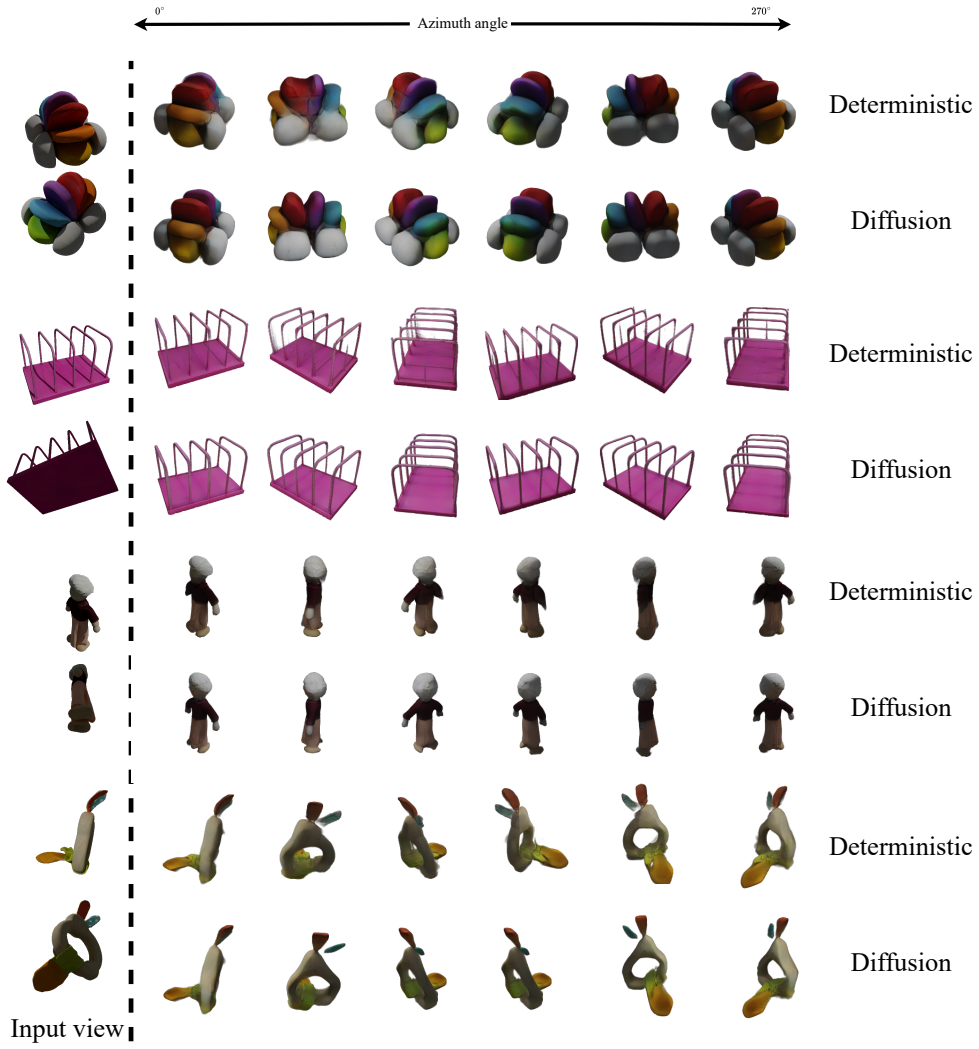
The central claim is that a 3D reconstructor and a 2D diffusion refiner, when combined through a progressive loop, give both the multi-view consistency of a neural field and the sharpness of a generative model. The reconstructor alone produces blurry but view-consistent results in unseen regions; the diffusion model alone produces sharp but somewhat inconsistent views. Progressive inference lets the two correct each other: each newly generated view is treated as an additional input to the reconstructor, and the final tri-plane is used to render the target. On the reported benchmarks the method beats the deterministic and probabilistic baselines, and the paper emphasizes that the volume-plus-triplane design needs far less compute than transformer-based LRM (4 A100 GPUs for 7 days versus 128 for 3 days).
Load-bearing premise
The progressive loop assumes that diffusion-generated intermediate views—which the supplement concedes are slightly inconsistent across angles—can be safely added to the input buffer and will strengthen rather than corrupt the volume-triplane reconstruction, even though the reconstructor was trained on real views only.
Editorial extensions
If this is right
- If the claims hold, single-image synthesis closes much of the gap to few-view synthesis in occluded regions, since the CO3D comparison shows one-view diffusion output approaching three-view deterministic quality.
- The progressive loop gives a direct quality knob: more interpolation steps trade pixel-wise metrics for distribution-level realism, with 4 iterations offering the best balance on CO3D-Hydrant.
- The two-stage design appears more data- and compute-efficient than transformer-based tri-plane reconstruction, which matters for scaling to large 3D datasets.
- The diffusion setting's lower FID and LPIPS suggest the rendered views are perceptually closer to real novel-view distributions, not just pixel-wise closer to ground truth.
- Because the reconstructor is a generalizable neural field, the method supports arbitrary output poses, unlike fixed-set multi-view generators such as SyncDreamer.
Reading between the lines
- The feedback loop is a form of self-conditioning at test time; a direct extension would weight generated views by the diffusion model's estimated confidence so that uncertain pseudo-views do not degrade the reconstructor (the paper does not test such weighting).
- A same-budget ablation—same total diffusion denoising steps spent on one target view versus spread over n interpolated views—would isolate whether the gain comes from the loop itself or simply from more sampling; the paper does not report this ablation.
- Since the diffusion model is initialized from a pretrained image-to-3D model, the method likely inherits that model's biases on categories or viewpoints it was not trained on; testing on rare CO3D categories beyond Hydrant, Teddybear, Vase, and Plant would map those failure modes.
- The supplement notes 'minor inconsistencies' in generated views; a quantitative multi-view consistency metric on the final render could tell whether progressive inference converges or drifts as iterations grow.
Signed reviews
Editorial analysis
A structured set of objections, weighed in public.
Referee Report
Summary. The paper proposes LiftRefine, a two-stage method for single- and few-view novel view synthesis. Stage 1 trains a reconstruction model that lifts input images into a coarse volume and then a fine tri-plane representation, which can be rendered to images and feature maps. Stage 2 trains a latent diffusion model conditioned on the rendered feature map and a CLIP embedding of the input to hallucinate details in occluded regions. The paper's third contribution is a progressive inference procedure in which diffusion-generated intermediate views are appended to an image buffer and the reconstructor is re-run on the growing buffer, eventually rendering the final view. Experiments on CO3D, GSO, and ShapeNet-SRN Cars report improvements over several baselines, with ablations on the 3D representation, backbone, and number of progressive iterations.
Significance. The volume-plus-triplane reconstruction design is a sensible engineering contribution that appears to give strong deterministic reconstruction results, and the FID improvements from diffusion refinement are consistent with the literature on generative view synthesis. If the progressive-inference claim were properly isolated, the method would be a useful addition to the single/few-view reconstruction literature. The paper provides detailed architecture and training details in the supplement, and the qualitative results show clear improvements in occluded regions. However, the key novelty--iterative feedback of generated views into the reconstructor--is not supported by an experiment that separates the feedback mechanism from the extra diffusion compute, and the abstract's Objaverse claim is unsupported. These gaps prevent acceptance as is.
major comments (3)
- [Section 3.3, Table 5] The central claim that progressive inference improves reconstruction quality is not isolated. In Table 5, iteration 0 is the deterministic baseline, and every nonzero iteration includes both a diffusion sampling step and a feedback of the generated intermediate view into the reconstructor buffer. The improvements in FID and LPIPS between iterations 1 and 8 could therefore be caused by the additional diffusion calls, by the increased number of conditioning views, or by the progressive feedback itself. Please add an equal-budget comparison: hold the number of diffusion calls fixed (e.g., 4) and compare (a) one-shot diffusion applied to the final target view feature map, (b) diffusion applied to the final target view after feeding all generated intermediate views into the buffer in a single batch, and (c) the proposed progressive loop. Only (c) versus (b) isolates the iterative nature, and only (c) versus (a) measures the cost-effectiveness of feedback.
- [Abstract and Section 4] The abstract claims empirical superiority on the 'large-scale Objaverse dataset,' but no quantitative evaluation on Objaverse appears anywhere in the main paper or supplement. Objaverse appears only as a training set. Either add Objaverse evaluation results (even a table in the supplement) or revise the abstract to remove this claim.
- [Supplementary Section 9 / Section 3.3] The progressive feedback loop assumes the reconstruction model generalizes to diffusion-generated pseudo-views, but the reconstructor was trained only on 1-3 ground-truth views (Supplementary Section 7), and Supplementary Section 9 states that the diffusion-generated GSO samples exhibit 'minor inconsistencies across views.' No experiment measures whether feeding such out-of-distribution views into the reconstructor degrades the triplane representation compared with feeding a ground-truth view at the same pose. Since this premise is structural to the method, it should be tested directly, for example by replacing the generated intermediate view with the ground-truth image at the same camera pose and measuring the change in final reconstruction metrics.
minor comments (6)
- [Section 4.1] The text contains the typo 'SpareFusion' in the sentence discussing FID; it should be 'SparseFusion.'
- [Related Work] The sentence 'one ought to to utilize' has a duplicated 'to'; remove the repetition.
- [Conclusion] The word 'empowerd' should be 'empowered' in the final paragraph.
- [Supplementary Section 6.1] The supplement lists both ResNet34 and Dino-v2 as possible feature extractors, but the main paper never states which one is used in the reported experiments; please specify and note whether results differ between the two.
- [Table 4] Table 4 lists OpenLRM as an image-to-triplane backbone, but OpenLRM is a full reconstruction method; clarify what part is used as the backbone and how it is trained in this ablation.
- [Table 5] Table 5 reports single runs with no variance or significance information; the FID differences between adjacent settings are small (e.g., 34.7 vs 34.0), so error bars or multiple seeds are needed to support the ranking.
Circularity Check
No significant circularity: LiftRefine's claims are supported by external benchmarks and standard losses, with no fitted parameter renamed as prediction.
full rationale
LiftRefine is an empirical systems paper whose contributions are validated against external benchmarks (CO3D, GSO, ShapeNet-SRN Cars) and external baselines (OpenLRM, Splatter Image, LaRa, ViewsetDiffusion, SparseFusion, SyncDreamer). I checked each load-bearing step for reduction to its own inputs. The reconstruction loss (Eq. 2) compares predicted renders against ground-truth target views with L2 and LPIPS, and the diffusion loss (Eq. 3) is a standard denoising objective conditioned on the reconstructor's feature maps; no reported metric is used as a training target or as a fitted parameter. Progressive inference (Sec. 3.3) is an inference-time feedback loop where diffusion-generated views are appended to the image buffer and the reconstructor is re-run; Table 5 varies the number of iterations, and although the paper does not isolate the feedback mechanism from the number of diffusion calls, that is an ablation gap or confound, not circularity, because the PSNR/SSIM/LPIPS/FID values are measured, not constructed by definition. The iteration count (4) is selected on CO3D-Hydrant, but this is ordinary hyperparameter tuning and does not make the later comparisons definitional. No load-bearing self-citation, uniqueness theorem, or ansatz smuggled in via citation was found; the authors' own prior work is not invoked to justify the central claim. Therefore the derivation chain is self-contained with respect to the stated benchmarks.
Assumptions & free parameters
free parameters (5)
- Number of progressive iterations =
4
- Classifier-free guidance scale =
2.0
- LPIPS loss weight lambda =
0.1
- Tri-plane resolution =
256
- Low-resolution volume dimensions =
32^3
assumptions (4)
- domain assumption Accurate input and target camera poses are known for every dataset.
- domain assumption Pretrained backbones (ResNet34/DINOv2, Zero123, CLIP) provide transferable priors.
- domain assumption Baselines are evaluated in a comparable training setup.
- domain assumption Benchmark protocols from prior work are adopted without re-verification.
Cite this review
Pith. "Pith review of LiftRefine: Progressively Refined View Synthesis from 3D Lifting with Volume-Triplane Representations." pith.science (2026). https://pith.science/paper/QT2USPFL
@misc{pith2026241214464,
  author       = {Pith},
  title        = {Pith review of: LiftRefine: Progressively Refined View Synthesis from 3D Lifting with Volume-Triplane Representations},
  year         = {2026},
  howpublished = {\url{https://pith.science/paper/QT2USPFL}},
  note         = {Machine review of arXiv:2412.14464}
}
read the original abstract
We propose a new view synthesis method via synthesizing a 3D neural field from both single or few-view input images. To address the ill-posed nature of the image-to-3D generation problem, we devise a two-stage method that involves a reconstruction model and a diffusion model for view synthesis. Our reconstruction model first lifts one or more input images to the 3D space from a volume as the coarse-scale 3D representation followed by a tri-plane as the fine-scale 3D representation. To mitigate the ambiguity in occluded regions, our diffusion model then hallucinates missing details in the rendered images from tri-planes. We then introduce a new progressive refinement technique that iteratively applies the reconstruction and diffusion model to gradually synthesize novel views, boosting the overall quality of the 3D representations and their rendering. Empirical evaluation demonstrates the superiority of our method over state-of-the-art methods on the synthetic SRN-Car dataset, the in-the-wild CO3D dataset, and large-scale Objaverse dataset while achieving both sampling efficacy and multi-view consistency.
Figures


Figures from the paper (16 more)



Reference graph
Works this paper leans on
-
[1]
, " * write output.state after.block = add.period write newline
ENTRY address archivePrefix author booktitle chapter edition editor eid eprint howpublished institution isbn journal key month note number organization pages publisher school series title type volume year label extra.label sort.label short.list INTEGERS output.state before.all mid.sentence after.sentence after.block FUNCTION init.state.consts #0 'before.a...
-
[2]
write newline
" write newline "" before.all 'output.state := FUNCTION n.dashify 't := "" t empty not t #1 #1 substring "-" = t #1 #2 substring "--" = not "--" * t #2 global.max substring 't := t #1 #1 substring "-" = "-" * t #2 global.max substring 't := while if t #1 #1 substring * t #2 global.max substring 't := if while FUNCTION word.in bbl.in capitalize " " * FUNCT...
-
[3]
Anciukevicius, T.; Xu, Z.; Fisher, M.; Henderson, P.; Bilen, H.; Mitra, N. J.; and Guerrero, P. 2022. RenderDiffusion : Image Diffusion for 3D Reconstruction, Inpainting and Generation. arXiv
work page 2022
-
[4]
Chan, E. R.; Nagano, K.; Chan, M. A.; Bergman, A. W.; Park, J. J.; Levy, A.; Aittala, M.; Mello, S. D.; Karras, T.; and Wetzstein, G. 2023. GeNVS : Generative Novel View Synthesis with 3D -Aware Diffusion Models. In arXiv
work page 2023
-
[5]
Chen, A.; Xu, H.; Esposito, S.; Tang, S.; and Geiger, A. 2024. LaRa: Efficient Large-Baseline Radiance Fields. In European Conference on Computer Vision (ECCV)
work page 2024
-
[6]
Chen, A.; Xu, Z.; Zhao, F.; Zhang, X.; Xiang, F.; Yu, J.; and Su, H. 2021. Mvsnerf: Fast generalizable radiance field reconstruction from multi-view stereo. In ICCV
work page 2021
-
[7]
Chen, H.; Gu, J.; Chen, A.; Tian, W.; Tu, Z.; Liu, L.; and Su, H. 2023. Single-Stage Diffusion NeRF: A Unified Approach to 3D Generation and Reconstruction. In ICCV
work page 2023
-
[8]
Deitke, M.; Schwenk, D.; Salvador, J.; Weihs, L.; Michel, O.; VanderBilt, E.; Schmidt, L.; Ehsani, K.; Kembhavi, A.; and Farhadi, A. 2022. Objaverse: A Universe of Annotated 3D Objects. arXiv preprint arXiv:2212.08051
arXiv 2022
Show all 44 references
-
[9]
G.; Kinman, B.; Reymann, K
Francis, A. G.; Kinman, B.; Reymann, K. A.; Downs, L.; Koenig, N.; Hickman, R. M.; McHugh, T. B.; and Vanhoucke, V. O., eds. 2022. Google Scanned Objects: A High-Quality Dataset of 3D Scanned Household Items
2022
-
[10]
Gu, J.; Trevithick, A.; Lin, K.-E.; Susskind, J.; Theobalt, C.; Liu, L.; and Ramamoorthi, R. 2023. NerfDiff: Single-image View Synthesis with NeRF-guided Distillation from 3D-aware Diffusion. In ICML
2023
-
[11]
He, K.; Zhang, X.; Ren, S.; and Sun, J. 2016. Deep Residual Learning for Image Recognition. CVPR
2016
-
[12]
He, Z.; and Wang, T. 2023. OpenLRM: Open-Source Large Reconstruction Models. https://github.com/3DTopia/OpenLRM
2023
-
[13]
Ho, J.; Jain, A.; and Abbeel, P. 2020. Denoising Diffusion Probabilistic Models. CVPR
2020
-
[14]
Hong, Y.; Zhang, K.; Gu, J.; Bi, S.; Zhou, Y.; Liu, D.; Liu, F.; Sunkavalli, K.; Bui, T.; and Tan, H. 2024. LRM: Large Reconstruction Model for Single Image to 3D
2024
-
[15]
Karnewar, A.; Vedaldi, A.; Novotny, D.; and Mitra, N. 2023. HoloDiffusion: Training a 3D Diffusion Model using 2D Images. In CVPR
2023
-
[16]
W.; Brown, B.; Yin, K.; Kreis, K.; Schwarz, K.; Li, D.; Rombach, R.; Torralba, A.; and Fidler, S
Kim, S. W.; Brown, B.; Yin, K.; Kreis, K.; Schwarz, K.; Li, D.; Rombach, R.; Torralba, A.; and Fidler, S. 2023. NeuralField-LDM: Scene Generation with Hierarchical Latent Diffusion Models. In CVPR
2023
-
[17]
P.; and Ba, J
Kingma, D. P.; and Ba, J. 2017. Adam: A Method for Stochastic Optimization. arXiv:1412.6980
2017 arXiv
-
[18]
Lin, K.-E.; Yen-Chen, L.; Lai, W.-S.; Lin, T.-Y.; Shih, Y.-C.; and Ramamoorthi, R. 2023. Vision Transformer for NeRF-Based View Synthesis from a Single Input Image. In WACV
2023
-
[19]
Liu, A.; Tucker, R.; Jampani, V.; Makadia, A.; Snavely, N.; and Kanazawa, A. 2021. Infinite Nature: Perpetual View Generation of Natural Scenes from a Single Image. In ICCV
2021
-
[20]
V.; Tokmakov, P.; Zakharov, S.; and Vondrick, C
Liu, R.; Wu, R.; Hoorick, B. V.; Tokmakov, P.; Zakharov, S.; and Vondrick, C. 2023 a . Zero-1-to-3: Zero-shot One Image to 3D Object. arXiv:2303.11328
2023 arXiv
-
[21]
Liu, Y.; Lin, C.; Zeng, Z.; Long, X.; Liu, L.; Komura, T.; and Wang, W. 2023 b . SyncDreamer: Learning to Generate Multiview-consistent Images from a Single-view Image. arXiv preprint arXiv:2309.03453
2023 arXiv
-
[22]
Long, X.; Guo, Y.-C.; Lin, C.; Liu, Y.; Dou, Z.; Liu, L.; Ma, Y.; Zhang, S.-H.; Habermann, M.; Theobalt, C.; et al. 2024. Wonder3D: Single Image to 3D using Cross-Domain Diffusion. In CVPR
2024
-
[23]
P.; Tancik, M.; Barron, J
Mildenhall, B.; Srinivasan, P. P.; Tancik, M.; Barron, J. T.; Ramamoorthi, R.; and Ng, R. 2020. NeRF: Representing Scenes as Neural Radiance Fields for View Synthesis. In ECCV
2020
-
[24]
T.; and Mildenhall, B
Poole, B.; Jain, A.; Barron, J. T.; and Mildenhall, B. 2022. DreamFusion: Text-to-3D using 2D Diffusion. arXiv
2022
-
[25]
Reizenstein, J.; Shapovalov, R.; Henzler, P.; Sbordone, L.; Labatut, P.; and Novotny, D. 2021. Common Objects in 3D: Large-Scale Learning and Evaluation of Real-life 3D Category Reconstruction. In ICCV
2021
-
[26]
Ren, X.; and Wang, X. 2022. Look Outside the Room: Synthesizing A Consistent Long-Term 3D Scene Video from A Single Image. In CVPR
2022
-
[27]
Rombach, R.; Blattmann, A.; Lorenz, D.; Esser, P.; and Ommer, B. 2021. High-Resolution Image Synthesis with Latent Diffusion Models. arXiv:2112.10752
2021 arXiv
-
[28]
Rombach, R.; Esser, P.; and Ommer, B. 2021. Geometry-Free View Synthesis: Transformers and no 3D Priors. arXiv:2104.07652
2021 arXiv
-
[29]
Schuhmann, C.; Beaumont, R.; Vencu, R.; Gordon, C.; Wightman, R.; Cherti, M.; Coombes, T.; Katta, A.; Mullis, C.; Wortsman, M.; Schramowski, P.; Kundurthy, S.; Crowson, K.; Schmidt, L.; Kaczmarczyk, R.; and Jitsev, J. 2022. LAION-5B: An open large-scale dataset for training ne...
2022 arXiv
-
[30]
Shi, Y.; Wang, P.; Ye, J.; Mai, L.; Li, K.; and Yang, X. 2024. MVDream: Multi-view Diffusion for 3D Generation. In ICLR
2024
-
[31]
Sitzmann, V.; Zollh \"o fer, M.; and Wetzstein, G. 2019. Scene Representation Networks: Continuous 3D-Structure-Aware Neural Scene Representations. In NeurIPS
2019
-
[32]
Song, J.; Meng, C.; and Ermon, S. 2022. Denoising Diffusion Implicit Models. arXiv:2010.02502
2022 arXiv
-
[33]
Szymanowicz, S.; Rupprecht, C.; and Vedaldi, A. 2023 a . Splatter Image: Ultra-Fast Single-View 3D Reconstruction. In arXiv
2023
-
[34]
Szymanowicz, S.; Rupprecht, C.; and Vedaldi, A. 2023 b . Viewset Diffusion: (0-)Image-Conditioned 3D Generative Models from 2D data. In ICCV
2023
-
[35]
B.; Durand, F.; Freeman, W
Tewari, A.; Yin, T.; Cazenavette, G.; Rezchikov, S.; Tenenbaum, J. B.; Durand, F.; Freeman, W. T.; and Sitzmann, V. 2023. Diffusion with Forward Models: Solving Stochastic Inverse Problems Without Direct Supervision. In arXiv
2023
-
[36]
Tseng, H.-Y.; Li, Q.; Kim, C.; Alsisan, S.; Huang, J.-B.; and Kopf, J. 2023. Consistent View Synthesis with Pose-Guided Diffusion Models. In CVPR
2023
-
[37]
Tucker, R.; and Snavely, N. 2020. Single-view View Synthesis with Multiplane Images. In CVPR
2020
-
[38]
Wang, P.; and Shi, Y. 2023. ImageDream: Image-Prompt Multi-view Diffusion for 3D Generation. arXiv preprint arXiv:2312.02201
2023 arXiv
-
[39]
T.; Martin-Brualla, R.; Snavely, N.; and Funkhouser, T
Wang, Q.; Wang, Z.; Genova, K.; Srinivasan, P.; Zhou, H.; Barron, J. T.; Martin-Brualla, R.; Snavely, N.; and Funkhouser, T. 2021. IBRNet: Learning Multi-View Image-Based Rendering. In CVPR
2021
-
[40]
Wang, Z.; Lu, C.; Wang, Y.; Bao, F.; Li, C.; Su, H.; and Zhu, J. 2023. ProlificDreamer: High-Fidelity and Diverse Text-to-3D Generation with Variational Score Distillation. arXiv preprint arXiv:2305.16213
2023 arXiv
-
[41]
Watson, D.; Chan, W.; Martin-Brualla, R.; Ho, J.; Tagliasacchi, A.; and Norouzi, M. 2022. Novel View Synthesis with Diffusion Models. arXiv:2210.04628
2022 arXiv
-
[42]
Xu, Y.; Tan, H.; Luan, F.; Bi, S.; Wang, P.; Li, J.; Shi, Z.; Sunkavalli, K.; Wetzstein, G.; Xu, Z.; and Zhang, K. 2024. DMV3D: Denoising Multi-View Diffusion using 3D Large Reconstruction Model. In ICLR
2024
-
[43]
Yu, A.; Ye, V.; Tancik, M.; and Kanazawa, A. 2021. pixelNeRF : Neural Radiance Fields from One or Few Images. In CVPR
2021
-
[44]
Zhou, Z.; and Tulsiani, S. 2023. SparseFusion: Distilling View-conditioned Diffusion for 3D Reconstruction. In CVPR
2023
Reviewed August 11, 2026 · model on record in the stance chip above.
Discussion (0). Continue with ORCID to comment.