REVIEW 3 major objections 5 minor 50 references
Logic Induced High-Order Reasoning Network for Event-Event Relation Extraction
T0 review · 3 major / 5 minor · reviewed 2026-08-11 · deepseek-v4-flash
Pith's one-line read Encoding coreference, symmetry, and conjunction rules into a heterogeneous graph improves extraction of temporal and subevent event relations.
desk verdict The graph architecture is interesting and the ablations are clean, but the MAVEN-ERE evaluation is not comparable to baselines and the conjunction loss doesn't follow from the t-norm derivation; the SOTA claim is not supported without a matched re-run. read the letter →
The pith
A machine-rendered reading of the paper's core claim, the machinery that carries it, and where it could break.
The reading
What carries the argument
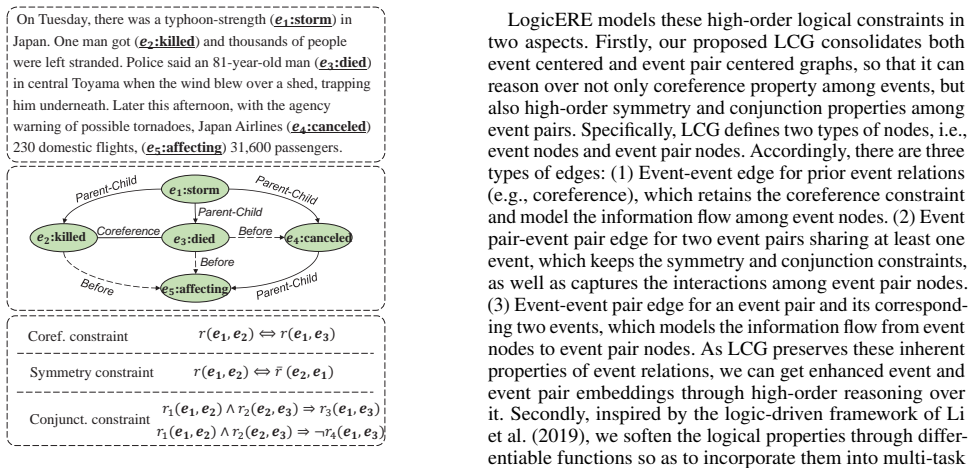
The key object is the Logic Constraint Induced Graph (LCG), a heterogeneous graph with event nodes and event pair nodes. Three edge types encode the paper's three constraints: event-event edges link co-referenced events (coreference constraint), event pair-event pair edges link pairs sharing an event (symmetry and conjunction constraints), and event-event pair edges connect an event pair to its two events. A relational graph transformer performs high-order reasoning over this graph, using an edge-type scalar as an attention bias, and a joint logic learning module turns symmetry and conjunction into differentiable losses using product t-norm.
What would settle it
Run the HiEve and MAVEN-ERE SRE evaluations with coreference edges predicted by an independent coreference model (or with event-event edges removed) and check whether the F1 gains over SDLG and GraphERE persist; if the advantage collapses, the reported subevent improvements depend on gold coreference leakage rather than on the logic constraints.
Extended reading notes
Core claim
The central discovery is that logic constraints can be enforced more strongly by feeding them into the graph itself. Co-referenced events are connected by event-event edges; event pairs that share an event are connected by event pair-event pair edges, which express symmetry and conjunction; and event-pair nodes are bridged to their two constituent events. Relational graph transformer layers propagate information over this heterogeneous graph, with an edge-type scalar modulating attention, producing enhanced event and event pair embeddings. Two additional losses derived from the same constraints via product t-norm push predictions toward symmetry and conjunctive consistency. The paper reports that this combination outperforms prior graph-based and logic-constrained baselines, including a gain of 5.4 F1 over the strongest previous coherence-constrained method on MATRES and 3.0 F1 in subevent relation extraction on MAVEN-ERE.
Load-bearing premise
The evaluation assumes it is legitimate to give the model ground-truth event coreference annotations as input edges when testing on HiEve and MAVEN-ERE; if those gold edges are not available at inference time, the reported subevent-relation gains shrink and the comparison with fully end-to-end baselines is no longer apples-to-apples.
Editorial extensions
If this is right
- If correct, LogicERE shows that logical constraints can be implemented as graph structure, producing predictions that are more coherent than soft-loss regularization alone.
- The method reaches state-of-the-art temporal relation scores on MATRES and TCR without dependency parsing or external ontologies, matching or beating systems that use them.
- On MAVEN-ERE, joint training of temporal and subevent relations yields larger gains than split training, indicating the logic constraints transfer information across the two tasks.
- The ablation results attribute the largest drops to removing event pair-event pair edges and to removing the joint logic learning objective, pinpointing where the graph reasoning carries the benefit.
Reading between the lines
- Because the SRE experiments on HiEve and MAVEN-ERE use ground-truth coreference annotations to build event-event edges, a fair end-to-end comparison would require predicted coreference; the paper does not report such a setting, so the SRE gains may not transfer to fully automatic pipelines.
- The conjunction table effectively defines a transitivity system; a direct test would be whether the model's predictions on longer event chains respect the closure properties, which the paper does not measure.
- A control experiment using random event-event edges instead of coreference edges could separate the benefit of the coreference signal itself from the benefit of extra graph connectivity.
- The edge-type scalar attention bias is a minimal relational encoding; learning richer edge-type embeddings, or allowing multiple relations per event pair, is a natural extension the paper leaves open.
Signed reviews
Editorial analysis
A structured set of objections, weighed in public.
Referee Report
Summary. The paper proposes LogicERE, a neural model for temporal event relation extraction (TRE) and subevent relation extraction (SRE). The core idea is to build a logic constraint induced graph (LCG) with two node types (events and event pairs) and three edge types that encode coreference, symmetry, and conjunction constraints. The model performs high-order reasoning on this graph using a relational graph transformer, and adds joint logic losses that softly enforce the symmetry and conjunction constraints. Experiments are reported on MATRES, TCR, HiEve, and MAVEN-ERE, claiming state-of-the-art performance on all four. The main contributions are the LCG construction and the joint logic learning objectives for event-event relation reasoning.
Significance. If the empirical claims were sound, the paper would make a useful contribution to event relation extraction by embedding logical constraints directly into a graph architecture, potentially removing the need for external parse trees or ontologies. The design of the LCG, with event-pair nodes enabling high-order interactions, is interesting and the ablation study is internally consistent. However, the evaluation contains two serious flaws that undermine the central SOTA claims: the MAVEN-ERE benchmark is modified by manually adding extra relation labels, and ground-truth coreference annotations are used as graph edges on datasets where coreference is a target relation. Because these flaws directly affect the headline comparisons, the contribution cannot be considered validated without a matched, benchmark-faithful evaluation.
major comments (3)
- [Datasets and Metrics] The MAVEN-ERE evaluation is not performed on the unmodified benchmark. The paper states that for TRE it 'only consider[s] type BEFORE and SIMULTANEOUS' and then 'manually annotate[s] reflexive relationships AFTER and VAGUE', and for SRE it 'manually annotate[s] corresponding reflexive relationships SUPEREVENT'. The baselines in Table 5 are inherited from prior work that was trained and evaluated on the original MAVEN-ERE label set and instance distribution. Since the label sets and the test instances differ, the reported F1 numbers are not comparable. In particular, the added labels AFTER and SUPEREVENT are precisely the converse relations that the symmetry constraint produces; a baseline that never outputs these labels receives no credit on every manually added instance, while LogicERE can score them via its symmetry objective. This alone may explain the reported +3.0 SRE gain over GraphEREjoint, independently of any reasoning ability. A fair comparison requires either (a) training all baselines on the same modified label set as LogicERE, or (b) evaluating LogicERE on the original MAVEN-ERE label set without the manually added labels. Without this, the SOTA claim for MAVEN-ERE is unsupported.
- [Logic Constraint Induced Graph] The use of ground-truth coreference annotations to construct Cee event-event edges is a label-leakage problem for HiEve. In the model definition, RSub includes COREF as a target relation, and the paper says 'HiEve and MAVEN-ERE provide ground-truth event coreference annotations' and that Cee edges are added from those annotations. Thus, during both training and testing, the model is given oracle knowledge of a relation that it is also expected to predict. Although Table 4 reports only PARENT-CHILD and CHILD-PARENT micro-averages, Cee edges connect coreferent events and can propagate information across the graph that affects PC/CP predictions, so the reported comparison against baselines that do not receive gold coreference is unfair. The ablation 'w/o coreference' in Table 6 is insufficient because it is performed only on MAVEN-ERE, where COREF is not a target relation; it does not measure the impact of this leak on HiEve. The paper should either remove gold coreference edges at test time, use predicted coreference, or provide a HiEve ablation that isolates this effect.
- [Comparison] The claim in the Joint Learning Evaluation that LogicERE 'improves by 3.0% in SRE' over GraphEREjoint and 'surpasses all baselines' is not meaningful under the current protocol, because GraphEREjoint was trained on the original MAVEN-ERE, which does not contain the manually added SUPEREVENT label. As a result, the comparison mixes a different label space with a different evaluation set. This is a load-bearing issue for the paper's central claim of state-of-the-art performance on benchmark datasets. The authors need to rerun all baselines on exactly the instances and label set used for LogicERE, or present results on the original MAVEN-ERE evaluation so that the comparison is apples-to-apples.
minor comments (5)
- [Abstract] There are typos in the abstract: 'uniffed' should be 'unified' and 'Speciffcally' should be 'Specifically'.
- [Model] The definition of the label sets R_Temp and R_Sub is written as a comma-separated run-on; use formal set notation and define the elements clearly, e.g., R_Temp = {BEFORE, AFTER, EQUAL, VAGUE}.
- [Equation (12)] The cross-entropy loss in Eq. (12) is written as if each relation label is an independent binary prediction, but the model outputs a probability distribution via softmax. Please clarify how y_ei,ej and p_ei,ej are defined for a multi-class setting.
- [Sequence Encoder] The dynamic window mechanism is described only briefly; please specify how overlapping spans are merged for tokens other than [CLS] and <t>, and how this affects the contextualized representations of events that appear in multiple windows.
- [Table 6] In the ablation 'w/o coreference', the paper says it removes Cee and does not use ground-truth coreference annotations as training labels. Please clarify whether this applies at both training and test time, and state whether the model still predicts the COREF relation on HiEve.
Circularity Check
MAVEN-ERE SOTA is inflated by manually added converse labels that mirror the model's own symmetry loss, and gold coreference edges inject target relations into the input graph.
-
self definitional
[Experiments, Datasets and Metrics]
"For TRE, it defines six relationships. To be consistent with our framework, we only consider type BEFORE and SIMULTANEOUS, and we manually annotate reflexive relationships AFTER and V AGUE, respectively. For SRE, it defines one relationships SUBEVENT and we manually annotate corresponding reflexive relationships SU-PEREVENT."
The manually added labels (AFTER, VAGUE, SUPEREVENT) are defined as the reflexive/converse counterparts of the retained labels (BEFORE, SIMULTANEOUS, SUBEVENT). The symmetry loss in Eq. 14 forces the model's prediction for the flipped pair to mirror the original pair: Lsym = sum |log p(ei,ej) - log p(ej,ei)|. Thus the model's 'prediction' of each added label is just its own prediction for the original pair reflected through the same symmetry constraint that generated the annotation. Baselines inherited from the original MAVEN-ERE papers were never trained on the extra converse labels and are scored as wrong on every added example, so the reported +3.0 SRE and +0.3 TRE gains on MAVEN-ERE are partially manufactured by the relabeling rather than by independent reasoning.
-
fitted input called prediction
[Model, Logic Constraint Induced Graph; Experiments, Datasets and Metrics]
"(1) Event-event edges Cee for two events that are co-referenced, which is motivated by the coreference constraint in Introduction. ... Note that HiEve and MA VEN-ERE provide ground-truth event coreference annotations, but MATRES does not."
The SRE label set includes COREF as one of the relations the model must predict. Populating Cee from ground-truth coreference annotations places the answer for that relation into the input graph at both training and test time, and the paper's coreference constraint ('co-referenced events are expected to share the same relations with other events') propagates that oracle information to other event pairs. This is a self-definitional input/output overlap: part of the SRE prediction reduces to reading gold coreference from the graph structure.
full rationale
The paper has independent, non-circular components: the LCG architecture, relational graph transformer, and joint logic losses are genuine modeling proposals, and the MATRES, TCR, and HiEve results are not generated from the same label set by the model's own symmetry constraint. However, the central 'state-of-the-art' claim on MAVEN-ERE (Table 5) is weakened by two evaluation-level reductions. First, the authors manually add converse/reflexive labels (AFTER, VAGUE, SUPEREVENT) that are exactly the outputs of the symmetry constraint encoded in Lsym, and then compare with baselines inherited from the original, unmodified MAVEN-ERE task. The added labels reward the model for doing what its own loss forces, while penalizing baselines that were never trained to emit them. Second, HiEve and MAVEN-ERE supply ground-truth coreference, which is used to build Cee edges; coreference (COREF) is itself one of the SRE labels, so the model receives part of the target relation as input. These two issues do not reduce the entire paper to circularity, since the core architecture and other datasets remain informative, but they do mean the reported MAVEN-ERE gains are not a clean measure of reasoning ability and the 'without any external tools' claim is overstated.
Assumptions & free parameters
free parameters (4)
- loss coefficients gamma_sym and gamma_conj =
grid search over {0.1, 0.2, 0.4, 0.6}; final values not reported
- attention heads C and dropout rate =
C in {1,2,4,8}, dropout in {0.1,0.2,0.3}
- dynamic window size and step size =
256 and 32
- pretrained coreference model for MATRES and TCR =
model pretrained on MAVEN-ERE following Chen et al. (2023)
assumptions (5)
- domain assumption The coreference, symmetry, and conjunction constraints fully describe the logical dependencies among the TRE and SRE label sets.
- ad hoc to paper The product t-norm relaxation correctly compiles the Boolean constraints into the differentiable losses.
- ad hoc to paper Ground-truth coreference annotations may be used as input edges for HiEve and MAVEN-ERE.
- ad hoc to paper The manually annotated reflexive labels on MAVEN-ERE are correct and comparable to the original annotations.
- domain assumption RoBERTa-base provides adequate event semantics from the trigger markers.
Cite this review
Pith. "Pith review of Logic Induced High-Order Reasoning Network for Event-Event Relation Extraction." pith.science (2026). https://pith.science/paper/2JI6GD7C
@misc{pith2026241214688,
  author       = {Pith},
  title        = {Pith review of: Logic Induced High-Order Reasoning Network for Event-Event Relation Extraction},
  year         = {2026},
  howpublished = {\url{https://pith.science/paper/2JI6GD7C}},
  note         = {Machine review of arXiv:2412.14688}
}
read the original abstract
To understand a document with multiple events, event-event relation extraction (ERE) emerges as a crucial task, aiming to discern how natural events temporally or structurally associate with each other. To achieve this goal, our work addresses the problems of temporal event relation extraction (TRE) and subevent relation extraction (SRE). The latest methods for such problems have commonly built document-level event graphs for global reasoning across sentences. However, the edges between events are usually derived from external tools heuristically, which are not always reliable and may introduce noise. Moreover, they are not capable of preserving logical constraints among event relations, e.g., coreference constraint, symmetry constraint and conjunction constraint. These constraints guarantee coherence between different relation types,enabling the generation of a uniffed event evolution graph. In this work, we propose a novel method named LogicERE, which performs high-order event relation reasoning through modeling logic constraints. Speciffcally, different from conventional event graphs, we design a logic constraint induced graph (LCG) without any external tools. LCG involves event nodes where the interactions among them can model the coreference constraint, and event pairs nodes where the interactions among them can retain the symmetry constraint and conjunction constraint. Then we perform high-order reasoning on LCG with relational graph transformer to obtain enhanced event and event pair embeddings. Finally, we further incorporate logic constraint information via a joint logic learning module. Extensive experiments demonstrate the effectiveness of the proposed method with state-of-the-art performance on benchmark datasets.
Figures

Reference graph
Works this paper leans on
-
[1]
, " * write output.state after.block = add.period write newline
ENTRY address archivePrefix author booktitle chapter edition editor eid eprint howpublished institution isbn journal key month note number organization pages publisher school series title type volume year label extra.label sort.label short.list INTEGERS output.state before.all mid.sentence after.sentence after.block FUNCTION init.state.consts #0 'before.a...
-
[2]
write newline
" write newline "" before.all 'output.state := FUNCTION n.dashify 't := "" t empty not t #1 #1 substring "-" = t #1 #2 substring "--" = not "--" * t #2 global.max substring 't := t #1 #1 substring "-" = "-" * t #2 global.max substring 't := while if t #1 #1 substring * t #2 global.max substring 't := if while FUNCTION word.in bbl.in capitalize " " * FUNCT...
-
[3]
Adhikari, A.; Ram, A.; Tang, R.; and Lin, J. 2019. DocBERT: BERT for Document Classification. CoRR, abs/1904.08398
arXiv 2019
-
[4]
Aldawsari, M.; and Finlayson, M. A. 2019. Detecting Subevents using Discourse and Narrative Features. In Proceedings of the 57th ACL, Volume 1: Long Papers, 4780--4790. Association for Computational Linguistics
work page 2019
-
[5]
Ba, L. J.; Kiros, J. R.; and Hinton, G. E. 2016. Layer Normalization. CoRR, abs/1607.06450
arXiv 2016
-
[6]
Ballesteros, M.; Anubhai, R.; Wang, S.; Pourdamghani, N.; Vyas, Y.; Ma, J.; Bhatia, P.; McKeown, K. R.; and Al - Onaizan, Y. 2020. Severing the Edge Between Before and After: Neural Architectures for Temporal Ordering of Events. In Proceedings of EMNLP, Online, 5412--5417. Association for Computational Linguistics
work page 2020
-
[7]
Bi, Z.; Cheng, S.; Chen, J.; Liang, X.; Xiong, F.; and Zhang, N. 2024. Relphormer: Relational Graph Transformer for Knowledge Graph Representations. Neurocomputing, 566: 127044
work page 2024
-
[8]
Chaturvedi, S.; Peng, H.; and Roth, D. 2017. Story Comprehension for Predicting What Happens Next. In Proceedings of EMNLP, 1603--1614. Association for Computational Linguistics
work page 2017
Show all 50 references
-
[9]
Chen, M.; Cao, Y.; Deng, K.; Li, M.; Wang, K.; Shao, J.; and Zhang, Y. 2022. ERGO: Event Relational Graph Transformer for Document-level Event Causality Identification. In Proceedings of the 29th COLING, 2118--2128. International Committee on Computational Linguistics
2022
-
[10]
Chen, M.; Cao, Y.; Zhang, Y.; and Liu, Z. 2023. CHEER: Centrality-aware High-order Event Reasoning Network for Document-level Event Causality Identification. In Proceedings of the 61st ACL, Volume 1: Long Papers, 10804--10816. Association for Computational Linguistics
2023
-
[11]
Fei, H.; Li, J.; Wu, S.; Li, C.; Ji, D.; and Li, F. 2022 a . Global Inference with Explicit Syntactic and Discourse Structures for Dialogue-Level Relation Extraction. In Proceedings of the Thirty-First IJCAI, 4107--4113
2022
-
[12]
Fei, H.; Wu, S.; Ren, Y.; and Zhang, M. 2022 b . Matching Structure for Dual Learning. In International Conference on Machine Learning, volume 162 of Proceedings of Machine Learning Research, 6373--6391. PMLR
2022
-
[13]
Glavas, G.; Snajder, J.; Moens, M.; and Kordjamshidi, P. 2014. HiEve: A Corpus for Extracting Event Hierarchies from News Stories. In Proceedings of the Ninth LREC, 3678--3683. European Language Resources Association (ELRA)
2014
-
[14]
Han, R.; Zhou, Y.; and Peng, N. 2020. Domain Knowledge Empowered Structured Neural Net for End-to-End Event Temporal Relation Extraction. In Proceedings of EMNLP, Online, 5717--5729. Association for Computational Linguistics
2020
-
[15]
Huang, Q.; Hu, Y.; Zhu, S.; Feng, Y.; Liu, C.; and Zhao, D. 2023. More than Classification: A Unified Framework for Event Temporal Relation Extraction. In Proceedings of the 61st ACL, Volume 1: Long Papers, 9631--9646. Association for Computational Linguistics
2023
-
[16]
Hwang, E.; Lee, J.; Yang, T.; Patel, D.; Zhang, D.; and McCallum, A. 2022. Event-Event Relation Extraction using Probabilistic Box Embedding. In Proceedings of the 60th ACL, Volume 2: Short Papers, 235--244. Association for Computational Linguistics
2022
-
[17]
Knez, T.; and Zitnik, S. 2024. Multimodal learning for temporal relation extraction in clinical texts. J. Am. Medical Informatics Assoc., 31(6): 1380--1387
2024
-
[18]
Li, H.; and Geng, D. 2024. GraphERE: Jointly Multiple Event-Event Relation Extraction via Graph-Enhanced Event Embeddings. CoRR, abs/2403.12523
2024 arXiv
-
[19]
Li, T.; Gupta, V.; Mehta, M.; and Srikumar, V. 2019. A Logic-Driven Framework for Consistency of Neural Models. In Proceedings of EMNLP-IJCNLP, 3922--3933. Association for Computational Linguistics
2019
-
[20]
Liu, J.; Xu, J.; Chen, Y.; and Zhang, Y. 2021. Discourse-Level Event Temporal Ordering with Uncertainty-Guided Graph Completion. In Proceedings of the Thirtieth IJCAI, Virtual Event, 3871--3877. ijcai.org
2021
-
[21]
Liu, Y.; Ott, M.; Goyal, N.; Du, J.; Joshi, M.; Chen, D.; Levy, O.; Lewis, M.; Zettlemoyer, L.; and Stoyanov, V. 2019. RoBERTa: A Robustly Optimized BERT Pretraining Approach. CoRR, abs/1907.11692
2019 arXiv
-
[22]
Loshchilov, I.; and Hutter, F. 2019. Decoupled Weight Decay Regularization. In 7th International Conference on Learning Representations. OpenReview.net
2019
-
[23]
T.; Van, L
Man, H.; Ngo, N. T.; Van, L. N.; and Nguyen, T. H. 2022. Selecting Optimal Context Sentences for Event-Event Relation Extraction. In Proceedings of Thirty-Sixth AAAI, Virtual Event, 11058--11066. AAAI Press
2022
-
[24]
M.; and Pustejovsky, J
Mani, I.; Verhagen, M.; Wellner, B.; Lee, C. M.; and Pustejovsky, J. 2006. Machine Learning of Temporal Relations. In Proceedings of ACL. The Association for Computer Linguistics
2006
-
[25]
I.; Kaynig - Fittkau, V.; Gu, J.; Dernoncourt, F.; Tran, Q
Mathur, P.; Morariu, V. I.; Kaynig - Fittkau, V.; Gu, J.; Dernoncourt, F.; Tran, Q. H.; Nenkova, A.; Manocha, D.; and Jain, R. 2022. DocTime: A Document-level Temporal Dependency Graph Parser. In Proceedings of NAACL, 993--1009. Association for Computational Linguistics
2022
-
[26]
Ning, Q.; Feng, Z.; Wu, H.; and Roth, D. 2018. Joint Reasoning for Temporal and Causal Relations. In Proceedings of the 56th ACL, Volume 1: Long Papers, 2278--2288. Association for Computational Linguistics
2018
-
[27]
Ning, Q.; Subramanian, S.; and Roth, D. 2019. An Improved Neural Baseline for Temporal Relation Extraction. In Proceedings of EMNLP-IJCNLP, 6202--6208. Association for Computational Linguistics
2019
-
[28]
Ning, Q.; Wu, H.; and Roth, D. 2018. A Multi-Axis Annotation Scheme for Event Temporal Relations. In Proceedings of the 56th ACL, Volume 1: Long Papers, 1318--1328. Association for Computational Linguistics
2018
-
[29]
Z.; DeVito, Z.; Raison, M.; Tejani, A.; Chilamkurthy, S.; Steiner, B.; Fang, L.; Bai, J.; and Chintala, S
Paszke, A.; Gross, S.; Massa, F.; Lerer, A.; Bradbury, J.; Chanan, G.; Killeen, T.; Lin, Z.; Gimelshein, N.; Antiga, L.; Desmaison, A.; K \" o pf, A.; Yang, E. Z.; DeVito, Z.; Raison, M.; Tejani, A.; Chilamkurthy, S.; Steiner, B.; Fang, L.; Bai, J.; and Chintala, S. 2019. PyTo...
2019
-
[30]
T.; and Nguyen, T
Phu, M. T.; and Nguyen, T. H. 2021. Graph Convolutional Networks for Event Causality Identification with Rich Document-level Structures. In Proceedings of NAACL-HLT, Online, 3480--3490. Association for Computational Linguistics
2021
-
[31]
Pustejovsky, J.; Hanks, P.; Saurí, R.; See, A.; and Lazo, M. 2003. The TimeBank corpus. Proceedings of corpus linguistics
2003
-
[32]
Roth, D.; and Yih, W. 2004. A Linear Programming Formulation for Global Inference in Natural Language Tasks. In Proceedings of the Eighth CoNLL, 1--8. ACL
2004
-
[33]
E.; Krizhevsky, A.; Sutskever, I.; and Salakhutdinov, R
Srivastava, N.; Hinton, G. E.; Krizhevsky, A.; Sutskever, I.; and Salakhutdinov, R. 2014. Dropout: a simple way to prevent neural networks from overfitting. J. Mach. Learn. Res., 15(1): 1929--1958
2014
-
[34]
Tan, X.; Pergola, G.; and He, Y. 2021. Extracting Event Temporal Relations via Hyperbolic Geometry. In Proceedings of EMNLP, Virtual Event, 8065--8077. Association for Computational Linguistics
2021
-
[35]
Tan, X.; Pergola, G.; and He, Y. 2023. Event Temporal Relation Extraction with Bayesian Translational Model. In Proceedings of the 17th EACL, 1117--1130. Association for Computational Linguistics
2023
-
[36]
N.; Kaiser, L.; and Polosukhin, I
Vaswani, A.; Shazeer, N.; Parmar, N.; Uszkoreit, J.; Jones, L.; Gomez, A. N.; Kaiser, L.; and Polosukhin, I. 2017. Attention is All you Need. In Advances in Neural Information Processing Systems 30: Annual Conference on Neural Information Processing Systems, 5998--6008
2017
-
[37]
Venkatachalam, K.; Mutharaju, R.; and Bhatia, S. 2021. SERC: Syntactic and Semantic Sequence based Event Relation Classification. In 33rd IEEE ICTAI , 1316--1321. IEEE
2021
-
[38]
Wang, H.; Chen, M.; Zhang, H.; and Roth, D. 2020. Joint Constrained Learning for Event-Event Relation Extraction. In Proceedings of EMNLP, Online, 696--706. Association for Computational Linguistics
2020
-
[39]
Wang, L.; Li, P.; and Xu, S. 2022. DCT-Centered Temporal Relation Extraction. In Proceedings of the 29th COLING, 2087--2097. International Committee on Computational Linguistics
2022
-
[40]
Wang, X.; Chen, Y.; Ding, N.; Peng, H.; Wang, Z.; Lin, Y.; Han, X.; Hou, L.; Li, J.; Liu, Z.; Li, P.; and Zhou, J. 2022. MAVEN-ERE: A Unified Large-scale Dataset for Event Coreference, Temporal, Causal, and Subevent Relation Extraction. In Proceedings of EMNLP, 926--941. Assoc...
2022
-
[41]
Wen, H.; and Ji, H. 2021. Utilizing Relative Event Time to Enhance Event-Event Temporal Relation Extraction. In Proceedings of EMNLP, Virtual Event, 10431--10437. Association for Computational Linguistics
2021
-
[42]
L.; Gugger, S.; Drame, M.; Lhoest, Q.; and Rush, A
Wolf, T.; Debut, L.; Sanh, V.; Chaumond, J.; Delangue, C.; Moi, A.; Cistac, P.; Rault, T.; Louf, R.; Funtowicz, M.; Davison, J.; Shleifer, S.; von Platen, P.; Ma, C.; Jernite, Y.; Plu, J.; Xu, C.; Scao, T. L.; Gugger, S.; Drame, M.; Lhoest, Q.; and Rush, A. M. 2020. Transforme...
2020
-
[43]
Xiang, W.; and Wang, B. 2019. A Survey of Event Extraction From Text. IEEE Access , 7: 173111--173137
2019
-
[44]
Yoshikawa, K.; Riedel, S.; Asahara, M.; and Matsumoto, Y. 2009. Jointly Identifying Temporal Relations with Markov Logic. In Proceedings of ACL/IJCNLP, 405--413. The Association for Computer Linguistics
2009
-
[45]
Zhang, S.; Ning, Q.; and Huang, L. 2022. Extracting Temporal Event Relation with Syntax-guided Graph Transformer. In Findings of NAACL, 379--390. Association for Computational Linguistics
2022
-
[46]
Zhou, B.; Ning, Q.; Khashabi, D.; and Roth, D. 2020. Temporal Common Sense Acquisition with Minimal Supervision. In Proceedings of the 58th ACL, Online, 7579--7589. Association for Computational Linguistics
2020
-
[47]
H.; Chang, K.; Sun, Y.; Ping, P.; and Wang, W
Zhou, Y.; Yan, Y.; Han, R.; Caufield, J. H.; Chang, K.; Sun, Y.; Ping, P.; and Wang, W. 2021. Clinical Temporal Relation Extraction with Probabilistic Soft Logic Regularization and Global Inference. In Proceedings of Thirty-Fifth AAAI, Virtual Event, 14647--14655. AAAI Press
2021
-
[48]
Zhuang, L.; Fei, H.; and Hu, P. 2023 a . Knowledge-enhanced event relation extraction via event ontology prompt. Inf. Fusion, 100: 101919
2023
-
[49]
Zhuang, L.; Fei, H.; and Hu, P. 2023 b . Syntax-based dynamic latent graph for event relation extraction. Inf. Process. Manag., 60(5): 103469
2023
-
[50]
Zhuang, L.; Hu, P.; and Zhao, W. 2023. Event Relation Extraction Using Type-Guided Attentive Graph Convolutional Networks. In Proceedings of DASFAA, volume 13946 of Lecture Notes in Computer Science, 3--20. Springer
2023
Reviewed August 11, 2026 · model on record in the stance chip above.
Discussion (0). Continue with ORCID to comment.