REVIEW 3 major objections 6 minor 74 references
Neutral atom transport and transfer between optical tweezers
T0 review · 3 major / 6 minor · reviewed 2026-08-11 · deepseek-v4-flash
Pith's one-line read A Shortcuts-to-Adiabaticity pulse that includes the static tweezers can move an atom between optical tweezers with infidelity below $10^{-4}$ in about 18 characteristic times, roughly 42% faster than the best standard ramp.
desk verdict Solid numerical study of STA-based tweezer transport; the speedup claim holds, but the 'quantum speed limit' and '9x faster' labels are over-interpretations of threshold data. read the letter →
The pith
A machine-rendered reading of the paper's core claim, the machinery that carries it, and where it could break.
The reading
What carries the argument
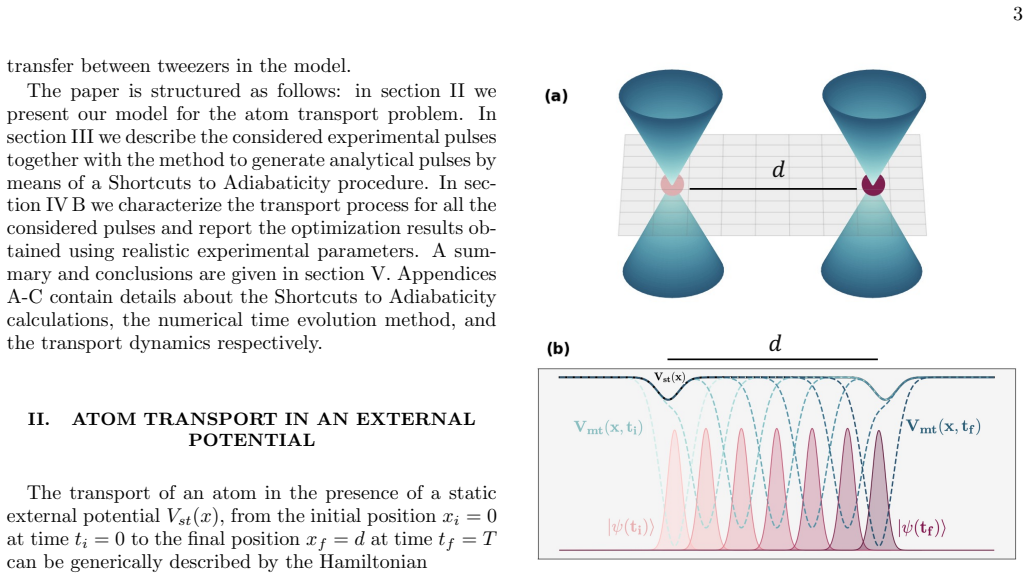
The load-bearing object is the Lewis–Riesenfeld dynamical invariant of a time-dependent harmonic oscillator with effective frequency $\omega(t)$ and center $x_0(t)$, obtained by expanding the combined Gaussian potentials to second order about the moving tweezer center. The pulse is reverse-engineered by choosing minimum-jerk polynomial forms for the auxiliary functions $\alpha(t)$ and $\rho(t)$, then using $x_0=\alpha+\ddot{\alpha}/\omega^2$ and $\omega^2=\omega_0^2/\rho^4-\ddot{\rho}/\rho$ to recover the physical controls: the tweezer position $x_{\rm mt}(t)$ and depth $A_{\rm mt}(t)$. The depth modulation is the element that carries the argument: its two-peak profile counteracts the static-trap restoring force and suppresses transfer-stage errors that position-only ramps leave uncontrolled.
What would settle it
Run the full Gaussian-potential dynamics with the STA controls given by Eqs. (21)–(22) for $^{39}$K atoms, $d=7\,\mu$m, $A_{\rm mt}^{\max}/\hbar=3.57\times 2\pi$ MHz, and $T=18\,\tau_{\rm st}$; if the final ground-state infidelity stays above $10^{-4}$, or if an exact-eigenstate calculation shows anharmonic corrections push the error above that threshold, the central performance claim is not supported.
Extended reading notes
Core claim
The paper's central claim is that a Shortcuts-to-Adiabaticity transport protocol built from the full Hamiltonian—expanding both moving and static Gaussian tweezers to second order around the moving trap—produces lower post-transport infidelity in shorter total time than position-only experimental ramps. The new ingredient is the amplitude control: the moving tweezer depth acquires two peaks during the travel stage that counteract the restoring force of the static tweezers, while the position trajectory closely follows the minimum jerk form. Simulating $^{39}$K atoms with 7$\,\mu$m spacing, static depth $0.53\times 2\pi$ MHz, moving depth $3.57\times 2\pi$ MHz, and a moving trap hosting about 55 oscillator levels, the paper finds the $10^{-4}$ infidelity threshold at about $18\,\tau_{\rm st}$ for the unoptimized STA pulse, versus $31\,\tau_{\rm st}$ for minimum jerk and $38\,\tau_{\rm st}$ for the quadratic pulse; randomized-basis optimization shortens the other pulses by 10–30% but leaves the STA threshold unchanged. That unchanged threshold is read as evidence that the analytical pulse sits close to the quantum speed limit, and the paper reports a total-time lower bound near $8\,\tau_{\rm st}$, below which vibrational excitation exceeds half the states hosted by the moving trap. The paper further claims that its optimized capture/release stage has a time threshold about 9 times smaller than a leading experiment, making transfer between tweezers, not the travel itself, the main remaining bottleneck.
Load-bearing premise
The STA guarantee rests on treating the combined Gaussian potentials as a single harmonic oscillator around the moving tweezer; the paper states that the lower states deviate only slightly from harmonic ones, but it does not quantify how exact anharmonicity degrades the error cancellation.
Editorial extensions
If this is right
- If the central claim is right, an atom can be moved between static tweezers with error below $10^{-4}$ in about 18 characteristic times using only the analytical STA formulas, with no numerical optimization required.
- Because the capture/release stage is the dominant time cost, optimizing the full protocol—not just the travel stage—should yield total speedups even when the travel stage itself is slowed.
- The near-$8\,\tau_{\rm st}$ lower bound gives a practical speed floor for tweezers hosting about 55 states: protocols much faster than this will lose atoms through excitation to unbound levels.
- The depth-modulated STA control works with ordinary laser power adjustment, so existing tweezer setups can adopt it without optical redesign.
Reading between the lines
- The paper's harmonic approximation is never quantified against exact Gaussian anharmonicity; a natural extension is to compute how anharmonic corrections shift the magic time windows, which the paper reports as narrow stripes of suppressed error.
- Since the STA approximation's 4% amplitude deviation changes final error by two orders of magnitude, experimental transfer functions for laser power will likely need calibration before the predicted threshold times transfer to hardware.
- The 9-times-faster capture/release bound implies that published transport times that quote only the travel stage may understate the true protocol time by roughly an order of magnitude; re-examining them with a transfer stage included is a testable extension.
- The two-peak depth modulation is a generic mechanism: any static background potential with a restoring force near the moving trap should benefit from a compensating depth pulse, so the same STA recipe could be tried for optical lattices or conveyor belts.
Editorial analysis
A structured set of objections, weighed in public.
Referee Report
Summary. The manuscript studies fast single-atom transport between static optical tweezers using a one-dimensional, two-Gaussian-well model for 39K atoms. It compares four experimentally motivated position ramps (piece-wise linear, piece-wise quadratic, minimum jerk, and hybrid linear/minimum-jerk) with a new control derived from Lewis-Riesenfeld invariants. The STA control includes the static tweezer potential in a harmonic approximation and provides both a numerical position/depth pulse and an analytical approximation (Eqs. (21)-(22)). Performance is assessed by post-transport infidelity and by transient vibrational excitation and temperature measures in full-Gaussian split-step simulations. d-CRAB optimization lowers the infidelity threshold times for most pulses; the STA pulse reaches 10^-4 at about 18 characteristic times before optimization and is unchanged after optimization. The authors additionally report a numerical threshold T≈8τst below which the tested pulses fail, interpret it as a quantum speed limit, and claim a factor-9 speedup for the capture/release stage compared with Ref. [30].
Significance. The central numerical comparison is careful: the simulations use split-step Fourier evolution with Strang splitting, the discretization errors are quantified in Appendix B, the error measures are reported with standard deviations, and the controls are derived without fitting parameters to the fidelity. If the claims are supported, the STA pulse with depth modulation would be a practically useful seed for high-fidelity transport and transfer, and the parameter maps in Fig. 5 would help experimentalists choose operating regions. The analytical approximation for the STA pulse is a useful deliverable. However, the paper's broader conclusions—the 'quantum speed limit' and the factor-9 transfer speedup—currently outrun the computed quantities and need revision.
major comments (3)
- [Section IV.B and Section V, Fig. 5] The label 'numerical quantum speed limit' is used for the threshold T≈8τst, but no quantum speed limit is actually computed. The threshold is obtained from the tested control pulses and an ad hoc excitation criterion (half of the 55 trap states). A genuine QSL is a lower bound over all admissible controls; the data show only that the optimized pulses in this family fail below this time. Please either compute a rigorous lower bound (e.g., a Bures-angle or Mandelstam-Tamm bound for the full Gaussian Hamiltonian, or the brachistochrone method of Ref. [17]) and compare, or replace the QSL language with 'empirical threshold for the tested pulses.' This wording affects the abstract claim that the STA time is 'compatible with the limit.'
- [Section IV.B and Abstract] The '9 times faster' transfer claim compares the total protocol threshold T≈8τst with the transfer time reported in Ref. [30]. Under the fixed split η=2/5 in Eq. (8), the capture and release stages last (1−η)T/3 = T/5 each, i.e., about 1.6τst (≈3.2τmt), not 8 oscillator units. If '8 oscillator units' refers to the total protocol time, the comparison is not apples-to-apples because it includes transport and waiting; if it refers to the transfer stage, the factor is not 9. Please recompute the comparison using the actual capture/release duration, define 'oscillator units' explicitly, and report the sensitivity of the factor to the chosen η.
- [Section III.B and Section IV.A] The STA controls are derived from the harmonic approximation of the combined static and moving Gaussian potentials (Eqs. (10)-(14)), while the performance evaluation uses the full Gaussian potential. The text states only that the deviation of the lower states from harmonic ones is small, without quantifying it. Since anharmonicity spoils the exact invariant-based cancellation, the analytical STA guarantee does not directly apply to the simulated system, and it is unclear whether the 10^-4 error floor and the time windows in Fig. 5 are affected by this approximation. Please quantify the anharmonicity (e.g., the STA fidelity in the ideal harmonic oscillator versus the full Gaussian potential, or the anharmonic corrections to the ground state) and discuss its effect on the error floor and on the meaning of the STA pulse as a shortcut.
minor comments (6)
- [Section II] The initial and target states are defined as ground states of the 'static Hamiltonian with a single Gaussian potential,' but the dynamics use a static potential with multiple wells. Please state explicitly why the neighboring static well is neglected in this definition.
- [Section IV.A and footnote 58] The measures in Fig. 4 are not all computed over the same interval: ⟨N⟩ and ΔN are computed over the transport interval, while Teff is computed over the full protocol. Please state this distinction in the main text to avoid ambiguity.
- [Eq. (20)] The notation for the fourth root in the expression for ρ(t) is ambiguous; please typeset it clearly, for example as (ω̃^2+1)^{-1/4}.
- [Section IV.A] The reported 7.8x total-time and 15x capture/release improvements over Ref. [21] are stated without a figure or table. Please provide the simulation parameters and a concrete comparison, for example in a table or appendix.
- [Throughout] The term 'oscillator units' is used without definition. Please specify whether it denotes τst, τmt, or 1/ω, and use it consistently in the comparisons with Refs. [29] and [30].
- [Figure 3 caption] The threshold times are given only in the caption; please add annotations or a table, since the vertical dashed lines are hard to distinguish, especially for the STA panel.
Circularity Check
Central STA-vs-experimental-pulse comparison is an independent numerical result; the advertised 'quantum speed limit' is a self-defined heating threshold relabeled as a bound.
-
self definitional
[Abstract; Sec. IV.A ('Atom transport characterization'); Sec. V ('Summary and Conclusions')]
"After pulse shape optimization we find a lower threshold for the total time of the protocol that is compatible with the limit below which the increase in the vibrational excitations exceeds half of the amount of states hosted by the moving tweezer. ... For T ≈ 0.22 ms ≈ 8 τst the mean occupied level plus the associated uncertainty reaches half of the trap states, i.e. 27 levels for our trap hosting a total of 55 states. ..."
The claimed 'numerical quantum speed limit of about 8 τst' is never computed from an independent QSL bound (e.g., an energy-time or Margolus-Levitin-type inequality). It is defined by the paper's own heating criterion: the limit below which the vibrational excitation exceeds half of the 55 trap states. The evidence quoted in support of the QSL (at T ≈ 8 τst the mean occupied level plus its uncertainty reaches 27 levels) is exactly the defining criterion, so the introduction's statement that the value 'coincides with' the heating threshold is true by construction rather than by discovery. The downstream quantitative conclusions ('9 times faster' than Ref. [30], '5 times larger' than Ref.
full rationale
The central derivation is not circular. The STA controls are reverse-engineered from the independent Lewis-Riesenfeld invariant formalism (external Refs. [15], [22], [49]): α(t) and ρ(t) are chosen as minimum-jerk polynomials satisfying the boundary conditions (Eqs. 15–16), then x₀(t) and ω(t) follow from Eqs. (13)–(14), and the physical controls x_mt(t) and A_mt(t) are obtained by numerically solving Eqs. (12) and (11). No infidelity value is fed back into the control design, so the performance comparison of Fig. 3 is a genuine full-Gaussian split-step simulation of analytically derived pulses. The target state is the exact-diagonalization ground state of the static Gaussian trap, which differs from the harmonic eigenstate the STA construction is designed to transfer; hence the measured 10⁻⁴ threshold is not enforced by construction, and the harmonic-approximation caveat noted in Sec. IV.A does not invalidate the raw ordering of pulses. The self-citations (Refs. [17], [18], [24]–[27]) are not load-bearing: the d-CRAB optimizations are recomputed here with the public QuOCS toolkit, and the STA theory is drawn from external sources. The one self-definitional element concerns the advertised 'quantum speed limit' of about 8 τst, which is defined by the authors' own heating criterion (mean occupied level plus width reaching half of the 55 trap states) and then presented as a discovered bound that 'coincides with' that threshold; the coincidence is tautological, and the '9 times faster' transfer claim inherits this definition and depends on the hand-chosen η = 2/5 split of Eq. (8). These secondary conclusions are over-interpretations of threshold-dependent simulation data, but the central claim that the STA pulse outperforms the experimentally inspired ramps is an independent and self-contained numerical result.
Assumptions & free parameters
free parameters (3)
- protocol time split eta =
2/5
- hybridicity xi values =
0.4 and 0.8
- QSL excitation threshold =
mean level plus width reaching 27 states (half of 55)
assumptions (6)
- standard math Standard Lewis-Riesenfeld and Dhara-Lawande invariant theory for time-dependent harmonic oscillators
- domain assumption One-dimensional single-particle model with no dissipation, no spontaneous emission, and no technical noise
- domain assumption Harmonic approximation of the total Gaussian potential in the STA derivation
- ad hoc to paper Minimum jerk polynomial ansatz for auxiliary functions alpha(t) and rho(t)
- domain assumption Target state is the ground state of the final static tweezer, and initial and final static traps are identical
- domain assumption Virial theorem used for effective temperature during transient dynamics
Cite this review
Pith. "Pith review of Neutral atom transport and transfer between optical tweezers." pith.science (2026). https://pith.science/paper/WWJPTW7C
@misc{pith2026241215173,
  author       = {Pith},
  title        = {Pith review of: Neutral atom transport and transfer between optical tweezers},
  year         = {2026},
  howpublished = {\url{https://pith.science/paper/WWJPTW7C}},
  note         = {Machine review of arXiv:2412.15173}
}
read the original abstract
We focus on the optimization of neutral atom transport and transfer between optical tweezers, both critical steps towards the implementation of quantum processors and simulators. We consider four different types of experimentally relevant pulses: piece-wise linear, piece-wise quadratic, minimum jerk, and a family of hybrid linear and minimum jerk ramps. We also develop a protocol using Shortcuts to Adiabaticity (STA) techniques that allows us to include the effects of static traps. By computing a measure of the error after transport and two measures of the heating for transient times, we provide a systematic characterization of the performance of all the considered pulses and show that our proposed STA protocol outperforms the experimentally inspired pulses. After pulse shape optimization we find a lower threshold for the total time of the protocol that is compatible with the limit below which the increase in the vibrational excitations exceeds half of the amount of states hosted by the moving tweezer. Since the obtained lower bound for the atom capturing or releasing stage is 9 times faster than the one reported in state-of-the-art experiments, we interpret our results as a wake-up call towards the importance of the inclusion and optimization of the transfer between tweezers, which may be the largest bottleneck to speed. For the two pulses having the best performance (minimum jerk and STA), we determine optimal regions in the experimentally accessible parameters to implement high fidelity transport pulses. Finally, our STA results prove that a modulation in the depth of the moving tweezer designed to counteract the effect of the static traps reduces errors and allows for shorter pulse duration. To motivate the use of our STA pulse in future experiments, we provide a simple analytical approximation for the tweezer position and depth controls.
Figures


Figures from the paper (2 more)


Reference graph
Works this paper leans on
-
[30]
Optimal control transport of neutral atoms in optical tweezers at finite temperature
A. Pagano, D. Jaschke, W. Weiss, and S. Montangero, “Optimal control transport of neutral atoms in optical tweezers at finite temperature”, Phys. Rev. Res. , vol. 6, p. 033282, Sep 2024
work page 2024
-
[20]
Fast and op- timal transport of atoms with nonharmonic traps
Q. Zhang, X. Chen, and D. Gu´ ery-Odelin, “Fast and op- timal transport of atoms with nonharmonic traps”, Phys. Rev. A, vol. 92, p. 043410, Oct 2015
work page 2015
-
[17]
Ultrafast energy ex- change between two single rydberg atoms on a nanosec- ond timescale
Y. Chew, T. Tomita, T. P. Mahesh, S. Sugawa, S. de L´ es´ eleuc, and K. Ohmori, “Ultrafast energy ex- change between two single rydberg atoms on a nanosec- ond timescale”, Nature Photonics , vol. 16, pp. 724–729, Oct 2022
work page 2022
-
[1]
A quantum processor based on coherent transport of entangled atom arrays
D. Bluvstein, H. Levine, G. Semeghini, T. T. Wang, S. Ebadi, M. Kalinowski, A. Keesling, N. Maskara, H. Pichler, M. Greiner, et al. , “A quantum processor based on coherent transport of entangled atom arrays”, Nature, vol. 604, no. 7906, pp. 451–456, 2022
work page 2022
-
[2]
Many-body physics with individually controlled rydberg atoms
A. Browaeys and T. Lahaye, “Many-body physics with individually controlled rydberg atoms”, Nature Physics, vol. 16, p. 132, 2020
work page 2020
-
[3]
Practical quantum advantage in quantum simulation
A. J. Daley, I. Bloch, C. Kokail, S. Flannigan, N. Pearson, M. Troyer, and P. Zoller, “Practical quantum advantage in quantum simulation”, Nature, vol. 607, p. 667, 2022
work page 2022
-
[4]
M. Morgado and S. Whitlock, “Quantum simulation and 18 ξ ξ FIG. C.1. Error for transient times. Infidelity I vs. time for a total pulse time T = 0.5, 1.5, 2.5, 3 ms (lighter to darker color) for all the considered initial pulses (top row) and the corresponding optimizations (bottom). The time scales are given in SI and characteristic units, being τst the ...
work page 2021
-
[5]
Continuous operation of large-scale atom arrays in optical lattices
F. Gyger et al. , “Continuous operation of large-scale atom arrays in optical lattices”, 2024. arXiv preprint arXiv:2402.04994
arXiv 2024
Show all 74 references
-
[6]
An atom-by-atom assembler of defect- free arbitrary two-dimensional atomic arrays
D. Barredo, S. de L´ es´ eleuc, V. Lienhard, T. Lahaye, and A. Browaeys, “An atom-by-atom assembler of defect- free arbitrary two-dimensional atomic arrays”, Science, vol. 354, no. 6315, pp. 1021–1023, 2016
2016
-
[7]
Endres, H
M. Endres, H. Bernien, A. Keesling, H. Levine, E. R. Anschuetz, A. Krajenbrink, C. Senko, V. Vuletic, M. Greiner, and M. D. Lukin, “Atom-by-atom assem- 19 FIG. C.3. Examples of optimized pulses. Amplitude Amt(t) and position xmt(t) of the moving tweezer for the linear (left), ...
2016
-
[8]
Logical quantum processor based on reconfigurable atom arrays
D. Bluvstein, S. J. Evered, A. A. Geim, S. H. Li, H. Zhou, T. Manovitz, S. Ebadi, M. Cain, M. Kali- nowski, D. Hangleiter, et al., “Logical quantum processor based on reconfigurable atom arrays”, Nature, vol. 626, no. 7997, pp. 58–65, 2024
2024
-
[9]
Quantum science with optical tweezer arrays of ultracold atoms and molecules
A. M. Kaufman and K.-K. Ni, “Quantum science with optical tweezer arrays of ultracold atoms and molecules”, Nature Physics, vol. 17, p. 1324, 2021
2021
-
[10]
Molecular as- sembly of ground-state cooled single atoms
L. R. Liu, J. D. Hood, Y. Yu, J. T. Zhang, K. Wang, Y.-W. Lin, T. Rosenband, and K.-K. Ni, “Molecular as- sembly of ground-state cooled single atoms”, Phys. Rev. X, vol. 9, p. 021039, May 2019
2019
-
[11]
Site-selective preparation and multistate readout of molecules in optical tweezers
L. R. B. Picard, G. E. Patenotte, A. J. Park, S. F. Gebretsadkan, and K.-K. Ni, “Site-selective preparation and multistate readout of molecules in optical tweezers”, PRX Quantum , vol. 5, p. 020344, May 2024
2024
-
[12]
An optical tweezer array of ground-state polar molecules
J. T. Zhang, L. R. B. Picard, W. B. Cairncross, K. Wang, Y. Yu, F. Fang, and K.-K. Ni, “An optical tweezer array of ground-state polar molecules”, Quantum Science and Technology, vol. 7, p. 035006, may 2022
2022
-
[13]
Efficient tensor network simulation of ibm’s eagle kicked ising experiment
J. Tindall, M. Fishman, E. M. Stoudenmire, and D. Sels, “Efficient tensor network simulation of ibm’s eagle kicked ising experiment”, PRX Quantum, vol. 5, p. 010308, Jan 2024
2024
-
[14]
Two-dimensional transport and transfer of a single atomic qubit in optical tweezers
J. Beugnon, C. Tuchendler, H. Marion, A. Ga¨ etan, Y. Miroshnychenko, Y. R. P. Sortais, A. M. Lance, M. P. A. Jones, G. Messin, A. Browaeys, and P. Grang- ier, “Two-dimensional transport and transfer of a single atomic qubit in optical tweezers”, Nature Physics, vol. 3, pp. 69...
2007
-
[15]
(10), while Eqs
from Eq. (10), while Eqs. (A.10)-(A.11) become re- spectively Eqs. (13)-(14) of the main text. Appendix B: Time evolution method and discretization error analysis The numerical simulations inherently contain errors as an infinite Hilbert space is approximated by a finite one. ...
-
[16]
Fast atomic trans- port without vibrational heating
E. Torrontegui, S. Ib´ a˜ nez, X. Chen, A. Ruschhaupt, D. Gu´ ery-Odelin, and J. G. Muga, “Fast atomic trans- port without vibrational heating”, Phys. Rev. A, vol. 83, p. 013415, Jan 2011
2011
-
[18]
Demonstration of quantum brachis- tochrones between distant states of an atom
M. R. Lam, N. Peter, T. Groh, W. Alt, C. Robens, D. Meschede, A. Negretti, S. Montangero, T. Calarco, and A. Alberti, “Demonstration of quantum brachis- tochrones between distant states of an atom”, Phys. Rev. X, vol. 11, p. 011035, Feb 2021
2021
-
[19]
Optimal control at the quantum speed limit
T. Caneva, M. Murphy, T. Calarco, R. Fazio, S. Mon- tangero, V. Giovannetti, and G. E. Santoro, “Optimal control at the quantum speed limit”, Physical review let- ters, vol. 103, no. 24, p. 240501, 2009
2009
-
[21]
[54, 55, 73]
Even though there is no dissipative mechanism con- sidered in our model we adhere to the identification of vibrational excitations and heating, see for instance Refs. [54, 55, 73]
-
[22]
Enhanced atom-by-atom assembly of arbitrary tweezer arrays
K.-N. Schymik, V. Lienhard, D. Barredo, P. Scholl, H. Williams, A. Browaeys, and T. Lahaye, “Enhanced atom-by-atom assembly of arbitrary tweezer arrays”, Phys. Rev. A , vol. 102, p. 063107, Dec 2020
2020
-
[23]
An exact quantum theory of the time-dependent harmonic oscillator and of a charged particle in a time-dependent electromagnetic field
H. R. Lewis and W. B. Riesenfeld, “An exact quantum theory of the time-dependent harmonic oscillator and of a charged particle in a time-dependent electromagnetic field”, Journal of Mathematical Physics , vol. 10, no. 8, pp. 1458–1473, 1969
1969
-
[24]
Optimal trajectories for efficient atomic transport without final excitation
X. Chen, E. Torrontegui, D. Stefanatos, J.-S. Li, and J. G. Muga, “Optimal trajectories for efficient atomic transport without final excitation”, Phys. Rev. A, vol. 84, p. 043415, Oct 2011
2011
-
[25]
Chopped random-basis quantum optimization
T. Caneva, T. Calarco, and S. Montangero, “Chopped random-basis quantum optimization”, Physical Review A, vol. 84, no. 2, p. 022326, 2011
2011
-
[26]
Dressing the chopped-random-basis optimization: A bandwidth-limited access to the trap-free landscape
N. Rach, M. M. M¨ uller, T. Calarco, and S. Montangero, “Dressing the chopped-random-basis optimization: A bandwidth-limited access to the trap-free landscape”, Physical Review A , vol. 92, no. 6, p. 062343, 2015
2015
-
[27]
One decade of quantum optimal control in the chopped random basis
M. M. M¨ uller, R. S. Said, F. Jelezko, T. Calarco, and S. Montangero, “One decade of quantum optimal control in the chopped random basis”, Reports on progress in physics, vol. 85, no. 7, p. 076001, 2022
2022
-
[28]
Quocs: The quantum op- timal control suite
M. Rossignolo, T. Reisser, A. Marshall, P. Rembold, A. Pagano, P. J. Vetter, R. S. Said, M. M. M¨ uller, F. Motzoi, T. Calarco, et al. , “Quocs: The quantum op- timal control suite”, Computer Physics Communications, vol. 291, p. 108782, 2023
2023
-
[29]
Quantum speed limits: from heisenberg’s uncertainty principle to optimal quan- tum control
S. Deffner and S. Campbell, “Quantum speed limits: from heisenberg’s uncertainty principle to optimal quan- tum control”, Journal of Physics A: Mathematical and Theoretical, vol. 50, p. 453001, oct 2017. 20
2017
-
[31]
Preparation of 87rb and 133cs in the motional ground state of a single optical tweezer
S. Spence, R. V. Brooks, D. K. Ruttley, A. Guttridge, and S. L. Cornish, “Preparation of 87rb and 133cs in the motional ground state of a single optical tweezer”, New Journal of Physics , vol. 24, p. 103022, oct 2022
2022
-
[32]
Ultracold quantum gases in optical lattices
I. Bloch, “Ultracold quantum gases in optical lattices”, Nature physics, vol. 1, no. 1, pp. 23–30, 2005
2005
-
[33]
Cooling and entangling ultracold atoms in optical lattices
B. Yang, H. Sun, C.-J. Huang, H.-Y. Wang, Y. Deng, H.-N. Dai, Z.-S. Yuan, and J.-W. Pan, “Cooling and entangling ultracold atoms in optical lattices”, Science, vol. 369, no. 6503, pp. 550–553, 2020
2020
-
[34]
Quantum simulations with ultra- cold atoms in optical lattices
C. Gross and I. Bloch, “Quantum simulations with ultra- cold atoms in optical lattices”,Science, vol. 357, no. 6355, pp. 995–1001, 2017
2017
-
[35]
Quantum information with rydberg atoms
M. Saffman, T. G. Walker, and K. Mølmer, “Quantum information with rydberg atoms”, Reviews of modern physics, vol. 82, no. 3, pp. 2313–2363, 2010
2010
-
[36]
Optical superlattice for engineering hubbard couplings in quantum simula- tion
T. Chalopin, P. Bojovi´ c, D. Bourgund, S. Wang, T. Franz, I. Bloch, and T. Hilker, “Optical superlattice for engineering hubbard couplings in quantum simula- tion”, arXiv preprint arXiv:2405.19322 , 2024
2024 arXiv
-
[37]
Spa- tially tunable spin interactions in neutral atom arrays
L.-M. Steinert, P. Osterholz, R. Eberhard, L. Festa, N. Lorenz, Z. Chen, A. Trautmann, and C. Gross, “Spa- tially tunable spin interactions in neutral atom arrays”, Physical Review Letters, vol. 130, no. 24, p. 243001, 2023
2023
-
[38]
Osterholz, Freely Configurable Holographic Trap Ar- rays for the Trapping of Single Atoms
P. Osterholz, Freely Configurable Holographic Trap Ar- rays for the Trapping of Single Atoms . PhD thesis, Lud- wig Maximilians Universit¨ at M¨ unchen, 2020
2020
-
[39]
Parameters suggested by Christian Groß group
-
[40]
Optical tweezers: theory and practice
G. Pesce, P. H. Jones, O. M. Marag` o, and G. Volpe, “Optical tweezers: theory and practice”, The European Physical Journal Plus , vol. 135, p. 949, Dec 2020
2020
-
[41]
Gaussian beams and lasers
D. S. Simon, “Gaussian beams and lasers”, in A Guided Tour of Light Beams, 2053-2571, pp. 3–1 to 3–14, Morgan and Claypool Publishers, 2016
2016
-
[42]
Matthies, Optical Conveyor-Belt Transport of Cs and Rb Atoms,
A. Matthies, Optical Conveyor-Belt Transport of Cs and Rb Atoms,. Durham theses, Durham University, 2023
2023
-
[43]
An organizing principle for a class of volun- tary movements
N. Hogan, “An organizing principle for a class of volun- tary movements”, Journal of Neuroscience, vol. 4, no. 11, pp. 2745–2754, 1984
1984
-
[44]
Nonperturbative and perturbative treat- ments of parametric heating in atom traps
R. J´ auregui, “Nonperturbative and perturbative treat- ments of parametric heating in atom traps”, Phys. Rev. A, vol. 64, p. 053408, Oct 2001
2001
-
[45]
Short- cuts to adiabaticity: Concepts, methods, and applica- tions
D. Gu´ ery-Odelin, A. Ruschhaupt, A. Kiely, E. Tor- rontegui, S. Mart ´ ınez-Garaot, and J. G. Muga, “Short- cuts to adiabaticity: Concepts, methods, and applica- tions”, Rev. Mod. Phys. , vol. 91, p. 045001, Oct 2019
2019
-
[46]
Re- alistic shortcuts to adiabaticity in optical transfer
G. Ness, C. Shkedrov, Y. Florshaim, and Y. Sagi, “Re- alistic shortcuts to adiabaticity in optical transfer”, New Journal of Physics , vol. 20, p. 095002, sep 2018
2018
-
[47]
Optimal shortcuts for atomic transport in anharmonic traps
Q. Zhang, J. G. Muga, D. Gu´ ery-Odelin, and X. Chen, “Optimal shortcuts for atomic transport in anharmonic traps”, Journal of Physics B: Atomic, Molecular and Op- tical Physics, vol. 49, p. 125503, May 2016
2016
-
[48]
Coherent atom trans- port via enhanced shortcuts to adiabaticity: Double-well optical lattice
S. H. Hauck and V. M. Stojanovi´ c, “Coherent atom trans- port via enhanced shortcuts to adiabaticity: Double-well optical lattice”, Phys. Rev. Appl. , vol. 18, p. 014016, Jul 2022
2022
-
[49]
Transport in a har- monic trap: Shortcuts to adiabaticity and robust proto- cols
D. Gu´ ery-Odelin and J. G. Muga, “Transport in a har- monic trap: Shortcuts to adiabaticity and robust proto- cols”, Phys. Rev. A , vol. 90, p. 063425, Dec 2014
2014
-
[50]
Feynman propagator for time-dependent lagrangians possessing an invariant quadratic in momentum
A. K. Dhara and S. V. Lawande, “Feynman propagator for time-dependent lagrangians possessing an invariant quadratic in momentum”, Journal of Physics A: Mathe- matical and General , vol. 17, p. 2423, aug 1984
1984
-
[51]
The solutions of the gen- eralized classical and quantum harmonic oscillators with time dependent mass, frequency, two-photon parameter and external force: The squeezing effects
S. K. Singh and S. Mandal, “The solutions of the gen- eralized classical and quantum harmonic oscillators with time dependent mass, frequency, two-photon parameter and external force: The squeezing effects”, Optics Com- munications, vol. 283, no. 23, pp. 4685–4695, 2010
2010
-
[52]
Shortcuts to adiabatic- ity in a time-dependent box
A. d. Campo and M. G. Boshier, “Shortcuts to adiabatic- ity in a time-dependent box”, Scientific Reports, vol. 2, p. 648, Sep 2012
2012
-
[53]
Fast optimal fric- tionless atom cooling in harmonic traps: Shortcut to adiabaticity
X. Chen, A. Ruschhaupt, S. Schmidt, A. del Campo, D. Gu´ ery-Odelin, and J. G. Muga, “Fast optimal fric- tionless atom cooling in harmonic traps: Shortcut to adiabaticity”, Phys. Rev. Lett. , vol. 104, p. 063002, Feb 2010
2010
-
[54]
Fast and reliable atom transport by optical tweezers
S. Hwang, H. Hwang, K. Kim, A. Byun, S. Jeong, M. P. Soegianto, and J. Ahn, “Fast and reliable atom transport by optical tweezers”, arXiv, no. 2410.22627, 2024
2024 arXiv
-
[55]
Laser- noise-induced heating in far-off resonance optical traps
T. A. Savard, K. M. O’Hara, and J. E. Thomas, “Laser- noise-induced heating in far-off resonance optical traps”, Phys. Rev. A , vol. 56, pp. R1095–R1098, Aug 1997
1997
-
[56]
Evaluation of heating effects on atoms trapped in an optical trap
C. W. Gardiner, J. Ye, H. C. Nagerl, and H. J. Kimble, “Evaluation of heating effects on atoms trapped in an optical trap”, Phys. Rev. A, vol. 61, p. 045801, Mar 2000
2000
-
[57]
Speed, retention loss, and motional heating of atoms in an optical conveyor belt
G. T. Hickman and M. Saffman, “Speed, retention loss, and motional heating of atoms in an optical conveyor belt”, Phys. Rev. A , vol. 101, p. 063411, Jun 2020
2020
-
[58]
Cohen-Tannoudji, B
C. Cohen-Tannoudji, B. Diu, and F. Lalo¨ e, Quanten- mechanik. DE GRUYTER, Dec. 2007
2007
-
[59]
The expected value and maximum width of the distribu- tion over the moving tweezer states are computed on the transport interval as follows. For each time t we compute the states |ϕn(t)⟩ of the moving trap via diagonalization of the moving tweezer Hamiltonian, then we project ...
-
[60]
Coherent States and the Forced Quantum Oscillator
P. Carruthers and M. M. Nieto, “Coherent States and the Forced Quantum Oscillator”, American Journal of Physics, vol. 33, pp. 537–544, 07 1965
1965
-
[61]
Optimal con- trol technique for many-body quantum dynamics
P. Doria, T. Calarco, and S. Montangero, “Optimal con- trol technique for many-body quantum dynamics”, Phys- ical review letters , vol. 106, no. 19, p. 190501, 2011
2011
-
[62]
Optimal control of hybrid optomechanical sys- tems for generating non-classical states of mechanical motion
V. Bergholm, W. Wieczorek, T. Schulte-Herbr¨ uggen, and M. Keyl, “Optimal control of hybrid optomechanical sys- tems for generating non-classical states of mechanical motion”, Quantum Science and Technology, vol. 4, no. 3, p. 034001, 2019
2019
-
[63]
Optimal control of coupled spin dy- namics: design of nmr pulse sequences by gradient ascent algorithms
N. Khaneja, T. Reiss, C. Kehlet, T. Schulte-Herbr¨ uggen, and S. J. Glaser, “Optimal control of coupled spin dy- namics: design of nmr pulse sequences by gradient ascent algorithms”, Journal of magnetic resonance , vol. 172, no. 2, pp. 296–305, 2005
2005
-
[64]
Comparing, optimizing, and benchmarking quantum- 21 control algorithms in a unifying programming frame- work
S. Machnes, U. Sander, S. J. Glaser, P. de Fouquieres, A. Gruslys, S. Schirmer, and T. Schulte-Herbr¨ uggen, “Comparing, optimizing, and benchmarking quantum- 21 control algorithms in a unifying programming frame- work”, Physical Review A, vol. 84, no. 2, p. 022305, 2011
2011
-
[65]
Compensating for nonlinear distortions in controlled quantum systems
J. Singh et al. , “Compensating for nonlinear distortions in controlled quantum systems”, Physical Review Ap- plied, vol. 19, no. 6, p. 064067, 2023
2023
-
[66]
J. W. Demmel, Applied numerical linear algebra . SIAM, 1997
1997
-
[67]
Montangero, E
S. Montangero, E. Montangero, and Evenson, Introduc- tion to tensor network methods . Springer, 2018
2018
-
[68]
Lubich, From quantum to classical molecular dynam- ics: reduced models and numerical analysis , vol
C. Lubich, From quantum to classical molecular dynam- ics: reduced models and numerical analysis , vol. 12. Eu- ropean Mathematical Society, 2008
2008
-
[69]
On time-splitting spectral approximations for the schr¨ odinger equation in the semiclassical regime
W. Bao, S. Jin, and P. A. Markowich, “On time-splitting spectral approximations for the schr¨ odinger equation in the semiclassical regime”, Journal of Computational Physics, vol. 175, no. 2, pp. 487–524, 2002
2002
-
[70]
Balanced splitting and rebalanced splitting
R. L. Speth, W. H. Green, S. MacNamara, and G. Strang, “Balanced splitting and rebalanced splitting”, SIAM Journal on Numerical Analysis , vol. 51, no. 6, pp. 3084– 3105, 2013
2013
-
[71]
Operator splitting
S. MacNamara and G. Strang, “Operator splitting”, Splitting methods in communication, imaging, science, and engineering, pp. 95–114, 2016
2016
-
[72]
Cohen-Tannoudji, B
C. Cohen-Tannoudji, B. Diu, and F. Lalo¨ e,Quantum me- chanics, volume 3: fermions, bosons, photons, correla- tions, and entanglement . John Wiley & Sons, 2019
2019
-
[73]
The design and implemen- tation of fftw3
M. Frigo and S. G. Johnson, “The design and implemen- tation of fftw3”, Proceedings of the IEEE, vol. 93, no. 2, pp. 216–231, 2005
2005
-
[74]
Dynamics of noise-induced heating in atom traps
M. E. Gehm, K. M. O’Hara, T. A. Savard, and J. E. Thomas, “Dynamics of noise-induced heating in atom traps”, Phys. Rev. A , vol. 58, pp. 3914–3921, Nov 1998
1998
Reviewed August 11, 2026 · model on record in the stance chip above.
Discussion (0). Continue with ORCID to comment.