REVIEW 5 major objections 4 minor 45 references
Multi-Branch Mutual-Distillation Transformer for EEG-Based Seizure Subtype Classification
T0 review · 5 major / 4 minor · reviewed 2026-08-11 · deepseek-v4-flash
Pith's one-line read This paper claims that its Multi-Branch Mutual-Distillation Transformer classifies EEG seizure subtypes across patients better than prior machine-learning and deep-learning approaches on two public datasets.
desk verdict The architecture is sensible and the experiments are thorough, but the reported statistics do not support the headline superiority claim. read the letter →
The pith
A machine-rendered reading of the paper's core claim, the machinery that carries it, and where it could break.
The reading
What carries the argument
The load-bearing mechanism is the multi-branch encoder block paired with wavelet packet decomposition. Each raw EEG trial is decomposed into six frequency bands — delta (0–4 Hz), theta (4–8 Hz), alpha (8–16 Hz), beta (16–32 Hz), gamma (32–64 Hz), and a residual band — and all six wavelets plus the raw signal share the same linear projection and multi-head attention layers, while each wavelet gets its own expert feedforward network inside the even-numbered blocks. A branch-wise wavelet attention mechanism learns an adaptive weight vector (softmax-normalized, with L1 regularization) that is used to ensemble the expert outputs for the raw-data path. Training couples the raw-data classifier and the six wavelet classifiers through a mutual-distillation loss: the sum of KL divergences in both directions, at temperature T, so each branch acts as both student and teacher. At test time only the raw EEG is fed in, with the ensemble of expert feedforwards used for classification.
What would settle it
Re-running the reported three-fold cross-patient protocol while auditing that every window from a given patient and recording is confined to a single fold, then measuring the balanced accuracy gap between MBMD Transformer and WaveletTransformer on CHSZ and TUSZ; if the gap disappears under leakage-free splits or the variance across the three folds is comparable to the gap itself, the claimed superiority is not established.
Extended reading notes
Core claim
On its own terms, the paper establishes that a transformer architecture can be made to learn cross-subject seizure subtype classification from small labeled EEG data by forcing collaboration between the raw signal and its wavelet decompositions. Specifically, the authors replace every even-numbered encoder block of a vanilla Vision Transformer with a multi-branch encoder block in which six wavelet-specific expert feedforward networks process the raw EEG simultaneously, and a wavelet attention mechanism learns per-branch weights that are made sparse by L1 regularization. A mutual-distillation loss, defined as the average of the KL divergences in both directions between the raw-data prediction and each branch prediction at temperature T, transfers knowledge back and forth. In experiments on CHSZ (27 patients) and TUSZ (68 patients), the MBMD Transformer achieved the best ACC, BCA, and weighted F1 among nine baseline classifiers (SVM, RC, LR, GBDT, EEGNet, TIE-EEGNet, CE-stSENet, ViT, and WaveletTransformer) and among five prior self-distillation methods adapted to a ViT backbone. Ablations show that the bidirectional distillation term outperforms the one-way version and that the learned attention beats simple averaging and a gate network, and the authors state this is the first application of knowledge distillation to EEG-based seizure subtype classification.
Load-bearing premise
The evaluation assumes that the three-fold cross-patient splits built from overlapping 4-second windows keep each patient's data entirely within one fold, and that 27 and 68 patients are enough for the reported means and standard deviations to be stable; if windows leak across folds or the patient counts make the variance estimates unreliable, the reported performance gaps may not hold.
Editorial extensions
If this is right
- The method could be adopted for clinical EEG archives where labeled seizures are scarce, because it does not require a large pretrained teacher.
- The bidirectional distillation loss is a drop-in training objective that could improve other transformer-based EEG classifiers without changing their inference path.
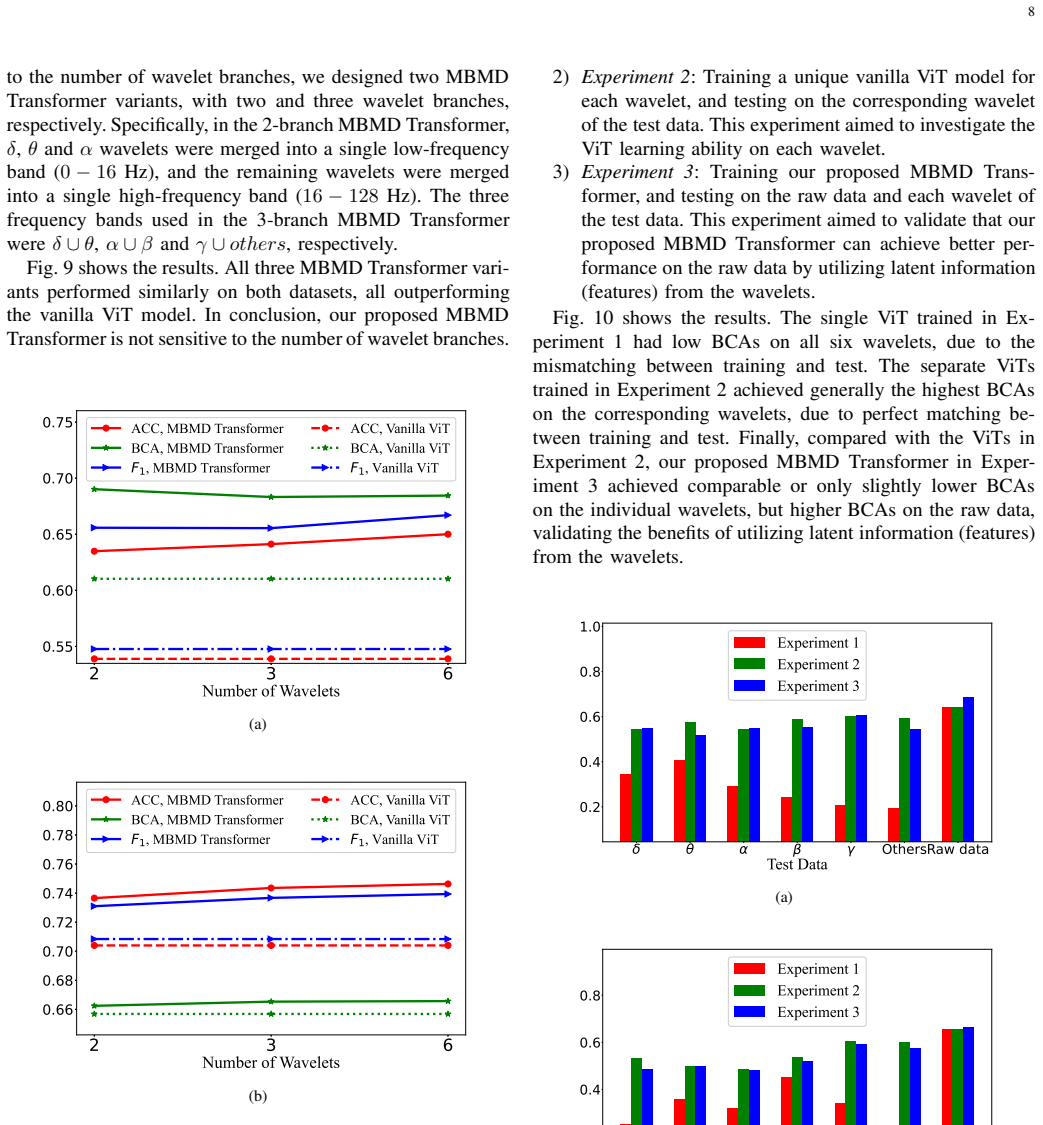
- Reducing the branch count from six to two or three retains most of the benefit, so the model can be made cheaper for deployment.
- Being the first distillation-based approach for seizure subtype classification, it opens that task to the wider toolbox of distillation methods.
Reading between the lines
- The same mutual-distillation scheme could transfer to other frequency-sensitive BCI tasks such as sleep staging or motor imagery, where sub-band decompositions also carry discriminative information.
- The reported insensitivity to the number of branches suggests the gain may come more from the distillation objective than from the specific band definitions; a test with randomized band splits on a fixed six-branch model would separate the two.
- The chosen hyperparameters (T=6, lambda=0.01) are dataset-specific; a validation-set sweep would likely be needed when applying the model to new montages or recording hardware.
Signed reviews
Editorial analysis
A structured set of objections, weighed in public.
Referee Report
Summary. The paper proposes the Multi-Branch Mutual-Distillation (MBMD) Transformer for cross-subject EEG-based seizure subtype classification. The architecture replaces even-numbered encoder blocks of a Vision Transformer with multi-branch encoder blocks that process wavelet-decomposed frequency bands through separate expert FFNs, and a mutual-distillation loss transfers soft-label knowledge between the raw EEG branch and the wavelet branches. Experiments on the CHSZ and TUSZ datasets compare the method against traditional machine learning baselines, several deep learning models, five self-distillation approaches, and ablations, reporting that MBMD Transformer achieves the best or near-best accuracy, balanced accuracy, and weighted F1 on both datasets. The authors claim this is the first work on knowledge distillation for EEG-based seizure subtype classification and make their code publicly available.
Significance. If the empirical superiority claim is statistically reliable, the MBMD Transformer is a useful contribution to small-data EEG classification and represents a plausible first application of self-distillation to seizure subtype classification. The paper has notable strengths: it provides open-source code, compares against multiple baselines and self-distillation methods, includes ablation studies for the distillation loss and attention mechanism, and examines parameter sensitivity. The proposed mechanism—using deterministic wavelet decomposition to create auxiliary branches that mutually distill with the raw signal—is conceptually clear and avoids the circularity that would arise if the targets were fitted to the labels. However, the central claim rests on performance gaps that are often smaller than the reported variability, and the evaluation protocol is not specified tightly enough to establish statistical significance. As presented, the contribution is promising but not yet fully validated.
major comments (5)
- [IV-A, Tables II–III] The central claim that MBMD Transformer "outperformed several traditional machine learning and state-of-the-art deep learning approaches" is not supported by any significance test, and several decisive comparisons show overlapping standard deviations: for example, on CHSZ the ACC is 0.650±0.071 for MBMD versus 0.632±0.073 for WaveletTransformer, and on TUSZ the ACC is 0.746±0.024 for MBMD versus 0.745±0.070 for CE-stSENet. Because the ultimate comparison unit is the patient or the fold, not the 4-second window or the training run, the paper should report per-fold results and perform paired tests (e.g., permutation or Wilcoxon signed-rank) at the patient/fold level. Without such tests, the reported margins are within the noise and do not establish superiority.
- [IV-A (experimental settings)] The sentence "All reported results were the average of ten repeats" is ambiguous: it is not stated whether each repeat is an independent three-fold cross-patient split with different patient assignments, or repeated training on the same fixed splits with different weight initializations. These two protocols yield very different interpretations of the reported standard deviations. The authors must specify the repeat protocol and, if the repeats are not independent patient splits, re-analyze the data with repeated patient-level splits to obtain valid estimates of patient-level variability.
- [IV-A (preprocessing and cross-validation)] Because the EEG is segmented into 4-second windows with 50% overlap, a genuine cross-patient evaluation requires that all windows belonging to the same patient be kept in the same fold. The manuscript states that three-fold cross-patient validation was used, but it does not provide patient-ID bookkeeping, per-fold patient counts, or a description of the splitting code. If overlapping windows from the same recording are split between training and test, the reported results would be inflated by patient leakage. Please clarify the exact splitting procedure and report per-fold patient and window counts for both datasets.
- [III-C, Eq. (2)] Equation (2) defines Lkl(pt||ps) with a leading minus sign, which makes it the negative of the Kullback-Leibler divergence. Minimizing this quantity in the overall loss of Eq. (7) would encourage divergence rather than agreement between the teacher and student distributions. This sign error mis-specifies the proposed training objective. The correct definition should be Lkl(pt||ps) = (1/K) Σ pt log(pt/ps), without the minus sign. The authors should correct Eq. (2) and verify that the reported experiments use the intended positive KL divergence.
- [Table I and IV-B] The CHSZ dataset contains only 15 TNSZ and 16 TCSZ samples, and Table I appears to report the number of windows rather than patients. Under three-fold cross-validation, each fold will contain very few examples of these minority classes, making per-fold balanced accuracy highly volatile. The reported BCA means can therefore be dominated by a single favorable fold assignment. The paper should report per-fold balanced accuracy and class-wise accuracies, or provide patient-level bootstrap confidence intervals, so that the reader can judge whether the reported differences are stable.
minor comments (4)
- [III-B] The text uses "FNN layers" when referring to the feedforward network in the multi-branch encoder block; the rest of the paper uses "FFN". Please standardize the terminology.
- [Figures 7–9] Figures 7, 8, and 9 contain garbled labels and legends (e.g., Unicode placeholder sequences), making the plots unreadable. Please regenerate these figures with proper font embedding so that the axis labels and legend entries are legible.
- [IV-B] The comparison with WaveletTransformer (4-layer) mentions that MBMD uses four encoder blocks while the baseline uses 24 encoders, but no parameter counts or computational costs are given. A parameter count and runtime comparison would strengthen the claim that MBMD "uses the encoders more effectively."
- [Abstract and Contributions] The claim that this is "the first work on knowledge distillation for EEG-based seizure subtype classification" is difficult to verify and is not supported by a systematic literature search. Consider softening this claim or providing a more comprehensive comparison with prior distillation-based EEG methods.
Circularity Check
No significant circularity; the empirical claim rests on external benchmarks, not on self-defined targets.
full rationale
The paper's central claim is empirical: MBMD Transformer outperforms traditional and deep baselines on the public CHSZ and TUSZ datasets. The mutual-distillation loss (Eq. 4) and wavelet attention weighting (Eq. 5) are training objectives defined on the same input EEG and its deterministic wavelet packet decomposition; no target quantity is defined in terms of a fitted parameter, and no reported 'prediction' is extracted from the calibration that produced it. The WPD and the cross-patient protocol are cited from the authors' earlier works ([24], [26], [21]), but these are ordinary methodological references: wavelet decomposition is a deterministic transform of the input, and the datasets are public, so the citations do not substitute for the experimental comparison. The ablation studies (Tables IV and V) compare model variants on held-out folds and therefore have independent content. Potential concerns about standard deviations, patient-level independence, and significance testing are statistical correctness issues, not circularity.
Assumptions & free parameters
free parameters (6)
- Distillation temperature T =
6
- L1 normalization weight lambda =
0.01
- Number of wavelet branches =
6
- Number of encoder blocks N =
4
- Patch size =
64
- Embedding dimension =
128
assumptions (4)
- domain assumption The three-fold cross-patient splits on CHSZ (27 patients) and TUSZ (68 patients) provide reliable estimates of cross-subject performance.
- domain assumption The six wavelet frequency bands carry complementary discriminative information for seizure subtypes.
- domain assumption The multi-view theory of Allen-Zhu and Li (2020) applies to raw EEG and its wavelet decompositions.
- domain assumption Standard training details (batch size 32, AdamW, early stopping) do not disadvantage any baseline.
Cite this review
Pith. "Pith review of Multi-Branch Mutual-Distillation Transformer for EEG-Based Seizure Subtype Classification." pith.science (2026). https://pith.science/paper/JL2VQKNY
@misc{pith2026241215224,
  author       = {Pith},
  title        = {Pith review of: Multi-Branch Mutual-Distillation Transformer for EEG-Based Seizure Subtype Classification},
  year         = {2026},
  howpublished = {\url{https://pith.science/paper/JL2VQKNY}},
  note         = {Machine review of arXiv:2412.15224}
}
read the original abstract
Cross-subject electroencephalogram (EEG) based seizure subtype classification is very important in precise epilepsy diagnostics. Deep learning is a promising solution, due to its ability to automatically extract latent patterns. However, it usually requires a large amount of training data, which may not always be available in clinical practice. This paper proposes Multi-Branch Mutual-Distillation (MBMD) Transformer for cross-subject EEG-based seizure subtype classification, which can be effectively trained from small labeled data. MBMD Transformer replaces all even-numbered encoder blocks of the vanilla Vision Transformer by our designed multi-branch encoder blocks. A mutual-distillation strategy is proposed to transfer knowledge between the raw EEG data and its wavelets of different frequency bands. Experiments on two public EEG datasets demonstrated that our proposed MBMD Transformer outperformed several traditional machine learning and state-of-the-art deep learning approaches. To our knowledge, this is the first work on knowledge distillation for EEG-based seizure subtype classification.
Figures


Figures from the paper (5 more)


Reference graph
Works this paper leans on
-
[1]
E pilepsy seizure detection using EEG signals,
Z. Lasefr, S. S. V . Ayyalasomayajula, and K. Elleithy, “E pilepsy seizure detection using EEG signals,” in Proc. IEEE Annual Ubiquitous Com- puting, Electronics and Mobile Communication Conf. , New Y ork City, NY , Oct. 2017
work page 2017
-
[2]
EEG datasets for seizure detection and prediction—A review,
S. Wong, A. Simmons, J. Rivera-Villicana, S. Barnett, S. Sivathamboo, P . Perucca, Z. Ge, P . Kwan, L. Kuhlmann, R. V asa et al., “EEG datasets for seizure detection and prediction—A review,” Epilepsia Open, vol. 8, pp. 252–267, 2023
work page 2023
-
[3]
B. Singhal and F. Pooja, “Unveiling intractable epilept ogenic brain networks with deep learning algorithms: A novel and compreh ensive framework for scalable seizure prediction with unimodal ne uroimaging data in pediatric patients,” arXiv:2309.02580, 2023. [Online]. Available: https://arxiv.org/abs/2309.02580
work page Pith review arXiv 2023
-
[4]
Self-supervised Graph Neural Networks for improved electroencephalographic seizure analysis,
S. Tang, J. Dunnmon, K. K. Saab, X. Zhang, Q. Huang, F. Dubo st, D. Rubin, and C. Lee-Messer, “Self-supervised Graph Neural Networks for improved electroencephalographic seizure analysis,” in Proc. Int’l Conf. on Learning Representations , Virtual Event, Apr. 2022
work page 2022
-
[5]
I. E. Scheffer, S. Berkovic, G. Capovilla, M. B. Connolly , J. French, L. Guilhoto, E. Hirsch, S. Jain, G. W. Mathern, S. L. Mosh´ eet al., “ILAE classification of the epilepsies: Position paper of the ILAE Commission for Classification and Terminology,” Epilepsia, vol. 58, no. 4, pp. 512– 521, 2017
work page 2017
-
[6]
R. S. Fisher, J. H. Cross, J. A. French, N. Higurashi, E. Hi rsch, F. E. Jansen, L. Lagae, S. L. Mosh´ e, J. Peltola, E. Roulet Perez, I . E. Scheffer, and S. M. Zuberi, “Operational classification of seizure typ es by the International League Against Epilepsy: Position paper of t he ILAE commission for classification and terminology,” Epilepsia, vol. 58, n...
work page 2017
-
[7]
A review of feature extraction and performance evaluation in epileptic seizure detection using EEG,
P . Boonyakitanont, A. Lek-Uthai, K. Chomtho, and J. Song siri, “A review of feature extraction and performance evaluation in epileptic seizure detection using EEG,” Biomedical Signal Processing and Con- trol, vol. 57, p. 101702, 2020
work page 2020
-
[8]
Feature extra ction and recognition of ictal EEG using EMD and SVM,
S. Li, W. Zhou, Q. Y uan, S. Geng, and D. Cai, “Feature extra ction and recognition of ictal EEG using EMD and SVM,” Computers in Biology and Medicine , vol. 43, no. 7, pp. 807–816, 2013
work page 2013
Show all 45 references
-
[9]
Epileptic seizure classification of EEG time-series using rational discrete short-time Four ier transform,
K. Samiee, P . Kovacs, and M. Gabbouj, “Epileptic seizure classification of EEG time-series using rational discrete short-time Four ier transform,” IEEE Trans. on Biomedical Engineering , vol. 62, no. 2, pp. 541–552, 2014
2014
-
[10]
Epileptic seizures detection using deep learning techni ques: A review,
A. Shoeibi, M. Khodatars, N. Ghassemi, M. Jafari, P . Mor idian, R. Al- izadehsani, M. Panahiazar, F. Khozeimeh, A. Zare, H. Hossei ni-Nejad et al. , “Epileptic seizures detection using deep learning techni ques: A review,” Int’l Journal of Environmental Research and Public He...
2021
-
[11]
Attention is all you need,
A. V aswani, N. Shazeer, N. Parmar, J. Uszkoreit, L. Jone s, A. N. Gomez, Ł. Kaiser, and I. Polosukhin, “Attention is all you need,” in Proc. Advances in Neural Information Processing Systems , Long Beach, CA, Dec. 2017
2017
-
[12]
What is the state of neural network pruning?
D. Blalock, J. J. Gonzalez Ortiz, J. Frankle, and J. Gutt ag, “What is the state of neural network pruning?” in Proc. Machine Learning and Systems, Austin, TX, Mar. 2020
2020
-
[13]
On compressing deep mo dels by low rank and sparse decomposition,
X. Y u, T. Liu, X. Wang, and D. Tao, “On compressing deep mo dels by low rank and sparse decomposition,” in Proc. IEEE Conf. on Computer Vision and Pattern Recognition , Honolulu, HI, Jul. 2017
2017
-
[14]
Model compress ion via distilla- tion and quantization,
A. Polino, R. Pascanu, and D. Alistarh, “Model compress ion via distilla- tion and quantization,” in Proc. Int’l Conf. on Learning Representations , V ancouver, Canada, May 2018
2018
-
[15]
Shufflenet: An extr emely efficient convolutional neural network for mobile devices,
X. Zhang, X. Zhou, M. Lin, and J. Sun, “Shufflenet: An extr emely efficient convolutional neural network for mobile devices, ” in Proc. of IEEE Conf. on Computer Vision and Pattern Recognition, Salt Lake City, UT, Jun. 2018
2018
-
[16]
Distilling the know ledge in a neural network,
G. Hinton, O. Vinyals, and J. Dean, “Distilling the know ledge in a neural network,” arXiv:1503.02531, 2015. [Online]. Available: https://arxiv.org/abs/1503.02531
2015 arXiv
-
[17]
Deep mut ual learn- ing,
Y . Zhang, T. Xiang, T. M. Hospedales, and H. Lu, “Deep mut ual learn- ing,” in Proc. IEEE Conf. on Computer Vision and Pattern Recognition , Salt Lake City, UT, Jun. 2018
2018
-
[18]
MixSKD: Self-knowledge distillation from mixup for image recogni- tion,
C. Y ang, Z. An, H. Zhou, L. Cai, X. Zhi, J. Wu, Y . Xu, and Q. Z hang, “MixSKD: Self-knowledge distillation from mixup for image recogni- tion,” in Proc. European Conf. on Computer Vision , Tel Aviv, Israel, Oct. 2022
2022
-
[19]
Epileptic seizure detection using EEG sig nals and extreme gradient boosting,
P . V anabelle, P . De Handschutter, R. El Tahry, M. Benjel loun, and M. Boukhebouze, “Epileptic seizure detection using EEG sig nals and extreme gradient boosting,” Journal of Biomedical Research , vol. 34, no. 3, p. 228, 2020
2020
-
[20]
Deep multi-view feature learning for EEG-base d epileptic seizure detection,
X. Tian, Z. Deng, W. Ying, K.-S. Choi, D. Wu, B. Qin, J. Wan g, H. Shen, and S. Wang, “Deep multi-view feature learning for EEG-base d epileptic seizure detection,” IEEE Trans. on Neural Systems and Rehabilitation Engineering, vol. 27, no. 10, pp. 1962–1972, 2019
1962
-
[21]
Source-free domain adaptat ion (SFDA) for privacy-preserving seizure subtype classification,
C. Zhao, R. Peng, and D. Wu, “Source-free domain adaptat ion (SFDA) for privacy-preserving seizure subtype classification,” IEEE Trans. on Neural Systems and Rehabilitation Engineering , vol. 31, pp. 2315–2325, 2023
2023
-
[22]
Epileptic seizure detection in EEG signals using a unified temporal-sp ectral squeeze-and-excitation network,
Y . Li, Y . Liu, W.-G. Cui, Y .-Z. Guo, H. Huang, and Z.-Y . Hu, “Epileptic seizure detection in EEG signals using a unified temporal-sp ectral squeeze-and-excitation network,” IEEE Trans. on Neural Systems and Rehabilitation Engineering , vol. 28, no. 4, pp. 782–794, 2020
2020
-
[23]
Squeeze-and-Excitation net works,
J. Hu, L. Shen, and G. Sun, “Squeeze-and-Excitation net works,” in Proc. of IEEE Conf. on Computer Vision and Pattern Recognition , Salt Lake City, UT, Jun. 2018
2018
-
[24]
TIE-EEGNet: Temporal information enhanced EEGN et for seizure subtype classification,
R. Peng, C. Zhao, J. Jiang, G. Kuang, Y . Cui, Y . Xu, H. Du, J . Shao, and D. Wu, “TIE-EEGNet: Temporal information enhanced EEGN et for seizure subtype classification,” IEEE Trans. on Neural Systems and Rehabilitation Engineering , vol. 30, pp. 2567–2576, 2022
2022
-
[25]
EEGNet: A compact convolutional neural net work for EEG-based brain–computer interfaces,
V . J. Lawhern, A. J. Solon, N. R. Waytowich, S. M. Gordon, C. P . Hung, and B. J. Lance, “EEGNet: A compact convolutional neural net work for EEG-based brain–computer interfaces,” Journal of Neural Engineering , vol. 15, no. 5, p. 056013, 2018
2018
-
[26]
W A VELET2VEC: A filter bank masked autoencoder for EEG-base d seizure subtype classification,
R. Peng, C. Zhao, Y . Xu, J. Jiang, G. Kuang, J. Shao, and D. Wu, “W A VELET2VEC: A filter bank masked autoencoder for EEG-base d seizure subtype classification,” in Proc. IEEE Int’l Conf. on Acoustics, Speech and Signal Processing , Rhodes Island, Greece, Jun. 2023
2023
-
[27]
An image is worth 16x16 words: Transformers for image recognition at scale,
A. Dosovitskiy, L. Beyer, A. Kolesnikov, D. Weissenbor n, X. Zhai, T. Unterthiner, M. Dehghani, M. Minderer, G. Heigold, S. Gel ly, J. Uszkoreit, and N. Houlsby, “An image is worth 16x16 words: Transformers for image recognition at scale,” in Proc. Int’l Conf. on Learning Repr...
2021
-
[28]
Data-distortion guided self-d istillation for deep neural networks,
T.-B. Xu and C.-L. Liu, “Data-distortion guided self-d istillation for deep neural networks,” in Proc. AAAI Conf. on Artificial Intelligence , Honolulu, HI, Jan. 2019
2019
-
[29]
Deep residual learni ng for image recognition,
K. He, X. Zhang, S. Ren, and J. Sun, “Deep residual learni ng for image recognition,” in Proc. IEEE Conf. on Computer Vision and Pattern Recognition, Las V egas, NV , Jul. 2016
2016
-
[30]
Regularizing class -wise predictions via self-knowledge distillation,
S. Y un, J. Park, K. Lee, and J. Shin, “Regularizing class -wise predictions via self-knowledge distillation,” in Proc. IEEE/CVF Conf. on Computer Vision and Pattern Recognition , Virtual Event, Jun. 2020
2020
-
[31]
Be yo ur own teacher: Improve the performance of convolutional neural n etworks via self distillation,
L. Zhang, J. Song, A. Gao, J. Chen, C. Bao, and K. Ma, “Be yo ur own teacher: Improve the performance of convolutional neural n etworks via self distillation,” in Proc. IEEE/CVF Int’l Conf. on Computer Vision , Seoul, Korea, Oct. 2019
2019
-
[32]
Knowledge distillation by o n-the-fly native ensemble,
X. lan, X. Zhu, and S. Gong, “Knowledge distillation by o n-the-fly native ensemble,” in Proc. Advances in Neural Information Processing Systems, Montr´ eal, Canada, Dec. 2018. 10
2018
-
[33]
Learning lightweigh t lane detection CNNs by self attention distillation,
Y . Hou, Z. Ma, C. Liu, and C. C. Loy, “Learning lightweigh t lane detection CNNs by self attention distillation,” in Proc. IEEE/CVF Int’l Conf. on Computer Vision , Seoul, Korea, Oct. 2019
2019
-
[34]
Self-distillation with batch knowledge ensembling improves imagenet classification,
Y . Ge, X. Zhang, C. L. Choi, K. C. Cheung, P . Zhao, F. Zhu, X . Wang, R. Zhao, and H. Li, “Self-distillation with batch knowledge ensembling improves imagenet classification,” in Proc. IEEE/CVF Conf. on Com- puter Vision and Pattern Recognition , Virtual Event, Jun. 2021
2021
-
[35]
mixup: Beyond empirical risk minimization,
H. Zhang, M. Cisse, Y . N. Dauphin, and D. Lopez-Paz, “ mixup: Beyond empirical risk minimization,” in Proc. Int’l Conf. on Learning Representations, V ancouver, Canada, May 2018
2018
-
[36]
Towards understanding ensembl e, knowledge distillation and self-distillation in deep learning,
Z. Allen-Zhu and Y . Li, “Towards understanding ensembl e, knowledge distillation and self-distillation in deep learning,” arXiv:2012.09816,
2012 arXiv
-
[37]
The Temple university h ospital seizure detection corpus,
V . Shah, E. V on Weltin, S. Lopez, J. R. McHugh, L. V eloso, M. Gol- mohammadi, I. Obeid, and J. Picone, “The Temple university h ospital seizure detection corpus,” Frontiers in Neuroinformatics, vol. 12, p. 83, 2018
2018
-
[38]
The balanced accuracy and its posterior distribution,
K. H. Brodersen, C. S. Ong, K. E. Stephan, and J. M. Buhman n, “The balanced accuracy and its posterior distribution,” in Proc. Int’l Conf. on Pattern Recognition, Istanbul, Turkey, Aug. 2010
2010
-
[39]
Why only Micro-F1? Class weighting of measures for relation classification,
D. Harbecke, Y . Chen, L. Hennig, and C. Alt, “Why only Micro-F1? Class weighting of measures for relation classification,” arXiv:2205.09460, 2022. [Online]. Available: https://arxiv.org/abs/2205.09460
2022 arXiv
-
[40]
EEG signal classification using wavelet fea ture extraction and a mixture of expert model,
A. Subasi, “EEG signal classification using wavelet fea ture extraction and a mixture of expert model,” Expert Systems with Applications , vol. 32, no. 4, pp. 1084–1093, 2007
2007
-
[41]
Wavelet/mixture of experts network structure for EEG signals classification,
E. D. ¨Ubeyli, “Wavelet/mixture of experts network structure for EEG signals classification,” Expert Systems with Applications , vol. 34, no. 3, pp. 1954–1962, 2008
1954
-
[42]
Outrageously large neural networks: The spars ely-gated mixture-of-experts layer,
N. Shazeer, A. Mirhoseini, K. Maziarz, A. Davis, Q. Le, G . Hinton, and J. Dean, “Outrageously large neural networks: The spars ely-gated mixture-of-experts layer,” in Proc. Int’l Conf. on Learning Representa- tions, Toulon, France, Apr. 2017
2017
-
[43]
Temporal ensembling for semi-sup ervised learn- ing,
S. Laine and T. Aila, “Temporal ensembling for semi-sup ervised learn- ing,” in Proc. Int’l Conf. on Learning Representations , San Juan, Puerto Rico, May. 2016
2016
-
[44]
Semi-supervised domain adaptation for EEG- based sleep stage classification,
S. Zheng and D. Wu, “Semi-supervised domain adaptation for EEG- based sleep stage classification,” in Proc. IEEE Int’l Conf. on Acoustics, Speech, and Signal Processing , Seoul, South Korea, Apr. 2024
2024
-
[2020]
Available: https://arxiv.org/abs/2012
[Online]. Available: https://arxiv.org/abs/2012. 09816
2012
Reviewed August 11, 2026 · model on record in the stance chip above.
Discussion (0). Continue with ORCID to comment.