REVIEW 5 major objections 6 minor 16 references
A Multi-Fidelity Graph U-Net Model for Accelerated Physics Simulations
T0 review · 5 major / 6 minor · reviewed 2026-08-11 · deepseek-v4-flash
Pith's one-line read A single graph U-Net trained jointly on coarse and fine meshes outperforms single-fidelity and transfer-learning GNN surrogates for physics simulations.
desk verdict Real architectural novelty in multi-fidelity GNNs, but the headline accuracy margins lean on a likely-broken single-fidelity baseline and an evidence base that needs reinforcement. read the letter →
The pith
A machine-rendered reading of the paper's core claim, the machinery that carries it, and where it could break.
The reading
What carries the argument
The central mechanism is the coupling operator between fidelity levels: for each node in a coarser graph, find its k nearest nodes in the finer graph by Euclidean distance; add the coarser node's updated attributes to those k fine nodes (up-sampling) and, in the full MF-UNet, add the mean of the k nearest fine-node attributes to the coarse node (down-sampling). The strength of each coupling is a learned scalar weight. All fidelity levels share one encoder, one stack of GN blocks, and one decoder, so adding fidelity levels changes the data flow but not the parameter count. The loss is a weighted sum of per-fidelity errors, $L = \sum_i \lambda_i L_i$, with larger weights placed on higher-fidelity terms.
What would settle it
Run MF-UNet with a large resolution gap between the low-fidelity and high-fidelity meshes (for example, 200 nodes versus 10,000 nodes) and compare against a single-fidelity GNN trained on the same high-fidelity data-generation budget; if the multi-fidelity model's high-fidelity test error is not lower, the k-NN coupling is injecting noise rather than learning a useful correction.
Extended reading notes
Core claim
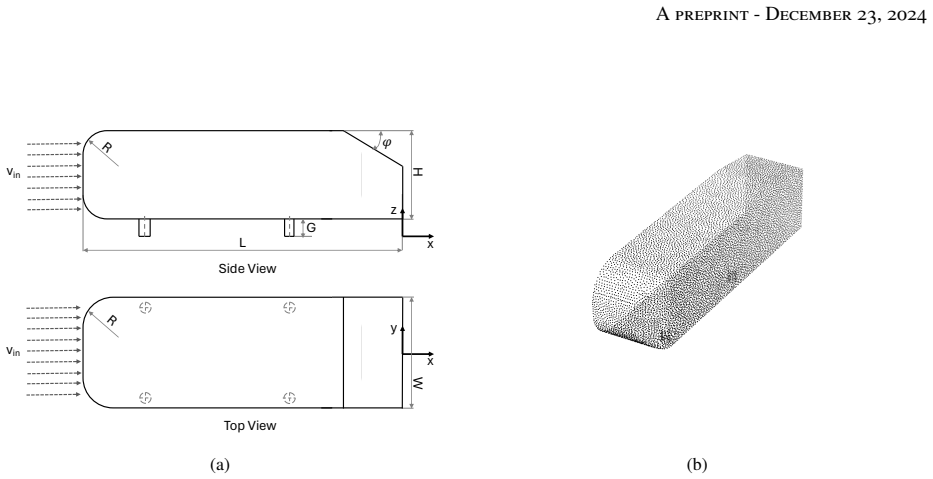
The authors introduce the Multi-Fidelity U-Net (MF-UNet), a GNN architecture in which graphs of different mesh resolutions occupy different levels of a U-Net-like pipeline; updated node attributes flow from high to low resolution via down-sampling and back up via up-sampling, using k-nearest-neighbor Euclidean mapping between node sets. Because encoder, GN blocks, and decoder are shared across levels, the model has the same number of parameters as a single-fidelity GNN. Trained jointly with a weighted loss on all fidelity outputs, MF-UNet reports relative errors far below single-fidelity GNN and transfer-learning GNN on high-resolution test meshes—for example, 8% versus 73% (single-fidelity) and 46% (transfer learning with three fidelities) relative L1 error on beam x-displacement, and 14.2% versus 28.1% relative L2 error on the Ahmed-body aerodynamics dataset—while using equal or less total data-generation compute. A Lite variant that passes information only from low to high fidelity trains about 35% faster per iteration with a 2 to 5% accuracy penalty.
Load-bearing premise
The load-bearing assumption is that the Euclidean k-nearest-neighbor mapping between meshes of different resolutions transfers physically meaningful nodal information; if that mapping misaligns nodes or the resolution gap is too large, the coupled signals would contaminate the fine-mesh prediction instead of improving it.
Editorial extensions
If this is right
- Engineers can produce accurate high-resolution surrogate models while generating most training data on coarse meshes, cutting the computational cost of data generation.
- Multi-fidelity training adds no parameter-count overhead, so the accuracy gain comes without a larger network.
- The trained model extrapolates to meshes three times finer than any seen in training, at least for the cantilever beam problem.
- Three fidelity levels capture almost all of the benefit; adding a fourth level did not significantly reduce error.
- MF-UNet Lite offers a 35% training-speed gain per iteration at a 2 to 5% accuracy cost, giving practitioners a tunable speed-accuracy trade-off.
Reading between the lines
- Beyond the reported cases, the coupling operator's reliance on Euclidean k-nearest neighbors suggests the method will work best on meshes that are geometrically nested or similarly shaped; for anisotropic or adaptively refined meshes, a distance-aware or volume-weighted interpolation may be needed to preserve the gain.
- The observation that bi-directional coupling matters most for shallow networks suggests the downward flow mainly lets the network be shallower, pointing to a practical rule: use full MF-UNet rather than Lite when message-passing depth is limited.
- A natural next test, not run in the paper, is autoregressive time-stepping for time-dependent PDEs; if coarse-mesh histories condition fine-mesh states, the data savings should carry over.
- The accuracy gap between MF-UNet and transfer learning widens as the problem becomes more complex, suggesting the coupling also acts as a data-efficiency mechanism; a scaling study with decreasing high-fidelity sample sizes would show where the advantage saturates.
Editorial analysis
A structured set of objections, weighed in public.
Referee Report
Summary. The manuscript proposes Multi-Fidelity U-Net (MF-UNet) and a faster variant, Multi-Fidelity U-Net Lite, for surrogate modeling of PDEs on meshes of different resolutions. The architecture processes low-, medium-, and high-resolution graphs with a shared encoder, shared GN blocks, and a shared decoder, coupling node attributes across fidelity levels via k-nearest-neighbor up- and down-sampling with learned coupling weights. Training uses a loss that is a weighted sum of per-fidelity errors. The authors validate the method on 2D cantilever-beam displacement, 2D plate stress concentration, and 3D Ahmed-body aerodynamics, reporting lower relative L1/L2 errors than a single-fidelity GNN and a transfer-learning GNN, at the same parameter count, and claim improved accuracy and data requirement.
Significance. If the reported gains hold, the architecture is a useful contribution to mesh-based GNN surrogates: it keeps parameter cost flat while exploiting cheap low-fidelity data, and the paper includes ablations on the number of fidelity levels, resolution ratios, and uni- versus bi-directional coupling. The attention to cost-matched data generation and the use of three substantially different problems (including an industry-scale 3D dataset) are strengths. However, the central comparative claim is undermined by a suspiciously weak single-fidelity baseline, the absence of a comparison against the closest prior multi-fidelity GNN, and the lack of uncertainty quantification. These issues are fixable, but the evidence as presented does not yet establish that the coupling mechanism itself, rather than baseline failure or training choices, produces the reported margins.
major comments (5)
- [§4.1, Table 1] The single-fidelity baseline is implausibly poor: a GNN with 1.7M parameters, 10 GN blocks, and 2,700 training samples achieves 73% relative L1 error on ux for a smooth 2D linear-elastic cantilever beam. Such errors on a smooth elliptic problem are more consistent with a training failure (e.g., unnormalized outputs, learning-rate collapse, or a bug in the loss) than with a genuine limitation of single-fidelity GNNs. If this baseline is degenerate, the 8–10× margins reported for MF-UNet are not a valid measure of the method's advantage. Please re-run the single-fidelity model with tuned hyperparameters, report its training and test learning curves, and show that the reported error is a converged result rather than an artifact.
- [§2.1 and §4.2] Taghizadeh et al. (2024) is identified as the closest hierarchical multi-fidelity GNN baseline, and the plate datasets in Section 4.2 are generated from the same authors' code, yet no experiment in the paper compares against this method. Without that comparison, the evidence cannot separate the benefit of the proposed coupling from the benefit of simply providing coarse-mesh information to a high-fidelity model. Please implement Taghizadeh et al.'s hierarchical MF-GNN on at least the plate-with-hole and Ahmed-body datasets and report the same error metrics.
- [Abstract and §4] The claim that the method 'performs significantly better in accuracy and data requirement' is not directly tested for the data-requirement component. All experiments use a single cost-matched dataset size; no sample-complexity curves are shown in which the number of high-fidelity training samples is varied while low-fidelity data are held fixed or co-varied. Please add such curves for at least one 2D problem and the Ahmed body, or revise the claim to be specifically about accuracy at fixed data-generation cost.
- [§3.1] The k-nearest-neighbor Euclidean-distance mapping between nodes of different-resolution meshes is a load-bearing design choice, but the paper provides no analysis of when this mapping is accurate, and no ablation against alternative coupling operators (e.g., interpolation-based upsampling, graph-coarsening correspondences, or no coupling). The resolution-ratio ablation in §4.1.1 varies only the medium-resolution density under a fixed k=4, which does not test the robustness of the kNN operator to large resolution gaps or non-uniform meshes. Please add either an analysis of the mapping error or an ablation comparing coupling operators, or both.
- [Tables 1, 2, 3, 5] All reported errors are from what appear to be single training runs; no seeds, standard deviations, or confidence intervals are given. Several reported margins are small (e.g., 8% vs 10% in Table 1, and 0.09% vs 0.10% in Table 2), and small differences between model variants may be within run-to-run variability. Since the central claim is that the proposed models are 'significantly better,' please report results over at least three seeds (ideally five) as mean ± std, and test the significance of the observed differences.
minor comments (6)
- [§3.3, Eq. (2)] The text 'L = λ1L1 + λ1L2 + λ1L3' should use λ2 for the second term; the sentence following Eq. (2) repeats λ1 for all three loss weights.
- [§4.1] The sentence 'The same decoder architecture as other models is used for evaluating the nodal stress concentration from all the three fidelity graphs' appears in the beam-displacement experiment, where the outputs are ux and uy, not stress; the wording should be corrected.
- [Table 4] The parameter ranges are given as '700 − 1400 m', '250 − 550 m', '200 − 400 m', '30 − 90 m', and '80 − 120 m', which are physically implausible for an Ahmed body; the units are presumably millimetres and should be corrected.
- [§2.1] The acronym 'MFT' is used for the multi-fidelity transfer-learning approach, but it is not defined at first use; also, the reference to Liu et al. [2022] appears before some related works are introduced, making the paragraph slightly hard to follow.
- [Figures 4 and 5] The histograms and scatter comparisons in Figures 4 and 5 would benefit from axis labels, the number of test samples, and, in Figure 5, explicit legends for the two compared models; currently the reader cannot verify the distributions described in the text.
- [§4.1, §4.2] The loss weights λi are described as 'tuned during training' but no procedure or sensitivity analysis is given; a brief statement of how λi were selected and their sensitivity would help reproducibility.
Circularity Check
No circularity found: the accuracy and data-requirement claims are empirical held-out test measurements, and self-citations are to published building blocks, not load-bearing.
full rationale
The paper's central claim that MF-UNet is more accurate and requires less high-fidelity data than single-fidelity and transfer-learning GNNs is supported by held-out test error tables (Tables 1, 2, 5) and per-sample error comparisons (Figs. 4, 5), not by a derivation from the architecture. The loss in Eq. (2) is a weighted sum of per-fidelity error terms; the weights lambda are tuned hyperparameters, and the coupling gains beta1, beta2 are learned, but the reported test errors are measurements on held-out high-fidelity graphs, so no fitted quantity is renamed as a prediction. The k-NN Euclidean up/down-sampling in Section 3.1 is a stated geometric design choice, not an imported ansatz from the authors' prior work. Self-citations (Gladstone et al. [2023] for the node update rule; Gladstone et al. [2024] for GNN U-Nets) are to published, independently reusable building blocks and do not carry the multi-fidelity coupling claim. One self-critical passage in Section 4.1 concedes that the transfer-learning baseline was under-trained ('The given sample size used for training seems to be insufficient for the transfer learning approach... This performance could be improved by training with a much larger sample of low-fidelity data'), and Section 2.1 identifies Taghizadeh et al. [2024] as the closest prior work without a direct experimental comparison; both are benchmark-fairness and completeness concerns, not circularity. No equation in the paper reduces the predicted output to its training inputs by construction, and no uniqueness theorem or forced-choice argument is imported from the authors' prior work. The derivation chain is therefore not circular.
Assumptions & free parameters
free parameters (4)
- Loss weights lambda_i =
lambda1=10, lambda2=1 or 5, lambda3=1 (varies by experiment)
- k in k-nearest-neighbor coupling =
k=4 (beam), k=3 (plates), k=5 (Ahmed body)
- Coupling weights beta1, beta2 (MF-UNet) and beta (Lite) =
learned during training
- Number of GN blocks and coupling position =
10 GN blocks with coupling after the 5th (12 with coupling after the 6th for Ahmed)
assumptions (5)
- domain assumption Mesh resolution is a valid proxy for fidelity, and coarser meshes provide useful information for predicting fine-mesh solutions.
- ad hoc to paper k-nearest-neighbor Euclidean-distance mapping between nodes of different-resolution meshes preserves the information needed for coupling.
- domain assumption Shared parameters across fidelity levels are sufficient to represent the multi-fidelity mapping.
- standard math Standard supervised-learning assumptions: train/test graphs are i.i.d. samples from the same generative process.
- domain assumption FEM/CFD solutions at each resolution are treated as ground truth for that fidelity.
Cite this review
Pith. "Pith review of A Multi-Fidelity Graph U-Net Model for Accelerated Physics Simulations." pith.science (2026). https://pith.science/paper/4P5EM5ON
@misc{pith2026241215372,
  author       = {Pith},
  title        = {Pith review of: A Multi-Fidelity Graph U-Net Model for Accelerated Physics Simulations},
  year         = {2026},
  howpublished = {\url{https://pith.science/paper/4P5EM5ON}},
  note         = {Machine review of arXiv:2412.15372}
}
read the original abstract
Physics-based deep learning frameworks have shown to be effective in accurately modeling the dynamics of complex physical systems with generalization capability across problem inputs. Data-driven networks like GNN, Neural Operators have proved to be very effective in generalizing the model across unseen domain and resolutions. But one of the most critical issues in these data-based models is the computational cost of generating training datasets. Complex phenomena can only be captured accurately using deep networks with large training datasets. Furthermore, numerical error of training samples is propagated in the model errors, thus requiring the need for accurate data, i.e. FEM solutions on high-resolution meshes. Multi-fidelity methods offer a potential solution to reduce the training data requirements. To this end, we propose a novel GNN architecture, Multi-Fidelity U-Net, that utilizes the advantages of the multi-fidelity methods for enhancing the performance of the GNN model. The proposed architecture utilizes the capability of GNNs to manage complex geometries across different fidelity levels, while enabling flow of information between these levels for improved prediction accuracy for high-fidelity graphs. We show that the proposed approach performs significantly better in accuracy and data requirement and only requires training of a single network compared to other benchmark multi-fidelity approaches like transfer learning. We also present Multi-Fidelity U-Net Lite, a faster version of the proposed architecture, with 35% faster training, with 2 to 5% reduction in accuracy. We carry out extensive validation to show that the proposed models surpass traditional single-fidelity GNN models in their performance, thus providing feasible alternative for addressing computational and accuracy requirements where traditional high-fidelity simulations can be time-consuming.
Figures


Figures from the paper (8 more)



Reference graph
Works this paper leans on
-
[6]
Issues in deciding whether to use multifidelity surrogates.Aiaa Journal, 57(5):2039–2054,
M Giselle Fernández-Godino, Chanyoung Park, Nam H Kim, and Raphael T Haftka. Issues in deciding whether to use multifidelity surrogates.Aiaa Journal, 57(5):2039–2054,
-
[7]
Rini J Gladstone, Mohammad A Nabian, and Hadi Meidani. Fo-pinns: A first-order formulation for physics informed neural networks.arXiv preprint arXiv:2210.14320,
-
[8]
Robust Topology Optimization Using Multi-Fidelity Variational Autoencoders
Rini Jasmine Gladstone, Mohammad Amin Nabian, Vahid Keshavarzzadeh, and Hadi Meidani. Robust topology optimization using variational autoencoders.arXiv preprint arXiv:2107.10661,
-
[10]
Semi-supervised classification with graph convolutional networks.arXiv preprint arXiv:1609.02907,
Thomas N Kipf and Max Welling. Semi-supervised classification with graph convolutional networks.arXiv preprint arXiv:1609.02907,
-
[12]
Fixing weight decay regularization in adam.arXiv preprint arXiv:1711.05101, 5,
Ilya Loshchilov, Frank Hutter, et al. Fixing weight decay regularization in adam.arXiv preprint arXiv:1711.05101, 5,
-
[15]
Jonathan Tompson, Kristofer Schlachter, Pablo Sprechmann, and Ken Perlin
URLhttps://physicsbaseddeeplearning.org. Jonathan Tompson, Kristofer Schlachter, Pablo Sprechmann, and Ken Perlin. Accelerating eulerian fluid simulation with convolutional networks.arXiv preprint arXiv:1607.03597,
-
[16]
Graph attention networks.arXiv preprint arXiv:1710.10903,
Petar Veličković, Guillem Cucurull, Arantxa Casanova, Adriana Romero, Pietro Lio, and Yoshua Bengio. Graph attention networks.arXiv preprint arXiv:1710.10903,
-
[17]
20 A preprint - December 23, 2024 Seongjun Yun, Minbyul Jeong, Raehyun Kim, Jaewoo Kang, and Hyunwoo J Kim. Graph transformer networks. Advances in neural information processing systems, 32,
work page 2024
Show all 16 references
-
[2015]
Relational inductive biases, deep learning, and graph networks.arXiv preprint arXiv:1806.01261,
PeterWBattaglia,JessicaBHamrick,VictorBapst,AlvaroSanchez-Gonzalez,ViniciusZambaldi,MateuszMalinowski, Andrea Tacchetti, David Raposo, Adam Santoro, Ryan Faulkner, et al. Relational inductive biases, deep learning, and graph networks.arXiv preprint arXiv:1806.01261,
-
[2016]
Multiscale meshgraphnets
Meire Fortunato, Tobias Pfaff, Peter Wirnsberger, Alexander Pritzel, and Peter Battaglia. Multiscale meshgraphnets. arXiv preprint arXiv:2210.00612,
-
[2019]
Review of multi-fidelity models.arXiv preprint arXiv:1609.07196,
M Giselle Fernández-Godino. Review of multi-fidelity models.arXiv preprint arXiv:1609.07196,
-
[2020]
Maziar Raissi, Paris Perdikaris, and George Em Karniadakis
URLhttps://arxiv.org/abs/2010.03409. Maziar Raissi, Paris Perdikaris, and George Em Karniadakis. Inferring solutions of differential equations using noisy multi-fidelity data.Journal of Computational Physics, 335:736–746, 2017a. Maziar Raissi, Paris Perdikaris, and George Em K...
2010 arXiv
-
[2021]
Graph neural networks for particle reconstruction in high energy physics detectors.arXiv preprint arXiv:2003.11603,
XiangyangJu,StevenFarrell,PaoloCalafiura,DanielMurnane,LindseyGray,ThomasKlijnsma,KevinPedro,Giuseppe Cerati, Jim Kowalkowski, Gabriel Perdue, et al. Graph neural networks for particle reconstruction in high energy physics detectors.arXiv preprint arXiv:2003.11603,
2003 arXiv
-
[2022]
Transfer learning based multi-fidelity physics informed deep neural network.Journal of Computa- tional Physics, 426:109942,
18 A preprint - December 23, 2024 Souvik Chakraborty. Transfer learning based multi-fidelity physics informed deep neural network.Journal of Computa- tional Physics, 426:109942,
2024
-
[2023]
Fourier neural operator for parametric partial differential equations.arXiv preprint arXiv:2010.08895, 2020a
ZongyiLi, NikolaKovachki, KamyarAzizzadenesheli, BurigedeLiu, KaushikBhattacharya, AndrewStuart, andAnima Anandkumar. Fourier neural operator for parametric partial differential equations.arXiv preprint arXiv:2010.08895, 2020a. Zongyi Li, Nikola Kovachki, Kamyar Azizzadeneshel...
2010 arXiv
-
[2024]
Graph neural solver for power systems
Balthazar Donon, Benjamin Donnot, Isabelle Guyon, and Antoine Marot. Graph neural solver for power systems. In 2019 international joint conference on neural networks (ijcnn), pages 1–8. IEEE,
2019
Reviewed August 11, 2026 · model on record in the stance chip above.
Discussion (0). Continue with ORCID to comment.