REVIEW 5 major objections 4 minor 43 references
Template-Driven LLM-Paraphrased Framework for Tabular Math Word Problem Generation
T0 review · 5 major / 4 minor · reviewed 2026-08-11 · deepseek-v4-flash
Pith's one-line read Synthetic tabular math problems lift LLM accuracy ~4 points
desk verdict Useful pipeline and dataset, but the reported gains may be an artifact of a modified test set and a missing equal-volume baseline. read the letter →
The pith
A machine-rendered reading of the paper's core claim, the machinery that carries it, and where it could break.
The reading
What carries the argument
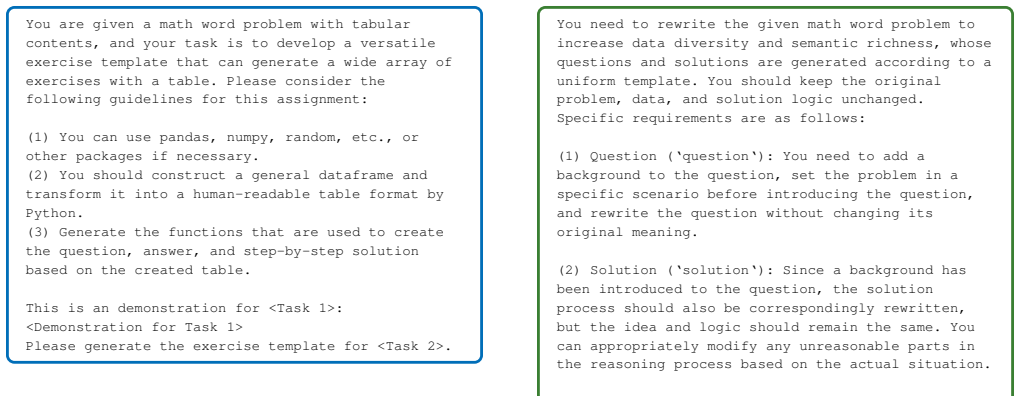
The load-bearing object is the template tuple $P(x)$, which couples question, table, answer, and solution through shared placeholders. The pipeline's invariants are: templates are abstracted from real samples so the arithmetic is valid; an LLM extends templates to neighboring question types; instantiation fills random numbers and categories; and a final LLM paraphrases the problem into a contextual story under instructions not to change the logic. The step-by-step illustrative solution is a key part of the generated item: it is produced by an LLM from the original free-form solution, and the ablations show that models trained on these illustrative solutions beat models trained on the original free-form solutions by about 1.6-1.9 points.
What would settle it
Take a random sample of generated items where the paraphrased problem and the template problem share the same answer, have expert annotators judge whether the question, table, and solution express the same mathematical query, and compute the proportion of semantic mismatches; a rate above a few percent would invalidate the correctness guarantee. A cleaner experimental falsifier is to re-run the fine-tuning comparisons with the answer-consistency filter replaced by a stricter logic-preservation check, such as back-translation or symbolic validation, and see whether the reported gains persist.
Extended reading notes
Core claim
The central discovery is that a hybrid template/LLM pipeline can produce tabular math problems that are simultaneously correct and diverse, and that these synthetic problems transfer to real tests. Each template is a tuple $P(x)=(Q(x), T(x), A(x), S(x))$ with shared placeholders for numbers and categories. After instantiation, the LLM paraphrase step is instructed to keep the problem, data, and solution logic unchanged; an answer-consistency filter drops cases where the solution's answer differs from the template's answer, and a BLEU threshold removes near-duplicates of test questions. Fine-tuning Mistral-7B, Qwen 2-7B, and Llama 3-8B on TabMWP plus TabMWP-TeLL outperforms training on TabMWP alone on every model, with the largest gains on difficult grade 7-8 and stem-leaf plot problems, and a human check of 1,000 generated samples reports 97.5% correctness.
Load-bearing premise
The load-bearing assumption is that the LLM paraphrase step preserves the mathematical logic of the template problem, with only the final answer compared automatically; if the paraphrase changes what the question asks while still yielding the same numeric answer, the generated data can contain mismatched or mislabeled problems.
Editorial extensions
If this is right
- Adding TabMWP-TeLL to the training mix improves Mistral, Qwen 2, and Llama 3 by 3.96%, 3.70%, and 3.78% on the TabMWP test set, with Llama 3 reaching 98.07% overall.
- The gains concentrate on challenging items: Llama 3's grade 7-8 accuracy rises to 97.42%, and stem-leaf plot subtypes improve by 11.92% on average over training on TabMWP alone.
- Data scaling shows that even 20% of the generated data yields a substantial improvement, and accuracy keeps rising as more generated data is added.
- The framework is not tied to the 25 question types instantiated here; the authors state it can be extended to new and unseen question types.
- Human verification of 1,000 sampled generated problems reports a 97.5% correctness rate, with the remaining errors classed as incomplete paraphrases, incorrect paraphrased solutions, or grammar issues.
Reading between the lines
- Editorial inference: the answer-consistency filter only catches items where the paraphrased solution produces a different number from the template; semantic drift that preserves the answer would pass, so the 97.5% human verification rate may be an upper bound on the clean fraction if such drift is common.
- Editorial inference: the ablations suggest the illustrative solutions, not just the new questions, drive much of the gain; a factorial design that holds questions fixed while toggling solution style would isolate this contribution.
- Editorial inference: because the source of templates is a single dataset, the template database may inherit that dataset's question-type distribution; applying the same pipeline to broader or noisier tabular sources would test how far the correctness guarantee degrades.
- Editorial inference: the BLEU-based deduplication at $\delta=0.95$ removes near-exact copies of test questions, but semantically equivalent rephrasings with lower BLEU could still leak; evaluating on a fresh paraphrase distribution, or using a semantic similarity measure, would give a sharper estimate of true generalization.
Editorial analysis
A structured set of objections, weighed in public.
Referee Report
Summary. The paper proposes TeLL, a two-stage framework for generating tabular math word problems (TMWPs): first, abstract templates are extracted from existing real samples and augmented by an LLM; second, template-instantiated problems are paraphrased by an LLM into diverse, contextualized questions while preserving the template's arithmetic logic. The authors construct a new dataset TabMWP-TeLL and fine-tune Mistral-7B, Qwen 2-7B, and Llama-3-8B on TabMWP plus TabMWP-TeLL. They report consistent gains over fine-tuning on TabMWP alone: 3.96%, 3.70%, and 3.78% absolute accuracy improvements on the TabMWP test set, with Llama 3 reaching 98.07% overall accuracy. They also report a human-verification correctness rate of 97.5% on 1,000 generated samples and ablations showing that template-based, LLM-only, and question-only generation methods underperform the full TeLL pipeline.
Significance. If the reported gains are verified, the paper makes a useful contribution to data augmentation for tabular math reasoning: it combines a correctness-preserving template stage with an LLM paraphrase stage, releases code and data, performs controlled ablations that fix the generated-data size at 23K, and includes human verification of generated samples. The three-LLM evaluation and the emphasis on illustrative step-by-step solutions are also strengths. However, the central empirical claim depends on the integrity of the test-set construction and on the absence of a like-for-like control for added data volume; both need to be clarified before the measured improvements can be taken at face value.
major comments (5)
- [Methodology, Problem Paraphrasing] The paper states: "We also remove questions in the test set where at least one sample has a BLEU score greater than δ to prevent potential data leakage issues." This means that the TabMWP test set used in Table 2 is a filtered subset, not the full 7,686-question test set, yet the table does not report how many questions were removed, whether all baseline and fine-tuned rows were evaluated on exactly the same subset, or whether any baseline accuracy was recomputed on the reduced set. Because BLEU-based filtering is likely to remove test questions that resemble the generated data, the reported gains of 3.96%, 3.70%, and 3.78% could be inflated by evaluating on an easier subset. The authors must report the number and identities of removed test questions, recompute all rows of Table 2 on the identical subset, and either evaluate on the full test set or justify the filtering as a necessary leakage-prevention step.
- [Methodology, Template Abstraction] The template database is described as being built from "existing real samples" without specifying that only the TabMWP training split was used. If any validation or test examples contributed templates, then generated training samples could share structural, lexical, or tabular patterns with test examples, and the BLEU filter at δ=0.95 would only catch near-verbatim duplicates rather than structurally similar rewrites. The paper should explicitly state which TabMWP split was used for template extraction and, ideally, rerun the main experiment with templates derived solely from the training split.
- [Main Results and Ablation Study] The main comparison in Table 2 contrasts fine-tuning on TabMWP alone with fine-tuning on TabMWP plus TabMWP-TeLL. Since the latter adds roughly 23K extra training instances, the observed gains could be due to increased data quantity rather than to the quality or design of TabMWP-TeLL. Table 3 controls for the generation method by fixing the generated-data size at 23K, but it does not include a control that adds an equal volume of original TabMWP training examples (or a similarly human-written dataset) to the TabMWP training set. An equal-volume augmentation control is needed to attribute the improvements to the framework rather than to the larger training set.
- [Methodology, Problem Paraphrasing and Human Verification] The claim that "Since our LLM-based paraphrasing does not change the mathematical logic, the correctness can be ensured" is stronger than the evidence supports. The only automated consistency check is whether the LLM-produced solution's final answer matches the template's answer; this cannot detect paraphrases that change the question semantics while coincidentally yielding the same numerical answer. The human verification reports a 97.5% correctness rate and categorizes errors, but it does not report a separate judgment on whether the paraphrased question is semantically equivalent to the template question. The authors should either strengthen the automated verification (e.g., checking the paraphrase against the template's logical form) or provide a human-verified measure of semantic equivalence on a sample of the generated data.
- [Experimental Setup] All fine-tuning results in Tables 2–4 are reported from what appears to be a single run per configuration, with no standard deviations, no repeated seeds, and no significance tests. Given that the headline gains are around 3.7–4.0 percentage points and that QLoRA fine-tuning is stochastic, the authors should report means and variances over at least three runs, or otherwise justify that the differences are stable. This is particularly important for the subtable comparisons in Table 5, where some cells differ by only a fraction of a point.
minor comments (4)
- [Table 5] The column header "TableMWP" appears to be a typo for "TabMWP."
- [Abstract and Methodology] The abstract states "we find the reasoning annotation is important for solving TMWPs," but the paper does not provide a comparison with alternative reasoning-annotation formats (e.g., compact formulas or numeric-only solutions); the ablation in Table 4 compares free-form versus illustrative solutions only.
- [Dataset Description] The main text never states the total size of the released TabMWP-TeLL dataset. Table 3 mentions that the ablation methods generate 23K problems, but the final dataset size should be stated explicitly in the experiments section.
- [Problem Definition and Equation (2)] Equation (2) writes the paraphrasing step as producing (q,t,a,s), but in the pipeline the answer a is supposed to remain unchanged from the template while only the question, table wording, and solution are paraphrased. The notation should clarify that the answer is carried through the paraphrase step rather than regenerated.
Circularity Check
No significant circularity: the generation pipeline's correctness anchor is template arithmetic, and the evaluation is against the held-out TabMWP test set.
full rationale
The central claim—that adding TabMWP-TeLL to fine-tuning data improves TabMWP accuracy—does not reduce to its inputs. Generated problems are produced by instantiating abstract templates with random numbers and categories (Equation 1), so answers are computed algorithmically from the template rather than taken from evaluation labels. The LLM paraphrase step (Equation 2) is post-hoc and is filtered by consistency with the template answer, so the correctness guarantee is anchored to the template computation, not to the LLM's own output. The empirical evaluation compares models fine-tuned with and without the generated data on the official held-out TabMWP test set, using the official evaluation script; the reported gains depend on actual training outcomes rather than being true by construction. The use of Yi for paraphrasing and illustrative solutions is not a self-citation chain: Yi is an external model, and the target models (Mistral, Qwen 2, Llama 3) are distinct. The paper's self-citations (e.g., Zhou et al. 2023b; Wang et al. 2024) appear in related-work background and are not load-bearing for the main derivation. A potential evaluation-integrity concern is that the paper removes test questions with high BLEU to generated data without disclosing whether baselines were recomputed on the reduced set; this is a correctness/transparency risk, not a circularity reduction, because the comparison is still empirically measured rather than forced by definition. No circular step can be exhibited from the quoted text, so the appropriate finding is no significant circularity.
Assumptions & free parameters
free parameters (2)
- BLEU threshold delta =
0.95
- Number of question types =
25
assumptions (4)
- domain assumption The 25 selected question types are representative of the TabMWP distribution, so training on generated examples transfers to the full test set.
- domain assumption LLM paraphrasing preserves the mathematical logic and answer of the template-based problem.
- domain assumption The manually abstracted templates correctly encode the arithmetic operations of the original problems, so random instantiation yields correct problems.
- domain assumption The human-verification sample is representative, and the 97.5% correctness estimate is unbiased.
Cite this review
Pith. "Pith review of Template-Driven LLM-Paraphrased Framework for Tabular Math Word Problem Generation." pith.science (2026). https://pith.science/paper/7HJII4JO
@misc{pith2026241215594,
  author       = {Pith},
  title        = {Pith review of: Template-Driven LLM-Paraphrased Framework for Tabular Math Word Problem Generation},
  year         = {2026},
  howpublished = {\url{https://pith.science/paper/7HJII4JO}},
  note         = {Machine review of arXiv:2412.15594}
}
read the original abstract
Solving tabular math word problems (TMWPs) has become a critical role in evaluating the mathematical reasoning ability of large language models (LLMs), where large-scale TMWP samples are commonly required for LLM fine-tuning. Since the collection of high-quality TMWP datasets is costly and time-consuming, recent research has concentrated on automatic TMWP generation. However, current generated samples usually suffer from issues of either correctness or diversity. In this paper, we propose a Template-driven LLM-paraphrased (TeLL) framework for generating high-quality TMWP samples with diverse backgrounds and accurate tables, questions, answers, and solutions. To this end, we first extract templates from existing real samples to generate initial problems, ensuring correctness. Then, we adopt an LLM to extend templates and paraphrase problems, obtaining diverse TMWP samples. Furthermore, we find the reasoning annotation is important for solving TMWPs. Therefore, we propose to enrich each solution with illustrative reasoning steps. Through the proposed framework, we construct a high-quality dataset TabMWP-TeLL by adhering to the question types in the TabMWP dataset, and we conduct extensive experiments on a variety of LLMs to demonstrate the effectiveness of TabMWP-TeLL in improving TMWP solving performance. The code and data of this paper are available at: https://github.com/Jason8Kang/TELL.
Figures


Figures from the paper (3 more)


Reference graph
Works this paper leans on
-
[1]
Bambhaniya, A.; Raj, R.; Jeong, G.; Kundu, S.; Srinivasan, S.; Elavazhagan, M.; Kumar, M.; and Krishna, T. 2024. Demystifying Platform Requirements for Diverse LLM Inference Use Cases. arXiv:2406.01698
arXiv 2024
-
[2]
D.; Dhariwal, P.; Neelakantan, A.; Shyam, P.; Sastry, G.; Askell, A.; et al
Brown, T.; Mann, B.; Ryder, N.; Subbiah, M.; Kaplan, J. D.; Dhariwal, P.; Neelakantan, A.; Shyam, P.; Sastry, G.; Askell, A.; et al. 2020. Language Models are Few-Shot Learners. In Advances in Neural Information Processing Systems, volume 33, 1877--1901
work page 2020
-
[3]
Chen, W.; Ma, X.; Wang, X.; and Cohen, W. W. 2023. Program of Thoughts Prompting: Disentangling Computation from Reasoning for Numerical Reasoning Tasks. Transactions on Machine Learning Research
2023
-
[4]
Dettmers, T.; Pagnoni, A.; Holtzman, A.; and Zettlemoyer, L. 2023. QLoRA: Efficient Finetuning of Quantized LLMs. In Oh, A.; Naumann, T.; Globerson, A.; Saenko, K.; Hardt, M.; and Levine, S., eds., Advances in Neural Information Processing Systems, volume 36, 10088--10115
work page 2023
-
[5]
Dubey, A.; Jauhri, A.; Pandey, A.; Kadian, A.; Al-Dahle, A.; Letman, A.; Mathur, A.; Schelten, A.; Yang, A.; Fan, A.; et al. 2024. The Llama 3 Herd of Models. arXiv:2407.21783
arXiv 2024
-
[6]
Fu, Y.; Peng, H.; Sabharwal, A.; Clark, P.; and Khot, T. 2023. Complexity-Based Prompting for Multi-step Reasoning. In The Eleventh International Conference on Learning Representations
work page 2023
-
[7]
Huang, Y.; Liu, X.; Gong, Y.; Gou, Z.; Shen, Y.; Duan, N.; and Chen, W. 2024. Key-Point-Driven Data Synthesis with its Enhancement on Mathematical Reasoning. arXiv:2403.02333
arXiv 2024
-
[8]
Q.; Sablayrolles, A.; Mensch, A.; Bamford, C.; Chaplot, D
Jiang, A. Q.; Sablayrolles, A.; Mensch, A.; Bamford, C.; Chaplot, D. S.; Casas, D. d. l.; Bressand, F.; Lengyel, G.; Lample, G.; Saulnier, L.; et al. 2023. Mistral 7B. arXiv:2310.06825
arXiv 2023
Show all 43 references
-
[9]
Khashabi, D.; Min, S.; Khot, T.; Sabharwal, A.; Tafjord, O.; Clark, P.; and Hajishirzi, H. 2020. UNIFIEDQA : Crossing Format Boundaries with a Single QA System. In Findings of the Association for Computational Linguistics: EMNLP 2020, 1896--1907
2020
-
[10]
Koncel-Kedziorski, R.; Konstas, I.; Zettlemoyer, L.; and Hajishirzi, H. 2016. A Theme-Rewriting Approach for Generating Algebra Word Problems. In Proceedings of the 2016 Conference on Empirical Methods in Natural Language Processing, 1617--1628
2016
-
[11]
Q.; Xia, L.; and Du, X
Li, R.; Wang, Z.; Tran, S. Q.; Xia, L.; and Du, X. 2024. MEQA : A Benchmark for Multi-hop Event-centric Question Answering with Explanations. In The Thirty-eight Conference on Neural Information Processing Systems Datasets and Benchmarks Track
2024
-
[12]
Liang, Z.; Yu, D.; Pan, X.; Yao, W.; Zeng, Q.; Zhang, X.; and Yu, D. 2024. M in T : Boosting Generalization in Mathematical Reasoning via Multi-view Fine-tuning. In Calzolari, N.; Kan, M.-Y.; Hoste, V.; Lenci, A.; Sakti, S.; and Xue, N., eds., Proceedings of the 2024 Joint Int...
2024
-
[13]
Liu, Q.; Chen, B.; Guo, J.; Ziyadi, M.; Lin, Z.; Chen, W.; and Lou, J.-G. 2022. TAPEX : Table Pre-training via Learning a Neural SQL Executor. In International Conference on Learning Representations
2022
-
[14]
Liu, T.; Fang, Q.; Ding, W.; Li, H.; Wu, Z.; and Liu, Z. 2021. Mathematical Word Problem Generation from Commonsense Knowledge Graph and Equations. In Proceedings of the 2021 Conference on Empirical Methods in Natural Language Processing, 4225--4240
2021
-
[15]
D.; Co-Reyes, J
Liu, Y.; Singh, A.; Freeman, C. D.; Co-Reyes, J. D.; and Liu, P. J. 2023. Improving Large Language Model Fine-tuning for Solving Math Problems. arXiv:2310.10047
2023 arXiv
-
[16]
Liyanage, V.; and Ranathunga, S. 2020. Multi-lingual Mathematical Word Problem Generation using Long Short Term Memory Networks with Enhanced Input Features. In Proceedings of the Twelfth Language Resources and Evaluation Conference, 4709--4716
2020
-
[17]
N.; Zhu, S.-C.; and Gao, J
Lu, P.; Peng, B.; Cheng, H.; Galley, M.; Chang, K.-W.; Wu, Y. N.; Zhu, S.-C.; and Gao, J. 2023 a . Chameleon: Plug-and-Play Compositional Reasoning with Large Language Models. In Advances in Neural Information Processing Systems, volume 36, 43447--43478
2023
-
[18]
N.; Zhu, S.-C.; Rajpurohit, T.; Clark, P.; and Kalyan, A
Lu, P.; Qiu, L.; Chang, K.-W.; Wu, Y. N.; Zhu, S.-C.; Rajpurohit, T.; Clark, P.; and Kalyan, A. 2023 b . Dynamic Prompt Learning via Policy Gradient for Semi-structured Mathematical Reasoning. In The Eleventh International Conference on Learning Representations
2023
-
[19]
Luo, H.; Sun, Q.; Xu, C.; Zhao, P.; Lou, J.; Tao, C.; Geng, X.; Lin, Q.; Chen, S.; and Zhang, D. 2023. WizardMath: Empowering Mathematical Reasoning for Large Language Models via Reinforced Evol-Instruct. arXiv:2308.09583
2023 arXiv
-
[20]
Macina, J.; Daheim, N.; Chowdhury, S.; Sinha, T.; Kapur, M.; Gurevych, I.; and Sachan, M. 2023. M ath D ial: A Dialogue Tutoring Dataset with Rich Pedagogical Properties Grounded in Math Reasoning Problems. In Bouamor, H.; Pino, J.; and Bali, K., eds., Findings of the Associat...
2023
-
[21]
G.; and Gilbert, J
Moon-Rembert, D. G.; and Gilbert, J. E. 2019. Illmatics: A Web-based Math Word Problem Generator for Students’ Distal and Proximal Interests. In Proceedings of E-Learn: World Conference on E-Learning in Corporate, Government, Healthcare, and Higher Education 2019, 842--848
2019
-
[22]
L.; Almeida, D.; Altenschmidt, J.; Altman, S.; et al
OpenAI; Achiam, J.; Adler, S.; Agarwal, S.; Ahmad, L.; Akkaya, I.; Aleman, F. L.; Almeida, D.; Altenschmidt, J.; Altman, S.; et al. 2024. GPT-4 Technical Report. arXiv:2303.08774
2024 arXiv
-
[23]
Peng, H.; Wang, X.; Chen, J.; Li, W.; Qi, Y.; Wang, Z.; Wu, Z.; Zeng, K.; Xu, B.; Hou, L.; et al. 2023. When does In-context Learning Fall Short and Why? A Study on Specification-Heavy Tasks. arXiv:2311.08993
2023 arXiv
-
[24]
M.; Zettlemoyer, L.; Gulwani, S.; and Popovi \'c , Z
Polozov, O.; O'Rourke, E.; Smith, A. M.; Zettlemoyer, L.; Gulwani, S.; and Popovi \'c , Z. 2015. Personalized Mathematical Word Problem Generation. In Twenty-Fourth International Joint Conference on Artificial Intelligence
2015
-
[25]
Qian, C.; Han, C.; Fung, Y.; Qin, Y.; Liu, Z.; and Ji, H. 2023. CREATOR : Tool Creation for Disentangling Abstract and Concrete Reasoning of Large Language Models. In Findings of the Association for Computational Linguistics: EMNLP 2023, 6922--6939
2023
-
[26]
Tang, Z.; Zhang, X.; Wang, B.; and Wei, F. 2024. MathScale: Scaling Instruction Tuning for Mathematical Reasoning. In Forty-first International Conference on Machine Learning
2024
-
[27]
K.-W.; and Lim, E.-P
Wang, L.; Xu, W.; Lan, Y.; Hu, Z.; Lan, Y.; Lee, R. K.-W.; and Lim, E.-P. 2023. Plan-and-Solve Prompting: Improving Zero-Shot Chain-of-Thought Reasoning by Large Language Models. In Rogers, A.; Boyd-Graber, J.; and Okazaki, N., eds., Proceedings of the 61st Annual Meeting of t...
2023
-
[28]
Wang, R.; and Demszky, D. 2023. Is C hat GPT a Good Teacher Coach? Measuring Zero-Shot Performance For Scoring and Providing Actionable Insights on Classroom Instruction. In Kochmar, E.; Burstein, J.; Horbach, A.; Laarmann-Quante, R.; Madnani, N.; Tack, A.; Yaneva, V.; Yuan, Z...
2023
-
[29]
Wang, Y.; Liu, X.; and Shi, S. 2017. Deep Neural Solver for Math Word Problems. In Palmer, M.; Hwa, R.; and Riedel, S., eds., Proceedings of the 2017 Conference on Empirical Methods in Natural Language Processing, 845--854. Copenhagen, Denmark: Association for Computational Li...
2017
-
[30]
Wang, Z.; Xia, L.; Wang, W.; and Du, X. 2024. Document-level Causal Relation Extraction with Knowledge-guided Binary Question Answering. In Al-Onaizan, Y.; Bansal, M.; and Chen, Y.-N., eds., Findings of the Association for Computational Linguistics: EMNLP 2024, 16944--16955. M...
2024
-
[31]
V.; and Zhou, D
Wei, J.; Wang, X.; Schuurmans, D.; Bosma, M.; ichter, b.; Xia, F.; Chi, E.; Le, Q. V.; and Zhou, D. 2022. Chain-of-Thought Prompting Elicits Reasoning in Large Language Models. In Advances in Neural Information Processing Systems, volume 35, 24824--24837
2022
-
[32]
Williams, S. 2011. Generating Mathematical Word Problems. In 2011 AAAI Fall symposium series
2011
-
[33]
Xie, Z.; and Sun, S. 2019. A Goal-Driven Tree-Structured Neural Model for Math Word Problems. In Proceedings of the Twenty-Eighth International Joint Conference on Artificial Intelligence, IJCAI-19 , 5299--5305. International Joint Conferences on Artificial Intelligence Organization
2019
-
[34]
Yang, A.; Yang, B.; Hui, B.; Zheng, B.; Yu, B.; Zhou, C.; Li, C.; Li, C.; Liu, D.; Huang, F.; et al. 2024. Qwen2 Technical Report. arXiv:2407.10671
2024 arXiv
-
[35]
Young, A.; Chen, B.; Li, C.; Huang, C.; Zhang, G.; Zhang, G.; Li, H.; Zhu, J.; Chen, J.; Chang, J.; et al. 2024. Yi: Open Foundation Models by 01.AI. arXiv:2403.04652
2024 arXiv
-
[36]
Yuan, L.; Chen, Y.; Wang, X.; Fung, Y.; Peng, H.; and Ji, H. 2024. CRAFT : Customizing LLM s by Creating and Retrieving from Specialized Toolsets. In The Twelfth International Conference on Learning Representations
2024
-
[37]
K.-W.; Bin, Y.; Wang, Y.; Shao, J.; and Lim, E.-P
Zhang, J.; Wang, L.; Lee, R. K.-W.; Bin, Y.; Wang, Y.; Shao, J.; and Lim, E.-P. 2020. Graph-to-Tree Learning for Solving Math Word Problems. In Jurafsky, D.; Chai, J.; Schluter, N.; and Tetreault, J., eds., Proceedings of the 58th Annual Meeting of the Association for Computat...
2020
-
[38]
Zhang, Y.; Li, Y.; Cui, L.; Cai, D.; Liu, L.; Fu, T.; Huang, X.; Zhao, E.; Zhang, Y.; Chen, Y.; et al. 2023. Siren's Song in the AI Ocean: A Survey on Hallucination in Large Language Models. arXiv:2309.01219
2023 arXiv
-
[39]
Zheng, M.; Yang, H.; Jiang, W.; Lin, Z.; Lyu, Y.; She, Q.; and Wang, W. 2023. Chain-of-Thought Reasoning in Tabular Language Models. In Findings of the Association for Computational Linguistics: EMNLP 2023, 11006--11019
2023
-
[40]
V.; and Chi, E
Zhou, D.; Sch \"a rli, N.; Hou, L.; Wei, J.; Scales, N.; Wang, X.; Schuurmans, D.; Cui, C.; Bousquet, O.; Le, Q. V.; and Chi, E. H. 2023 a . Least-to-Most Prompting Enables Complex Reasoning in Large Language Models. In The Eleventh International Conference on Learning Representations
2023
-
[41]
Zhou, Z.; Ning, M.; Wang, Q.; Yao, J.; Wang, W.; Huang, X.; and Huang, K. 2023 b . Learning by Analogy: Diverse Questions Generation in Math Word Problem. In Findings of the Association for Computational Linguistics: ACL 2023, 11091--11104
2023
-
[42]
, " * write output.state after.block = add.period write newline
ENTRY address archivePrefix author booktitle chapter edition editor eid eprint howpublished institution isbn journal key month note number organization pages publisher school series title type volume year label extra.label sort.label short.list INTEGERS output.state before.all...
-
[43]
write newline
" write newline "" before.all 'output.state := FUNCTION n.dashify 't := "" t empty not t #1 #1 substring "-" = t #1 #2 substring "--" = not "--" * t #2 global.max substring 't := t #1 #1 substring "-" = "-" * t #2 global.max substring 't := while if t #1 #1 substring * t #2 gl...
Reviewed August 11, 2026 · model on record in the stance chip above.
Discussion (0). Continue with ORCID to comment.