REVIEW 2 major objections 5 minor 148 references
Composite asymmetric dark matter with a dark photon portal: Multimessenger tests
T0 review · 2 major / 5 minor · reviewed 2026-08-11 · deepseek-v4-flash
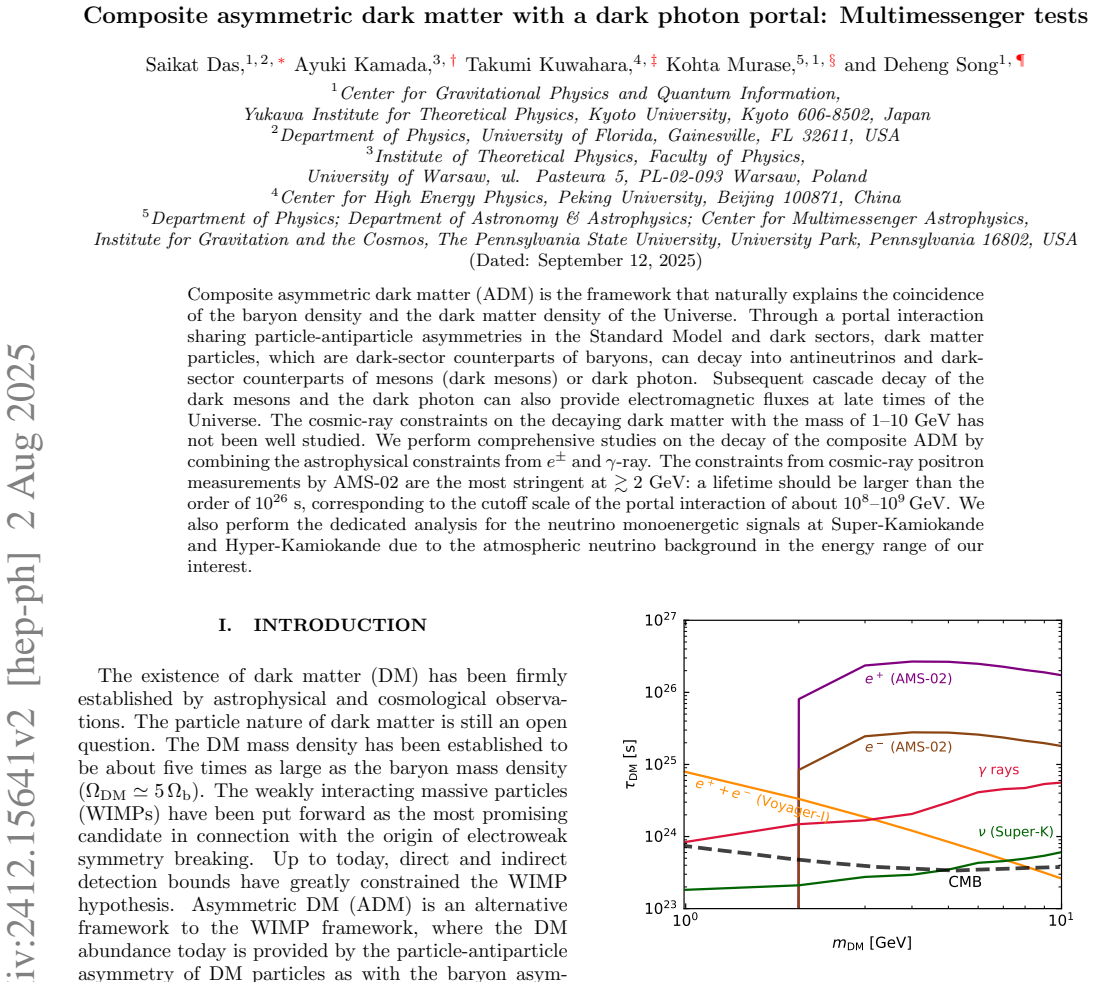
Pith's one-line read Composite asymmetric dark matter in the 1-10 GeV mass range must be extremely long-lived: AMS-02 positrons require a lifetime above about 10^26 seconds, while Super-K neutrino data require at least 10^23 seconds.
desk verdict Solid multimessenger analysis of 1–10 GeV composite ADM; the headline lifetime bound is conditional on a stated but unquantified two-body decay assumption that could shift the limits by an order of magnitude. read the letter →
The pith
A machine-rendered reading of the paper's core claim, the machinery that carries it, and where it could break.
The reading
What carries the argument
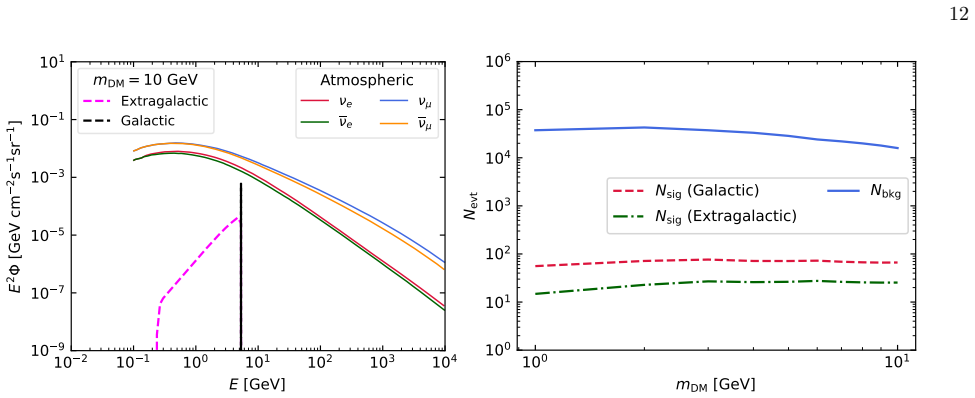
The engine of the calculation is the cascade-decay spectrum: the dark baryon n' decays through the portal operator into a neutral dark meson pi'0 plus an antineutrino; pi'0 then decays either into two on-shell dark photons when kinematically allowed, or into an off-shell dark photon plus an electron-positron pair, and each dark photon decays to e+e-(gamma) through kinetic mixing with the Standard Model photon. The primary spectra are built by boosting the rest-frame decay spectra using the final-state-radiation splitting function, with the branching fractions of dark baryons into neutral dark mesons fixed by Clebsch-Gordan coefficients, one-third in the minimal vector-like model. These spectra are then propagated with a standard cosmic-ray transport framework under four propagation scenarios, and the neutrino signal is analyzed with a three-bin chi-squared approach using Super-K effective areas and the atmospheric neutrino background.
What would settle it
A dedicated search for a monoenergetic neutrino line at an energy near half the dark matter mass in the 1-10 GeV range would settle the claim: if Super-K, Hyper-K, or DUNE sees a line flux corresponding to a lifetime below the limits claimed here, the central conclusion would be wrong. Equally decisive would be a lattice or chiral-effective-theory calculation showing that the three-body dark-baryon decay rate is comparable to the two-body rate, since that would invalidate the assumed spectra and require all limits to be recomputed.
Extended reading notes
Core claim
The paper claims that the decay of composite asymmetric dark matter in the 1-10 GeV mass window is already strongly bounded by existing cosmic-ray and neutrino observations, and that these bounds cannot be obtained by naive extrapolation from higher-mass dark matter searches. Modeling the full cascade chain, dark baryon to dark meson plus antineutrino, dark meson to dark photons (or to an off-shell dark photon plus electron-positron pair), and dark photon to e+e-(gamma), the authors compute the primary e±, gamma-ray, and neutrino spectra and compare them with positron, electron, gamma-ray, and neutrino data. The strongest limit comes from AMS-02 positrons at masses above about 2 GeV, requiring the dark matter lifetime to exceed about $10^{26}$ seconds, which translates into a portal cutoff scale of about $10^{8}$-$10^{9}$ GeV. The dedicated Super-K monoenergetic neutrino search yields tau_DM greater than about 2 x $10^{23}$ seconds at low masses and about 6 x $10^{23}$ seconds at 10 GeV. These results imply that in the viable parameter region the dark baryon must be very long-lived and the portal interaction that shares the asymmetry must be very weak.
Load-bearing premise
The entire spectral calculation rests on the assumption that dark baryons decay overwhelmingly through the two-body channels such as n' -> pi'0 + nu, with spin-one, multi-meson, and three-body final states negligible; the paper flags this in footnote 5, and if the neglected channels are comparable, the e±, gamma-ray, and neutrino spectra change and the derived lifetime limits shift.
Editorial extensions
If this is right
- AMS-02 positron data alone place the vector-like two-body model at tau_DM above about 3 x 10^27 seconds at 1 GeV and above about 10^26 seconds across most of the 2-10 GeV range, making positrons the current strongest probe.
- The neutrino line at roughly half the dark matter mass is robust and nearly model-independent, and Super-K already excludes lifetimes below about 2 x 10^23 seconds at low masses and about 6 x 10^23 seconds at 10 GeV.
- Hyper-Kamiokande will improve on Super-K only if the systematic uncertainty on the atmospheric neutrino background drops to roughly 10 percent or better energy resolution is achieved.
- Chiral composite ADM models are less constrained than vector-like models because their branching fractions into neutral dark mesons differ.
Reading between the lines
- If three-body dark-baryon decay channels are comparable to the two-body ones, as the paper notes can happen in GUT nucleon decay through final-state interactions, the monochromatic neutrino line would be smeared and the e± and gamma spectra softened, shifting the quoted lifetime limits; a dedicated calculation of the three-body branching fraction would settle how much.
- The same cascade-spectrum machinery could be applied to other portal-decay dark matter scenarios with GeV-scale masses, and the steep mass scaling of the lifetime means the bounds tighten quickly toward 10 GeV and relax toward 1 GeV.
- A full analysis of actual Super-K event data rather than the conservative effective-area and binning approach used here could strengthen the neutrino limits by a factor of a few.
Editorial analysis
A structured set of objections, weighed in public.
Referee Report
Summary. This paper studies decaying composite asymmetric dark matter (ADM) in the 1-10 GeV mass range, in both vector-like and chiral realizations with a dark photon portal. It computes analytic cascade spectra for dark baryon decay into a dark meson plus antineutrino, followed by two- or three-body dark meson decays into dark photons and e±/γ, and uses these spectra to derive 95% C.L. lifetime lower limits from AMS-02 e±, Voyager e±, Fermi/EGRET/COMPTEL/SMM γ-ray data, and a dedicated three-bin line search against atmospheric neutrino backgrounds for Super-K, with projections for Hyper-K. The headline result is that AMS-02 positrons provide the most stringent limit, τ_DM ≳ 10^26 s, corresponding to a portal cutoff of about 10^8-10^9 GeV, and that Super-K yields constraints around 2×10^23 s at low masses and 6×10^23 s at 10 GeV.
Significance. The paper fills a genuine gap: existing decaying-DM constraints at 1-10 GeV are not directly applicable to this scenario because the e± spectrum is softened by the cascade and the atmospheric neutrino background is large. The authors provide explicit analytic spectra for both two-body and three-body dark meson decays, use four cosmic-ray propagation scenarios, cross-check against CMB constraints, and give a concrete Hyper-K projection. The methods are transparent: Section III and Appendices A-C contain the spectrum derivations, decay-rate relations via Clebsch-Gordan coefficients, and an equivalence-theorem check for the chiral model, while the propagation uses the public GALPROP code. The derived limits are robust across propagation models for the higher end of the mass range, and the neutrino analysis is appropriately framed as conservative. If the two-body dominance assumption for dark baryon decay holds, the constraints are an important and nontrivial input to composite ADM model building.
major comments (2)
- [Section III, footnote 5; Eqs. (10)-(15)] The assumption that dark baryon decay is dominated by two-body channels n' → π' + ν (and analogous modes), with spin-one, multi-meson, and three-body channels negligible, is load-bearing for the entire spectrum computation. The paper itself notes in footnote 5 that in GUT nucleon decay three-body final states can be comparable via pion final-state interactions (Ref. [110]), and it defers investigation of such channels to future work. Because the monochromatic neutrino line used in the Super-K analysis (Section IV.D) and the e± injection spectrum behind the AMS-02 bound (Section IV.C) both assume precisely these initial two-body kinematics, the quoted lifetime limits in Figs. 6 and 9 are conditional on an unquantified model assumption. I request either a chiral-perturbation/final-state-interaction estimate of the three-body branching fraction in this specific model, or at least a sensitivity study showing how the τ_DM limits shift for a non-negligible three-body branching fraction (e.g., 10% and 50%). Without one of these, the caveat is not merely cosmetic but directly affects the central numerical claims.
- [Section IV.D, Figs. 8-9] The Super-K 'constraint' is not derived from observed event counts; it is a comparison of the predicted signal plus atmospheric background model to the HKKM model expectation, with the model used as pseudo-data. The text does state that this is intended as a conservative bound and encourages more sophisticated analyses with actual Super-K data, which is commendable. However, the abstract and figure captions present the result as a constraint from Super-K data, and the quantitative statements in the abstract ('Super-K neutrino data require...') are stronger than what the analysis actually supports. I recommend rewording the presentation to make explicit that these are expected limits from a Super-K-like background-model analysis, not limits extracted from the unbinned or event-level data set, and to state this qualification in the abstract and conclusions where the neutrino numbers are quoted.
minor comments (5)
- [Eq. (21)] The expression for ξ1:min is missing parentheses; as printed, the denominator is ambiguous. It should read ξ1:min = [1 + ϵ1^2 − 2ξ2 + ξ2^2]/(1 − ξ2).
- [Section IV.C and summary] For m_DM below about 2.4 GeV, the PD and DC propagation models produce no AMS-02 limits because the modulated flux falls below the lowest data point, as noted in the text. The summary statement that e± yield τ_DM ≳ 10^26 s 'for all ADM models' should therefore be qualified by the mass range and propagation-model dependence.
- [Section II.A, Eqs. (3)-(5)] The effective cutoff M_* in Eq. (5) is defined only collectively, and its relation to M and M' in Eq. (3) is not stated. A sentence or footnote explaining this connection would help readers follow the cutoff-scale interpretation of the main limit.
- [Fig. 4 caption] The caption uses '2mA/mπ = 0.4'; this should be '2mA′/mπ′' for consistency with the rest of the paper.
- [Section IV.D, Fig. 9 caption] The statement that both vector-like and chiral models lead to the same neutrino constraint is correct but should be explained at first use: the neutrino line flux is independent of the neutral-meson branching ratio because every dark baryon decay produces an antineutrino, whereas the e± and γ-ray fluxes do depend on that branching ratio.
Circularity Check
No significant circularity: the lifetime limits are derived by comparing independently propagated model spectra with external data, so no fitted input is renamed as a prediction.
full rationale
The paper's derivation chain is conditional rather than circular: it takes a pre-existing composite-ADM framework (Refs. [17,19,85]) as input, computes dark-baryon cascade-decay spectra using standard methods (Eqs. (10)-(27)), and derives lifetime lower limits by comparing the propagated Galactic/extragalactic fluxes with external data (AMS-02, Voyager-I, Fermi-LAT/EGRET/COMPTEL/SMM, and Super-K atmospheric-neutrino backgrounds). No parameter relevant to the target constraints is fitted to those constraints. The only fitted inputs are the cosmic-ray propagation parameters of Ref. [124], which are calibrated to other CR species and are explicitly stated not to fit the local e± data; the DM mass and dark-meson/dark-photon mass ratios are scanned as benchmark parameters rather than fitted. The self-citations (notably Ref. [17], with overlapping authorship) supply the model Lagrangian, gauge charges, and U(1)D assignments, but they do not contain the lifetime constraints, so the central claim does not reduce to them by construction. The explicit caveat in footnote 5, neglecting three-body dark-baryon decay channels such as n' -> pi' pi' nu, is a physical modeling assumption that could soften the quoted limits if relaxed; it is a correctness/robustness risk, not a circular step, because the limits are computed from that assumed spectrum and compared to data, not derived from data back into the assumption. Overall, the paper is self-contained against external benchmarks for its main multimessenger claims, and I find no equation or fitted parameter that is equivalent by definition to the claimed result.
Assumptions & free parameters
free parameters (4)
- Dark matter mass m_N' (m_DM) =
1-10 GeV (scanned)
- Dark meson to dark photon mass ratio 2 m_A'/m_pi' =
0.4 and 1.4
- Dark meson to dark baryon mass ratio m_pi'/m_N' =
0.1 (for 0.4) and 0.03 (for 1.4)
- Chiral reduced matrix element ratios A_Lambda(1):A_Lambda(2):A_Sigma(1):A_Sigma(2) =
1:1:1:1
assumptions (7)
- domain assumption Dark neutral mesons decay into two dark photons via the chiral anomaly in the dark sector.
- domain assumption Dark baryon decay is dominated by two-body channels into a single dark meson (or longitudinal dark photon) plus antineutrino; spin-one and multi-meson final states are negligible.
- domain assumption The dark photon decays promptly (lifetime smaller than O(1) s, kinetic mixing epsilon greater than 1e-10) and its mass lies in 20-200 MeV so only electron channels are open.
- domain assumption The cosmic-ray propagation models from Ref [124], which were not fit to local electron/positron data, are adequate for e+ and e- in the 1-10 GeV range.
- domain assumption The atmospheric neutrino background is described by the HKKM model (Ref [132]) with a 15% systematic uncertainty.
- domain assumption The extragalactic gamma-ray contribution from ADM decay is substantially lower than the Galactic component and can be neglected.
- standard math For the simplified boost formulas, the dark baryon is much heavier than the dark meson and dark photon (epsilon_2 much less than 1 and epsilon_tilde_1 much less than 1).
invented entities (4)
-
Dark baryons p', n' (vector-like) and Sigma', Lambda', Xi' (chiral)
-
Dark mesons pi'0, eta', K', pi'
-
Dark photon A'
-
Dark quarks U', D', S' and dark Higgs phi_D
Cite this review
Pith. "Pith review of Composite asymmetric dark matter with a dark photon portal: Multimessenger tests." pith.science (2026). https://pith.science/paper/P3RASCZD
@misc{pith2026241215641,
  author       = {Pith},
  title        = {Pith review of: Composite asymmetric dark matter with a dark photon portal: Multimessenger tests},
  year         = {2026},
  howpublished = {\url{https://pith.science/paper/P3RASCZD}},
  note         = {Machine review of arXiv:2412.15641}
}
abstract
Composite asymmetric dark matter (ADM) is the framework that naturally explains the coincidence of the baryon density and the dark matter density of the Universe. Through a portal interaction sharing particle-antiparticle asymmetries in the Standard Model and dark sectors, dark matter particles, which are dark-sector counterparts of baryons, can decay into antineutrinos and dark-sector counterparts of mesons (dark mesons) or dark photon. Subsequent cascade decay of the dark mesons and the dark photon can also provide electromagnetic fluxes at late times of the Universe. The cosmic-ray constraints on the decaying dark matter with the mass of $1$--$10$~GeV has not been well studied. We perform comprehensive studies on the decay of the composite ADM by combining the astrophysical constraints from $e^\pm$ and $\gamma$-ray. The constraints from cosmic-ray positron measurements by AMS-02 are the most stringent at $\gtrsim2$~GeV: a lifetime should be larger than the order of $10^{26}$~s, corresponding to the cutoff scale of the portal interaction of about $10^8 \text{--} 10^9 \, \mathrm{GeV}$. We also perform the dedicated analysis for the neutrino monoenergetic signals at Super-Kamiokande and Hyper-Kamiokande due to the atmospheric neutrino background in the energy range of our interest.
Figures


Figures from the paper (6 more)




Reference graph
Works this paper leans on
-
[110]
H. Ruegg and M. Ruiz-Altaba, Int. J. Mod. Phys. A 19, 3265 (2004), arXiv:hep-th/0304245
arXiv 2004
-
[1]
dark isospin
cosθ0 . (11) Here, x1 = 2 E1/mπ′, ϵ1 = 2 mA′/mπ′, and ˜ ϵ1 = 2mψ/mπ′ with E1 the energy of a particle ψ = e± , γ in the π′ rest frame. A prefactor two implies the multi- plicity of A′ in the π′ decay. The function f0 denotes the angular distribution of the A′ decay. For the transverse mode of the dark photon, we take f0(cos θ) = 3 8 (1 + cos2 θ) . (12) Th...
2015
-
[2]
The resulting energy spectrum in the ϕ1 rest frame is dNψ dx1 = Z 1 −1 d cos θ0 Z 1 ϵ0 dx0 dNψ dx0 × δ 2x1 − x0 − q (1 − ϵ2 1)(x2 0 − ˜ϵ2
As for isotropic decay of the scalar particle, the angular distribution is f0(θ0) = 1 /2, which is normalized as the integral over cos θ0 to be one. The resulting energy spectrum in the ϕ1 rest frame is dNψ dx1 = Z 1 −1 d cos θ0 Z 1 ϵ0 dx0 dNψ dx0 × δ 2x1 − x0 − q (1 − ϵ2 1)(x2 0 − ˜ϵ2
-
[3]
(B7) This is consistent with Ref
cosθ0 . (B7) This is consistent with Ref. [111]. Next, we consider cascade decay to be a three-body decay. We discuss the dark meson decay chain with the off-shell dark photon, which includes a pair of the SM fermions f ¯f in the final state. We assign each four- momentum as π′(q) → A′(p1) + f (p2) + ¯f (p3). We now compute the three-body phase space fact...
-
[4]
(C5) Here, the prefactor is from the CGCs
= 1√ 5 iM(1) . (C5) Here, the prefactor is from the CGCs. Comparing these with Eq. (C4), one finds iM(1) = 1 2 r 5 3 (x + y + x + y)u(k) ̸ p − ̸k fπ′ u(p) − 1 2 r 5 3 (x + y − x − y)u(k) ̸ p − ̸k fπ′ γ5u(p) . (C6) We can compute the decay Σ ′(p) → Σ′ 3(k) + π′(q) in the effective theory, and its decay amplitude corresponds to the second matrix element A(2...
-
[5]
Nussinov, Phys
S. Nussinov, Phys. Lett. 165B, 55 (1985)
1985
-
[6]
S. M. Barr, R. S. Chivukula, and E. Farhi, Phys. Lett. B241, 387 (1990)
1990
-
[7]
S. M. Barr, Phys. Rev. D44, 3062 (1991)
1991
Show all 148 references
-
[8]
D. B. Kaplan, Phys. Rev. Lett. 68, 741 (1992)
1992
-
[9]
Dodelson, B
S. Dodelson, B. R. Greene, and L. M. Widrow, Nucl. Phys. B372, 467 (1992)
1992
-
[10]
V. A. Kuzmin, Nonaccelerator new physics. Proceed- ings, 1st International Workshop, NANP’97, Dubna, Russia, July 7-11, 1997 , Phys. Part. Nucl. 29, 257 (1998), [Phys. Atom. Nucl.61,1107(1998)], arXiv:hep- ph/9701269 [hep-ph]
1998
-
[11]
Fujii and T
M. Fujii and T. Yanagida, Phys. Lett. B542, 80 (2002), arXiv:hep-ph/0206066 [hep-ph]
2002 arXiv
-
[12]
Kitano and I
R. Kitano and I. Low, Phys. Rev. D71, 023510 (2005), arXiv:hep-ph/0411133 [hep-ph]
2005 arXiv
-
[13]
G. R. Farrar and G. Zaharijas, Phys. Rev. Lett. 96, 041302 (2006), arXiv:hep-ph/0510079 [hep-ph]
2006 arXiv
-
[14]
S. B. Gudnason, C. Kouvaris, and F. Sannino, Phys. Rev. D73, 115003 (2006), arXiv:hep-ph/0603014 [hep- ph]
2006 arXiv
-
[15]
Kitano, H
R. Kitano, H. Murayama, and M. Ratz, Phys. Lett. B669, 145 (2008), arXiv:0807.4313 [hep-ph]
2008 arXiv
-
[16]
D. E. Kaplan, M. A. Luty, and K. M. Zurek, Phys. Rev. D79, 115016 (2009), arXiv:0901.4117 [hep-ph]
2009 arXiv
-
[17]
Davoudiasl and R
H. Davoudiasl and R. N. Mohapatra, New J. Phys. 14, 095011 (2012), arXiv:1203.1247 [hep-ph]
2012 arXiv
-
[18]
Petraki and R
K. Petraki and R. R. Volkas, Int. J. Mod. Phys. A28, 1330028 (2013), arXiv:1305.4939 [hep-ph]
2013 arXiv
-
[19]
K. M. Zurek, Phys. Rept. 537, 91 (2014), arXiv:1308.0338 [hep-ph]
2014 arXiv
-
[20]
T. R. Slatyer and C.-L. Wu, Phys. Rev. D 95, 023010 (2017), arXiv:1610.06933 [astro-ph.CO]
2017 arXiv
-
[21]
M. Ibe, A. Kamada, S. Kobayashi, and W. Nakano, JHEP 11, 203 (2018), arXiv:1805.06876 [hep-ph]
2018 arXiv
-
[22]
Fukugita and T
M. Fukugita and T. Yanagida, Phys. Lett. B 174, 45 (1986)
1986
-
[23]
Fukuda, S
H. Fukuda, S. Matsumoto, and S. Mukhopadhyay, Phys. Rev. D 92, 013008 (2015), arXiv:1411.4014 [hep- ph]
2015 arXiv
-
[24]
L. Covi, M. Grefe, A. Ibarra, and D. Tran, JCAP 04, 017 (2010), arXiv:0912.3521 [hep-ph]
2010 arXiv
-
[25]
Fukuda et al
Y. Fukuda et al. (Super-Kamiokande), Nucl. Instrum. Meth. A 501, 418 (2003)
2003
-
[26]
Abe et al., (2011), arXiv:1109.3262 [hep-ex]
K. Abe et al., (2011), arXiv:1109.3262 [hep-ex]
2011 arXiv
-
[27]
Malek et al
M. Malek et al. (Super-Kamiokande), Phys. Rev. Lett. 90, 061101 (2003), arXiv:hep-ex/0209028
2003 arXiv
-
[28]
J. F. Beacom, N. F. Bell, and G. D. Mack, Phys. Rev. Lett. 99, 231301 (2007), arXiv:astro-ph/0608090
2007 arXiv
-
[29]
Yuksel, S
H. Yuksel, S. Horiuchi, J. F. Beacom, and S. Ando, Phys. Rev. D 76, 123506 (2007), arXiv:0707.0196 [astro- ph]
2007 arXiv
-
[30]
Palomares-Ruiz and S
S. Palomares-Ruiz and S. Pascoli, Phys. Rev. D 77, 025025 (2008), arXiv:0710.5420 [astro-ph]
2008 arXiv
-
[31]
Aguilar et al
M. Aguilar et al. (AMS), Phys. Rev. Lett. 113, 121102 (2014)
2014
-
[32]
Graziani, in 25th European Cosmic Ray Symposium (2017) arXiv:1701.07305 [astro-ph.HE]
M. Graziani, in 25th European Cosmic Ray Symposium (2017) arXiv:1701.07305 [astro-ph.HE]
2017 arXiv
-
[33]
E. C. Stone, A. C. Cummings, F. B. McDonald, B. C. Heikkila, N. Lal, and W. R. Webber, Science 341, 1236408 (2013)
2013
-
[34]
A. C. Cummings, E. C. Stone, B. C. Heikkila, N. Lal, W. R. Webber, G. J´ ohannesson, I. V. Moskalenko, E. Orlando, and T. A. Porter, Astrophys. J. 831, 18 (2016)
2016
-
[35]
Ackermann et al
M. Ackermann et al. (Fermi-LAT), Astrophys. J. 799, 86 (2015), arXiv:1410.3696 [astro-ph.HE]
2015 arXiv
-
[36]
Sreekumar et al
P. Sreekumar et al. (EGRET), Astrophys. J. 494, 523 (1998), arXiv:astro-ph/9709257
1998 arXiv
-
[37]
A. W. Strong, I. V. Moskalenko, and O. Reimer, As- trophys. J. 613, 962 (2004), arXiv:astro-ph/0406254
2004 arXiv
-
[38]
Weidenspointner, M
G. Weidenspointner, M. Varendorff, S. C. Kappadath, K. Bennett, H. Bloemen, R. Diehl, W. Hermsen, G. G. Lichti, J. Ryan, and V. Sch¨ onfelder, inThe Fifth Comp- ton Symposium, American Institute of Physics Confer- ence Series, Vol. 510, edited by M. L. McConnell and J. M. Ryan...
2000
-
[39]
Watanabe, M
K. Watanabe, M. D. Leising, G. H. Share, and R. L. Kinzer, in The Fifth Compton Symposium, American Institute of Physics Conference Series, Vol. 510, edited by M. L. McConnell and J. M. Ryan (AIP, 2000) pp. 471–475. 19
2000
-
[40]
Boudaud, J
M. Boudaud, J. Lavalle, and P. Salati, Phys. Rev. Lett. 119, 021103 (2017), arXiv:1612.07698 [astro-ph.HE]
2017 arXiv
-
[41]
Essig, E
R. Essig, E. Kuflik, S. D. McDermott, T. Volansky, and K. M. Zurek, JHEP 11, 193 (2013), arXiv:1309.4091 [hep-ph]
2013 arXiv
-
[42]
S. B. Gudnason, C. Kouvaris, and F. Sannino, Phys. Rev. D74, 095008 (2006), arXiv:hep-ph/0608055 [hep- ph]
2006 arXiv
-
[43]
D. D. Dietrich and F. Sannino, Phys. Rev. D75, 085018 (2007), arXiv:hep-ph/0611341 [hep-ph]
2007 arXiv
-
[44]
M. Yu. Khlopov and C. Kouvaris, Phys. Rev. D77, 065002 (2008), arXiv:0710.2189 [astro-ph]
2008 arXiv
-
[45]
M. Yu. Khlopov and C. Kouvaris, Phys. Rev. D78, 065040 (2008), arXiv:0806.1191 [astro-ph]
2008 arXiv
-
[46]
Foadi, M
R. Foadi, M. T. Frandsen, and F. Sannino, Phys. Rev. D80, 037702 (2009), arXiv:0812.3406 [hep-ph]
2009 arXiv
-
[47]
Mardon, Y
J. Mardon, Y. Nomura, and J. Thaler, Phys. Rev. D80, 035013 (2009), arXiv:0905.3749 [hep-ph]
2009 arXiv
-
[48]
G. D. Kribs, T. S. Roy, J. Terning, and K. M. Zurek, Phys. Rev. D81, 095001 (2010), arXiv:0909.2034 [hep- ph]
2010 arXiv
-
[49]
Barbieri, S
R. Barbieri, S. Rychkov, and R. Torre, Phys. Lett. B688, 212 (2010), arXiv:1001.3149 [hep-ph]
2010 arXiv
-
[50]
Blennow, B
M. Blennow, B. Dasgupta, E. Fernandez-Martinez, and N. Rius, JHEP 03, 014 (2011), arXiv:1009.3159 [hep- ph]
2011 arXiv
-
[51]
Lewis, C
R. Lewis, C. Pica, and F. Sannino, Phys. Rev. D85, 014504 (2012), arXiv:1109.3513 [hep-ph]
2012 arXiv
-
[52]
Appelquist et al
T. Appelquist et al. (Lattice Strong Dynamics (LSD)), Phys. Rev. D88, 014502 (2013), arXiv:1301.1693 [hep- ph]
2013 arXiv
-
[53]
Hietanen, R
A. Hietanen, R. Lewis, C. Pica, and F. Sannino, JHEP 12, 130 (2014), arXiv:1308.4130 [hep-ph]
2014 arXiv
-
[54]
J. M. Cline, Z. Liu, G. Moore, and W. Xue, Phys. Rev. D90, 015023 (2014), arXiv:1312.3325 [hep-ph]
2014 arXiv
-
[55]
Appelquist et al
T. Appelquist et al. (Lattice Strong Dynamics (LSD)), Phys. Rev. D89, 094508 (2014), arXiv:1402.6656 [hep- lat]
2014 arXiv
-
[56]
Hietanen, R
A. Hietanen, R. Lewis, C. Pica, and F. Sannino, JHEP 07, 116 (2014), arXiv:1404.2794 [hep-lat]
2014 arXiv
-
[57]
Krnjaic and K
G. Krnjaic and K. Sigurdson, Phys. Lett. B751, 464 (2015), arXiv:1406.1171 [hep-ph]
2015 arXiv
-
[58]
Detmold, M
W. Detmold, M. McCullough, and A. Pochinsky, Phys. Rev. D90, 115013 (2014), arXiv:1406.2276 [hep-ph]
2014 arXiv
-
[59]
Detmold, M
W. Detmold, M. McCullough, and A. Pochinsky, Phys. Rev. D90, 114506 (2014), arXiv:1406.4116 [hep-lat]
2014 arXiv
- [60]
-
[61]
J. Brod, J. Drobnak, A. L. Kagan, E. Stamou, and J. Zupan, Phys. Rev. D91, 095009 (2015), arXiv:1407.8188 [hep-ph]
2015 arXiv
-
[62]
Antipin, M
O. Antipin, M. Redi, and A. Strumia, JHEP 01, 157 (2015), arXiv:1410.1817 [hep-ph]
2015 arXiv
-
[63]
Hardy, R
E. Hardy, R. Lasenby, J. March-Russell, and S. M. West, JHEP 06, 011 (2015), arXiv:1411.3739 [hep-ph]
2015 arXiv
-
[64]
Appelquist et al
T. Appelquist et al. (Lattice Strong Dynamics (LSD)), Phys. Rev. D92, 075030 (2015), arXiv:1503.04203 [hep- ph]
2015 arXiv
-
[65]
Appelquist et al
T. Appelquist et al. (Lattice Strong Dynamics (LSD)), Phys. Rev. Lett. 115, 171803 (2015), arXiv:1503.04205 [hep-ph]
2015 arXiv
-
[66]
Antipin, M
O. Antipin, M. Redi, A. Strumia, and E. Vigiani, JHEP 07, 039 (2015), arXiv:1503.08749 [hep-ph]
2015 arXiv
-
[67]
Hardy, R
E. Hardy, R. Lasenby, J. March-Russell, and S. M. West, JHEP 07, 133 (2015), arXiv:1504.05419 [hep-ph]
2015 arXiv
-
[68]
R. T. Co, K. Harigaya, and Y. Nomura, Phys. Rev. Lett. 118, 101801 (2017), arXiv:1610.03848 [hep-ph]
2017 arXiv
-
[69]
K. R. Dienes, F. Huang, S. Su, and B. Thomas, Phys. Rev. D95, 043526 (2017), arXiv:1610.04112 [hep-ph]
2017 arXiv
-
[70]
Ishida, S
H. Ishida, S. Matsuzaki, and Y. Yamaguchi, PTEP 2017, 103B01 (2017), arXiv:1610.07137 [hep-ph]
2017 arXiv
-
[71]
S. J. Lonsdale, M. Schroor, and R. R. Volkas, Phys. Rev. D96, 055027 (2017), arXiv:1704.05213 [hep-ph]
2017 arXiv
-
[72]
J. M. Berryman, A. de Gouvˆ ea, K. J. Kelly, and Y. Zhang, Phys. Rev. D96, 075010 (2017), arXiv:1706.02722 [hep-ph]
2017 arXiv
-
[73]
M. I. Gresham, H. K. Lou, and K. M. Zurek, Phys. Rev. D96, 096012 (2017), arXiv:1707.02313 [hep-ph]
2017 arXiv
-
[74]
M. I. Gresham, H. K. Lou, and K. M. Zurek, Phys. Rev. D97, 036003 (2018), arXiv:1707.02316 [hep-ph]
2018 arXiv
-
[75]
Mitridate, M
A. Mitridate, M. Redi, J. Smirnov, and A. Strumia, JHEP 10, 210 (2017), arXiv:1707.05380 [hep-ph]
2017 arXiv
-
[76]
M. I. Gresham, H. K. Lou, and K. M. Zurek, Phys. Rev. D98, 096001 (2018), arXiv:1805.04512 [hep-ph]
2018 arXiv
-
[77]
Braaten, D
E. Braaten, D. Kang, and R. Laha, JHEP 11, 084 (2018), arXiv:1806.00609 [hep-ph]
2018 arXiv
-
[78]
Francis, R
A. Francis, R. J. Hudspith, R. Lewis, and S. Tulin, (2018), arXiv:1809.09117 [hep-ph]
2018 arXiv
-
[79]
Y. Bai, A. J. Long, and S. Lu, Phys. Rev. D 99, 055047 (2019), arXiv:1810.04360 [hep-ph]
2019 arXiv
- [80]
-
[81]
X. Chu, C. Garcia-Cely, and H. Murayama, Phys. Rev. Lett. 124, 041101 (2020), arXiv:1901.00075 [hep-ph]
2020 arXiv
-
[82]
Mahbubani, M
R. Mahbubani, M. Redi, and A. Tesi, Phys. Rev. D 101, 103037 (2020), arXiv:1908.00538 [hep-ph]
2020 arXiv
-
[83]
E. Hall, T. Konstandin, R. McGehee, and H. Mu- rayama, (2019), arXiv:1911.12342 [hep-ph]
2019 arXiv
-
[84]
Y.-D. Tsai, R. McGehee, and H. Murayama, Phys. Rev. Lett. 128, 172001 (2022), arXiv:2008.08608 [hep-ph]
2022 arXiv
-
[85]
Asadi, E
P. Asadi, E. D. Kramer, E. Kuflik, G. W. Ridgway, T. R. Slatyer, and J. Smirnov, Phys. Rev. Lett. 127, 211101 (2021), arXiv:2103.09822 [hep-ph]
2021 arXiv
-
[86]
Asadi, E
P. Asadi, E. D. Kramer, E. Kuflik, G. W. Ridgway, T. R. Slatyer, and J. Smirnov, Phys. Rev. D 104, 095013 (2021), arXiv:2103.09827 [hep-ph]
2021 arXiv
- [87]
-
[88]
Bottaro, M
S. Bottaro, M. Costa, and O. Popov, JHEP 11, 055 (2021), arXiv:2104.14244 [hep-ph]
2021 arXiv
-
[89]
M. Ibe, S. Kobayashi, and K. Watanabe, JHEP 07, 220 (2021), arXiv:2105.07642 [hep-ph]
2021 arXiv
-
[90]
E. Hall, R. McGehee, H. Murayama, and B. Suter, Phys. Rev. D 106, 075008 (2022), arXiv:2107.03398 [hep-ph]
2022 arXiv
-
[91]
Asadi, E
P. Asadi, E. D. Kramer, E. Kuflik, T. R. Slatyer, and J. Smirnov, JHEP 07, 006 (2022), arXiv:2203.15813 [hep-ph]
2022 arXiv
-
[92]
Aprile et al
E. Aprile et al. (XENON), JCAP 11, 031 (2020), arXiv:2007.08796 [physics.ins-det]
2020 arXiv
-
[93]
Aprile et al.(XENON), Phys
E. Aprile et al.(XENON), Phys. Rev. Lett. 129, 161805 (2022), arXiv:2207.11330 [hep-ex]
2022 arXiv
-
[94]
Aprile et al.(XENON), Phys
E. Aprile et al.(XENON), Phys. Rev. Lett. 131, 041003 (2023), arXiv:2303.14729 [hep-ex]
2023 arXiv
-
[95]
Aalbers et al
J. Aalbers et al. (LZ), Phys. Rev. Lett. 131, 041002 (2023), arXiv:2207.03764 [hep-ex]
2023 arXiv
-
[96]
Meng et al
Y. Meng et al. (PandaX-4T), Phys. Rev. Lett. 127, 261802 (2021), arXiv:2107.13438 [hep-ex]. 20
2021 arXiv
- [97]
-
[98]
Kamada, H
A. Kamada, H. J. Kim, and T. Kuwahara, JHEP 12, 202 (2020), arXiv:2007.15522 [hep-ph]
2020 arXiv
-
[99]
A. H. Abdelhameed et al.(CRESST), Phys. Rev. D100, 102002 (2019), arXiv:1904.00498 [astro-ph.CO]
2019 arXiv
-
[100]
Agnese et al
R. Agnese et al. (SuperCDMS), Phys. Rev. D 99, 062001 (2019), arXiv:1808.09098 [astro-ph.CO]
2019 arXiv
-
[101]
Agnes et al.(DarkSide-50), Phys
P. Agnes et al.(DarkSide-50), Phys. Rev. D107, 063001 (2023), arXiv:2207.11966 [hep-ex]
2023
-
[102]
Agnes et al.(Global Argon Dark Matter), Phys
P. Agnes et al.(Global Argon Dark Matter), Phys. Rev. D 107, 112006 (2023), arXiv:2209.01177 [physics.ins- det]
2023 arXiv
-
[103]
Aprile et al.(XENON), Phys
E. Aprile et al.(XENON), Phys. Rev. Lett. 123, 241803 (2019), arXiv:1907.12771 [hep-ex]
2019 arXiv
-
[104]
Agnes et al.(DarkSide), Phys
P. Agnes et al.(DarkSide), Phys. Rev. Lett.130, 101001 (2023), arXiv:2207.11967 [hep-ex]
2023
-
[105]
G. F. Giudice, A. Notari, M. Raidal, A. Riotto, and A. Strumia, Nucl. Phys. B 685, 89 (2004), arXiv:hep- ph/0310123
2004
-
[106]
Buchmuller, R
W. Buchmuller, R. D. Peccei, and T. Yanagida, Ann. Rev. Nucl. Part. Sci. 55, 311 (2005), arXiv:hep- ph/0502169
2005
-
[107]
Davidson, E
S. Davidson, E. Nardi, and Y. Nir, Phys. Rept. 466, 105 (2008), arXiv:0802.2962 [hep-ph]
2008 arXiv
-
[108]
Y. Aoki, E. Shintani, and A. Soni, Phys. Rev. D 89, 014505 (2014), arXiv:1304.7424 [hep-lat]
2014 arXiv
-
[109]
E. C. G. Stueckelberg, Helv. Phys. Acta 11, 225 (1938)
1938
- [111]
-
[112]
Feldman, Z
D. Feldman, Z. Liu, and P. Nath, Phys. Rev. D 75, 115001 (2007), arXiv:hep-ph/0702123
2007 arXiv
-
[113]
Harigaya and Y
K. Harigaya and Y. Nomura, Phys. Rev. D 94, 035013 (2016), arXiv:1603.03430 [hep-ph]
2016 arXiv
-
[114]
M. B. Wise, R. Blankenbecler, and L. F. Abbott, Phys. Rev. D 23, 1591 (1981)
1981
-
[115]
Mardon, Y
J. Mardon, Y. Nomura, D. Stolarski, and J. Thaler, JCAP 05, 016 (2009), arXiv:0901.2926 [hep-ph]
2009 arXiv
-
[116]
M. Ibe, S. Kobayashi, Y. Nakayama, and S. Shirai, JHEP 04, 009 (2020), arXiv:1912.12152 [hep-ph]
2020 arXiv
-
[117]
J. F. Navarro, C. S. Frenk, and S. D. M. White, Astro- phys. J. 490, 493 (1997), arXiv:astro-ph/9611107
1997 arXiv
-
[118]
J. F. Navarro, E. Hayashi, C. Power, A. Jenkins, C. S. Frenk, S. D. M. White, V. Springel, J. Stadel, and T. R. Quinn, Mon. Not. Roy. Astron. Soc. 349, 1039 (2004), arXiv:astro-ph/0311231
2004 arXiv
-
[119]
Salucci, F
P. Salucci, F. Nesti, G. Gentile, and C. F. Martins, Astron. Astrophys. 523, A83 (2010), arXiv:1003.3101 [astro-ph.GA]
2010 arXiv
- [120]
-
[121]
Aghanim et al.(Planck), Astron
N. Aghanim et al.(Planck), Astron. Astrophys. 641, A6 (2020), [Erratum: Astron.Astrophys. 652, C4 (2021)], arXiv:1807.06209 [astro-ph.CO]
2020 arXiv
-
[122]
I. V. Moskalenko and A. W. Strong, Astrophys. J. 493, 694 (1998), arXiv:astro-ph/9710124
1998 arXiv
-
[123]
A. W. Strong and I. V. Moskalenko, Astrophys. J. 509, 212 (1998), arXiv:astro-ph/9807150
1998 arXiv
-
[124]
T. A. Porter, G. Johannesson, and I. V. Moskalenko, Astrophys. J. Supp. 262, 30 (2022), arXiv:2112.12745 [astro-ph.HE]
2022 arXiv
-
[125]
T. A. Porter, G. Johannesson, and I. V. Moskalenko, Astrophys. J. 846, 67 (2017), arXiv:1708.00816 [astro- ph.HE]
2017 arXiv
-
[126]
J´ ohannesson, T
G. J´ ohannesson, T. A. Porter, and I. V. Moskalenko, Astrophys. J. 856, 45 (2018), arXiv:1802.08646 [astro- ph.HE]
2018 arXiv
-
[127]
Johannesson, T
G. Johannesson, T. A. Porter, and I. V. Moskalenko, Astrophys. J. 879, 91 (2019), arXiv:1903.05509 [astro- ph.HE]
2019 arXiv
-
[128]
Silver and E
E. Silver and E. Orlando, Astrophys. J. 963, 111 (2024), arXiv:2401.06242 [astro-ph.HE]
2024 arXiv
-
[129]
L. J. Gleeson and W. I. Axford, Astrophys. J. 154, 1011 (1968)
1968
-
[130]
D. Song, O. Macias, and S. Horiuchi, Phys. Rev. D 99, 123020 (2019), arXiv:1901.07025 [astro-ph.HE]
2019 arXiv
-
[131]
Macias, H
O. Macias, H. van Leijen, D. Song, S. Ando, S. Horiuchi, and R. M. Crocker, Mon. Not. Roy. Astron. Soc. 506, 1741 (2021), arXiv:2102.05648 [astro-ph.HE]
2021 arXiv
-
[132]
A. E. Egorov, Phys. Rev. D 106, 023023 (2022), arXiv:2205.01033 [astro-ph.CO]
2022 arXiv
-
[133]
A. A. Abdo et al. (Fermi-LAT), JCAP 04, 014 (2010), arXiv:1002.4415 [astro-ph.CO]
2010 arXiv
-
[134]
Li et al
Z. Li et al. (Super-Kamiokande), Phys. Rev. D 98, 052006 (2018), arXiv:1711.09436 [hep-ex]
2018 arXiv
-
[135]
Richard et al.(Super-Kamiokande), Phys
E. Richard et al.(Super-Kamiokande), Phys. Rev. D94, 052001 (2016), arXiv:1510.08127 [hep-ex]
2016 arXiv
-
[136]
Honda, M
M. Honda, M. Sajjad Athar, T. Kajita, K. Kasahara, and S. Midorikawa, Phys. Rev. D 92, 023004 (2015), arXiv:1502.03916 [astro-ph.HE]
2015 arXiv
-
[137]
Abe et al
K. Abe et al. (Super-Kamiokande), Astrophys. J. 918, 78 (2021), arXiv:2104.09196 [astro-ph.HE]
2021
-
[138]
Honda, T
M. Honda, T. Kajita, K. Kasahara, and S. Mi- dorikawa, Phys. Rev. D 70, 043008 (2004), arXiv:astro- ph/0404457
2004
-
[139]
Honda, T
M. Honda, T. Kajita, K. Kasahara, S. Midorikawa, and T. Sanuki, Phys. Rev. D75, 043006 (2007), arXiv:astro- ph/0611418
2007
-
[140]
Honda, T
M. Honda, T. Kajita, K. Kasahara, and S. Midorikawa, Phys. Rev. D 83, 123001 (2011), arXiv:1102.2688 [astro- ph.HE]
2011 arXiv
-
[141]
Esteban, M
I. Esteban, M. C. Gonzalez-Garcia, M. Maltoni, T. Schwetz, and A. Zhou, Journal of High Energy Physics 2020, 178 (2020), arXiv:2007.14792 [hep-ph]
2020 arXiv
-
[142]
G. D. Barr, T. K. Gaisser, S. Robbins, and T. Stanev, Phys. Rev. D 74, 094009 (2006), arXiv:astro- ph/0611266
2006
-
[143]
Evans, D
J. Evans, D. G. Gamez, S. D. Porzio, S. S¨ oldner- Rembold, and S. Wren, Phys. Rev. D 95, 023012 (2017), arXiv:1612.03219 [astro-ph.HE]
2017 arXiv
-
[144]
Friedland and S
A. Friedland and S. W. Li, Phys. Rev. D 99, 036009 (2019), arXiv:1811.06159 [hep-ph]
2019 arXiv
-
[145]
M. G. Aartsen et al. (IceCube-Gen2), J. Phys. G 48, 060501 (2021), arXiv:2008.04323 [astro-ph.HE]
2021
-
[146]
L. S. Miranda, S. Basegmez du Pree, K. C. Y. Ng, A. Cheek, and C. Arina, JCAP 08, 006 (2023), arXiv:2211.12235 [hep-ph]
2023 arXiv
-
[147]
P. S. J. McNamee and F. Chilton, Rev. Mod. Phys. 36, 1005 (1964)
1964
-
[148]
G. Elor, N. L. Rodd, and T. R. Slatyer, Phys. Rev. D 91, 103531 (2015), arXiv:1503.01773 [hep-ph]
2015 arXiv
Reviewed August 11, 2026 · model on record in the stance chip above.
Discussion (0). Continue with ORCID to comment.