REVIEW 4 major objections 5 minor 55 references
Prompt-based Unifying Inference Attack on Graph Neural Networks
T0 review · 4 major / 5 minor · reviewed 2026-08-11 · deepseek-v4-flash
Pith's one-line read A single prompt-based framework, ProIA, is claimed to strengthen both membership and attribute inference attacks on graph neural networks by making the prompt part of training.
desk verdict The central claim is undermined by a broken threat model: the attacker trains the target model with its own prompt, so the reported gains are manufactured rather than extracted from a fixed victim. read the letter →
The pith
A machine-rendered reading of the paper's core claim, the machinery that carries it, and where it could break.
The reading
What carries the argument
The load-bearing mechanism is the trainable graph prompt $p$ injected into target and shadow model training, together with the information-bottleneck pre-training that shapes it. The pre-training objective combines contrastive learning on local and global subgraphs with a graph information bottleneck loss that keeps topology-related content while discarding irrelevant noise, so the prompt carries structural knowledge and appears as a benign query. The disentanglement module in the attack model then splits each prompt feature into $k$ virtual channels and iteratively re-weights node contributions within each channel, producing latent factors that guide the attack classifier through a KL-constrained objective.
What would settle it
Train the target model normally, without the prompt $p$ in its training; query it with ProIA's prompts and run the same attack model. If membership and attribute inference accuracy falls back to the vanilla baseline, the attack's gains depend on training-time control and do not transfer to a fixed victim model.
Extended reading notes
Core claim
The central claim is that a prompt should be treated not just as a query but as a training-time instrument. ProIA builds prompt features $p$ from a pre-trained encoder, then explicitly trains the target model $F_T$ (and the shadow model $F_S$ for membership attacks) using those prompts via $h_{\text{query}} = \text{READOUT}\{p \odot h\}$, which the authors say increases the target's overfitting and obfuscates the target's training process. The prompted posteriors are then fed into an attack model whose disentanglement module maps them into $k$ virtual channels, re-weights neighbors within each channel, and uses a KL-constrained loss to isolate latent factors relevant to the downstream attack. The paper reports that this unified recipe improves attribute and membership inference over vanilla baselines on Cora, Facebook, Lastfm, Bail, and Pokec-n, and that it disrupts the Vandp, Neighb, and PPGL defenses.
Load-bearing premise
The load-bearing premise is that the attacker can train the target and shadow models with the attacker-designed prompt, so the reported attack success relies on the attacker shaping the victim's training rather than only querying a fixed victim.
Editorial extensions
If this is right
- The same framework can drive both attribute and membership inference attacks, so an adversary no longer needs a separate attack module for each supervision signal.
- Membership inference succeeds even when the target is a strong, regularized model, because ProIA deliberately widens the training-test gap rather than relying on the target's natural overfitting.
- Output noise, neighborhood perturbation, and sensitive-attribute separation defenses lose part of their protection; the paper reports AUC-ROC gains of up to 18.7% on defended models.
- Topology retained during pre-training provides an attack signal beyond what label fitting alone offers, which helps attribute inference on sparse graphs such as Pokec-n.
Reading between the lines
- I infer that the reported gains depend on the attacker training the victim with the prompt: the case study says ProIA increases the target's overfitting, which would not occur when querying a fixed, already-trained victim, so testing against a frozen target is the natural check.
- I infer that the same prompting idea could apply to graph-level inference attacks, since the disentanglement module operates on readout features and does not rely on node-level supervision, though the paper does not test this.
- I infer that a defense that detects or strips anomalous readout patterns before they reach the model, or that refuses to train with user-supplied prompts, could close this attack vector without degrading normal tasks; the paper does not evaluate such adaptive defenses.
Signed reviews
Editorial analysis
A structured set of objections, weighed in public.
Referee Report
Summary. The paper proposes ProIA, a prompt-based unifying inference attack framework for graph neural networks. ProIA consists of a pre-training stage that combines an information bottleneck objective with global-local contrastive learning, an attack data generation stage that uses prompt features to query target and shadow models, and a disentanglement module for downstream attribute and membership inference attacks. Experiments on five datasets and against several defenses are reported as evidence that ProIA improves attack accuracy and weakens existing defenses.
Significance. If the threat model were valid, the idea of unifying attribute and membership inference attacks under a single prompt framework would be a useful contribution to the graph privacy literature. The paper also provides an information-theoretic formulation and a public code link, which are positive elements. However, the central claim is not supported as stated because the adversary is assumed to train the target model itself, which turns the inference attack into a training-time manipulation. The reported gains are therefore not evidence of private information extraction from an independently trained victim model.
major comments (4)
- [Algorithm 1 (line 15)] Algorithm 1 line 15 states 'Train FT and FS with p using Eq. (3)'. This means the adversary trains the target model FT (and shadow model FS) with the attacker-designed prompt p. In the standard inference attack setting (Shokri et al. 2017; Olatunji et al. 2021) the target model is a fixed victim model that the adversary only queries. Under the paper's setup, the leaked information is introduced during training rather than extracted from a fixed model, so the reported attack improvements (e.g., +18.54% on Lastfm/SAGE in Section 5.2) are partly manufactured by the attacker's own training choices. The paper must either adopt and clearly state a training-time threat model (e.g., adversarial pre-training or poisoning) or re-evaluate on a fixed target model.
- [Section 5.2 (Case study)] The case study states that ProIA 'obfuscates the target's training process and increases the target's overfitting.' Since membership inference classically relies on target overfitting, deliberately increasing overfitting is equivalent to making the attack easier by construction. This undermines the comparison against Vanilla and the claim of 'disrupting' defenses; the experiment needs to control for target model capacity, regularization, or training epochs, or be repositioned as a poisoning/capacity-manipulation attack.
- [Tables 1 and Figure 3] All results are reported as single runs without error bars or significance tests. For an attack method whose reported gains are often a few percent (e.g., Table 1, Facebook GAT F1 = 60.72 vs. Vanilla 55.17), the absence of variance estimates makes it impossible to assess whether the improvements are statistically meaningful. Please report the mean and standard deviation over multiple random seeds, or at least provide the seeds and code to reproduce the exact runs.
- [Section 3.3 and Equation (3)] The prompt mechanism is not clearly defined. Equation (3) defines a graph-prompt readout for downstream task adaptation, but it is not explained how p is used as an attack query to FT in Algorithm 1, nor how the 'obfuscation' of malicious intent is achieved. The notation hquery = READ OUT{p ⊙ h} suggests element-wise multiplication with node embeddings, which is not obviously a prompt query in the NLP sense referenced in Section 2.2. Please clarify the query construction and why it is inconspicuous to the target.
minor comments (5)
- [Section 4.2] The Jaccard threshold description uses 'u and v' after defining nodes i and j; the notation is inconsistent.
- [Algorithm 1] Algorithm 1 Input and Parameter lists contain errors: 'Non-linear rectifier τ' and 'Activation function YC' are misleading (YC is the label set), and the parameter list repeats 't' and uses 'βA.βM ' with a period instead of a comma.
- [Section 5.1] Section 5.1 writes 'Neigbh' and 'Vandp' inconsistently; the defense names should be consistent throughout (e.g., 'Neighb' and 'VanDP').
- [Table 1] Table 1: the variants 'ProIAp' and 'ProIAd' are not defined before being used in the table; the ablation definitions appear only in Section 5.2.
- [Equation (16)] Equation (16) has a formatting issue in the normalization term; please ensure the equation renders correctly and define all variables (e.g., MLP, W_k, b_k) at first use.
Circularity Check
ProIA's reported inference-attack gains reduce to the attacker-controlled training setup: Algorithm 1 line 15 trains the target model FT with the attacker-chosen prompt p, and the case study admits this 'increases the target's overfitting'—the exact defect MIA exploits.
-
self definitional
[Appendix A, Algorithm 1, line 15]
"Train FT and FS with p using Eq. (3);"
Section 3.2 defines the inference attack as one where the adversary constructs prompts p and queries a target model FT, treating FT as the victim whose private training data is to be inferred. Algorithm 1 line 15 instead has the adversary train FT (and the shadow model FS) using the attacker-designed p. The target model is therefore not a fixed, independently trained victim; its behavior under p is a direct product of the attacker's own training objective. Any leakage or membership signal in FT's outputs is manufactured by the attack setup, not extracted from a model trained by someone else. The central claim of enhancing inference attacks is thus self-defined by the training procedure it prescribes.
-
fitted input called prediction
[Section 5.2, Case study and Fig. 4]
"This indicates that ProIA obfuscates the target's training process and increases the target's overfitting."
Section 3.2 states that MIA 'typically relies on the assumption that FT overfits to achieve the attack.' The case study explicitly says ProIA deliberately increases the target's overfitting. Consequently, the improved MIA accuracy reported in Table 1 and Fig. 3 is obtained by manufacturing the exact condition on which MIA success depends, rather than by demonstrating inference capability against a fixed target whose training the adversary does not control. The reported attack 'prediction' is forced by the attacker's training choices, not discovered from an independently trained model. This is a fitted input—induced overfitting—being presented as a general attack enhancement.
full rationale
The paper's headline experimental claim depends on training the target model with the attacker-designed prompt. Section 3.2 establishes the standard inference-attack setting: the adversary constructs prompts p and queries a target model FT to extract private information. Algorithm 1 line 15, however, instructs the adversary to 'Train FT and FS with p using Eq. (3).' This collapses the distinction between the attacked model and the attacker's own training procedure. The target's responses are not those of a fixed victim; they are the result of the adversary's chosen training objective. The case study confirms this by stating that ProIA 'obfuscates the target's training process and increases the target's overfitting,' and the paper itself notes that MIA typically relies on target overfitting. Thus the reported gains (up to 18.54% on Lastfm/SAGE) are consequences of the attacker's control over target training, not evidence of a unified query-time inference attack against fixed models. If the intended scenario is training-time poisoning or adversarial pre-training, that is a different threat model and must be explicitly stated and evaluated as such; under the standard fixed-target threat model the central claim is not demonstrated. No load-bearing self-citation or imported uniqueness theorem was found; the circularity is in the threat-model setup itself.
Assumptions & free parameters
free parameters (7)
- Jaccard threshold t
- Lagrangian parameters beta_A, beta_M
- Pre-training trade-off alpha
- Number of virtual channels k =
dataset-dependent (tuned per dataset)
- Temperature tau
- Iteration count t in disentanglement
- KL penalty lambda
assumptions (4)
- ad hoc to paper The adversary controls pre-training and fine-tuning of the target model and shadow model with the attacker-designed prompt p.
- domain assumption A local subgraph is assumed independent of the rest of the graph so the information bottleneck can be optimized via a Markov chain.
- standard math Variational bounds on mutual information (Propositions 1 and 2) are valid and sufficient to optimize Eq. (4).
- domain assumption The shadow model FS mimics the target model's behavior, a standard membership inference assumption.
Cite this review
Pith. "Pith review of Prompt-based Unifying Inference Attack on Graph Neural Networks." pith.science (2026). https://pith.science/paper/JTWPOAXJ
@misc{pith2026241215735,
  author       = {Pith},
  title        = {Pith review of: Prompt-based Unifying Inference Attack on Graph Neural Networks},
  year         = {2026},
  howpublished = {\url{https://pith.science/paper/JTWPOAXJ}},
  note         = {Machine review of arXiv:2412.15735}
}
read the original abstract
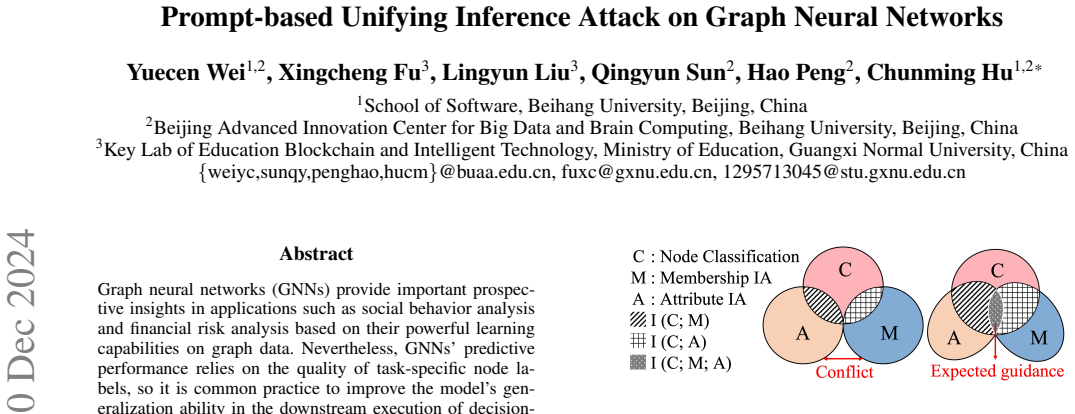
Graph neural networks (GNNs) provide important prospective insights in applications such as social behavior analysis and financial risk analysis based on their powerful learning capabilities on graph data. Nevertheless, GNNs' predictive performance relies on the quality of task-specific node labels, so it is common practice to improve the model's generalization ability in the downstream execution of decision-making tasks through pre-training. Graph prompting is a prudent choice but risky without taking measures to prevent data leakage. In other words, in high-risk decision scenarios, prompt learning can infer private information by accessing model parameters trained on private data (publishing model parameters in pre-training, i.e., without directly leaking the raw data, is a tacitly accepted trend). However, myriad graph inference attacks necessitate tailored module design and processing to enhance inference capabilities due to variations in supervision signals. In this paper, we propose a novel Prompt-based unifying Inference Attack framework on GNNs, named ProIA. Specifically, ProIA retains the crucial topological information of the graph during pre-training, enhancing the background knowledge of the inference attack model. It then utilizes a unified prompt and introduces additional disentanglement factors in downstream attacks to adapt to task-relevant knowledge. Finally, extensive experiments show that ProIA enhances attack capabilities and demonstrates remarkable adaptability to various inference attacks.
Figures


Figures from the paper (1 more)

Reference graph
Works this paper leans on
-
[1]
, " * write output.state after.block = add.period write newline
ENTRY address archivePrefix author booktitle chapter edition editor eid eprint howpublished institution isbn journal key month note number organization pages publisher school series title type volume year label extra.label sort.label short.list INTEGERS output.state before.all mid.sentence after.sentence after.block FUNCTION init.state.consts #0 'before.a...
-
[2]
write newline
" write newline "" before.all 'output.state := FUNCTION n.dashify 't := "" t empty not t #1 #1 substring "-" = t #1 #2 substring "--" = not "--" * t #2 global.max substring 't := t #1 #1 substring "-" = "-" * t #2 global.max substring 't := while if t #1 #1 substring * t #2 global.max substring 't := if while FUNCTION word.in bbl.in capitalize " " * FUNCT...
-
[3]
Agarwal, C.; Lakkaraju, H.; and Zitnik, M. 2021. Towards a unified framework for fair and stable graph representation learning. In Uncertainty in Artificial Intelligence, 2114--2124
work page 2021
-
[4]
Alemi, A. A.; Fischer, I.; Dillon, J. V.; and Murphy, K. 2016. Deep variational information bottleneck. arXiv:1612.00410
arXiv 2016
-
[5]
Beaudry, N. J.; and Renner, R. 2011. An intuitive proof of the data processing inequality. arXiv:1107.0740
arXiv 2011
-
[6]
O.; Amirahmadi, A.; Ghazani, M
Boll, H. O.; Amirahmadi, A.; Ghazani, M. M.; de Morais, W. O.; de Freitas, E. P.; Soliman, A.; Etminani, K.; Byttner, S.; and Recamonde-Mendoza, M. 2024. Graph neural networks for clinical risk prediction based on electronic health records: A survey. Journal of Biomedical Informatics, 104616
work page 2024
-
[7]
D.; Dhariwal, P.; Neelakantan, A.; Shyam, P.; Sastry, G.; Askell, A.; et al
Brown, T.; Mann, B.; Ryder, N.; Subbiah, M.; Kaplan, J. D.; Dhariwal, P.; Neelakantan, A.; Shyam, P.; Sastry, G.; Askell, A.; et al. 2020. Language models are few-shot learners. NeurIPS, 1877--1901
work page 2020
-
[8]
B.; Song, D.; Erlingsson, \' U .; Oprea, A.; and Raffel, C
Carlini, N.; Tram \` e r, F.; Wallace, E.; Jagielski, M.; Herbert - Voss, A.; Lee, K.; Roberts, A.; Brown, T. B.; Song, D.; Erlingsson, \' U .; Oprea, A.; and Raffel, C. 2021. Extracting Training Data from Large Language Models. In USENIX Security , 2633--2650
work page 2021
Show all 55 references
-
[9]
Conti, M.; Li, J.; Picek, S.; and Xu, J. 2022. Label-only membership inference attack against node-level graph neural networks. In Proceedings of the 15th ACM Workshop on Artificial Intelligence and Security, 1--12
2022
-
[10]
Dai, E.; Cui, L.; Wang, Z.; Tang, X.; Wang, Y.; Cheng, M.; Yin, B.; and Wang, S. 2023. A unified framework of graph information bottleneck for robustness and membership privacy. In KDD , 368--379
2023
-
[11]
Dai, E.; Zhao, T.; Zhu, H.; Xu, J.; Guo, Z.; Liu, H.; Tang, J.; and Wang, S. 2022. A comprehensive survey on trustworthy graph neural networks: Privacy, robustness, fairness, and explainability. arXiv:2204.08570
2022 arXiv
-
[12]
J.; and Bing, L
Deng, Y.; Zhang, W.; Pan, S. J.; and Bing, L. 2024. Multilingual jailbreak challenges in large language models. In ICLR
2024
-
[13]
Dong, X.; He, Y.; Zhu, Z.; and Caverlee, J. 2023. PromptAttack: Probing Dialogue State Trackers with Adversarial Prompts. In ACL (Findings) , 10651--10666
2023
-
[14]
Duan, M.; Suri, A.; Mireshghallah, N.; Min, S.; Shi, W.; Zettlemoyer, L.; Tsvetkov, Y.; Choi, Y.; Evans, D.; and Hajishirzi, H. 2024. Do membership inference attacks work on large language models? arXiv:2402.07841
2024 arXiv
-
[15]
Duddu, V.; Boutet, A.; and Shejwalkar, V. 2020. Quantifying privacy leakage in graph embedding. In MobiQuitous , 76--85
2020
-
[16]
P.; and Borowczak, M
Hu, H.; Cheng, L.; Vap, J. P.; and Borowczak, M. 2022. Learning privacy-preserving graph convolutional network with partially observed sensitive attributes. In WWW , 3552--3561
2022
-
[17]
A.-Z.; Theodonis, I.; and Bennai, M
Innan, N.; Sawaika, A.; Dhor, A.; Dutta, S.; Thota, S.; Gokal, H.; Patel, N.; Khan, M. A.-Z.; Theodonis, I.; and Bennai, M. 2024. Financial fraud detection using quantum graph neural networks. Quantum Machine Intelligence, 7
2024
-
[18]
N.; and Welling, M
Kipf, T. N.; and Welling, M. 2017. Semi-Supervised Classification with Graph Convolutional Networks. In ICLR (Poster)
2017
-
[19]
Leskovec, J.; and Mcauley, J. 2012. Learning to discover social circles in ego networks. In NeurIPS, volume 25
2012
-
[20]
Li, H.; Guo, D.; Fan, W.; Xu, M.; and Song, Y. 2023. Multi-step jailbreaking privacy attacks on chatgpt. arXiv:2304.05197
2023 arXiv
-
[21]
Li, K.; Liu, Y.; Ao, X.; Chi, J.; Feng, J.; Yang, H.; and He, Q. 2022. Reliable representations make a stronger defender: Unsupervised structure refinement for robust gnn. In KDD , 925--935
2022
-
[22]
Li, X.; Wang, R.; Cheng, M.; Zhou, T.; and Hsieh, C.-J. 2024. Drattack: Prompt decomposition and reconstruction makes powerful llm jailbreakers. arXiv:2402.16914
2024 arXiv
-
[23]
Liu, P.; Yuan, W.; Fu, J.; Jiang, Z.; Hayashi, H.; and Neubig, G. 2023 a . Pre-train, Prompt, and Predict: A Systematic Survey of Prompting Methods in Natural Language Processing. ACM Comput. Surv. , 195:1--195:35
2023
-
[24]
Liu, X.; Xu, N.; Chen, M.; and Xiao, C. 2024 a . Autodan: Generating stealthy jailbreak prompts on aligned large language models. In ICLR
2024
-
[25]
Liu, X.; Yu, Z.; Zhang, Y.; Zhang, N.; and Xiao, C. 2024 b . Automatic and universal prompt injection attacks against large language models. arXiv:2403.04957
2024 arXiv
-
[26]
Liu, Y.; Wu, Z.; Lu, Z.; Nie, C.; Wen, G.; Hu, P.; and Zhu, X. 2024 c . Noisy Node Classification by Bi-level Optimization based Multi-teacher Distillation. arXiv preprint arXiv:2404.17875
2024 arXiv
-
[27]
Liu, Y.; Wu, Z.; Lu, Z.; Wen, G.; Ma, J.; Lu, G.; and Zhu, X. 2023 b . Multi-teacher Self-training for Semi-supervised Node Classification with Noisy Labels. In Proceedings of the 31st ACM International Conference on Multimedia, 2946--2954
2023
-
[28]
J.; and Jordan, M
Nguyen, X.; Wainwright, M. J.; and Jordan, M. I. 2010. Estimating divergence functionals and the likelihood ratio by convex risk minimization. IEEE Transactions on Information Theory
2010
-
[29]
Niu, Z.; Ren, H.; Gao, X.; Hua, G.; and Jin, R. 2024. Jailbreaking attack against multimodal large language model. In ICLR
2024
-
[30]
E.; Hizber, A.; Sihlovec, O.; and Khosla, M
Olatunji, I. E.; Hizber, A.; Sihlovec, O.; and Khosla, M. 2023. Does black-box attribute inference attacks on graph neural networks constitute privacy risk? arXiv:2306.00578
2023 arXiv
-
[31]
E.; Nejdl, W.; and Khosla, M
Olatunji, I. E.; Nejdl, W.; and Khosla, M. 2021. Membership Inference Attack on Graph Neural Networks. In TPS-ISA , 11--20
2021
-
[32]
Poole, B.; Ozair, S.; Van Den Oord, A.; Alemi, A.; and Tucker, G. 2019. On variational bounds of mutual information. In ICML , 5171--5180. PMLR
2019
-
[33]
Rozemberczki, B.; and Sarkar, R. 2020. Characteristic functions on graphs: Birds of a feather, from statistical descriptors to parametric models. In CIKM , 1325--1334
2020
-
[34]
Sharma, K.; Lee, Y.-C.; Nambi, S.; Salian, A.; Shah, S.; Kim, S.-W.; and Kumar, S. 2024. A survey of graph neural networks for social recommender systems. ACM Computing Surveys, 1--34
2024
-
[35]
Shi, J.; Yuan, Z.; Liu, Y.; Huang, Y.; Zhou, P.; Sun, L.; and Gong, N. Z. 2024. Optimization-based Prompt Injection Attack to LLM-as-a-Judge. arXiv:2403.17710
2024 arXiv
-
[36]
Shokri, R.; Stronati, M.; Song, C.; and Shmatikov, V. 2017. Membership Inference Attacks Against Machine Learning Models. In S & P , 3--18
2017
-
[37]
Takac, L.; and Zabovsky, M. 2012. Data analysis in public social networks. In International scientific conference and international workshop present day trends of innovations
2012
-
[38]
Tram \`e r, F.; Shokri, R.; San Joaquin, A.; Le, H.; Jagielski, M.; Hong, S.; and Carlini, N. 2022. Truth serum: Poisoning machine learning models to reveal their secrets. In CCS , 2779--2792
2022
-
[39]
Velickovic, P.; Cucurull, G.; Casanova, A.; Romero, A.; Li \` o , P.; and Bengio, Y. 2018. Graph Attention Networks. In ICLR
2018
-
[40]
Wang, X.; and Wang, W. H. 2022. Group property inference attacks against graph neural networks. In CCS , 2871--2884
2022
-
[41]
Wei, Y.; Yuan, H.; Fu, X.; Sun, Q.; Peng, H.; Li, X.; and Hu, C. 2024. Poincar \'e Differential Privacy for Hierarchy-aware Graph Embedding. In AAAI , 9160--9168
2024
-
[42]
Wu, B.; Yang, X.; Pan, S.; and Yuan, X. 2021. Adapting membership inference attacks to GNN for graph classification: Approaches and implications. In ICDM , 1421--1426. IEEE
2021
-
[43]
Wu, T.; Ren, H.; Li, P.; and Leskovec, J. 2020. Graph information bottleneck. NeurIPS , 20437--20448
2020
-
[44]
Wu, Z.; Zhou, P.; Wen, G.; Wan, Y.; Ma, J.; Cheng, D.; and Zhu, X. 2022. Information Augmentation for Few-shot Node Classification. In IJCAI, 3601--3607
2022
-
[45]
G.; and Carlsson, M
Yao, D.; Zhang, J.; Harris, I. G.; and Carlsson, M. 2024. Fuzzllm: A novel and universal fuzzing framework for proactively discovering jailbreak vulnerabilities in large language models. In ICASSP , 4485--4489
2024
-
[46]
Yuan, H.; Sun, Q.; Fu, X.; Ji, C.; and Li, J. 2024 a . Dynamic Graph Information Bottleneck. In Proceedings of the ACM on Web Conference 2024, 469--480
2024
-
[47]
Yuan, H.; Sun, Q.; Fu, X.; Zhang, Z.; Ji, C.; Peng, H.; and Li, J. 2024 b . Environment-aware dynamic graph learning for out-of-distribution generalization. Advances in Neural Information Processing Systems, 36
2024
-
[48]
Zarifzadeh, S.; Liu, P.; and Shokri, R. 2024. Low-Cost High-Power Membership Inference Attacks. In ICML
2024
-
[49]
Zhang, C.; Bengio, S.; Hardt, M.; Recht, B.; and Vinyals, O. 2017. Understanding deep learning requires rethinking generalization. In ICLR
2017
-
[50]
Zhang, G.; Zhang, S.; and Yuan, G. 2024. Bayesian graph local extrema convolution with long-tail strategy for misinformation detection. ACM Transactions on Knowledge Discovery from Data, 18(4): 1--21
2024
-
[51]
Zhang, Q.; Wang, H.; Long, C.; Su, L.; He, X.; Chang, J.; Wu, T.; Yin, H.; Yiu, S.-M.; Tian, Q.; et al. 2024. A Survey of Generative Techniques for Spatial-Temporal Data Mining. arXiv:2405.09592
2024 arXiv
-
[52]
S.; and Derr, T
Zhang, Y.; Zhao, Y.; Li, Z.; Cheng, X.; Wang, Y.; Kotevska, O.; Yu, P. S.; and Derr, T. 2023. A Survey on Privacy in Graph Neural Networks: Attacks, Preservation, and Applications. arXiv:2308.16375
2023 arXiv
-
[53]
Zhang, Z.; Chen, M.; Backes, M.; Shen, Y.; and Zhang, Y. 2022. Inference Attacks Against Graph Neural Networks. In USENIX Security Symposium , 4543--4560
2022
-
[54]
Zhang, Z.; Liu, Q.; Wang, H.; Lu, C.; and Lee, C. 2021. Motif-based Graph Self-Supervised Learning for Molecular Property Prediction. In NeurIPS, 15870--15882
2021
-
[55]
Zhiyao, Z.; Zhou, S.; Mao, B.; Zhou, X.; Chen, J.; Tan, Q.; Zha, D.; Feng, Y.; Chen, C.; and Wang, C. 2024. Opengsl: A comprehensive benchmark for graph structure learning. In NeurIPS
2024
Reviewed August 11, 2026 · model on record in the stance chip above.
Discussion (0). Continue with ORCID to comment.