REVIEW 5 major objections 6 minor 78 references
VORD: Visual Ordinal Calibration for Mitigating Object Hallucinations in Large Vision-Language Models
T0 review · 5 major / 6 minor · reviewed 2026-08-11 · deepseek-v4-flash
Pith's one-line read VORD claims that enforcing one ordinal inequality on token probabilities suppresses object hallucinations in large vision-language models.
desk verdict A simple contrastive decoding method with consistent gains, but the paper's own motivating observation undercuts its core mechanism and needs to be resolved before I would trust it. read the letter →
The pith
A machine-rendered reading of the paper's core claim, the machinery that carries it, and where it could break.
The reading
What carries the argument
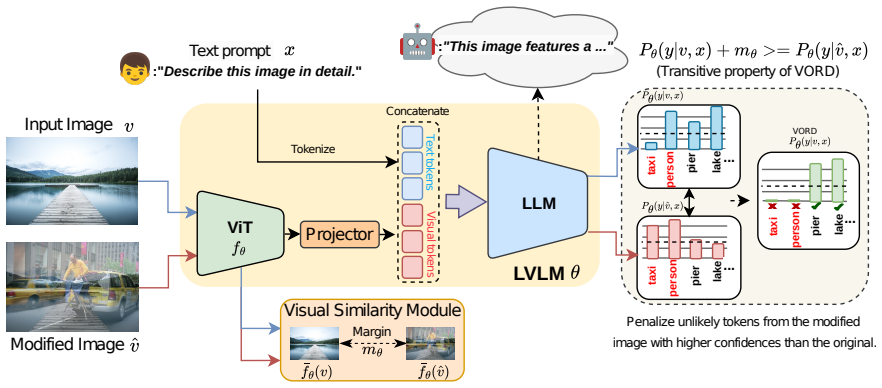
The load-bearing object is the ordinal mask δθ = Pθ(yt|v,x) + mθ >= Pθ(yt|v_hat,x), where v_hat is a corrupted copy of the image built by Mixup or diffusion noise and mθ is an adaptive margin mθ = (1/π) arccos( (f̄θ(v)·f̄θ(v_hat))/(||f̄θ(v)|| ||f̄θ(v_hat)||) ), the normalized angular distance between the averaged visual tokens of the clean and corrupted images. In VORD Decoding the mask is applied at each autoregressive step, zeroing any token that violates the inequality and then truncating further with an adaptive plausibility constraint; in VORD Loss the same inequality is converted into a convex, piecewise-quadratic ranking penalty max(·,0)^ψ whose gradients pull the clean-image probabilities above corrupted-image probabilities. The adaptive margin is what lets the method set its own strictness from the visual similarity of the image pair, which the ablations show is necessary because fixed margins either under-filter or over-penalize.
What would settle it
Take a set of images with known ground-truth object labels and corrupt each image with the same Mixup or diffusion recipe used in the paper; count how often a ground-truth object token has strictly lower probability on the clean image than on the corrupted image. If that violation rate is non-negligible on correct tokens, then the ordinal mask in Eq. (4) is deleting valid content, and the observed POPE gains would be explained by filtering rather than by a true ordinal regularity.
Extended reading notes
Core claim
The paper's central claim is that token probabilities in LVLMs are not naturally ordinal under visual corruption, and that enforcing ordinality fixes hallucination. Concretely, for a clean image v, a corrupted image v_hat, and a text prompt x, the paper posits that tokens consistent with the image should satisfy Pθ(yt|v,x) >= Pθ(yt|v_hat,x); VORD turns this into a hard mask P_VORD = Pθ(yt|v,x) if the inequality with margin mθ holds, and 0 otherwise, and into a convex loss L_vord = max(Pθ(y|v_hat,x) - Pθ(y|v,x) + mθ, 0)^ψ added to cross-entropy. The paper reports that this suppresses hallucinated objects like <person> or <loudspeaker>, improves accuracy, precision, recall and F1 on POPE, raises overall MME perception scores, and produces shorter, more detailed open-ended answers on LLaVA-Bench, all while lowering expected calibration error.
Load-bearing premise
VORD stands on the assumption that for every token that matters, the model's probability on the clean image exceeds its probability on the corrupted image by at least the margin; if a genuinely correct token ever scores higher on the corrupted image, the decoding rule sets its probability to zero and the correct answer is destroyed.
Editorial extensions
If this is right
- A training-free decoder can lower object hallucination rates on POPE and MME without retraining, by comparing one forward pass on the image with one forward pass on a corrupted image.
- The same ordinal principle works as a fine-tuning objective: adding max(Pθ(y|v_hat,x) - Pθ(y|v,x) + mθ, 0)^ψ to cross-entropy improves POPE accuracy and F1, with the squared variant (ψ=2) slightly ahead.
- Calibration improves alongside accuracy: VORD reports the lowest expected calibration error among compared decoders on the tested backbone LVLMs, so hallucination suppression does not come at the cost of overconfident predictions.
- Combining VORD loss with VORD decoding yields the best overall scores, so the training-time and decoding-time forms reinforce each other.
- Because the method only needs image pairs and token probabilities, it is portable to any LVLM with a vision encoder, which is why the paper tests three backbone architectures.
Reading between the lines
- Editorial extension: the ordinal rule is not tied to object categories; it should apply to attribute-level hallucinations such as color, position, or count whenever the corrupted image lowers the true attribute's probability, so VORD may generalize beyond the existence-focused POPE benchmark.
- Editorial extension: a testable implication the paper does not pursue is that using a corruption which leaves semantically irrelevant tokens nearly unchanged could make VORD behave like a pure linguistic-prior filter; comparing Mixup against text-only corruptions would separate visual grounding from language-prior suppression.
- Editorial extension: if the ordinal assumption holds only for severe corruptions, as the ablation suggests, a practical extension would be to schedule corruption intensity per image, adapting the margin so that mild corruptions still activate the constraint without deleting valid tokens.
- Editorial extension: the authors note VORD could extend to LLMs and NLP via text modifications; an implicit consequence is that any input perturbation that selectively damages signal while preserving structure could support the same ordinal calibration, making the idea a general confidence-grounding recipe.
Editorial analysis
A structured set of objections, weighed in public.
Referee Report
Summary. The paper proposes VORD (Visual Ordinal Calibration), a method to reduce object hallucinations in large vision-language models by enforcing an ordinal relationship between token probabilities under clean and corrupted images. VORD has two forms: a training-free decoding filter that zeroes out tokens whose probability on the modified image exceeds their probability on the original image plus an adaptive margin, and a trainable loss that penalizes such violations. The adaptive margin is computed from the angular similarity between the visual features of the original and modified images. Experiments on POPE, MME, and LLaVA-Bench with LLaVA-v1.5, Qwen-VL, and InstructBLIP report consistent improvements in accuracy, F1, and ECE over regular decoding and against VCD and OPERA baselines, along with GPT-4oV-assessed gains in response accuracy and detailedness.
Significance. If the empirical claims hold, VORD offers a lightweight, training-free intervention and a complementary regularizer that improve both hallucination metrics and calibration across several backbone LVLMs. The code is publicly available, and the evaluation includes error bars over reruns, which is a strength. However, the significance is currently conditional because the central mechanistic justification—the ordinal assumption in Eq. (3)—is internally contradicted by the paper's own motivating observations, and the formal analysis of the loss function contains mathematical errors. The method may still work as an effective heuristic, but the paper does not yet establish the ordinal-calibration story it advertises.
major comments (5)
- [Sec. 3.4 and Eq. (4)] The motivating observation in Sec. 3.4 states that desired tokens (shown in green in Fig. 2) 'did not behave as expected' under Mixup, meaning they violate the ordinal relation in Eq. (3). Yet the decoding rule in Eq. (4) rejects exactly those tokens by setting their probability to zero when Pθ(yt|v,x) + mθ < Pθ(yt|v̂,x). The adaptive plausibility constraint in Eq. (5) only limits rejection to high-probability tokens; it does not repair the ordering. This is an internal inconsistency in the central mechanism: the paper argues from the failure of ordinality and then enforces ordinality as the acceptance criterion. The paper provides no quantitative measurement of how often ground-truth or human-judged correct tokens are rejected by Eq. (4). Without such a per-token or per-sequence analysis, the observed benchmark gains could result from aggressive suppression of all non-trivial tokens rather than from a sound ordinal property. This needs to be addressed with a direct measurement of correct-token survival rates or an equivalent analysis.
- [Sec. 4.2.1, Eqs. (8)–(9)] The convexity proof is mathematically unsupported. In Eq. (9), θ is the full parameter vector of the LVLM, so ∂²gθ/∂²θ is a Hessian matrix, not a scalar, and the statement that 'the second derivative is always positive' is not well-defined for a matrix. Moreover, (∂gθ/∂θ)² is an outer product, and the coefficient (ψ² − ψ) is negative when 0 < ψ < 1, so the second term is not necessarily positive semidefinite. The first term ψ g^{ψ−1} H is positive semidefinite only if H is positive semidefinite, which is not established. The claim that the VORD loss is convex in θ is therefore not proven. The authors should either provide a correct convexity argument (e.g., convexity in the functional output space) or remove the convexity claim and instead describe the loss as a heuristic penalty.
- [Sec. 4.2, Eq. (8) and Eq. (10)] The gradient analysis in Eq. (8) treats the margin mθ as a constant when differentiating gθ = Pθ(y|v̂,x) − Pθ(y|v,x) + mθ. However, Eq. (10) defines mθ as a function of the visual encoder parameters θ (through fθ(v) and fθ(v̂)). The correct gradient should include ∂mθ/∂θ, which is absent. Consequently, the reported gradient of Lvord is incomplete, and the same issue propagates to the second-derivative analysis. This is load-bearing for the training variant: the actual loss that is optimized differs from the analyzed one, and the claimed behavior (e.g., not penalizing when the ordinal property is obeyed) may not hold if the margin changes during optimization. The authors should correct the gradient derivation or explicitly state that they treat mθ as a fixed, non-differentiable scalar during backpropagation.
- [Appendix B, Table 8] The corruption ablation shows that VORD underperforms VCD on mild corruptions: Gaussian Blur (F1 80.83 vs. 82.18), Jpeg Compression (81.99 vs. 82.25), and Saturate (81.46 vs. 82.11). The authors attribute this to smaller margins and state that the corruption must be 'severe enough' for VORD to work. This is a direct acknowledgment that the ordinal assumption in Eq. (3) is corruption-dependent, and it weakens the paper's central claim that VORD calibrates based on a general ordinal relationship between modified image pairs. The paper should provide a quantitative characterization of when Eq. (3) holds and when it fails, and should report the survival rate of correct tokens under the recommended Mixup setting. Without such evidence, the choice of Mixup as the default corruption appears to be tuned to make the method work, rather than derived from the proposed principle.
- [Sec. 5.3 and Table 7] The abstract and Sec. 5.3 claim that VORD delivers 'better calibration,' but Table 7 shows that the VORD loss consistently increases ECE relative to the baseline: for example, on A-OKVQA Random with LLaVA-1.5-7B, ECE rises from 2.82 to 2.94 (ψ=1) and 3.01 (ψ=2); on MSCOCO Popular it rises from 3.14 to 3.31 and 3.56; and on GQA Adversarial from 5.63 to 5.82 and 5.85. The calibration improvement is only demonstrated for VORD decoding in Table 1, not for VORD loss. The claims should be qualified to distinguish between the two variants, and the ECE results for the loss variant should be discussed honestly.
minor comments (6)
- [Algorithm 1 and Algorithm 2] The algorithms use the notation 'ˆv = α ∗ v1 + (1 − α) ∗ v2', but the text defines the Mixup coefficient as λ drawn from Beta(α, α). Using α both for the Beta distribution shape parameter and for the mixing weight is confusing; please rename the mixing weight (e.g., λ) consistently.
- [Eq. (3)] The statement '1.0 ≥ λi ≥ λj ⇔ Pθ(yt|v,x) ≥ Pθ(yt|v̂,x)' uses λi and λj without a clear definition. Only a single λ is introduced in the preceding sentence; please clarify what λi and λj denote (e.g., two different mixing strengths) and whether the equivalence is an empirical claim or a definition.
- [Table 3 and Sec. 6] The text states that VORD generates shorter responses, but Table 3 shows that for Qwen-VL, VORD has a longer average length (13.13) than regular decoding (10.41) and VCD (10.36). Please reconcile this observation with the 'Short & Sweet' claim.
- [Sec. 5.3] Figure 5 is referenced as showing the 'squared variant (ψ = 2) highlighted in magenta,' but the manuscript appears to be in black-and-white; consider using a distinguishable marker pattern or a color-blind-safe palette.
- [Sec. 4.3] The paper claims the adaptive margin 'eliminates the need for hyperparameter tuning,' but the method still requires choosing the corruption type (e.g., Mixup), the Mixup strength α, and the plausibility threshold β. Please temper this claim to reflect the remaining hyperparameters.
- [Throughout] There are several minor grammatical issues: the abstract reads 'we present VORD a simple and effective method' (missing comma), and Sec. 4.1.2 has 'Higher values ofβ results' (grammar/spacing). A careful proofread is recommended.
Circularity Check
No significant circularity; VORD's ordinal criterion is an applied hypothesis evaluated on held-out benchmarks, not a fitted or self-referential derivation.
full rationale
The paper's central mechanism Eq. (4) is a decoding rule, not a derived prediction: it filters tokens by comparing probabilities on clean and corrupted images plus a margin, and the claimed benefit is then measured on held-out POPE, MME, and LLaVA-Bench labels. The margin in Eq. (10) is a fixed functional form of the cosine similarity between the model's visual embeddings of v and v_hat; it is not tuned to benchmark outcomes, and no fitted parameter is renamed as a prediction. The VORD loss in Eq. (6) is likewise a fixed ordinal regularizer combined with cross-entropy, not an identity with the evaluation metric. No load-bearing self-citation appears: the paper cites VCD for adaptive plausibility constraints, but VCD is external prior work, and no uniqueness theorem or prior result by the same authors is invoked to forbid alternatives. The paper's own Sec. 3.4 admits that desired tokens 'did not behave as expected' under Mixup, and Appendix B shows that mild corruptions with small margins yield weaker gains than VCD (e.g., Gaussian Blur F1 80.83 vs 82.18). These are validity and robustness concerns about the ordinal assumption, not circular reductions: the assumption is externally testable, and the paper provides held-out evidence both for and against it. There is also an internal inconsistency in the margin semantics (Eq. (4) adds mθ to the clean probability, making larger mθ more lenient, while the Tab. 4 discussion says excessively large margins 'over-penalize'), but that is a correctness issue and is explicitly outside the circularity criterion. Overall, the central claim is empirically contingent rather than equivalent to its inputs by construction.
Assumptions & free parameters
free parameters (4)
- Adaptive margin mθ =
Not grid-searched; computed via Eq. (10), with observed values 0.027 to 0.131 across corruptions (Table 8)
- β (adaptive plausibility threshold) =
0.2
- ψ (power term) =
1.0 or 2.0
- Mixup Beta parameter α =
1.0
assumptions (3)
- domain assumption Ordinal ranking assumption (Eq. 3): for relevant tokens, Pθ(yt|v,x) >= Pθ(yt|v_hat,x) as corruption strength increases
- domain assumption Adaptive margin mθ from cosine similarity (Eq. 10) is an appropriate penalty scale
- domain assumption The corrupted image exposes hallucination-prone tokens that should be suppressed
Cite this review
Pith. "Pith review of VORD: Visual Ordinal Calibration for Mitigating Object Hallucinations in Large Vision-Language Models." pith.science (2026). https://pith.science/paper/QMNB5HRP
@misc{pith2026241215739,
  author       = {Pith},
  title        = {Pith review of: VORD: Visual Ordinal Calibration for Mitigating Object Hallucinations in Large Vision-Language Models},
  year         = {2026},
  howpublished = {\url{https://pith.science/paper/QMNB5HRP}},
  note         = {Machine review of arXiv:2412.15739}
}
read the original abstract
Large Vision-Language Models (LVLMs) have made remarkable developments along with the recent surge of large language models. Despite their advancements, LVLMs have a tendency to generate plausible yet inaccurate or inconsistent information based on the provided source content. This phenomenon, also known as ``hallucinations" can have serious downstream implications during the deployment of LVLMs. To address this, we present VORD a simple and effective method that alleviates hallucinations by calibrating token predictions based on ordinal relationships between modified image pairs. VORD is presented in two forms: 1.) a minimalist training-free variant which eliminates implausible tokens from modified image pairs, and 2.) a trainable objective function that penalizes unlikely tokens. Our experiments demonstrate that VORD delivers better calibration and effectively mitigates object hallucinations on a wide-range of LVLM benchmarks.
Figures


Figures from the paper (3 more)


Reference graph
Works this paper leans on
-
[1]
Vedika Agarwal, Rakshith Shetty, and Mario Fritz. Towards causal vqa: Revealing and reducing spurious correlations by invariant and covariant semantic editing. In IEEE/CVF Conference on Computer Vision and Pattern Recognition (CVPR), 2020. 3
work page 2020
-
[2]
Ana- lyzing the behavior of visual question answering models
Aishwarya Agrawal, Dhruv Batra, and Devi Parikh. Ana- lyzing the behavior of visual question answering models. In Proceedings of the 2016 Conference on Empirical Methods in Natural Language Processing, pages 1955–1960, Austin, Texas, 2016. Association for Computational Linguistics. 3
work page 2016
-
[3]
Wenbin An, Feng Tian, Sicong Leng, Jiahao Nie, Haonan Lin, Qianying Wang, Guang Dai, Ping Chen, and Shijian Lu. Agla: Mitigating object hallucinations in large vision- language models with assembly of global and local attention. ArXiv, abs/2406.12718, 2024. 3
arXiv 2024
-
[4]
Let there be a clock on the beach: Reducing object hal- lucination in image captioning
Ali Furkan Biten, Llu ´ıs G ´omez, and Dimosthenis Karatzas. Let there be a clock on the beach: Reducing object hal- lucination in image captioning. In Proceedings of the IEEE/CVF Winter Conference on Applications of Computer Vision (WACV), pages 1381–1390, 2022. 3
work page 2022
-
[5]
Driving with llms: Fusing object-level vec- tor modality for explainable autonomous driving
Long Chen, Oleg Sinavski, Jan H ¨unermann, Alice Karnsund, Andrew James Willmott, Danny Birch, Daniel Maund, and Jamie Shotton. Driving with llms: Fusing object-level vec- tor modality for explainable autonomous driving. In 2024 IEEE International Conference on Robotics and Automation (ICRA), 2024. 1
2024
-
[6]
HALC: Object hallucination reduc- tion via adaptive focal-contrast decoding
Zhaorun Chen, Zhuokai Zhao, Hongyin Luo, Huaxiu Yao, Bo Li, and Jiawei Zhou. HALC: Object hallucination reduc- tion via adaptive focal-contrast decoding. In Proceedings of the 41st International Conference on Machine Learning , pages 7824–7846. PMLR, 2024. 2, 3
work page 2024
-
[7]
Calibrating deep neural networks by pairwise constraints
Jiacheng Cheng and Nuno Vasconcelos. Calibrating deep neural networks by pairwise constraints. In Proceedings of the IEEE/CVF Conference on Computer Vision and Pattern Recognition (CVPR), pages 13709–13718, 2022. 2
work page 2022
-
[8]
InstructBLIP: Towards general-purpose vision-language models with instruction tuning
Wenliang Dai, Junnan Li, Dongxu Li, Anthony Tiong, Junqi Zhao, Weisheng Wang, Boyang Li, Pascale Fung, and Steven Hoi. InstructBLIP: Towards general-purpose vision-language models with instruction tuning. In Thirty- seventh Conference on Neural Information Processing Sys- tems, 2023. 6
work page 2023
Show all 78 references
-
[9]
BERT: Pre-training of deep bidirectional trans- formers for language understanding
Jacob Devlin, Ming-Wei Chang, Kenton Lee, and Kristina Toutanova. BERT: Pre-training of deep bidirectional trans- formers for language understanding. In Proceedings of the 2019 Conference of the North American Chapter of the As- sociation for Computational Linguistics: Human L...
2019
-
[10]
Hierarchi- cal neural story generation
Angela Fan, Mike Lewis, and Yann Dauphin. Hierarchi- cal neural story generation. In Proceedings of the 56th An- nual Meeting of the Association for Computational Linguis- tics (Volume 1: Long Papers) , pages 889–898, Melbourne, Australia, 2018. Association for Computational L...
2018
-
[11]
Multi-modal hal- lucination control by visual information grounding
Alessandro Favero, Luca Zancato, Matthew Trager, Sid- dharth Choudhary, Pramuditha Perera, Alessandro Achille, Ashwin Swaminathan, and Stefano Soatto. Multi-modal hal- lucination control by visual information grounding. In Pro- ceedings of the IEEE/CVF Conference on Computer V...
2024
-
[12]
Beam search strate- gies for neural machine translation
Markus Freitag and Yaser Al-Onaizan. Beam search strate- gies for neural machine translation. In Proceedings of the First Workshop on Neural Machine Translation , pages 56– 60, Vancouver, 2017. Association for Computational Lin- guistics. 4
2017
-
[13]
Dropout as a bayesian approximation: Representing model uncertainty in deep learning
Yarin Gal and Zoubin Ghahramani. Dropout as a bayesian approximation: Representing model uncertainty in deep learning. In Proceedings of The 33rd International Confer- ence on Machine Learning , pages 1050–1059, New York, New York, USA, 2016. PMLR. 2
2016
-
[14]
Ido Galil, Mohammed Dabbah, and Ran El-Yaniv. What can we learn from the selective prediction and uncertainty esti- mation performance of 523 imagenet classifiers? In The Eleventh International Conference on Learning Representa- tions, 2023. 2
2023
-
[15]
Making the v in vqa matter: Elevating the role of image understanding in visual question answer- ing
Yash Goyal, Tejas Khot, Douglas Summers-Stay, Dhruv Ba- tra, and Devi Parikh. Making the v in vqa matter: Elevating the role of image understanding in visual question answer- ing. In Proceedings of the IEEE Conference on Computer Vision and Pattern Recognition (CVPR), 2017. 3
2017
-
[16]
A stitch in time saves nine: A train-time reg- ularizing loss for improved neural network calibration
Ramya Hebbalaguppe, Jatin Prakash, Neelabh Madan, and Chetan Arora. A stitch in time saves nine: A train-time reg- ularizing loss for improved neural network calibration. In Proceedings of the IEEE/CVF Conference on Computer Vi- sion and Pattern Recognition (CVPR), pages 16081–16090,
-
[17]
Dietterich
Dan Hendrycks and Thomas G. Dietterich. Benchmarking neural network robustness to common corruptions and per- turbations. In 7th International Conference on Learning Representations, ICLR 2019, New Orleans, LA, USA, May 6-9, 2019. OpenReview.net, 2019. 3, 13
2019
-
[18]
The curious case of neural text degeneration
Ari Holtzman, Jan Buys, Li Du, Maxwell Forbes, and Yejin Choi. The curious case of neural text degeneration. In In- ternational Conference on Learning Representations , 2020. 4
2020
-
[19]
LoRA: Low-rank adaptation of large language models
Edward J Hu, Yelong Shen, Phillip Wallis, Zeyuan Allen- Zhu, Yuanzhi Li, Shean Wang, Lu Wang, and Weizhu Chen. LoRA: Low-rank adaptation of large language models. InIn- ternational Conference on Learning Representations , 2022. 6
2022
-
[20]
Scaling up vision-language pre-training for image captioning
Xiaowei Hu, Zhe Gan, Jianfeng Wang, Zhengyuan Yang, Zicheng Liu, Yumao Lu, and Lijuan Wang. Scaling up vision-language pre-training for image captioning. In Pro- ceedings of the IEEE/CVF Conference on Computer Vision and Pattern Recognition (CVPR), pages 17980–17989, 2022. 1
2022
-
[21]
Movienet: A holistic dataset for movie un- derstanding
Qingqiu Huang, Yu Xiong, Anyi Rao, Jiaze Wang, and Dahua Lin. Movienet: A holistic dataset for movie un- derstanding. In European Conference on Computer Vision,
-
[22]
Opera: Alleviating hallucination in multi- modal large language models via over-trust penalty and retrospection-allocation
Qidong Huang, Xiaoyi Dong, Pan Zhang, Bin Wang, Con- ghui He, Jiaqi Wang, Dahua Lin, Weiming Zhang, and Nenghai Yu. Opera: Alleviating hallucination in multi- modal large language models via over-trust penalty and retrospection-allocation. In Proceedings of the IEEE/CVF Confer...
2024
-
[23]
Hudson and Christopher D
Drew A. Hudson and Christopher D. Manning. Gqa: A new dataset for real-world visual reasoning and composi- tional question answering. In Proceedings of the IEEE/CVF Conference on Computer Vision and Pattern Recognition (CVPR), 2019. 6
2019
-
[24]
Langsuit-e: Controlling, planning, and interacting with large language models in embodied text environments
Zixia Jia, Mengmeng Wang, Baichen Tong, and Zilong Zheng. Langsuit-e: Controlling, planning, and interacting with large language models in embodied text environments. In Findings of the 62nd Annual Meeting of the Association for Computational Linguistics (ACL 2024), 2024. 1
2024
-
[25]
Adam Tauman Kalai and Santosh S. Vempala. Calibrated language models must hallucinate. Proceedings of the 56th Annual ACM Symposium on Theory of Computing, 2023. 2
2023
-
[26]
Mitigating object hallucinations in large vision-language models through vi- sual contrastive decoding
Sicong Leng, Hang Zhang, Guanzheng Chen, Xin Li, Shi- jian Lu, Chunyan Miao, and Lidong Bing. Mitigating object hallucinations in large vision-language models through vi- sual contrastive decoding. In Proceedings of the IEEE/CVF Conference on Computer Vision and Pattern Recogn...
2024
-
[27]
BLIP: Bootstrapping language-image pre-training for unified vision-language understanding and generation
Junnan Li, Dongxu Li, Caiming Xiong, and Steven Hoi. BLIP: Bootstrapping language-image pre-training for unified vision-language understanding and generation. In Proceed- ings of the 39th International Conference on Machine Learn- ing, pages 12888–12900. PMLR, 2022. 2
2022
-
[28]
What does BERT with vision look at? In Proceedings of the 58th Annual Meeting of the Associa- tion for Computational Linguistics , pages 5265–5275, On- line, 2020
Liunian Harold Li, Mark Yatskar, Da Yin, Cho-Jui Hsieh, and Kai-Wei Chang. What does BERT with vision look at? In Proceedings of the 58th Annual Meeting of the Associa- tion for Computational Linguistics , pages 5265–5275, On- line, 2020. Association for Computational Linguistics. 2
2020
-
[29]
Contrastive decoding: Open-ended text genera- tion as optimization
Xiang Lisa Li, Ari Holtzman, Daniel Fried, Percy Liang, Jason Eisner, Tatsunori Hashimoto, Luke Zettlemoyer, and Mike Lewis. Contrastive decoding: Open-ended text genera- tion as optimization. InProceedings of the 61st Annual Meet- ing of the Association for Computational Ling...
-
[30]
Evaluating object hallucination in large vision- language models
Yifan Li, Yifan Du, Kun Zhou, Jinpeng Wang, Xin Zhao, and Ji-Rong Wen. Evaluating object hallucination in large vision- language models. In Proceedings of the 2023 Conference on Empirical Methods in Natural Language Processing , pages 292–305, Singapore, 2023. Association for ...
2023
-
[31]
Vila: On pre-training for visual language models
Ji Lin, Hongxu Yin, Wei Ping, Pavlo Molchanov, Moham- mad Shoeybi, and Song Han. Vila: On pre-training for visual language models. In Proceedings of the IEEE/CVF Confer- ence on Computer Vision and Pattern Recognition (CVPR) , pages 26689–26699, 2024. 2
2024
-
[32]
TruthfulQA: Measuring how models mimic human falsehoods
Stephanie Lin, Jacob Hilton, and Owain Evans. TruthfulQA: Measuring how models mimic human falsehoods. In Pro- ceedings of the 60th Annual Meeting of the Association for Computational Linguistics (Volume 1: Long Papers) , pages 3214–3252, Dublin, Ireland, 2022. Association for...
2022
-
[33]
Belongie, James Hays, Pietro Perona, Deva Ramanan, Piotr Doll ´ar, and C
Tsung-Yi Lin, Michael Maire, Serge J. Belongie, James Hays, Pietro Perona, Deva Ramanan, Piotr Doll ´ar, and C. Lawrence Zitnick. Microsoft coco: Common objects in context. In European Conference on Computer Vision, 2014. 6
2014
-
[34]
The devil is in the margin: Margin-based label smooth- ing for network calibration
Bingyuan Liu, Ismail Ben Ayed, Adrian Galdran, and Jose Dolz. The devil is in the margin: Margin-based label smooth- ing for network calibration. InProceedings of the IEEE/CVF Conference on Computer Vision and Pattern Recognition (CVPR), pages 80–88, 2022. 2
2022
-
[35]
Class adaptive network calibration
Bingyuan Liu, J ´erˆome Rony, Adrian Galdran, Jose Dolz, and Ismail Ben Ayed. Class adaptive network calibration. InPro- ceedings of the IEEE/CVF Conference on Computer Vision and Pattern Recognition (CVPR), pages 16070–16079, 2023. 2
2023
-
[36]
Visual instruction tuning
Haotian Liu, Chunyuan Li, Qingyang Wu, and Yong Jae Lee. Visual instruction tuning. InAdvances in Neural Information Processing Systems, pages 34892–34916. Curran Associates, Inc., 2023. 2, 6
2023
-
[37]
Improved baselines with visual instruction tuning
Haotian Liu, Chunyuan Li, Yuheng Li, and Yong Jae Lee. Improved baselines with visual instruction tuning. In Pro- ceedings of the IEEE/CVF Conference on Computer Vision and Pattern Recognition (CVPR), pages 26296–26306, 2024. 2, 6
2024
-
[38]
SimCLS: A simple framework for contrastive learning of abstractive summarization
Yixin Liu and Pengfei Liu. SimCLS: A simple framework for contrastive learning of abstractive summarization. In Proceedings of the 59th Annual Meeting of the Association for Computational Linguistics and the 11th International Joint Conference on Natural Language Processing (V...
2021
-
[39]
Curved scene text detection via transverse and longitudinal sequence connection
Yuliang Liu, Lianwen Jin, Shuaitao Zhang, Canjie Luo, and Sheng Zhang. Curved scene text detection via transverse and longitudinal sequence connection. Pattern Recognition, 90: 337–345, 2019. 6
2019
-
[40]
Roberta: A robustly optimized bert pretraining approach, 2019
Yinhan Liu, Myle Ott, Naman Goyal, Jingfei Du, Mandar Joshi, Danqi Chen, Omer Levy, Mike Lewis, Luke Zettle- moyer, and Veselin Stoyanov. Roberta: A robustly optimized bert pretraining approach, 2019. 2
2019
-
[41]
BRIO: Bringing order to abstractive summarization
Yixin Liu, Pengfei Liu, Dragomir Radev, and Graham Neu- big. BRIO: Bringing order to abstractive summarization. In Proceedings of the 60th Annual Meeting of the Associ- ation for Computational Linguistics (Volume 1: Long Pa- pers), pages 2890–2903, Dublin, Ireland, 2022. Assoc...
2022
-
[42]
Soft augmentation for image classifica- tion
Yang Liu, Shen Yan, Laura Leal-Taix ´e, James Hays, and Deva Ramanan. Soft augmentation for image classifica- tion. In Proceedings of the IEEE/CVF Conference on Com- puter Vision and Pattern Recognition (CVPR), pages 16241– 16250, 2023. 2
2023
-
[43]
Dolphins: Multimodal language model for driving, 2023
Yingzi Ma, Yulong Cao, Jiachen Sun, Marco Pavone, and Chaowei Xiao. Dolphins: Multimodal language model for driving, 2023. 1
2023
-
[44]
Deepart: Learn- ing joint representations of visual arts
Hui Mao, Ming Cheung, and James She. Deepart: Learn- ing joint representations of visual arts. In Proceedings of 10 the 25th ACM International Conference on Multimedia, page 1183–1191, New York, NY , USA, 2017. Association for Computing Machinery. 6
2017
-
[45]
Revisiting the calibration of modern neu- ral networks
Matthias Minderer, Josip Djolonga, Rob Romijnders, Frances Hubis, Xiaohua Zhai, Neil Houlsby, Dustin Tran, and Mario Lucic. Revisiting the calibration of modern neu- ral networks. In Advances in Neural Information Processing Systems, pages 15682–15694. Curran Associates, Inc., 2021. 2
2021
-
[46]
Confidence-aware learning for deep neural net- works
Jooyoung Moon, Jihyo Kim, Younghak Shin, and Sangheum Hwang. Confidence-aware learning for deep neural net- works. In Proceedings of the 37th International Conference on Machine Learning, pages 7034–7044. PMLR, 2020. 2
2020
-
[47]
When does label smoothing help? In Advances in Neu- ral Information Processing Systems
Rafael M ¨uller, Simon Kornblith, and Geoffrey E Hinton. When does label smoothing help? In Advances in Neu- ral Information Processing Systems. Curran Associates, Inc.,
-
[48]
Cooper, and Milos Hauskrecht
Mahdi Pakdaman Naeini, Gregory F. Cooper, and Milos Hauskrecht. Obtaining well calibrated probabilities us- ing bayesian binning. In Proceedings of the Twenty-Ninth AAAI Conference on Artificial Intelligence, page 2901–2907. AAAI Press, 2015. 3
2015
-
[49]
Rankmixup: Ranking-based mixup training for net- work calibration
Jongyoun Noh, Hyekang Park, Junghyup Lee, and Bumsub Ham. Rankmixup: Ranking-based mixup training for net- work calibration. In Proceedings of the IEEE/CVF Interna- tional Conference on Computer Vision (ICCV), pages 1358– 1368, 2023. 2
2023
-
[50]
Gpt-4 technical report
Sandhini Agarwal OpenAI: Josh Achiam, Steven Adler and Lama Ahmad et al. Gpt-4 technical report. In ChatGPT4 Report, 2023. 2
2023
-
[51]
Learning transferable visual models from natural language supervision
Alec Radford, Jong Wook Kim, Chris Hallacy, Aditya Ramesh, Gabriel Goh, Sandhini Agarwal, Girish Sastry, Amanda Askell, Pamela Mishkin, Jack Clark, Gretchen Krueger, and Ilya Sutskever. Learning transferable visual models from natural language supervision. In Proceedings of th...
2021
-
[52]
SummaR- eranker: A multi-task mixture-of-experts re-ranking frame- work for abstractive summarization
Mathieu Ravaut, Shafiq Joty, and Nancy Chen. SummaR- eranker: A multi-task mixture-of-experts re-ranking frame- work for abstractive summarization. In Proceedings of the 60th Annual Meeting of the Association for Computational Linguistics (Volume 1: Long Papers) , pages 4504–4...
2022
-
[53]
Distributionally robust ensemble of lottery tickets towards calibrated sparse network training
Hitesh Sapkota, Dingrong Wang, Zhiqiang Tao, and Qi Yu. Distributionally robust ensemble of lottery tickets towards calibrated sparse network training. In Advances in Neural Information Processing Systems, pages 62657–62681. Cur- ran Associates, Inc., 2023. 2
2023
-
[54]
A-okvqa: A benchmark for visual question answering using world knowl- edge
Dustin Schwenk, Apoorv Khandelwal, Christopher Clark, Kenneth Marino, and Roozbeh Mottaghi. A-okvqa: A benchmark for visual question answering using world knowl- edge. In European Conference on Computer Vision, 2022. 6
2022
-
[55]
REPLUG: Retrieval-augmented black-box language models
Weijia Shi, Sewon Min, Michihiro Yasunaga, Minjoon Seo, Richard James, Mike Lewis, Luke Zettlemoyer, and Wen- tau Yih. REPLUG: Retrieval-augmented black-box language models. In Proceedings of the 2024 Conference of the North American Chapter of the Association for Computationa...
2024
-
[56]
Videobert: A joint model for video and language representation learning
Chen Sun, Austin Myers, Carl V ondrick, Kevin Murphy, and Cordelia Schmid. Videobert: A joint model for video and language representation learning. In Proceedings of the IEEE/CVF International Conference on Computer Vision (ICCV), 2019. 2
2019
-
[57]
Sq-llava: Self-questioning for large vision-language assistant
Guohao Sun, Can Qin, Jiamian Wang, Zeyuan Chen, Ran Xu, and Zhiqiang Tao. Sq-llava: Self-questioning for large vision-language assistant. In ECCV, 2024. 2
2024
-
[58]
Llama: Open and efficient foundation lan- guage models
Hugo Touvron, Thibaut Lavril, Gautier Izacard, Xavier Martinet, Marie-Anne Lachaux, Timoth´ee Lacroix, Baptiste Rozi`ere, Naman Goyal, Eric Hambro, Faisal Azhar, Aure- lien Rodriguez, Armand Joulin, Edouard Grave, and Guil- laume Lample. Llama: Open and efficient foundation la...
2023 arXiv
-
[59]
A closer look at the robustness of contrastive language-image pre-training (clip)
Weijie Tu, Weijian Deng, and Tom Gedeon. A closer look at the robustness of contrastive language-image pre-training (clip). In Advances in Neural Information Processing Sys- tems, pages 13678–13691. Curran Associates, Inc., 2023. 2
2023
-
[60]
An empirical study into what matters for calibrating vision-language models
Weijie Tu, Weijian Deng, Dylan Campbell, Stephen Gould, and Tom Gedeon. An empirical study into what matters for calibrating vision-language models. In Proceedings of the 41st International Conference on Machine Learning , pages 48791–48808. PMLR, 2024. 2
2024
-
[61]
GIT: A generative image-to-text transformer for vision and language
Jianfeng Wang, Zhengyuan Yang, Xiaowei Hu, Linjie Li, Kevin Lin, Zhe Gan, Zicheng Liu, Ce Liu, and Lijuan Wang. GIT: A generative image-to-text transformer for vision and language. Transactions on Machine Learning Research ,
-
[62]
Chatcad: Interactive computer-aided diag- nosis on medical image using large language models
Sheng Wang, Zihao Zhao, Xi Ouyang, Qian Wang, and Dinggang Shen. Chatcad: Interactive computer-aided diag- nosis on medical image using large language models. arXiv preprint arXiv:2302.07257, 2023. 1
2023 arXiv
-
[63]
Editable scene simulation for autonomous driving via collaborative llm-agents
Yuxi Wei, Zi Wang, Yifan Lu, Chenxin Xu, Changxing Liu, Hao Zhao, Siheng Chen, and Yanfeng Wang. Editable scene simulation for autonomous driving via collaborative llm-agents. In Proceedings of the IEEE/CVF Conference on Computer Vision and Pattern Recognition (CVPR), pages 15...
2024
-
[64]
Google landmarks dataset v2 - a large-scale benchmark for instance-level recognition and retrieval
Tobias Weyand, Andre Araujo, Bingyi Cao, and Jack Sim. Google landmarks dataset v2 - a large-scale benchmark for instance-level recognition and retrieval. In IEEE/CVF Conference on Computer Vision and Pattern Recognition (CVPR), 2020. 6
2020
-
[65]
Precedent-enhanced legal judgment prediction with LLM and domain-model collaboration
Yiquan Wu, Siying Zhou, Yifei Liu, Weiming Lu, Xiaozhong Liu, Yating Zhang, Changlong Sun, Fei Wu, and Kun Kuang. Precedent-enhanced legal judgment prediction with LLM and domain-model collaboration. InThe 2023 Conference on Empirical Methods in Natural Language Processing , 2023. 1
2023
-
[66]
Martindale, and Marine Carpuat
Weijia Xu, Sweta Agrawal, Eleftheria Briakou, Marianna J. Martindale, and Marine Carpuat. Understanding and detect- ing hallucinations in neural machine translation via model introspection. Transactions of the Association for Computa- tional Linguistics, 11:546–564, 2023. 2 11
2023
-
[67]
mplug-owl: Modularization empowers large language models with mul- timodality
Qinghao Ye, Haiyang Xu, Guohai Xu, Jiabo Ye, Ming Yan, Yi Zhou, Junyan Wang, Anwen Hu, Pengcheng Shi, Yaya Shi, Chenliang Li, Yuanhong Xu, Hehong Chen, Junfeng Tian, Qiang Qi, Ji Zhang, and Feiyan Huang. mplug-owl: Modularization empowers large language models with mul- timoda...
2023 arXiv
-
[68]
Mul- timodal healthcare ai: Identifying and designing clinically relevant vision-language applications for radiology
Nur Yildirim, Hannah Richardson (nee Murfet), Maria T Wetscherek, Junaid Bajwa, Joseph Jacob, Mark A Pin- nock, Stephen Harris, Daniel Coelho de Castro, Shruthi Bannur, Stephanie Hyland, Pratik Ghosh, Mercy Ran- jit, Kenza Bouzid, Anton Schwaighofer, Fernando P ´erez- Garc´ıa,...
-
[69]
Woodpecker: Hallucination correction for multi- modal large language models
Shukang Yin, Chaoyou Fu, Sirui Zhao, Tong Xu, Hao Wang, Dianbo Sui, Yunhang Shen, Ke Li, Xingguo Sun, and En- hong Chen. Woodpecker: Hallucination correction for multi- modal large language models. ArXiv, abs/2310.16045, 2023. 1, 2, 7
-
[70]
Dauphin, and David Lopez-Paz
Hongyi Zhang, Moustapha Ciss ´e, Yann N. Dauphin, and David Lopez-Paz. mixup: Beyond empirical risk minimiza- tion. In 6th International Conference on Learning Represen- tations, ICLR 2018, Vancouver, BC, Canada, April 30 - May 3, 2018, Conference Track Proceedings . OpenReview.net,
2018
-
[71]
What if the tv was off? examining counterfactual reasoning abilities of multi-modal language models
Letian Zhang, Xiaotong Zhai, Zhongkai Zhao, Yongshuo Zong, Xin Wen, and Bingchen Zhao. What if the tv was off? examining counterfactual reasoning abilities of multi-modal language models. In Proceedings of the IEEE/CVF Confer- ence on Computer Vision and Pattern Recognition (C...
2024
-
[72]
Siren’s song in the ai ocean: A survey on hal- lucination in large language models
Yue Zhang, Yafu Li, Leyang Cui, Deng Cai, Lemao Liu, Tingchen Fu, Xinting Huang, Enbo Zhao, Yu Zhang, Yulong Chen, Longyue Wang, Anh Tuan Luu, Wei Bi, Freda Shi, and Shuming Shi. Siren’s song in the ai ocean: A survey on hal- lucination in large language models. ArXiv, abs/2309.01219,
-
[73]
Calibrating sequence likelihood improves conditional language genera- tion
Yao Zhao, Mikhail Khalman, Rishabh Joshi, Shashi Narayan, Mohammad Saleh, and Peter J Liu. Calibrating sequence likelihood improves conditional language genera- tion. In The Eleventh International Conference on Learning Representations, 2023. 3
2023
-
[74]
Judging llm-as-a-judge with mt-bench and chatbot arena
Lianmin Zheng, Wei-Lin Chiang, Ying Sheng, Siyuan Zhuang, Zhanghao Wu, Yonghao Zhuang, Zi Lin, Zhuohan Li, Dacheng Li, Eric Xing, Hao Zhang, Joseph E Gonzalez, and Ion Stoica. Judging llm-as-a-judge with mt-bench and chatbot arena. In Advances in Neural Information Process- in...
-
[75]
Learning deep features for scene recognition using places database
Bolei Zhou, Agata Lapedriza, Jianxiong Xiao, Antonio Tor- ralba, and Aude Oliva. Learning deep features for scene recognition using places database. In Advances in Neu- ral Information Processing Systems. Curran Associates, Inc.,
-
[76]
Detecting hallucinated content in conditional neural sequence generation
Chunting Zhou, Graham Neubig, Jiatao Gu, Mona Diab, Francisco Guzm ´an, Luke Zettlemoyer, and Marjan Ghazvininejad. Detecting hallucinated content in conditional neural sequence generation. In Findings of the Association for Computational Linguistics: ACL-IJCNLP 2021 , pages 1...
2021
-
[77]
Jpeg Compression
Yiyang Zhou, Chenhang Cui, Jaehong Yoon, Linjun Zhang, Zhun Deng, Chelsea Finn, Mohit Bansal, and Huaxiu Yao. Analyzing and mitigating object hallucination in large vision-language models. In The Twelfth International Con- ference on Learning Representations, 2024. 1, 2, 3 12 ...
2024
-
[2023]
Association for Computational Linguistics. 4
Reviewed August 11, 2026 · model on record in the stance chip above.
Discussion (0). Continue with ORCID to comment.