REVIEW 3 major objections 5 minor 26 references
Extracting Interpretable Task-Specific Circuits from Large Language Models for Faster Inference
T0 review · 3 major / 5 minor · reviewed 2026-08-11 · deepseek-v4-flash
Pith's one-line read A pretrained LLM can be pruned without training into a standalone task-specific circuit that keeps accuracy while dropping up to 83% of parameters and running 88% faster.
desk verdict A genuinely new and practical idea—turning circuit identification into real standalone pruning—but the evaluation's missing held-out test and weak circuit recovery keep the central claims only partially supported. read the letter →
The pith
A machine-rendered reading of the paper's core claim, the machinery that carries it, and where it could break.
The reading
What carries the argument
Algorithm 1, a greedy backward ablation pass with a KL-divergence gate. Starting from the full model, it traverses layers from top to bottom and heads within each layer; for each candidate component it patches it (zero or mean ablation), computes ΔKL = KL(fθ ∥ g′θ) − KL(fθ ∥ gθ) on a validation set, and permanently prunes the component if ΔKL < α. The residual-stream formulation of transformers makes zero ablation equivalent to removing the component and mean ablation equivalent to replacing it with a bias term, so the pruned model is executable as a standard smaller network; pruning nodes instead of edges keeps the result compatible with parallel matrix-multiplication hardware.
What would settle it
Run the paper's greater-than experiment with zero ablation and MLP pruning: the reported result is that a model pruned to roughly half size reaches 100% accuracy while its KL divergence from the original remains large. If a similar divergence between KL and task accuracy appears on any held-out task—or if a component whose ablation leaves KL nearly unchanged but destroys accuracy can be exhibited—then the KL gate is not selecting for task competence and the extracted submodel's reliability is not assured.
Extended reading notes
Core claim
The central discovery is that the circuit responsible for a single-token task can be not just located but physically extracted: by greedily pruning nodes (individual attention heads and, optionally, MLPs) in reverse layer order and keeping only components whose ablation raises the KL divergence between the pruned model and the original model beyond a threshold α, the authors obtain a truly smaller network that still performs the task. Unlike prior circuit-discovery methods that patch edges via hooks and leave the model unchanged, this method removes the component's weight matrices outright (zero ablation) or replaces them with a constant mean bias (mean ablation), which is what yields actual size and speed gains. In their evaluation, the pruned GPT-2 Small models retain or exceed the original accuracy on acronym prediction, IOI, and greater-than, while removing up to 82.77% of parameters and reducing inference time by up to 88%; the false-positive rate against manually identified circuits is low, and a same-size distilled student trained on the same small datasets fails to reach comparable accuracy.
Load-bearing premise
The load-bearing premise is that how much a component's removal shifts the model's full prediction distribution (measured by KL divergence) tells you how essential that component is to the task, and that this measurement remains trustworthy even after earlier components have already been pruned.
Editorial extensions
If this is right
- Single-task deployment of an LLM no longer requires running the full model: the same pretrained weights, pruned by this method, can serve one task with a fraction of the parameters and latency.
- Because pruning removes nodes rather than edges, the resulting submodel is executable with ordinary batching and matrix libraries, unlike earlier circuit-identification outputs that only slow the forward pass.
- The extracted submodel is small enough to be inspected: low false-positive rates against manual circuits mean an analyst can apply mechanistic-interpretability tools to a handful of components rather than the whole network.
- With only a few hundred curated samples, circuit extraction beats distillation at matching the teacher's task behavior, so the method is attractive when task-specific training data is scarce.
Reading between the lines
- A task-specific accuracy metric (for example, logit difference or exact-match) could replace or augment KL divergence in the greedy gate; the paper's own greater-than results show KL and accuracy can diverge, so a hybrid gate might yield smaller submodels without the observed accuracy spikes.
- The same backward ablation could be run separately for several tasks and the surviving component sets intersected or unioned, which would reveal shared versus task-specific circuitry and could enable multi-task submodels.
- Because the method needs only forward passes, it should scale to larger models, but the sweep cost is roughly one forward pass per candidate component, so on very large models the ablation sweep rather than the data becomes the bottleneck.
- The resulting task circuits could be stress-tested for shortcut learning: if a pruned submodel relies on a spurious template cue, its accuracy should collapse when the template distribution shifts, offering a practical check on whether the extracted circuit is the real mechanism.
Editorial analysis
A structured set of objections, weighed in public.
Referee Report
Summary. The paper proposes a method to automatically prune GPT-2 Small into a task-specific submodel (a 'circuit') by iterating over attention heads and optionally MLPs in reverse layer order, temporarily ablating each component, and permanently removing it if the increase in KL divergence between the ablated model and the original model's predictions on a validation set falls below a threshold α. The method requires no additional training and small datasets. The authors evaluate on three tasks whose circuits were manually identified in prior work: 3-letter acronym prediction, indirect object identification (IOI), and greater-than. They report parameter reductions up to 82.77%, inference speedups up to 88%, and accuracy that preserves or improves over the original model, along with low false-positive rates relative to the manually identified circuits. They also compare against a distillation baseline.
Significance. If the claims are validated, the work is a useful bridge between mechanistic interpretability and model compression: it is among the first to make extracted circuits usable as standalone, smaller, faster models without fine-tuning, and it provides a concrete algorithm with released code and data. The use of three tasks with known circuits is a strength, as is the honesty in reporting low true-positive rates relative to manual circuits. However, the significance is currently limited by evaluation gaps: no held-out test set, a pruning proxy (KL divergence) that the paper itself shows can diverge from task accuracy, and a relatively narrow experimental scope (GPT-2 Small, single-token prediction, synthetic templates). The core idea is promising and the direction is valuable, but the evidence as presented does not yet support the strong claims in the abstract.
major comments (3)
- [Section 4, Table 1 and Appendix E, Table 3] The reported accuracies are computed on the same validation set Dv that was used to select the threshold α in RQ1 (Figures 2–7). No held-out test set is ever split off. Since α is chosen by inspecting accuracy-versus-size curves on Dv, the headline numbers (e.g., 99.92% accuracy at 32.88% parameter reduction on acronyms) are in-sample estimates. With batch sizes of only 150–250 samples, the risk of overfitting to Dv is non-negligible, and averaging over five batches drawn from the same distribution does not mitigate selection bias. The central claim that the extracted submodel properly performs the task in a standalone manner requires out-of-sample evidence; please report accuracies on a test set that is not used for threshold selection.
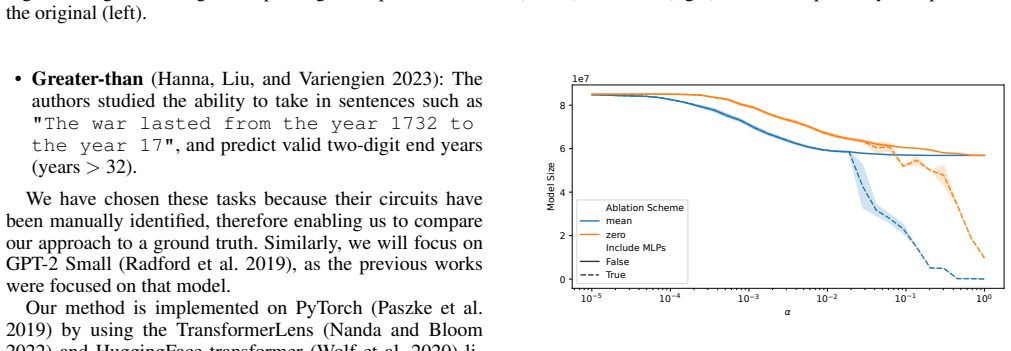
- [Algorithm 1 (Section 3) and Appendix D (Figure 7)] The pruning criterion is the increase in KL divergence between the ablated model and the original model, but the reported success metric is task accuracy. The paper itself documents a counterexample in Appendix D: for the greater-than task, with zero ablation and MLPs included, submodels around 50% size achieve 100% accuracy while having large KL divergence, and models at near-100% size reduction still reach 100% accuracy because the model degenerates to always predicting the starting year. This shows that KL divergence is not reliably correlated with task performance. Because every pruning decision in Algorithm 1 is made using this proxy, the method may remove task-critical components as long as the KL divergence stays low, or retain components that do not help accuracy. The paper acknowledges this phenomenon but leaves it out of scope; please adopt a task-appropriate metric (e.g., logit difference or direct accuracy) or provide evidence that KL-based pruning nonetheless recovers the correct submodel in this case.
- [Section 4, RQ3 and Table 1] The true-positive rates against manually identified circuits are low: 20–40% for acronyms, 25–57% for IOI and greater-than, while false-positive rates are low. The authors explain that many manually identified heads contribute small amounts and that different ablation schemes are used, but the claim that the pruned models are 'more interpretable' or 'focus on the circuit' is undercut when a large fraction of the known circuit is absent. Please provide a more direct analysis, for example by measuring how much task accuracy is recovered when the missing heads are re-added, or by quantifying the contribution of each missing head, so that the retained heads can be shown to be the functionally important ones.
minor comments (5)
- [Algorithm 1] The loop bounds 'for layer ← [num layers(fθ), ...0]' and 'for head ← [num heads(fθ), ...0]' appear to include out-of-range indices if read literally; the intended bounds are likely num layers−1 and num heads−1. Also, in the MLP pruning branch, 'ablate mlp(g′θ, layer, head, ...)' uses 'head' from the previous loop, which is not a defined argument in that scope.
- [Section 4, RQ1, Figure 2] The y-axis label 'Model Size' is vague; please specify that it is the number of parameters (excluding embedding and unembedding matrices, as stated in the text) and consider a log-scale x-axis to make the threshold behavior clearer.
- [Appendix A] There is a typo: 'especifically' should be 'specifically'.
- [Section 4, RQ4] The distillation baseline is described as trained 'for a total of 20000 epochs'; please clarify whether this means 20,000 gradient update steps or 20,000 full passes over the (very small) training set, as the latter would be unusual.
- [Table 3] The Δacc column shows positive improvements over the original model (e.g., +9.28% for Acronyms, +2.93% for IOI). Since pruning cannot add information, please explain how the pruned model can exceed the original model's accuracy on the same validation set, or specify whether the original model's accuracy on that set was imperfect.
Circularity Check
Partial circularity: alpha thresholds are selected on the same validation set whose accuracies are then reported as results (in-sample, fitted-input evaluation), and the acronym ground-truth circuit is the authors' own prior work; the core KL-based extraction claim itself is not definitionally circular.
-
fitted input called prediction
[Section 4, RQ1 (Figures 2-7) and RQ2 (Table 1); Appendix E (Table 3)]
"The thresholds were selected according to the results of the previous section, and mean ablation is used across all runs. ... we are able to obtain a submodel that is 33% smaller, which contains just 2 attention heads and all the MLPs and has 100% accuracy in the validation set."
RQ1 plots accuracy versus alpha on Dv, explicitly reporting '100% accuracy in the validation set.' RQ2 then selects alpha 'according to the results of the previous section,' i.e., by reading the desired accuracy/size point off those in-sample curves. Tables 1 and 3 report accuracy of the resulting pruned models on the same Dv; no held-out test split is defined. The headline accuracies (99.92%, 100.00%, 100.00%) are the y-values of the frontier points chosen on the very data used for alpha selection, so they are selection-optimized in-sample estimates, not predictions. Averaging five batches does not remove the selection dependence. The claim that the submodel 'properly performs' the task is therefore statistically forced by the alpha-tuning loop on its own evaluation data.
-
self citation load bearing
[Section 4, RQ3; Appendix A, Ablation Scheme paragraph; reference Garcia-Carrasco, Mate, and Carlos Trujillo (2024)]
"We have chosen these tasks because their circuits have been manually identified, therefore enabling us to compare our approach to a ground truth. ... Acronym Prediction (García-Carrasco, Maté, and Carlos Trujillo 2024): The authors studied the task of 3-letter acronym prediction."
For the acronym task, both the 'ground truth' circuit and the dataset come from the authors' own previous publication, Garcia-Carrasco et al. 2024. RQ3's conclusion that pruned models 'contain the most important heads that were also discovered manually in previous works' relies, for the acronyms row (TPR 20-40%), on comparing against that self-identified circuit. This is a self-referential validation loop for that task. However, it is localized: the KL-divergence objective, the accuracy/size/speed measurements, and the IOI and greater-than comparisons are independent; hence minor rather than definitional circularity.
1 more flagged steps
-
other
[Appendix B end, Appendix D end, Appendix E end (unexplained standalone 'Barrier' passages)]
"Barrier"
The manuscript contains an unexplained standalone passage reading only 'Barrier' at three appendix boundaries. It asserts no readable claim, so no circular step can be derived from it; it is flagged because the instructions require any unusual inserted passage to be located and weighed, and a bare placeholder of this kind may mark a removed or withheld limitation statement. It neither increases nor decreases the circularity score.
full rationale
The central derivation is not self-definitional. Algorithm 1 prunes components according to the increase in KL divergence between the temporarily ablated model and the original model's predictions on Dv, whereas the reported success metric is task accuracy against ground-truth labels; these are distinct quantities, and the paper itself demonstrates the distinction in Appendix D ('the KL divergence is not correlated with how the accuracy is computed'), where the greater-than task admits a degenerate 100%-accuracy submodel that still has large KL divergence. The result therefore does not reduce to its inputs by construction, and no uniqueness-theorem or imported-ansatz pattern is present. The genuine circularity concerns are two. First, the evaluation is self-referential: the alpha threshold is selected from accuracy-versus-alpha curves computed on Dv, and the accuracy of the resulting pruned models is then reported on that same Dv, with no held-out test split anywhere in the paper; the headline accuracy numbers are in-sample points of the very curves used for selection. Second, for the acronym task, the ground-truth circuit used in RQ3 is the authors' own prior work, making part of the 'circuit recovery' validation a self-comparison. Both issues are localized: the parameter-reduction and speedup figures (82.77% and 88.33%) are direct engineering measurements unaffected by either concern, the IOI and greater-than tasks provide external validation, and the reported trade-offs include a low-accuracy case (78.64%), showing the numbers are not uniformly forced. The standalone 'Barrier' passages assert no claim and are flagged only for completeness. Overall: score 4 -- partial circularity through self-referential threshold selection and a minor self-citation, while the core extraction method retains independent content.
Assumptions & free parameters
free parameters (4)
- threshold α =
task-specific: 8.86e-2, 3.50e-2, 8.53e-3, 1.88e-2, 8.53e-2
- include MLPs flag =
True or False per task
- ablation scheme =
mean or zero
- dataset sizes (Da and Dv) =
250 or 150 samples per batch, five batches
assumptions (3)
- domain assumption Transformer components read and write residually, so zero ablation equals component removal and mean ablation equals adding a bias.
- domain assumption KL divergence to the original model is a valid and sufficient metric for component relevance.
- domain assumption The synthetic template datasets are representative of the tasks.
Cite this review
Pith. "Pith review of Extracting Interpretable Task-Specific Circuits from Large Language Models for Faster Inference." pith.science (2026). https://pith.science/paper/6FXBEX2B
@misc{pith2026241215750,
  author       = {Pith},
  title        = {Pith review of: Extracting Interpretable Task-Specific Circuits from Large Language Models for Faster Inference},
  year         = {2026},
  howpublished = {\url{https://pith.science/paper/6FXBEX2B}},
  note         = {Machine review of arXiv:2412.15750}
}
read the original abstract
Large Language Models (LLMs) have shown impressive performance across a wide range of tasks. However, the size of LLMs is steadily increasing, hindering their application on computationally constrained environments. On the other hand, despite their general capabilities, there are many situations where only one specific task is performed, rendering all other capabilities unnecessary and wasteful. This leads us to the following question: Is it possible to extract the minimal subset from an LLM that is able to perform a specific task in a faster, standalone manner? Recent works on Mechanistic Interpretability (MI) have shown that specific tasks are performed by a localized subset of components, or circuit. However, current techniques used to identify the circuit cannot be used to extract it for its standalone usage. In this work, we propose a novel approach to automatically extract the subset of the LLM that properly performs a targeted task requiring no additional training and a small amount of data samples. We evaluate our approach on different tasks and show that the resulting models are (i) considerably smaller, reducing the number of parameters up to 82.77% and (ii) more interpretable, as they focus on the circuit that is used to carry out the specific task, and can therefore be understood using MI techniques.
Figures


Figures from the paper (5 more)


Reference graph
Works this paper leans on
-
[1]
Https://transformer- circuits.pub/2021/framework/index.html. Frantar, E.; and Alistarh, D
work page 2021
-
[6]
arXiv preprint arXiv:2403.17806
Have faith in faithfulness: Going beyond circuit overlap when finding model mechanisms. arXiv preprint arXiv:2403.17806. Hinton, G. E.; Vinyals, O.; and Dean, J
-
[8]
In- context Learning Distillation: Transferring Few-shot Learn- ing Ability of Pre-trained Language Models. CoRR, abs/2212.10670. Idelbayev, Y .; and Carreira-Perpi˜n´an, M. A
-
[9]
In 2020 IEEE/CVF Conference on Computer Vision and Pattern Recognition (CVPR), 8046–8056
Low- Rank Compression of Neural Nets: Learning the Rank of Each Layer. In 2020 IEEE/CVF Conference on Computer Vision and Pattern Recognition (CVPR), 8046–8056. Kaplan, J.; McCandlish, S.; Henighan, T.; Brown, T. B.; Chess, B.; Child, R.; Gray, S.; Radford, A.; Wu, J.; and Amodei, D
work page 2020
-
[10]
arXiv preprint arXiv:2001.08361
Scaling laws for neural language mod- els. arXiv preprint arXiv:2001.08361. Kim, J.; Lee, J. H.; Kim, S.; Park, J.; Yoo, K. M.; Kwon, S. J.; and Lee, D
arXiv 2001
-
[12]
arXiv preprint arXiv:2305.17888
Llm- qat: Data-free quantization aware training for large language models. arXiv preprint arXiv:2305.17888. Ma, X.; Fang, G.; and Wang, X
-
[13]
arXiv preprint arXiv:2307.15771
The hydra effect: Emergent self-repair in language model computations. arXiv preprint arXiv:2307.15771. Meng, K.; Bau, D.; Andonian, A.; and Belinkov, Y
-
[14]
Advances in Neural Information Processing Systems, NeurIPS 2022 , 35: 17359–17372
Locating and editing factual associations in GPT. Advances in Neural Information Processing Systems, NeurIPS 2022 , 35: 17359–17372. Nanda, N.; and Bloom, J
work page 2022
Show all 26 references
-
[15]
Https://transformer-circuits.pub/2022/in-context- learning-and-induction-heads/index.html
In- context Learning and Induction Heads.Transformer Circuits Thread. Https://transformer-circuits.pub/2022/in-context- learning-and-induction-heads/index.html. Park, G.; Park, B.; Kim, M.; Lee, S.; Kim, J.; Kwon, B.; Kwon, S. J.; Kim, B.; Lee, Y .; and Lee, D
2022
-
[16]
arXiv preprint arXiv:2206.09557
Lut-gemm: Quantized matrix multiplication based on luts for efficient inference in large-scale generative language models. arXiv preprint arXiv:2206.09557. Paszke, A.; Gross, S.; Massa, F.; Lerer, A.; Bradbury, J.; Chanan, G.; Killeen, T.; Lin, Z.; Gimelshein, N.; Antiga, L.; et al
-
[18]
Shridhar, K.; Stolfo, A.; and Sachan, M
What matters in the structured pruning of generative language models? arXiv preprint arXiv:2302.03773. Shridhar, K.; Stolfo, A.; and Sachan, M
-
[19]
In Rogers, A.; Boyd-Graber, J.; and Okazaki, N., eds., Find- ings of the Association for Computational Linguistics: ACL 2023, 7059–7073
Distilling Reasoning Capabilities into Smaller Language Models. In Rogers, A.; Boyd-Graber, J.; and Okazaki, N., eds., Find- ings of the Association for Computational Linguistics: ACL 2023, 7059–7073. Toronto, Canada: Association for Com- putational Linguistics. Sun, M.; Liu, ...
2023
-
[20]
arXiv preprint arXiv:2306.11695
A simple and effective pruning approach for large language models. arXiv preprint arXiv:2306.11695. Tang, R.; Lu, Y .; Liu, L.; Mou, L.; Vechtomova, O.; and Lin, J
-
[22]
arXiv preprint arXiv:2201.08239
Lamda: Language models for dialog appli- cations. arXiv preprint arXiv:2201.08239. Touvron, H.; Lavril, T.; Izacard, G.; Martinet, X.; Lachaux, M.-A.; Lacroix, T.; Rozi `ere, B.; Goyal, N.; Hambro, E.; Azhar, F.; et al. 2023a. Llama: Open and efficient foundation language mode...
-
[24]
In Proceedings of the 2020 Confer- ence on Empirical Methods in Natural Language Process- ing: System Demonstrations, 38–45
Transformers: State-of-the-Art Natural Language Processing. In Proceedings of the 2020 Confer- ence on Empirical Methods in Natural Language Process- ing: System Demonstrations, 38–45. Online: Association for Computational Linguistics. Yao, Z.; Yazdani Aminabadi, R.; Zhang, M....
2020
-
[25]
arXiv preprint arXiv:2305.18403
Pruning meets low-rank parameter-efficient fine- tuning. arXiv preprint arXiv:2305.18403. Zhu, X.; Li, J.; Liu, Y .; Ma, C.; and Wang, W
-
[26]
The Chief Executive Officer (CEO
A sur- vey on model compression for large language models.arXiv preprint arXiv:2308.07633. Appendix A Datasets The current workflow on circuit identification is to first build a synthetic dataset that elicits the behavior or specific task under study. Such dataset is not used ...
2024 arXiv
-
[2014]
arXiv preprint arXiv:1412.6980
Adam: a method for stochastic optimiza- tion. arXiv preprint arXiv:1412.6980. LeCun, Y .; Denker, J.; and Solla, S
-
[2015]
CoRR, abs/1503.02531
Distilling the Knowledge in a Neural Network. CoRR, abs/1503.02531. Huang, Y .; Chen, Y .; Yu, Z.; and McKeown, K. R
-
[2017]
At- tention is all you need.Advances in Neural Information Pro- cessing Systems, NeurIPS 2017,
2017
-
[2018]
Semi-Orthogonal Low- Rank Matrix Factorization for Deep Neural Networks. In Proc. Interspeech 2018, 3743–3747. Radford, A.; Wu, J.; Child, R.; Luan, D.; Amodei, D.; and Sutskever, I
2018
-
[2019]
arXiv preprint arXiv:1903.12136
Distilling task-specific knowledge from bert into simple neural networks. arXiv preprint arXiv:1903.12136. Thoppilan, R.; De Freitas, D.; Hall, J.; Shazeer, N.; Kul- shreshtha, A.; Cheng, H.-T.; Jin, A.; Bos, T.; Baker, L.; Du, Y .; et al
1903 arXiv
-
[2020]
Ad- vances in Neural Information Processing Systems, NeurIPS 2020, 33: 1877–1901
Language models are few-shot learners. Ad- vances in Neural Information Processing Systems, NeurIPS 2020, 33: 1877–1901. Conmy, A.; Mavor-Parker, A. N.; Lynch, A.; Heimersheim, S.; and Garriga-Alonso, A
2020
-
[2022]
arXiv preprint arXiv:2209.10652
Toy models of superposition. arXiv preprint arXiv:2209.10652. Elhage, N.; Nanda, N.; Olsson, C.; Henighan, T.; Joseph, N.; Mann, B.; Askell, A.; Bai, Y .; Chen, A.; Conerly, T.; et al
-
[2023]
arXiv preprint arXiv:2303.08774
Gpt-4 technical report. arXiv preprint arXiv:2303.08774. Agarwal, R.; Vieillard, N.; Zhou, Y .; Stanczyk, P.; Garea, S. R.; Geist, M.; and Bachem, O
-
[2024]
arXiv:2406.16778
Finding Transformer Circuits with Edge Pruning. arXiv:2406.16778. Brown, T.; Mann, B.; Ryder, N.; Subbiah, M.; Kaplan, J. D.; Dhariwal, P.; Neelakantan, A.; Shyam, P.; Sastry, G.; Askell, A.; et al
Reviewed August 11, 2026 · model on record in the stance chip above.
Discussion (0). Continue with ORCID to comment.