REVIEW 4 major objections 5 minor 41 references
IMPLY-based Approximate Full Adders for Efficient Arithmetic Operations in Image Processing and Machine Learning
T0 review · 4 major / 5 minor · reviewed 2026-08-11 · deepseek-v4-flash
Pith's one-line read This paper claims that two serial IMPLY-based approximate full adders, SAPPI-1 and SAPPI-2, cut ripple-carry adder steps by 39%–41% and energy by 39%–42% while keeping image quality and MNIST accuracy intact.
desk verdict Two new serial IMPLY approximate adders with real step-count wins, but the energy-savings claim rests on an isolated-cell model and the boolean equations have errors that need fixing. read the letter →
The pith
A machine-rendered reading of the paper's core claim, the machinery that carries it, and where it could break.
The reading
What carries the argument
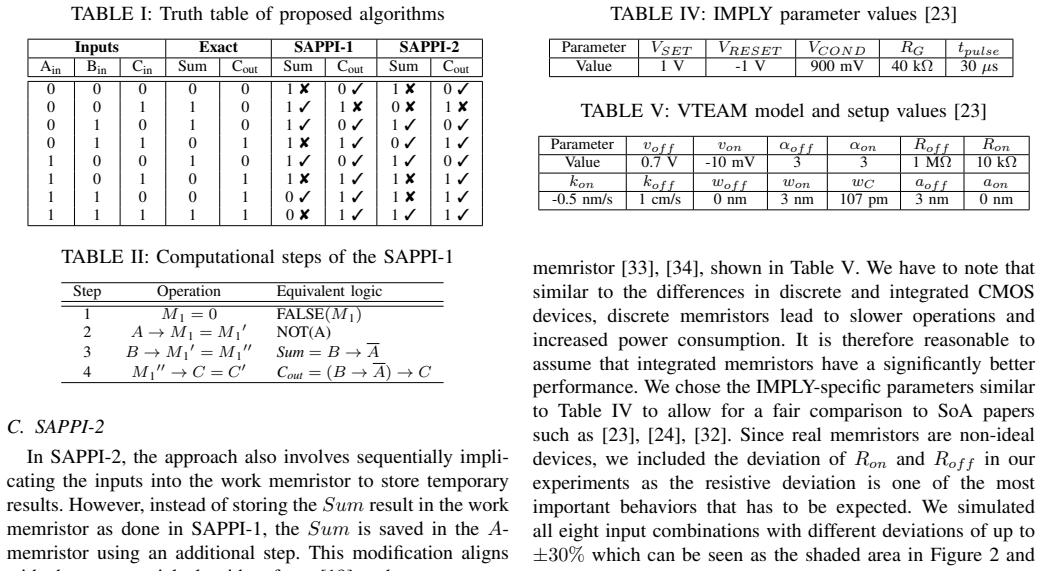
In the serial IMPLY topology, one IMPLY or FALSE operation runs per cycle and the second operand is overwritten. SAPPI turns this overwrite into the computation: reset the work memristor $M$ to 0 (FALSE), then $A \to M$ gives $\overline{A}$, then $B \to M$ gives $\overline{AB}$ (the Sum for SAPPI-1), then $M \to C$ gives $AB + C$ (the carry-out for both). SAPPI-2 adds a fifth step, $C' \to A$, which stores the Sum in the A-memristor and changes the error pattern so that the '001' mistake is partially mitigated. The key object is the reusable work memristor plus the carry-in memristor that is overwritten once, giving a defined error rate of 1/8 for Cout and 4/8 for Sum.
What would settle it
Build an 8-bit ripple-carry adder with four SAPPI-1 (or SAPPI-2) low bits and four exact bits on a real integrated memristive crossbar, run all 65,536 input pairs, and compare the total cycle count and energy to the exact 22n-step adder; if the measured savings is below 39% in either steps or energy, because of extra carry-propagation cycles, signal restoration, or non-additive per-bit energy, the paper's central quantitative claim is refuted.
Extended reading notes
Core claim
The central discovery is that the destructive overwrite behavior of IMPLY logic can itself be used as a design resource rather than a liability. By sequentially implicating the two input memristors into a reset work memristor, the algorithms form the sum as a NAND of the inputs in four steps (SAPPI-1) or five steps (SAPPI-2), and form the carry-out by implicating that intermediate result into the carry-in memristor. The deliberate approximation is concentrated: the carry-out is wrong only for the input pattern '001', and the sum is wrong in four of eight input combinations. SAPPI-1 preserves both input states after the operation, which the authors describe as the first IMPLY adder to do so, at the cost of extra work memristors; SAPPI-2 writes the sum into the A-memristor, which matches the exact serial algorithm's interface. The paper claims these designs beat the exact adder by 39%–42% in energy and 39%–41% in steps, beat the state-of-the-art approximate IMPLY adders by 9%–13% in energy and 7%–10% in steps, keep PSNR above 30 dB in three image-processing tasks with up to half of the RCA approximated, and preserve MNIST accuracy in a CNN with up to four approximated adders.
Load-bearing premise
The savings figures assume that the energy and step counts of a whole ripple-carry adder are just the sums of the per-bit values, with no extra work when a carry passes between slices, and that the behavior measured on discrete memristors carries over to integrated devices; the authors note integrated devices should be faster and use less power, but the 39%–42% numbers depend on that transfer.
Editorial extensions
If this is right
- In an n-bit ripple-carry adder with k approximated low bits, SAPPI-1 gives $4k + 22(n-k)$ steps and SAPPI-2 gives $5k + 22(n-k)$ steps, versus $22n$ for the exact adder, yielding the claimed 39%–41% step savings.
- For image addition and grayscale conversion, both algorithms keep PSNR above 30 dB with up to 4/8 approximated adders; for Gaussian smoothing, the threshold is reached with up to 8/20 approximated adders.
- In MNIST classification with a partially approximated 20-bit RCA inside a shift-and-add multiplier, a fully connected network keeps accuracy up to six approximated adders and a LeNet-5-style CNN up to four approximated adders, with SAPPI-1 saving up to 296 mJ (21%) and 1.33 billion steps (20%) per CNN inference.
- Because SAPPI-1 preserves both input memristor states, the same input data can be reused for later computations without reloading, which prior IMPLY adder designs cannot do.
- The approximation degree is reconfigurable per run because IMPLY adders are algorithm-defined, so the same hardware can trade accuracy for efficiency depending on the application's error tolerance.
Reading between the lines
- The paper does not explore composing SAPPI with error-correction or prediction circuits: since the only carry error is the '001' pattern, a cheap decoder could detect and fix most of the damage, potentially extending the acceptable approximation degree beyond 4/8.
- If the additive energy model holds on integrated devices, the same percentage savings should carry over to wider adders and to multipliers, so a natural next check is measuring a full 32-bit RCA or a multiplier in an integrated memory array rather than extrapolating from per-bit simulation.
- Because SAPPI-1 preserves both operands, it may enable iterative in-memory algorithms such as accumulation or averaging that reuse the same inputs many times; the paper only demonstrates single-pass addition and multiplication, leaving this potential implicit.
- The trade-off between SAPPI-1's lower energy per bit and SAPPI-2's better error metrics at high approximation degrees suggests a runtime-selectable knob within the same adder family, which could be tuned per bit based on application sensitivity.
Signed reviews
Editorial analysis
A structured set of objections, weighed in public.
Referee Report
Summary. This manuscript proposes two approximate full adders, SAPPI-1 and SAPPI-2, for serial memristive IMPLY logic. SAPPI-1 uses 4 steps per bit and stores the Sum in a work memristor while preserving the A and B operands; SAPPI-2 uses 5 steps per bit and stores the Sum in the A memristor. The authors verify all eight input combinations with LT-SPICE using the VTEAM model under up to +-30% resistance variation, report per-cell energy and step counts, and combine them in linear RCA formulas to claim 39%-41% step and 39%-42% energy reductions against an exact serial adder. They then evaluate partially approximated RCAs in three image-processing tasks using PSNR/MSSIM and in FC-NN/CNN classifiers on MNIST, reporting application-level energy and step savings while maintaining accuracy.
Significance. If the step and energy claims survive scrutiny in a realistic crossbar setting, the contribution is useful: a very short 4-step per-bit serial IMPLY adder with an acceptable error profile for image processing, plus one of the first demonstrations of approximate IMPLY adders in CNN inference. The algorithmic step count reduction is well defined and independent of device models, and the SPICE verification with resistance variation is a concrete strength. The paper is also honest in reporting that its re-simulations of baseline circuits do not match the published values. The main obstacles are the incorrect Boolean equations for Sum and the unvalidated additive energy model, both of which must be fixed before the headline quantitative claims can be accepted.
major comments (4)
- [Eq. (1) and Eq. (3), Section III-B/III-C] Equation (1) states Sum = B -> A = AB. In Boolean algebra B -> A is not AB but not-B or A, and the step sequence in Table II actually implements M = not(A) or not(B) = NAND(A,B), which is what the truth table shows. Equation (3) is likewise inconsistent with Table III: step 5 writes C' -> A, which yields Sum = A or not(C), not AB + C + A. The authors should correct these Boolean expressions and the notation B -> A, since the step sequences and truth tables are otherwise self-consistent.
- [Section V-A, Eqs. (5)-(6)] The energy claims rest on per-bit energies measured from isolated two-memristor cells and then summed linearly over k approximate and n-k exact bits. In a real serial IMPLY crossbar, cells share word-line and bit-line drivers, so every IMPLY or FALSE step also charges shared lines and can create sneak-path currents that are absent in isolated-cell LT-SPICE runs. The footnote in Table VII already reports unexplained discrepancies between the authors' re-simulations and the published values for [23] and [32]. Because the 39%-42% energy reduction is a headline result, the authors should either simulate a multi-bit crossbar or provide a concrete overhead model demonstrating that shared-line effects do not materially change the claimed savings.
- [Section III-A and Introduction] The paper states that the proposed approach is the first adder algorithm that maintains all input states after the operation. This is not literally true: SAPPI-1 overwrites the carry input C in step 4, and SAPPI-2 additionally overwrites A in step 5. If the claim refers only to the A and B operands, it should be stated that way; as written, it overstates the property.
- [Section VII-B and Table VIII] The application-level energy and step savings for the CNN inference (296 mJ, 1.33 billion steps) and for image processing are computed by extrapolating per-bit adder savings through the shift-and-add multiplier, but the paper does not describe the calculation or account for the cost of loading operands, storing partial products, or moving data between memristors in the serial topology. The authors should provide the derivation for these application-level numbers, or clearly state which overheads are excluded, so that the ML and image-processing savings are reproducible.
minor comments (5)
- [Figs. 2 and 3] The time axis label reads 'Time in s', but the simulations use 30 us pulses; the label should be 'Time in us' or the axis should be rescaled.
- [Section III-B and Section V-C] The text in Section III-B says an n-bit addition using only SAPPI-1 requires 3n+1 memristors, while Section V-C and Table VII report 2n+k+3 memristors for a mixed RCA; these counts should be reconciled with a clear definition of n and k.
- [References] References [20] and [35] appear to be the same paper and should be merged or distinguished.
- [Section VI-B] The sentence 'our approach is not able to reach the 30dB threshold of PSNR with 5/8 approximated adders' should specify that this refers to the evaluated image-processing tasks, since the ML experiments still show acceptable accuracy at some approximation degrees.
- [Section VII and Fig. 5] The text gives accuracy thresholds but not the exact accuracy values or the formula used to compute energy savings for the FC-NN and CNN experiments; adding a short description of the calculation and a table of the accuracy numbers would improve reproducibility.
Circularity Check
No significant circularity: the step and energy savings are arithmetic consequences of per-full-adder step counts and SPICE energy measurements, not of fitted parameters; minor self-citation in the exact baseline does not make the derivation circular.
full rationale
The paper's central quantitative claims are not circular. SAPPI-1 and SAPPI-2 are defined by the IMPLY step sequences in Tables II and III, giving 4 and 5 steps per full adder. The exact serial adder [19] is an independent, published algorithm with 22 steps per bit; this count is not derived from the proposed adders. The energy savings rest on Eqs. (5)-(6), where the coefficients 0.7980 nJ, 1.0919 nJ and 4.8250 nJ are the mean per-full-adder energies measured in LT-SPICE under the stated VTEAM parameters (Tables IV-V), not parameters fitted to reproduce the 39%-42% claim. Total energy is then a linear sum over k approximated and n-k exact bits; the claimed savings are the arithmetic difference of these measured values, so no quantity is defined in terms of the result it is supposed to predict. The application-level savings (Tables VIII and Figure 5) are the same per-adder values scaled by image size or MNIST inference operation counts, which is a scaling calculation, not a new fitted prediction. The main self-citation is the choice of [19] (Rohani and TaheriNejad, same group) as the 'exact algorithm' baseline, and the VTEAM SPICE implementation [33] by the same group; this is a minor baseline choice, not a load-bearing circular step, because [19]'s step count is externally checkable and an independent exact adder [35] is also tabulated. The footnote to Table VII explicitly reports that the authors' re-simulations of [23] and [32] differ from the published values ('we are not sure why'), which is a calibration/reliability limitation in the SoA comparison; it weakens the 'up to 10%/13% over SoA' sub-claim but does not make the derivation circular.
Assumptions & free parameters
free parameters (3)
- E_approx_SAPPI1 =
0.7980 nJ per bit
- E_approx_SAPPI2 =
1.0919 nJ per bit
- E_exact =
4.8250 nJ per bit
assumptions (4)
- domain assumption IMPLY operation follows P to Q = not-P or Q and overwrites the second operand; memristor resistances satisfy Ron << RG << Roff and voltage constraints VCOND < VC < VSET.
- domain assumption Energy and step counts of an n-bit RCA are additive sums of per-bit energies and steps, as in Eqs. (5)-(8), with no inter-bit or crossbar-level overhead.
- domain assumption LT-SPICE VTEAM model parameters in Tables IV and V, fitted to discrete Knowm devices, are representative enough to extrapolate to integrated memristors.
- domain assumption All eight input combinations are equally weighted when computing error metrics MED, NMED, and MRED.
Cite this review
Pith. "Pith review of IMPLY-based Approximate Full Adders for Efficient Arithmetic Operations in Image Processing and Machine Learning." pith.science (2026). https://pith.science/paper/5KQUC76Q
@misc{pith2026241215888,
  author       = {Pith},
  title        = {Pith review of: IMPLY-based Approximate Full Adders for Efficient Arithmetic Operations in Image Processing and Machine Learning},
  year         = {2026},
  howpublished = {\url{https://pith.science/paper/5KQUC76Q}},
  note         = {Machine review of arXiv:2412.15888}
}
read the original abstract
To overcome the performance limitations in modern computing, such as the power wall, emerging computing paradigms are gaining increasing importance. Approximate computing offers a promising solution by substantially enhancing energy efficiency and reducing latency, albeit with a trade-off in accuracy. Another emerging method is memristor-based In-Memory Computing (IMC) which has the potential to overcome the Von Neumann bottleneck. In this work, we combine these two approaches and propose two Serial APProximate IMPLY-based full adders (SAPPI). When embedded in a Ripple Carry Adder (RCA), our designs reduce the number of steps by 39%-41% and the energy consumption by 39%-42% compared to the exact algorithm. We evaluated our approach at the circuit level and compared it with State-of-the-Art (SoA) approximations where our adders improved the speed by up to 10% and the energy efficiency by up to 13%. We applied our designs in three common image processing applications where we achieved acceptable image quality with up to half of the RCA approximated. We performed a case study to demonstrate the applicability of our approximations in Machine Learning (ML) underscoring the potential gains in more complex scenarios. The proposed approach demonstrates energy savings of up to 296 mJ (21%) and a reduction of 1.3 billion (20%) computational steps when applied to Convolutional Neural Networks (CNNs) trained on the MNIST dataset while maintaining accuracy.
Figures


Figures from the paper (4 more)


Reference graph
Works this paper leans on
-
[23]
S. E. Fatemieh et al. Fast and compact serial imply-based approximate full adders applied in image processing. IEEE Journal on Emerging and Selected Topics in Circuits and Systems , 13(1):175–188, 2023
work page 2023
-
[32]
S. Asgari et al. Energy-efficient and fast imply-based approximate full adder applying nand gates for image processing. Computers and Electrical Engineering, 113:109053, 2024
work page 2024
-
[1]
A. Boroumand et al. Google workloads for consumer devices: Mitigating data movement bottlenecks. SIGPLAN Notices, 53(2):316–331, 2018
work page 2018
-
[2]
N. TaheriNejad. In-memory computing: Global energy consumption, carbon footprint, technology, and products status quo. In IEEE Nano Conference, pp. 1–6, 2024
work page 2024
-
[3]
N. Taherinejad et al. Memristors’ potential for multi-bit storage and pattern learning. In 2015 IEEE European Modelling Symposium (EMS) , pp. 450–455, Oct 2015
work page 2015
-
[4]
N. Taherinejad et al. Fully digital write-in scheme for multi-bit memristive storage. In 2016 13th International Conference on Electrical Engineering, Computing Science and Automatic Control (CCE), pp. 1–6, Sept 2016
work page 2016
-
[5]
D. Radakovits and N. TaheriNejad. Implementation and characterization of a memristive memory system. In 2019 IEEE 32nd Canadian Conference on Electrical and Computer Engineering (CCECE), pp. 1–5, May 2019
work page 2019
-
[6]
J. Borghetti et al. Memristive switches enable stateful logic operations via material implication. Nature, 464:873–6, 04 2010
work page 2010
Show all 41 references
-
[7]
Lehtonen and M
E. Lehtonen and M. Laiho. Stateful implication logic with memristors. 2009 IEEE/ACM International Symposium on Nanoscale Architectures , pp. 33–36, 2009
2009
-
[8]
D. B. Strukov et al. The missing memristor found. Nature, 453:80–83, 2008
2008
-
[9]
Gupta et al
S. Gupta et al. Felix: Fast and energy-efficient logic in memory. In 2018 IEEE/ACM International Conference on Computer-Aided Design (ICCAD), pp. 1–7, 2018
2018
-
[10]
TaheriNejad
N. TaheriNejad. Sixor: Single-cycle in-memristor xor. IEEE Transac- tions on Very Large Scale Integration (VLSI) Systems , 29(5):925–935, 2021
2021
-
[11]
Huang et al
P. Huang et al. Reconfigurable nonvolatile logic operations in resistance switching crossbar array for large-scale circuits. Advanced Materials , 28(44):9758–9764, 2016
2016
-
[12]
Kvatinsky et al
S. Kvatinsky et al. Magic—memristor-aided logic. IEEE Transactions on Circuits and Systems II: Express Briefs , 61(11):895–899, 2014
2014
-
[13]
Kvatinsky et al
S. Kvatinsky et al. Memristor-based imply logic design procedure. In 2011 IEEE 29th International Conference on Computer Design (ICCD) , pp. 142–147, 2011
2011
-
[14]
Radakovits and N
D. Radakovits and N. Taherinejad. Behavioral leakage and inter- cycle variability emulator model for rerams (BELIEVER). CoRR, abs/2103.04179, 2021
2021 arXiv
-
[15]
Liu et al
W. Liu et al. A retrospective and prospective view of approximate computing. Proceedings of the IEEE , 108:394–399, 03 2020
2020
-
[16]
Gupta et al
V . Gupta et al. Low-power digital signal processing using approximate adders. IEEE Transactions on Computer-Aided Design of Integrated Circuits and Systems , 32(1):124–137, 2013
2013
-
[17]
Jiang et al
H. Jiang et al. A review, classification, and comparative evaluation of approximate arithmetic circuits. ACM Journal on Emerging Technologies in Computing Systems (JETC) , 13(4), 2017
2017
-
[18]
L. Chua. Memristor-the missing circuit element. IEEE Transactions on Circuit Theory, 18(5):507–519, 1971
1971
-
[19]
S. G. Rohani and N. TaheriNejad. An improved algorithm for imply logic based memristive full-adder. In 2017 IEEE 30th Canadian Conference on Electrical and Computer Engineering (CCECE), pp. 1–4, 2017
2017
-
[20]
Karimi and A
A. Karimi and A. Rezai. Novel design for a memristor-based full adder using a new imply logic approach. Journal of Computational Electronics, 17(3):1303–1314, 2018
2018
-
[21]
Radakovits et al
D. Radakovits et al. A memristive multiplier using semi-serial imply- based adder. IEEE Transactions on Circuits and Systems I: Regular Papers, 67(5):1495–1506, 2020
2020
-
[22]
Kvatinsky et al
S. Kvatinsky et al. Memristor-based material implication (imply) logic: Design principles and methodologies. IEEE Transactions on Very Large Scale Integration (VLSI) Systems , 22(10):2054–2066, 2014
2014
-
[24]
Seiler and N
F. Seiler and N. TaheriNejad. An imply-based semi-serial approximate in-memristor adder. In 2023 IEEE Nordic Circuits and Systems Confer- ence (NorCAS), pp. 1–7, 2023
2023
-
[25]
S. E. Fatemieh et al. Approximate in-memory computing using mem- ristive imply logic and its application to image processing. In 2022 IEEE International Symposium on Circuits and Systems (ISCAS) , pp. 3115–3119, 2022
2022
-
[26]
TaheriNejad et al
N. TaheriNejad et al. A semi-serial topology for compact and fast imply- based memristive full adders. In 2019 17th IEEE International New Circuits and Systems Conference (NEWCAS) , pp. 1–4, 2019
2019
-
[27]
Ganjeheizadeh Rohani et al
S. Ganjeheizadeh Rohani et al. A semiparallel full-adder in imply logic. IEEE Transactions on Very Large Scale Integration (VLSI) Systems , 28(1):297–301, 2020
2020
-
[28]
Jiang et al
H. Jiang et al. Approximate arithmetic circuits: A survey, characteriza- tion, and recent applications. Proceedings of the IEEE , 108(12):2108– 2135, 2020
2020
-
[29]
H. A. Almurib et al. Inexact designs for approximate low power addition by cell replacement. In 2016 Design, Automation & Test in Europe Conference & Exhibition (DATE) , pp. 660–665, 01 2016
2016
-
[30]
Jiang et al
H. Jiang et al. A review, classification, and comparative evaluation of approximate arithmetic circuits. ACM Journal on Emerging Technologies in Computing Systems (JETC) , 13:1 – 34, 2017
2017
-
[31]
S. Mittal. A survey of techniques for approximate computing. ACM Computing Surveys, 48(4):1–33, 2016
2016
-
[33]
D. R. M. Jungwirth and N. TaheriNejad. Spice implementation of vteam model, 2018
2018
-
[34]
Last accessed Feb 2024
Knowm sdc memristors, knowm.org/downloads/Knowm Memristors.pdf. Last accessed Feb 2024
2024
-
[35]
Karimi and A
A. Karimi and A. Rezai. Novel design for a memristor-based full adder using a new imply logic approach. Journal of Computational Electronics, 17, 09 2018
2018
-
[36]
Khaleqi Qaleh Jooq et al
M. Khaleqi Qaleh Jooq et al. Ultraefficient imprecise multipliers based on innovative 4:2 approximate compressors. International Journal of Circuit Theory and Applications , 49:169–184, 2021
2021
-
[37]
Amirafshar et al
N. Amirafshar et al. Carry disregard approximate multipliers. IEEE Transactions on Circuits and Systems I: Regular Papers , 70(12):4840– 4853, 2023
2023
-
[38]
L. Deng. The mnist database of handwritten digit images for machine learning research. IEEE Signal Processing Magazine , 29(6):141–142, 2012
2012
-
[39]
Lecun et al
Y . Lecun et al. Gradient-based learning applied to document recognition. Proceedings of the IEEE , 86(11):2278–2324, 1998
1998
-
[40]
Shakibhamedan et al
S. Shakibhamedan et al. An analytical approach to enhancing DNN efficiency and accuracy using approximate multiplication. In 2nd Work- shop on Advancing Neural Network Training: Computational Efficiency, Scalability, and Resource Optimization (WANT@ICML 2024) , 2024
2024
-
[41]
Shakibhamedan et al
S. Shakibhamedan et al. Ace-cnn: Approximate carry disregard multipliers for energy-efficient cnn-based image classification. IEEE Transactions on Circuits and Systems I: Regular Papers , 71(5):2280– 2293, 2024
2024
Reviewed August 11, 2026 · model on record in the stance chip above.
Discussion (0). Continue with ORCID to comment.