REVIEW 4 major objections 5 minor 68 references
NeuroPump: Simultaneous Geometric and Color Rectification for Underwater Images
T0 review · 4 major / 5 minor · reviewed 2026-08-11 · deepseek-v4-flash
Pith's one-line read This paper claims that underwater photographs can have their refraction-warped geometry and water-discolored colors corrected in a single self-supervised neural rendering pass.
desk verdict A genuinely useful joint underwater rectification pipeline with a real paired dataset; the geometry branch rests on an acknowledged but unquantified s≈0 assumption, so treat the geometric claims as conditional pending sensitivity analysis. read the letter →
The pith
A machine-rendered reading of the paper's core claim, the machinery that carries it, and where it could break.
The reading
What carries the argument
The load-bearing mechanism is a volume-rendering model that treats water as two decoupled physical effects. Each camera ray is bent once at the flat lens-case interface by Snell's law, giving the refracted ray $r_w$; the accumulated color follows the simplified scattering-plus-absorption model $I(r_w) \approx e^{-\beta d}J(r_w) + (1-e^{-\beta d})A$, where $\beta$ is the per-channel water attenuation, $A$ is the global background light, $d$ is the distance to the first opaque surface, and $J$ is the unattenuated in-air radiance. The network learns the radiance field $(c_o, \sigma_o)$ together with $\beta$ and $A$; rendering without the water terms yields the rectified in-air image, while the simplified pre-rectification factor $h = \tan(\phi_w)/\tan(\phi_a)$ (valid when the optical-center-to-interface distance $s \approx 0$) rewrites underwater images before pose estimation.
What would settle it
Take a flat-port underwater camera whose $s$ has been measured, capture a scene with known 3D structure, and compare poses and depths obtained with the simplified factor $h = \tan(\phi_w)/\tan(\phi_a)$ against those obtained with the full expression; a systematic divergence without another error source would refute the $s \approx 0$ basis of the geometric claim.
Extended reading notes
Core claim
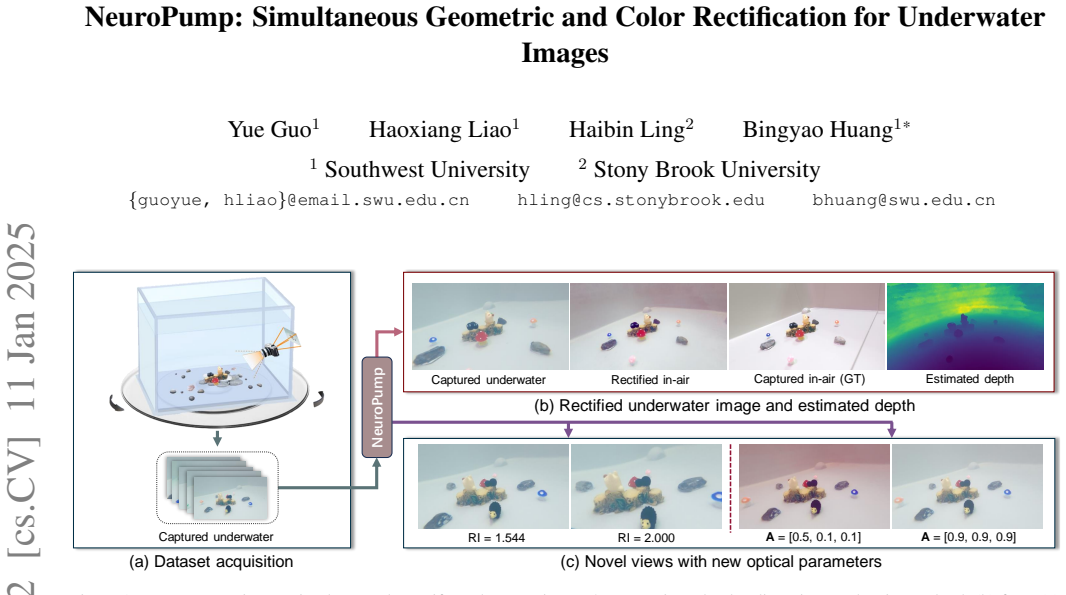
The paper's central claim is that a single neural renderer can recover both the geometric and the color corrections for underwater images at once. Instead of removing refraction with a dome port or approximating it as radial distortion, NeuroPump bends each camera ray once at the flat lens-case interface using Snell's law, then renders color with a simplified underwater formation model $I \approx e^{-\beta d}J + (1-e^{-\beta d})A$, where $\beta$ is per-channel water attenuation, $A$ is global background light, and $J$ is the unattenuated in-air radiance. After training, turning off the water terms yields a rectified in-air image and depth, and changing the decoupled optical parameters yields synthetic novel views with different water properties. The paper reports that on its new real paired 360-degree benchmark, this joint rectification is quantitatively and qualitatively closer to the captured in-air ground truth than sequential pipelines that first fix refraction and then apply a color-restoration method.
Load-bearing premise
The geometric correction rests on treating the perpendicular distance between the camera's optical center and the flat lens-case window as negligible ($s \approx 0$); if that distance is not negligible for a given camera, the pre-rectified images fed to pose estimation are warped by the wrong factor and the recovered geometry is biased.
Editorial extensions
If this is right
- Underwater 3D capture with a plain flat-port camera can recover geometrically correct depth and a color-true in-air appearance without a dome port.
- A single trained scene representation supports novel-view synthesis and lets a user change refractive index, background light, and attenuation to simulate different water conditions.
- Joint rectification, rather than separate color and geometry pipelines, becomes a viable default for underwater neural radiance field reconstruction.
- The new real paired 360-degree benchmark gives future methods a way to measure both geometry and color rectification against true in-air images.
Reading between the lines
- A natural next test is to estimate the optical-center-to-interface distance $s$ instead of assuming it is zero; the paper itself lists joint estimation of intrinsics, extrinsics, and water parameters as future work.
- Because the water parameters are learned separately from the scene radiance, a model trained in clear lab water could in principle be re-rendered with field-measured attenuation and background light, moving the approach from tank to open water.
- The limit imposed by feature-matching pose estimation suggests that turbid-water failure is as much a pose-estimation problem as a rendering problem; a pose-free variant would isolate how much of the geometric gain comes from Snell's law itself.
Signed reviews
Editorial analysis
A structured set of objections, weighed in public.
Referee Report
Summary. The paper proposes NeuroPump, a self-supervised NeRF-based method that simultaneously rectifies geometric distortion (refraction at a flat lens-case interface) and color distortion (absorption and scattering) in underwater images. The model extends mip-NeRF 360 with an explicit Snell's-law ray-bending step and an underwater image formation model with per-scene attenuation coefficients and global background light, trained by a reconstruction loss plus auxiliary losses on color cast and ray distributions. The authors also introduce a real captured 360-degree benchmark with paired underwater and in-air ground-truth images across five setups. Experiments report that NeuroPump outperforms separate color and geometry rectification baselines on the joint rectification task (PSNR 22.76 vs. 20.88 for the best physics-based baseline), while geometry-only rectification is roughly on par with the Lavest radial-distortion approximation. The paper additionally demonstrates novel-view and novel-optical-parameter synthesis.
Significance. If the central claim holds, NeuroPump is a useful step beyond prior work that handles underwater color and geometry separately: it provides a single self-supervised pipeline that recovers an in-air scene representation from underwater multi-view images, and it releases a real paired benchmark that avoids purely synthetic evaluation. The evaluation is not circular: in-air ground truth is used only for assessment, not for fitting, since the in-air output is obtained by inverting the learned underwater formation model. The derivations in Sec. 3 and the supplementary are mostly standard and clearly presented, and the decoupling of refractive index, attenuation, and background light enables a genuinely new synthesis capability. The main weaknesses are in the geometric branch: the load-bearing s≈0 assumption for the GoPro Hero 8 is not validated, and there are algebraic inconsistencies in the pre-rectification formula and in the brightness compensation equation. These issues are fixable and do not undermine the overall idea, but they must be addressed before the paper's core claims can be fully accepted.
major comments (4)
- [§4.1, Supp. C (Eq. 21/25) and Sec. 7] The geometric rectification used for COLMAP pose estimation rests on the assumption s≈0 for the GoPro Hero 8, but the paper provides no measurement of s, no upper bound, and no sensitivity analysis. In the exact factor (Supp. Eq. 25), h depends on the object depth z through (z−s); the simplified form h=tan(ϕw)/tan(ϕa) removes that depth dependence. Since COLMAP receives only pre-rectified images, a systematic warp error at near depths would bias all estimated poses and propagate into the density/color field and the final in-air rendering. The paper acknowledges the assumption as a limitation in Sec. 7, but it is load-bearing for the central 'simultaneous geometric and color rectification' claim. Please report a measured value or upper bound for s for the actual camera, and provide a sensitivity study (e.g., perturbing s by plausible amounts and reporting pose/rectification changes), or replace the assumption by joint estimation of s with poses.
- [§4.1 vs. Supp. C (Eq. 21 vs. Eq. 26)] The simplified rectification factor is inverted between the main text and the supplementary material. Main-text Eq. (21) states that for s≈0, h=tan(ϕa)/tan(ϕw), while Supp. Eq. (26) states h=tan(ϕw)/tan(ϕa). Substituting s=0 into Eq. (21) gives h=tan(ϕw)/tan(ϕa), agreeing with the supplementary derivation. The main-text expression is therefore inverted; if implemented, it would warp the pre-rectified images in the wrong direction, affecting COLMAP keypoint matching and pose estimation. Please correct the main-text formula and verify that the experiments used the correct form.
- [§6.1, Eq. (20)] The brightness compensation update is written as ˆJ(ra) ← −max(1,W) ˆJ(ra). Taken literally, this multiplies the in-air radiance by a negative scale, producing an invalid inverted image rather than the brighter output that the ablation and Tab. 4 describe. The surrounding text indicates the intended operation is a positive multiplication by max(1,W) or W. Please correct the equation and clarify whether the arrow denotes an assignment in an algorithmic step, since this term is load-bearing for the color-rectification results.
- [Tab. 3 and Sec. 6] The joint-rectification advantage over the best separate pipeline is driven almost entirely by color: the geometry-only PSNR for Ours and Mip360(Lav) is effectively identical (21.09 vs. 21.09), with similar SSIM/RMSE. The paper should state this explicitly and provide additional geometric evidence beyond image-domain metrics, such as per-setup pose accuracy or depth error relative to the paired benchmark, to support the claim that the Snell's-law geometry branch is genuinely more accurate than the Lavest radial-distortion approximation. As written, the simultaneous-rectification claim is supported mainly by the color channel, and the geometry branch also inherits the unvalidated s≈0 assumption from the first comment.
minor comments (5)
- [§4.1 and Supp. C] The cross-references are inconsistent: the main text says 'apply Eq. 25' and the supplementary refers to 'main paper's Eq. 25', but the equations are numbered Eq. (21) in the main text and Eq. (26) in the supplementary. Please harmonize the equation numbering throughout.
- [§6.1, Eq. (20)] The use of '←' inside a displayed mathematical formula is unusual; if this denotes an algorithmic assignment, please use explicit pseudocode or a clear notation to avoid ambiguity with mathematical equality.
- [§7] The sentence 'We present a the first model that simultaneously restores both geometric and color distortions' contains a typo ('a the'); please correct it.
- [Tab. 3] The note that the identical value of Ours and Mip360 (Lav) + Others baselines is a coincidence is confusing as printed; please rephrase or remove it, since the table caption already explains the grouping.
- [Abstract] The phrase 'to our best knowledge' should be 'to the best of our knowledge' for grammatical correctness.
Circularity Check
No significant circularity: the in-air output is produced by inverting a physically parameterized forward model trained only on underwater views, with paired in-air ground truth used only for evaluation.
full rationale
The derivation chain is self-contained in the relevant sense. NeuroPump trains only on underwater multi-view images, minimizing a reconstruction loss (Eq. 16) against the input views; the in-air output J(ra) (Eq. 15) is produced by rendering the same learned object radiance field after removing the explicitly modeled attenuation and back-scatter (Eqs. 11-12). No in-air ground-truth image is used to fit beta, A, or the MLP weights; the paired GT dataset (Sec. 5) is used only for evaluation (Tabs. 3-5). The brightness compensation (Eq. 20) is a deterministic global scale computed from the model's own outputs and input statistics, not a parameter fitted to the target. The geometry branch applies Snell's law both in the COLMAP pre-rectification (Sec. 4.1, Supp. Eq. 25-26) and in the NeRF ray casting; this consistency is a modeling choice, not a reduction of the prediction to its inputs. The acknowledged s≈0 assumption (Sec. 7) is a potential accuracy limitation for cameras with a thick lens housing, and the paper explicitly notes it 'may not apply to all cameras'; but an untested modeling assumption is an approximation risk, not a circular dependency. There are no load-bearing self-citations: citations to Sea-thru, Jaffe, and mip-NeRF 360 are external and code-reproduced or standard results, and the Snell-law derivation is textbook. Hence no step is equivalent to its input by construction. A separate correctness concern is that the main text after Eq. 21 and Supp. Eq. 26 give reciprocal forms for h under the s≈0 simplification, but that internal inconsistency affects accuracy rather than circularity.
Assumptions & free parameters
free parameters (3)
- Water attenuation coefficients β =
learned, initialized to [0.4, 0.2, 0.2], bounded [0.1, 1]
- Global background light A =
learned, initialized to [0.9, 0.9, 0.9], bounded [0, 1]
- Loss weight λ =
10^-3
assumptions (6)
- standard math Snell's law governs refraction at a flat lens case interface (Eq. 2).
- domain assumption Underwater image formation model: I ≈ e^{-βd} J + (1 - e^{-βd}) A (Eq. 11).
- domain assumption β and A are uniform along each ray and across the scene.
- domain assumption Objects are opaque, with σ_o(d) ≈ 1 and no object in front of the first intersection d.
- ad hoc to paper The distance s between the camera optical center and the lens case interface is negligible (s ≈ 0) for the GoPro Hero 8.
- domain assumption Camera poses are obtained by COLMAP on pre-rectified images using a pinhole camera model.
Cite this review
Pith. "Pith review of NeuroPump: Simultaneous Geometric and Color Rectification for Underwater Images." pith.science (2026). https://pith.science/paper/N4UHR67V
@misc{pith2026241215890,
  author       = {Pith},
  title        = {Pith review of: NeuroPump: Simultaneous Geometric and Color Rectification for Underwater Images},
  year         = {2026},
  howpublished = {\url{https://pith.science/paper/N4UHR67V}},
  note         = {Machine review of arXiv:2412.15890}
}
read the original abstract
Underwater image restoration aims to remove geometric and color distortions due to water refraction, absorption and scattering. Previous studies focus on restoring either color or the geometry, but to our best knowledge, not both. However, in practice it may be cumbersome to address the two rectifications one-by-one. In this paper, we propose NeuroPump, a self-supervised method to simultaneously optimize and rectify underwater geometry and color as if water were pumped out. The key idea is to explicitly model refraction, absorption and scattering in Neural Radiance Field (NeRF) pipeline, such that it not only performs simultaneous geometric and color rectification, but also enables to synthesize novel views and optical effects by controlling the decoupled parameters. In addition, to address issue of lack of real paired ground truth images, we propose an underwater 360 benchmark dataset that has real paired (i.e., with and without water) images. Our method clearly outperforms other baselines both quantitatively and qualitatively. Our project page is available at: https://ygswu.github.io/NeuroPump.github.io/.
Figures


Figures from the paper (4 more)


Reference graph
Works this paper leans on
-
[1]
A revised underwater image formation model
Derya Akkaynak and Tali Treibitz. A revised underwater image formation model. In Proceedings of the IEEE/CVF Conference on Computer Vision and Pattern Recognition (CVPR), pages 6723–6732, 2018. 2
work page 2018
-
[2]
Sea-thru: A method for removing water from underwater images
Derya Akkaynak and Tali Treibitz. Sea-thru: A method for removing water from underwater images. In Proceedings of the IEEE/CVF Conference on Computer Vision and Pattern Recognition (CVPR), pages 1682–1691, 2019. 1, 3, 5
work page 2019
-
[3]
Enhancing underwater images and videos by fusion
Cosmin Ancuti, Codruta Orniana Ancuti, Tom Haber, and Philippe Bekaert. Enhancing underwater images and videos by fusion. In 2012 IEEE conference on computer vision and pattern recognition, pages 81–88. IEEE, 2012. 7
work page 2012
-
[4]
I-haze: A dehazing bench- mark with real hazy and haze-free indoor images
Cosmin Ancuti, Codruta O Ancuti, Radu Timofte, and Christophe De Vleeschouwer. I-haze: A dehazing bench- mark with real hazy and haze-free indoor images. In Ad- vanced Concepts for Intelligent Vision Systems: 19th Inter- national Conference, ACIVS 2018, Poitiers, France, Septem- ber 24–27, 2018, Proceedings 19, pages 620–631. Springer,
2018
-
[5]
Ancuti, Cosmin Ancuti, Christophe De Vleeschouwer, and Philippe Bekaert
Codruta O. Ancuti, Cosmin Ancuti, Christophe De Vleeschouwer, and Philippe Bekaert. Color bal- ance and fusion for underwater image enhancement. IEEE Transactions on Image Processing (TIP) , 27(1):379–393,
-
[6]
Mip-nerf 360: Unbounded anti-aliased neural radiance fields
Jonathan T Barron, Ben Mildenhall, Dor Verbin, Pratul P Srinivasan, and Peter Hedman. Mip-nerf 360: Unbounded anti-aliased neural radiance fields. In Proceedings of the IEEE/CVF Conference on Computer Vision and Pattern Recognition (CVPR), pages 5470–5479, 2022. 2, 5, 6, 7
work page 2022
-
[7]
Eikonal fields for refractive novel-view synthesis
Mojtaba Bemana, Karol Myszkowski, Jeppe Revall Frisvad, Hans-Peter Seidel, and Tobias Ritschel. Eikonal fields for refractive novel-view synthesis. In ACM SIGGRAPH 2022 Conference Proceedings, pages 1–9, 2022. 3
work page 2022
-
[8]
Underwater single image color restoration using haze- lines and a new quantitative dataset
Dana Berman, Deborah Levy, Shai Avidan, and Tali Treib- itz. Underwater single image color restoration using haze- lines and a new quantitative dataset. IEEE Transactions on Pattern Analysis and Machine Intelligence (TPAMI) , 43(8): 2822–2837, 2020. 3
work page 2020
Show all 68 references
-
[9]
Augmented reality under water
Lisa Blum, Wolfgang Broll, and Stefan M ¨uller. Augmented reality under water. In SIGGRAPH’09: Posters, pages 1–1
-
[10]
JAX: composable transformations of Python+NumPy programs, 2018
James Bradbury, Roy Frostig, Peter Hawkins, Matthew James Johnson, Chris Leary, Dougal Maclau- rin, George Necula, Adam Paszke, Jake VanderPlas, Skye Wanderman-Milne, and Qiao Zhang. JAX: composable transformations of Python+NumPy programs, 2018. 6
2018
-
[11]
3d reconstruction of natural underwater scenes using the stereovision system iris
Vincent Brandou, Anne-Gaelle Allais, Michel Perrier, Ezio Malis, Patrick Rives, Jozee Sarrazin, and Pierre-Marie Sar- radin. 3d reconstruction of natural underwater scenes using the stereovision system iris. In Proc. MTS/IEEE OCEANS, pages 1–6. IEEE, 2007. 2
2007
-
[12]
Refractive structure-from-motion through a flat refractive interface
Franc ¸ois Chadebecq, Francisco Vasconcelos, George Dwyer, Ren´e Lacher, S ´ebastien Ourselin, Tom Vercauteren, and Danail Stoyanov. Refractive structure-from-motion through a flat refractive interface. In Proc. IEEE Int. Conf. on Com- put. Vis. (ICCV), pages 5325–5333, 2017. 2, 7
2017
-
[13]
W. Chen, W. Yifan, S. Kuo, and G. Wetzstein. Dehazenerf: Multiple image haze removal and 3d shape reconstruction using neural radiance fields. In International Conference on 3D Vision (3DV), 2024. 2, 3, 6
2024
-
[14]
Underwater image en- hancement by wavelength compensation and dehazing.IEEE Trans
John Y Chiang and Ying-Ching Chen. Underwater image en- hancement by wavelength compensation and dehazing.IEEE Trans. Image Processing (TIP), 21(4):1756–1769, 2011. 1, 2
2011
-
[15]
Towards usable underwater virtual reality systems
Raphael Costa, Rongkai Guo, and John Quarles. Towards usable underwater virtual reality systems. In 2017 IEEE Vir- tual Reality (VR), pages 271–272. IEEE, 2017. 1
2017
-
[16]
Aleth-nerf: Low-light condition view synthesis with con- cealing fields
Ziteng Cui, Lin Gu, Xiao Sun, Yu Qiao, and Tatsuya Harada. Aleth-nerf: Low-light condition view synthesis with con- cealing fields. arXiv preprint arXiv:2303.05807, 2023. 3
2023 arXiv
-
[17]
The rov 3d project: Deep-sea underwater survey using photogrammetry: Applications for underwater archaeology
Pierre Drap, Julien Seinturier, Bilal Hijazi, Djamal Merad, Jean-Marc Boi, Bertrand Chemisky, Emmanuelle Seguin, and Luc Long. The rov 3d project: Deep-sea underwater survey using photogrammetry: Applications for underwater archaeology. Journal on Computing and Cultural Herita...
2015
-
[18]
A dataset to evaluate underwater image restoration methods
Amanda Duarte, Felipe Codevilla, Joel De O Gaya, and Sil- via SC Botelho. A dataset to evaluate underwater image restoration methods. In OCEANS 2016-Shanghai, pages 1–
2016
-
[19]
A comprehensive uav indoor navigation system based on vision optical flow and laser fastslam
Wang Fei, CUI Jin-Qiang, CHEN Ben-Mei, and H LEE Tong. A comprehensive uav indoor navigation system based on vision optical flow and laser fastslam. Acta Automatica Sinica, 39(11):1889–1899, 2013. 2, 6
2013
-
[20]
a single image dehaz- ing dataset with low-light real-world indoor images, depth maps and infrared images
A Filin, A Kopylov, and I Gracheva. a single image dehaz- ing dataset with low-light real-world indoor images, depth maps and infrared images. The International Archives of the Photogrammetry, Remote Sensing and Spatial Information Sciences, 48:53–57, 2023. 2, 6
2023
-
[21]
Nerfren: Neural radiance fields with reflec- tions
Yuan-Chen Guo, Di Kang, Linchao Bao, Yu He, and Song- Hai Zhang. Nerfren: Neural radiance fields with reflec- tions. In Proceedings of the IEEE/CVF Conference on Com- puter Vision and Pattern Recognition (CVPR), pages 18409– 18418, 2022. 3
2022
-
[22]
Blind contrast enhancement assessment by gradient ratioing at visible edges
Nicolas Hautiere, Jean-Philippe Tarel, Didier Aubert, and Eric Dumont. Blind contrast enhancement assessment by gradient ratioing at visible edges. Image Analysis & Stereol- ogy, 27(2):87–95, 2008. 2
2008
-
[23]
Single image haze removal using dark channel prior
Kaiming He, Jian Sun, and Xiaoou Tang. Single image haze removal using dark channel prior. IEEE Transactions on Pattern Analysis and Machine Intelligence (TPAMI), 33(12): 2341–2353, 2010. 1, 2, 5
2010
-
[24]
E. Hecht. Optics. Addison-Wesley, 2002. 2, 3, 7
2002
-
[25]
Hdr-nerf: High dynamic range neu- ral radiance fields
Xin Huang, Qi Zhang, Ying Feng, Hongdong Li, Xuan Wang, and Qing Wang. Hdr-nerf: High dynamic range neu- ral radiance fields. In Proceedings of the IEEE/CVF Confer- ence on Computer Vision and Pattern Recognition (CVPR) , pages 18377–18387, 2022. 3
2022
-
[26]
Computer modeling and the design of opti- mal underwater imaging systems
Jules S Jaffe. Computer modeling and the design of opti- mal underwater imaging systems. IEEE Journal of Oceanic Engineering, 15(2):101–111, 1990. 2, 5
1990
-
[27]
Five a+ network: 9 You only need 9k parameters for underwater image enhance- ment
Jingxia Jiang, Tian Ye, Jinbin Bai, Sixiang Chen, Wenhao Chai, Shi Jun, Yun Liu, and Erkang Chen. Five a+ network: 9 You only need 9k parameters for underwater image enhance- ment. arXiv preprint arXiv:2305.08824, 2023. 3
2023 arXiv
-
[28]
Reliable image dehazing by nerf
Zheyan Jin, Shiqi Chen, Huajun Feng, Zhihai Xu, Qi Li, and Yueting Chen. Reliable image dehazing by nerf. arXiv preprint arXiv:2303.09153, 2023. 3
2023 arXiv
-
[29]
Refractive cali- bration of underwater cameras
Anne Jordt-Sedlazeck and Reinhard Koch. Refractive cali- bration of underwater cameras. In Proc. Eur. Conf. Comput. Vis. (ECCV), pages 846–859. Springer, 2012. 1, 2, 7
2012
-
[30]
Refractive structure-from-motion on underwater images
Anne Jordt-Sedlazeck and Reinhard Koch. Refractive structure-from-motion on underwater images. In Proceed- ings of the IEEE international Conference on Computer Vi- sion (ICCV), pages 57–64, 2013. 1, 2
2013
-
[31]
Hdr-plenoxels: Self-calibrating high dynamic range radiance fields
Kim Jun-Seong, Kim Yu-Ji, Moon Ye-Bin, and Tae-Hyun Oh. Hdr-plenoxels: Self-calibrating high dynamic range radiance fields. In Proc. Eur. Conf. Comput. Vis. (ECCV) , pages 384–401. Springer, 2022. 3
2022
-
[32]
Experimen- tal study of the influence of refraction on underwater three- dimensional reconstruction using the svp camera model
Lai Kang, Lingda Wu, and Yee-Hong Yang. Experimen- tal study of the influence of refraction on underwater three- dimensional reconstruction using the svp camera model. Ap- plied Optics, 51(31):7591–7603, 2012. 1, 2
2012
-
[33]
Recording and playback of camera shake: Benchmarking blind deconvolution with a real-world database
Rolf K ¨ohler, Michael Hirsch, Betty Mohler, Bernhard Sch¨olkopf, and Stefan Harmeling. Recording and playback of camera shake: Benchmarking blind deconvolution with a real-world database. In Computer Vision–ECCV 2012: 12th European Conference on Computer Vision, Florence, Ita...
2012
-
[34]
Underwater camera calibration
Jean-Marc Lavest, G ´erard Rives, and Jean-Thierry Laprest´e. Underwater camera calibration. In Proc. Eur. Conf. Comput. Vis. (ECCV), pages 654–668. Springer, 2000. 1, 2, 7
2000
-
[35]
Vision-based object detection and tracking for autonomous navigation of underwater robots
Donghwa Lee, Gonyop Kim, Donghoon Kim, Hyun Myung, and Hyun-Taek Choi. Vision-based object detection and tracking for autonomous navigation of underwater robots. Ocean Engineering, 48:59–68, 2012. 1
2012
-
[36]
Seathru- nerf: Neural radiance fields in scattering media
Deborah Levy, Amit Peleg, Naama Pearl, Dan Rosenbaum, Derya Akkaynak, Simon Korman, and Tali Treibitz. Seathru- nerf: Neural radiance fields in scattering media. In Proceed- ings of the IEEE/CVF Conference on Computer Vision and Pattern Recognition (CVPR), pages 56–65, 2023. 1...
2023
-
[37]
Single underwater image restoration by blue- green channels dehazing and red channel correction
Chongyi Li, Jichang Quo, Yanwei Pang, Shanji Chen, and Jian Wang. Single underwater image restoration by blue- green channels dehazing and red channel correction. InProc. IEEE Int. Conf. on Acoustics, Speech and Signal Processing (ICASSP), pages 1731–1735, 2016. 1, 2
2016
-
[38]
Emerging from water: Underwater image color correction based on weakly supervised color transfer
Chongyi Li, Jichang Guo, and Chunle Guo. Emerging from water: Underwater image color correction based on weakly supervised color transfer. IEEE Signal Processing Letters (SPL), 25(3):323–327, 2018. 2
2018
-
[39]
Underwater scene prior inspired deep underwater image and video en- hancement
Chongyi Li, Saeed Anwar, and Fatih Porikli. Underwater scene prior inspired deep underwater image and video en- hancement. Pattern Recognition, 98:107038, 2020. 2, 3, 6
2020
-
[40]
An underwater image enhancement benchmark dataset and beyond
Chongyi Li, Chunle Guo, Wenqi Ren, Runmin Cong, Junhui Hou, Sam Kwong, and Dacheng Tao. An underwater image enhancement benchmark dataset and beyond. IEEE Trans. Image Processing (TIP), 29:4376–4389, 2020. 2, 3, 6, 7
2020
-
[41]
Watergan: Unsupervised generative net- work to enable real-time color correction of monocular un- derwater images
Jie Li, Katherine A Skinner, Ryan M Eustice, and Matthew Johnson-Roberson. Watergan: Unsupervised generative net- work to enable real-time color correction of monocular un- derwater images. Proc. IEEE Robotics and Automation Let- ters (RAL), 3(1):387–394, 2017. 1, 2
2017
-
[42]
Advanced informa- tion mining from ocean remote sensing imagery with deep learning
Xiaofeng Li, Yuan Zhou, and Fan Wang. Advanced informa- tion mining from ocean remote sensing imagery with deep learning. Journal of Remote Sensing (JRS), 2022. 1
2022
-
[43]
Underwater hyperspec- tral imaging technology and its applications for detecting and mapping the seafloor: A review.Sensors, 20(17):4962, 2020
Bohan Liu, Zhaojun Liu, Shaojie Men, Yongfu Li, Zhongjun Ding, Jiahao He, and Zhigang Zhao. Underwater hyperspec- tral imaging technology and its applications for detecting and mapping the seafloor: A review.Sensors, 20(17):4962, 2020. 1, 2
2020
-
[44]
Nerf: Representing scenes as neural radiance fields for view syn- thesis
Ben Mildenhall, Pratul P Srinivasan, Matthew Tancik, Jonathan T Barron, Ravi Ramamoorthi, and Ren Ng. Nerf: Representing scenes as neural radiance fields for view syn- thesis. Communications of the ACM, 65(1):99–106, 2021. 2, 6
2021
-
[45]
Srinivasan, and Jonathan T
Ben Mildenhall, Peter Hedman, Ricardo Martin-Brualla, Pratul P. Srinivasan, and Jonathan T. Barron. Nerf in the dark: High dynamic range view synthesis from noisy raw im- ages. In Proceedings of the IEEE/CVF Conference on Com- puter Vision and Pattern Recognition (CVPR), pages...
2022
-
[46]
Srinivasan, Peter Hedman, Ricardo Martin-Brualla, and Jonathan T
Ben Mildenhall, Dor Verbin, Pratul P. Srinivasan, Peter Hedman, Ricardo Martin-Brualla, and Jonathan T. Barron. MultiNeRF: A Code Release for Mip-NeRF 360, Ref-NeRF, and RawNeRF, 2022. 6
2022
-
[47]
An underwater augmented reality system for commercial diving operations
R Morales-Garcia, P Keitler, P Maier, and G Klinker. An underwater augmented reality system for commercial diving operations. oceans 2009 mts. In IEEE, Conference Proceed- ings, 2009. 1
2009
-
[48]
Vision in bad weather
Shree K Nayar and Srinivasa G Narasimhan. Vision in bad weather. In Proceedings of the seventh IEEE International Conference on Computer Vision (ICCV) , pages 820–827. IEEE, 1999. 2, 5
1999
-
[49]
Human-visual- system-inspired underwater image quality measures
Karen Panetta, Chen Gao, and Sos Agaian. Human-visual- system-inspired underwater image quality measures. IEEE Journal of Oceanic Engineering, 41(3):541–551, 2015. 2
2015
-
[50]
Yan-Tsung Peng, Keming Cao, and Pamela C. Cosman. Gen- eralization of the dark channel prior for single image restora- tion. IEEE Trans. Image Processing (TIP) , 27(6):2856– 2868, 2018. 1, 2
2018
-
[51]
Scat- ternerf: Seeing through fog with physically-based inverse neural rendering
Andrea Ramazzina, Mario Bijelic, Stefanie Walz, Alessan- dro Sanvito, Dominik Scheuble, and Felix Heide. Scat- ternerf: Seeing through fog with physically-based inverse neural rendering. In Proceedings of the IEEE/CVF In- ternational Conference on Computer Vision (ICCV) , page...
2023
-
[52]
Structure-from-motion revisited
Johannes Lutz Sch ¨onberger and Jan-Michael Frahm. Structure-from-motion revisited. In Proceedings of the IEEE/CVF Conference on Computer Vision and Pattern Recognition (CVPR), 2016. 6
2016
-
[53]
Pixelwise view selection for un- structured multi-view stereo
Johannes Lutz Sch ¨onberger, Enliang Zheng, Marc Pollefeys, and Jan-Michael Frahm. Pixelwise view selection for un- structured multi-view stereo. In European Conference on Computer Vision (ECCV), 2016. 6 10
2016
-
[54]
Automatic color correction for 3d reconstruction of underwater scenes
Katherine A Skinner, Eduardo Iscar, and Matthew Johnson- Roberson. Automatic color correction for 3d reconstruction of underwater scenes. In 2017 IEEE International Confer- ence on Robotics and Automation (ICRA), pages 5140–5147. IEEE, 2017. 2, 6
2017
-
[55]
A rapid scene depth estimation model based on under- water light attenuation prior for underwater image restora- tion
Wei Song, Yan Wang, Dongmei Huang, and Dian Tjondrone- goro. A rapid scene depth estimation model based on under- water light attenuation prior for underwater image restora- tion. In Advances in Multimedia Information Processing– PCM: 19th Pacific-Rim Conference on Multimedia,...
2018
-
[56]
Neural underwater scene representation
Yunkai Tang, Chengxuan Zhu, Renjie Wan, Chao Xu, and Boxin Shi. Neural underwater scene representation. In Pro- ceedings of the IEEE/CVF Conference on Computer Vision and Pattern Recognition (CVPR), 2024. 3
2024
-
[57]
Dynamic fluid surface reconstruction using deep neural network
Simron Thapa, Nianyi Li, and Jinwei Ye. Dynamic fluid surface reconstruction using deep neural network. In 2020 IEEE/CVF Conference on Computer Vision and Pattern Recognition (CVPR), pages 21–30, 2020. 2, 6
2020
-
[58]
Self- supervised monocular underwater depth recovery, image restoration, and a real-sea video dataset
Nisha Varghese, Ashish Kumar, and AN Rajagopalan. Self- supervised monocular underwater depth recovery, image restoration, and a real-sea video dataset. In Proceedings of the IEEE/CVF International Conference on Computer Vi- sion, pages 12248–12258, 2023. 3
2023
-
[59]
Water- nerf: Neural radiance fields for underwater scenes
Advaith Venkatramanan Sethuraman, Manikandasriram Srinivasan Ramanagopal, and Katherine A Skinner. Water- nerf: Neural radiance fields for underwater scenes. pages arXiv–2209, 2022. 1, 3, 6
2022
-
[60]
Ref-nerf: Struc- tured view-dependent appearance for neural radiance fields
Dor Verbin, Peter Hedman, Ben Mildenhall, Todd Zickler, Jonathan T Barron, and Pratul P Srinivasan. Ref-nerf: Struc- tured view-dependent appearance for neural radiance fields. In Proceedings of the IEEE/CVF Conference on Computer Vision and Pattern Recognition (CVPR) , pages ...
2022
-
[61]
Neref: Neural refractive field for fluid surface reconstruction and rendering
Ziyu Wang, Wei Yang, Junming Cao, Qiang Hu, Lan Xu, Junqing Yu, and Jingyi Yu. Neref: Neural refractive field for fluid surface reconstruction and rendering. In 2023 IEEE International Conference on Computational Photog- raphy (ICCP), pages 1–11. IEEE, 2023. 2, 6
2023
-
[62]
Sun database: Large-scale scene recognition from abbey to zoo
Jianxiong Xiao, James Hays, Krista A Ehinger, Aude Oliva, and Antonio Torralba. Sun database: Large-scale scene recognition from abbey to zoo. In 2010 IEEE computer so- ciety conference on computer vision and pattern recognition (CVPR), pages 3485–3492. IEEE, 2010. 3
2010
-
[63]
An underwater color im- age quality evaluation metric
Miao Yang and Arcot Sowmya. An underwater color im- age quality evaluation metric. IEEE Transactions on Image Processing (TIP), 24(12):6062–6071, 2015. 2
2015
-
[64]
Underwater light field retention: Neural rendering for underwater imaging
Tian Ye, Sixiang Chen, Yun Liu, Yi Ye, Erkang Chen, and Yuche Li. Underwater light field retention: Neural rendering for underwater imaging. In Proceedings of the IEEE/CVF Conference on Computer Vision and Pattern Recognition , pages 488–497, 2022. 3, 6
2022
-
[65]
Beyond nerf underwater: Learning neural reflectance fields for true color correction of marine imagery
Tianyi Zhang and Matthew Johnson-Roberson. Beyond nerf underwater: Learning neural reflectance fields for true color correction of marine imagery. Proc. IEEE Robotics and Au- tomation Letters (RAL), 8(10):6467–6474, 2023. 6
2023
-
[66]
A flexible new technique for camera cali- bration
Zhengyou Zhang. A flexible new technique for camera cali- bration. IEEE Transactions on pattern analysis and machine intelligence, 22(11):1330–1334, 2000. 6
2000
-
[67]
Mav navigation through indoor corridors using optical flow
Simon Zingg, Davide Scaramuzza, Stephan Weiss, and Roland Siegwart. Mav navigation through indoor corridors using optical flow. In 2010 IEEE International Confer- ence on Robotics and Automation (ICRA), pages 3361–3368. IEEE, 2010. 2, 6
2010
-
[68]
Contrast limited adaptive histogram equal- ization
Karel Zuiderveld. Contrast limited adaptive histogram equal- ization. Graphics gems, pages 474–485, 1994. 7, 2 11 NeuroPump: Simultaneous Geometric and Color Rectification for Underwater Images Supplementary Material A. Overview The supplementary material first provides in-dep...
1994
Reviewed August 11, 2026 · model on record in the stance chip above.
Discussion (0). Continue with ORCID to comment.