REVIEW 3 major objections 5 minor 48 references
Knowledge-dependent optimal Gaussian strategies for phase estimation
T0 review · 3 major / 5 minor · reviewed 2026-08-11 · deepseek-v4-flash
Pith's one-line read For homodyne phase estimation with fixed probe energy, the state that minimizes the average posterior variance switches discontinuously between a displaced squeezed state and a squeezed vacuum as the prior variance decreases.
desk verdict Useful numerical map of optimal Gaussian probes vs prior variance, but the 'optimal' claim rests on an unproven two-minima assumption. read the letter →
The pith
A machine-rendered reading of the paper's core claim, the machinery that carries it, and where it could break.
The reading
What carries the argument
The argument is carried by two one-parameter families of probe states. The high-uncertainty strategy (HUS) fixes $\tau = \theta_0 - \pi/2$ and $\varphi = -2\theta_0$, so that after the unknown rotation the state's mean is on the $p$-axis and its squeezing is along the measured $q$-quadrature; the remaining parameter $|\alpha|$ is chosen to minimize the average posterior variance at fixed energy $E = |\alpha|^2 + \sinh^2 r$. The low-uncertainty strategy (LUS) sets $\alpha = 0$, putting all energy into squeezing, with the squeezing angle $\varphi$ tuned to the prior; it gives Fisher information $8E(E+1)$ and locally saturates the quantum Cramér–Rao bound. The key calculation is the homodyne likelihood, a Gaussian in $q$ with mean $\sqrt{2}|\alpha|\cos(\tau-\theta)$ and variance $[\cosh 2r - \cos(\varphi+2\theta)\sinh 2r]/2$; from it the Fisher information is computed in closed form, while the average posterior variance is minimized numerically over the three parameters.
What would settle it
Run a global optimization of the average posterior variance over $(|\alpha|, \tau, \varphi)$ at fixed energy $E$ and a prior variance $\sigma^2 \in (0, 0.2]$, using a dense multi-start grid or a certified branch-and-bound method; a single point with lower average posterior variance than both the HUS and LUS optima would falsify the claim that those two families exhaust the optima. A cheaper partial check is to evaluate the Hessian at both putative optima and look for additional stationary points in the domain.
Extended reading notes
Core claim
Within the three-dimensional parameter space $(|\alpha|, \tau, \varphi)$ of pure single-mode Gaussian states of fixed energy $E$, the paper finds that the average posterior variance under homodyne detection has two local-minimum families for Gaussian priors with variance $\sigma^2 \in (0, 0.2]$. The first, called the high-uncertainty strategy (HUS), sets $\tau = \theta_0 - \pi/2$ and $\varphi = -2\theta_0$ and splits the energy between displacement and squeezing; the second, called the low-uncertainty strategy (LUS), sets $\alpha = 0$ and uses a squeezed vacuum whose angle is tuned to the prior. Which family is globally optimal depends on $\sigma^2$ and $E$: for large prior variance the HUS wins, for small prior variance the LUS wins, and the global optimum switches discontinuously between the two—there is no continuous path in parameter space connecting them. Within each family the parameters vary smoothly with the prior variance, so the discontinuous switch between families is the central non-smooth feature. The paper also computes the Fisher information for both families ($4E(E+1)$ for the HUS optimum, $8E(E+1)$ for the LUS) and shows that a purely local analysis misleads at finite uncertainty because the squeezed-vacuum Fisher information has a spurious second peak corresponding to a mirrored state homodyne detection cannot distinguish.
Load-bearing premise
The paper's central claim rests on the numerical observation that every minimization of the average posterior variance over the full $(|\alpha|, \tau, \varphi)$ parameter space lands on one of just two local-minimum families; if a third family were optimal in some part of the scanned energy and variance range, the abrupt-jump picture would collapse.
Editorial extensions
If this is right
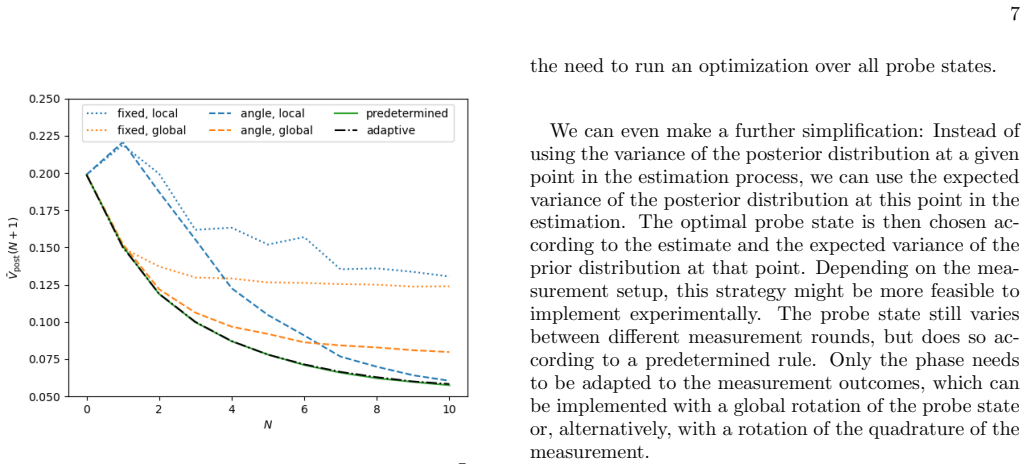
- In repeated measurements, updating the probe state from one round to the next beats any fixed probe state; the paper's numerical comparison shows that adapting only the measurement angle already gives most of the benefit, and updating the energy split according to the current variance matches the fully adaptive strategy.
- The prior variance at which the switch to squeezed vacuum occurs grows as the probe energy shrinks, so low-energy probes should abandon displaced states at larger prior uncertainty than high-energy probes.
- The Bayesian optimum within the HUS approaches the local frequentist optimum $|\alpha|^2/E = (E+1)/(2E+1)$ as the prior variance tends to zero, but the global optimum in that limit is the LUS, not the HUS.
- Because the squeezed-vacuum Fisher information has a second, misleading peak at a mirrored phase, any Fisher-information-only search for optimal probes at finite prior uncertainty can pick a state that systematically estimates the wrong angle.
- The same displacement-versus-squeezing tradeoff appears in noisy phase estimation with phase-diffusive noise, suggesting that noise and prior uncertainty can be treated as interchangeable resources in probe design.
Reading between the lines
- A natural extension the paper does not pursue is an analytical proof that the average posterior variance has no stationary points beyond the HUS and LUS families; if such a proof fails, the abrupt-jump claim would need to be weakened to a statement about the numerically accessible landscape.
- The two-family structure was established for Gaussian priors and homodyne detection; for heavier-tailed priors or other Gaussian measurements, the discontinuity may become a smooth crossover, which would be a testable prediction of the same optimization machinery.
- The near-optimality of the predetermined-rule strategy suggests a practical controller that stores the precomputed maps of $|\alpha|^2/E$ and $\varphi$ as functions of $\sigma^2$ and $E$ and updates the probe from the current posterior mean and variance; its regret relative to the fully adaptive strategy is an experimentally measurable quantity.
- If the discontinuous jump is generic, then any continuous feedback policy that interpolates smoothly between coherent and squeezed probes will pay a systematic penalty near the critical variance; this is a concrete design constraint for real-time adaptive interferometry.
Signed reviews
Editorial analysis
A structured set of objections, weighed in public.
Referee Report
Summary. The manuscript addresses the question of which pure single-mode Gaussian probe state is optimal for estimating an unknown phase rotation under homodyne detection, as a function of the prior knowledge of the phase. Working in a Bayesian framework with a Gaussian prior of variance σ² and fixed energy E, the authors numerically minimize the average posterior variance (APV) over (|α|, τ, φ). They identify two candidate optimal families: a high-uncertainty strategy (HUS) with τ = θ0 − π/2 and φ = −2θ0, in which energy is split between displacement and squeezing, and a low-uncertainty strategy (LUS) with α = 0, i.e., squeezed vacuum. The global optimum is claimed to switch discontinuously from HUS to LUS as σ² decreases. The paper also provides analytic Fisher information results (Appendix A), including I = 4E(E+1) for the optimal HUS state and I = 8E(E+1) for the LUS state, applies the results to repeated measurements with several adaptive strategies, and draws a qualitative analogy to noisy phase estimation.
Significance. If correct, the paper's main contribution is a clear map of knowledge-dependent optimal Gaussian probe states for homodyne phase estimation, connecting the known local (frequentist) optimality of squeezed vacuum to the Bayesian optimality of coherent-like states at large prior uncertainty. The analytic FI derivation is transparent and the limiting cases reproduce established results (the local FI of the LUS, 8E(E+1), and the constrained HUS FI, 4E(E+1)). The adaptive strategies for repeated measurements are practically motivated and the comparison in Fig. 4 is informative. The key weakness is that the global optimality of the two families is inferred from numerical minimization without exhaustive search or proof; this is the load-bearing element of the paper's central claim.
major comments (3)
- [IV.C, Appendix C] The central claim that the global minimum of the APV over the full (|α|,τ,φ) space is always attained by either the HUS or LUS family is not established. The evidence consists of multistart local minimization; Fig. 7 shows results only for E = 0.5, and for E = 1, 2, 5 the claim rests on the statement that minimization 'consistently results in one of the two strategies.' Since the APV is a non-convex integral over a compact 3D domain, other stationary points cannot be excluded. If a third family of states achieved a lower APV in some region of σ², both the identification of 'two distinct optimal strategies' and the 'clear jump' conclusion would need revision. Please provide a more exhaustive global optimization (e.g., dense grid combined with multistart or a global optimizer) or an analytic argument that every stationary point belongs to one of the two families.
- [V] The claim that 'a strategy that calculates the optimal probe state in each round will on average outperform any other strategy' is not justified. Myopic single-round optimality does not generally imply finite-horizon optimality in adaptive estimation problems. The numerical comparison in Fig. 4 is limited to fixed, angle-adaptive, predetermined, and a constrained adaptive strategy; the true fully optimal adaptive policy is not computed. Either prove the claim (e.g., by dynamic programming or by a dominance argument) or restate it as 'outperforms the strategies considered here.'
- [V] The repeated-measurement analysis approximates the posterior after each round as Gaussian with the same mean and variance, and asserts that the optimal probe state is 'nearly identical' to that for the true posterior. Because this approximation underlies the adaptive results in Fig. 4, a quantitative error estimate is needed (for example, by comparing the true and approximated posteriors for representative parameter values, or by comparing the resulting APVs). Without such a check, the performance ranking of the adaptive strategies may be affected.
minor comments (5)
- [IV.B, Figs. 2 and 3] The figures use specific parameters (e.g., φ = −π, τ = 0) that correspond to θ0 = π/2; please state this convention explicitly in the figure captions.
- [Appendix C] The numerical details are not specified: integration grid for the APV, number of starting points for the minimization, and convergence tolerances. Please include these for reproducibility.
- [IV.A and IV.B] The notation switches between θ (local true value) and θ0 (prior mean). In Eq. (17) and the discussion of the HUS, clarify that the expressions are evaluated at the prior mean when used in the Bayesian context.
- [Appendix B] The Van Trees bound could be compared with the numerically computed APV in a figure; this would show how tight the bound is for the parameter range studied.
- [I and VI] Ref. [29] is cited as the source of the uniform-prior result; because the present second author is a coauthor of that reference, the relationship should be acknowledged explicitly when the connection is made.
Circularity Check
No significant circularity; the optimal probe states are outputs of a direct APV minimization, with only a minor contextual self-citation.
full rationale
The central derivation is self-contained against the paper's own numerical figure of merit. The average posterior variance is computed from the likelihood in Eq. (15), the prior, and Bayes' rule, and then minimized over the full parameter space (|α|, τ, φ) at fixed energy. The HUS and LUS families are identified as the two local minima of this minimization, not as parameters fitted to a target quantity and then renamed as predictions. The analytic Fisher-information results in Eqs. (16)-(18) and Appendix A are derived from the stated likelihood rather than imported as the conclusion. The only self-citation is Ref. [29] (coauthored by S. Morelli), used in the introduction to motivate the problem and in the conclusions to note that the large-uncertainty limit recovers its uniform-prior result; this is contextual and not load-bearing for the numerical optimization. The paper's claim that the two found families exhaust the global minima rests on an extensive but not exhaustively proven numerical search, and the finite-horizon optimality of round-by-round adaptation is asserted rather than proven; these are completeness/correctness risks, not circularity, because the APV is independently evaluated rather than constructed to agree with the ansatz.
Assumptions & free parameters
assumptions (5)
- domain assumption Gaussian priors encode prior knowledge of the phase
- ad hoc to paper Posterior after each round is approximated as Gaussian with the same mean and variance
- domain assumption Homodyne detection of one quadrature gives the likelihood of Eq. (15)
- domain assumption Probe states are pure single-mode Gaussian states of fixed energy E = |α|² + sinh² r
- ad hoc to paper Prior support is restricted to [0,π) and variance σ² to (0,0.2]
Cite this review
Pith. "Pith review of Knowledge-dependent optimal Gaussian strategies for phase estimation." pith.science (2026). https://pith.science/paper/OR6JJ2AV
@misc{pith2026241216023,
  author       = {Pith},
  title        = {Pith review of: Knowledge-dependent optimal Gaussian strategies for phase estimation},
  year         = {2026},
  howpublished = {\url{https://pith.science/paper/OR6JJ2AV}},
  note         = {Machine review of arXiv:2412.16023}
}
read the original abstract
When estimating an unknown phase rotation of a continuous-variable system with homodyne detection, the optimal probe state strongly depends on the value of the estimated parameter. In this article, we identify the optimal pure single-mode Gaussian probe states depending on the knowledge of the estimated phase parameter before the measurement. We find that for a large prior uncertainty, the optimal probe states are close to coherent states, a result in line with findings from noisy parameter estimation. But with increasingly precise estimates of the parameter it becomes beneficial to put more of the available energy into the squeezing of the probe state. Surprisingly, there is a clear jump, where the optimal probe state changes abruptly to a squeezed vacuum state, which maximizes the Fisher information for this estimation task. We use our results to study repeated measurements and compare different methods to adapt the probe state based on the changing knowledge of the parameter according to the previous findings.
Figures


Figures from the paper (3 more)


Reference graph
Works this paper leans on
-
[1]
A. A. Michelson and E. W. Morley, On the relative mo- tion of the Earth and the luminiferous ether, American Journal of Science 34, 333 (1887)
-
[2]
In blue, yellow, green, red, violet, brown, and pink we see strategies with a fixed allocation of energy to displacement, going from ∣α∣2/E = 0.4 to ∣α∣2/E = 1 in steps of 0 .1. The green line coincides with the optimal frequentist probe state ∣α∣2/E = (E + 1)/(2E + 1) = 0.6 within the HUS. The black dotted curve corresponds to the optimized probe of the ...
work page 2026
-
[3]
S. D. Personick, Application of quantum estimation theory to analog communication over quantum chan- nels, IEEE Transactions on Information Theory 17, 240 (1971)
work page 1971
-
[4]
J. Shapiro, H. Yuen, and A. Mata, Optical communica- tion with two-photon coherent states–part ii: Photoemis- sive detection and structured receiver performance, IEEE Transactions on Information Theory 25, 179 (1979)
work page 1979
-
[5]
H. M. Wiseman and R. B. Killip, Adaptive single-shot phase measurements: The full quantum theory, Physical Review A 57, 2169–2185 (1998)
work page 1998
-
[6]
D. Berry, Adaptive phase measurements, (2002), arXiv:quant-ph/0202136 [quant-ph]
work page Pith review arXiv 2002
-
[7]
C. R. Rao, in Breakthroughs in Statistics: Foundations and basic theory (Springer, 1992) pp. 235–247
work page 1992
-
[8]
Cram´ er,Mathematical methods of statistics , Vol
H. Cram´ er,Mathematical methods of statistics , Vol. 26 (Princeton university press, 1999)
work page 1999
Show all 48 references
-
[9]
B. R. Frieden, Science from Fisher information: a unifi- cation (Cambridge University Press, 2004)
2004
-
[10]
S. L. Braunstein and C. M. Caves, Statistical distance and the geometry of quantum states, Physical Review Letter 72, 3439 (1994)
1994
-
[11]
M. G. A. Paris, Quantum estimation for quantum tech- nology, International Journal of Quantum Information 07, 125 (2009)
2009
-
[12]
T´ oth and I
G. T´ oth and I. Apellaniz, Quantum metrology from a quantum information science perspective, Journal of Physics A: Mathematical and Theoretical 47, 424006 (2014)
2014
-
[13]
Demkowicz-Dobrza´ nski, M
R. Demkowicz-Dobrza´ nski, M. Jarzyna, and J. Ko lody´ nski (Elsevier, 2015) pp. 345–435
2015
-
[14]
Friis, D
N. Friis, D. Orsucci, M. Skotiniotis, P. Sekatski, V. Dun- jko, H. J. Briegel, and W. D¨ ur, Flexible resources for quantum metrology, New Journal of Physics 19, 063044 (2017)
2017
-
[15]
Monras, Optimal phase measurements with pure Gaussian states, Physical Review A 73 (2006)
A. Monras, Optimal phase measurements with pure Gaussian states, Physical Review A 73 (2006)
2006
-
[16]
Olivares and M
S. Olivares and M. G. A. Paris, Bayesian estimation in homodyne interferometry, Journal of Physics B: Atomic, Molecular and Optical Physics 42, 055506 (2009)
2009
-
[17]
Gaiba and M
R. Gaiba and M. G. Paris, Squeezed vacuum as a uni- versal quantum probe, Physics Letters A 373, 934–939 (2009)
2009
-
[18]
M. G. Genoni, S. Olivares, and M. G. A. Paris, Opti- cal phase estimation in the presence of phase diffusion, Physical Review Letters 106 (2011)
2011
-
[19]
M. G. Genoni, S. Olivares, D. Brivio, S. Cialdi, D. Cipri- ani, A. Santamato, S. Vezzoli, and M. G. A. Paris, Op- tical interferometry in the presence of large phase diffu- sion, Physical Review A 85 (2012)
2012
-
[20]
Olivares, S
S. Olivares, S. Cialdi, F. Castelli, and M. G. A. Paris, Homodyne detection as a near-optimum receiver for phase-shift-keyed binary communication in the pres- ence of phase diffusion, Physical Review A 87 (2013)
2013
-
[21]
Macieszczak, M
K. Macieszczak, M. Fraas, and R. Demkowicz- Dobrza´ nski,Bayesian quantum frequency estimation in presence of collective dephasing, New Journal of Physics 16, 113002 (2014)
2014
-
[22]
B. T. Gard, C. You, D. K. Mishra, R. Singh, H. Lee, T. R. Corbitt, and J. P. Dowling, Nearly optimal mea- surement schemes in a noisy Mach-Zehnder interferom- eter with coherent and squeezed vacuum, EPJ Quantum Technology 4 (2017)
2017
-
[23]
Carrara, M
G. Carrara, M. G. Genoni, S. Cialdi, M. G. A. Paris, and S. Olivares, Squeezing as a resource to counteract phase diffusion in optical phase estimation, Physical Review A 102 (2020)
2020
-
[24]
Ataman, Optimal Mach-Zehnder phase sensitivity with Gaussian states, Physical Review A 100 (2019)
S. Ataman, Optimal Mach-Zehnder phase sensitivity with Gaussian states, Physical Review A 100 (2019)
2019
-
[25]
C. Oh, C. Lee, C. Rockstuhl, H. Jeong, J. Kim, H. Nha, and S.-Y. Lee, Optimal Gaussian measurements for phase estimation in single-mode Gaussian metrology, npj Quantum Information 5, 10 (2019). 10
2019
-
[26]
C. Oh, C. Lee, L. Banchi, S.-Y. Lee, C. Rockstuhl, and H. Jeong, Optimal measurements for quantum fidelity between Gaussian states and its relevance to quantum metrology, Physical Review A 100, 012323 (2019)
2019
-
[27]
Rubio and J
J. Rubio and J. Dunningham, Quantum metrology in the presence of limited data, New Journal of Physics 21, 043037 (2019)
2019
-
[28]
Teklu, S
B. Teklu, S. Olivares, and M. G. A. Paris, Bayesian esti- mation of one-parameter qubit gates, Journal of Physics B: Atomic, Molecular and Optical Physics 42, 035502 (2009)
2009
-
[29]
Wiebe and C
N. Wiebe and C. Granade, Efficient Bayesian phase es- timation, Physical Review Letters 117 (2016)
2016
-
[30]
Morelli, A
S. Morelli, A. Usui, E. Agudelo, and N. Friis, Bayesian parameter estimation using Gaussian states and mea- surements, Quantum Science and Technology 6, 025018 (2021)
2021
-
[31]
B. Zhou, S. Guha, and C. N. Gagatsos, Bayesian quan- tum phase estimation with fixed photon states, Quantum Information Processing 23 (2024)
2024
-
[32]
Pezz´ e and A
L. Pezz´ e and A. Smerzi,Mach-Zehnder interferometry at the Heisenberg limit with coherent and squeezed-vacuum light, Physical Review Letters 100 (2008)
2008
-
[33]
Pinel, P
O. Pinel, P. Jian, N. Treps, C. Fabre, and D. Braun, Quantum parameter estimation using general single- mode Gaussian states, Physical Review A 88 (2013)
2013
-
[34]
Friis, M
N. Friis, M. Skotiniotis, I. Fuentes, and W. D¨ ur,Heisen- berg scaling in Gaussian quantum metrology, Physical Review A 92 (2015)
2015
-
[35]
R. L. Berger and G. Casella, Statistical inference (Duxbury, 2001)
2001
-
[36]
Loudon, The quantum theory of light (OUP Oxford, 2000)
R. Loudon, The quantum theory of light (OUP Oxford, 2000)
2000
-
[37]
S. L. Braunstein and P. van Loock,Quantum information with continuous variables, Reviews of Modern Physics 77, 513 (2005)
2005
-
[38]
Weedbrook, S
C. Weedbrook, S. Pirandola, R. Garc ´ ıa-Patr´ on, N. J. Cerf, T. C. Ralph, J. H. Shapiro, and S. Lloyd, Gaus- sian quantum information, Reviews of Modern Physics 84, 621 (2012)
2012
-
[39]
Serafini, Quantum continuous variables: a primer of theoretical methods (CRC press, 2017)
A. Serafini, Quantum continuous variables: a primer of theoretical methods (CRC press, 2017)
2017
-
[40]
J. B. Brask, Gaussian states and operations – a quick reference, (2022), arXiv:2102.05748 [quant-ph]
2022 arXiv
-
[41]
Yuen and J
H. Yuen and J. Shapiro, Optical communication with two- photon coherent states–part i: Quantum-state propaga- tion and quantum-noise, IEEE Transactions on Informa- tion Theory 24, 657 (1978)
1978
-
[42]
Le Cam, in Proceedings of the Third Berkeley Sympo- sium on Mathematical Statistics and Probability, Volume 1: Contributions to the Theory of Statistics , Vol
L. Le Cam, in Proceedings of the Third Berkeley Sympo- sium on Mathematical Statistics and Probability, Volume 1: Contributions to the Theory of Statistics , Vol. 3 (Uni- versity of California Press, 1956) pp. 129–157
1956
-
[43]
Le Cam, Asymptotic methods in statistical decision theory (Springer Science & Business Media, 2012)
L. Le Cam, Asymptotic methods in statistical decision theory (Springer Science & Business Media, 2012)
2012
-
[44]
M. A. Rodr ´ ıguez-Garc ´ ıa and F. E. Becerra, Adaptive phase estimation with squeezed vacuum approaching the quantum limit, Quantum 8, 1480 (2024)
2024
-
[45]
Brivio, S
D. Brivio, S. Cialdi, S. Vezzoli, B. T. Gebrehiwot, M. G. Genoni, S. Olivares, and M. G. A. Paris, Experimental estimation of one-parameter qubit gates in the presence of phase diffusion, Physical Review A 81 (2010)
2010
-
[46]
Paesani, A
S. Paesani, A. Gentile, R. Santagati, J. Wang, N. Wiebe, D. Tew, J. O’Brien, and M. Thompson, Experimental Bayesian quantum phase estimation on a silicon photonic chip, Physical Review Letters 118 (2017)
2017
-
[47]
Mart ´ ınez-Garc ´ ıa, D
F. Mart ´ ınez-Garc ´ ıa, D. Vodola, and M. M¨ uller,Adaptive Bayesian phase estimation for quantum error correcting codes, New Journal of Physics 21, 123027 (2019)
2019
-
[48]
H. L. Van Trees, Detection, estimation, and modulation theory, part I: detection, estimation, and linear modula- tion theory (John Wiley & Sons, 2004) Appendix A: Fisher Information for homodyne measurements on Gaussian states When measuring in a continuous POVM with outcomes ...
2004
Reviewed August 11, 2026 · model on record in the stance chip above.
Discussion (0). Continue with ORCID to comment.