REVIEW 3 major objections 5 minor 1 cited by
Non-Linearities In Atomic Quantum Receivers: Harmonic And Intermodulation Distortion
T0 review · 3 major / 5 minor · reviewed 2026-08-11 · deepseek-v4-flash
Pith's one-line read This paper shows that a Rydberg atomic receiver can suppress harmonic and intermodulation distortion relative to classical receiver amplifiers, with a measured FoM=IP3-P1dB of about 35 dB versus 12 dB or less for typical 10 GHz LNAs.
desk verdict First distortion characterization of a Rydberg heterodyne receiver is useful, but the headline suppression claim rests on an extrapolated IP3 from sub-cubic IMD slopes and does not hold up. read the letter →
The pith
A machine-rendered reading of the paper's core claim, the machinery that carries it, and where it could break.
The reading
What carries the argument
The carrying mechanism is the nonlinear response of a cesium vapor under electromagnetically induced transparency (EIT) to the sum of RF fields: the receiver's local oscillator at the Rydberg transition frequency $42D_{5/2}\to43P_{3/2}$ (9.9376 GHz) and one or two signal tones. The atoms act as the mixer; their probe-beam transmission contains beat notes at the intermediate frequencies plus harmonics and intermodulation products of orders up to at least 8. The paper models this with a four-level Lindblad master equation in which the RF Rabi frequency is the sum of LO and signal Rabi frequencies, and the Fourier spectrum of the probe coherence yields the IF, harmonic, and IMD response. The comparison metric that carries the suppression claim is $\mathrm{FoM}=\mathrm{IP3}-P_{1\mathrm{dB}}$, the gap between the third-order intercept point and the 1 dB compression point.
What would settle it
Run a two-tone test at a fixed in-band signal level, converting the over-the-air field to an equivalent input power through a defined antenna factor, and compare the atomic receiver's third-order intermodulation-to-carrier ratio with that of a 10 GHz LNA of $\mathrm{FoM}=12$ dB; if the LNA shows a lower ratio at comparable operating points, the suppression claim is refuted.
Extended reading notes
Core claim
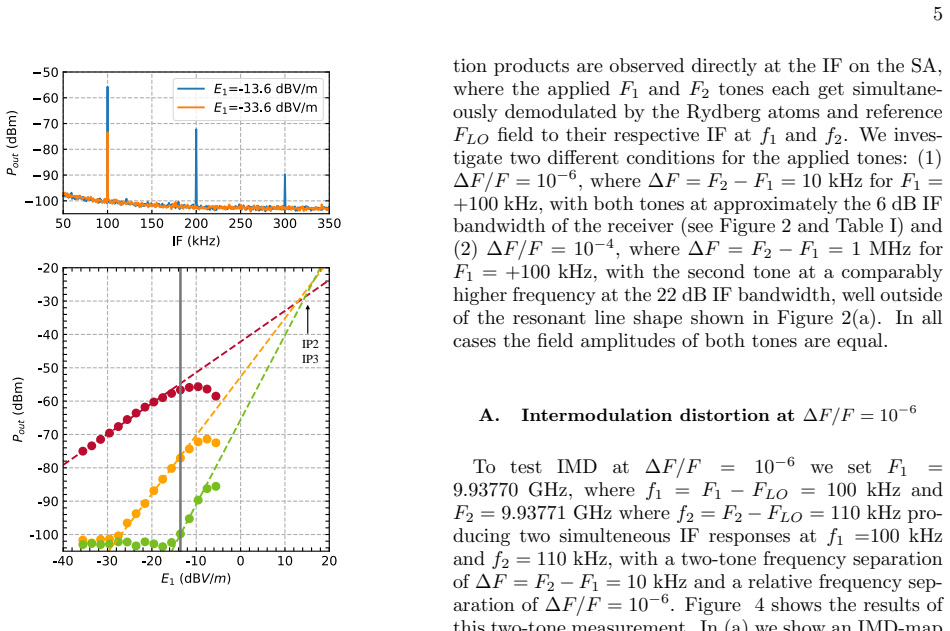
On the paper's own terms, the discovery is that the atomic medium itself produces the mixing and distortion that in a classical receiver would come from electronic components, and it does so with a non-classical scaling: third-order intermodulation products grow with applied field with slopes of $1.6\pm0.2$ to $2.1\pm0.08$ rather than the classical slope of 3. Because the intermodulation products rise more slowly than in a classical mixer, the extrapolated third-order intercept sits far above the compression point, giving $\mathrm{FoM}=\mathrm{IP3}-P_{1\mathrm{dB}}\approx 35$ dB for the atomic receiver compared with about 12 dB or less for typical 10 GHz LNAs. The paper interprets this as a suppression of harmonic and intermodulation distortion under suitable operating conditions, and it attributes the effect to the fundamental physics of the atom-field interaction rather than to the detection electronics.
Load-bearing premise
The central comparison assumes that a third-order intercept point extrapolated from intermodulation data with slopes of 1.6 to 2.1, instead of the classical slope of 3, is still a valid way to rank distortion suppression, so that a larger $\mathrm{IP3}-P_{1\mathrm{dB}}$ gap means less intermodulation at realistic signal levels.
Editorial extensions
If this is right
- Standard receiver metrics (P1dB, IP2, IP3, SFDR) can be measured on an atomic receiver, so atomic receivers can be benchmarked directly against electronic receivers on the same distortion scales.
- If the measured FoM of about 35 dB holds, a Rydberg atomic receiver would maintain third-order intermodulation products below its compression point over a wider input range than a typical 10 GHz low-noise amplifier.
- The sub-classical IMD slopes imply that the atomic receiver's distortion does not follow the usual slope-3 rule, so its IP3 can be pushed much farther out by operating conditions.
- The nonlinear response is tied to atomic parameters and is controllable by laser and LO settings, enabling physical-layer signatures such as switchable harmonic spectra for secure communications.
Reading between the lines
- The paper's FoM comparison is field-referred and omits an antenna transducer; adding a practical antenna to the atomic receiver could change the apparent distortion advantage, so a system-level benchmark is a natural next test.
- Because the measured IMD slopes deviate from 3, a single IP3 number is not a complete description; a slope-aware or power-dependent distortion metric would be needed for fair comparison across receivers.
- The proposed encryption scheme, switching the nonlinear spectrum by changing LO amplitude or frequency, could be tested by encoding and decoding bits in the IMD-map patterns; the paper does not demonstrate this.
- The Lindblad model's ability to reproduce the measured slopes and roll-offs suggests it could be used to search for operating points with even larger FoM, which the paper does not do.
Signed reviews
Editorial analysis
A structured set of objections, weighed in public.
Referee Report
Summary. The manuscript reports single-tone and two-tone RF distortion measurements on a Rydberg atomic heterodyne receiver operating near 10 GHz. It characterizes IF selectivity and bandwidth, harmonic distortion, and intermodulation distortion at two tone separations, and extracts P1dB, IP2, IP3, and SFDR. The authors introduce a figure of merit FoM = IP3 - P1dB, compare the atomic receiver with classical LNAs, and claim that under suitable operating conditions the atomic receiver suppresses harmonic and intermodulation distortion relative to classical receivers. A Lindblad master-equation simulation of the four-level atomic response is presented as qualitative support. The paper closes with suggestions for using the receiver's nonlinear response for secure-communication schemes.
Significance. The experimental methodology and raw data are valuable: the paper provides one of the first systematic characterizations of harmonic and intermodulation distortion in a Rydberg heterodyne receiver, with measured fundamental slopes near 1, harmonic slopes near 2 and 3, detailed IMD maps up to eighth order, and quantitative bandwidth and compression data. If the central suppression claim were established, it would be of real interest to RF engineering and quantum-sensor communities. However, the headline claim rests on a figure of merit whose standard interpretation requires the third-order IMD slope to be close to 3, whereas the measured slopes are 1.6-2.1; the paper also acknowledges that the simulation shows a slope near 3. The significance is therefore conditional: the measurement infrastructure and raw results are solid, but the comparison to classical LNAs needs to be reworked or substantially qualified before the suppression claim can be accepted.
major comments (3)
- [Section V B, Fig. 5(c)] The central FoM=IP3-P1dB ~ 35 dB is not a directly measured quantity: it is obtained by extrapolating the fitted fundamental line (slope near 0.9) and the fitted third-order IMD line (slope 1.6 +/- 0.2) to a crossing point roughly 35-40 dB above the highest data used in the fit. The standard IP3 and FoM semantics assume a third-order product rising with slope 3 against a slope-1 fundamental. With a slope near 1.6, the fundamental-to-IMD gap improves by only about 0.7 dB per dB reduction of input drive instead of 2 dB per dB. Consequently, a larger extrapolated FoM does not by itself imply lower IMD at normal operating levels. Concretely, using the fitted slopes and FoM=35 dB, at an input 10 dB below P1dB the third-order IMD would be only about 32 dB below the fundamental, whereas a classical LNA with FoM=12 dB and slope 3 would be about 44 dB below; the apparent suppression reverses. The authors should either present directly measured IMD-to-fundamental ratios within the data range or explicitly limit the claim to the observed slow growth of the IMD products.
- [Section VI, Fig. 6] The Lindblad simulation is described as being in good qualitative agreement with Fig. 5, but the simulated third-order IMD products have a slope near 3, whereas the corresponding experimental fit in Fig. 5(c) reports a slope of 1.6 +/- 0.2. This discrepancy is directly relevant to the paper's central claim, because the suppression argument depends on the shallow measured slope. The manuscript should discuss why the experiment deviates from the simulation and either identify the physical mechanism responsible or show that the simulation reproduces the off-slope behavior when run with the actual experimental parameters. As written, the simulation supports the raw observations but not the extrapolated FoM used for the LNA comparison.
- [Section V A vs V B] The large FoM is obtained only for the DeltaF/F = 1e-4 configuration, in which the second tone sits near the edge of the IF response. In the DeltaF/F = 1e-6 configuration, which the text describes as having both tones near the 6 dB IF bandwidth, the measured IMD slope is 2.1 +/- 0.08 and the derived FoM is 20.2 dB, much closer to the classical LNA values cited in Section V B. The paper should specify what 'suitable operating conditions' means and justify why the DeltaF/F = 1e-4 case is the relevant one for the suppression claim, rather than presenting the in-band two-tone case as the primary comparison.
minor comments (5)
- [Abstract] The abstract assigns DeltaF/F = 1e-4 to the 6 dB bandwidth and DeltaF/F = 1e-6 to the 22 dB bandwidth, but Section V states the opposite: DeltaF/F = 1e-6 corresponds to both tones near the 6 dB IF bandwidth, and DeltaF/F = 1e-4 places the second tone near the 22 dB bandwidth. Please correct the abstract.
- [Section V A] The sentence reporting P1dB at '-20(-22) dBm' for f1(f2) uses dBm units, while the corresponding RF electric fields are given in dBV/m and the figure caption lists -17.5(-15.5) dBV/m. The units should be made consistent.
- [Section V B] The SFDR formula is written as 2/3 (IP3-N0), but the preceding text and the numerical values refer to IP3out, the output power at the intercept. Please add the subscript and define the notation to avoid confusing input and output intercepts.
- [Section VI] The notation 'rho1.2' in the text should read 'rho_{1,2}' to match the definition of the ground-excited-state coherence. There are also several typographical errors, including 'distoriiton', 'harminics', and 'This spectra' in the caption of Fig. 4.
- [Introduction] The outline in the introduction says that Section VII contains both the discussion and the conclusion; this should be corrected to the actual section numbering (the discussion in Section VII and the conclusion in the following unnumbered final section, or renumber accordingly).
Circularity Check
No significant circularity; the distortion measurements are direct and the central FoM comparison is a validity/extrapolation concern, not a circular derivation.
full rationale
The harmonic and intermodulation results are direct spectrum-analyzer measurements with fitted slopes reported as data characterization, not as predictions derived from a model whose inputs include the claimed outcome. The paper's self-citations (e.g., [19], [20], [24], [32]) establish the heterodyne setup, stabilization, and prior receiver demonstrations; none of these is invoked as the authority for the nonlinearity claim, which rests on the present measurements. The FoM=IP3−P1dB comparison in Section V B is the only load-bearing step that could look like a fitted-parameter-as-prediction: IP3 is extrapolated from linear fits to fundamental and IMD data with measured IMD slope 1.6±0.2 rather than the classical slope 3, and the 'suppression' conclusion is inferred from that extrapolated metric. However, this is a statistical/interpretive concern about whether the metric retains its standard meaning at non-classical slopes, not a circularity: the paper does not define 'suppression' solely as a large FoM, and the FoM value is an empirical result of fits rather than an input assumed to prove the conclusion. The Lindblad simulation uses additive calibration constants and is explicitly labeled qualitative agreement, so it does not independently confirm the extrapolation, but neither is it a circular confirmation of the measurement. Overall, the derivation chain is self-contained with respect to the distortion data; the only notable weakness is the off-slope IP3 extrapolation, which is a correctness risk rather than a circular reasoning defect.
Assumptions & free parameters
free parameters (2)
- Simulation dBV/m offset
- Simulation dBm offset
assumptions (4)
- domain assumption The four-level Lindblad master equation captures the receiver's nonlinear response.
- domain assumption Observed IMD products originate in the atomic medium, not in the RF generation or detection electronics.
- ad hoc to paper The IP3-P1dB figure of merit is commensurate across field-input atomic receivers and power-input classical LNAs.
- domain assumption Autler-Townes calibration at high fields remains valid at the low test fields.
Cite this review
Pith. "Pith review of Non-Linearities In Atomic Quantum Receivers: Harmonic And Intermodulation Distortion." pith.science (2026). https://pith.science/paper/ITB3AAY6
@misc{pith2026241216366,
  author       = {Pith},
  title        = {Pith review of: Non-Linearities In Atomic Quantum Receivers: Harmonic And Intermodulation Distortion},
  year         = {2026},
  howpublished = {\url{https://pith.science/paper/ITB3AAY6}},
  note         = {Machine review of arXiv:2412.16366}
}
abstract
Rydberg sensors offer a unique approach to radio frequency (RF) detection, leveraging the high sensitivity and quantum properties of highly-excited atomic states to achieve performance levels beyond classical technologies. Non-linear responses and distortion behavior in Rydberg atom receivers are critical to evaluating and establishing performance metrics and capabilities such as spur-free dynamic range and tolerance to unwanted interfering signals. We report here on the measurement and characterization of non-linear behavior and spurious response of a Rydberg atomic heterodyne receiver. Single-tone and two-tone testing procedures are developed and implemented for measurement of harmonic and inter-modulation distortion in Rydberg atomic receivers based on multi-photon Rydberg spectroscopy and radio-frequency heterodyne signal detection and demodulation in an atomic vapor. For a predetermined set of atomic receiver parameters and RF carrier wave in the SHF band near-resonant to a cesium Rydberg transition, we measure and characterize atomic receiver selectivity, bandwidth, roll-off, compression point (P1dB), second-order (IP2) and third-order (IP3) intercepts, and spur-free dynamic range. Receiver intermodulation distortion is characterized for the case of an interfering signal wave applied at two frequency offsets relative to the near-resonant reference local oscillator, $\Delta F/F= 10^{-4}$ at 6dB and $10^{-6}$ at 22dB single-tone bandwidths, respectively. We observe that under suitable operating conditions the atomic receiver can exhibit a suppression of harmonic and inter-modulation distortion relative to that of classical receiver mixer amplifiers. Finally, we describe how the non-linear behaviors of atomic receivers can provide unique, controllable RF signatures inaccessible by classical counterparts and propose their use to realize secure communication modalities and applications.
Figures


Figures from the paper (3 more)


Forward citations
Cited by 1 Pith paper
-
Rydberg Atomic Quantum Radio: A Comprehensive Survey From Wireless Communication Perspective
A wireless-communications-oriented survey of Rydberg atomic quantum radios covering physics, architectures, sensitivity-bandwidth-frequency trade-offs, channel models, and SAGSIN use cases.
Reference graph
Works this paper leans on
-
[1]
C. S. Adams, J. D. Pritchard, and J. P. Shaffer, Ry- dberg atom quantum technologies, Journal of Physics B: Atomic, Molecular and Optical Physics 53, 012002 (2019)
2019
-
[2]
D. A. Anderson, G. Raithel, T. Nithiwadee, S. A. Miller, and A. Schwarzkopf, Atom-based electromagnetic radia- tion electric-field and power sensor, Patent US 9,970,973 B2 (2017)
work page 2017
-
[3]
D. A. Anderson, G. Raithel, E. G. Paradis, and R. E. Sapiro, Atom-based electromagnetic field sensing element and measurement system, Patent US20190187198A1 (2018)
work page 2018
-
[4]
B. Liu, L. Zhang, Z. Liu, Z. Deng, D. Ding, B. Shi, and G. Guo, Electric field measurement and application based on rydberg atoms, Electromagnetic Science 1, 1 (2023)
work page 2023
-
[5]
D. A. Anderson, R. E. Sapiro, and G. Raithel, A self- calibrated si-traceable rydberg atom-based radio fre- quency electric field probe and measurement instrument, IEEE Transactions on Antennas and Propagation 69, 5931 (2021)
work page 2021
- [6]
-
[7]
D.-S. Ding, Z.-K. Liu, B.-S. Shi, G.-C. Guo, K. Mølmer, and C. S. Adams, Enhanced metrology at the critical point of a many-body rydberg atomic system, Nature Physics 18, 1447 (2022)
work page 2022
-
[8]
C. L. Holloway, J. A. Gordon, A. Schwarzkopf, D. A. Anderson, S. A. Miller, N. Thaicharoen, and G. Raithel, Sub-wavelength imaging and field mapping via electro- magnetically induced transparency and autler-townes splitting in rydberg atoms, Applied Physics Letters 104, 244102 (2014)
work page 2014
Show all 47 references
-
[9]
S. A. Miller, D. A. Anderson, and G. Raithel, Radio- frequency-modulated rydberg states in a vapor cell, New Journal of Physics 18, 053017 (2016)
2016
-
[10]
Allinson, M
G. Allinson, M. J. Jamieson, A. R. Mackellar, L. Downes, C. S. Adams, and K. J. Weatherill, Simultaneous multiband radio-frequency detection using high-orbital- angular-momentum states in a rydberg-atom receiver, Phys. Rev. Res. 6, 023317 (2024)
2024
-
[11]
D. A. Anderson, E. Paradis, G. Raithel, R. E. Sapiro, and C. L. Holloway, High-resolution antenna near-field imaging and sub-thz measurements with a small atomic vapor-cell sensing element, in 2018 11th Global Sympo- sium on Millimeter Waves (GSMM)(2018) pp. 1–3
2018
-
[12]
Holloway, J
C. Holloway, J. Gordon, S. Jefferts, A. Schwarzkopf, D. Anderson, S. Miller, N. Thaicharoen, and G. Raithel, Broadband rydberg atom-based electric-field probe for si-traceable, self-calibrated measurements, IEEE Trans- actions on Antennas and Propagation 62, 6169 (2014)
2014
-
[13]
D. A. Anderson, A. Schwarzkopf, S. A. Miller, N. Thaicharoen, G. Raithel, J. A. Gordon, and C. L. Holloway, Two-photon microwave transitions and strong- field effects in a room-temperature rydberg-atom gas, Phys. Rev. A 90, 043419 (2014)
2014
-
[14]
Paradis, G
E. Paradis, G. Raithel, and D. A. Anderson, Atomic measurements of high-intensity vhf-band radio-frequency fields with a rydberg vapor-cell detector, Phys. Rev. A 11 100, 013420 (2019)
2019
-
[15]
M. T. Simons, M. D. Kautz, C. L. Holloway, D. A. Anderson, G. Raithel, D. Stack, M. C. St. John, and W. Su, Electromagnetically Induced Transparency (EIT) and Autler-Townes (AT) splitting in the presence of band-limited white Gaussian noise, Journal of Applied Physics 123, 203...
2018 doi
-
[16]
D. A. Anderson, G. Raithel, M. Simons, and C. L. Hol- loway, Quantum-optical spectroscopy for plasma electric field measurements and diagnostics, arXiv:1712.08717 (2017)
2017 arXiv
-
[17]
Anderson, R
D. Anderson, R. Sapiro, L. Gon¸ calves, R. Cardman, and G. Raithel, Optical radio-frequency phase measure- ment with an internal-state rydberg atom interferometer, Phys. Rev. Appl. 17, 044020 (2022)
2022
-
[18]
M. T. Simons, A. H. Haddab, J. A. Gordon, and C. L. Holloway, A rydberg atom-based mixer: Measuring the phase of a radio frequency wave, Applied Physics Letters 114, 114101 (2019), https://doi.org/10.1063/1.5088821
2019 doi
-
[19]
M. Jing, Y. Hu, J. Ma, H. Zhang, L. Zhang, L. Xiao, and S. Jia, Atomic superheterodyne receiver based on microwave-dressed rydberg spectroscopy, Nat. Phys. 16, 911–915 (2020)
2020
-
[20]
Legaie, G
R. Legaie, G. Raithel, and D. A. Anderson, A millimeter- wave atomic receiver, A VS Quantum Science 6, 024402 (2024), https://pubs.aip.org/avs/aqs/article- pdf/doi/10.1116/5.0173654/19870078/024402 1 5.0173654.pdf
2024 doi
-
[21]
D. A. Anderson and G. Raithel, Continuous-frequency measurements of high-intensity microwave electric fields with atomic vapor cells, Applied Physics Letters 111, 053504 (2017), http://dx.doi.org/10.1063/1.4996234
2017 doi
-
[22]
Berweger, N
S. Berweger, N. Prajapati, A. B. Artusio-Glimpse, A. P. Rotunno, R. Brown, C. L. Holloway, M. T. Simons, E. Imhof, S. R. Jefferts, B. N. Kayim, M. A. Viray, R. Wyllie, B. C. Sawyer, and T. G. Walker, Rydberg- state engineering: Investigations of tuning schemes for continuous f...
2023
-
[23]
D. H. Meyer, J. C. Hill, P. D. Kunz, and K. C. Cox, Simultaneous multiband demodulation using a rydberg atomic sensor, Phys. Rev. Appl. 19, 014025 (2023)
2023
-
[24]
D. A. Anderson, R. E. Sapiro, and G. Raithel, An atomic receiver for am and fm radio communication, IEEE Transactions on Antennas and Propagation 69, 2455 (2021)
2021
-
[25]
D. A. Anderson, R. E. Sapiro, and G. Raithel, Rydberg atoms for radio-frequency communications and sensing: Atomic receivers for pulsed rf field and phase detection, IEEE Aerospace and Electronic Systems Magazine 35, 48 (2020)
2020
-
[26]
D. H. Meyer, K. C. Cox, F. K. Fatemi, and P. D. Kunz, Digital communication with rydberg atoms and amplitude-modulated microwave fields, Applied Physics Letters 112, 211108 (2018)
2018
-
[27]
A. B. Deb and N. Kjærgaard, Radio-over-fiber us- ing an optical antenna based on rydberg states of atoms, Applied Physics Letters 112, 211106 (2018), https://doi.org/10.1063/1.5031033
2018 doi
-
[28]
C. L. Holloway, M. T. Simons, A. H. Haddab, J. A. Gordon, and S. D. Voran, A multiple-band rydberg- atom based receiver/antenna: Am/fm stereo reception, arXiv:1903.00786 [physics.atom-ph] (2019)
2019 arXiv
-
[29]
Liu, L.-H
Z.-K. Liu, L.-H. Zhang, B. Liu, Z.-Y. Zhang, G.-C. Guo, D.-S. Ding, and B.-S. Shi, Deep learning enhanced ryd- berg multifrequency microwave recognition, Nature Com- munications 13 (2022)
2022
-
[30]
Cardman, L
R. Cardman, L. F. Gon¸ calves, R. E. Sapiro, G. Raithel, and D. A. Anderson, Atomic 2d electric field imaging of a yagiˆ a€“uda antenna near-field using a portable rydberg- atom probe and measurement instrument, Advanced Op- tical Technologies 9, 305 (2020)
2020
-
[31]
Schlossberger, N
N. Schlossberger, N. Prajapati, S. Berweger, A. P. Ro- tunno, A. B. Artusio-Glimpse, M. T. Simons, A. A. Sheikh, E. B. Norrgard, S. P. Eckel, and C. L. Holloway, Rydberg states of alkali atoms in atomic vapour as si- traceable field probes and communications receivers, Na- tur...
2024
-
[32]
D. A. Anderson, L. F. Gon¸ calves, G. Raithel, and J. Detlefs, Long-range wireless communication with a quantum radio based on rydberg atoms, in 2024 IEEE INC-USNC-URSI Radio Science Meeting (Joint with AP-S Symposium) (2024) pp. 249–249
2024
-
[33]
Y. Ma, Y. Yamao, K. Ishibashi, and Y. Akaiwa, Adap- tive compensation of inter-band modulation distortion for tunable concurrent dual-band receivers, IEEE Trans- actions on Microwave Theory and Techniques 61, 4209 (2013)
2013
-
[34]
D. A. Steck, Cesium d line data (2023)
2023
-
[35]
D. M. Pozar, Microwave and RF Design of Wireless Sys- tems (Wiley, 2000)
2000
-
[36]
A. V. Padaki and J. H. Reed, Impact of intermodulation distortion on spectrum preclusion for dsa: A new figure of merit, in 2014 IEEE International Symposium on Dy- namic Spectrum Access Networks (DYSPAN)(2014) pp. 358–361
2014
-
[37]
S. M. Bohaichuk, F. Ripka, V. Venu, F. Christaller, C. Liu, M. Schmidt, H. K¨ ubler, and J. P. Shaffer, Three-photon rydberg-atom-based radio-frequency sens- ing scheme with narrow linewidth, Phys. Rev. Appl. 20, L061004 (2023)
2023
-
[38]
Giraldo, A
F. Giraldo, A. Kumar, T.-Y. Wu, P. Du, and D. S. Weiss, State-selective electromagnetically induced transparency for quantum error correction in neutral atom quantum computers, Phys. Rev. A 106, 032425 (2022)
2022
-
[39]
J. A. Sedlacek, A. Schwettmann, H. K¨ ubler, R. L¨ ow, T. Pfau, and J. P. Shaffer, Microwave electrometry with rydberg atoms in a vapour cell using bright atomic reso- nances, Nature physics 8, 819 (2012)
2012
-
[40]
Sapiro, G
R. Sapiro, G. Raithel, and D. Anderson, Time depen- dence of rydberg eit in pulsed optical and rf fields, Jour- nal of Physics B: Atomic, Molecular and Optical Physics 53, 094003 (2020)
2020
-
[41]
Su, J.-Y
H.-J. Su, J.-Y. Liou, I.-C. Lin, and Y.-H. Chen, Optimiz- ing the rydberg eit spectrum in a thermal vapor, Optics Express 30, 1499 (2022)
2022
-
[42]
Ningyuan, A
J. Ningyuan, A. Georgakopoulos, A. Ryou, N. Schine, A. Sommer, and J. Simon, Observation and character- ization of cavity rydberg polaritons, Phys. Rev. A 93, 041802 (2016)
2016
-
[43]
Sheng, Y
J. Sheng, Y. Chao, S. Kumar, H. Fan, J. Sedlacek, and J. P. Shaffer, Intracavity rydberg-atom electromagneti- cally induced transparency using a high-finesse optical cavity, Phys. Rev. A 96, 033813 (2017)
2017
-
[44]
R. Mao, Y. Lin, A. Zhou, K. Yang, and Y. Fu, Shortwave ultra-high sensitivity rydberg atomic electric field sensing based on a subminiature resonator, IEEE Transactions 12 on Antennas and Propagation (2024)
2024
-
[45]
H. Fan, S. Kumar, J. Sheng, J. P. Shaffer, C. L. Hol- loway, and J. A. Gordon, Effect of vapor-cell geometry on rydberg-atom-based measurements of radio-frequency electric fields, Phys. Rev. Appl. 4, 044015 (2015)
2015
-
[46]
B. Wu, J. Yao, F. Wu, Q. An, and Y. Fu, Dependence of rydberg-atom-based sensor performance on different ryd- berg atom populations in one atomic-vapor cell, Chinese Physics B 33, 024205 (2024)
2024
-
[47]
Z. Song, W. Zhang, Q. Wu, H. Mu, X. Liu, L. Zhang, and J. Qu, Field distortion and optimization of a vapor cell in rydberg atom-based radio-frequency electric field measurement, Sensors 18, 3205 (2018)
2018
Reviewed August 11, 2026 · model on record in the stance chip above.
Discussion (0). Continue with ORCID to comment.