REVIEW 4 major objections 6 minor 72 references
Query Quantized Neural SLAM
T0 review · 4 major / 6 minor · reviewed 2026-08-11 · deepseek-v4-flash
Pith's one-line read Quantizing neural SLAM queries into discrete codes makes the network overfit each frame in fewer iterations, improving reconstruction completeness and camera tracking accuracy.
desk verdict Quantized queries genuinely help tracking and completeness in neural SLAM, but the paper's reconstruction-accuracy claims go beyond its own tables. read the letter →
The pith
A machine-rendered reading of the paper's core claim, the machinery that carries it, and where it could break.
The reading
What carries the argument
The load-bearing mechanism is the quantized query $\tilde{q}$, which combines a coordinate snapped to an extremely fine 3D grid, a one-blob positional encoding of that quantized coordinate, a normalized geometry feature from a multi-resolution hash grid replaced by its nearest codebook code, and a TSDF interpolation at the quantized coordinate. The codebook contains $B=128$ unit-norm codes initialized from a Bernoulli(0.5) distribution, kept diverse by a pairwise distance loss, and updated with a stop-gradient commitment loss that decouples code training from SDF and color network training. The tanh augmentation on the TSDF prior prevents the network from learning a shortcut that would directly map the prior to the predicted signed distance, and the Bernoulli initialization constrains the optimization space to stabilize early optimization.
What would settle it
Run the same SLAM pipeline on a sequence where the camera suddenly enters a completely unseen region or a new object appears, and measure per-frame convergence iterations and ATE drift; if the quantized-query system degrades to or below the continuous-query baseline precisely when novel codes dominate, the claim that code familiarity is the mechanism is falsified. A more direct check is to reset the codebook every frame while keeping everything else fixed—if tracking accuracy does not drop, the benefit does not come from code familiarity across frames.
Extended reading notes
Core claim
The paper's central claim is that reducing input variation through query quantization is an effective remedy for the underfitting problem in neural SLAM. The authors construct a quantized query $\tilde{q} = [\tilde{p}, h_{\tilde{p}}, e_{\tilde{p}}, t_{\tilde{p}}]$ where the coordinate is snapped to a $12800^{3}$ grid, the positional encoding uses one-blob encoding on the quantized coordinate, the geometry feature is replaced by its nearest code in a learned codebook (via Eq. (1) with L2 distance), and the TSDF prior is interpolated at the quantized coordinate. They claim that, after overfitting many previous frames, the network becomes familiar with these codes, so each new frame requires fewer iterations to overfit, which stabilizes camera tracking and produces more complete reconstructions. The paper supports this with convergence-iteration measurements against Co-SLAM, ablation studies isolating each component (coordinate quantization, codebook, TSDF prior, tanh augmentation, Bernoulli initialization, and loss terms), and consistent benchmark improvements in tracking and reconstruction metrics.
Load-bearing premise
The codebook learned from earlier frames must still match the geometry features of later frames; if a new camera view produces features that map to codes far from any learned code, quantization erases the very information the network needs to track and reconstruct.
Editorial extensions
If this is right
- - Per-frame convergence can be accelerated by input discretization rather than by architectural changes alone, since the network only observes a finite vocabulary of codes.
- - Camera tracking should drift less on long sequences because the recurring codes keep the optimization landscape stable frame after frame.
- - Reconstruction completeness, measured by completion ratio and completion distance, should improve on thin or under-observed surfaces because the network overfits the observed codes instead of underfitting continuous coordinates.
- - The quantized-query idea transfers to other neural implicit pipelines: the paper demonstrates improved multi-view reconstruction when applying its query quantization to Go-Surf's architecture.
- - Codebook size is a critical trade-off: too few codes under-represent geometry and too many codes slow pattern learning, so the benefit depends on choosing $B$ appropriately.
Reading between the lines
- - The same recipe could be adapted to monocular or RGB-only SLAM systems, though the TSDF depth-prior component would need a replacement that does not rely on measured depth.
- - The observed semantic clustering of codes (sofa-like and wall-like vertices share codes) suggests a testable extension: using codebook labels directly as an object-level mapping or scene-understanding signal.
- - Since quantized queries converge in fewer iterations, a direct runtime or FLOPs comparison against continuous-query baselines would quantify the computational savings that the paper reports only indirectly through convergence curves.
- - If code familiarity across frames is the true cause of the improvement, then an online codebook update rule that adapts to newly seen geometry while preserving old codes would let the method handle scenes whose appearance changes over time.
Editorial analysis
A structured set of objections, weighed in public.
Referee Report
Summary. The paper proposes query quantized neural SLAM (QQ-SLAM), which quantizes continuous queries—coordinates, positional encodings, geometry features, and TSDF interpolations—into a finite set of discrete codes before feeding them to neural SDF and color functions in an RGB-D SLAM system. The central hypothesis is that discrete queries reduce input variation, enabling faster per-frame overfitting, which in turn improves both reconstruction and camera tracking. The method introduces Bernoulli codebook initialization, code-diversity and code-commitment losses, and a tanh augmentation of TSDF priors. The paper evaluates on Replica, ScanNet, SyntheticRGBD, and TUM RGB-D, and reports ablations on ScanNet. The main empirical pattern is that the method improves Depth L1, Completion, Completion Ratio, and tracking ATE relative to Co-SLAM, but it is worse than Co-SLAM on the Accuracy metric on several benchmarks.
Significance. If the claims are supported, the quantized-query idea is a useful and transferable contribution: it directly targets the per-frame optimization bottleneck in neural SLAM and is backed by a plausible mechanism, a released codebase, and a systematic ablation study showing that each proposed component contributes to tracking accuracy. The convergence-figure evidence that quantized queries reduce the number of iterations per frame is also valuable. However, the paper's headline claim of superiority in both reconstruction and camera tracking is not uniformly supported by its own tables, because Accuracy—a central reconstruction metric—is worse than Co-SLAM on Replica, ScanNet, and SyntheticRGBD. The absence of error bars makes it impossible to tell whether the reported deficits are within run-to-run noise. The core idea is defensible, but the quantitative case needs substantial revision before the claimed superiority is established.
major comments (4)
- [Evaluations, Tables 1, 2, and 7] The abstract and conclusion claim superiority over latest methods in both reconstruction and camera tracking, but the paper's own Accuracy numbers contradict this on multiple benchmarks. In Table 1, Ours has mean Accuracy 2.43 cm versus Co-SLAM's 2.10 cm on Replica, and is worse in 6 of 8 individual scenes. In Table 2, Ours is 39.67 cm versus Co-SLAM's 36.89 cm on ScanNet. In Table 7, Ours is 3.07 cm versus Co-SLAM's 2.95 cm on SyntheticRGBD, and is worse in 4 of 7 scenes. Since Accuracy is a standard and central reconstruction metric, the claim of reconstruction superiority is not supported as stated; the paper should either report a balanced assessment (e.g., depth/completion improvements weighed against accuracy loss), provide a statistically meaningful comparison, or soften the claim.
- [Experiments and Analysis, 'Metrics' section] No error bars, confidence intervals, or multiple-seed results are reported for any table. Several differences are small in absolute terms—for example, Table 4 shows Accuracy 3.17 vs 3.18 on scene 0000 and Completion 2.33 vs 2.37—so it is unclear whether the accuracy deficits and even some of the claimed improvements are within run-to-run variation. Neural SLAM systems are sensitive to initialization and random sampling; the paper should report mean and standard deviation over at least three runs, or specify a fixed-seed protocol and justify that the differences exceed noise.
- [Method, Eq. (1), and Analysis, 'Why Quantized Queries Work'] The load-bearing premise is that a codebook learned from early frames remains valid for later frames as the camera moves. The paper does not directly test whether current-frame geometry features remain close to existing codes; if they do not, quantization would erase information needed for tracking and mapping. The convergence evidence in Fig. 10 and the tracking-error evidence in Fig. 8(b) only show aggregate behavior. I recommend a quantitative analysis such as the fraction of new-frame queries whose nearest-code distance exceeds a threshold, the rate of code reassignment over frames, or an experiment that reinitializes the codebook on a later frame to measure the cost of code mismatch.
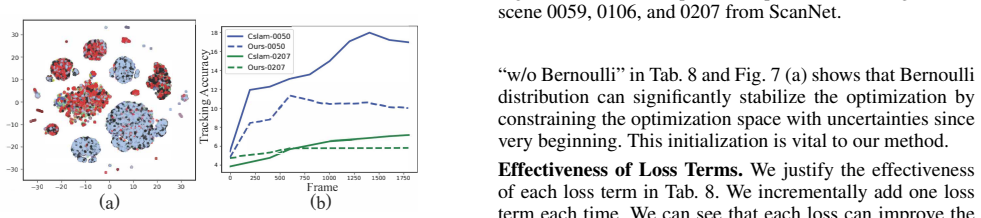
- [Analysis, 'Why Quantized Queries Work'] The convergence criterion is the RGB rendering loss L_I with a threshold of 0.0002, which is the same objective being optimized. Claiming 'fewer iterations to converge' based on the training loss is partially tautological and does not directly establish generalization benefits. The tracking-error-over-iterations plot in Fig. 8(b) is the right type of evidence, but it is shown for only two scenes. Please report convergence in terms of downstream metrics—tracking ATE, reconstruction Accuracy, or a held-out rendering loss—under matched iteration counts, ideally across all benchmark scenes.
minor comments (6)
- [Abstract and Main Text] The abstract says 'argumentation' where 'augmentation' is meant, and the introduction says 'neural singed distance function' instead of 'signed distance function'.
- [Method, Eq. (8)] Eq. (8) lists fs, fc, {eb}, and θg as optimization variables but not camera poses, although the text says poses are refined jointly in bundle adjustment. Please make the objective explicit for the tracking stage and the bundle-adjustment stage.
- [Experiments, Table 8 caption] The caption contains a typo, 'Abalation', and the row labels 'w/o Gridcor' and 'w/o TSDF1' are not defined in the text. Please define these terms precisely (e.g., continuous coordinate vs. quantized coordinate, continuous TSDF value vs. quantized TSDF interpolation).
- [Method, 'Details in SLAM'] The text says 'We select a key frame very 5 frames', which should read 'every 5 frames'. Please also clarify the relationship between the 5-frame key frame interval and the 5-frame bundle-adjustment interval.
- [Analysis, Fig. 8(a)] The TSNE visualization colorizes codes with ground-truth segmentation labels, but it is unclear how vertex-level labels are obtained and mapped to codes. Please describe this procedure and report a quantitative measure of code-semantic consistency rather than only a visual pattern.
- [Method, Eq. (5)] The volume rendering equation should state the denominator explicitly as the sum of weights and clarify the definition of t in Eq. (4); the implementation later uses both truncation distance t and loss weights, which is a potential source of confusion.
Circularity Check
No significant circularity: the quantized-query design is independently evaluated on external benchmarks, and the only self-citation (coordinate quantization) is ablated rather than load-bearing.
full rationale
The paper's derivation chain is not circular. The quantized query is explicitly defined as a tuple of coordinate, positional encoding, feature code, and TSDF prior (Eq. 3), and the SDF and color functions map these quantized inputs to signed distances and colors through volume rendering; the losses in Eq. 8 are all grounded in rendering errors against observed RGB-D data or in the defined VQ objective. The codebook is learned online with nearest-neighbor assignment (Eq. 1) and VQ-style losses (Eq. 7), and the resulting reconstruction and tracking claims are tested against external benchmark datasets. The convergence analysis in 'Why Quantized Queries Work' monitors the same RGB rendering loss that is optimized, which is a measurement choice rather than a circular derivation: the paper does not define the outcome in terms of the cause. The central premise that quantization reduces input variation is true by construction, but the paper does not stop there; it provides benchmark comparisons and ablations showing that the specific design choices matter. The only self-citation is 'coordinate quantization (Jiang, Hua, and Han 2023)', but the contribution does not rest solely on that citation; the paper ablates continuous coordinates ('w/o Gridcor' in Table 8), demonstrating that the component is independently tested here. No fitted parameter is renamed as a prediction, no uniqueness theorem is imported from the authors, and no known empirical result is merely relabeled. The fact that Accuracy is sometimes worse than Co-SLAM on Replica and SyntheticRGBD is a possible evidence or correctness concern, not a circularity concern. Overall, the derivation is self-contained with respect to circularity.
Assumptions & free parameters
free parameters (6)
- Codebook size B =
128
- Loss weights (alpha, beta, gamma, zeta, eta) =
0.02, 0.06, 0.0001, 200, 2
- Coordinate grid resolution =
12800^3
- Ray sample counts =
43 (32 uniform, 11 near-surface)
- Truncation distance t_r =
10 voxel sizes
- Convergence threshold for analysis =
0.0002 RGB loss
assumptions (5)
- standard math Volume rendering equations with bell-shaped density transform SDF predictions into color and depth images (Eqs. 4-5).
- domain assumption Depth images provide approximately valid geometry for TSDF fusion and depth supervision.
- domain assumption The codebook learned from previous frames covers the quantized queries of the current frame.
- ad hoc to paper Bernoulli initialization of code entries stabilizes early optimization.
- ad hoc to paper The tanh augmentation of TSDF interpolation prevents shortcut learning.
Cite this review
Pith. "Pith review of Query Quantized Neural SLAM." pith.science (2026). https://pith.science/paper/PF36AXPS
@misc{pith2026241216476,
  author       = {Pith},
  title        = {Pith review of: Query Quantized Neural SLAM},
  year         = {2026},
  howpublished = {\url{https://pith.science/paper/PF36AXPS}},
  note         = {Machine review of arXiv:2412.16476}
}
read the original abstract
Neural implicit representations have shown remarkable abilities in jointly modeling geometry, color, and camera poses in simultaneous localization and mapping (SLAM). Current methods use coordinates, positional encodings, or other geometry features as input to query neural implicit functions for signed distances and color which produce rendering errors to drive the optimization in overfitting image observations. However, due to the run time efficiency requirement in SLAM systems, we are merely allowed to conduct optimization on each frame in few iterations, which is far from enough for neural networks to overfit these queries. The underfitting usually results in severe drifts in camera tracking and artifacts in reconstruction. To resolve this issue, we propose query quantized neural SLAM which uses quantized queries to reduce variations of input for much easier and faster overfitting a frame. To this end, we quantize a query into a discrete representation with a set of codes, and only allow neural networks to observe a finite number of variations. This allows neural networks to become increasingly familiar with these codes after overfitting more and more previous frames. Moreover, we also introduce novel initialization, losses, and argumentation to stabilize the optimization with significant uncertainty in the early optimization stage, constrain the optimization space, and estimate camera poses more accurately. We justify the effectiveness of each design and report visual and numerical comparisons on widely used benchmarks to show our superiority over the latest methods in both reconstruction and camera tracking.
Figures


Figures from the paper (5 more)



Reference graph
Works this paper leans on
-
[1]
, " * write output.state after.block = add.period write newline
ENTRY address archivePrefix author booktitle chapter edition editor eid eprint howpublished institution isbn journal key month note number organization pages publisher school series title type volume year label extra.label sort.label short.list INTEGERS output.state before.all mid.sentence after.sentence after.block FUNCTION init.state.consts #0 'before.a...
-
[2]
write newline
" write newline "" before.all 'output.state := FUNCTION n.dashify 't := "" t empty not t #1 #1 substring "-" = t #1 #2 substring "--" = not "--" * t #2 global.max substring 't := t #1 #1 substring "-" = "-" * t #2 global.max substring 't := while if t #1 #1 substring * t #2 global.max substring 't := if while FUNCTION word.in bbl.in capitalize " " * FUNCT...
-
[3]
Atzmon, M.; and Lipman, y. 2021. SALD: Sign Agnostic Learning with Derivatives. In International Conference on Learning Representations
work page 2021
-
[4]
Azinovi\'c, D.; Martin-Brualla, R.; Goldman, D. B.; Nie ner, M.; and Thies, J. 2022. Neural RGB-D Surface Reconstruction. In IEEE Conference on Computer Vision and Pattern Recognition, 6290--6301
work page 2022
-
[5]
Chen, C.; Liu, Y.-S.; and Han, Z. 2022. Latent Partition Implicit with Surface Codes for 3D Representation. In European Conference on Computer Vision
2022
-
[6]
Chen, C.; Liu, Y.-S.; and Han, Z. 2023 a . GridPull: Towards Scalability in Learning Implicit Representations from 3D Point Clouds. In IEEE International Conference on Computer Vision
work page 2023
-
[7]
Chen, C.; Liu, Y.-S.; and Han, Z. 2023 b . Unsupervised Inference of Signed Distance Functions from Single Sparse Point Clouds without Learning Priors. In Proceedings of the IEEE/CVF Conference on Computer Vsion and Pattern Recognition
work page 2023
-
[8]
Chen, C.; Liu, Y.-S.; and Han, Z. 2024. Inferring Neural Signed Distance Functions by Overfitting on Single Noisy Point Clouds through Finetuning Data-Driven based Priors. In Advances in Neural Information Processing Systems
2024
Show all 72 references
-
[9]
Corona-Figueroa, A.; Bond-Taylor, S.; Bhowmik, N.; Gaus, Y. F. A.; Breckon, T. P.; Shum, H. P.; and Willcocks, C. G. 2023. Unaligned 2D to 3D Translation with Conditional Vector-Quantized Code Diffusion using Transformers. In IEEE/CVF International Conference on Computer Visio...
2023
-
[10]
W.; and Doucet, A
Dupont, E.; Loya, H.; Alizadeh, M.; Goli \'n ski, A.; Teh, Y. W.; and Doucet, A. 2022. COIN++: Neural compression across modalities. arXiv preprint arXiv:2201.12904
2022 arXiv
-
[11]
Fei, B.; Yang, W.; Chen, W.-M.; and Ma, L. 2022. VQ-DcTr: Vector-quantized autoencoder with dual-channel transformer points splitting for 3D point cloud completion. In 30th ACM international conference on multimedia, 4769--4778
2022
-
[12]
Fu, Q.; Xu, Q.; Ong, Y.-S.; and Tao, W. 2022. Geo-Neus : Geometry-Consistent Neural Implicit Surfaces Learning for Multi-view Reconstruction. In Advances in Neural Information Processing Systems
2022
-
[13]
Gordon, C.; Chng, S.-F.; MacDonald, L.; and Lucey, S. 2023. On Quantizing Implicit Neural Representations. In IEEE/CVF Winter Conference on Applications of Computer Vision, 341--350
2023
-
[14]
Gu, S.; Chen, D.; Bao, J.; Wen, F.; Zhang, B.; Chen, D.; Yuan, L.; and Guo, B. 2022. Vector quantized diffusion model for text-to-image synthesis. In Proceedings of the IEEE/CVF Conference on Computer Vision and Pattern Recognition, 10696--10706
2022
-
[15]
Guo, H.; Peng, S.; Lin, H.; Wang, Q.; Zhang, G.; Bao, H.; and Zhou, X. 2022. Neural 3D Scene Reconstruction with the Manhattan-world Assumption. In IEEE Conference on Computer Vision and Pattern Recognition
2022
-
[16]
Haghighi, Y.; Kumar, S.; Thiran, J.-P.; and Gool, L. V. 2023. Neural Implicit Dense Semantic SLAM. arXiv:2304.14560
2023 arXiv
-
[17]
Hu, P.; and Han, Z. 2023. Learning Neural Implicit through Volume Rendering with Attentive Depth Fusion Priors. In Advances in Neural Information Processing Systems (NeurIPS)
2023
-
[18]
Huang, B.; Yu, Z.; Chen, A.; Geiger, A.; and Gao, S. 2024 a . 2D Gaussian Splatting for Geometrically Accurate Radiance Fields. In Special Interest Group on Computer Graphics and Interactive Techniques Conference Conference Papers ’24, SIGGRAPH ’24. ACM
2024
-
[19]
Huang, H.; Li, L.; Hui, C.; and Yeung, S.-K. 2024 b . Photo-SLAM: Real-time Simultaneous Localization and Photorealistic Mapping for Monocular, Stereo, and RGB-D Cameras. In IEEE/CVF Conference on Computer Vision and Pattern Recognition
2024
-
[20]
Jiang, S.; Hua, J.; and Han, Z. 2023. Coordinate Quantized Neural Implicit Representations for Multi-view 3D Reconstruction. In IEEE International Conference on Computer Vision
2023
-
[21]
M.; Yang, G.; Scherer, S.; Ramanan, D.; and Luiten, J
Keetha, N.; Karhade, J.; Jatavallabhula, K. M.; Yang, G.; Scherer, S.; Ramanan, D.; and Luiten, J. 2024. SplaTAM: Splat, Track & Map 3D Gaussians for Dense RGB-D SLAM. In IEEE/CVF Conference on Computer Vision and Pattern Recognition
2024
-
[22]
Koestler, L.; Yang, N.; Zeller, N.; and Cremers, D. 2022. Tandem: Tracking and dense mapping in real-time using deep multi-view stereo. In Conference on Robot Learning, 34--45. PMLR
2022
-
[23]
Kong, X.; Liu, S.; Taher, M.; and Davison, A. J. 2023. vMAP: Vectorised Object Mapping for Neural Field SLAM. arXiv preprint arXiv:2302.01838
2023 arXiv
-
[24]
Laurentini, A. 1994. The visual hull concept for silhouette-based image understanding. IEEE Transactions on Pattern Analysis and Machine Intelligence, 16(2): 150--162
1994
-
[25]
Lee, S.; Park, G.; Son, H.; Ryu, J.; and Chae, H. J. 2023. FastSurf: Fast Neural RGB-D Surface Reconstruction using Per-Frame Intrinsic Refinement and TSDF Fusion Prior Learning. arXiv preprint arXiv:2303.04508
2023 arXiv
-
[26]
Li, Y.; Dou, Y.; Chen, X.; Ni, B.; Sun, Y.; Liu, Y.; and Wang, F. 2023 a . Generalized Deep 3D Shape Prior via Part-Discretized Diffusion Process. In Proceedings of the IEEE/CVF Conference on Computer Vision and Pattern Recognition, 16784--16794
2023
-
[27]
H.; Unberath, M.; Liu, M.-Y.; and Lin, C.-H
Li, Z.; M\"uller, T.; Evans, A.; Taylor, R. H.; Unberath, M.; Liu, M.-Y.; and Lin, C.-H. 2023 b . Neuralangelo: High-Fidelity Neural Surface Reconstruction. In IEEE Conference on Computer Vision and Pattern Recognition
2023
-
[28]
Liu, S.-L.; Guo, H.-X.; Pan, H.; Wang, P.; Tong, X.; and Liu, Y. 2021. Deep Implicit Moving Least-Squares Functions for 3D Reconstruction. In IEEE Conference on Computer Vision and Pattern Recognition
2021
-
[29]
E.; and Cline, H
Lorensen, W. E.; and Cline, H. E. 1987. Marching cubes: A high resolution 3D surface construction algorithm. Computer Graphics, 21(4): 163--169
1987
-
[30]
Ma, B.; Zhou, J.; Liu, Y.-S.; and Han, Z. 2023. Towards Better Gradient Consistency for Neural Signed Distance Functions via Level Set Alignment. In IEEE/CVF Conference on Computer Vsion and Pattern Recognition
2023
-
[31]
Matsuki, H.; Murai, R.; Kelly, P. H. J.; and Davison, A. J. 2024. G aussian S platting SLAM
2024
-
[32]
P.; Tancik, M.; Barron, J
Mildenhall, B.; Srinivasan, P. P.; Tancik, M.; Barron, J. T.; Ramamoorthi, R.; and Ng, R. 2020. NeRF : Representing Scenes as Neural Radiance Fields for View Synthesis. In European Conference on Computer Vision
2020
-
[33]
M\"uller, T.; Evans, A.; Schied, C.; and Keller, A. 2022. Instant Neural Graphics Primitives with a Multiresolution Hash Encoding. arXiv:2201.05989
2022 arXiv
-
[34]
M \"u ller, T.; McWilliams, B.; Rousselle, F.; Gross, M.; and Nov \'a k, J. 2019. Neural importance sampling. ACM Transactions on Graphics (ToG), 38(5): 1--19
2019
-
[35]
Niemeyer, M.; Mescheder, L.; Oechsle, M.; and Geiger, A. 2020. Differentiable Volumetric Rendering: Learning Implicit 3D Representations without 3D Supervision. In IEEE Conference on Computer Vision and Pattern Recognition
2020
-
[36]
Noda, T.; Chen, C.; Zhang, W.; Liu, X.; Liu, Y.-S.; and Han, Z. 2024. MultiPull: Detailing Signed Distance Functions by Pulling Multi-Level Queries at Multi-Step. In Advances in Neural Information Processing Systems
2024
-
[37]
Oechsle, M.; Peng, S.; and Geiger, A. 2021. UNISURF : Unifying Neural Implicit Surfaces and Radiance Fields for Multi-View Reconstruction. In International Conference on Computer Vision
2021
-
[38]
Oord, A. v. d.; Vinyals, O.; and Kavukcuoglu, K. 2017. Neural discrete representation learning. arXiv preprint arXiv:1711.00937
2017 arXiv
-
[39]
T.; Bouaziz, S.; Goldman, D
Park, K.; Sinha, U.; Barron, J. T.; Bouaziz, S.; Goldman, D. B.; Seitz, S. M.; and Martin-Brualla, R. 2021. Nerfies: Deformable Neural Radiance Fields. ICCV
2021
-
[40]
Peng, S.; Niemeyer, M.; Mescheder, L.; Pollefeys, M.; and Geiger, A. 2020. Convolutional occupancy networks. In Computer Vision--ECCV 2020: 16th European Conference, Glasgow, UK, August 23--28, 2020, Proceedings, Part III 16, 523--540. Springer
2020
-
[41]
Rajpal, A.; Cheema, N.; Illgner-Fehns, K.; Slusallek, P.; and Jaiswal, S. 2023. High-Resolution Synthetic RGB-D Datasets for Monocular Depth Estimation. In CVPR, 1188--1198
2023
-
[42]
A.; and Behnke, S
Rosu, R. A.; and Behnke, S. 2023. PermutoSDF: Fast Multi-View Reconstruction with Implicit Surfaces using Permutohedral Lattices. In IEEE/CVF Conference on Computer Vision and Pattern Recognition (CVPR)
2023
-
[43]
V.; and Oswald, M
Sandström, E.; Ta, K.; Gool, L. V.; and Oswald, M. R. 2023. Uncle- SLAM : Uncertainty Learning for Dense Neural SLAM . In International Conference on Computer Vision Workshops (ICCVW)
2023
-
[44]
L.; and Frahm, J.-M
Sch\" o nberger, J. L.; and Frahm, J.-M. 2016. Structure-from-Motion Revisited. In IEEE Conference on Computer Vision and Pattern Recognition
2016
-
[45]
L.; Zheng, E.; Pollefeys, M.; and Frahm, J.-M
Sch\" o nberger, J. L.; Zheng, E.; Pollefeys, M.; and Frahm, J.-M. 2016. Pixelwise View Selection for Unstructured Multi-View Stereo. In European Conference on Computer Vision
2016
-
[46]
Stier, N.; Ranjan, A.; Colburn, A.; Yan, Y.; Yang, L.; Ma, F.; and Angles, B. 2023. FineRecon : Depth-aware Feed-forward Network for Detailed 3D Reconstruction. arXiv preprint
2023
-
[47]
Straub, J.; Whelan, T.; Ma, L.; Chen, Y.; Wijmans, E.; Green, S.; Engel, J. J.; Mur-Artal, R.; Ren, C.; Verma, S.; Clarkson, A.; Yan, M.; Budge, B.; Yan, Y.; Pan, X.; Yon, J.; Zou, Y.; Leon, K.; Carter, N.; Briales, J.; Gillingham, T.; Mueggler, E.; Pesqueira, L.; Savva, M.; B...
2019 arXiv
-
[48]
Sturm, J.; Engelhard, N.; Endres, F.; Burgard, W.; and Cremers, D. 2012. A Benchmark for the Evaluation of RGB-D SLAM Systems. In International Conference on Intelligent Robot Systems (IROS)
2012
-
[49]
Sucar, E.; Liu, S.; Ortiz, J.; and Davison, A. J. 2021. iMAP: Implicit mapping and positioning in real-time. In IEEE/CVF International Conference on Computer Vision, 6229--6238
2021
-
[50]
Sun, J.; Xie, Y.; Chen, L.; Zhou, X.; and Bao, H. 2021. NeuralRecon : Real-Time Coherent 3D Reconstruction from Monocular Video. CVPR
2021
-
[51]
Tang, J.; Lei, J.; Xu, D.; Ma, F.; Jia, K.; and Zhang, L. 2021. SA-ConvONet : Sign-Agnostic Optimization of Convolutional Occupancy Networks. In ICCV
2021
-
[52]
L.; Park, Y.; Stahl, A.; and Mester, R
Teigen, A. L.; Park, Y.; Stahl, A.; and Mester, R. 2023. RGB-D Mapping and Tracking in a Plenoxel Radiance Field. arXiv preprint arXiv:2307.03404
2023 arXiv
-
[53]
Wang, H.; Wang, J.; and Agapito, L. 2023. Co-SLAM: Joint Coordinate and Sparse Parametric Encodings for Neural Real-Time SLAM. arXiv:2304.14377
2023 arXiv
-
[54]
Wang, J.; Bleja, T.; and Agapito, L. 2022. GO-Surf: Neural Feature Grid Optimization for Fast, High-Fidelity RGB-D Surface Reconstruction. In International Conference on 3D Vision
2022
-
[55]
Wang, J.; Wang, P.; Long, X.; Theobalt, C.; Komura, T.; Liu, L.; and Wang, W. 2022. NeuRIS : Neural Reconstruction of Indoor Scenes Using Normal Priors. In European Conference on Computer Vision
2022
-
[56]
Wang, P.; Liu, L.; Liu, Y.; Theobalt, C.; Komura, T.; and Wang, W. 2021. NeuS : Learning Neural Implicit Surfaces by Volume Rendering for Multi-view Reconstruction. In Advances in Neural Information Processing Systems, 27171--27183
2021
-
[57]
Wu, H.; Lei, C.; Sun, X.; Wang, P.-S.; Chen, Q.; Cheng, K.-T.; Lin, S.; and Wu, Z. 2022. Randomized Quantization for Data Agnostic Representation Learning. arXiv preprint arXiv:2212.08663
2022 arXiv
-
[58]
Xinyang, L.; Yijin, L.; Yanbin, T.; Hujun, B.; Guofeng, Z.; Yinda, Z.; and Zhaopeng, C. 2023. Multi-Modal Neural Radiance Field for Monocular Dense SLAM with a Light-Weight ToF Sensor. In International Conference on Computer Vision (ICCV)
2023
-
[59]
Yang, X.; Lin, G.; Chen, Z.; and Zhou, L. 2023 a . Neural Vector Fields: Implicit Representation by Explicit Learning. In Proceedings of the IEEE/CVF Conference on Computer Vision and Pattern Recognition, 16727--16738
2023
-
[60]
Yang, Y.; Liu, W.; Yin, F.; Chen, X.; Yu, G.; Fan, J.; and Chen, T. 2023 b . VQ-NeRF: Vector Quantization Enhances Implicit Neural Representations. arXiv preprint arXiv:2310.14487
2023 arXiv
-
[61]
Yao, Y.; Luo, Z.; Li, S.; Fang, T.; and Quan, L. 2018. MVSNet: Depth Inference for Unstructured Multi-view Stereo. European Conference on Computer Vision
2018
-
[62]
Yariv, L.; Kasten, Y.; Moran, D.; Galun, M.; Atzmon, M.; Ronen, B.; and Lipman, Y. 2020. Multiview Neural Surface Reconstruction by Disentangling Geometry and Appearance. Advances in Neural Information Processing Systems, 33
2020
-
[63]
Yu, Z.; Peng, S.; Niemeyer, M.; Sattler, T.; and Geiger, A. 2022. MonoSDF : Exploring Monocular Geometric Cues for Neural Implicit Surface Reconstruction. ArXiv, abs/2022.00665
2022
-
[64]
Yu, Z.; Sattler, T.; and Geiger, A. 2024. Gaussian Opacity Fields: Efficient and Compact Surface Reconstruction in Unbounded Scenes. arXiv:2404.10772
2024 arXiv
-
[65]
Zhang, W.; Liu, Y.-S.; and Han, Z. 2024. Neural Signed Distance Function Inference through Splatting 3D Gaussians Pulled on Zero-Level Set. In NeurIPS
2024
-
[66]
Zhang, W.; Shi, K.; Liu, Y.-S.; and Han, Z. 2024. Learning Unsigned Distance Functions from Multi-view Images with Volume Rendering Priors. In European Conference on Computer Vision
2024
-
[67]
Zhang, Y.; Tosi, F.; Mattoccia, S.; and Poggi, M. 2023. GO-SLAM: Global Optimization for Consistent 3D Instant Reconstruction. In IEEE/CVF International Conference on Computer Vision
2023
-
[68]
Zhou, J.; Ma, B.; Li, S.; Liu, Y.-S.; and Han, Z. 2023. Learning a More Continuous Zero Level Set in Unsigned Distance Fields through Level Set Projection. In ICCV
2023
-
[69]
Zhou, J.; Zhang, W.; Ma, B.; Shi, K.; Liu, Y.-S.; and Han, Z. 2024. UDiFF: Generating Conditional Unsigned Distance Fields with Optimal Wavelet Diffusion. In CVPR
2024
-
[70]
Zhou, T.; Brown, M.; Snavely, N.; and Lowe, D. G. 2017. Unsupervised Learning of Depth and Ego-Motion from Video. In CVPR, 6612--6619
2017
-
[71]
R.; Geiger, A.; and Pollefeys, M
Zhu, Z.; Peng, S.; Larsson, V.; Cui, Z.; Oswald, M. R.; Geiger, A.; and Pollefeys, M. 2023. NICER-SLAM: Neural Implicit Scene Encoding for RGB SLAM . CoRR, abs/2302.03594
2023 arXiv
-
[72]
R.; and Pollefeys, M
Zhu, Z.; Peng, S.; Larsson, V.; Xu, W.; Bao, H.; Cui, Z.; Oswald, M. R.; and Pollefeys, M. 2022. NICE-SLAM: Neural Implicit Scalable Encoding for SLAM. In IEEE Conference on Computer Vision and Pattern Recognition
2022
Reviewed August 11, 2026 · model on record in the stance chip above.
Discussion (0). Continue with ORCID to comment.